

AI monitoring for construction sites
CCTV for construction sites can do more than record. Woodcock AI adds intrusion, vehicle and PPE detection for hard hats and hi-vis, plus smoke and fire detection, to compatible cameras already on site, including towers and mobile units after assessment. It watches the gate, compound and stores out of hours and sends each alert with the clip.
For assessed construction-site views, AI CCTV can add intrusion and PPE detection for hi-vis and hard hats.
If site cameras need specifying or fitting, see CCTV installation.
Out-of-hours intrusion and plant theft
Construction sites stand empty at night and at weekends, with plant, tools, cable and materials behind a hoarding. Cameras usually record but nobody watches them in real time, so a break-in is often found the next morning.
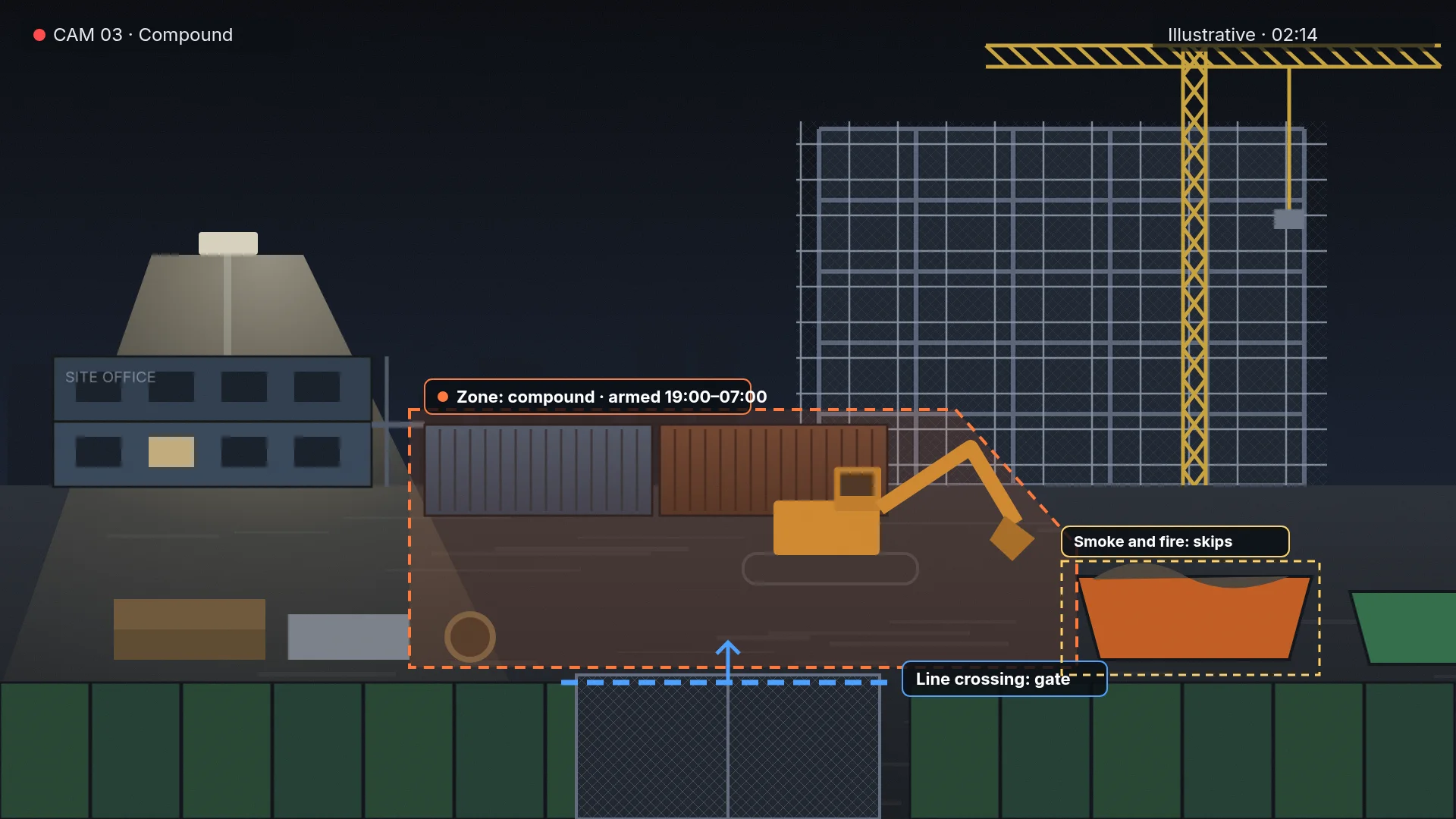
Hoarding lines and site gates suit line crossing detection: draw the line once, choose the direction, and set it to arm when the site closes.
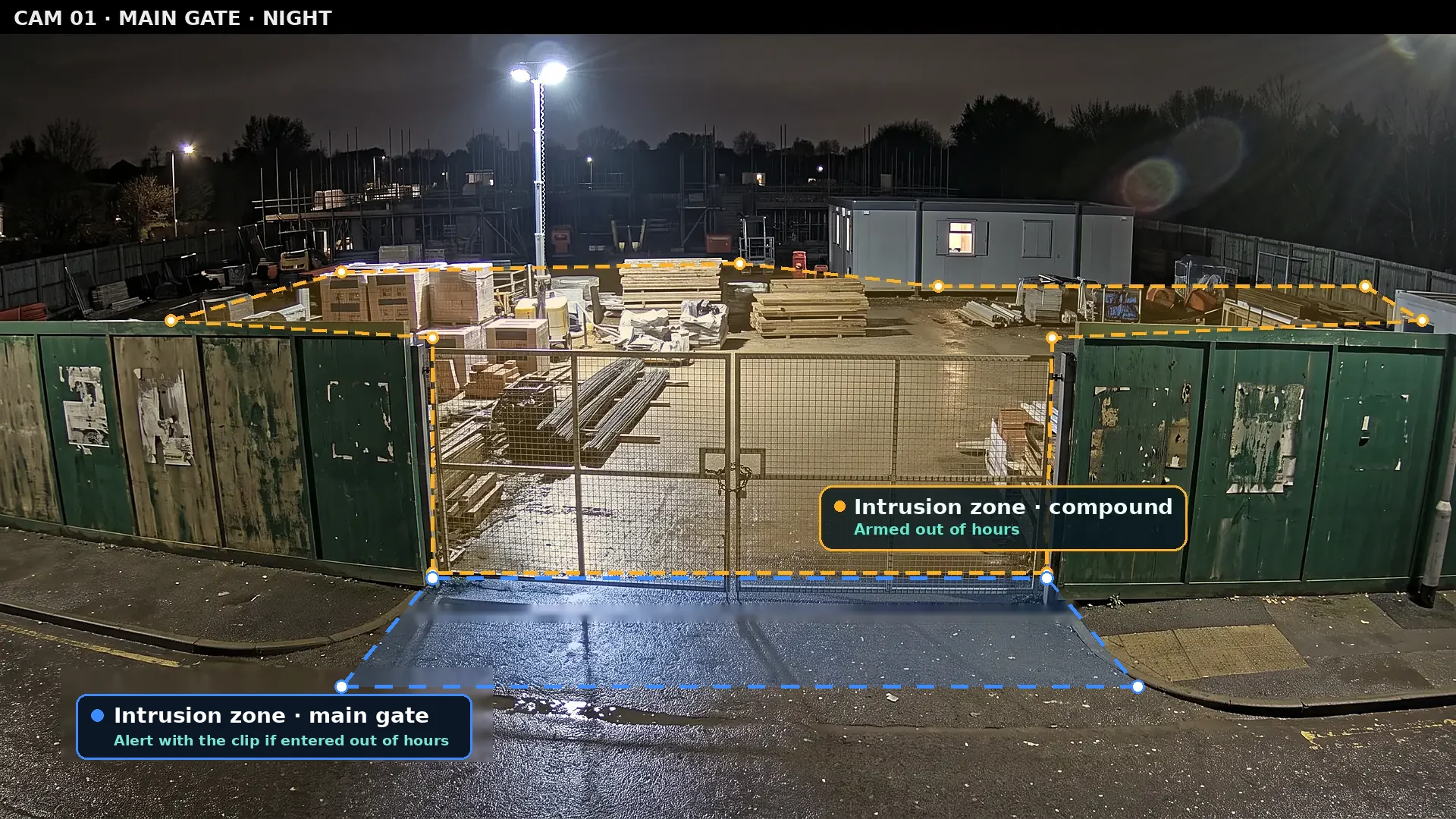
Woodcock AI turns those cameras into alerts. Draw an intrusion zone over the compound, or a line crossing rule across the gate, set the hours it is armed, and get the clip when someone enters. Our guide to preventing metal and cable theft covers cable stores and compounds. Vehicle detection flags vans arriving at the gate out of hours. HSE guidance HSG168, Fire safety in construction also links site security to fire: it lists hoarding, security lighting and CCTV monitoring among the measures against arson.
Plant and tool theft out of hours
Plant, small tools, cable, fuel and materials are left on site every night. Thefts usually happen when the site is empty, and a camera that only records shows you what happened after the fact. Woodcock AI raises the alert while it is happening.
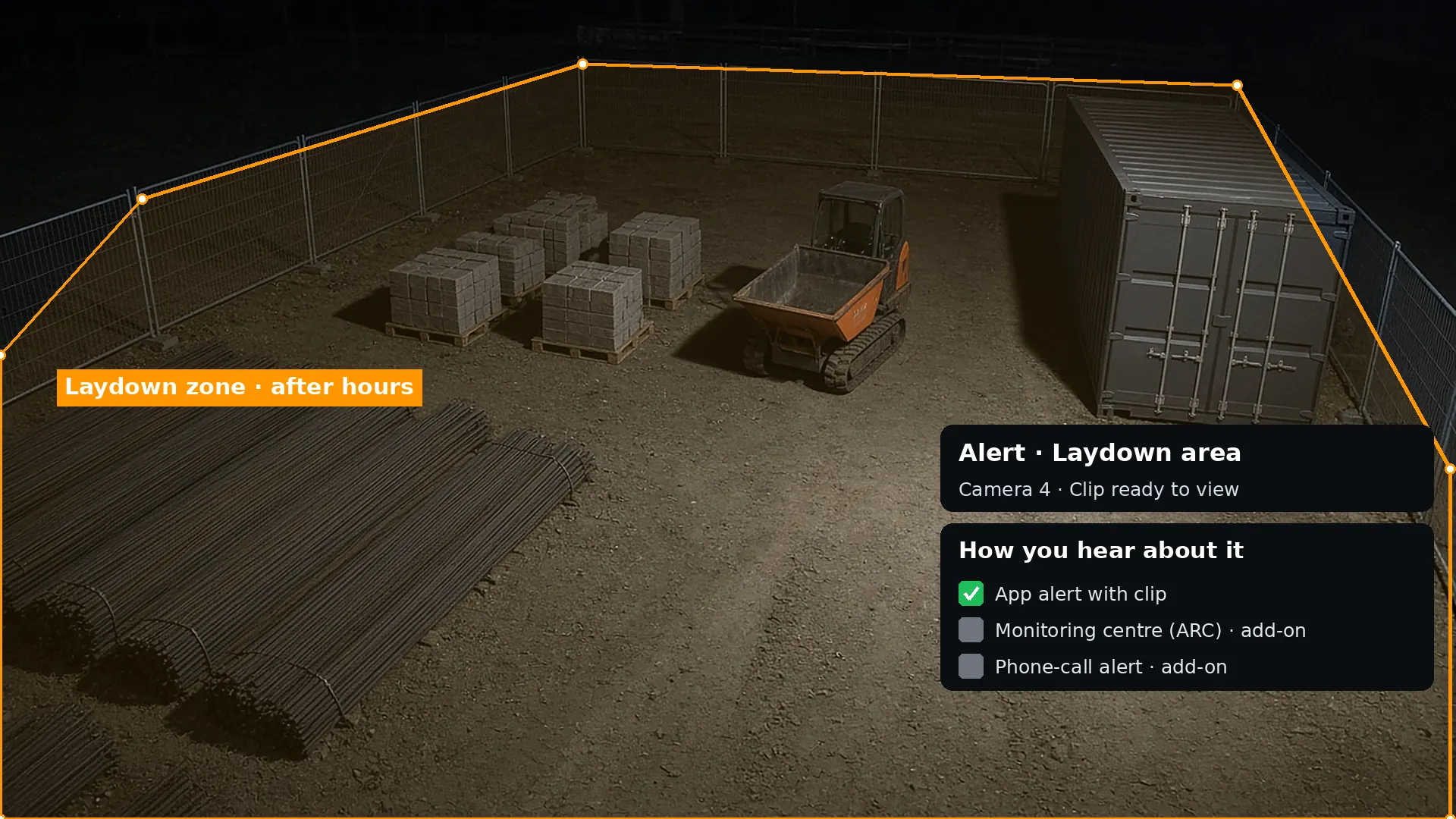
Draw an intrusion zone over the plant compound, the tool container and the materials store, and arm it from when the site closes until it opens. Person detection flags anyone inside those zones after hours. Vehicle detection flags a van or a truck pulling up at the gate or driving into the compound when nobody should be there. Because each camera has its own schedule, the compound can stay armed all weekend while the gate camera checks PPE on a Saturday shift.
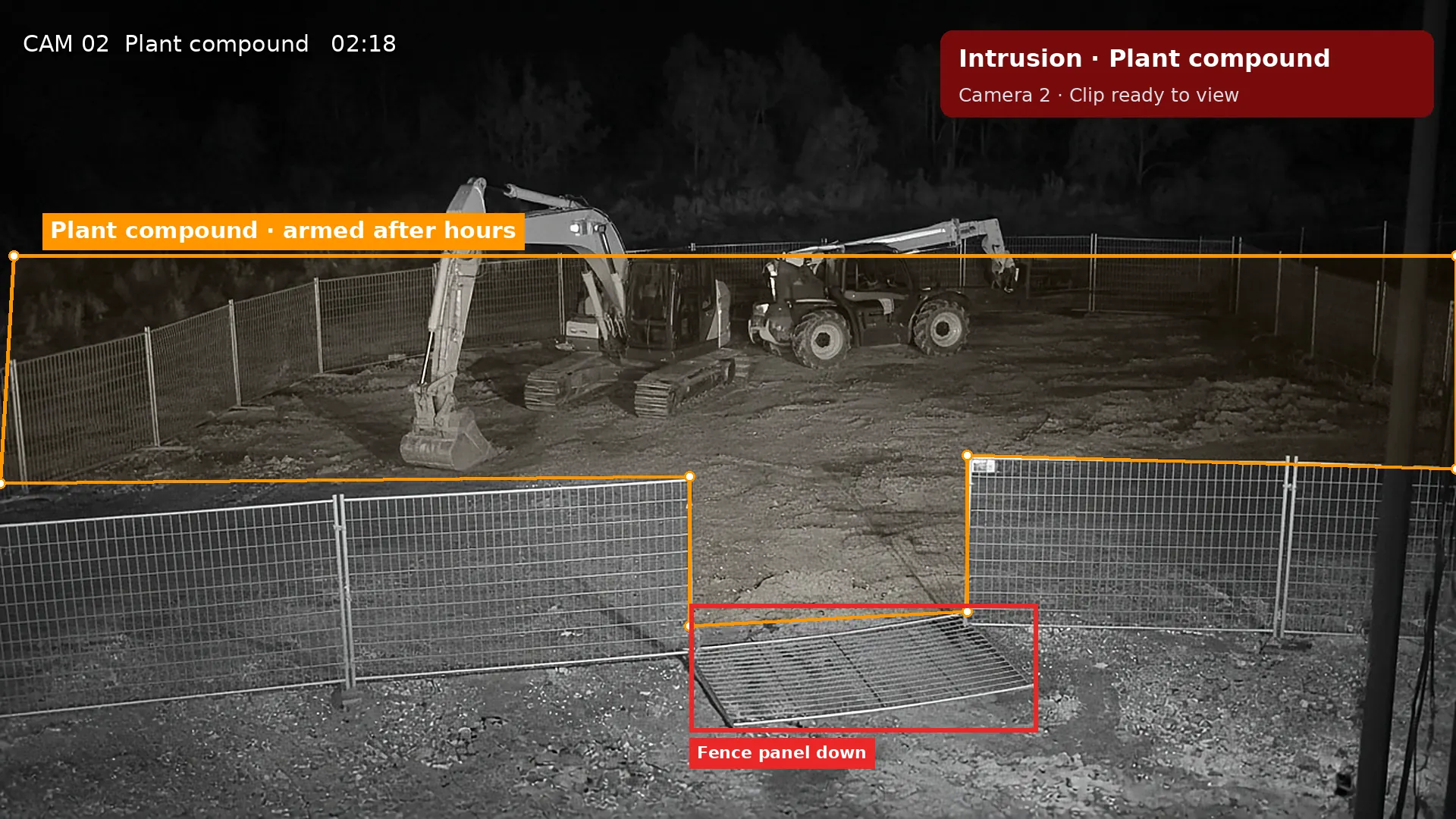
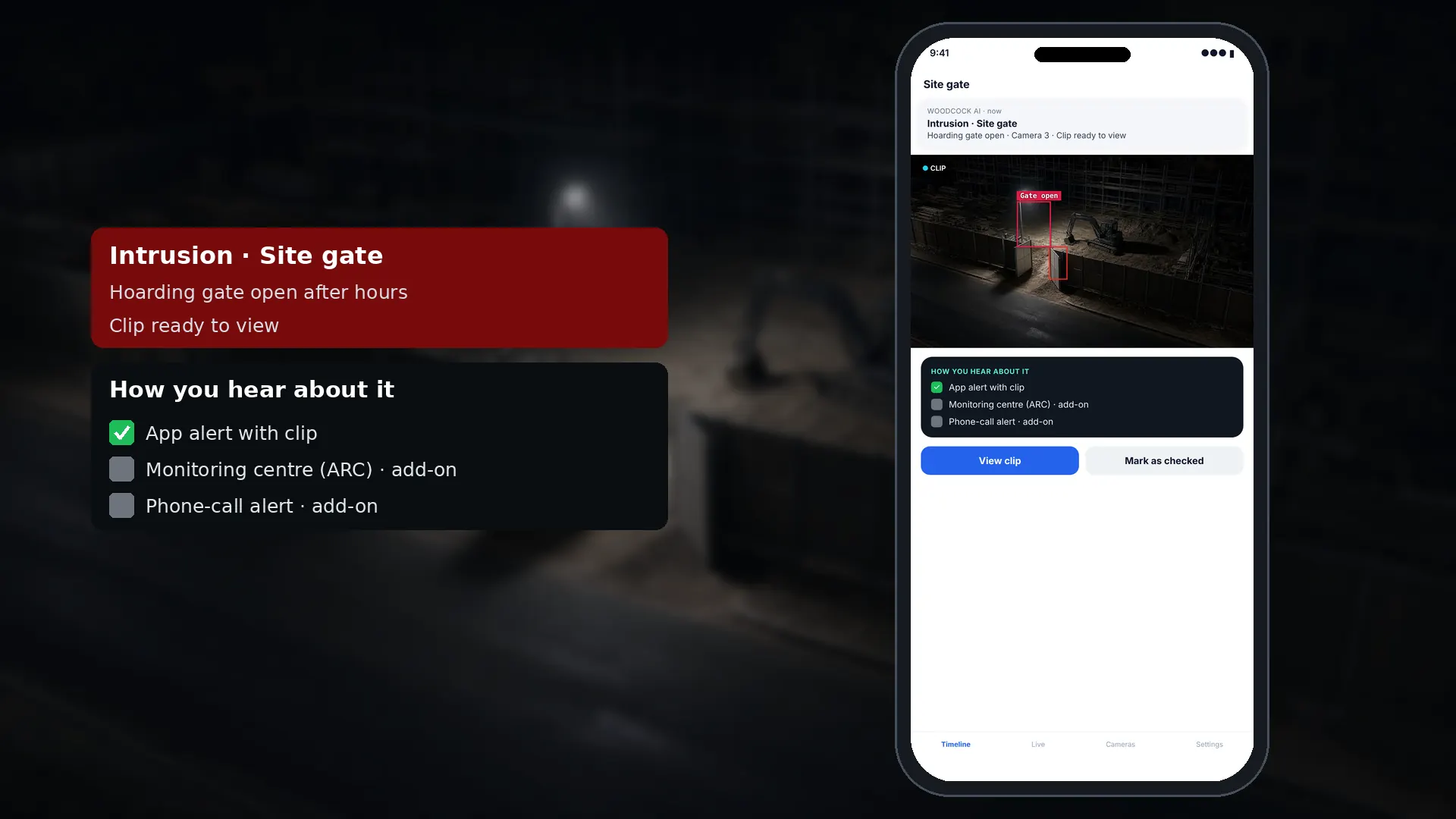
Alerts go by app push notification and email to the keyholders you choose, each with the clip, so they can see straight away whether it is a person at the container or a fox under the hoarding. If nobody on your team is on call overnight, alerts can also go to an alarm receiving centre (ARC), or arrive as a phone call, as optional add-ons. Woodcock AI does not read number plates; vehicle detection tells you a vehicle is there and gives you the clip.
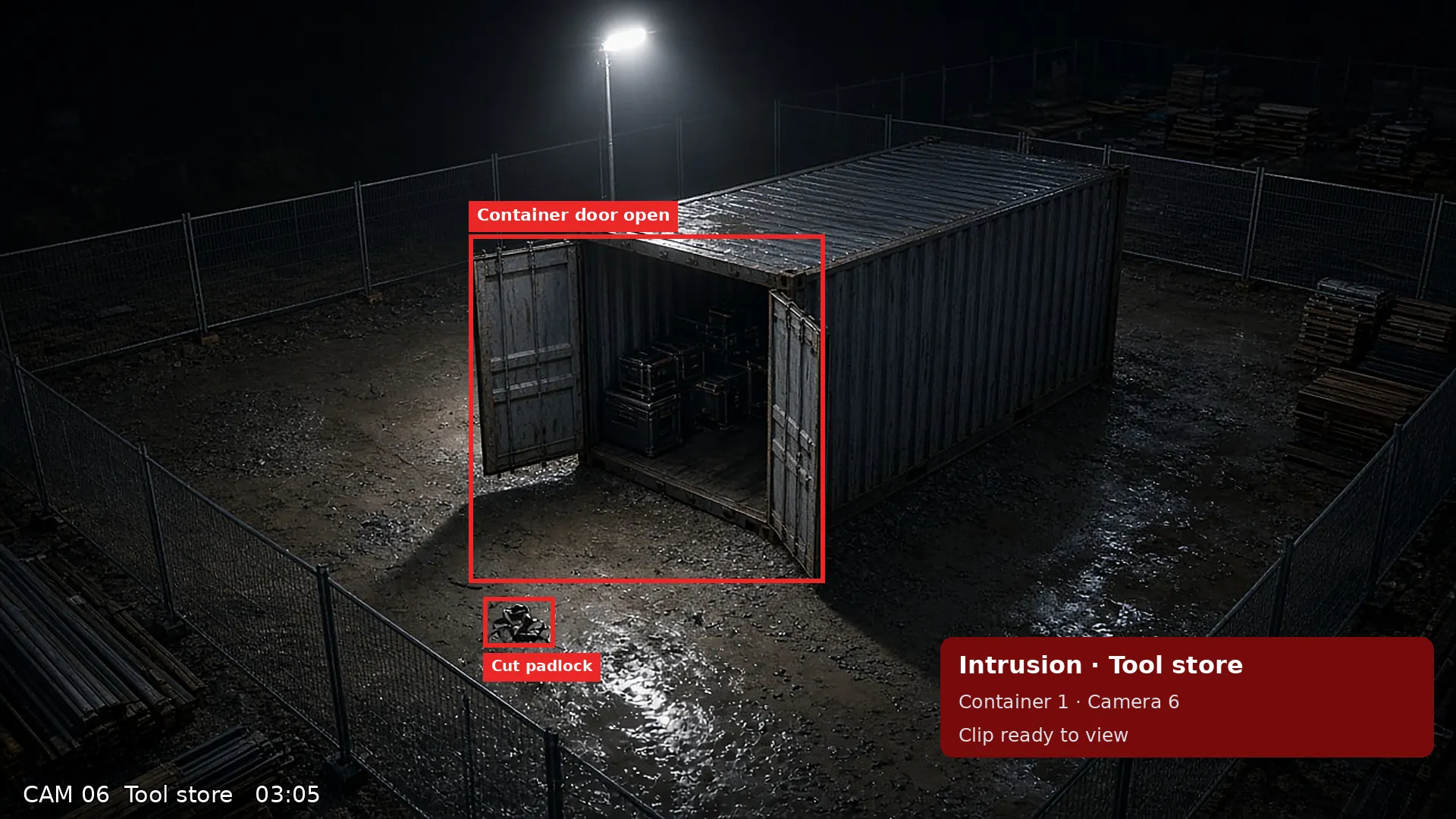
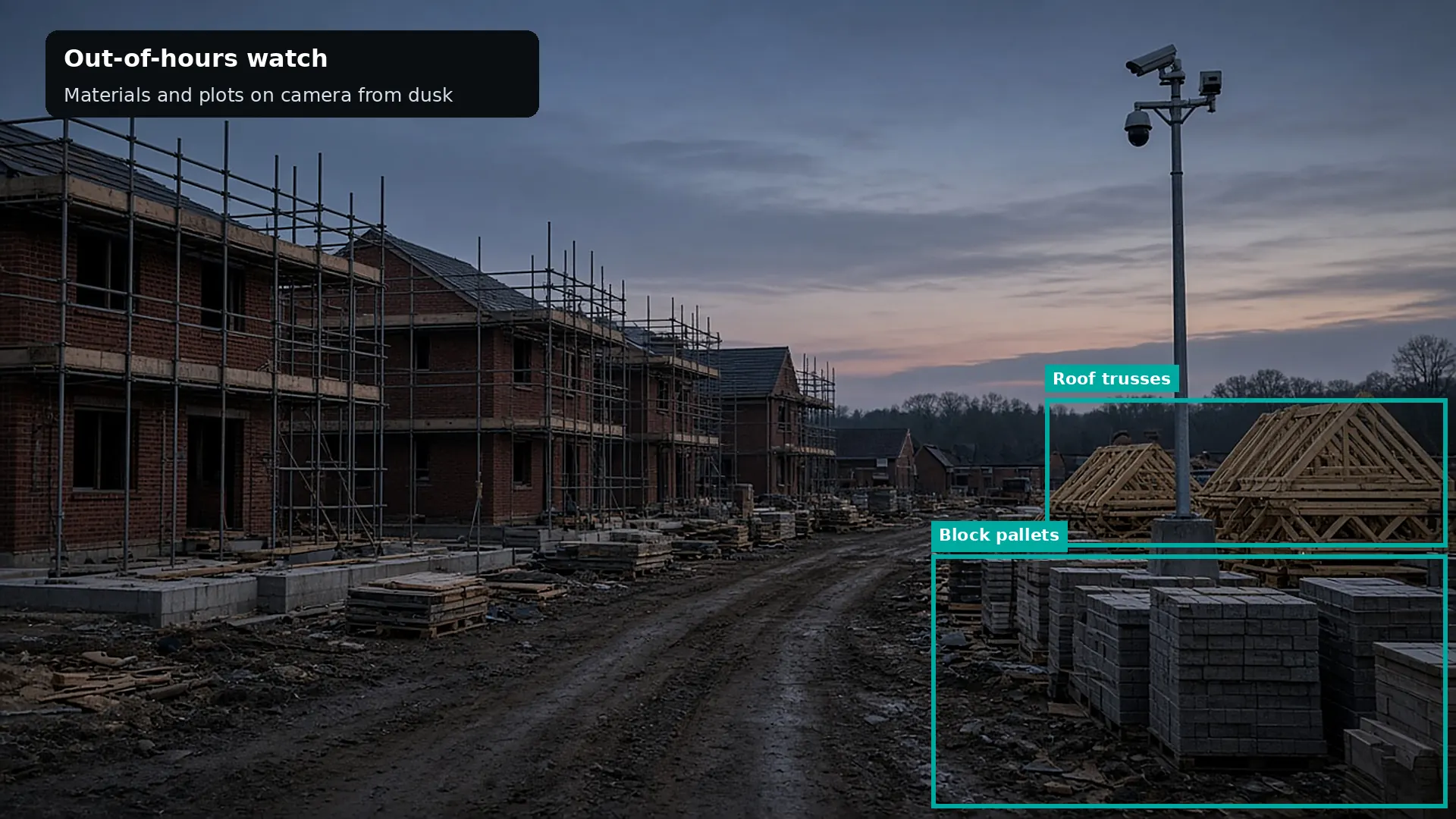
Night views need the most care. Check that compound and gate cameras have working infrared or site lighting, that floodlights do not point straight into a lens, and that containers and parked plant do not block the view of the doors you care about. Sheeting, netting and moving shadows are learnt as normal for each camera, and the feedback button helps the AI settle on each view in the first weeks. The site assessment walks through each night view with you before anything is armed.
Out-of-hours alerts also help with fire. A camera watching the compound overnight can watch the same skips and cabins for visible smoke and flame, so one set of cameras covers both theft and fire after the last person leaves.
- 18:00 to 07:00Intrusion zones on the compound, store and hoarding are armed on their own schedule.
- Person or vehicleSomeone climbs the hoarding, or a vehicle pulls up at the gate after hours.
- Alert with the clipAn app push and an email go to the keyholders you choose, with the clip attached.
- Decide and actCheck the clip, then call the police or attend. ARC and phone-call alerts are optional add-ons.
Fire risk on site: hot works, skips and temporary buildings
This is general guidance, not a fire risk assessment. On most sites, three places come up again and again: hot work areas, waste skips and temporary buildings such as cabins and offices.
Hot works. See the hot works fire risk guide for permits and the fire watch. HSG168 asks for a fire watch while hot work is carried out and for at least an hour after it ends, followed by another check later. A camera that sees the work area can add a watch for visible smoke overnight. It does not replace the fire watch or the permit.
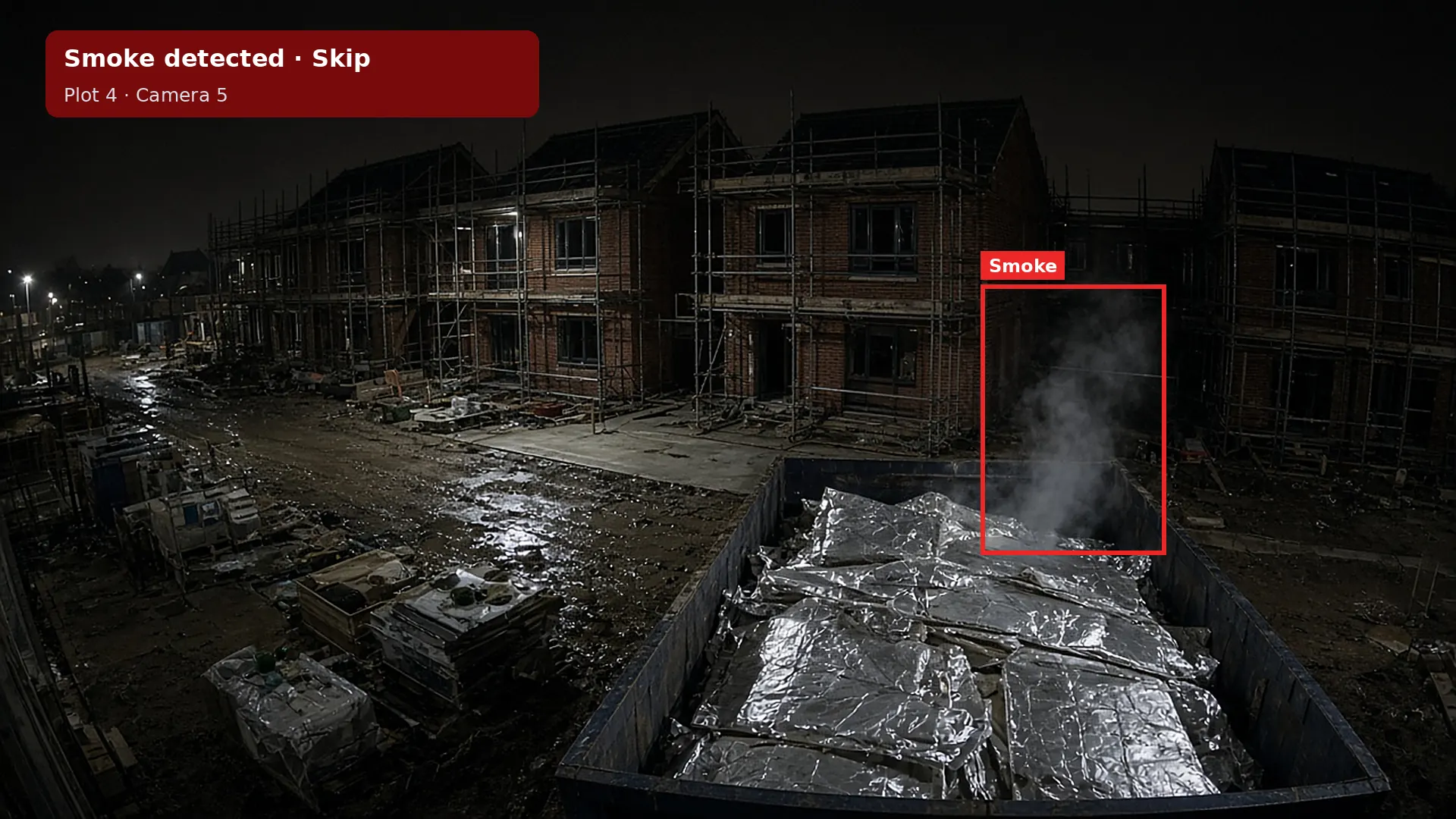
Waste skips. HSE guidance notes that skips are often a target for arson, and says to place them where a fire will not put the site at risk. Keep each skip in view of a camera so smoke or flame raises an alert with the clip.
Temporary buildings. Cabins, offices and welfare units can hold heaters, chargers and drying rooms, and HSG168 has an appendix on their fire safety. The Fire Protection Association publishes the Joint Code of Practice on fire prevention on construction sites for larger projects. See how camera smoke detection works in the video smoke detection guide.
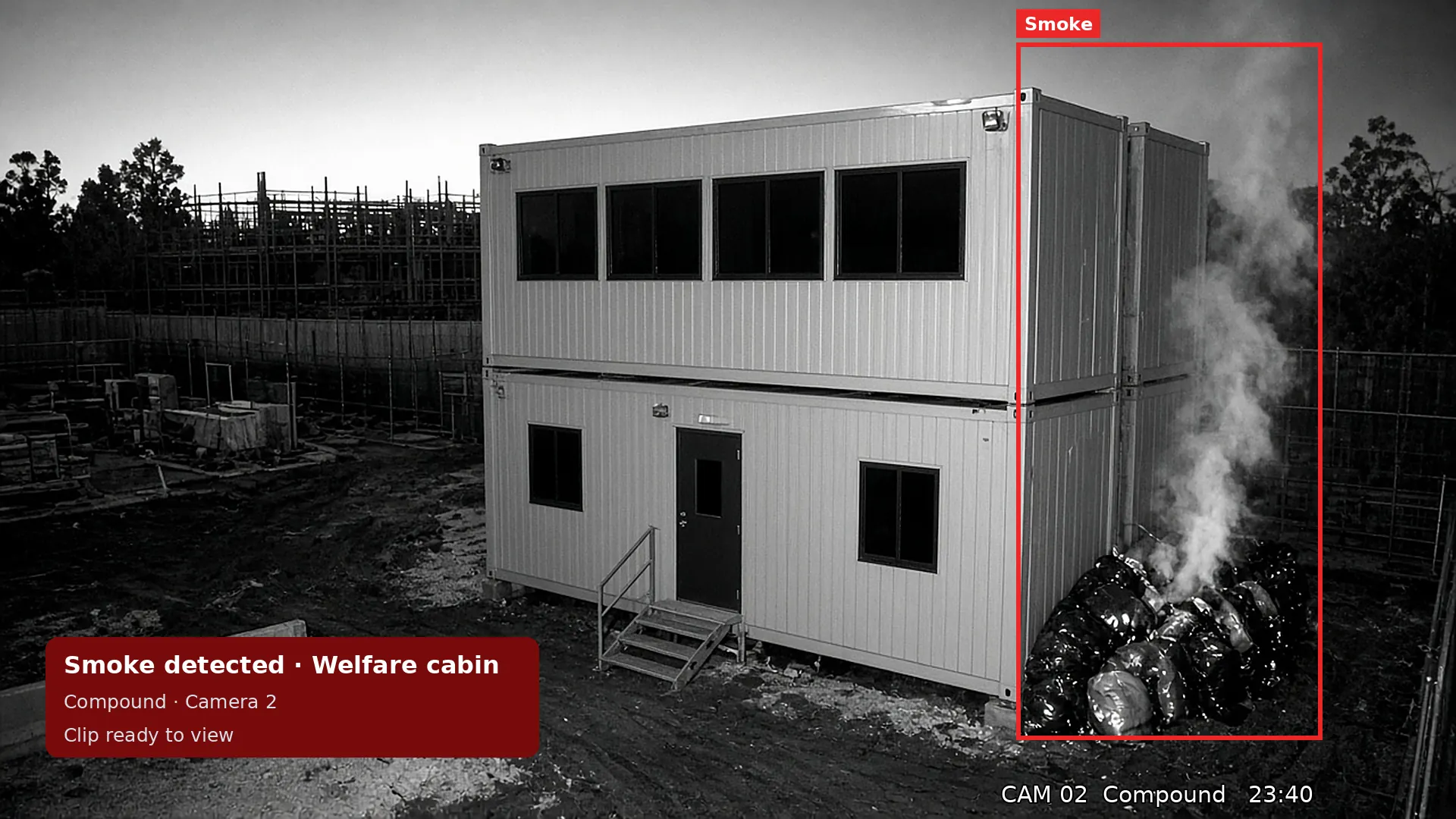
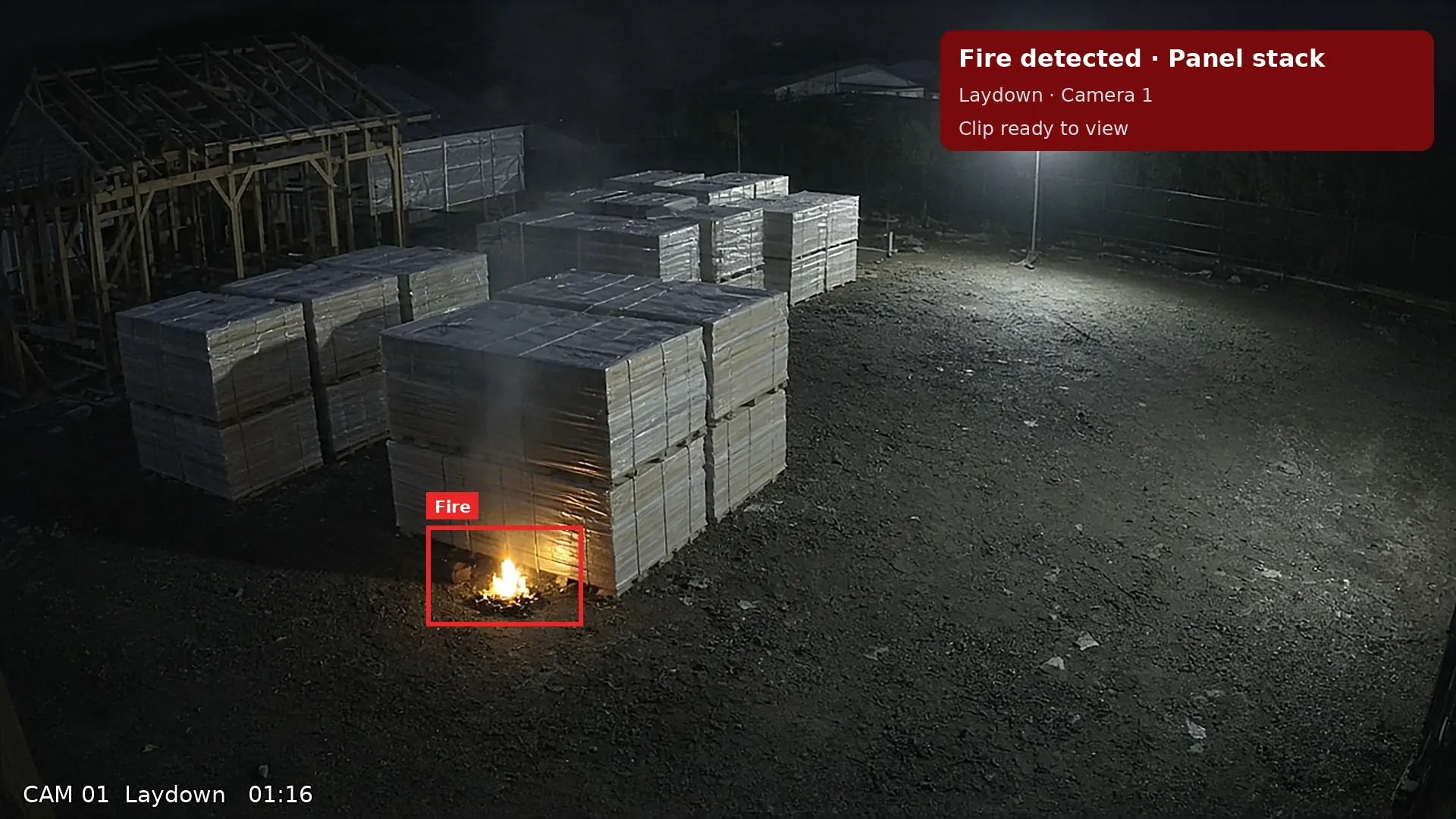
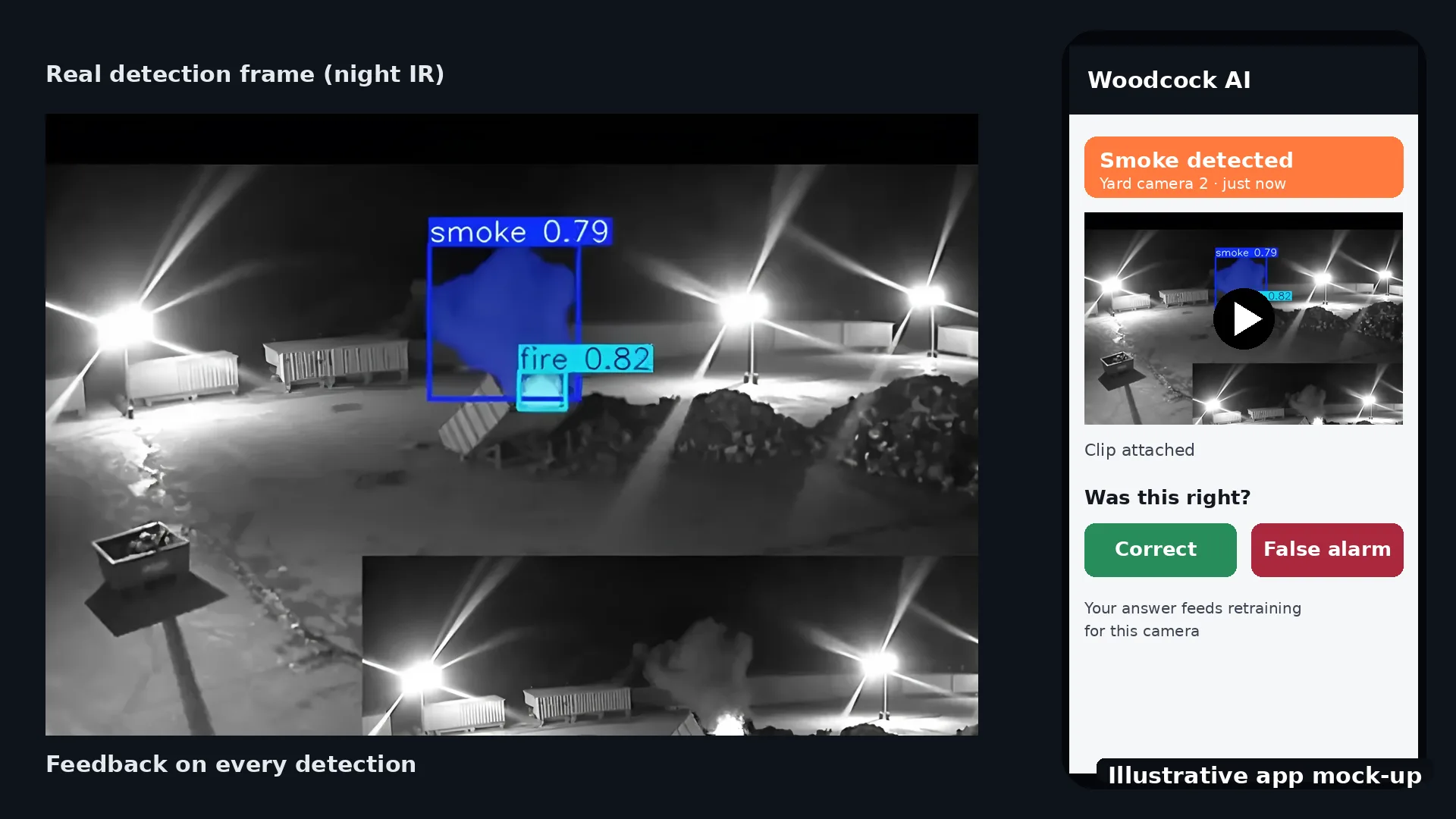
- The eventSmoke and a small flame are boxed and labelled, and the alert is sent with the clip.
- FloodlightsBright site lights in the frame are learnt as normal for this camera rather than raising alerts.
- Wet groundReflections on wet ground move with the light, but do not look like smoke.
- SkyOpen sky and drifting cloud are part of the normal view the AI learns for each camera.
Explore a construction site, area by area
Tap an area of the plan, or choose a tab, to see the risk there and what a camera needs to see.
Gate and hoarding
The risk: Trespassers can cause theft, damage and fires. HSE guidance lists perimeter fencing or hoarding, security lighting and CCTV monitoring among the measures against arson.
What the camera should see: Draw a line across the gate and zones along the hoarding, and set the hours they are armed.
Plant and compound
The risk: Plant, fuel and tools left overnight attract theft and vandalism, often when the site is empty.
What the camera should see: Cover the compound with an intrusion zone after hours. Vehicle detection flags vans at the gate.
Materials and tool store
The risk: Containers hold tools, cable and materials. HSE guidance says flammable liquids and gas cylinders should be stored securely, or removed, while the site is closed.
What the camera should see: Point a camera at container doors and the store fence, armed out of hours.
Waste skips
The risk: HSE guidance notes that skips are often a target for arson, and that they should be placed so a skip fire does not spread to the building.
What the camera should see: Keep every skip in view of a camera, day and night, so visible smoke or flame raises an alert.
Site cabins and offices
The risk: Temporary buildings can hold heaters, chargers and drying rooms, and HSE guidance has a section on their fire safety.
What the camera should see: Watch the outside of the cabins for smoke out of hours, and the doors for intrusion.
Building and scaffold
The risk: Hot work such as cutting, welding and grinding is a common fire risk. HSE guidance asks for a fire watch during and after it.
What the camera should see: A camera with a clear view of the structure can watch for visible smoke overnight, alongside the fire watch.
PPE checks on site: hard hats and hi-vis
Woodcock AI PPE detection checks for hard hats and hi-vis on the cameras you already have on site. You choose where the rules apply, when they apply, and who gets the alert.
Zones, shift schedules, camera requirements and a live test on your own cameras are covered on PPE detection on existing CCTV.
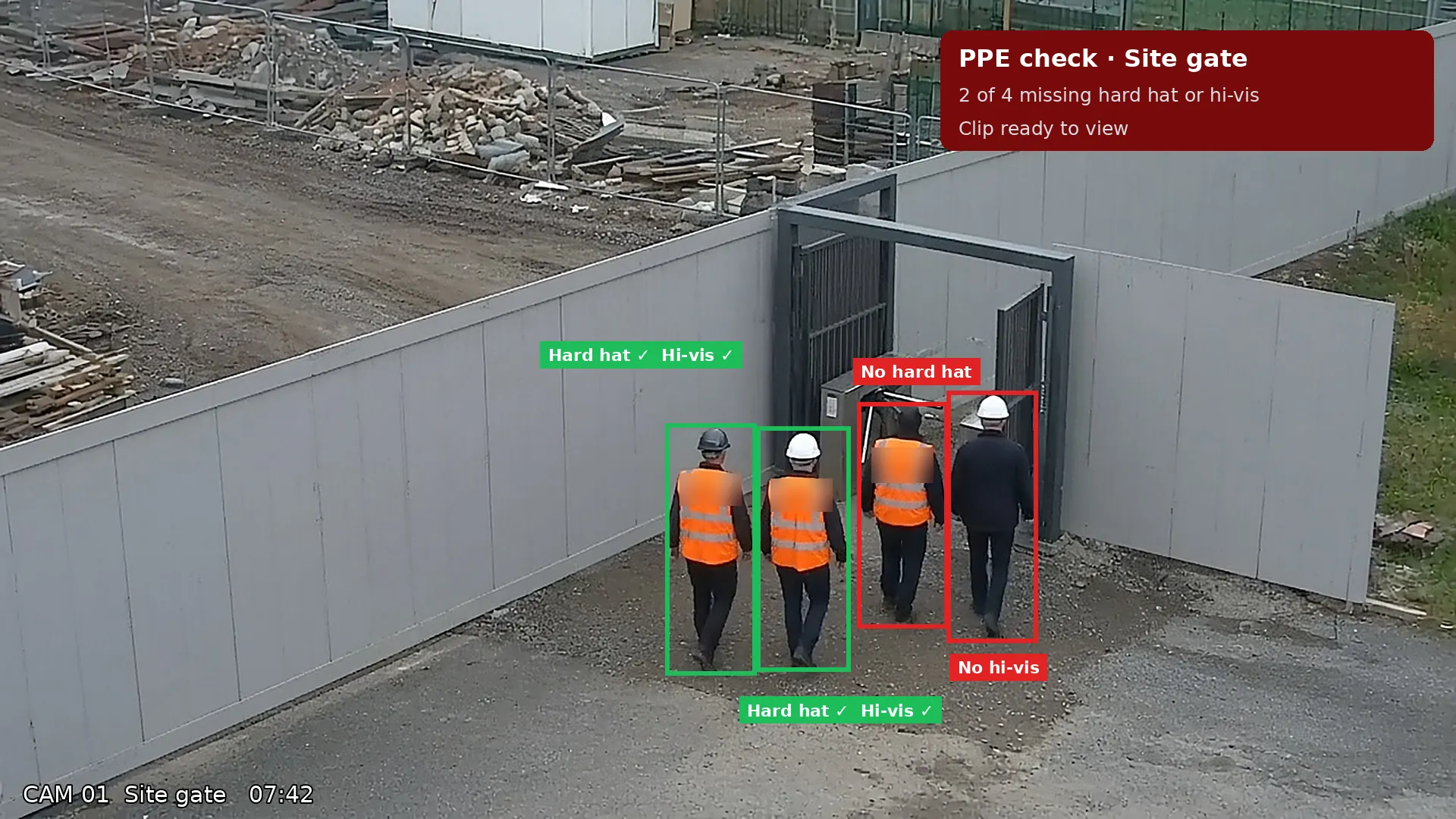
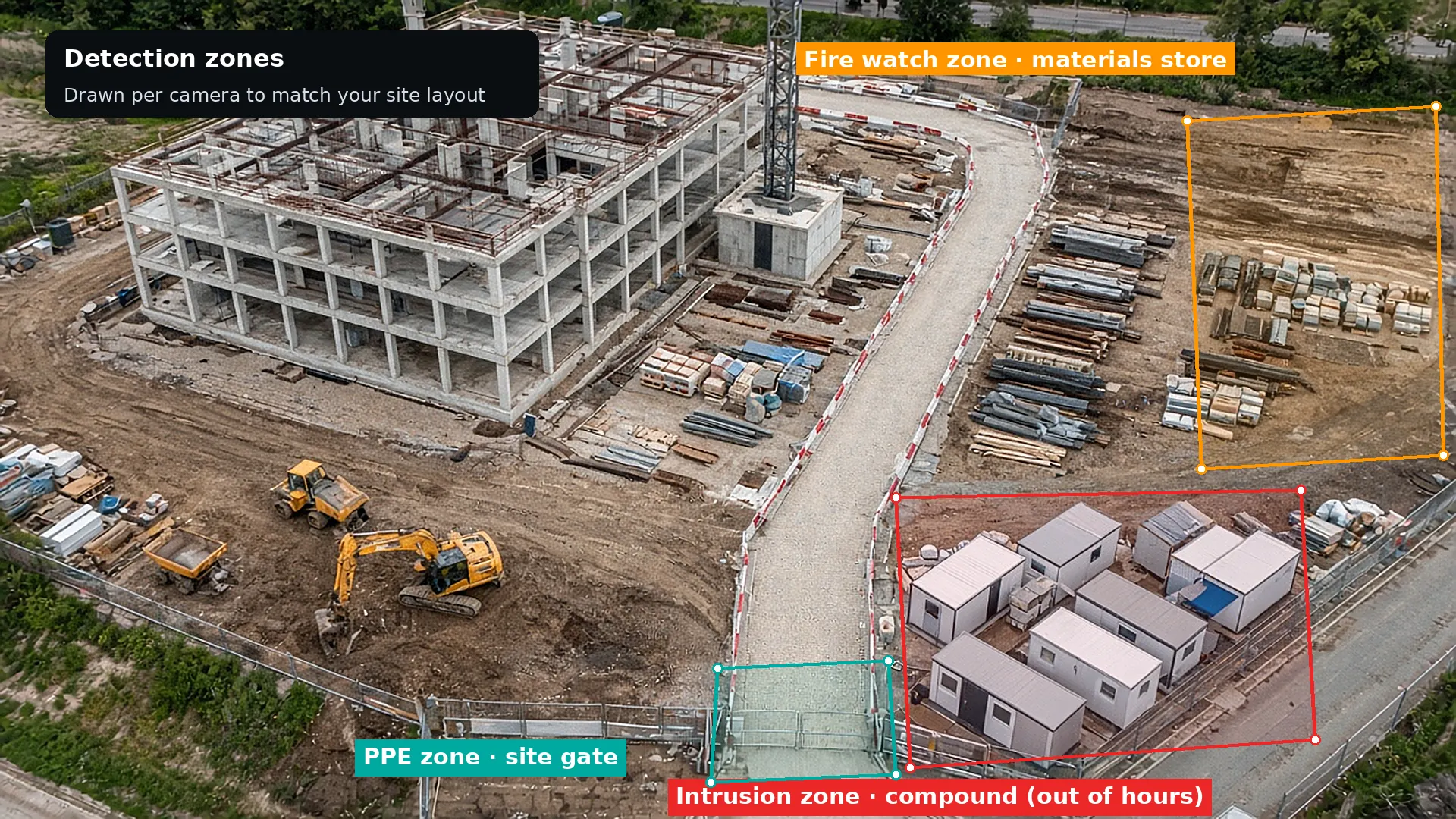
Rules are set per area with polygon detection zones. You draw the shape of each area on the camera view, such as the gate entry, scaffold access or the loading bay, and give it its own rule: a hard hat, hi-vis, or both. Someone walking on the public footpath outside the hoarding, or sitting in the welfare cabin, is outside the zone, so they do not raise an alert. A zone can be redrawn in the app when the site changes, as it does every few weeks on most builds.
Each camera also has its own alert schedule. A gate camera might check PPE from 07:30 to 18:00 on weekdays, then switch to out-of-hours intrusion detection at night and over the weekend. That way the same camera does two jobs, and nobody gets PPE alerts when the site is shut.
When someone enters a zone without the PPE that zone needs, an alert goes to the people you choose by app push notification and email, with the clip. The site manager can see who was in the zone and what they were missing, then deal with it on the spot or raise it at the next briefing. Clips can be downloaded and kept as evidence for a toolbox talk, an incident review or your own records.
Like every module, PPE detection is self-learning and fitted to your site. It learns each camera view, and the feedback button on each detection, correct or false alarm, goes into retraining for your site. A yellow coat that is not hi-vis, or a cap that is not a hard hat, is the kind of case your feedback helps with. Detection depends on the camera seeing the person clearly enough, so the Book a site assessment checks each view first. For the UK rules behind PPE, how to set up zones and a rollout checklist, read our guide to PPE detection on CCTV in the UK.
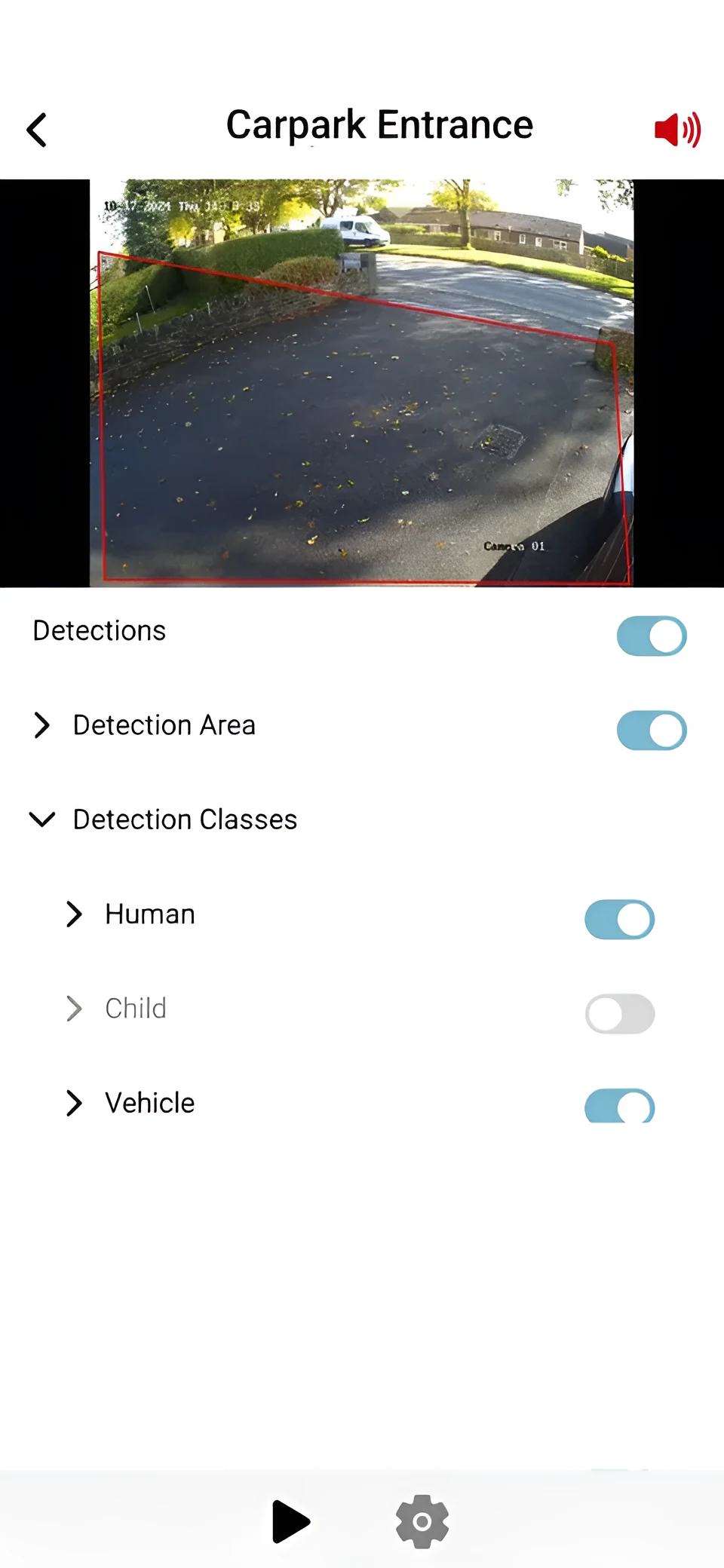
Modules side by side
Each camera can run the modules that match its risks, such as intrusion after hours and smoke and fire all day. PPE checks can run on the same camera in working hours. Everything arrives in one app, with the clip.
Supporting your CDM 2015 and HSE duties
This is general information, not legal advice. Woodcock AI does not make a site compliant on its own, and it does not replace supervision, induction or your construction phase plan. What it can do is give the people with those duties better information.
The Construction (Design and Management) Regulations 2015 place duties on clients, designers, principal contractors and contractors to plan, manage and monitor work so it is carried out safely. HSE guidance on PPE at work covers choosing, providing and using protective equipment. On most construction sites, that includes site rules on head protection and high-visibility clothing. Security matters too: HSG168 links hoarding, lighting and CCTV monitoring to preventing arson.
Camera alerts fit alongside those duties. A PPE zone at the gate shows whether site rules are followed as people come on site. Clips by area and time help when you review an incident or plan a toolbox talk. Out-of-hours intrusion alerts help you keep the public and trespassers out of a closed site. The table shows where the cameras help, and what stays with your team.
The principal contractor and the site manager usually own these checks day to day, so they are the natural people to receive PPE alerts and review clips. Clients and principal designers rarely need live alerts, but a summary of what was seen and acted on can help in progress meetings. Keep clips only as long as you need them, in line with your data protection policy, and share them only with the people who need to see them.
| Your duty or task | How camera alerts can support it | What stays with you |
|---|---|---|
| Planning, managing and monitoring the construction phase | Alerts and clips from PPE zones give the site team a record of what the cameras saw, by area and by time | The construction phase plan, supervision and site rules |
| Site induction and PPE rules at the gate | A gate-entry zone checks for a hard hat and hi-vis as people come on site, during working hours | Issuing PPE, induction and briefing |
| Keeping the site secure from unauthorised access | Out-of-hours intrusion alerts on the hoarding, gate and compound | Fencing, hoarding, lighting and locking up |
| Reviewing what went wrong and toolbox talks | Clips can be downloaded and used as evidence in a review or a briefing | The investigation, the decisions and any changes to the plan |
Rolling out on a live construction site
A construction site changes every week, so the set-up has to be quick to change too. Most of the work is in choosing the right views and drawing the right zones, not in new hardware.
Start with the places where a rule really applies and a camera can see clearly. The site gate and turnstile are usually the best first PPE zone, because everyone passes through them and the view is close. Scaffold access points and the loading bay come next. Wide views across the whole site are better for intrusion and smoke than for PPE, because people are small in the frame.
Tell the workforce what the cameras do before the alerts start. Cover it in the induction and on the site noticeboard, and make clear that alerts are about site rules and safety. If the cameras capture people, data protection applies, so check your CCTV notices and your data protection impact assessment. Our compliance hub covers the UK rules that touch site cameras.
Keep the alert list short. A PPE alert is most useful to the person who can walk over and fix it, usually the site manager or a supervisor. Out-of-hours alerts belong with the keyholders on call. Each camera's schedule and recipients can be changed in the app as the phases of the build change.
Where an area that matters has no camera, or the only view is too far away for PPE checks, a camera can be added for that area. Our design, supply and install service covers the survey, the cameras and edge server where needed, commissioning and support after go-live, so new views join the same app as the cameras you already have. When the build finishes, the zones and schedules can be removed, or the set-up can move with you to the next site, depending on the cameras there.
- Step 1: Survey the viewsWe check each camera on the gate, scaffold, loading bay and compound, in daylight and at night, and note any view that cannot see an area clearly.
- Step 2: Draw the zonesEach area is drawn as a polygon on its camera view and given a rule: hard hat, hi-vis, both, or intrusion after hours.
- Step 3: Set the schedulesWorking hours, nights and weekends are set per camera, so PPE checks and intrusion alerts run at the right times.
- Step 4: Choose who is alertedSite managers get PPE alerts in the day. Keyholders get intrusion alerts at night. ARC and phone-call alerts can be added.
- Step 5: Tune with feedbackFor the first weeks, the team marks each detection as correct or a false alarm, and that feedback goes into retraining for your site.
- Step 6: Redraw as the build movesWhen the scaffold goes up, the hoist moves or the gate changes, zones are redrawn in the app.
Works with your existing cameras
Woodcock AI works with most existing IP CCTV and recorders, confirmed in your site assessment. Most sites do not need new cameras. Towers and mobile units are confirmed in your site assessment, the same way as fixed cameras.
The AI is self-learning and fitted to each site. It learns what is normal for each camera, such as flapping sheeting, swaying netting, parked plant and floodlights. Every detection has a feedback button, and your feedback goes into retraining for your site. Read how it works.
 Deployment options
Alerts, plus optional ARC and phone-call add-ons
Alerts go by app push notification and email to the people you choose, each with the clip. Alerts to a monitoring centre (ARC) and phone-call alerts are available as optional add-ons.
Because each alert carries the clip, the site manager or keyholder can see at a glance whether it is an intruder at the hoarding or a fox crossing the compound. Read how to reduce CCTV false alarms, and compare AI CCTV with remote monitoring.
Is your construction site covered? A quick check
Tick what is already true on your site. Your answers are saved in this browser only.
Anything unticked is worth raising in a Book a site assessment: we'll map your gate, compound, stores, skips and cabins to the cameras you have.
Can AI CCTV detect intruders on a construction site at night?
Yes. Intrusion detection runs in the zones and schedules you set on hoarding, gate and compound cameras, and raises an alert with the clip when someone enters the site out of hours. Vehicle detection can flag vans arriving at the gate.
Can it spot a fire in a skip or a cabin?
Yes, where a camera can see it. Woodcock AI watches your existing cameras for visible smoke and flame, so skips, site cabins and material stores in view can raise an alert with the clip, day and night.
Does it work with the cameras already on site, including towers?
Often, if the cameras provide RTSP or ONVIF access and the view is suitable. Construction CCTV towers and mobile units can be included once that is confirmed in a site assessment.
Will wind, plant or moving sheeting cause false alarms?
The AI is self-learning and fitted to each site, so it learns what is normal for each camera, such as flapping sheeting, swaying netting, parked plant and floodlights. Every detection has a feedback button that goes into retraining for your site.
How do alerts arrive?
By app push notification and email, sent to the people you choose. Each alert comes with the clip, so you can see what the camera saw before deciding what to do.
Can alerts go to a monitoring centre or by phone call?
Standard alerts go to the people you choose by app and email, with the clip. Discuss any separate monitoring or integration requirements during the site assessment; do not assume another alert channel is included.
Does it replace a fire watch or the site fire alarm?
No. Visible smoke and flame alerts are for people to review, alongside required fire precautions, any fire watch and certified alarms.
How do we start?
Book a site assessment, or request a live test on your cameras, so views can be checked before anything is agreed.
Can AI CCTV check hard hats and hi-vis on a construction site?
Yes. Woodcock AI PPE detection checks for hard hats and hi-vis in the zones you draw, such as the gate entry or scaffold access, during the hours you set. When someone in a zone is missing the PPE that zone needs, an alert goes by app and email with the clip. It needs a camera with a clear enough view, which the site assessment checks.
Does it work on our existing site cameras?
Usually, yes. Woodcock AI works with most existing IP CCTV and recorders, connected over RTSP or ONVIF, and the site assessment confirms which cameras and views are suitable. Most sites do not need new cameras, but a view may need moving or adding where it cannot see an area clearly.
Can we set different rules for different areas of the site?
Yes. Each area is drawn as its own polygon zone with its own rule, such as hard hats and hi-vis at the gate, and intrusion in the compound after hours. Each camera also has its own alert schedule, so rules can change between the working day, nights and weekends.
Does it help with CDM 2015?
It can support your CDM 2015 duties to plan, manage and monitor work, by giving you alerts and downloadable clips from the areas that matter. It does not make a site compliant on its own, and supervision, induction, site rules and the construction phase plan stay in place.
Can it help with plant theft at night?
It can watch assessed views of the compound, plant and stores for people or vehicles after hours and send an alert with the clip. It does not replace locks, lighting, immobilisers or a human response.
What can CCTV for construction sites detect with AI?
On compatible, assessed views, Woodcock AI can flag people and vehicles out of hours, missing hard hats or hi-vis in the zones you set, and visible smoke or flame. Detections and schedules are chosen for the site.
Map your construction site to the cameras you have
A site assessment maps your gate, compound, stores, skips and cabins to your existing cameras, and confirms what is supported before anything is set up.
Night CCTV of a fenced construction laydown area in an after-hours zoneKeep exploring
Planning a new system for your compound? Our AI CCTV design, supply and install service runs from site survey and design through installation and commissioning to go-live and 24/7 support.
Related
Get a free assessment for your site
Skips, pallets and plant left on site overnight? See arson prevention for business sites.
Planning fire safety for a build? See our construction site fire safety guide.
Worried about plant going missing from site? See our plant and machinery theft prevention guide.
Diesel bowsers on site? See our fuel and diesel theft prevention guide.
Cabins, hoardings and plant damaged out of hours? See our vandalism prevention guide.
Supplying sites from a merchant’s yard? See our builders’ merchant and timber yard security guide.
Running a quarry or aggregates site rather than a construction site? See our quarry security guide.
The law, the risks and the 2026 cases behind site security: see our construction site security guide.