

What insurers expect from fire detection on waste and industrial sites
Last reviewed
Short answer: insurers expect detection that suits each part of your site, raises the alarm at any hour and meets their own standards, which often means certificated fire alarm and detection systems. Video AI on your existing CCTV can add early visual warning in yards, large open buildings and out of hours, alongside those systems rather than instead of them. Talk to your insurer or broker before you change anything.
Why do insurers focus on fire risk at waste and industrial sites?
Because waste fires are frequent, hard to put out and expensive. WISH, the industry's health and safety forum, puts it bluntly: waste management is not a popular industry for property insurers because of fire risk, and the standards insurers require are increasing.[1]
The numbers back this up. Fire and rescue services in England attended 256 industrial waste fires in 2025, up from 183 in 2021, and 32 of the 2025 fires lasted more than 24 hours.[7] Our waste fire facts page breaks the figures down by cause and year.
For an insurer, the concern is not only the fire itself. It is property damage and business interruption: weeks of lost operation, replacement plant and the cost of clearing a burnt stockpile. WISH warns that operators who fail to satisfy their insurers are likely to find insurance increasingly difficult and costly to obtain, and that after a major fire premiums are likely to rise substantially, or insurance may not be available at any economic cost.[1]
That is why a survey looks well beyond whether you have a fire alarm. The insurer wants to know how a fire would start, how quickly it would be found, who would hear about it at three in the morning on a Sunday, and whether the systems you rely on are ones they trust.
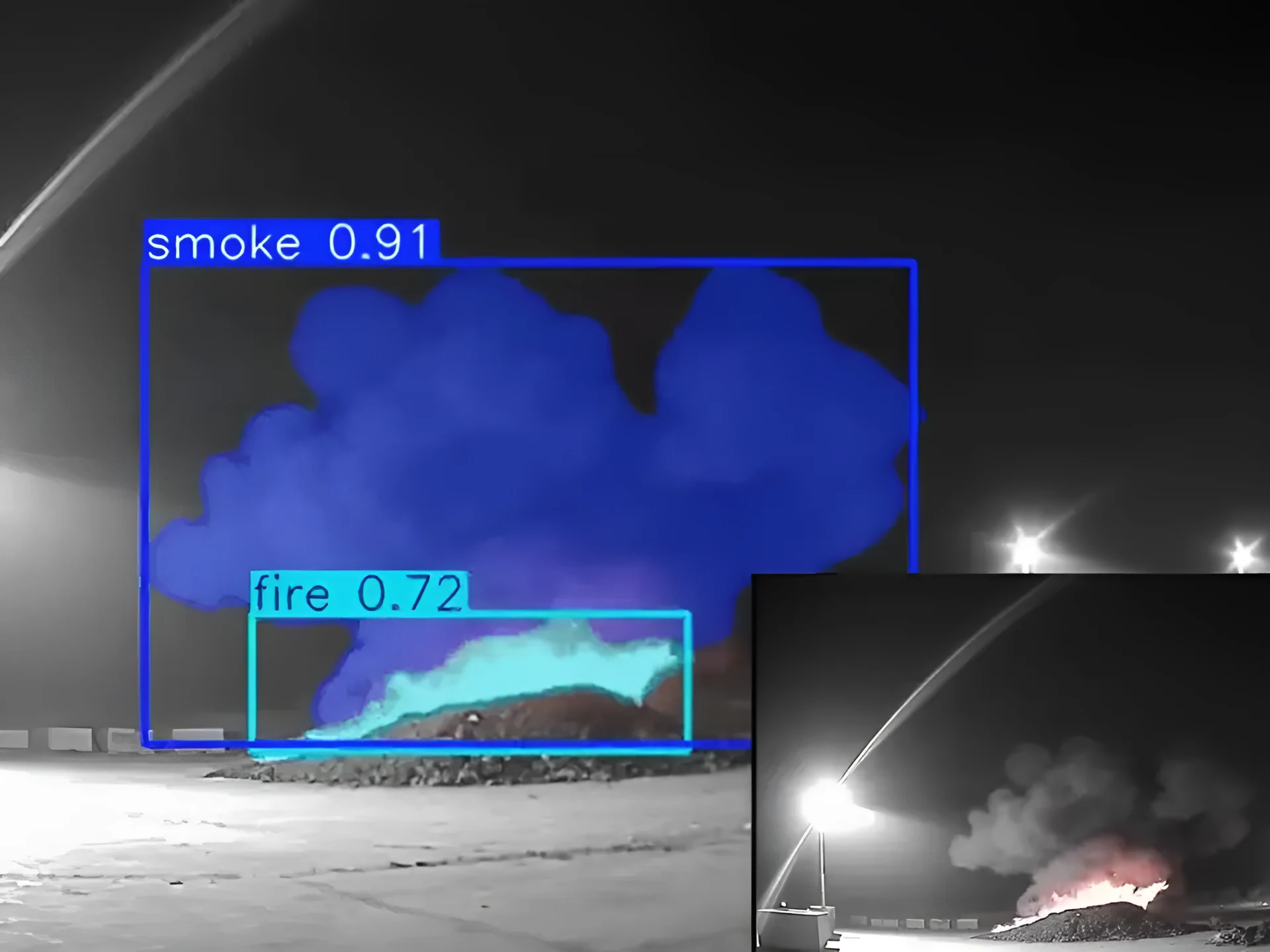 Real detection
Who decides what fire detection is acceptable on your site?
Three parties have a say, and they do not always agree: the law through your fire risk assessment, the Environment Agency through your permit, and your insurer through your policy.
The law. Under the Regulatory Reform (Fire Safety) Order 2005, the responsible person must carry out a suitable and sufficient fire risk assessment, keep it under review and record it.[3] Where necessary, the premises must be equipped with appropriate fire detectors and alarms.[4]
The regulator. If you hold an environmental permit for combustible waste, your fire prevention plan must meet three objectives: minimise the likelihood of a fire, aim to extinguish it within four hours, and minimise its spread. You must show how detection raises the alarm both in working hours and when the site is closed. The EA lists CCTV visual flame detection among automated systems, and says design, installation and maintenance must be covered by third-party certification or a recognised standard; if not, you must show you can still meet the three objectives.[2]
Your insurer. WISH notes that insurers may set their own standards, and that you may reach a standard your regulator is content with but your insurer is not.[1] Even guidance written with insurer input, such as the RISCAuthority recommendations, says individual insurers have their own requirements.[6]
What do insurers look at during a risk survey?
Every insurer has its own survey, but the same themes come up in the guidance they helped shape. Expect questions on these eight areas.
Fire risk assessment
A current, recorded fire risk assessment that is reviewed when things change. This is a legal duty for the responsible person.[3]
Fire prevention plan
For permitted waste sites, an FPP that meets the three objectives and shows how detection raises the alarm in working hours and when the site is closed.[2]
Housekeeping and close-down
Litter and dust under control, plant run clear and a formal close-down, because fires can smoulder undetected after the shift ends.[1]
Separation and stack sizes
Stack sizes and gaps from your FPP, and any stand-off distances between waste and buildings set by your property policy.[1]
Detection and alarm
What type of detection covers each area, who designed and installed it, its certification, commissioning, maintenance and test records.[1]
Out-of-hours cover
How an alarm reaches someone when nobody is on site, and who responds. WISH notes a significant number of waste site fires occur after working hours.[1]
Security and arson
Fencing, intruder alarms and CCTV, with arrangements outside working hours and the locations of CCTV and alarms described in your FPP.[2]
Not every insurer asks about all of these, and some ask for more. Your broker can tell you what your insurer's surveyor will focus on.
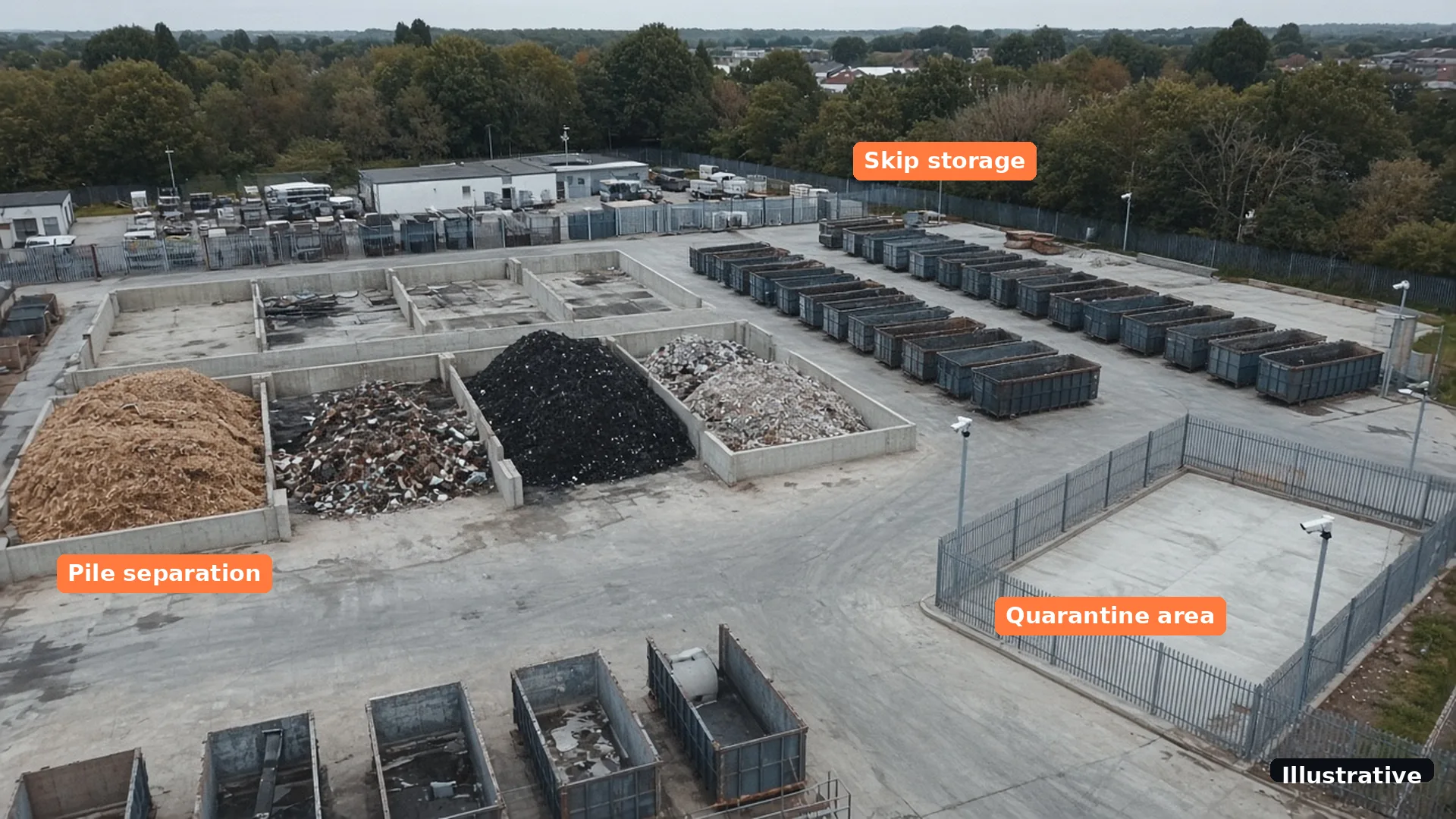
Surveyors read your site plan before your fire alarm
Stack sizes, separation and a quarantine area for hot loads tell an insurer how far a fire could spread. Your FPP should show these, along with where your CCTV and alarms are.
Work through them with our fire prevention plan checklist.
Hot works and close-down are common weak spots
Two topics catch many sites out. The first is hot works. RC7, the insurer-backed recommendations on hot work, calls for a continuous fire watch for at least one hour after work finishes, then further checks at intervals of no more than 20 minutes, and no hot work in the last hour of the working day.[5] WISH suggests at least two hours on waste sites and warns that some insurers now require a four-hour fire watch, or your insurance may be invalid.[1] Our hot works fire risk guide covers the permit and the fire watch in detail.
The second is close-down. WISH notes that a significant number of waste site fires occur after working hours, and that hot or hazardous items can smoulder deep in a waste pile, bursting into flame overnight or at the weekend when no one is around to raise the alarm.[1] Its close-down list includes a fire watch after operations end and a check that fire detection and security systems are activated and working.
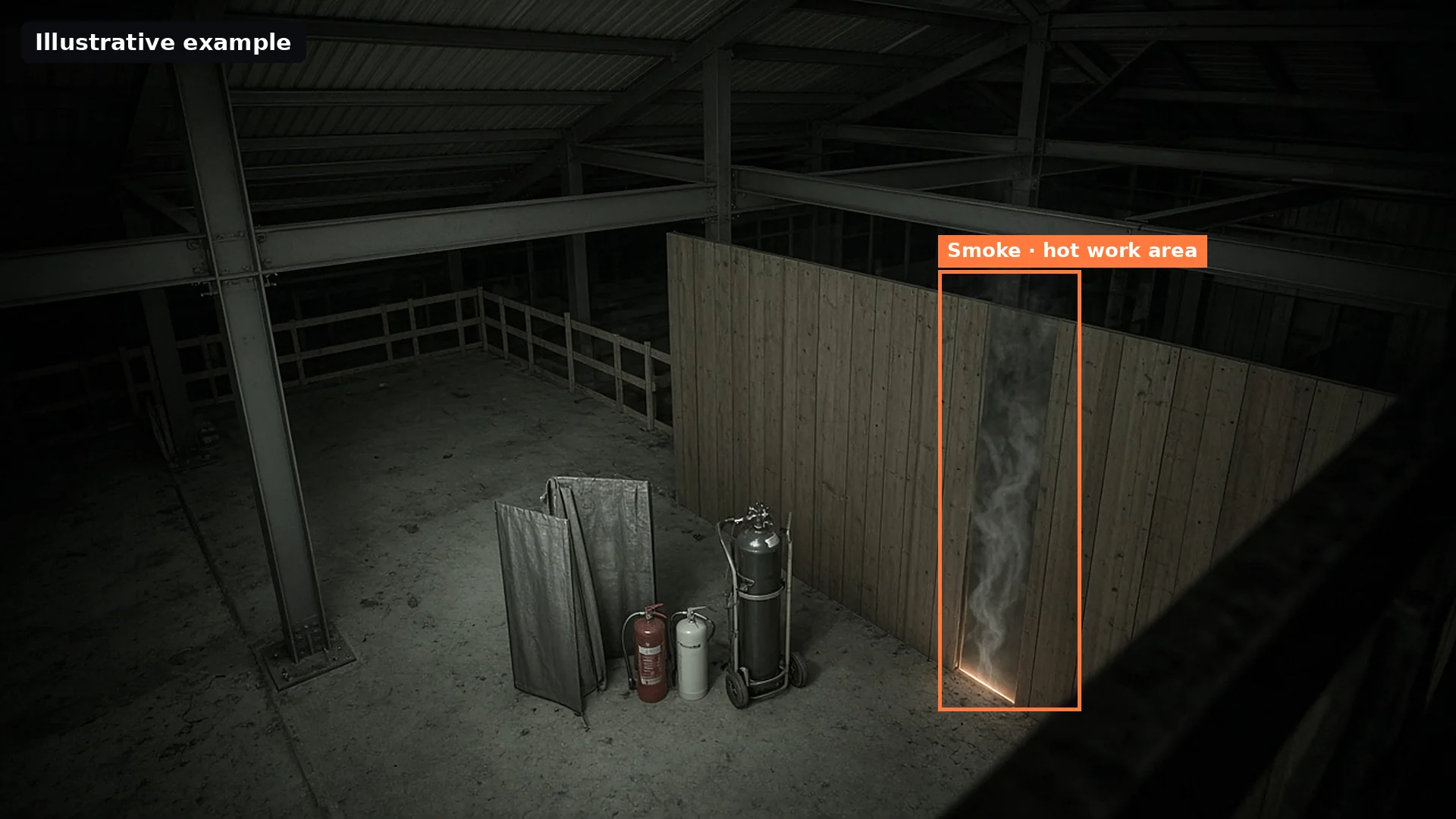 Illustrative
Where is certified detection expected, and where can video detection add early warning?
Inside buildings, certified fire alarm, detection and suppression systems carry the weight, and your insurer will usually say which standards it accepts. Video detection on existing cameras earns its place where fixed detection is hard to fit, and at times when nobody is there to see.
| Area | What the guidance says | Where video AI can add early warning |
|---|---|---|
| Inside waste halls and storage buildings | The EA requires a suppression system where waste is stored in a building.[2] Insurers may require detectors and systems certificated to standards such as LPCB or FM, designed and installed to their requirements.[1] | A camera with a clear view can add a visual check for smoke and flame and send the clip, alongside the certified system. WISH lists video smoke detection as fairly new to waste management, with waste halls as a potential use.[1] |
| Outdoor stockpiles and yards | WISH says automatic detection at external storage poses practical problems, but some sites have fitted camera or heat type detectors, and you should at least visually inspect stored waste.[1] | Existing yard cameras often already look at the piles. Video AI can watch them for visible smoke and flame at any hour, so the visual checks are not limited to when someone walks past. |
| External reception areas | Hot loads can smoulder unseen. WISH notes some sites have installed camera type detectors over external reception bunkers.[1] The EA asks you to watch for signs of heating, such as steam or smoke.[2] | A camera over the tipping or quarantine area can flag visible smoke from a load after it is tipped, including overnight. Steam can look like smoke, so alerts are checked using the clip. |
| Large open buildings and bays | Some detectors struggle where dust, moisture or air flow from roller doors is an issue, and any visual detector can be blocked by obstructions.[1] | Cameras that already cover a large open space can add another type of detection. WISH advises that more than one type of detector may be more effective than relying on one.[1] |
| Out of hours and weekends | Your FPP must show how the alarm is raised when the site is closed.[2] For out-of-hours fires the alarm may need monitoring 24/7, for example by an external responder.[1] | Alerts go to the app with the clip, to the people you choose, on a schedule set for each camera. Alerts to a monitoring centre (ARC) and phone-call alerts are available as optional paid add-ons. |
| Fires deep inside a pile | WISH fire tests found no detector fully effective at detecting fires that start inside a pile until they were close to or through the surface.[1] | Video AI only sees what is visible. Temperature probes, thermal imaging and regular checks remain the tools for heat inside a pile. See the video AI vs thermal comparison. |
WISH advises asking any detection supplier for proof that their detector works reliably in waste operations, and for references you can check.[1] That applies to video AI too, and a free site assessment is where we show what your own cameras can see.
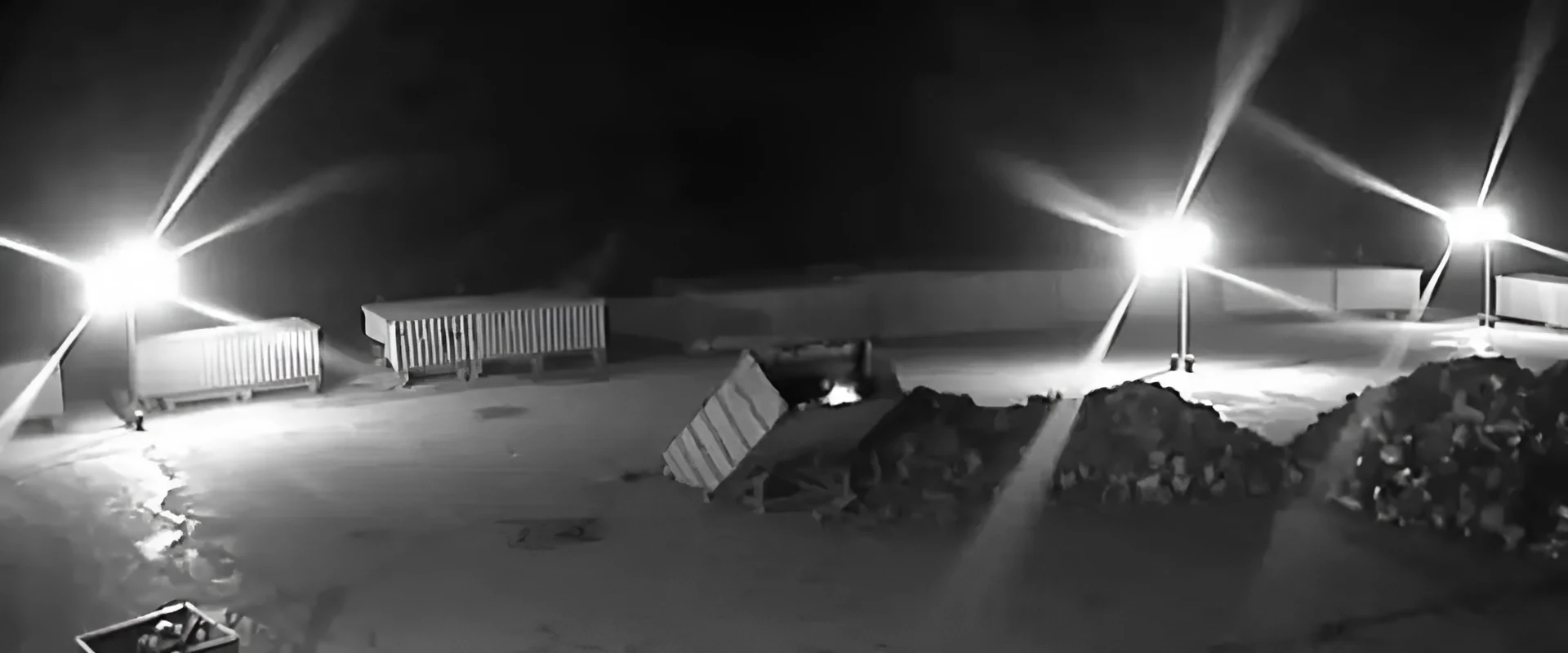 Real footage
Batteries add another layer. A damaged lithium-ion battery buried in mixed waste can start a fire long after it is tipped. The EA lists batteries, especially lithium-ion, among the contaminants to look out for and requires a quarantine area for hot loads.[2] See lithium-ion battery fires in waste and how video smoke detection works on existing CCTV.
Want to know where your cameras could add early warning?
A free site assessment checks which existing cameras can connect, what each one can see, and where smoke, fire and intrusion detection would sit alongside the systems your insurer already expects.
How should you present your detection set-up to an insurer or broker?
Show, do not tell. A short evidence pack makes a survey quicker and answers questions before they are asked. WISH's advice is simple: talk to your insurer first, and asking for advice in advance is likely to be better than arguing afterwards.[1]
Map your detection
A simple site plan showing each area, the detection that covers it and which cameras can see it. Mark any area with no cover.
File the certificates
Design, installation, commissioning and maintenance certificates for certified fire alarm, detection and suppression systems, which the EA expects to see in your FPP.[2]
Show the schedules
Which cameras watch for smoke, fire and intrusion, and at what times, including nights and weekends.
Add alert logs and sample clips
A record of alerts, what was checked and what was done, with a few example clips. WISH notes insurers may accept test data as proof that a detector is effective.[1]
Write the response plan
Who receives alerts in and out of hours, who attends, who calls the fire and rescue service, and any monitoring centre arrangement.
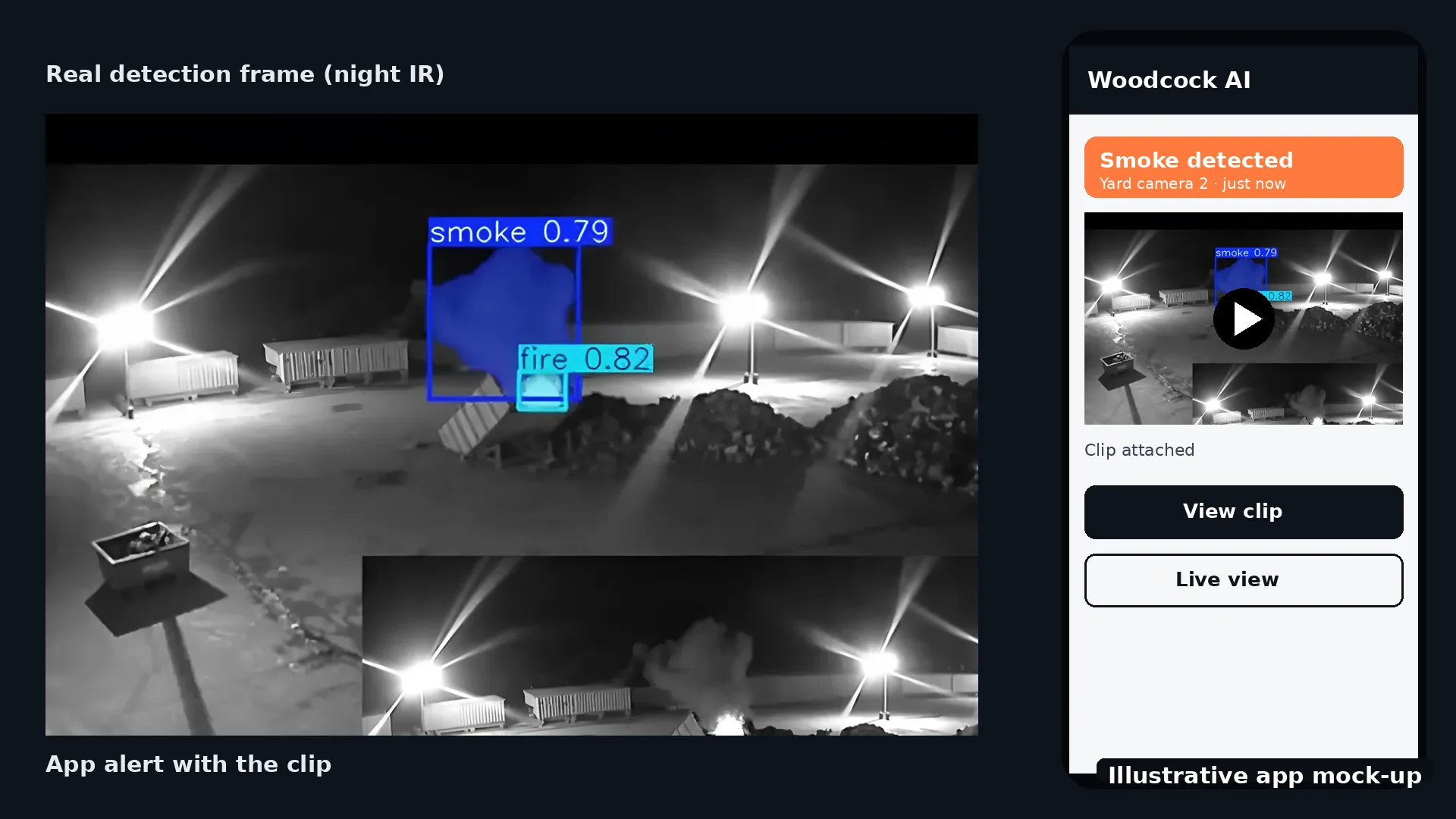
Every alert is a record you can show
Each alert arrives with the clip, so you can show a surveyor what was detected, when, and what happened next. Clips can be downloaded for your records.
Read how we keep false alarms down, which matters to anyone reading your log.
How does Woodcock AI fit alongside your insurer's requirements?
Woodcock AI adds smoke, fire and intrusion detection to the CCTV you already have. It supplements certified fire alarm and detection systems; it does not replace them.
It can support the detection measures in your fire prevention plan; your FPP, your insurer and the Environment Agency decide what is acceptable. What it adds is another set of eyes on every connected camera, day and night:
- App alerts with the clip, sent to the people you choose, on a schedule you set for each camera, such as smoke and fire all day and intrusion out of hours.
- Alerts to a monitoring centre (ARC) and phone-call alerts are available as optional paid add-ons.
- The AI learns each site's cameras, and every detection has a feedback button that feeds into retraining. See how the self-learning AI works.
- Plain-English questions about your footage, and clip download, which helps when you assemble an alert log or answer a surveyor's question.
- Support available 24/7.
Before you tell your insurer anything about video detection, agree with them how they want it described in your survey and your FPP. Our waste and recycling page shows how sites use it, and the comparison of video AI, thermal and on-camera analytics explains what each can and cannot see.
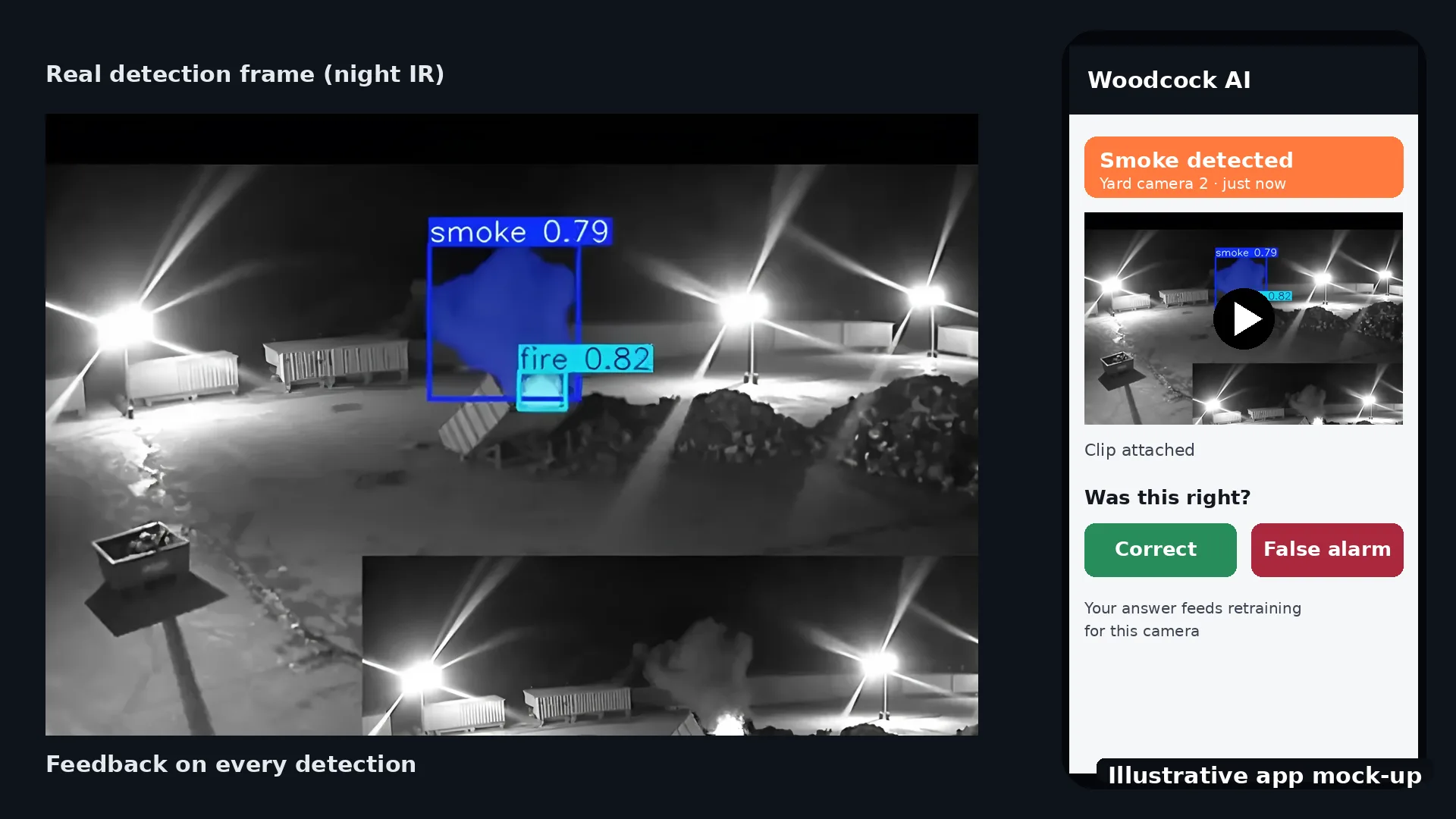
Feedback on every detection
Marking an alert as correct or a false alarm feeds into retraining for that camera, so the AI learns what is normal on your site, such as steam, dust or headlights.
A cleaner alert log is easier to explain to a surveyor.
Are you ready for your insurer's survey?
Tick off what is in place. Your progress is saved in this browser, and you can print it or save it as a PDF to share with your broker.
This checklist is a starting point drawn from the sources below, not your insurer's survey. Gaps are worth raising with your broker before the surveyor visits. For locking up, see the out-of-hours site security checklist.
 Illustrative
What do insurers expect from fire detection on a waste site?
They expect detection that suits each area, raises the alarm at any hour and meets their own standards. WISH guidance says many insurers require specific certifications for fire systems, such as LPCB or FM, and may not accept a system that does not meet them, so talk to your insurer first.[1]
Do insurers and the Environment Agency want the same thing?
Is CCTV required on a permitted waste site?
The EA fire prevention plan guidance says you must have security measures in place, such as security fencing, intruder alarms and CCTV, with arrangements outside working hours, and describe where the CCTV and alarms are.[2]
Can CCTV count as fire detection in an FPP?
The EA lists CCTV visual flame detection among automated detection systems. Its design, installation and maintenance must be covered by third-party certification or a recognised standard; otherwise you must show you can still meet the three objectives.[2] Your insurer may have its own view, so ask.
Does video AI replace a certified fire alarm?
No. Video AI on existing CCTV supplements certified fire alarm and detection systems. It adds early visual warning where cameras already look, such as yards, large open buildings and out of hours.
What is the fire watch after hot works?
What should I show an insurer about my detection?
A coverage plan, certificates for certified systems, camera alert schedules, alert logs with sample clips, a response plan, and impairment and fire watch records. The checklist on this page covers each item.
What if part of my fire system stops working?
Tell your insurer. WISH says it is common for property policies to require you to report an impaired fire system, and your insurer may ask for steps such as a dedicated fire watch.[1]
How does Woodcock AI fit alongside insurer requirements?
Woodcock AI adds smoke, fire and intrusion detection to your existing CCTV and sends app alerts with the clip, on schedules set per camera. It can support the detection measures in your fire prevention plan; your FPP, your insurer and the Environment Agency decide what is acceptable. Alerts to a monitoring centre (ARC) and phone-call alerts are available as optional paid add-ons.
Is my checklist progress saved?
Yes, ticks are saved in this browser on this device only. Nothing is sent to us. Use the print button to keep a paper or PDF copy for your broker.
Sources
Law, regulatory guidance and insurer-backed guidance referred to in this guide. This guide is general information, not legal or insurance advice. Your insurer's requirements take precedence.
- WISH, WASTE 28: Reducing fire risk at waste management sites (issue 3, March 2020). Good practice guidance written with the EA, HSE, NFCC, ESA and others, with some of the main insurers consulted on fire engineering. It says insurers may set their own standards, may require certificated detection such as LPCB or FM, and that you should talk to your insurer first (sections 1.6, 1.8, 2.6, 2.7, 6.2 and appendix 4). Last checked 23 October 2026.
- Environment Agency, Fire prevention plans: environmental permits. Sets the three FPP objectives and requires procedures to detect a fire in its early stages, both in working hours and when the site is closed. Automated systems may include CCTV visual flame detection, and must be covered by third-party certification or a recognised standard, or you must show you can still meet the three objectives (sections 7 and 13). Last checked 23 October 2026.
- The Regulatory Reform (Fire Safety) Order 2005, article 9: Risk assessment. The responsible person must make a suitable and sufficient fire risk assessment, review it regularly and record it. Last checked 23 October 2026.
- The Regulatory Reform (Fire Safety) Order 2005, article 13: Fire-fighting and fire detection. Where necessary, premises must be equipped, to the extent that it is appropriate, with fire detectors and alarms. Last checked 23 October 2026.
- FPA, RC7: Risk control for hot work (version 9, 2023). RISCAuthority recommendations: a continuous fire watch for at least one hour after hot work, further checks at intervals of no more than 20 minutes, and no hot work in the 60 minutes before the end of the working day. Last checked 23 October 2026.
- RISCAuthority, RC48: Arson prevention, the protection of premises from deliberate fire raising (2010, copy hosted by IAAI). Produced with insurer input but not a pan-insurer view; individual insurers have their own requirements. Recommends CCTV coverage of all vulnerable areas and that cameras are monitored so they are not moved or their view obscured. Last checked 23 October 2026.
- MHCLG, Number of industrial waste fires, England 2021 to 2025 (Table A81, published 22 July 2026). Fire and rescue services in England attended 256 industrial waste fires in the year ending December 2025, up from 183 in 2021; 32 of the 2025 fires lasted more than 24 hours. Last checked 23 October 2026.
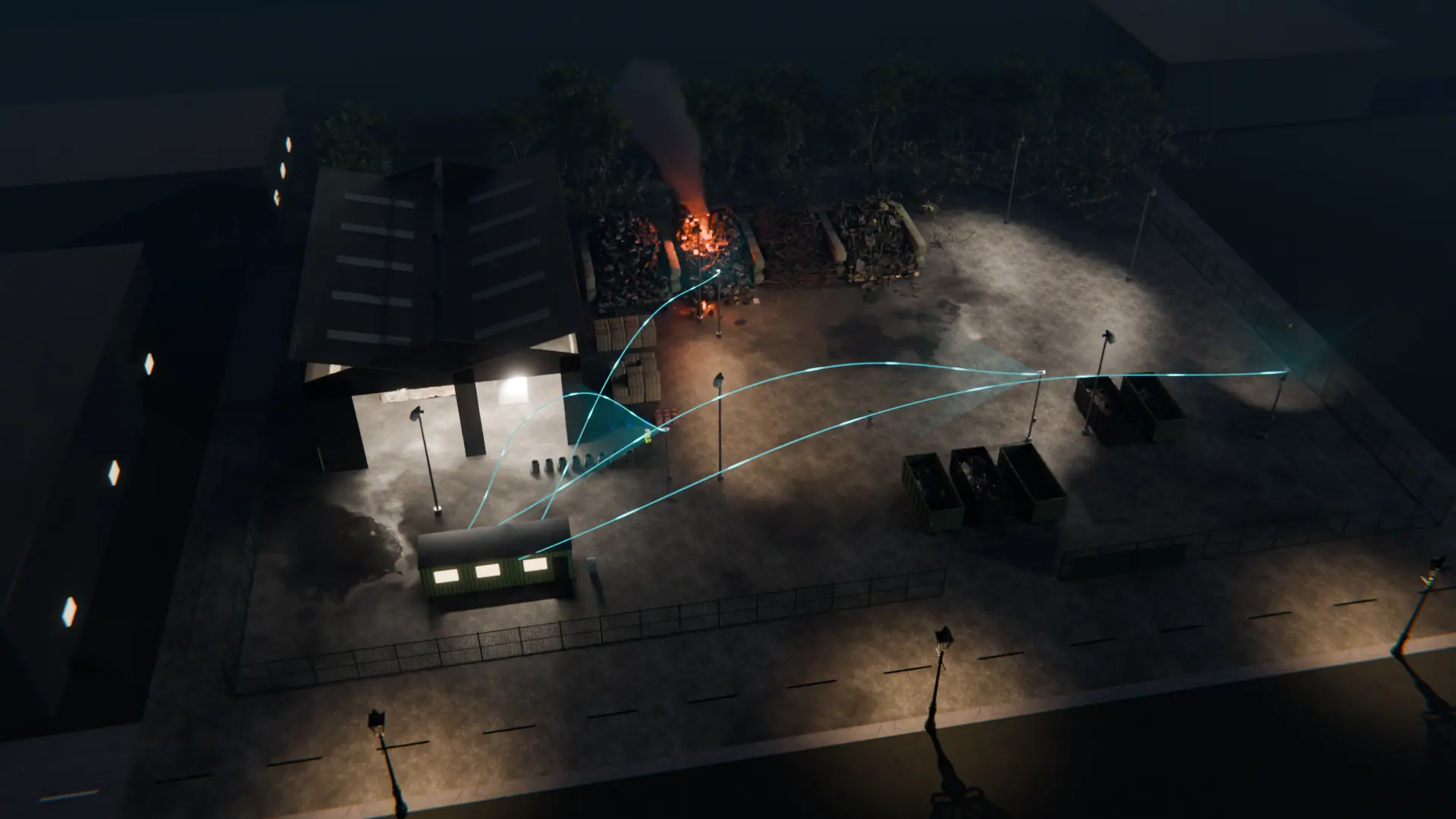
See where your cameras could add early warning
A free site assessment reviews your existing cameras, the fire risks on your site and where smoke, fire and intrusion detection would sit alongside the systems your insurer expects. Support is available 24/7. Alerts to a monitoring centre (ARC) and phone-call alerts are available as optional paid add-ons.
Illustrative 3D renderRelated
Want us to check your site against this?