

CCTV compliance for UK business sites
Last reviewed
Short answer: if your business runs CCTV, UK GDPR applies to the footage, and adding AI does not change that: you still need a purpose, a lawful basis, a DPIA in most cases, clear signs and sensible retention.[1] Fire safety law, health and safety duties, your insurer and, on permitted waste sites, the Environment Agency each have their own expectations for how a fire or break-in is spotted. This hub brings our guides on each together, every one cited to the official source.
Which rules apply to your site's cameras?
Five sets of rules can touch the same cameras. Most businesses deal with data protection and fire safety; waste, industrial and construction sites usually add the rest.
It helps to think of your CCTV as one system with several audiences. The Information Commissioner's Office (ICO) cares about the people the cameras record. The fire safety law cares about whether a fire would be found and people warned. The Environment Agency, if you hold a permit for combustible waste, cares about how quickly a fire is detected and put out, in working hours and when the site is closed.[7] Your insurer cares about all of that, plus property damage and business interruption, and may set its own standards on top.[8]
The good news is that these overlap. The same camera register, the same map of what each camera covers and the same alert log can answer questions from all five. The table below shows who sets each rule, what it asks of your cameras, and where to read more.
| Area | Who sets it | What it asks of your cameras | Our guide |
|---|---|---|---|
| Data protection | UK GDPR and the Data Protection Act 2018, with ICO guidance | Footage of identifiable people is personal data: purpose, lawful basis, DPIA, signs, retention, access and requests. | AI CCTV and GDPR |
| Fire safety law | Regulatory Reform (Fire Safety) Order 2005 (England and Wales) | A recorded fire risk assessment, and fire detection and alarms where necessary. | Insurer expectations |
| Environmental permit | Environment Agency fire prevention plan (permitted waste sites in England) | Detection in working hours and when the site is closed; security measures such as CCTV, with locations described. | FPP checklist |
| Health and safety | HSE guidance, plus FPA recommendations on hot work | Permits to work, a fire watch after hot work, and managing the risks of lone working. | Hot works fire risk |
| Insurance | Your property policy and your insurer's survey | The insurer's own standards for detection, out-of-hours cover, security and evidence. | Insurer expectations |
This hub is general information, not legal or insurance advice. Scotland and Northern Ireland have their own fire safety law and environmental regulators, so check the rules for your nation.
Guides in this hub
Six practical guides, each written for site and operations managers and cited to the ICO, the Environment Agency, legislation.gov.uk, the HSE and industry guidance.
- Data protection
AI CCTV and GDPR: a UK guide for businesses
Lawful basis, DPIA, signs, retention, access, footage requests and complaints when AI analyses your CCTV, with a printable checklist.
Best for: Anyone running business CCTV
Read the guide - Environmental permit
Fire prevention plan checklist for waste sites
The Environment Agency FPP, section by section: detection in and out of hours, pile sizes, separation, quarantine and security.
Best for: Permitted waste sites in England
Read the guide - Health and safety
Hot works fire risk: permits, fire watch and after hours
What counts as hot work, the permit, clearing combustibles and the fire watch after work stops, with a checklist.
Best for: Industrial, construction and waste sites
Read the guide - Insurance
What insurers expect from fire detection
What a risk survey looks at, where certified detection is expected, where video detection adds early warning, and the evidence to show.
Best for: Sites preparing for a survey or renewal
Read the guide - Evidence
Waste site fires in the UK: key facts and sources
Official figures on waste fires in England, lithium-ion battery fires and what the Environment Agency expects, each with its source.
Best for: Anyone writing a risk assessment or business case
Read the guide - Security
Out-of-hours site security checklist
Perimeter, lighting, CCTV coverage and alerts, fire risks, keyholders and lone working, in a checklist you can tick, save and print.
Best for: Any site that empties at night
Read the guide
New to the technology? Start with what AI CCTV is, then see how video smoke detection works on existing CCTV. Every guide we publish is listed on the guides page.
What does UK GDPR mean for business CCTV and AI?
Footage of people who can be identified is personal data, so the same principles apply whether a person or an AI is watching. You remain the controller, and you stay responsible for how the system is used.[1]
In practice, the ICO expects a written purpose for each camera, a lawful basis (usually legitimate interests for site security and safety) and a data protection impact assessment. The ICO says a DPIA is a legal requirement for surveillance likely to be high risk, and that this applies in most cases. It also asks operators to document any use of algorithms, AI or machine learning in the DPIA.[1]
Signs should be visible and readable, placed before people enter the area a camera covers, and should say who runs the system and how to contact them.[2] Keep footage for the shortest period your purpose needs; the law sets no fixed period.[2] People can ask for footage of themselves, and you have one month to respond, extendable in complex cases.[3] You also need a process for data protection complaints.[4]
For AI on existing CCTV, the DPIA usually records which detections run on which cameras, what triggers an alert, who receives it and where video is processed. Our AI CCTV and GDPR guide walks through eight steps and includes a checklist you can print.
 Illustrative
What do fire law and fire prevention plans expect from detection?
In England and Wales, the responsible person for business premises must carry out a suitable and sufficient fire risk assessment, review it and record it.[5] Where necessary, the premises must have appropriate fire detectors and alarms.[6]
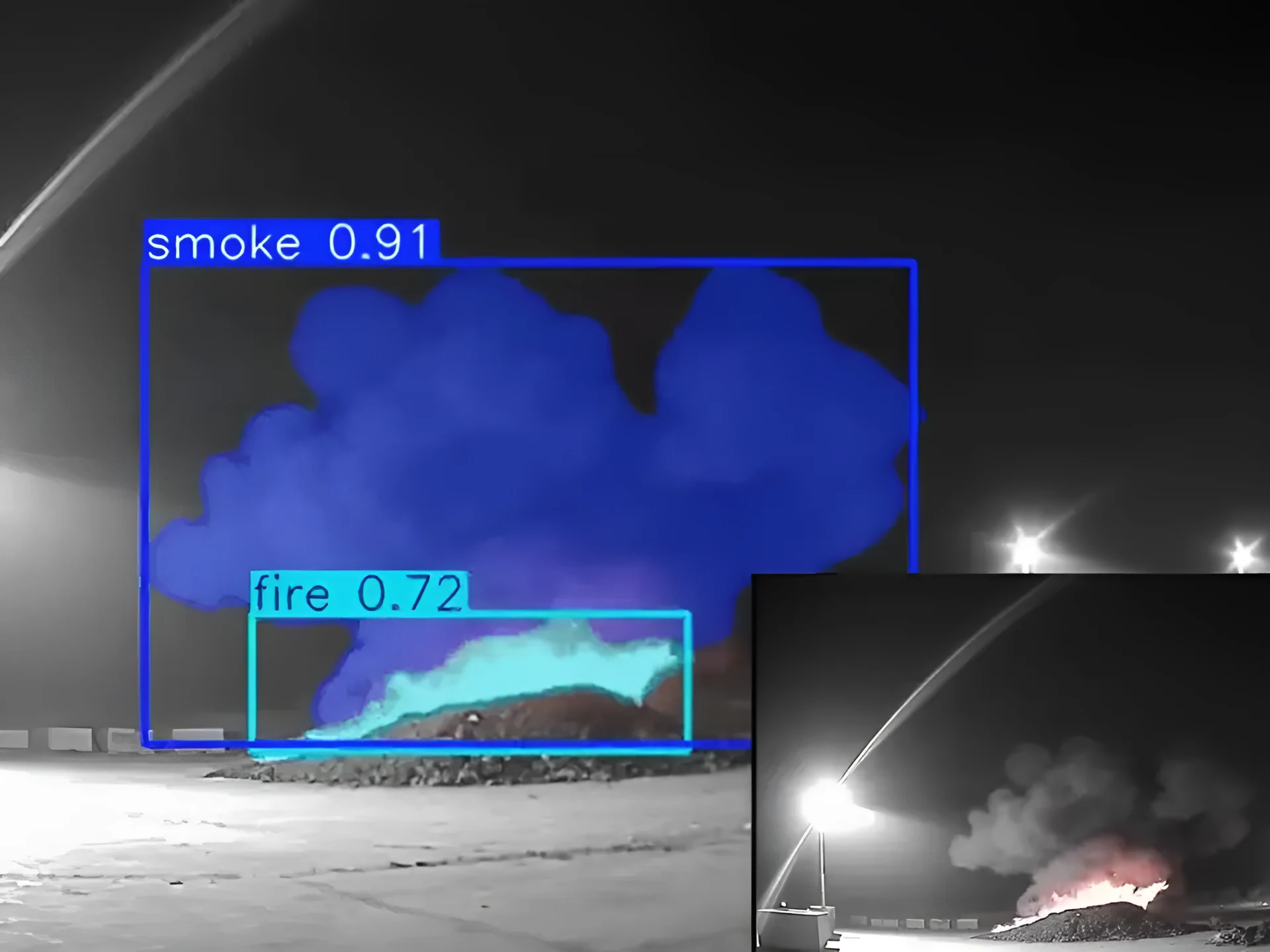
Permitted waste sites in England go further. The Environment Agency fire prevention plan has three objectives: minimise the likelihood of a fire, aim to extinguish it within four hours, and minimise its spread. The plan must show how a fire is detected in its early stages, both in working hours and when the site is closed. The EA lists CCTV visual flame detection among automated systems, and says it must be covered by third-party certification or a recognised standard, or you must show you can still meet the three objectives.[7]
The same guidance says you must have security measures in place, such as security fencing, intruder alarms and CCTV, with arrangements outside working hours, and describe where the CCTV and alarms are.[7] That makes your camera layout part of your permit paperwork, not just your security set-up.
Waste fires are a real and growing risk: fire and rescue services in England attended 256 industrial waste fires in 2025, up from 183 in 2021.[12] The waste fire facts page sets out the figures and their sources, and the fire prevention plan checklist takes you through the plan section by section.
 Real detection
Hot works, lone working and the hours after close
Many fires start when nobody is looking: after hot work has finished, after the last shift has left, or when one person is covering a large site alone.
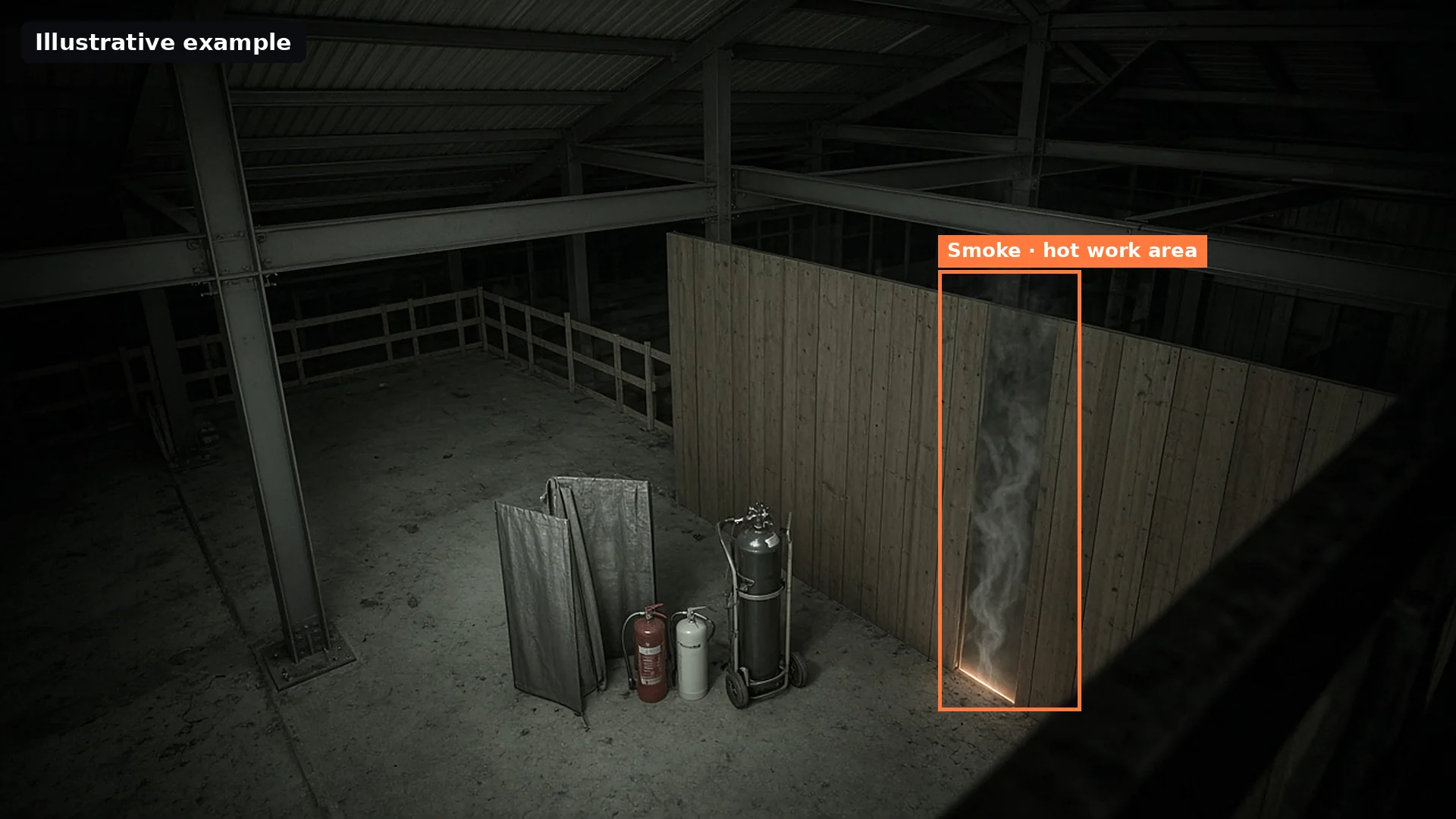
Hot work such as welding, cutting and grinding needs a permit to work, cleared combustibles and a fire watch after the job.[9] The FPA's RC7 recommendations call for a continuous fire watch for at least one hour after work finishes, then further checks at intervals of no more than 20 minutes.[10] WISH notes that some insurers ask for longer on waste sites, so check your policy.[8] The hot works fire risk guide covers the permit and fire watch in detail.
WISH also notes that a significant number of waste site fires occur after working hours, when hot or hazardous items can smoulder in a pile and flare up overnight or at the weekend.[8] If anyone works alone, for example on security rounds, the HSE expects employers to manage the risks before they do.[11] Our out-of-hours site security checklist covers lock-up, keyholders and alerts.
 Illustrative
What will your insurer ask about your cameras?
Insurers may set their own standards for fire detection, and you can meet what your regulator asks while still falling short of what your insurer wants.[8]
A risk survey usually looks at your fire risk assessment, your fire prevention plan if you have one, housekeeping and close-down, separation, detection and alarm, out-of-hours cover, security and hot works. WISH advises talking to your insurer before you change your fire detection, because asking first is easier than arguing afterwards.[8]
Cameras come up in two ways: as security, and as a possible extra layer of early fire warning. Be clear which is which. Certified fire alarm and detection systems carry the weight inside buildings; video detection on existing CCTV can add early visual warning in yards, on stockpiles and out of hours. The insurer expectations guide includes a survey readiness checklist.
Every alert is a record you can show
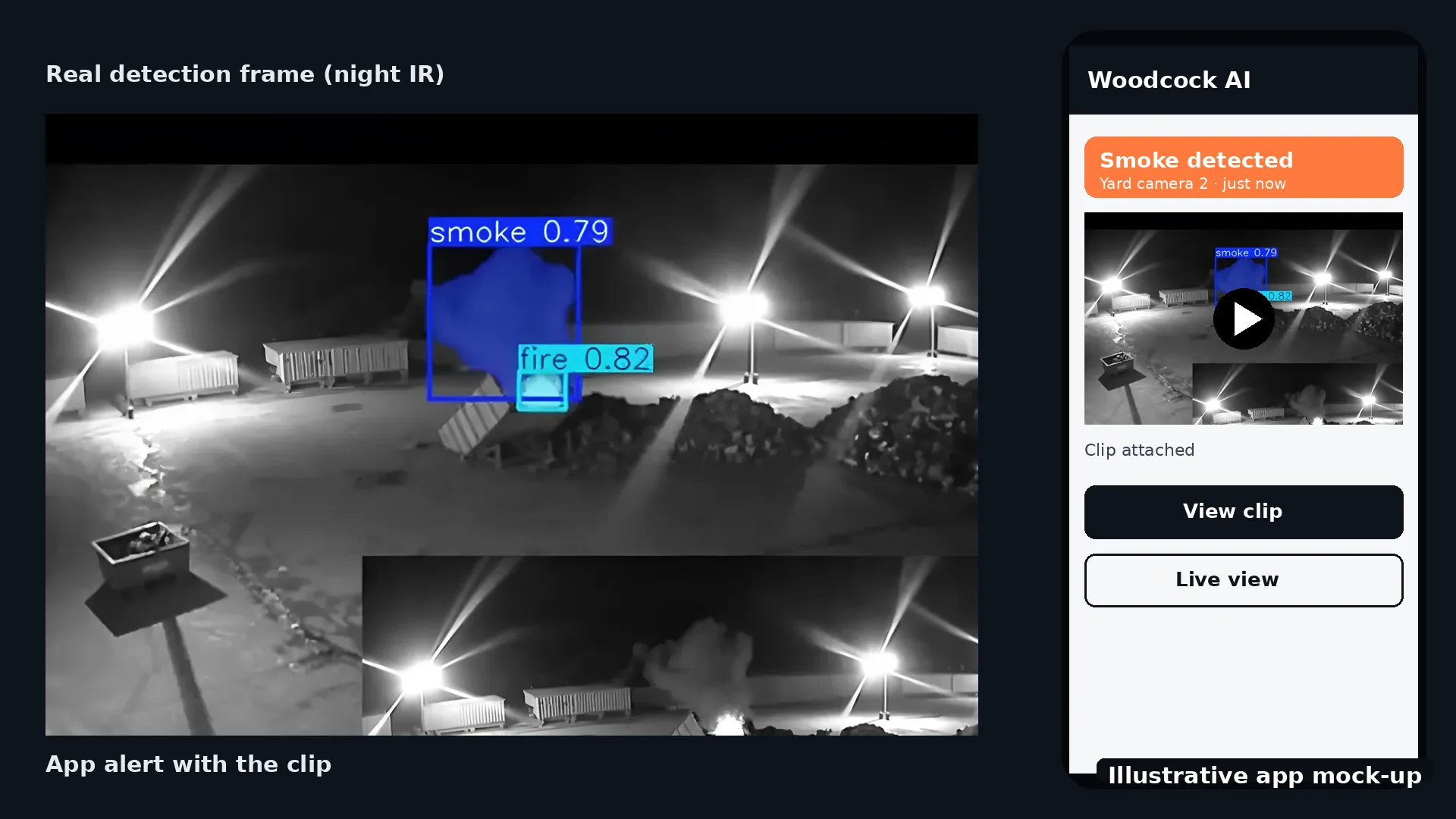
Each alert arrives with the clip, so you can show a surveyor or auditor what was detected, when and what happened next. Clips can be downloaded for your records.
Read how to keep false alarms down, which matters to anyone reading your alert log.
Where AI on existing CCTV fits, and where it does not
Woodcock AI adds smoke, fire and intrusion detection to the cameras you already have. It supplements certified fire alarm and detection systems and your statutory procedures; it does not replace them, and it does not do your paperwork for you.
What it can do is make the paperwork easier to write and easier to prove:
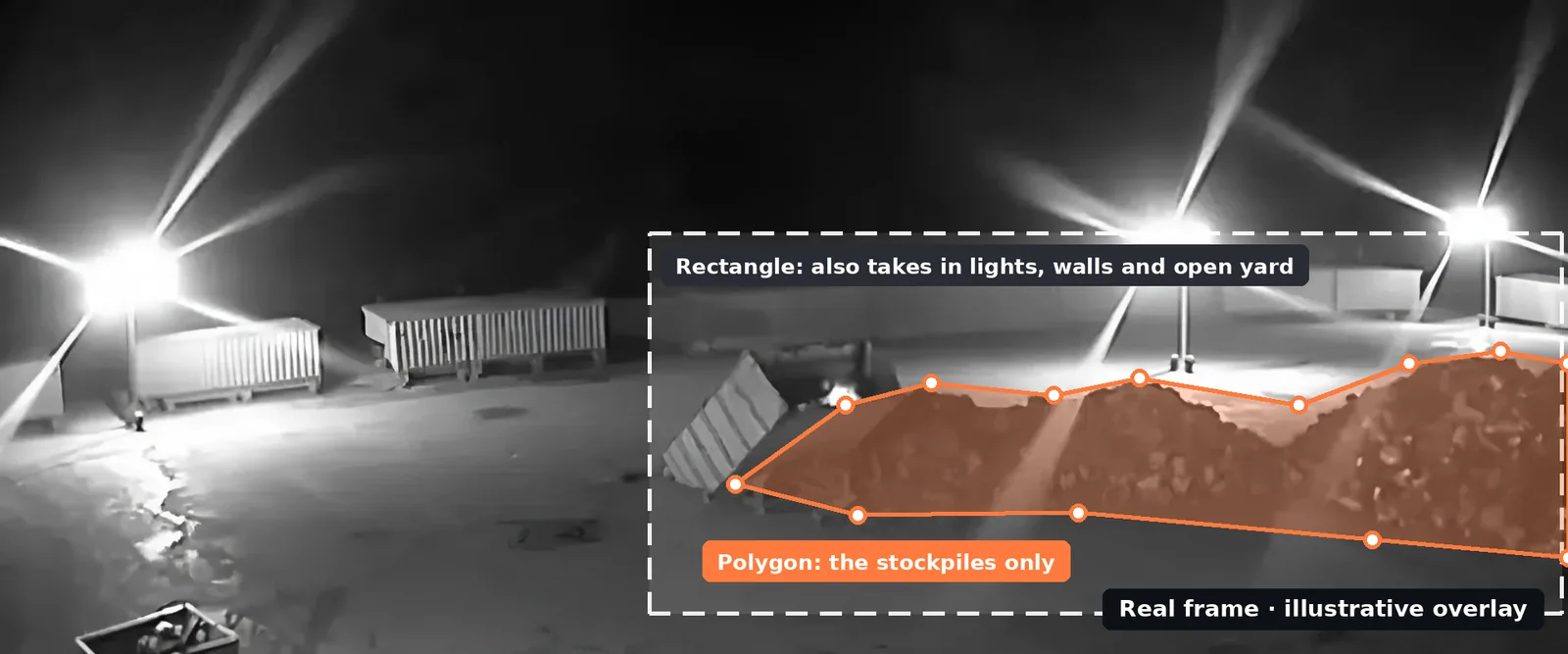
- Polygon detection areas. Draw the exact area each camera should watch, such as round a stockpile or along a fence line, so alerts come only from the places you have a reason to monitor. See polygon detection zones.
- Per-camera alert schedules. Smoke and fire all day, intrusion out of hours, set camera by camera, which maps straight onto the "in working hours and when the site is closed" question in a fire prevention plan.
- A self-learning AI. It learns each site's cameras, and every detection has a feedback button that feeds into retraining, so the alert log stays clean. See how the self-learning AI works.
- Plain-English questions and clip download. Ask your footage questions in everyday language and download the clips you need for a request, an incident report or a survey.
- Alerts that reach someone. App alerts with the clip go to the people you choose, with support available 24/7. Alerts to a monitoring centre (ARC) and phone-call alerts are available as optional paid add-ons.
Before you describe video detection in your DPIA, fire prevention plan or insurer survey, agree the wording with whoever reviews it. The comparison of video AI, thermal and on-camera analytics explains what each can and cannot see.
Want a second pair of eyes on your cameras?
A free site assessment checks which existing cameras can connect, what each one can see and which detections are supported on each, and gives you the details to record in your DPIA, fire prevention plan and insurer evidence.
 Illustrative overlay
How to keep one evidence folder for every audit
Keep these six items together and up to date, and most questions from the ICO, a fire officer, the Environment Agency or your insurer can be answered from the same place.
Camera register
Each camera, what it covers, its purpose and who is responsible for it. This feeds your DPIA, your FPP and your insurer's survey.
Detection map and schedules
Which cameras watch for smoke, fire and intrusion, the detection areas drawn on each, and the times each one is active.
Alert log and response plan
A record of alerts, what was checked and what was done, plus who responds in and out of hours.
Review the folder whenever you add or move a camera, change who receives alerts, or change how the site operates, and after any fire, near miss or break-in.
 Illustrative
What does CCTV compliance mean for a UK business?
It means running your cameras within every set of rules that applies to your site. For most businesses that is data protection law (UK GDPR and the Data Protection Act 2018), plus fire safety law, health and safety duties and your insurance policy. Permitted waste sites in England also have an Environment Agency fire prevention plan.[1][7]
Is AI CCTV legal in the UK?
Yes. Using AI to analyse business CCTV is allowed under UK GDPR, as long as you follow the same rules as for any CCTV: a clear purpose, a lawful basis, a DPIA in most cases, clear signs, sensible retention and secure access.[1][2] Our AI CCTV and GDPR guide goes through each step.
Do I need a DPIA for business CCTV?
Very likely. The ICO says a DPIA is a legal requirement for surveillance likely to result in a high risk to individuals, and that this applies in most cases. If AI analyses the footage, document that in the DPIA.[1]
Is CCTV required on a permitted waste site?
The Environment Agency fire prevention plan guidance says you must have security measures in place, such as security fencing, intruder alarms and CCTV, with arrangements outside working hours, and describe where the CCTV and alarms are.[7]
Can CCTV count as fire detection?
The Environment Agency lists CCTV visual flame detection among automated detection systems for a fire prevention plan, but it must be covered by third-party certification or a recognised standard, or you must show you can still meet the plan's three objectives.[7] Your insurer may have its own view, so ask before you rely on it.
Does AI on existing CCTV replace a fire alarm?
No. Video AI on existing CCTV supplements certified fire alarm and detection systems. It adds early visual warning where cameras already look, such as yards, stockpiles and large open buildings, including out of hours.
How long should I keep CCTV footage?
The law sets no minimum or maximum period. The ICO says to choose the shortest period your purpose needs, rather than keeping footage because the recorder has space.[2]
How can Woodcock AI help with compliance?
It adds smoke, fire and intrusion detection to the cameras you already have and keeps a record of every alert with its clip. Polygon detection areas and per-camera schedules let you set exactly where and when each camera alerts, which you can record in your DPIA, FPP and insurer evidence. Your own assessments decide what applies to your site.
Sources
Law, regulatory guidance and industry guidance referred to on this page. This is general information, not legal or insurance advice; your own assessments, your regulator and your insurer decide what applies to your site.
- ICO, Video surveillance guidance: what are our responsibilities in terms of accountability?. Lawful basis, DPIAs (a legal requirement for surveillance likely to be high risk, which the ICO says applies in most cases), documenting any use of AI or algorithms, records and contracts with processors. Last checked 24 October 2026.
- ICO, Video surveillance guidance: how can we comply with the data protection principles?. Signs and transparency, retention based on purpose, audio, workplace use and security, including cloud storage. Last checked 24 October 2026.
- ICO, Video surveillance guidance: governance (post-deployment). Requests for footage and the one-month response time, redaction and disclosure to third parties. Last checked 24 October 2026.
- ICO, How to deal with data protection complaints. You must have a process for handling data protection complaints and acknowledge them within 30 days. Last checked 24 October 2026.
- The Regulatory Reform (Fire Safety) Order 2005, article 9: Risk assessment. The responsible person must make a suitable and sufficient fire risk assessment, review it regularly and record it. Last checked 24 October 2026.
- The Regulatory Reform (Fire Safety) Order 2005, article 13: Fire-fighting and fire detection. Where necessary, premises must be equipped, to the extent that it is appropriate, with fire detectors and alarms. Last checked 24 October 2026.
- Environment Agency, Fire prevention plans: environmental permits. The three FPP objectives, detection in working hours and when the site is closed, CCTV visual flame detection among automated systems, and security measures such as fencing, intruder alarms and CCTV. Last checked 24 October 2026.
- WISH, WASTE 28: Reducing fire risk at waste management sites (issue 3, March 2020). Good practice guidance written with the EA, HSE, NFCC and others. Notes that insurers may set their own standards and that a significant number of waste site fires occur after working hours. Last checked 24 October 2026.
- HSE, HSG168 Fire safety in construction. Defines hot work and sets out precautions before, during and after it, including the fire watch. Last checked 24 October 2026.
- FPA, RC7: Risk control for hot work. A continuous fire watch for at least one hour after hot work, then further checks at intervals of no more than 20 minutes. Last checked 24 October 2026.
- HSE, Lone working: protect those working alone. Employers must manage health and safety risks before people work alone; security staff are given as an example. Last checked 24 October 2026.
- MHCLG, Number of industrial waste fires, England 2021 to 2025. Fire and rescue services in England attended 256 industrial waste fires in the year ending December 2025, up from 183 in 2021. Last checked 24 October 2026.
Check your cameras against the rules that matter
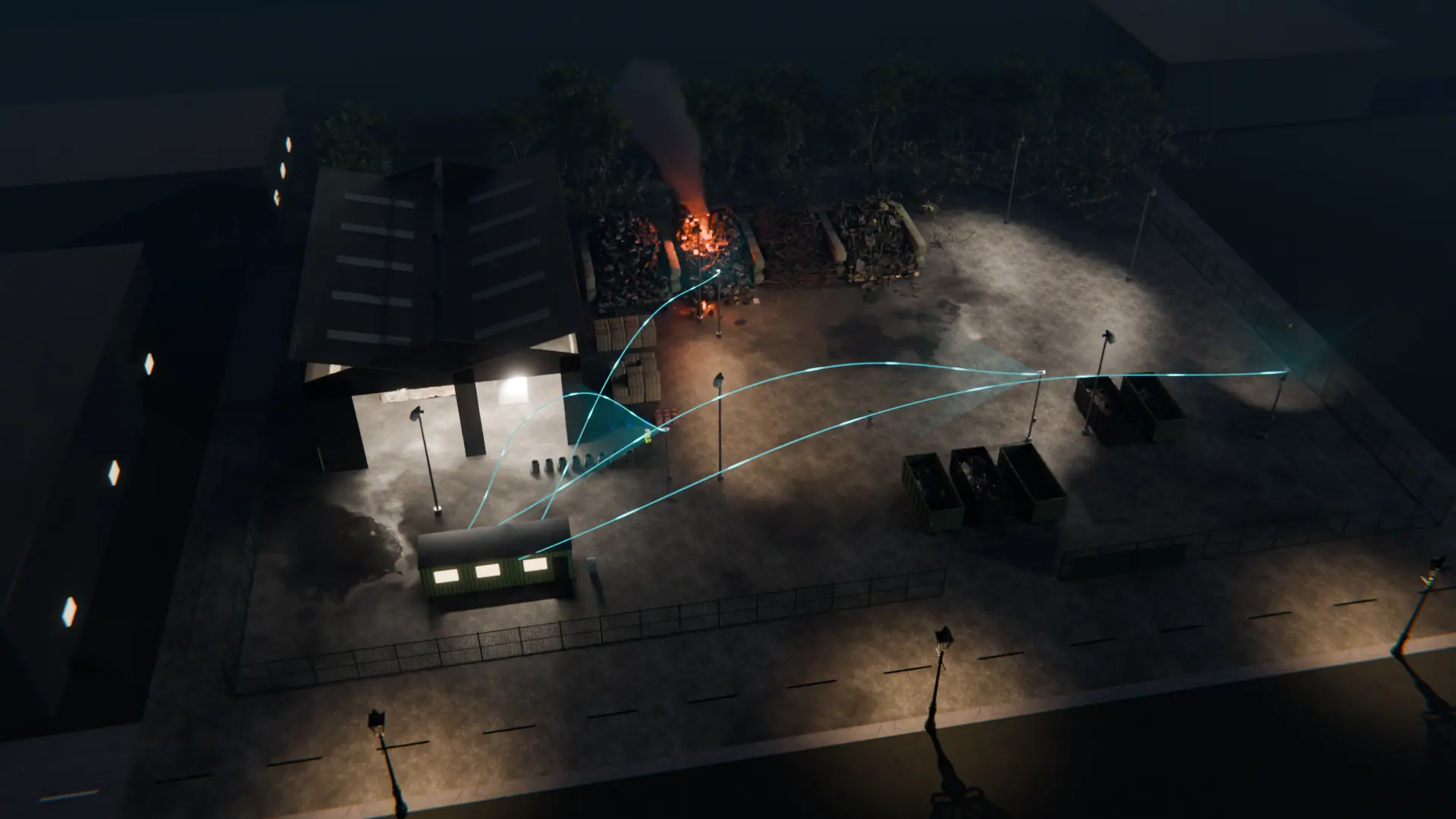
A free site assessment reviews your existing cameras, what each one can see and where smoke, fire and intrusion detection would sit alongside the systems you already rely on. Support is available 24/7. Alerts to a monitoring centre (ARC) and phone-call alerts are available as optional paid add-ons.
Illustrative 3D render