

Hidden batteries
Crushed or punctured cells in vapes and small electricals are a growing cause of fires in the recycling stream.
Woodcock AI turns the CCTV your recycling plant already has into early fire detection. It watches the tipping hall, picking lines, conveyors, baler and bale store for the first visible smoke and flame, day and night, and sends an alert with the clip by app and email. It works alongside your fire alarm, detection and suppression, not instead of them.
Fire and rescue services in England attended 256 industrial waste fires in 2025, and 195 of them were at recycling properties. Every figure below links to its source, and our waste fire facts page breaks them down by year and cause.
The most common recorded main cause in 2025 was overheating of unknown cause, for 65 of the 256 fires. That is what a recycling plant fire often looks like at the start: something heating up out of sight, in a heap, a bale or a pile of fines, with nobody watching. The fires that grow into the long, costly incidents are usually the ones found late.
A materials recovery facility takes in a mixed stream of paper, card, plastics, cans and glass, and it cannot see everything inside every load. Most of it is harmless. A small number of items are not, and the machines that sort and compress the stream give them every chance to start a fire.
Lithium-ion batteries in mixed recyclables. Batteries hidden in disposable vapes, toys, phones, toothbrushes and other small electricals end up in kerbside recycling in large numbers. When one is crushed in a collection vehicle, punctured on a picking line or squeezed in a baler, it can short circuit, heat up and catch fire, sometimes minutes later and sometimes hours later. The Environmental Services Association has called for urgent reform on battery fires, and the NFCC has reported more than 1,200 battery fires in bin lorries and waste sites across the UK in a year. Read more on our lithium-ion battery fires page.
Friction and heat in the machinery. Conveyors, shredders, screens, trommels and balers all run with moving parts, motors and bearings. Material jams at transfer points, wraps round rollers and builds up as dust and fines. A hot bearing or a spark from metal in the stream can be enough to light dry paper and plastic film.
Stored material holding heat. Heaps on the tipping floor, piles of residues and fines, and bales of card or plastic hold heat well. A fire can start inside them and grow slowly before any smoke shows on the surface.
After-hours smouldering. Many plant fires are found when the site is quiet: after the last shift, overnight or at a weekend. A heap left on the tipping floor or a line of fresh bales can smoulder for hours with nobody there to see it.
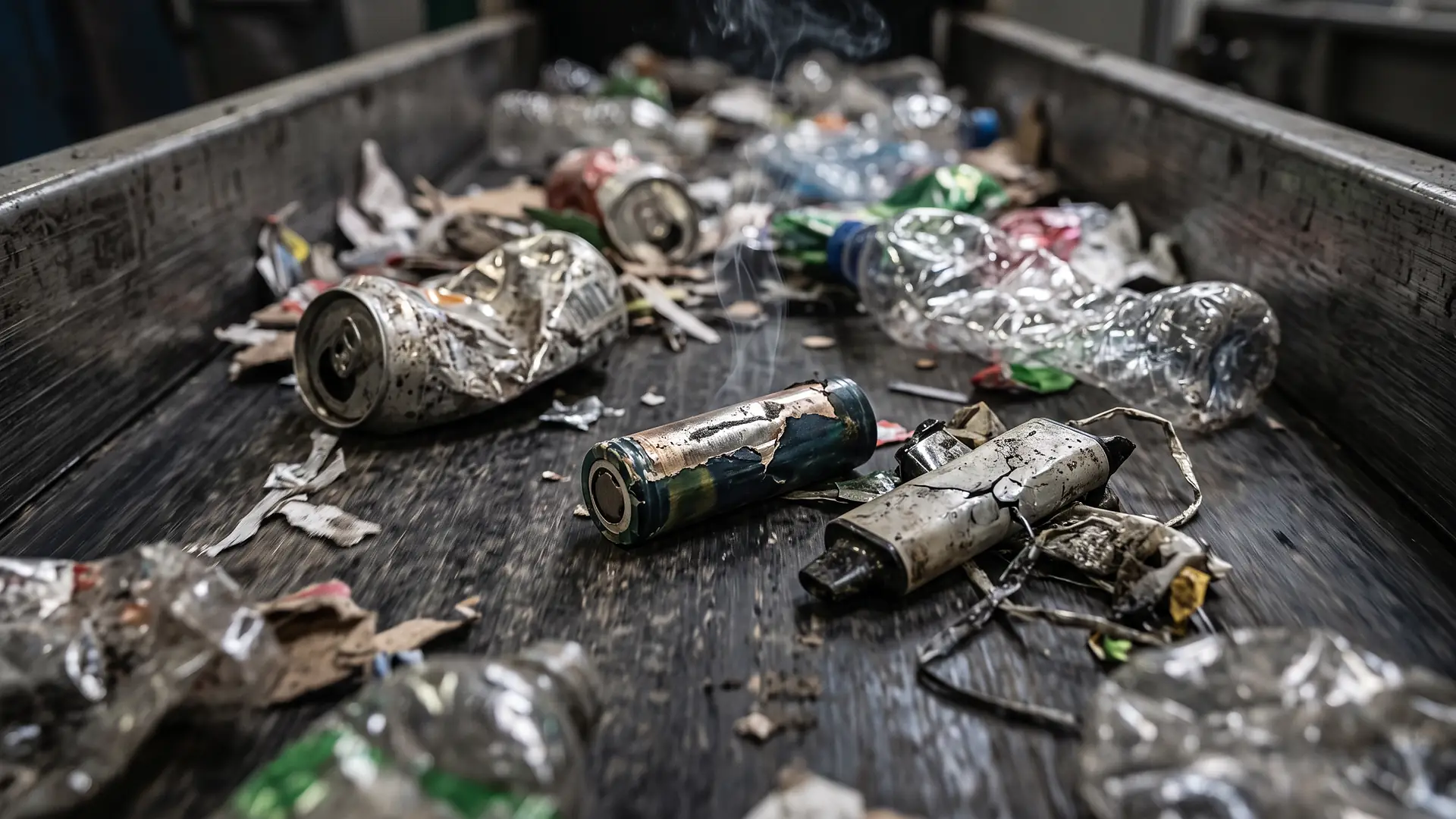
Crushed or punctured cells in vapes and small electricals are a growing cause of fires in the recycling stream.
Jams, dust, fines and hot bearings at conveyors, shredders and screens can light dry material.
Stored material holds heat, so fires can grow inside before smoke reaches the surface.
Select an area on the plan, or use the buttons, to see the fire risk there, what a camera needs to see, and where the detection zone goes. The dashed outlines show where zones would be drawn.
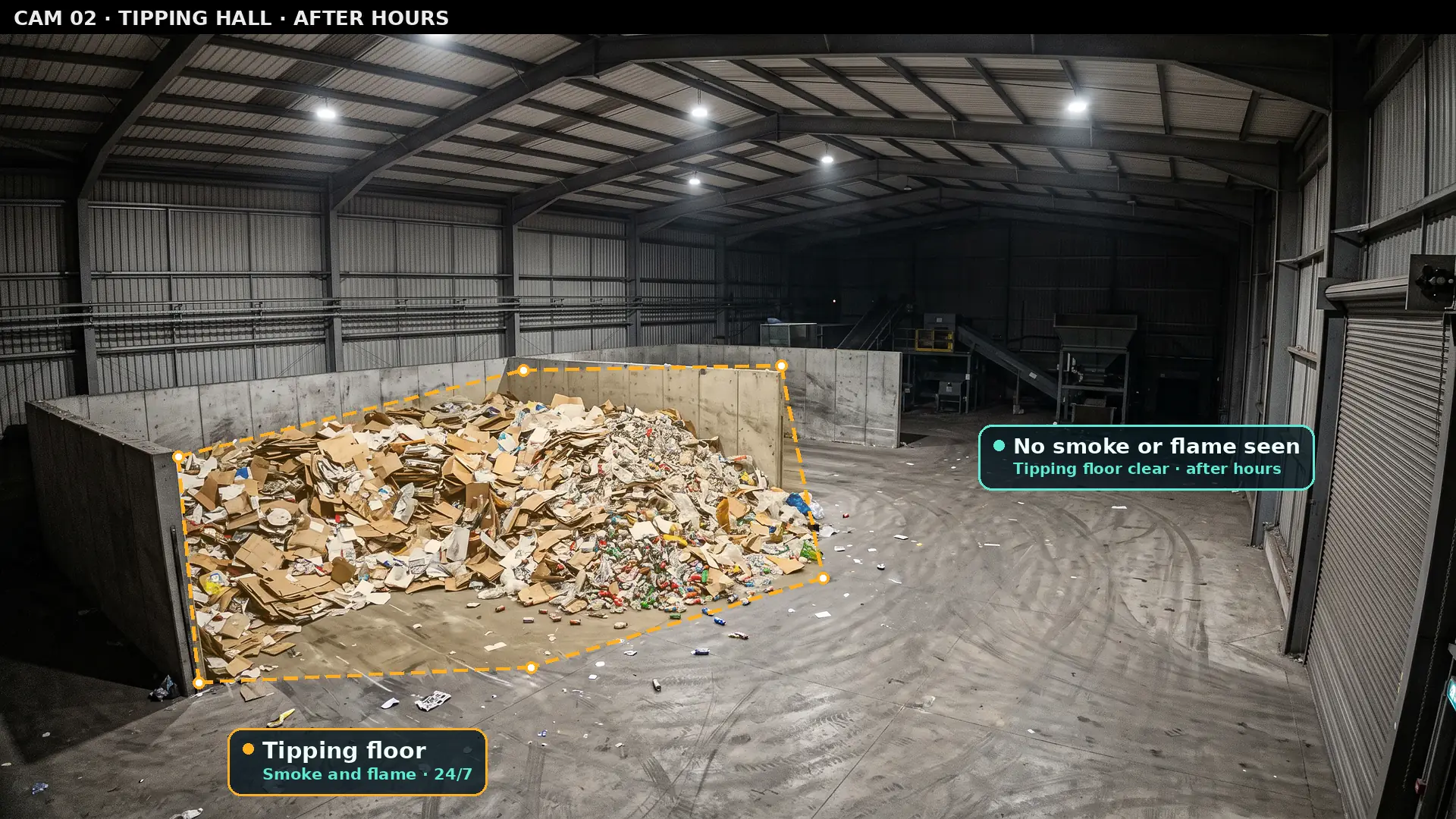
The risk: Incoming loads are tipped in a heap before anyone has seen what is in them. This is where a hidden lithium-ion battery, a gas canister or a hot load is most likely to come out into the open, and where a heap left at the end of the day can start to smoulder overnight.
What the camera should see: A high camera that sees the whole tipping floor and the faces of the heap, with a polygon zone drawn along the push walls.
The risk: Pickers pull out large items and contaminants, but small batteries in vapes, toys and phones are easy to miss. Material is moving, tumbling and catching on itself, so any smoke can be dragged along the line.
What the camera should see: A camera along the line, angled so the belt is not hidden by guarding, with a zone along the belt edges.
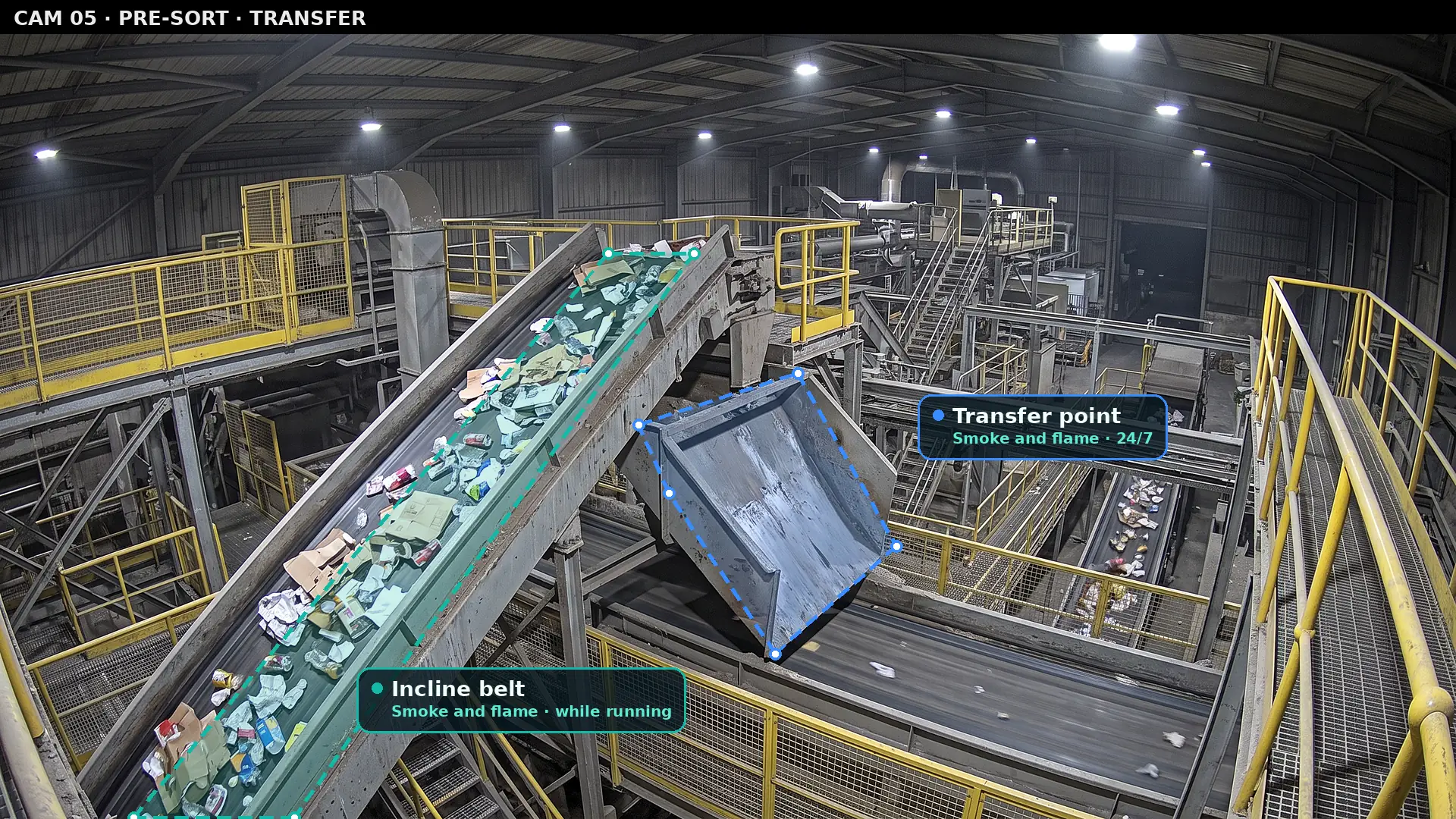
The risk: Where one belt drops onto another, material falls, jams and rubs. A battery crushed at a transfer chute, or a bearing running hot, can start a small fire that travels with the belt.
What the camera should see: A camera on each key transfer point and incline, with a zone round the chute and a second along the belt.
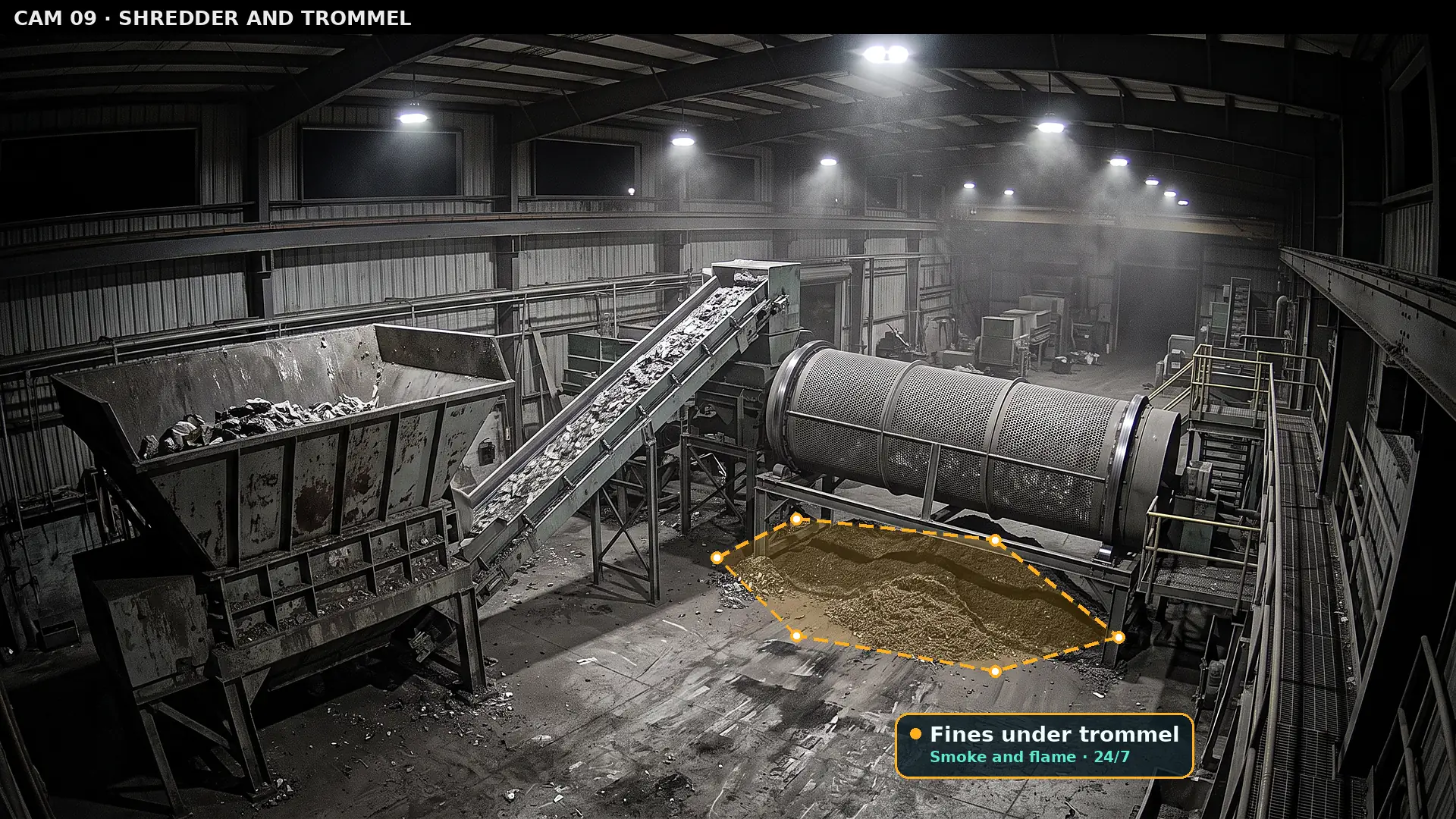
The risk: Shredding and screening break items open and release heat and fine material. Fines build up under screens and trommels, and dust and residues can catch light from a spark.
What the camera should see: A view of the shredder hopper and the floor under the trommel, with a zone round the fines pile.
The risk: Material is compressed hard, so a battery inside can be punctured in the baler. Fresh bales can smoulder after they leave the chamber, often once the shift has gone home.
What the camera should see: A camera on the baler hopper and the line of fresh bales, with a zone on each and a schedule that runs after hours.
The risk: Bales wait in walled bays, indoors or out, before they leave site. Packed material holds heat, so a fire can grow slowly inside a stack before smoke shows.
What the camera should see: A camera that sees every bay face, with one polygon per bay drawn along the tops of the bay walls.
The risk: Rejected loads, damaged batteries in quarantine, plant and vehicles sit outside overnight. The perimeter also needs watching for intruders once the gates shut.
What the camera should see: Cameras on the quarantine area and stored material, plus intrusion zones on the gate and fence with their own schedules.
The tipping hall is the first place a problem item comes out into the open, and the last place anyone looks at night. A heap left at the end of the shift is exactly where a battery or a hot load can start to smoulder.
A camera high on the wall that sees the whole tipping floor and the faces of the heap gives the best chance of seeing smoke early. In Woodcock AI you draw a polygon detection zone round the tipping floor, following the line of the push walls and the edge of the floor, so detection stays on the waste rather than the roller shutters, the roof lights or vehicles at the door. Polygons follow the real shape of an area, which a simple box drawn over a camera view cannot.
The zone can run around the clock, or you can give that camera a schedule so it alerts the out-of-hours team only once the hall has closed, when an alert matters most. During the day, the same view helps the team check a load that looked wrong as it was tipped. Environment Agency guidance also expects waste acceptance checks to spot hot loads and incompatible wastes such as lithium batteries, with a quarantine area where needed.
Once material is moving, a fire can move with it. Smoke that starts at a transfer chute can be carried along a belt, into a screen or up an incline into the building.
Transfer points are where belts drop onto each other, so they are where material falls, jams and rubs, and where a battery can be crushed. They are also where a camera gets the clearest view of the stream. Draw one zone along the edges of the incline belt and a second round the chute, and the AI watches both for visible smoke and flame. Because the zones are polygons, they can follow a belt running diagonally across the frame without taking in the walkways and guarding beside it.
A belt that only runs during the day can have a zone that is armed only while it runs, while the chute and the floor below it stay watched around the clock. Each camera has its own schedule, so the rules match the way your plant works. On a busy line the AI also has to cope with dust, moving machinery and changing light; that is why it learns each camera's normal view, as explained below.
Shredding and screening break items open, and they leave fines, dust and residues on the floor and under the machines. That material is easy to light and easy to overlook.
A shredder can split a battery or a gas canister that slipped through pre-sort, and the heat and sparks of the process add to the risk. Under a trommel or a screen, fines build up through the day. A single camera that sees the shredder hopper and the floor under the trommel covers both. A zone drawn round the fines pile keeps detection on that material, and ignores the drum turning above it.
Fines and residues are also where housekeeping matters most. Our hot works fire risk guide covers the extra care needed when maintenance crews cut or weld near these areas, and the fire watch that should follow.
A baler compresses material hard, so it is one of the most likely places for a battery to be punctured. The fire may not start in the chamber. It can start in a fresh bale an hour later, after the shift has gone.
A camera on the baler hopper and the line of fresh bales covers the two places that matter. Give each its own zone: the hopper while the baler runs, and the fresh bales after the shift finishes, when nobody is around to notice a wisp of smoke.
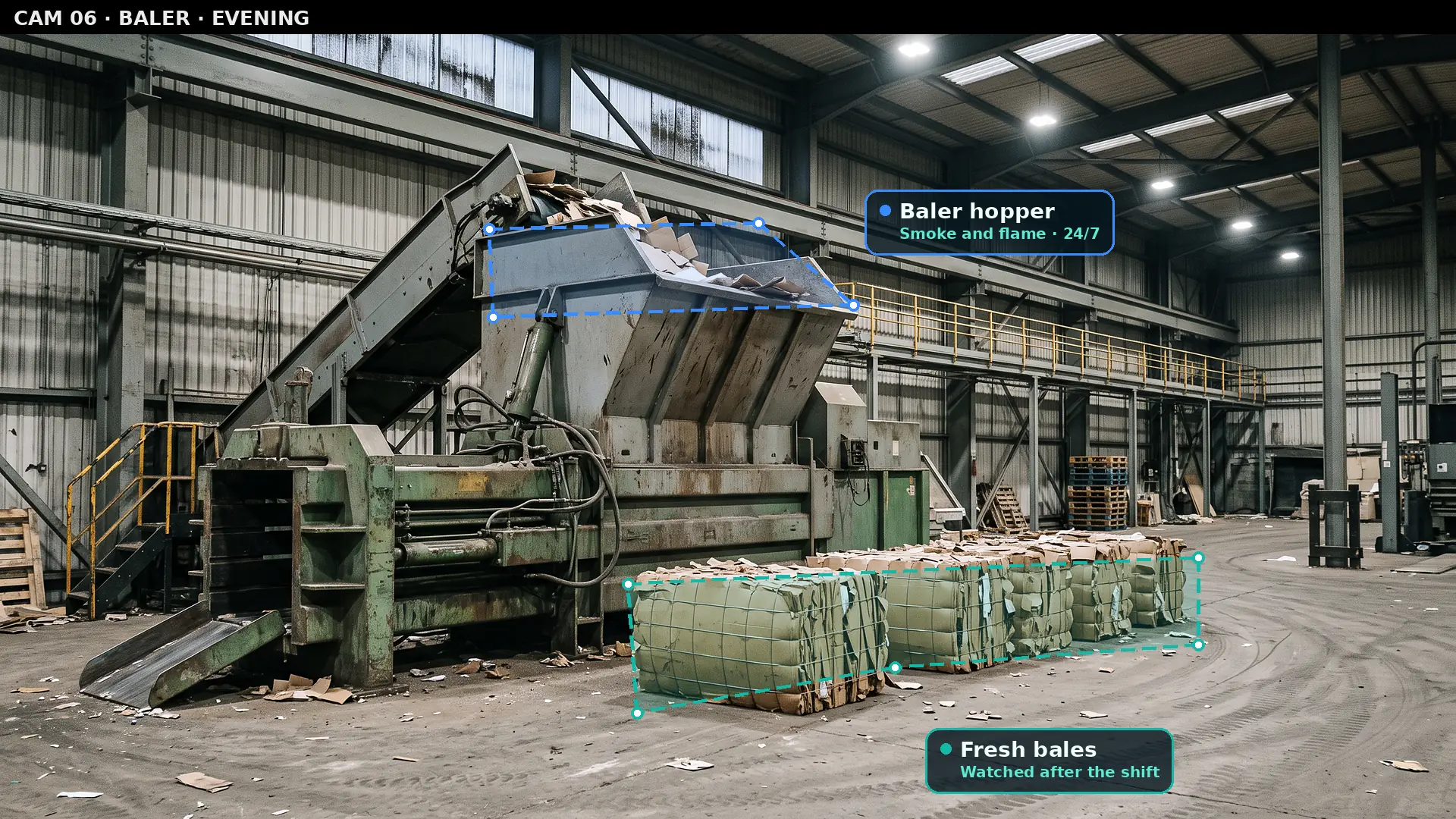
Bale stores are where a plant keeps the most material in one place. Bales hold heat, and a fire in one bay can spread to the next. Environment Agency guidance sets out how waste should be stored, including separation between piles and the site boundary, and asks for a quarantine area.
For a walled bale store, draw one polygon per bay along the tops of the bay walls, and label each one: card, mixed or plastics. When the AI sees smoke in a bay, the alert names the bay, so the person who receives it knows exactly where to go. Indoors or out, the zones can run around the clock, with floodlights, rain and reflections on wet concrete learnt as normal for that camera.
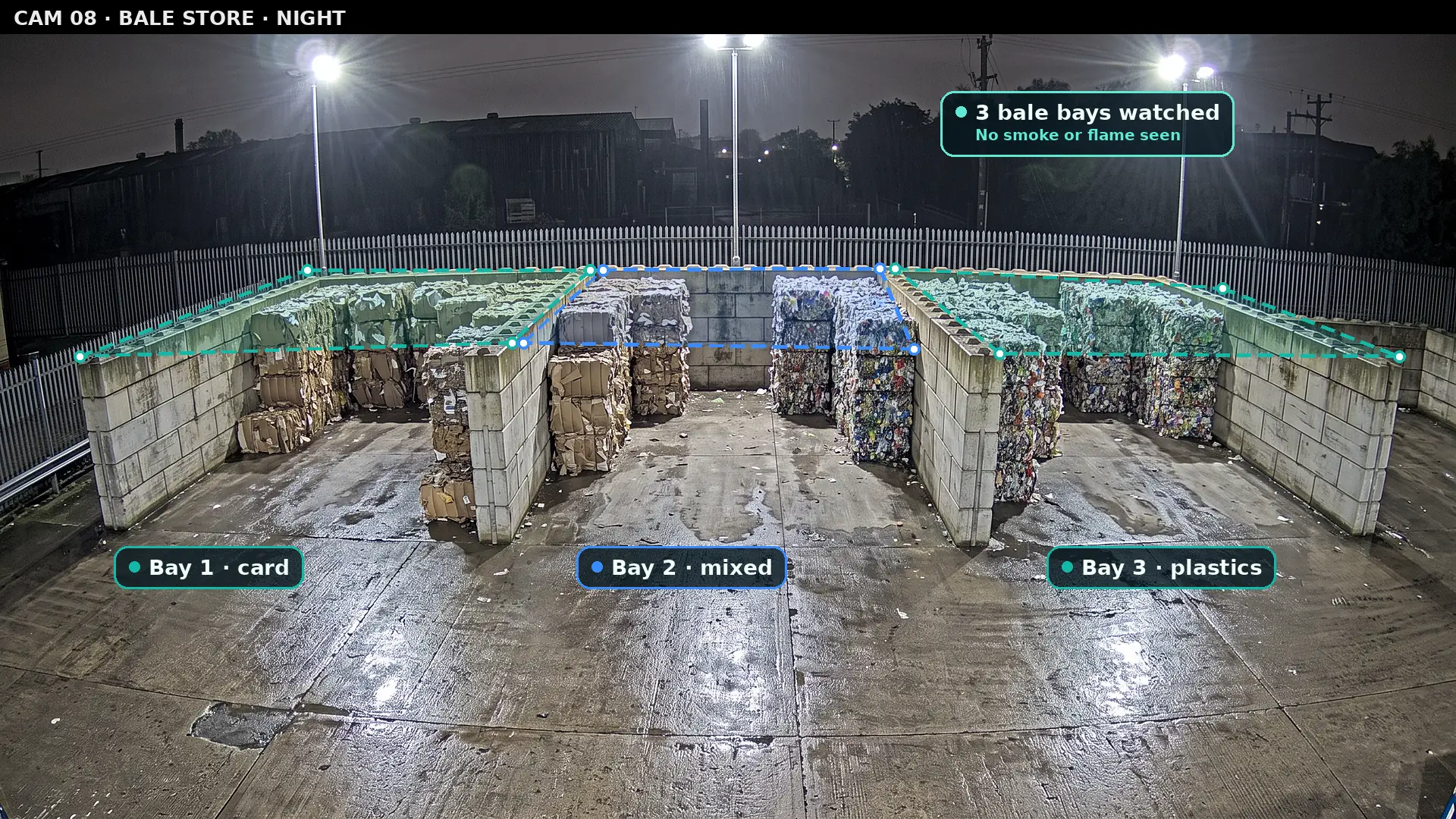
When the AI sees smoke or flame in a zone, the alert goes straight to the people you choose for that camera and time, with the clip and a short plain-English description of what the camera saw.
Alerts go out by the Woodcock AI app, as a push notification with the clip, and by email. Alerts to a monitoring centre (ARC) and phone-call alerts are available as optional add-ons. The clip is what makes the alert useful at three in the morning: the person on call can see straight away whether it is smoke from a bale or steam from a vent, and call the fire service, send someone to look or stand down. Every event is saved, so you can review what happened afterwards.
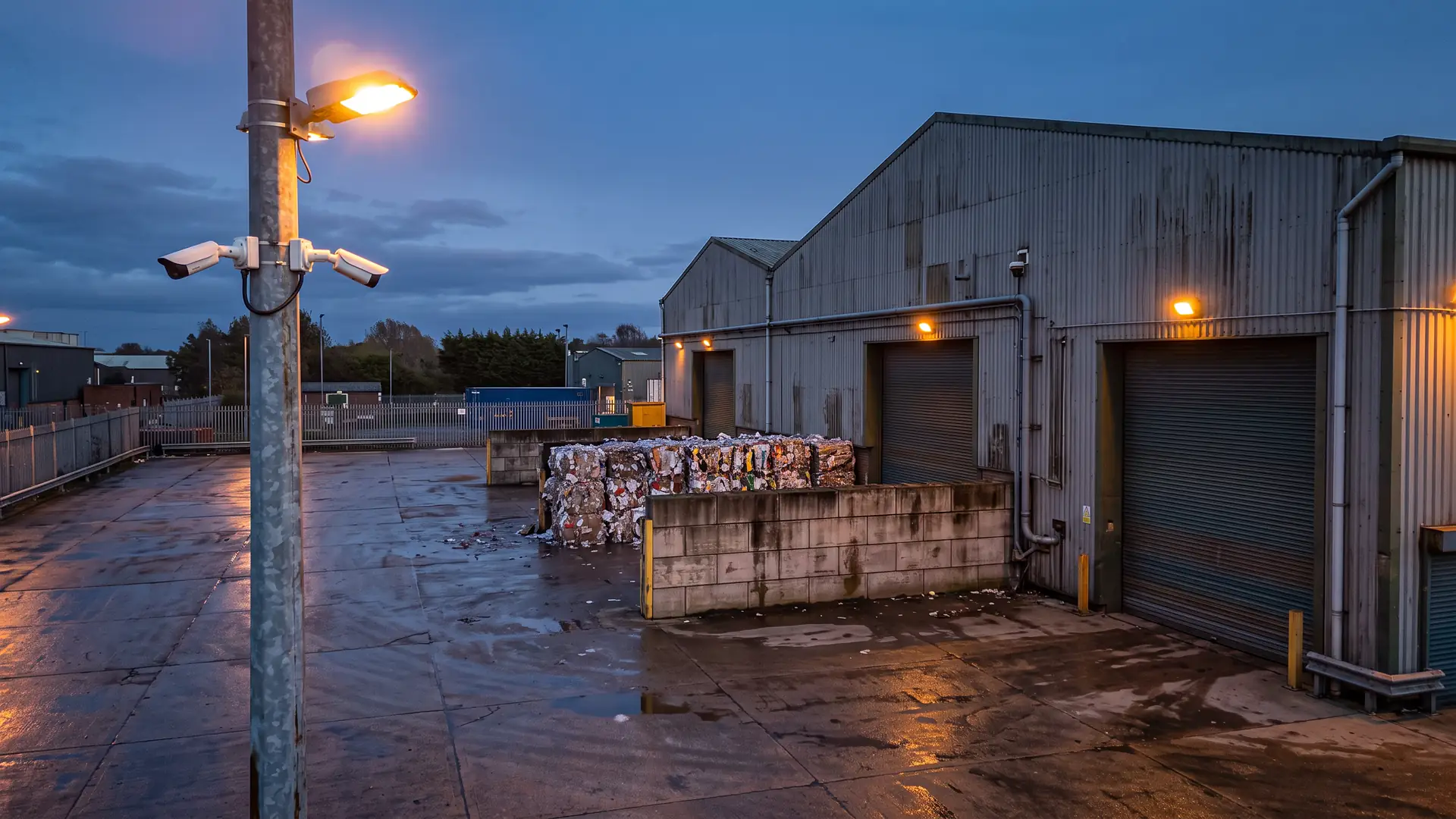
A recycling plant is a hard place for a generic smoke model. Dust lifts when a load is tipped, steam rises from wet material and vents, lights change with every shift and machines move all day. Each of those can look like smoke to software that has never seen your plant.
Woodcock AI does not ship one generic model to every customer. Each camera gets a model fitted closely to its own scene. It is trained on hours of footage from your cameras in which nothing went wrong, so it learns what a normal tipping floor, belt or bale bay looks like there. It is sharpened with synthesised smoke and with controlled smoke tests on site, and then it keeps improving: every detection has a feedback button, and that feedback goes into retraining for your site. Read how this works on our self-learning AI page.
You can also ask your cameras what happened in plain English. Ask whether smoke was seen near the baler last night, or what happened on the tipping floor after the last shift, and download the clip that answers the question. Zones are drawn as polygon detection zones, so detection follows the real shape of a belt, a bay or a heap.
No single system covers every risk in a recycling plant. Video AI on existing cameras is one layer: it watches wide areas for visible smoke and flame and gets the clip to the right person, especially out of hours.
Heat that builds deep inside a bale or a pile is not visible to an ordinary camera until smoke reaches the surface. For that, thermal cameras and temperature monitoring help. Our comparison of video AI, thermal and on-camera analytics and our guide to thermal vs AI CCTV for fire prevention plans explain where each fits.
Many permitted recycling and waste sites in England that store combustible waste need a fire prevention plan under Environment Agency guidance. The plan aims for any fire to be put out within four hours, and covers how waste is stored, how fires are detected and how they are suppressed.
On detection, the guidance asks you to show how the detection system will raise the alarm if a fire is detected both during working hours and when the site is closed. It lists CCTV visual flame detection among the automated systems that may be appropriate, alongside smoke and heat detectors and spark, infrared and ultraviolet detection. It also expects automated systems to be covered by a third-party certification scheme or to meet a recognised standard, or for you to show you can still meet the plan's objectives. How camera detection is described in your plan is for you to agree with the Environment Agency; Woodcock AI is there to give you early visual warning across the areas your cameras see.
The guidance also covers batteries: damaged lithium batteries must be quarantined away from buildings and other combustible material. Since 21 May 2026, the Environment Agency's appropriate measures for permitted waste battery facilities have applied to sites that store or treat waste batteries. Work through each section with our fire prevention plan checklist.
Insurers look closely at waste and recycling sites because fires there are frequent and hard to put out. The WISH forum's guidance on reducing fire risk at waste management sites notes that the standards insurers require are increasing. A survey will usually ask how a fire would be found and who would hear about it when the plant is closed. Our guide to what insurers expect from fire detection explains what to prepare. Talk to your insurer or broker before you change anything.
Most plants already have cameras on the tipping hall, the lines and the yard. Adding AI to them is usually a matter of connecting, zoning and choosing who is alerted.
We look at your camera views, recorder and layout, and agree which areas matter most: tipping hall, lines, transfer points, baler, bale store and yard.
Woodcock AI connects to your existing IP cameras or recorder over ONVIF or RTSP, through an on-site edge server or the cloud.
Polygon detection zones are drawn on each camera, along a belt, round a chute or over each bale bay, so detection stays on what matters.
Each camera gets its own schedule. Zones can run around the clock, or only when the plant is closed.
Pick who gets each alert by app and email, with the clip. Add a monitoring centre or phone-call alerts if nobody is on call.
The AI is fitted to each camera, and the feedback button on every detection goes into retraining, so it keeps learning what is normal at your plant.
Need more cameras, or a new system for a new hall or bale store? We offer design, supply and install, from site survey and design through supply, installation and commissioning to go-live and ongoing support. If you already work with a CCTV installer, they can add Woodcock AI to the cameras they look after through our installer programme. Read how it works for the technical detail.
Tick what is already true on your site. Your answers are saved in this browser only.
Anything unticked is worth raising in a free site assessment. For lens, lighting and night-view fixes, see how to reduce CCTV false alarms, and for wider out-of-hours cover see the out-of-hours site security checklist.
Short answers on fire detection, false alarms and alerts. More in the Woodcock AI FAQ.
Yes, where a camera can see the area. Woodcock AI watches the cameras a recycling plant or MRF already has for the first visible smoke and flame, in the tipping hall, along conveyors, round the baler and across the bale store, and sends an alert with the clip so someone can check it and act.
No. It adds early visual warning on the cameras you already have, alongside your fire alarm, detection and suppression. Your fire risk assessment, your fire prevention plan and your insurer decide which systems you must have; camera detection is an extra layer, not a substitute.
Usually not. It works with most IP cameras and recorders over ONVIF or RTSP. The free site assessment checks each view, and if a key area such as a transfer point or bale bay is not covered, we can design, supply and install the extra cameras.
Not until smoke or flame is visible. Heat buried inside a bale or a fines pile cannot be seen by an ordinary camera, which is where thermal cameras and temperature monitoring help. Video detection watches for the first visible smoke on the surface. See video AI vs thermal.
The AI is built for each site. Each camera gets a model fitted to its own scene, trained on hours of footage where nothing happened so it learns what normal dust, steam, lighting and moving machinery look like there. Polygon zones keep detection on the areas that matter, and the feedback button on every detection goes into retraining for your site.
Yes. Draw polygon detection zones round the tipping floor, along a conveyor, over each bale bay or round the fines under a trommel, and give each camera its own schedule, so a zone can be watched around the clock or only once the shift has finished.
By the Woodcock AI app, as a push notification with the clip, and by email, to the people you choose for each camera and time. Alerts to a monitoring centre (ARC) and phone-call alerts are available as optional add-ons.
Yes. Every alert comes with a plain-English description, and you can ask your cameras questions in everyday language, such as whether smoke was seen near the baler last night, then download the clip that answers it.
It can support the detection part of it. Environment Agency guidance asks permitted sites to show how a fire will be detected and the alarm raised both during working hours and when the site is closed, and it lists CCTV visual flame detection among the automated systems that may be appropriate. How camera detection is described in your plan is for you to agree with the Environment Agency.
Yes. Installers and security companies can add Woodcock AI to the cameras they already look after, through the installer programme. If you would rather we handle everything, we offer design, supply and install.
We only quote figures we can trace to a public source. Published 25 October 2026 by Woodcock AI.
A free site assessment reviews your cameras on the tipping hall, lines, baler, bale store and yard, and confirms what is supported before anything is set up.
Get a free assessment for your site