

Remote and dark
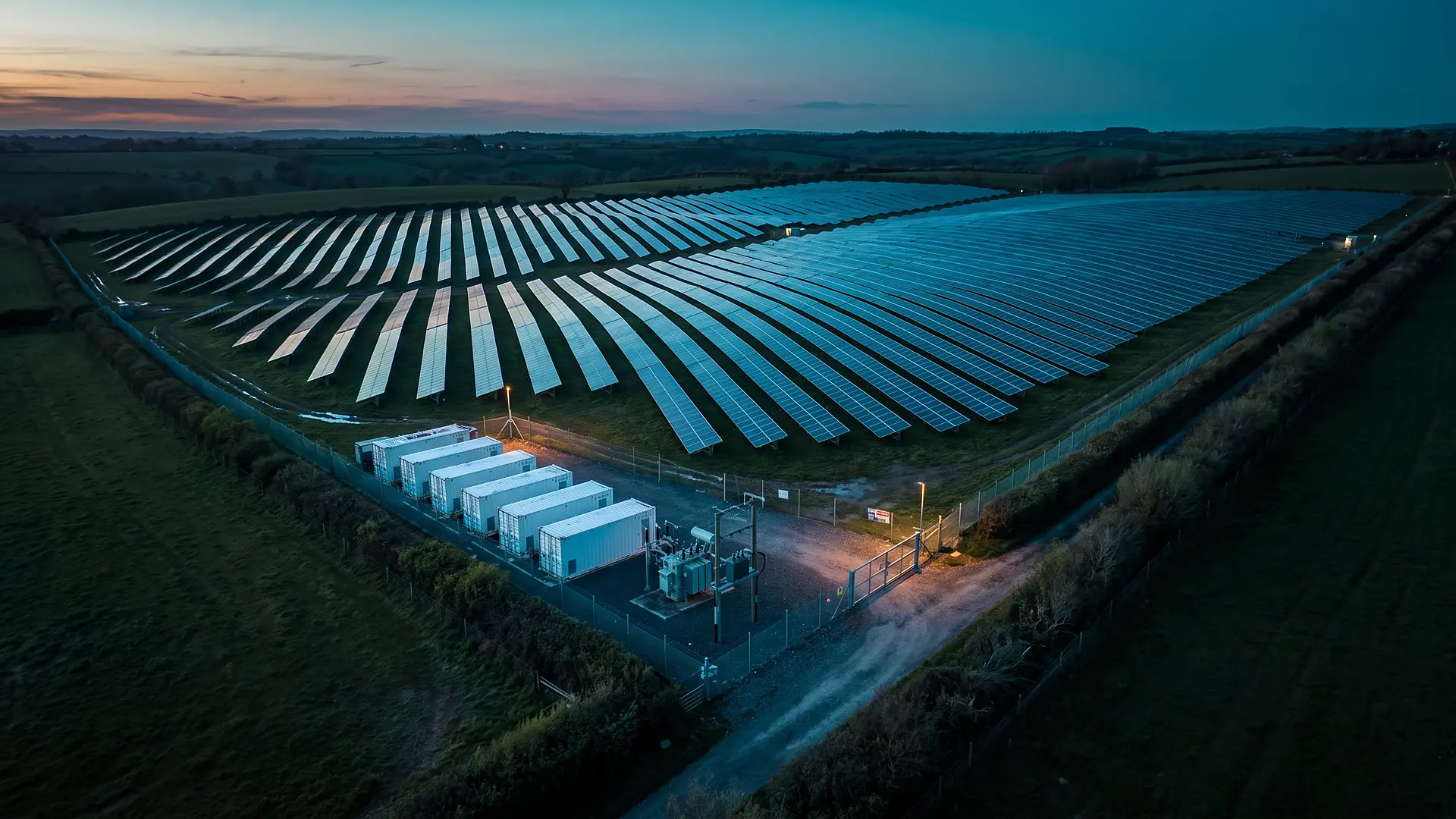
Long boundaries out of sight of roads and buildings give intruders time and cover.
Woodcock AI adds AI to the CCTV your solar farm or battery storage site already has. It watches fence lines, access tracks, gates and compounds for people and vehicles out of hours, and watches battery containers for the first visible smoke and flame. Every alert goes to the people you choose by app and email, with the clip, so they can see what is happening and act.
Renewable energy sites hold large amounts of copper cable, spread across remote fields that nobody watches at night. Crime intelligence shared with UK police forces shows organised groups targeting them more often, and coming back to the same sites. Every figure below links to its source.
DeterTech, which has a data sharing agreement with all 43 police forces in England and Wales, reported a 59 per cent year-on-year increase in offences against solar, onshore wind and battery storage facilities, with 169 offences in 2025. In Energy Global it describes the threat as a planned, organised one rather than opportunistic: groups working across several sites in one campaign, often in clusters a short distance apart, and targeting grid connection points, cabling routes and access infrastructure. The value of copper has risen by around 25 per cent since late 2025, which makes cable an even more attractive target.
Individual thefts can be large. Wiltshire Police warned that around 30km of cabling, worth around a hundred thousand pounds, was stolen from a solar farm near Trowbridge, and said they believed thefts like it were linked to organised crime groups (Wiltshire Times). The cost does not end with the cable: strings and inverters taken offline stop generating until the damage is repaired.
Sites that have been hit once are likely to be hit again. In a 2025 media alert, DeterTech warned that vulnerable sites that do not get an immediate and visible security upgrade are highly likely to be targeted again, and described one location suffering three break-ins in a month. The same alert described thieves in Derbyshire luring mobile patrols to a nearby location in a co-ordinated distraction, then stealing string cable from the site the patrols had been guarding.
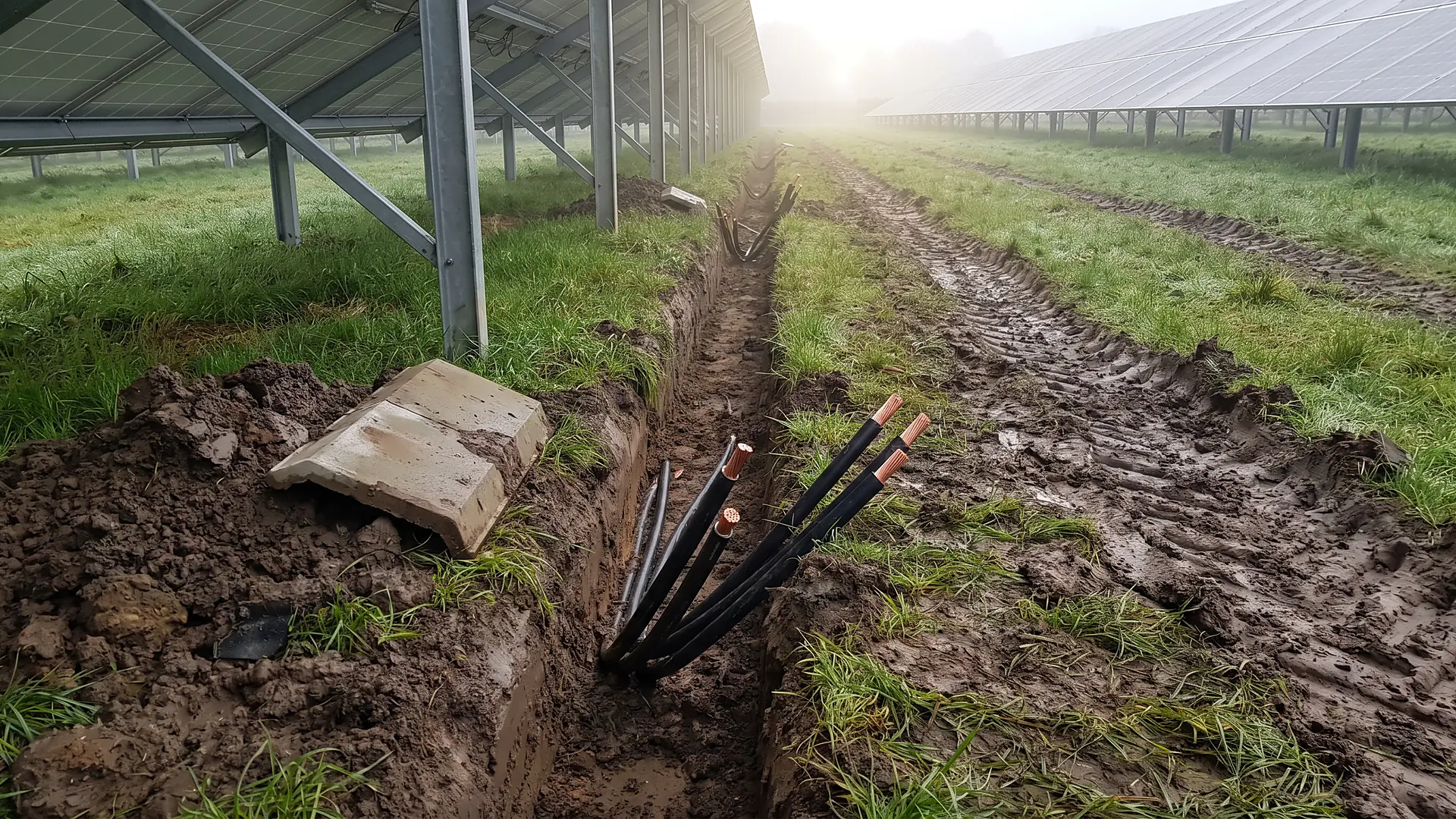
The way the cable is taken matters too. A DeterTech analyst told Solar Power Portal that string cable is the most common target, and that thieves pull the strings out row by row. With a hundred or more panels in a row, a gang can collect a large amount of cable quickly, and every row it strips stops generating.
Organised groups are targeting grid connection points, cabling routes and access infrastructure, where disruption is both easier and more valuable.Summary of DeterTech crime intelligence, Energy Global, June 2026
All of this points to the same gap. A solar farm is large, remote and dark, so a gang can be on site for a long time before anyone knows. Patrols can be drawn away, and a site that relies on someone noticing the damage the next morning has already lost the cable. The cameras a site already has can close that gap, if something is watching them at two in the morning.
Long boundaries out of sight of roads and buildings give intruders time and cover.
Planned campaigns, return visits and distractions aimed at patrols.
Battery storage containers add a fire risk to the theft risk.
Select an area on the plan, or use the buttons, to see the risk there, what a camera needs to see and where the detection zone goes. The dashed outlines show where zones would be drawn.
The risk: Solar farms often have kilometres of boundary, much of it far from the road and out of sight of any building. Fences are cut or lifted where hedges and ditches give cover, and a damaged section is often the first sign that a site is being looked at.
What the camera should see: Cameras along the fence line, each with a polygon zone that follows the fence posts and stops at the boundary, so the field beyond does not trigger alerts.
The risk: Cable is heavy. Taking it away needs a vehicle, and most vehicles use the access tracks and field gates. A van or pickup on a track at two in the morning is one of the clearest signs that something is wrong.
What the camera should see: A camera on each gate and the first stretch of track, with vehicle detection after hours and a line-crossing rule across the entrance.
The risk: String cable runs under every row of panels. Once inside, thieves can cut and pull it out row by row, which takes generation offline as well as costing the cable itself.
What the camera should see: Views down the main corridors between rows, zoned to the ground between the frames, with a schedule that runs out of hours.
The risk: Inverters, transformers and their cabling carry valuable copper and are essential to generation. Damage here can take a whole section of the site off line.
What the camera should see: A camera on each station or compound, with a zone across the compound gate and the fence around it.
The risk: The point of connection is where the most valuable cable comes together, and where a theft or a fire does the most damage to the whole site.
What the camera should see: A view of the compound fence, gate and surrounding ground, with intrusion zones armed out of hours and smoke and flame watched around the clock.
The risk: Battery energy storage systems (BESS) add a second risk to the theft risk: a fault inside a lithium-ion battery container can lead to smoke and fire.
What the camera should see: Cameras that see every container face and roof, with a smoke and flame zone over the containers and an intrusion zone on the compound fence and gate.
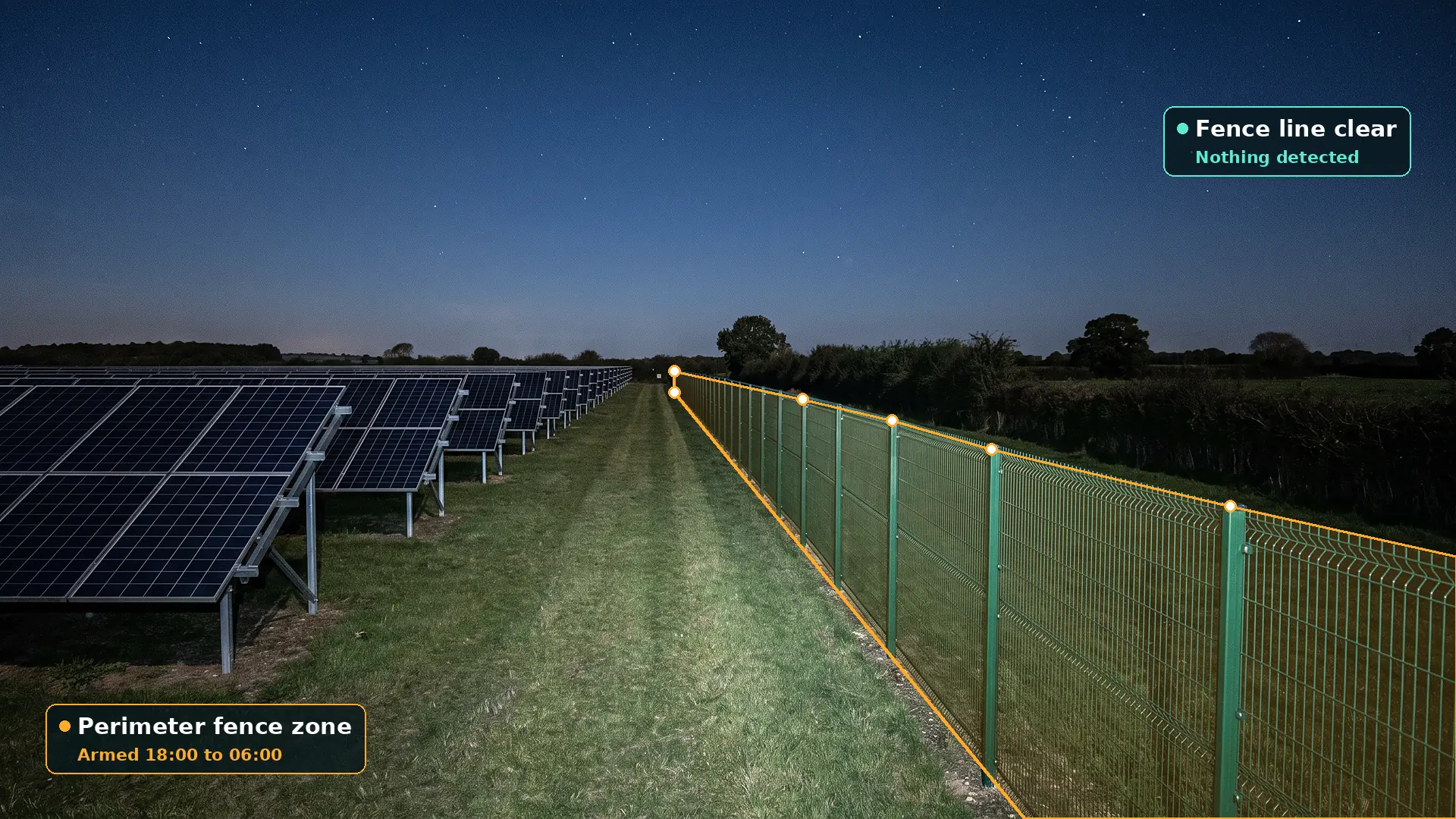
Most solar farm boundaries run for long distances beside fields, hedges and lanes. A camera that looks along the fence sees a long stretch of it, but it also sees the field next door, the road and the trees. The detection zone has to follow the fence itself.
In Woodcock AI you draw polygon detection zones on each camera view, point by point. On a fence line, the zone runs along the tops of the fence posts and down to the base of the fence, and stops at the boundary. A person climbing the fence or a section being lifted is inside the zone; a hare in the next field, a car on the lane or a tractor working the neighbouring farm is not. A simple box drawn over the view cannot follow a fence that runs diagonally away from the camera, which is why polygons matter so much on long boundaries.
Each zone can have its own schedule, so the fence line is armed once the O&M team has left and stays armed until the morning. During the day, when contractors and landowners are about, the same camera can stay quiet or watch only the most sensitive stretch. This is intrusion detection fitted to the shape of the site rather than to the shape of the camera view.
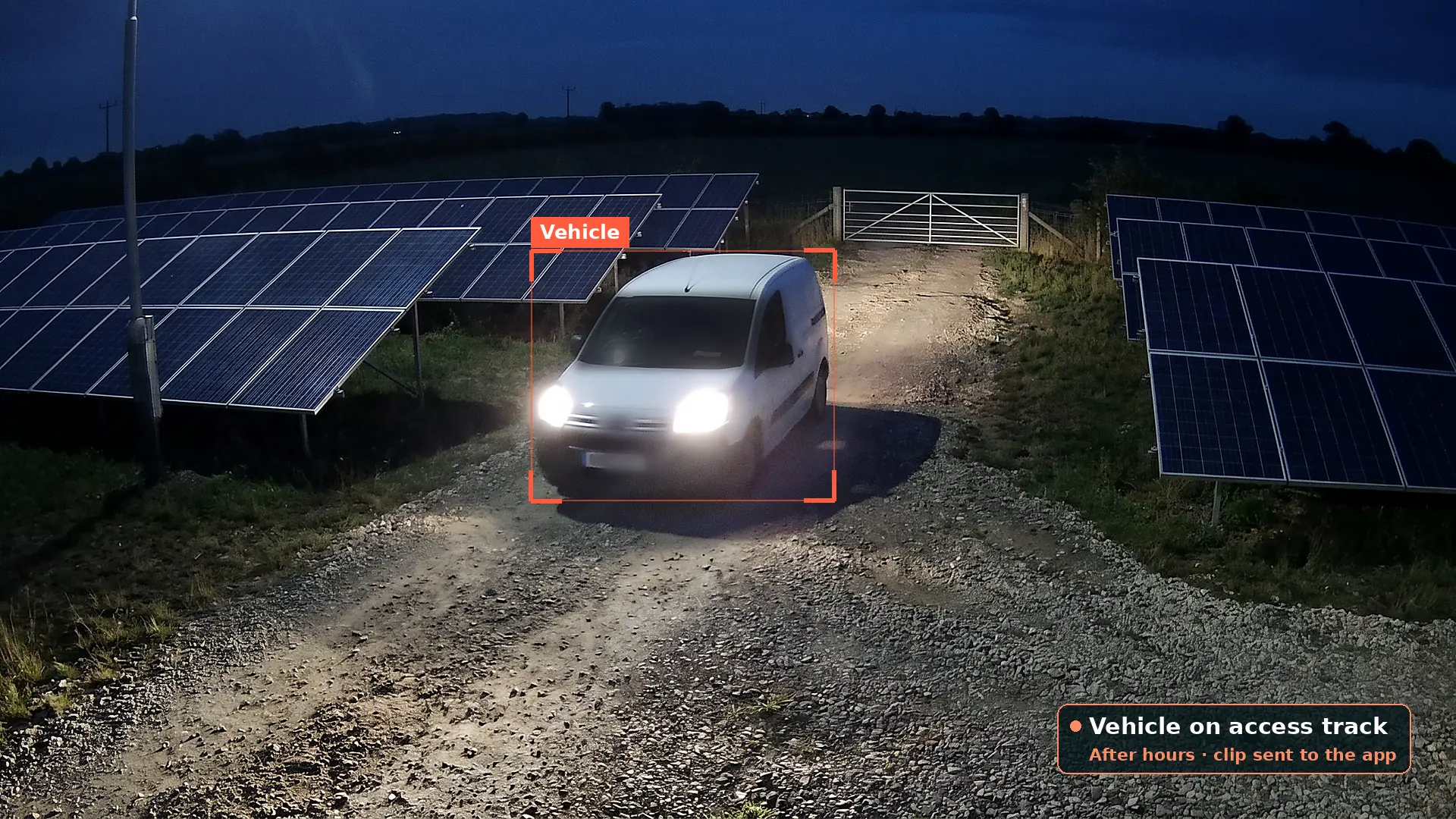
Cable is heavy and bulky, so a theft almost always involves a vehicle. Vans, pickups and trailers use the same access tracks and gates as the maintenance team, which makes those tracks one of the best places to catch a theft early.
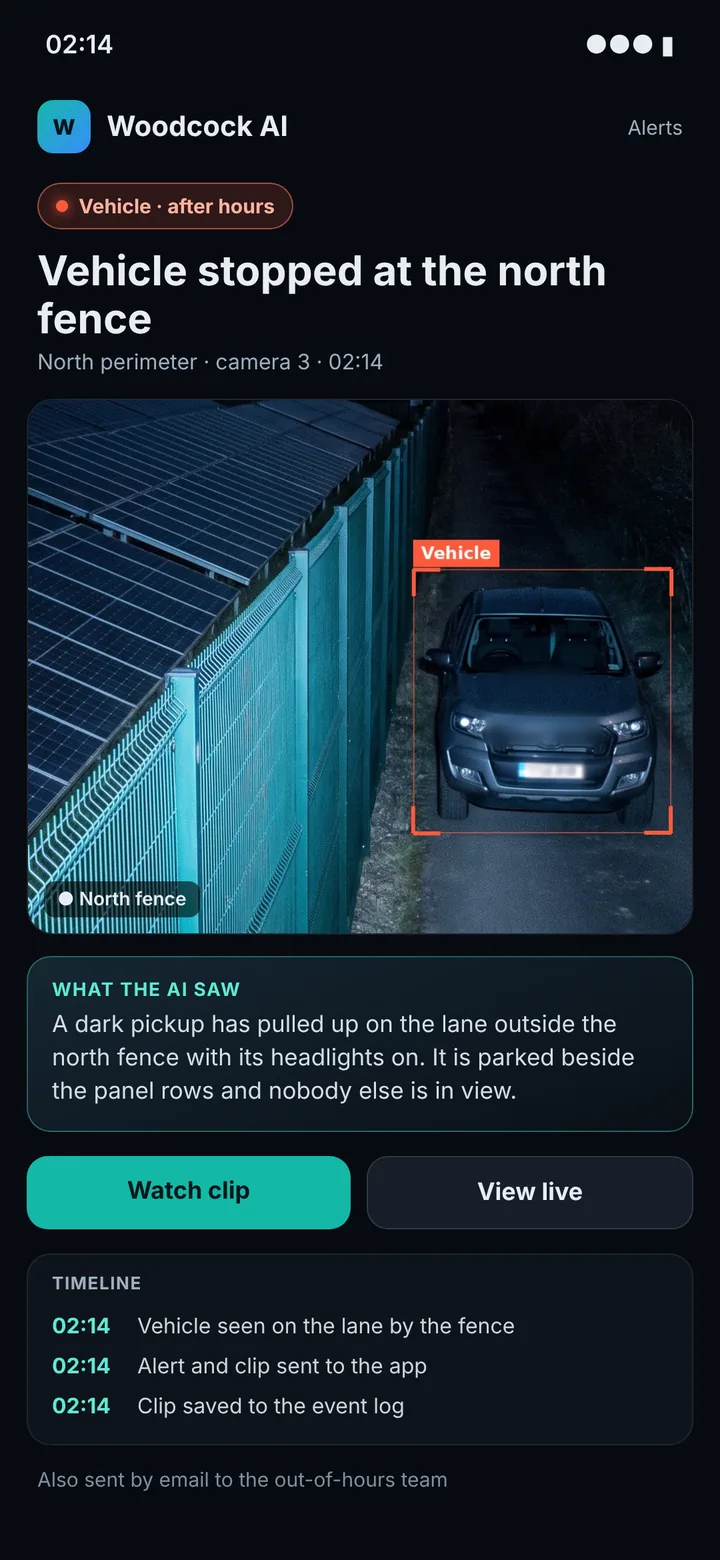
A camera on the main gate and the first stretch of the access track can be set to look for vehicles out of hours. Vehicle detection sends an alert as soon as a van or pickup appears on the track when nobody should be there, with the clip, so the person on call can see whether it is a contractor who arrived early or a vehicle with no reason to be on site. A line-crossing rule across the entrance adds a second check: a vehicle or person crossing the line into the site raises an alert, whichever way they came.
Vehicles parked on a lane outside the fence matter too. Gangs often case a site before a theft, or leave a vehicle close to the boundary while they work. A zone on the verge beside the fence, armed out of hours, can flag a vehicle that stops there in the middle of the night. Our metal theft prevention guide covers the wider pattern of cable and metal theft and how AI CCTV helps.
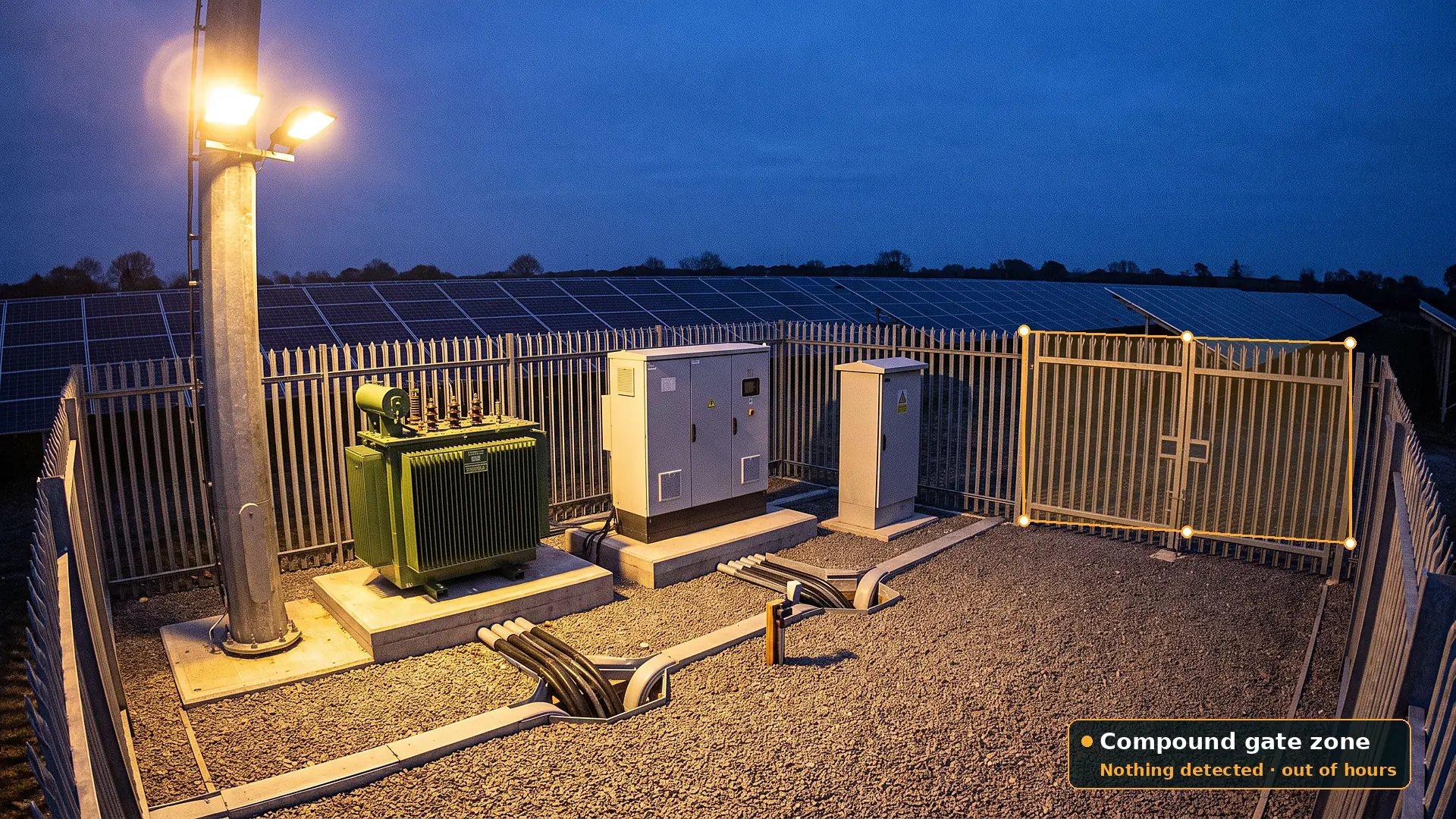
Inverter and transformer stations, and the substation at the point of connection, are where the most valuable equipment and cable on the site come together. Damage there takes whole sections of the site off line.
Most compounds sit inside their own palisade fence with a locked gate. A camera on the compound can have a zone across the gate and a second along the fence, so anyone opening the gate or climbing the fence out of hours raises an alert. Because zones are drawn as polygons, the zone on the gate can follow the gate itself, without taking in the floodlight, the kiosk or the panel rows behind it.
The same camera can watch for smoke and flame at the same time. Inverters and transformers are electrical equipment, and a fire in a compound is a serious event at any hour. Smoke and flame detection can run around the clock on that camera, while the intrusion zone on the gate runs only out of hours.
Battery energy storage systems add a second risk to a renewable site. A fault inside a lithium-ion battery can lead to overheating, smoke and fire, and a battery storage compound is often unstaffed and remote.
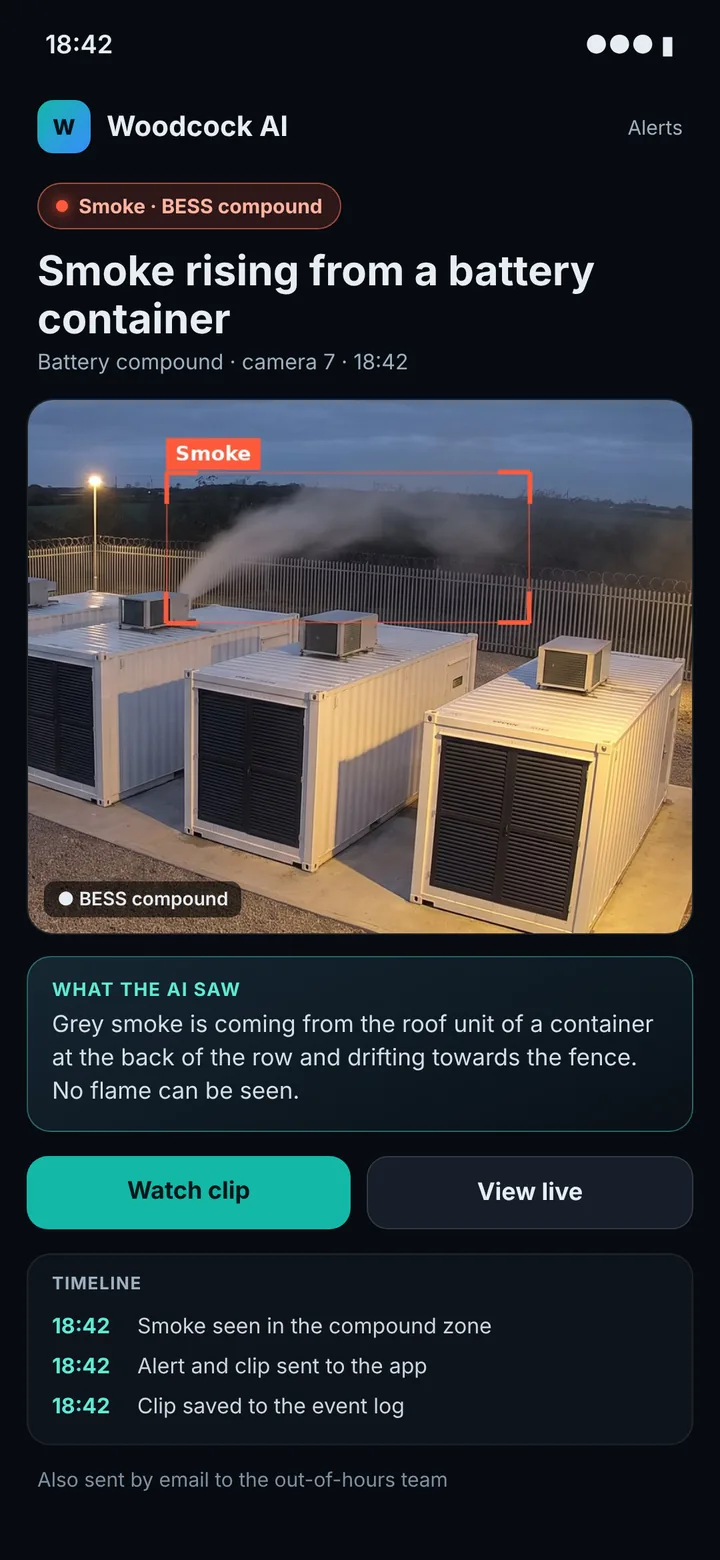
Woodcock AI watches the cameras that cover battery containers for the first visible smoke and flame, and sends an alert with the clip to the people you choose. The clip matters. The person on call can see straight away whether it is smoke from a container roof, mist drifting across the compound or dust kicked up by a vehicle, and decide whether to call the fire service, alert the battery operator or send someone to look. Every event is saved with its clip for the investigation that follows.
Camera detection is a complement to the fire safety built into the site, not a replacement. Battery containers have their own monitoring, detection and suppression, and the site will have its own fire strategy agreed with the fire and rescue service. Video AI adds a view from outside: it covers the whole compound, the gaps between containers and the ground around them, and it can see smoke that drifts away from a container before it reaches a sensor. We cover the wider risk of lithium-ion fires on our lithium-ion battery fires page.
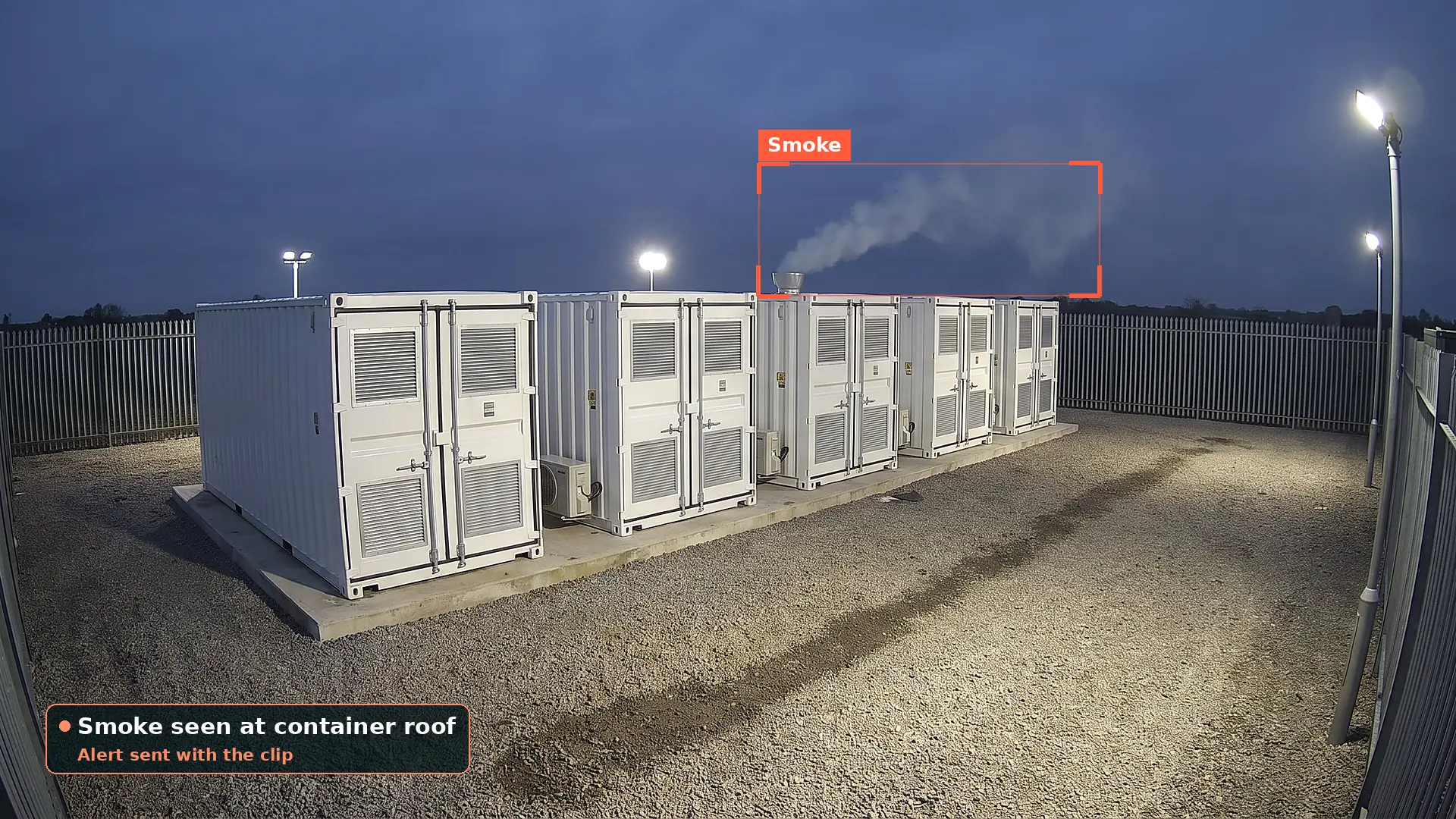
For the best view, cameras should see every container face and the roofs, with working lighting or infrared at night. The free site assessment checks which of your existing views already do this and where a camera would need to move or be added. For more on how smoke is detected on ordinary CCTV, see our video smoke detection guide, and for wind, rain and night views outdoors, our outdoor fire detection guide.
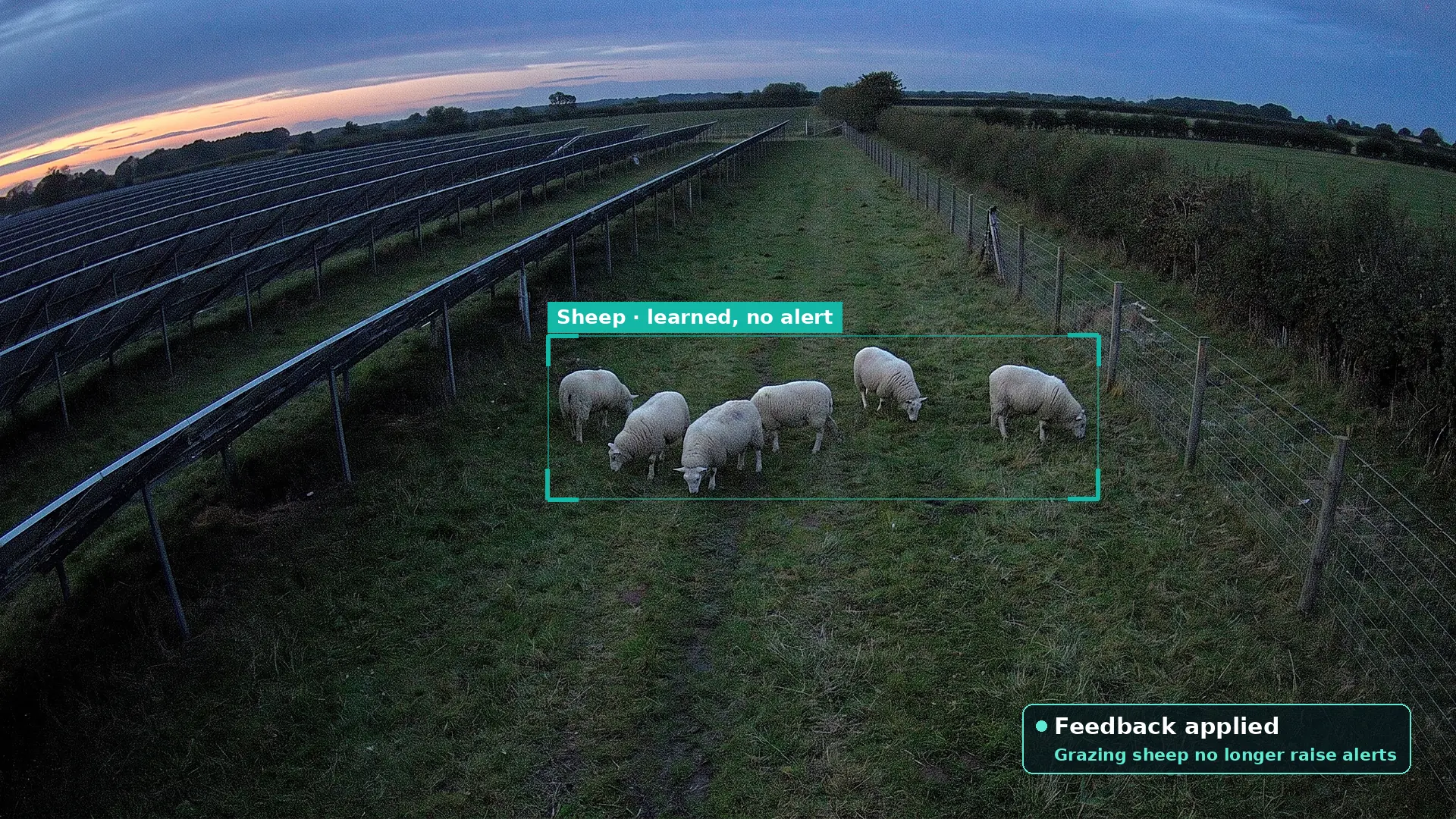
A solar farm is a hard place for a generic detection model. Sheep graze between the rows, deer and foxes cross at night, hedges move in the wind and headlights from a nearby road sweep across the fence. A model that alerts on all of that is soon ignored.
Woodcock AI is built for each site. Each camera gets a model fitted to its own scene, trained on hours of that camera's footage where nothing happened, so it learns what normal looks like there. Polygon zones keep detection on the areas that matter, and schedules keep the intrusion zones quiet when the O&M team is on site.
Every detection has a feedback button. If an alert was not useful, mark it and the feedback goes into retraining for that camera. Over time the AI gets better at telling a grazing flock from a person in the rows, or a deer at the fence from someone lifting it. Read more about self-learning AI, and for practical fixes to lenses, lighting and night views, see how to reduce CCTV false alarms.
After a theft, the first questions are always the same. When did they arrive, how did they get in, and what vehicle were they using? Scrolling through a night of footage from a dozen cameras to answer them takes hours.
With Woodcock AI you can ask your cameras questions in everyday language, and get back the clips that answer them. Every alert also comes with a short plain-English description of what the camera saw, so the record of the night reads like a log rather than a pile of recordings. Download the clips and hand them to the investigating officer, or to your insurer.
Example question and answer, to show how searching footage in plain English works.
Good evidence depends on good views. A camera that sees a vehicle's arrival at the gate, and the track it took, is far more useful than one that only sees the panel rows. The National Business Crime Centre's infrastructure crime responders guide notes that fingerprints and DNA on cut cable can help identify those responsible, which is one more reason to keep a scene untouched until the police have seen it.
An alert is only useful if it reaches someone who can act. Woodcock AI sends each alert to the people you choose for that camera and that time of day, with the clip and a plain-English description.
Alerts go out by the Woodcock AI app, as a push notification with the clip, and by email. Alerts to a monitoring centre (ARC) and phone-call alerts are available as optional add-ons. For a remote solar farm, the choice often depends on who is responsible out of hours: an asset manager, an O&M contractor, a security company or a monitoring centre. You can send fence and track alerts to one group and battery compound alerts to another, and change the rota as the season changes.
No single measure stops cable theft. The sites that fare best combine physical security, deterrence, detection and a clear response. Video AI on existing cameras is the detection layer that works across the whole site at night.
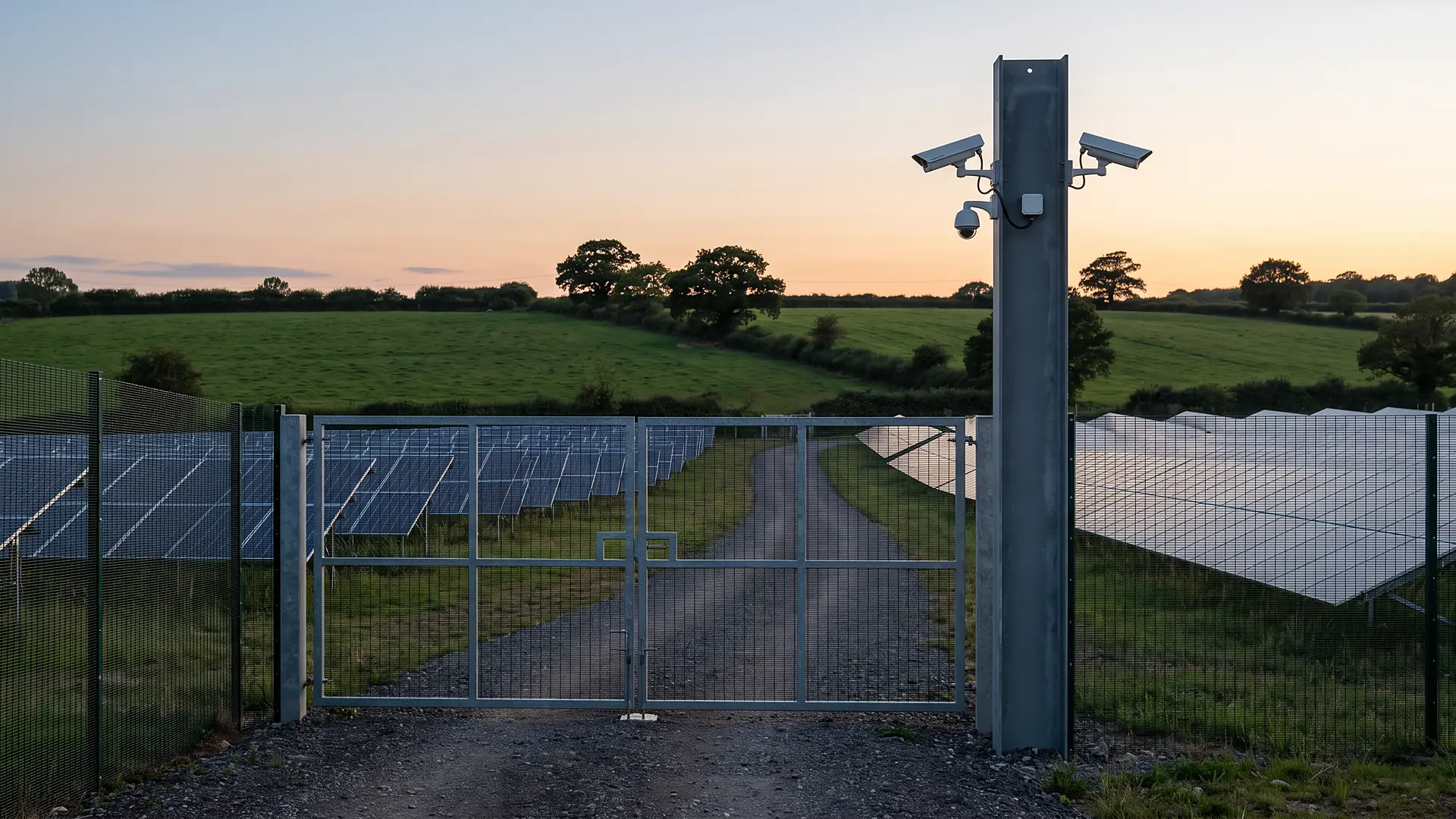
Most solar farms and battery storage sites already have CCTV on the entrance, the compounds and parts of the fence, often installed when the site was built. Adding AI to those cameras is usually a matter of connecting, zoning and choosing who is alerted.
Woodcock AI works on sites with a network connection to their cameras. How that connection is made differs from site to site, so the free site assessment looks at your recorder, your cameras and your connection before anything is set up, and tells you plainly what will and will not work.
We review your camera views, recorder and network connection, and agree which areas matter most: fence lines, gates, tracks, compounds and battery containers.
Woodcock AI connects to your existing IP cameras or recorder over ONVIF or RTSP, through an on-site edge server or the cloud.
Polygon zones are drawn on each camera, along a fence, across a gate or over the containers, with line-crossing rules where a track meets the boundary.
Each camera gets its own schedule. Intrusion zones can run out of hours, while smoke and flame on the battery compound are watched around the clock.
Pick who gets each alert by app and email, with the clip. Add a monitoring centre or phone-call alerts if nobody is on call.
The AI is fitted to each camera, and the feedback button on every detection goes into retraining, so it keeps learning what is normal on your site.
Need more cameras, or a new system for a new site? We offer design, supply and install, from site survey and design through supply, installation and commissioning to go-live and ongoing support. Read how it works for the technical detail.
Many solar farms and battery storage sites are looked after by an O&M contractor or a security installer who already maintains the cameras. Those companies can add Woodcock AI to the systems they look after.
Through the installer programme, partners connect their customers' cameras, draw the zones and set the schedules, then manage every site from one place. It turns cameras that only record into cameras that raise the alarm, without replacing the hardware. Our guide to adding AI to existing CCTV for installers explains how it works in practice, and the same approach applies on industrial sites and construction sites.
Tick what is already true on your site. Your answers are saved in this browser only. Several points follow the National Business Crime Centre's infrastructure crime responders guide, which advises investigating unlocked gates and out-of-hours work, and always reporting suspicious activity and crimes to the police.
If you find cut cable, the NBCC guide says secure the scene and do not touch it: it may still be live, and fingerprints and DNA on it can help identify those responsible. Anything unticked above is worth raising in a free site assessment. For wider out-of-hours cover, see the out-of-hours site security checklist.
Short answers on cable theft, battery fires, false alerts and evidence. More in the Woodcock AI FAQ.
It can watch the views your cameras already have and raise the alarm early. Woodcock AI watches the fence line, access tracks, gates and compounds for people and vehicles out of hours, and sends an alert with the clip by app and email, so someone can check it and act while the people responsible are still on site. It does not stop a determined gang on its own; it works best as part of layered security, with physical measures, forensic marking and a clear call-out plan.
Usually not. Woodcock AI works with most IP cameras and recorders over ONVIF or RTSP, on sites with a network connection to their cameras. The free site assessment checks each view, the recorder and the connection. If a key area such as a compound gate or an access track is not covered, we can design, supply and install extra cameras.
Yes, where a camera can see the containers. The AI watches for the first visible smoke and flame around battery storage containers and sends an alert with the clip. It complements the fire detection and suppression built into the battery system and the site; it does not replace them.
The AI is fitted to each camera and trained on footage of that scene where nothing happened, so it learns what normal looks like there: grazing sheep, swaying hedges, headlights on a nearby road. Polygon zones keep detection on the areas that matter, and the feedback button on every detection goes into retraining for your site.
Yes. Draw polygon zones along a fence, round an inverter or transformer station, across a compound gate or over the battery containers, and add line-crossing rules where a track meets the boundary. Each camera has its own schedule, so a zone can be watched around the clock or only out of hours.
By the Woodcock AI app, as a push notification with the clip, and by email, to the people you choose for each camera and time. Alerts to a monitoring centre (ARC) and phone-call alerts are available as optional add-ons.
Yes. Every alert is saved with its clip and a plain-English description. You can ask your cameras questions in everyday language, such as whether a vehicle used the access track after midnight, then download the clips that answer it and hand them to the investigating officer.
Yes. Installers, security companies and O&M contractors can add Woodcock AI to the cameras they already look after through the installer programme. If you would rather we handle everything, we offer design, supply and install.
We only quote figures we can trace to a public source. Published 26 October 2026 by Woodcock AI.
A free site assessment reviews the cameras on your fence lines, gates, tracks, compounds and battery containers, and confirms what is supported before anything is set up.