

Waste site fire risk assessment: a UK guide
A waste site fire risk assessment is the written assessment that fire safety law in England and Wales requires. The responsible person identifies fire hazards and people at risk, removes or reduces the risks, records the findings, plans and trains, then reviews it, covering hot loads, self-heating piles, plant and arson.
Last updated 28 October 2026
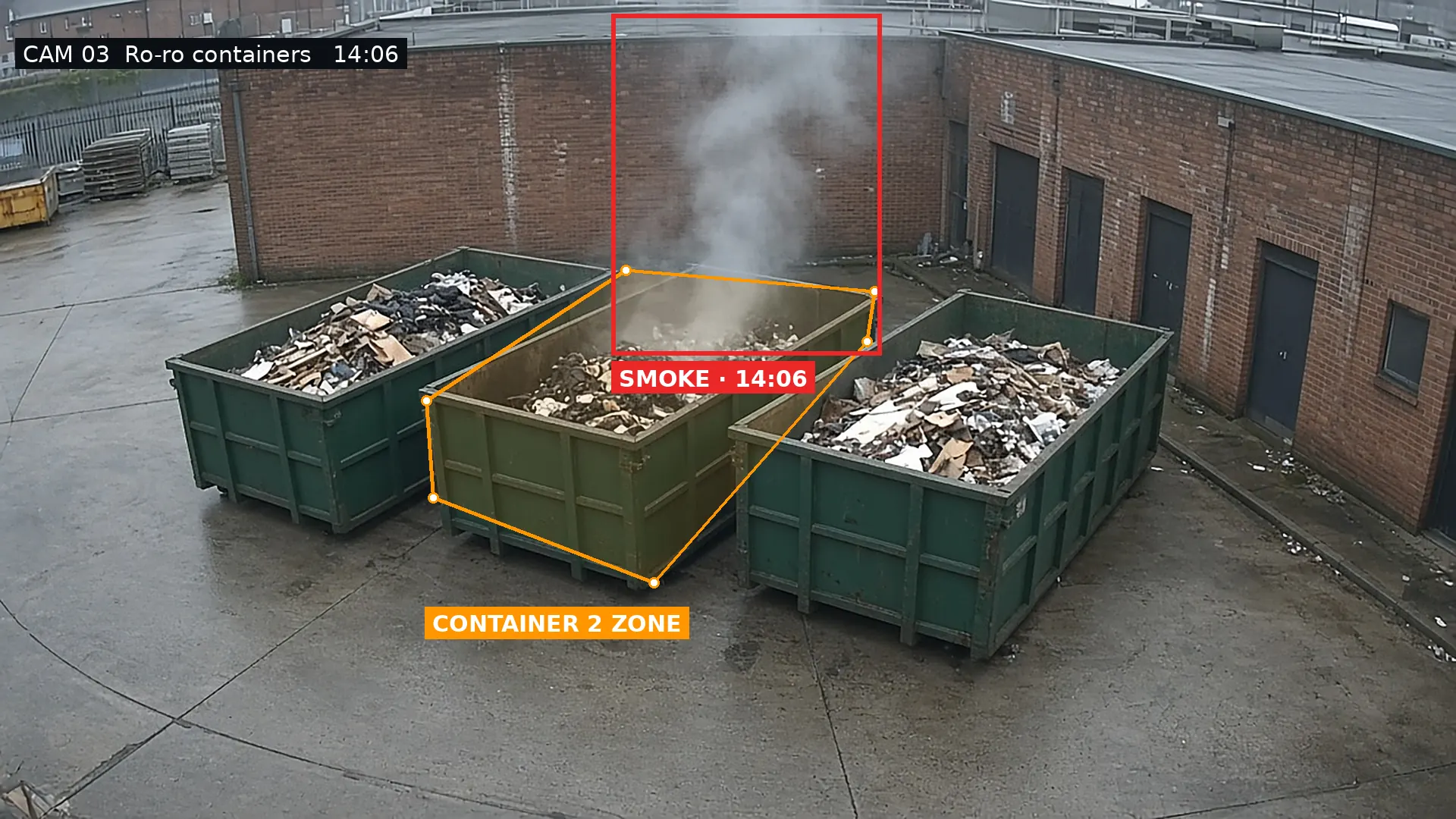 Smoke in a container zone
What is a fire risk assessment at a waste site?
It is a structured look at what could start a fire on your site, who could be harmed, and what you do about it, written down and kept up to date. The Regulatory Reform (Fire Safety) Order 2005 calls it a "suitable and sufficient assessment" of the risks to people.
Every workplace in England and Wales needs one, and a waste site is no exception. What makes a waste site different is the fuel. Most workplaces have a fire load you can count. A transfer station, a recycling plant or a wood yard takes in new fuel every day, from loads nobody has seen inside, and stores it in piles that can heat up on their own. WISH guidance, endorsed by HSE, puts it simply: what is the risk, how are you controlling it, and have you included it in your plan?
The assessment is your job, not the regulator's. WASTE 28 says that while you may seek advice, it is not the duty of a regulator to make sure your assessment is adequate. The GOV.UK guidance adds that your local fire and rescue authority can give advice but cannot carry out the assessment for you.
Who is the responsible person?
The responsible person is the employer, the owner, the landlord, the occupier, or anyone else with control of the premises, such as a facilities manager or risk assessor. On a waste site that often means more than one party: the operator, the landowner, and a contractor running a shredder or a workshop. Where there is more than one responsible person, the law says you must work together.
Their duties are to carry out a fire risk assessment and review it regularly, tell staff or their representatives about the risks, put in place and maintain appropriate fire safety measures, plan for an emergency, and provide information, instruction and training.
What are the five steps of a fire risk assessment?
GOV.UK sets out five steps: identify the fire hazards, identify the people at risk, evaluate and remove or reduce the risks, record your findings and prepare an emergency plan and training, then review and update the assessment regularly. Here is what each step means on a waste site.
Identify the fire hazards
Walk the site area by area and list what could burn and what could ignite it: hot or hazardous items in incoming waste, self-heating piles, friction and electrical faults in plant, hot exhausts, hot works, smoking and arson.
Identify the people at risk
List staff, drivers, visitors and contractors, people working alone or at night, anyone who may need help to escape, and neighbours and road users who could be affected by smoke.
Evaluate, remove or reduce the risks
Rate each hazard, then remove it or reduce it: waste acceptance checks, pile limits and separation, a quarantine area, maintenance, safe parking, hot works permits, security, and detection and warning in hours and out of hours.
Record, plan and train
Write down your findings and the action you have taken or will take, including any group especially at risk. Prepare an emergency plan and give staff information, instruction and training.
Review and update
Review the assessment regularly, and straight away after a significant change or if you suspect it is no longer valid, such as a new waste stream, new plant, a layout change or a fire.
For a larger site, the Home Office guide Fire safety risk assessment: factories and warehouses covers storage warehouses and goes into each step in detail. The shorter 5-step checklist is meant for the simplest premises, which a waste site rarely is.
What are the main fire hazards at a waste site?
Incoming waste is the biggest one. One large operator's analysis, published by WISH, found the most likely cause of fires and smoulders was hot or hazardous items in accepted waste, followed by self-heating in reception and storage. Friction, electrical faults, hot works and hot surfaces made up most of the rest.
WISH is careful about this data. It came from one company, covered more than 120 general waste recycling and recovery sites and over 300 reports of fires and smoulders across five years, and may not apply directly to your site. It is still the clearest picture published of where waste fires tend to start, and it lines up with what the assessment should look at first.
The 38 per cent group covers items like hot ashes, lithium-ion and vehicle batteries, gas cylinders, flammable liquids and aerosols. Self-heating, at 25 per cent, is a slow process inside a pile that may give no sign at the surface until smoke breaks out. WISH also warns that fires may smoulder undetected after the end of the shift, which is why it recommends a formal close-down procedure with an inspection after work stops.
Mobile plant deserves its own line. WISH gives the example of hot exhausts on loading shovels being cleared of dust and debris at the end of the shift, and advises parking machines away from waste stacks. Hot works are another: sparks from welding and grinding can smoulder for a long time after the job is done. Our hot works fire risk guide covers permits and fire watch.
How do you assess a waste site area by area?
Split the site into areas and, for each one, write down what could burn, what could ignite it, who could be harmed and what controls are in place. Tap an area on the plan, or use the buttons, to see what to look for and the controls you would typically record.
Reception and tipping
What to look for: Fuel: mixed loads nobody has seen inside. Ignition: hot ash, damaged batteries, gas cylinders and aerosols arriving in the waste. WISH puts hot or hazardous items in accepted waste as the most likely cause in one large operator's data.
Typical controls to record: Waste acceptance checks, a hot load procedure, a clear quarantine area, an end-of-shift fire watch, and a camera over the whole floor watched when the site is shut.
Storage piles and bays
What to look for: Fuel: piles of combustible waste, often stored for days. Ignition: self-heating inside the pile, which the same data puts as the second most likely cause, and fire spreading from a neighbouring pile.
Typical controls to record: Pile size and separation limits from your fire prevention plan, stock rotation, temperature checks, and early smoke detection on the surface of each pile.
Processing plant
What to look for: Fuel: dust, fines and waste caught in shredders, conveyors and balers. Ignition: friction, blunt blades, metal on metal and electrical faults.
Typical controls to record: Cleaning and maintenance schedules, any suppression or deluge your assessment calls for, a DSEAR assessment if combustible dust is present, and inspection after the plant stops.
Mobile plant parking
What to look for: Fuel: dust and debris built up on loading shovels and other machines. Ignition: hot exhausts and electrical faults after a long shift.
Typical controls to record: Clean down at the end of the shift, park machines away from stacks, check them before you leave, and keep the parking area in view out of hours.
Workshop and hot works
What to look for: Ignition: welding, cutting and grinding sparks that can smoulder unseen. Fuel: waste, rags and oils nearby.
Typical controls to record: A hot works permit, a fire watch during and after the job, and a camera on the area after the fire watch ends.
Yard and perimeter
What to look for: Ignition: arson by intruders, in or out of hours. People: neighbours and passers-by affected by smoke off site.
Typical controls to record: Fencing, intruder alarms and CCTV, a line-crossing or intrusion zone along the fence once the site closes, and a plan for smoke drifting off site.
Offices and welfare
What to look for: People: staff, drivers and visitors, some of whom may not know the site. Ignition: electrical equipment, heaters, smoking and charging points.
Typical controls to record: Escape routes, a fire alarm, extinguishers, a designated smoking area away from waste, and portable appliance testing.
Step 2 runs through every area too. WISH reminds operators to think about people both on and off site: neighbouring businesses, homes and roads can be affected by smoke from a waste fire long before flames reach a boundary. Add drivers, visitors and contractors who may not know your escape routes, anyone working alone or at night, and anyone who might need help to get out.
How do you rate and prioritise the risks?
A simple way is to judge how likely a fire is and how badly people would be harmed, then read the rating off a grid. The rating tells you how quickly to act. Pick a likelihood and a severity, or try one of the examples, and the grid shows the result.
| Likelihood | Slight harm | Serious harm | Major harm |
|---|---|---|---|
| Likely | Moderate | Substantial | Intolerable |
| Possible | Tolerable | Moderate | Substantial |
| Unlikely | Trivial | Tolerable | Moderate |
Moderate. Reduce it within a set time. Record who will do what and by when.
- Trivial: Keep it under review. No extra action needed beyond your normal checks.
- Tolerable: Keep existing controls working and check them. Improve if it costs little.
- Moderate: Reduce it within a set time. Record who will do what and by when.
- Substantial: Act urgently. Consider restricting the activity until the risk comes down.
- Intolerable: Stop the activity until the risk is reduced.
This five-level scale is one common approach, not a legal requirement, and your assessor may use another. The ratings for the examples are for an imagined site. What matters is that the reasoning is written down and the actions have owners and dates.
Then remove or reduce each risk. On a waste site, the usual controls are waste acceptance checks and a hot load procedure, pile size limits and separation, a quarantine area, stock rotation, plant maintenance and cleaning, safe parking, hot works permits, no smoking near waste, security against arson, and detection and warning that works in working hours and when the site is closed. Article 13 of the Order requires, where necessary, fire detectors and alarms appropriate to the size and use of the premises and the substances present.
What must the written record include?
Since 1 October 2023 every responsible person must record the assessment, as soon as practicable after it is made or reviewed. Article 9 says the record must include the findings, including the measures taken or to be taken, and any group of people identified as especially at risk.
The GOV.UK guidance lists what the assessment should consider: emergency routes and exits, fire detection and warning systems, firefighting equipment, the removal or safe storage of dangerous substances, an emergency evacuation plan, the needs of vulnerable people, information for employees and other people on the premises, and staff fire safety training. If you have dangerous substances on site, article 9 also brings in the matters in Schedule 1 to the Order, and no new work activity involving a dangerous substance may start until the assessment has been done.
Write the record so someone else could act on it. For each area, note the hazards, the people, the rating, the controls in place and the actions still to do, with a name and a date against each one. Tick off what your record already covers below; your answers are saved in this browser only.
How does a fire risk assessment relate to your fire prevention plan and insurer?
They overlap but they are not the same document. The fire risk assessment protects people and is enforced by the fire and rescue authority. A fire prevention plan is a permit requirement focused on the environment and fire spread. Your insurer may set its own standards on top.
| Document | Comes from | Enforced or checked by | Main focus |
|---|---|---|---|
| Fire risk assessment | Regulatory Reform (Fire Safety) Order 2005 | Your local fire and rescue authority | People on and off site: escape, warning, firefighting equipment, training and the emergency plan. |
| Fire prevention plan | Your environmental permit, where it covers combustible waste | The Environment Agency in England (NRW in Wales, SEPA in Scotland) | Preventing fires, aiming to put any fire out within 4 hours, and limiting spread and harm to the environment. |
| Dangerous substances | DSEAR 2002 | Health and Safety Executive | Flammable liquids, gases and combustible dusts: control, plans for incidents and explosive-atmosphere zones. |
| Insurer requirements | Your policy and any risk survey | Your insurer | Property and business interruption. Insurers may set their own standards for detection and suppression. |
WISH notes that regulators and insurers use different words for overlapping things: an environmental regulator may talk about a fire prevention plan, an insurer or fire engineer about a fire strategy. It also warns that a plan agreed with the fire and rescue service may not satisfy the environmental regulator, and the other way round, and advises consulting your insurer, who may have standards of their own. Small sites may combine everything into one fire plan; larger ones usually need several documents.
The Environment Agency guidance applies where your permit covers combustible waste. Its objectives are to minimise the likelihood of a fire, aim to put out any fire within 4 hours, and minimise spread within and outside the site. Our fire prevention plan checklist covers it section by section, and what insurers expect from fire detection covers the insurer side. For dangerous substances, HSE's DSEAR guidance explains how to find and control them, including combustible dusts.
When should you review a waste site fire risk assessment?
Regularly, and straight away if you have reason to suspect it is no longer valid or there has been a significant change. The law does not set a fixed interval, so set a review date, and treat changes in waste, plant, layout or people as triggers.
Waste sites change faster than most workplaces. A new contract can bring a waste stream with more batteries in it. A new shredder changes the friction and dust risk. Moving piles to make room changes separation distances and escape routes. Each one is a reason to go back to step 1 for the areas affected, and to check your fire prevention plan and insurer requirements still line up with the new assessment.
What happens if you get it wrong?
The fire and rescue authority inspects premises and can issue an informal notice, an alterations notice, an enforcement notice setting out what you must do, or a prohibition notice that restricts or stops use of the premises with immediate effect. You can appeal to the magistrates' court within 21 days of a notice. Major penalties for serious breaches include unlimited fines and up to two years in prison.
Where does camera detection fit in the assessment?
As one of the controls for the hours when nobody is watching. WISH warns that fires may smoulder undetected after the shift ends, and the Environment Agency expects detection that raises the alarm in working hours and when the site is closed, listing CCTV visual flame detection among the systems that may be appropriate.
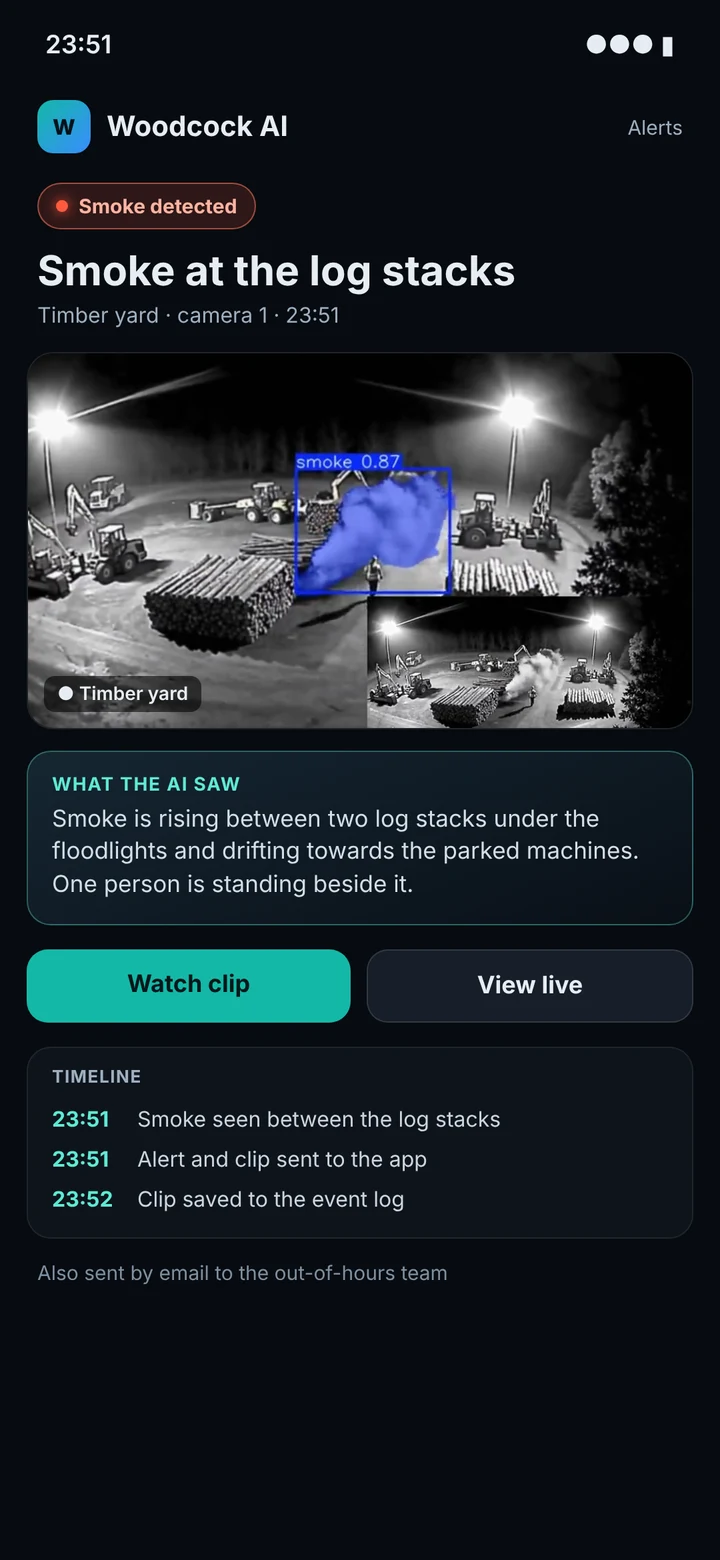
The guidance also expects detection systems to be covered by third-party certification, such as a UKAS-accredited scheme, or a recognised standard; where they are not, you need to show how your plan still meets its objectives. Woodcock AI does not replace a certified fire alarm or detection system. What it adds is early sight of the first smoke and flame on the open areas the cameras already watch: piles, bays, plant parking and the yard, with the clip in every alert so someone can judge it quickly.
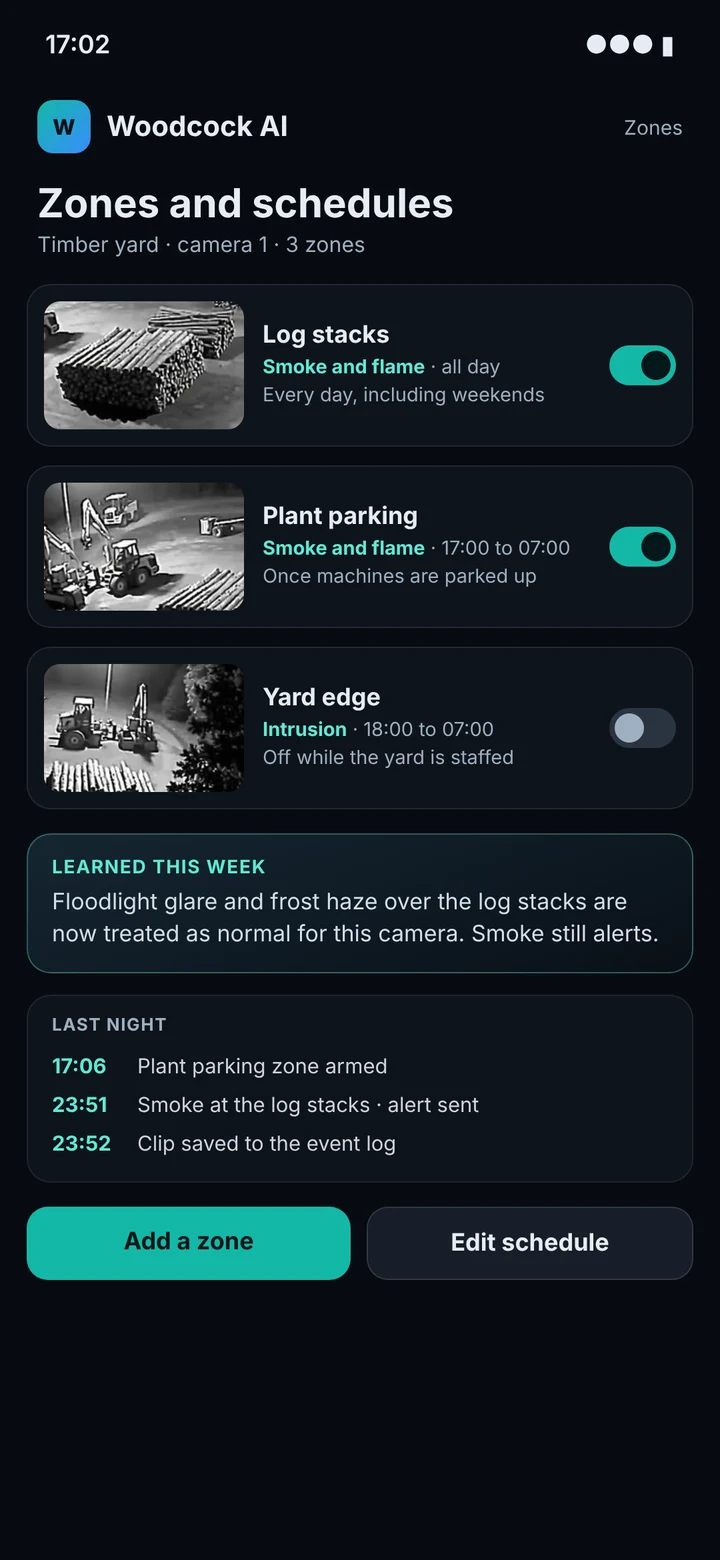
Woodcock AI connects to your cameras or recorder over ONVIF or RTSP. You draw polygon detection areas that follow the edge of each pile or bay rather than a rough box, and give each one its own schedule: smoke and flame on the stacks around the clock, the plant parking once machines are parked up, and an intrusion or line-crossing zone on the fence once the site closes. Each camera's model is fitted to its own scene and learns from feedback, so floodlight glare and frost haze stop raising alerts while smoke still does. This self-learning AI is the result of years of development, now running on real waste and industrial sites.
Coming soon, early 2027 You'll be able to ask your cameras what happened in plain English, for example whether any machine was parked beside the stacks after the close-down check, as evidence for your next review. Alert descriptions are live today.
- Waste acceptance and housekeepingLoad checks, a quarantine area, pile limits, separation and a close-down inspection at the end of every shift.
- Fire alarm and certified detectionThe fire alarm and any certified detection your assessment, permit and insurer require, maintained to the relevant standards.
- Video AI on existing CCTVWoodcock AI watches piles, plant parking and the yard for the first visible smoke and flame, and the fence line for intruders, when nobody is there.
- Suppression and waterSprinklers, deluge or fixed suppression where your assessment or permit calls for them, and enough water for firefighting.
- People and proceduresFire watch, hot works permits, an emergency plan, training and an out-of-hours call-out rota.
Record in your assessment what each camera watches, who receives alerts at each time of day, and how the system is checked. Want to see it first? Book an on-site demo, or a live test on your cameras: we connect two or three of your own cameras for about a fortnight. For more on specific sites, see waste transfer stations, recycling plants and MRFs and the waste and recycling hub.
Waste site fire risk assessment questions
Short answers on the law, records, reviews and where cameras fit. More in the Woodcock AI FAQ.
Is a fire risk assessment a legal requirement for a waste site?
Yes. In England and Wales the Regulatory Reform (Fire Safety) Order 2005 requires the responsible person for any workplace, including a waste or recycling site, to carry out a suitable and sufficient fire risk assessment and review it regularly. Scotland and Northern Ireland have their own fire safety law.
Does the fire risk assessment have to be written down?
Yes. Since 1 October 2023 the responsible person must record the assessment for all premises, as soon as practicable after it is made or reviewed. The record must include the findings, the measures taken or to be taken, and any group of people especially at risk.
Is our fire prevention plan the same as a fire risk assessment?
No. The fire risk assessment is a fire safety law duty focused on people, enforced by the fire and rescue authority. A fire prevention plan is required by your environmental permit where it covers combustible waste, and focuses on preventing fires and limiting spread and harm to the environment. WISH guidance warns that a plan agreed with one may not satisfy the other.
Who can carry out a waste site fire risk assessment?
The responsible person can do it themselves using the government guides, or appoint a competent person. WISH guidance says complex sites are likely to need competent advice, while smaller sites could train an employee. The fire and rescue authority can give advice but cannot do the assessment for you.
How often should we review it?
The law says regularly, and in particular when there is reason to suspect it is no longer valid or there has been a significant change. It does not set a fixed interval, so set a review date and also review after any new waste stream, new plant, layout change, fire or near miss.
Does a waste site need a DSEAR assessment as well?
Where dangerous substances are present, such as flammable liquids, gas cylinders or combustible dusts, the fire risk assessment must cover them and the Dangerous Substances and Explosive Atmospheres Regulations 2002 apply. HSE enforces DSEAR.
Can CCTV be part of the fire safety measures?
It can be one of them. The Environment Agency lists CCTV visual flame detection among the automated detection systems that may be appropriate, and WISH lists CCTV among security measures against arson. Camera detection works alongside the fire alarm and any certified detection your assessment, permit and insurer require.
How do Woodcock AI alerts reach people at night?
By the Woodcock AI app, as a push notification with the clip, and by email, to the people you choose for each camera and time of day. Alerts to a monitoring centre (ARC) and phone-call alerts are available as optional add-ons.
How can we see it working on our site?
Book a site assessment, then choose an on-site demo or a live test on your cameras: we connect two or three of your own cameras for about a fortnight.
Sources
We only quote figures we can trace to an official or industry source. This guide is general information, not legal advice. Published and last updated 28 October 2026 by Woodcock AI.
- Fire safety in the workplace: who's responsible GOV.UK. Last checked 28 October 2026.
- Fire safety in the workplace: fire risk assessments GOV.UK. Last checked 28 October 2026.
- Fire safety in the workplace: enforcement, appeals and penalties GOV.UK. Last checked 28 October 2026.
- Fire safety risk assessment: factories and warehouses Home Office, GOV.UK, updated 12 September 2023. Last checked 28 October 2026.
- Fire safety risk assessment: 5-step checklist Home Office, GOV.UK, updated 20 January 2025. Last checked 28 October 2026.
- Regulatory Reform (Fire Safety) Order 2005, article 9: risk assessment legislation.gov.uk. Last checked 28 October 2026.
- Regulatory Reform (Fire Safety) Order 2005, article 13: fire-fighting and fire detection legislation.gov.uk. Last checked 28 October 2026.
- Fire prevention plans: environmental permits Environment Agency, GOV.UK, updated 11 January 2021. Last checked 28 October 2026.
- WASTE 28: Reducing fire risk at waste management sites (issue 3) Waste Industry Safety and Health (WISH) Forum, March 2020. Last checked 28 October 2026.
- Waste Industry Safety and Health (WISH) Forum Health and Safety Executive (HSE). Last checked 28 October 2026.
- Dangerous Substances and Explosive Atmospheres Regulations (DSEAR) Health and Safety Executive (HSE). Last checked 28 October 2026.
Check what your cameras can watch out of hours
A site assessment reviews the cameras over your piles, bays, plant parking and yard, and confirms what is supported before anything is set up.
Keep exploring
Related
Want us to check your site against this?