

Arson prevention for business sites
Most arson on business premises is opportunist: someone gets on site and lights what is lying around, usually bins, skips, pallets or vehicles. Prevention means keeping the site secure, moving fuel at least 6 to 10 metres away from buildings, and a daily close-down check. AI detection on your existing CCTV adds early warning, flagging people after hours and smoke or flame within seconds, with the clip sent to your phone.

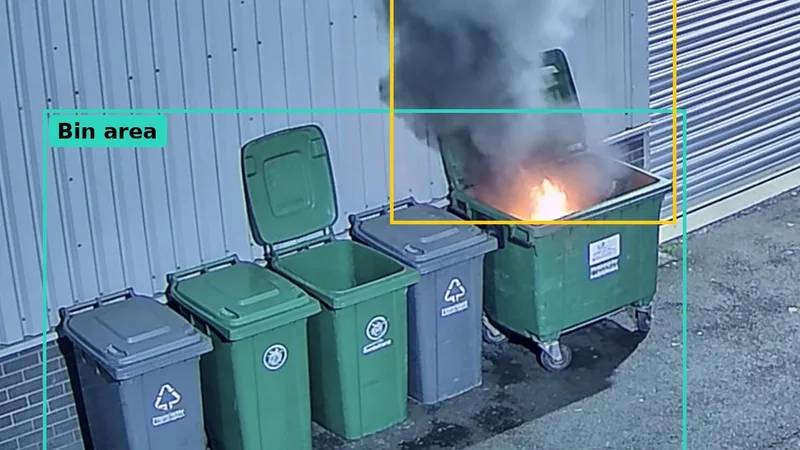
Last updated 31 October 2026. Arson is one of the biggest causes of fire on business premises, and one of the most preventable. Most deliberate fires are not planned attacks. They are fires set by someone who has got on to a site after hours and found something easy to light: a row of wheelie bins against a wall, a skip full of packaging, a stack of pallets by the fence, or a van parked in the yard. This guide sets out what the latest figures show, what the fire and rescue services and insurers recommend, a simple close-down routine, and how AI detection on the CCTV you already have can warn you while there is still time to act.
How common is arson on business sites?
Very common. The Home Office and MHCLG publish fire statistics for England every quarter. The latest fire statistics data tables, published in October 2026, show that fire and rescue services attended 71,588 fires recorded as deliberate in the year ending March 2026. That is about two in every five of the 170,770 fires they attended.
Of those deliberate fires, 15,872 were primary fires, the more serious kind that involve property, people or casualties. They included 3,732 fires in buildings other than homes, such as shops, factories, warehouses, offices, schools and farm buildings, and 7,191 road vehicle fires. Most of the rest were secondary fires: rubbish, bins, skips, grass and derelict property outdoors.
The numbers rose on the year before. FIRE0401 records 61,828 deliberate fires in the year ending March 2025, so the latest year was around 16% higher. Dry weather pushes outdoor fires up, and that is part of the picture, but the count of deliberate fires in non-home buildings and vehicles stays high every year.
The share is the striking part. Around 27% of fires in non-home buildings were recorded as deliberate, around 37% of road vehicle fires, and over half of all secondary fires outdoors. If your business has a yard, bins, skips or vehicles, arson is not an unusual risk. It is one of the main ones.
These figures only count fires where the motive was recorded as deliberate. Fires where the cause was doubtful or unknown are counted separately, so the true number is likely to be higher.
What counts as arson, and who is responsible for preventing it?
In England and Wales, arson is criminal damage by fire. Section 1 of the Criminal Damage Act 1971 says that an offence of destroying or damaging property by fire shall be charged as arson. Scotland treats it as wilful fire-raising under common law. Either way, it is a serious crime, and the police and fire investigators will want evidence.
Prevention, though, sits with the business. Under fire safety law, the responsible person for a workplace must carry out a fire risk assessment, put fire precautions in place and plan for emergencies. GOV.UK’s guide to workplace fire safety sets out those duties. RISCAuthority, the insurer research scheme run by the Fire Protection Association, is clear that arson should be part of that assessment, not a separate afterthought.
Its guide RC48, Arson prevention: the protection of premises from deliberate fire raising, opens with a simple point: all businesses are potential targets. It recommends that someone in the business is given the job of managing arson risk, and that the arson risk assessment looks at who might set a fire. That includes intruders, but also visitors, contractors and, occasionally, staff or former staff.
Insurers take the same view. Many policies include conditions about waste storage, security and alarms, and a fire that started in a bin against the wall can raise awkward questions after a claim. Our guide to insurer expectations on fire detection covers what insurers commonly ask for.
How do arson attacks on businesses usually happen?
The patterns are well known to fire investigators. Most attacks on commercial premises follow one of a few routes.
- Bins and skips set alight next to the building. This is the most common pattern. A bin fire on its own is minor. A bin fire against plastic cladding, under a canopy or by a door is not. Flames climb the wall, get into the roof or eaves, and the building becomes the fire.
- Stock, pallets and waste stored outside. Timber pallets, baled card, plastic crates, tyres and packaging stacked against a wall or a fence give a fire a lot of fuel, very quickly.
- Vehicles in the yard. Vans, cars, lorries and plant parked overnight are targets in their own right, and a fire in one vehicle can spread along the row and to nearby buildings.
- Through the letterbox or a broken window. Lit material pushed through a letterbox, or thrown in through a broken pane, starts a fire inside, often near the door.
- After a break-in. Some fires are set to cover up a burglary or to damage the business on purpose. These usually start inside.
Two things link almost all of them. Someone has to get on to the site, or close enough to it. And there has to be something to burn. Arson prevention is mostly about removing those two things, and about knowing early when one of them has gone wrong.
What does the fire service guidance say?
Fire and rescue services publish arson advice for businesses, and most of it lines up with RC48. The practical points come up again and again.
- Keep combustibles away from buildings. RC48 says pallets, waste, wheelie bins and skips should have 10 metres of clear space from the building or any canopy. Where they have to be closer, it recommends non-combustible, lockable containers that are locked out of hours. External storage, and portable cabins, should also be at least 10 metres away.
- Bins and skips. Essex County Fire and Rescue Service asks businesses to keep skips a minimum of 6 metres from premises, to keep bins in a compound, and not to store gas cylinders or flammables near them. Oxfordshire Fire and Rescue Service advises keeping wheelie bins at least 6 metres from buildings, 8 metres for larger bins, chaining them to a post if they cannot be locked away, and never leaving skips next to buildings.
- Secure the perimeter. County Durham and Darlington Fire and Rescue Service recommends secure perimeter fencing at least 2 metres high, and keeping flammable materials at least 1.2 metres back from the fence so they cannot be reached or lit from outside.
- Light it and watch it. RC48 covers security lighting, and recommends CCTV that covers all the vulnerable areas, cameras that are checked so they are not moved or obscured, and enough light or night-capable cameras to see at night. Fire services also suggest keeping skips and bins in clear view of cameras.
- Close down properly. Durham’s advice includes a close-down routine at the end of each day and a weekly walk round the site looking at it as an arsonist would.
The distances are not all the same, because they come from different bodies and different kinds of site. The 10-metre figure in RC48 is the insurer benchmark. The 6- and 8-metre figures are fire service minimums for bins and skips. In practice, use the largest gap your site allows, and make sure your fire risk assessment says what you have done and why.
Many sites cannot move everything 10 metres away. A small unit on an industrial estate may have a yard that is barely that deep. That is where the other layers matter more: locked, non-combustible containers, a secure perimeter, lighting, and a way of knowing quickly when something is wrong.
Where should cameras watch for arson?
Start with the places a fire is most likely to be set, then the places people get in. Choose an area to see what the camera watches and why.
Which part of the site?
Wheelie bins and paladins are the most common target. They are full of paper, card and plastic, they are easy to reach, and they are often pushed against a wall or under a canopy. A camera on the bin store, with a zone drawn round the cage or the bins themselves, watches for smoke and flame all night. If the bins are moved against the building, you see that too, on the next clip.
Smoke and fire, 24/7
A skip of timber, card and packaging is a ready-made bonfire. Fire services ask for skips to be kept well away from buildings, lidded or locked, and emptied often. Where a skip has to sit near the building for a day or two, a camera with a zone round the skip gives you warning while the fire is still small and still in the skip.
Smoke and fire, 24/7
Over a third of road vehicle fires in England are recorded as deliberate. Fleet vans, lorries and plant parked overnight are exposed, and a vehicle fire can spread to the next one and to the building. A zone over the parking bays watches for smoke and flame, and a night schedule flags people walking among the vehicles when nobody should be there.
Fire 24/7, people at night
Most arson on business premises starts with someone getting in. A line drawn along the fence top or across the gate, and an intrusion zone on the yard, armed outside working hours, tell you the moment someone is on site. That is the earliest point you can act: before anything is lit.
People after hours
Each area runs its own detections and its own schedule. Smoke and fire run day and night.
Other areas are worth a camera too. Loading bays, where cardboard and pallets build up during the day. Doors and shutters, especially any with a letterbox. Roof access points, such as stacked pallets or a bin store next to a low roof. And any part of the building with combustible cladding, where a small fire against the wall would spread quickly.
Two practical points on placement. First, cameras need to see the bins, skips and stock themselves, not just the door. A camera pointed at the front entrance will not see a fire set round the back. Second, they need to work at night. RC48 makes the same point: enough light, or cameras that can see in the dark. Most modern IP cameras have infrared, and good yard lighting helps both the camera and the deterrent effect.
Why recorded CCTV alone does not stop arson
Most business sites already have CCTV. Most of it records to a box in a cupboard, and nobody looks at it until the morning after. That is useful for the police investigation, and for the insurer. It does nothing while the fire is being set.
The value of a camera in arson prevention is time. A fire in a wheelie bin can spread to a building in minutes. If someone sees it while it is still in the bin, a call to 999 and a keyholder on the way can be the difference between a burnt bin and a lost building. If nobody sees it until a passer-by calls it in, the fire service may arrive to a building already well alight.
That is why the guidance talks about layers. Fencing, gates and lighting deter. Moving bins, skips and stock away from the building removes the fuel. An intruder alarm and a fire alarm detect inside the building. Cameras that raise an alert, rather than just record, detect outside it, where most arson starts. And a response plan makes sure someone acts.
How does AI detection on CCTV help with arson?
Woodcock AI watches the streams from your existing cameras and raises an alert when it sees something that matters, in the areas you choose and at the times you choose. For arson, that means two kinds of detection working together.
- People and vehicles after hours. Intrusion detection flags a person or vehicle inside a zone on a night schedule, such as the yard, the bin store or the vehicle park. Line-crossing detection flags someone crossing a line along a fence or across a gate. This is the earliest warning you can get: someone is on site before anything is lit.
- Smoke and fire, all the time. Smoke and fire detection watches the bins, skips, pallets, vehicles and building walls day and night, and flags visible smoke or flame inside the zone. If a fire is set from outside the fence, or by someone the intrusion zones did not cover, you still get warning while it is small.
When either happens, you get an alert in the app with a short clip, and an email. The clip lets you see straight away whether it is a fox, a delivery driver who is running late, or someone with a lighter by the bins. A detection can also trigger a siren on site, and an alarm receiving centre (ARC) can follow your response plan if you use one.
Woodcock AI connects to IP cameras and recorders over RTSP or ONVIF, including Hikvision and most other mainstream makes, and detection runs on an edge server on site or on a cloud server. In many cases the cameras you already have over the yard and the bins are enough; a site assessment shows where an extra camera would close a gap.
What makes Woodcock AI suited to arson prevention?
Three things matter most on an exposed business site:
- Polygon detection zones. You draw the exact shape each camera should watch: the bin cage, the skip, the parking bays, the strip of yard along the building. Roads, footpaths and the neighbour’s yard are left out, so passing cars and people on the pavement do not trigger alerts. See polygon detection zones.
- Self-learning. Yards at night bring headlights, rain, moving shadows, foxes and steam from vents. The system learns what is normal on each camera, which cuts the false alerts that make people stop looking at their phones.
- Years of development, now in use. Woodcock AI has been developed over several years and is in use today on working waste, recycling and industrial sites, where skips, bins and yards at night are the everyday risk.
Sites with metal, cable or plant on the yard often face theft and arson together; our guide to metal theft prevention covers that side, and the out-of-hours site security checklist goes through the wider security routine.
What should a daily close-down check include?
Most arson prevention costs nothing but ten minutes at the end of the day. The person locking up walks the site and checks the same things every time.

- Bins. Lids shut, bins in their compound or chained to a post, and not pushed back against the wall during the day.
- Skips. Lidded or locked where possible, not overfull, and in their proper place away from the building. Ask your waste contractor to empty them often.
- Pallets and stock. Inside, or stacked well clear of walls, fences and windows. Nothing combustible within reach of the fence.
- Doors, windows and shutters. Closed and locked. Letterboxes sealed, or fitted with a metal box on the inside to catch anything pushed through.
- Flammables. Gas cylinders, fuel, paints and solvents locked in their proper store, not by the bins.
- Gates and fencing. Locked, no gaps, nothing stacked against the fence that could be used to climb it.
- Cameras and lights. Lights working, cameras online and still pointing where they should. RC48 recommends checking that cameras have not been moved or obscured.
Once a week, walk the whole site, inside and out, and look at it the way someone who wanted to start a fire would. Where would they get in? What could they light? Where would nobody see them? Fix what you find, and note it in your fire risk assessment.
Cameras help with the routine too. If bins are left against the wall at 6pm, the bin store camera shows it. If a gate is left open, the line-crossing alert on the first vehicle through it will tell you.
How do schedules work around opening hours?
Each camera has its own schedule, and each detection type on that camera can follow it.
- Smoke and fire on bins, skips, pallets, vehicles and walls run around the clock. Arson often happens at night, but bin fires in working hours happen too.
- People and vehicles on the yard, gate, fence line and vehicle park arm in the evening and stay armed until the first person is due, and all weekend if the site is shut. See vehicle detection for vehicles entering after hours.
You change the hours in the app whenever the routine changes, such as a late delivery night or a holiday shutdown, when the site sits empty for days. It is worth checking schedules, keyholders and the close-down routine before every long closure.
What should happen when an alert comes in?
Plan the response before you need it. An alert at 2am is only useful if the right person sees it and knows what to do.
- Who gets which alert. Agree who receives alerts, who is first to respond at night, and who covers holidays.
- What they check. The clip shows in seconds what is happening. If there is a fire, call 999 first and follow your fire plan. If there is someone on site who should not be, call the police.
- Who goes to site. Nobody should confront an intruder or tackle a fire alone. Keyholders should wait for the fire service or the police and meet them at a safe point.
- What the fire service needs. Where the fire is, what is stored nearby, where the gas cylinders and fuel are, and the best way in for an appliance.
- Keep the clips. Save the footage for the police, the fire investigator and your insurer.
Our guide to outdoor fire detection covers detection on yards and stockpiles in the open, and the skip hire and construction pages cover sites where skips and waste sit outside for long periods.
What are the limits?
- A camera needs a view. It cannot see round corners, inside a closed skip or behind a parked lorry. Placement decides what it can see.
- It sees visible smoke and flame. It does not detect heat, and it does not replace a fire alarm inside the building.
- It is not a certified alarm. It adds early warning. It does not replace your fire alarm, intruder alarm, sprinklers or your insurer’s requirements.
- It does not identify people. Detection tells you a person is there, and the clip shows what they did. Identifying them is a job for the police.
- Alerts need a connection. The app and email need internet to reach phones, so we check the connection in the site assessment.
- It does not remove the fuel. The best camera in the world will not stop a fire spreading from a bin pushed against cladding. Housekeeping comes first.
We also have a feature for asking your cameras questions on the way: Ask your cameras is coming soon, early 2027. Everything else on this page is available now.
Sources
- Home Office / MHCLG, Fire statistics data tables: FIRE0401, deliberate fires and FIRE0102, fires by location (England, published October 2026).
- RISCAuthority (Fire Protection Association), RC48: Arson prevention, the protection of premises from deliberate fire raising (PDF).
- Essex County Fire and Rescue Service, Preventing arson in your business.
- Oxfordshire Fire and Rescue Service, How businesses can avoid wheelie bin blaze risk.
- County Durham and Darlington Fire and Rescue Service, Arson prevention advice.
- legislation.gov.uk, Criminal Damage Act 1971, section 1.
- GOV.UK, Workplace fire safety: your responsibilities.
We have summarised these sources in our own words. Always read the current versions. This page is general guidance, not fire engineering, security or legal advice; your fire risk assessment, your local fire and rescue service and your insurer decide what your site needs.
Want early warning of arson on your site?
Book a site assessment and we will look at the cameras you already have over the yard, bins, skips, vehicles and fence line, and plan zones, schedules and who gets which alert. Or ask for a live test on your cameras first: we connect two or three of them for about a fortnight.
Related pages
Frequently asked questions
How common is arson on business premises?
Very common. In England in the year ending March 2026, fire services attended 71,588 fires recorded as deliberate, about two in five of all fires. They included 3,732 fires in buildings other than homes and 7,191 road vehicle fires.
How far should bins and skips be from a building?
RISCAuthority RC48 recommends 10 metres of clear space for pallets, waste, wheelie bins and skips. Fire services ask for at least 6 metres for bins and skips, and Oxfordshire FRS says 8 metres for larger bins. Where that is not possible, use locked, non-combustible containers.
Does CCTV prevent arson?
Recorded CCTV mainly helps after the event. Cameras with AI detection help prevent damage by alerting you when someone is on site after hours, or when smoke or flame appears, while there is still time to call 999 and send a keyholder.
What should a close-down check include?
Bins locked away from walls, skips lidded and in place, pallets and stock inside or well clear of the building, doors and letterboxes secured, flammables locked away, gates locked, and lights and cameras working.
Does AI smoke detection replace a fire alarm?
No. A fire alarm and an intruder alarm stay in place. AI smoke and fire detection on CCTV adds early warning outside the building, where most arson starts, and sends the clip to your phone.
Can Woodcock AI use our existing CCTV?
Usually, yes. It connects to IP cameras and recorders over RTSP or ONVIF, including Hikvision, and runs on an edge server on site or on a cloud server.
Last reviewed 31 October 2026
Tipped waste is often set alight. See fly-tipping CCTV for business and farm land.