

What does the Environment Agency expect for fire detection in a fire prevention plan?
The Environment Agency expects permitted waste sites to detect a fire in its early stages in every storage area, including when the site is closed, and to explain in the fire prevention plan which detection systems are used and how an alert reaches someone who will respond.

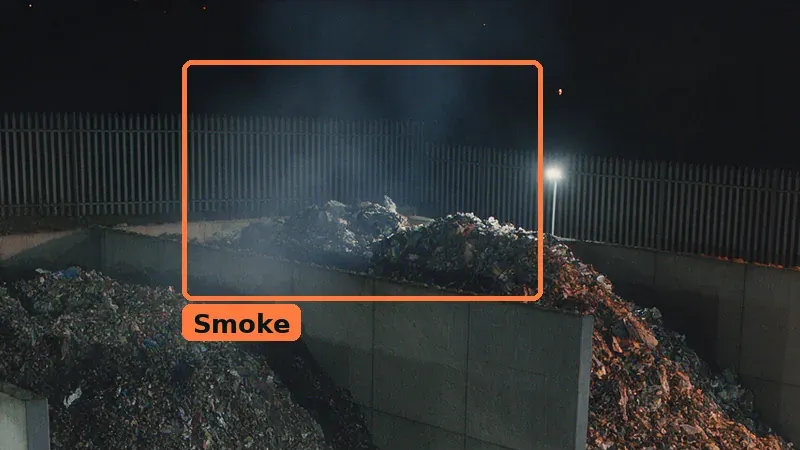
The short answer comes from one section of the GOV.UK guidance, but it only makes sense alongside the rest of the plan. This page sets out what the Environment Agency (EA) actually asks for on fire detection, which sites it applies to, the detection options it names, and how to show that the alarm is raised when nobody is on site. Every point below is a paraphrase of the guidance, with a link to the source.
What does the guidance say about detection?
Section 13 of the EA guidance on fire prevention plans for environmental permits, headed “Detecting fires”, makes four points, summarised here:
You must have procedures to detect a fire in its early stages. Your plan must show how your detection system raises the alarm both during working hours and when the site is closed. Detection must be proportionate to your activities and risks, and it can be automated or manual. Design, installation and maintenance must be covered by an appropriate third-party certification scheme (such as UKAS) or meet a recognised standard (such as a British Standard), with evidence of certification included in the plan. If you meet neither, you must show that you can still meet the three objectives.
Paraphrased from GOV.UK, section 13, checked 29 Oct 2026Detection is not a stand-alone requirement. The guidance sets three objectives for every plan, and detection is what makes the second and third achievable: you cannot aim to put a fire out within four hours, or stop it spreading, if nobody knows it has started.
Which sites need a fire prevention plan?
The guidance applies to operators who accept any amount of combustible waste under an environmental permit in England. It names waste metals (including end-of-life vehicles and scrap), non-hazardous waste and waste electrical equipment (WEEE), and it applies in part to biowaste, intensive farming, incineration and combustion sites, paper and pulp, and cement, lime and minerals.
You may not need a plan if you store only waste of low combustibility and the EA is satisfied you can still meet the objectives. The EA asks for, and approves, a plan when you apply for a new permit, when a variation raises the fire risk, or when it has a serious concern. It may also ask for one when a permit is transferred, after a fire, or where it sees a risk.
Plans are assessed site by site on a risk basis. That matters for detection: there is no single system that is right for every yard, and the EA will judge your choice against your own waste types, layout and opening hours.
What types of detection does the EA name?
The guidance does not insist on one technology. It lists examples of appropriate automated systems and leaves the choice to you, as long as it is proportionate and is covered by an appropriate third-party certification scheme (such as UKAS) or meets a recognised standard (such as a British Standard). The table sets these out neutrally; most sites combine more than one.
| Named in the guidance | What it watches | Points to consider |
|---|---|---|
| Smoke and heat detectors, including temperature probes | Buildings, enclosed storage and the inside of stockpiles | Detectors need smoke or heat to reach them, which is harder outdoors; probes read only where they are placed |
| CCTV and visual flame detection | Open yards, bays and stockpiles within a camera view | Coverage depends on camera positions and lighting; AI video can spot smoke as well as flame |
| Spark, infrared and ultraviolet detection | Conveyors, shredders, ducts and process lines | Usually fitted to specific machinery rather than whole yards |
| Manual detection | Wherever staff are working | Only covers working hours, so it rarely meets the out-of-hours test alone |
Thermal cameras are another camera-based route that sites often consider for open storage. If you are weighing them up, our thermal vs AI CCTV guide for FPPs compares the two without the sales pitch.

Whatever you choose, describe it area by area. An officer reading “CCTV covers the site” cannot tell which stockpiles are watched. With AI smoke and fire detection on CCTV, you draw polygon detection areas on each camera view, round each bay and the air above it, and each alert names the area as well as the camera.
What does the EA expect when the site is closed?
This is the line in section 13 that catches most plans out. The guidance asks you to show how the alarm is raised when the site is closed, not just that a system exists. Footage that is recorded but not watched, or a sounder in an empty building, does not raise the alarm with anyone.

In practice, your plan should say which areas are watched out of hours, who receives an alert at night and at weekends, how quickly they are expected to respond, and what happens if they do not acknowledge it. It should also tie into the rest of the plan: access for the fire and rescue service, the quarantine area, and how a fire would be contained.
Woodcock AI sends an app alert with a short clip and an email alert to the people you choose, at any hour, so the person on call sees the smoke, which area it is in and how it is developing before deciding what to do. An alarm receiving centre (ARC) connection is available as an optional add-on if you want a monitoring centre to act on alerts too.
How does AI CCTV help evidence the plan?
The guidance expects evidence, not just a description. It asks for proof of certification or a recognised standard, regular exercises and training, and a plan that is reviewed after a fire or near miss, when activities change, or when the EA asks. If you propose alternative measures, the EA may ask you to demonstrate them, in person or on film.
A camera-based system produces much of that evidence as it runs. Each detection is recorded with the area, the time and a clip. Zones are drawn to match your site plan, so the drawing and the system agree. During commissioning we run smoke tests on site and record the results, and the models are fitted to each camera’s scene, trained on that site’s normal, no-incident footage and on synthesised smoke, so the system learns what normal looks like on your yard.
Keep these records with the rest of your fire log. When the plan is reviewed, they show the officer what the system has actually done, not just what it is meant to do. If you change the layout of your bays, update the zones at the same time, and note it in the plan.
What about sites in Wales?
The guidance on this page is the EA’s and covers England. Permitted sites in Wales are regulated by Natural Resources Wales (NRW), which sets its own fire prevention requirements, so check its guidance and speak to your NRW officer.
What are the next steps?
- 1Map your areas. List every storage and process area as named on your site plan, and note which are watched when the site is closed.
- 2Check the rest of the plan. Work through our fire prevention plan checklist and your waste site fire risk assessment.
- 3Write the detection section. Use our FPP detection section template for example wording by area.
- 4Test it on your yard. Woodcock AI connects to your cameras or recorder over ONVIF or RTSP, and we supply and install cameras where there are gaps. Ask for a live test on your cameras or an on-site demo.
This is a summary, not legal advice. The Environment Agency approves fire prevention plans site by site and may ask for more than is shown here. Check your plan with your EA officer before you submit it.
Want detection your officer can check?
Book a site assessment and we will show you how your cameras could watch each storage area, day and night.
Related pages
Frequently asked questions
Do all waste sites need a fire prevention plan?
No. The Environment Agency guidance applies to permitted sites that accept combustible waste. If you store only waste of low combustibility and the EA is satisfied you can meet the objectives, you may not need one. Check with your EA officer.
Does the Environment Agency specify a type of fire detection?
No. It requires early detection that raises the alarm in and out of working hours, proportionate to your risks, and lists examples such as smoke and heat detectors, CCTV, visual flame detection, and spark, infrared and ultraviolet detection.
Is CCTV acceptable as fire detection in an FPP?
The guidance names CCTV and visual flame detection among appropriate automated systems. Whether it is enough for your site depends on your risks, coverage and evidence, so describe it area by area and check with your officer.
Does fire detection in an FPP need to be certified?
Yes. The design, installation and maintenance must be covered by an appropriate third-party certification scheme (such as UKAS) or meet a recognised standard (such as a British Standard), and you must include evidence of certification in the plan. If you meet neither, you must show that you can still meet the three objectives.
What happens if my FPP is rejected?
The EA will explain what it needs and you revise and resubmit the plan. You can propose alternative measures if they still meet the three objectives, and the EA may ask you to demonstrate them, in person or on film.
How do I evidence out-of-hours detection?
Say which areas are watched when the site is closed, who receives alerts at night and at weekends, how quickly they respond and the fallback if nobody acknowledges. Keep alert records, clips and test results with your fire log.
Does the guidance apply in Wales?
No. The fire prevention plan guidance on GOV.UK is the Environment Agency’s and covers England. In Wales, Natural Resources Wales regulates permitted sites and sets its own requirements.
Last reviewed 29 October 2026