

Fire prevention plan template: the fire detection section
The detection section of a waste site fire prevention plan should say how fires are detected in every storage area, in and out of hours, how alerts reach someone who can act, and how detection is tested. This template gives example wording mapped to the Environment Agency’s FPP guidance.
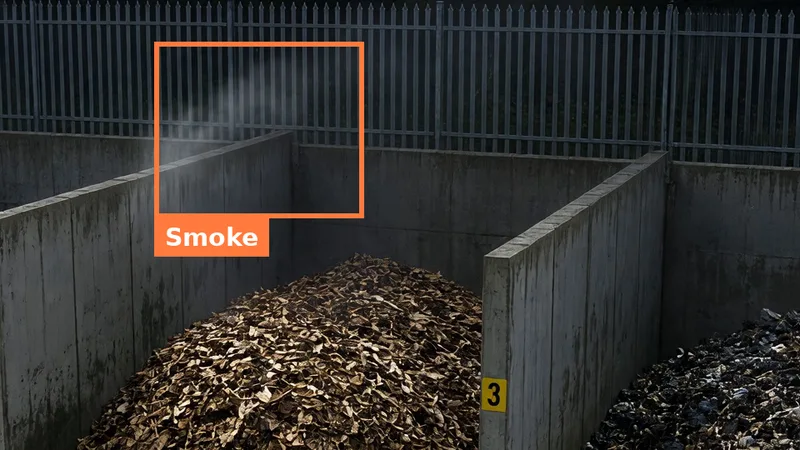
A fire prevention plan (FPP) is required for most environmental permits that cover combustible waste in England. The detection section is short, but it is where many plans are vague: “CCTV covers the site” tells the Environment Agency very little. This page sets out what the section needs to say, gives wording you can copy and adapt, and shows how camera-based smoke detection can be described if you use it.
Use it alongside our fire prevention plan checklist, which covers the rest of the plan, and your waste site fire risk assessment, which should drive the choices you make here.
What must the detection section cover?
Section 13 of the Environment Agency fire prevention plan guidance is brief. In summary, it says you must have procedures to detect a fire in its early stages, and you must show in your plan how the detection system will raise the alarm both during working hours and when the site is closed. The system must be proportionate to your activities and risks, and it can be automated or manual.
The guidance lists examples of appropriate automated systems: smoke and heat detectors including temperature probes, CCTV, visual flame detection, and spark, infrared and ultraviolet detection. It also says design, installation and maintenance must be covered by an appropriate third-party certification scheme or meet a recognised standard, with evidence in the plan. If a system does not, you must show how you still meet the guidance’s three objectives.
In practice, that means the section should answer six questions: which areas are covered, by what method, at what times, how an alert reaches a person who can act, what evidence supports the system, and how it is tested and recorded. The wording below follows that order.
Template wording you can copy
Replace everything in square brackets with your own details, and delete lines that do not apply. Keep the area names identical to those on your site plan, so an officer can match each line to a place on the drawing.
1. Purpose and approach
[Site name] uses a combination of [automated and manual] fire detection proportionate to the waste we store and the risks identified in section [x]. The aim is to detect a fire in its early stages, both during working hours and when the site is closed, so that the alarm is raised quickly and the fire can be dealt with before it spreads.
2. Detection by area
Detection by area (see site plan, drawing [ref]):
- [Bay 1 to 3, baled paper and card]: [AI video smoke and flame detection on camera(s) [ref], with a detection zone drawn round each bay and the air above it]. Active 24 hours a day.
- [Shredder and picking line]: [heat detection to BS [ref]] plus [AI video smoke detection on camera [ref]].
- [Quarantine area]: [AI video smoke and flame detection on camera [ref]]. Active 24 hours a day.
- [Office and welfare]: [smoke detectors on the building fire alarm].
Area-by-area wording is where camera detection is easiest to describe well. Rather than saying a camera “covers the yard”, name the zones. With Woodcock AI you draw polygon detection zones on each camera view, for example round each bay and the air above it, and each zone carries a name that appears in the alert.

Out-of-hours detection and alert routing
The guidance specifically asks how the alarm is raised when the site is closed. This is the part most often missed: a system that records footage nobody watches, or an alarm that only sounds in an empty building, does not raise the alarm with anyone. Your plan should name who receives an alert at night and at weekends, how quickly they are expected to respond, and what happens if they do not.
3. Out-of-hours detection and alert routing
When the site is closed, detection continues on all areas listed above. A detection sends an app alert with a short video clip and an email alert to the duty manager on the rota at [location of rota]. If the duty manager does not acknowledge within [minutes], the alert is followed up by [the second keyholder / our alarm receiving centre]. The person receiving the alert checks the clip, calls 999 if there is a fire, and then attends or sends a keyholder. Access arrangements for the fire and rescue service are set out in section [x].
Woodcock AI sends an app alert with a short clip and an email alert to the people you choose, at any hour, so the person on call can see whether it is smoke, which bay it is in, and how fast it is growing before deciding what to do. You can set a schedule per camera, and an alarm receiving centre (ARC) connection is available as an optional add-on if you want a monitoring centre to act on alerts.

Testing and records
The guidance requires maintenance to be covered by certification or a recognised standard, and it requires regular exercises to test the plan as a whole. Your detection section should therefore say how often each system is checked, who does it, and where the records are kept. Follow the manufacturer’s instructions and the relevant standard for each system; the frequencies below are an example to adapt, not a requirement from the guidance.
4. Testing, maintenance and records
Each detection system is checked as follows: [daily] check that every camera and detector is online; [weekly] review of alerts, with any false alert recorded and fed back; [monthly] test of [one zone per area] using [a smoke test / the manufacturer's test method]; and an [annual] service by [contractor]. Results are recorded in [the fire log / the maintenance system] and kept for [period]. Detection zones are reviewed whenever the layout of storage bays changes.
For camera detection, Woodcock AI runs smoke tests on site during commissioning. Keep a note of these tests and of any changes to zones in the same log as your other fire checks.
5. Certification and standards
The design, installation and maintenance of [system] are covered by [certification scheme or British Standard]; evidence is attached at appendix [x]. Where a system does not meet a recognised standard, section [x] explains how it still meets the three objectives of the Environment Agency fire prevention plan guidance.
Get the editable version
If you would like this template as an editable document, with the area table laid out for your site plan, ask for it when you book a site assessment. We will send it with notes on which of your existing camera views can carry smoke detection and where the gaps are. Woodcock AI connects to your cameras or recorder over ONVIF or RTSP, and we also supply and install cameras where you need them.
Check with your officer
This is example wording, not legal advice. The Environment Agency approves fire prevention plans site by site, and it may ask for more detail than shown here. Check your draft with your EA officer before you submit it. In Wales, permits are issued by Natural Resources Wales, which sets its own requirements, so check with NRW.
How do we get started?
- 1Site assessment. We review your site plan and existing camera views, remotely or on site.
- 2Zones and routing. We draw zones that match the areas in your plan and agree who gets which alerts, and when.
- 3Commissioning. Cameras are connected, models are fitted to each view and smoke tests are run on site.
- 4Your plan. You get the wording and records you need for the detection section.
Need the detection section to stand up?
Book a site assessment and we will show you how your cameras could cover each storage area, day and night.
Related pages
Frequently asked questions
What should the detection section of a fire prevention plan include?
Which areas are covered, the detection method in each, how the alarm is raised in and out of working hours, who receives alerts, evidence of certification or a recognised standard, and how the system is tested and recorded.
Does the Environment Agency accept camera-based smoke detection?
The Environment Agency guidance lists CCTV and visual flame detection among examples of appropriate automated systems. Whether a system is acceptable for your site depends on your risks and the evidence you provide, so check with your EA officer.
How do I show out-of-hours detection?
Name the areas watched when the site is closed, say how an alert reaches a named person at night and at weekends, how quickly they respond, and what happens if they do not acknowledge it.
How often should detection be tested?
The guidance does not set one frequency for detection testing. Follow the manufacturer’s instructions and the relevant standard, set your own schedule in the plan, and keep a record of every check.
Is there an official FPP template for the detection section?
The Environment Agency guidance sets out what a plan must cover rather than a fill-in form for this section. This page gives example wording mapped to that guidance, which you should adapt and check with your officer.
Can I adapt this for a Natural Resources Wales permit?
The structure may help, but Natural Resources Wales sets its own requirements for sites in Wales. Check its guidance and speak to your NRW officer before using this wording.
Last reviewed 29 October 2026
Before you fill this in, read what the Environment Agency expects for fire detection in an FPP.