

Does my insurer require fire detection CCTV?
Often, yes. Many UK insurers of waste, recycling and industrial sites ask for automatic fire detection covering storage areas, especially out of hours, and some will consider camera-based smoke detection as part of it. Requirements vary by insurer and policy. Woodcock AI adds smoke and fire detection to your existing cameras; check your risk survey and use this checklist.

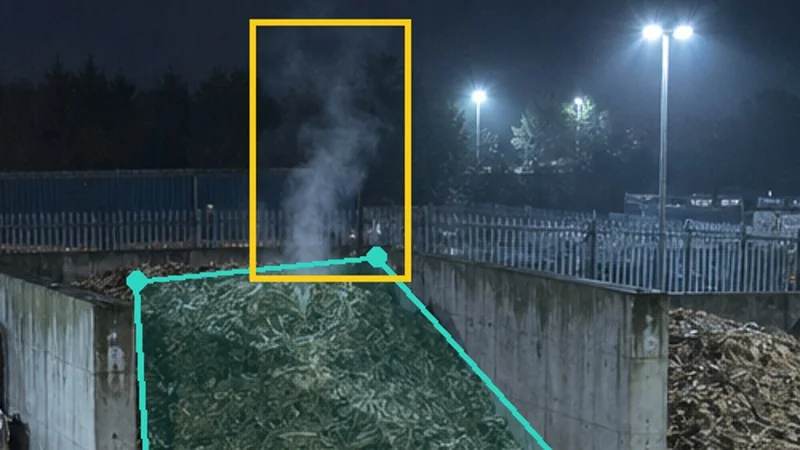
If a risk surveyor is due, or your broker has asked what fire detection you have, this page gives you a straight answer, a checklist to work through before the visit, and practical advice on talking to your broker. For the wider picture of the standards insurers work from, see our guide to what insurers expect from fire detection on waste and industrial sites.
Will my insurer insist on fire detection?
There is no single rule that applies to every policy. Insurers write their own conditions, so the honest answer is that it depends on your insurer, your policy and your site. What industry guidance does make clear is the direction of travel.
The Waste Industry Safety and Health (WISH) Forum guidance WASTE 28, Reducing fire risk at waste management sites, says insurers may set their own standards, and that you may meet a standard your regulator is content with but your insurer is not. It also notes that waste management is not a popular industry for property insurers because of fire risk, that the standards insurers require are increasing, and that operators who cannot satisfy their insurer will find cover harder and more costly to get.
RISCAuthority guidance, written with insurer input, makes the same point from the other side: its RC48 arson prevention recommendations state that individual insurers have their own requirements. So the first step is always to read your policy and your last risk survey report.
If you hold an environmental permit, your fire prevention plan is a separate requirement again. The GOV.UK guidance on fire prevention plans for environmental permits asks you to show how detection raises the alarm both during working hours and when the site is closed. Our guide to EA fire prevention plan detection requirements covers that in detail.
Does camera smoke detection count for insurance?
It can, but check with your insurer before you rely on it. WASTE 28 lists video systems that look for smoke among the detector types used on waste sites, describes video smoke detection as fairly new to waste management, and gives waste halls as a potential use. The same guidance notes that thermal camera systems may not be accepted by insurers, which is a useful reminder that acceptance is decided policy by policy.
On the regulatory side, the GOV.UK fire prevention plan guidance lists CCTV visual flame detection among the automated systems you can describe, and says design, installation and maintenance must be covered by an appropriate third-party certification scheme (such as UKAS) or meet a recognised standard (such as a British Standard).
In practice, many sites use camera detection alongside their certified fire alarm system rather than instead of it. It adds eyes on outdoor bays, stockpiles and large halls where point detectors struggle, and it gives you a clip of what triggered each alert. WASTE 28 also notes that some sites have installed camera-type detectors over external reception bunkers.

What do risk surveyors typically look at?
Every surveyor works to their own insurer’s brief, but the published guidance gives a good idea of the ground they cover. This table pulls together points from the three sources this page is based on.
| Area | What it means on your site | Source |
|---|---|---|
| Out-of-hours alarm | Detection should raise the alarm when the site is closed, not only when staff are on site | GOV.UK FPP guidance |
| CCTV coverage | Cameras covering all vulnerable areas inside or outside buildings | RISCAuthority RC48 |
| Night picture | Enough lighting, or night-capable cameras, to see after dark | RISCAuthority RC48 |
| Camera condition | Cameras monitored so they are not moved or obscured | RISCAuthority RC48 |
| Who fitted it | Supply, installation and maintenance by a company accredited by a UKAS-accredited certification body | RISCAuthority RC48 |
| Commissioning | A commissioning certificate; the insurer may want a copy or to witness tests | WISH WASTE 28 |
| Maintenance records | Maintenance, testing and checking recorded and the records kept | WISH WASTE 28 |
| Impairments | Telling your insurer when a system is out of action, as many policies require | WISH WASTE 28 |
| Arson security | Fencing, alarms and CCTV, including arrangements outside working hours | GOV.UK FPP guidance |
WASTE 28 adds that many insurers ask for installers and maintainers accredited to recognised third-party schemes, and that some require particular certifications for the equipment itself. If your survey report names a scheme, that is the one to follow.

What should be on your pre-survey checklist?
Work through this list before your next risk survey or policy renewal. Tick items as you go: your ticks are saved in this browser on this device, and you can print the list or save it as a PDF to share with your broker or site team. The list is a starting point, not a substitute for the conditions in your own policy.
Anything you cannot tick is worth raising with your broker before the survey rather than on the day. WASTE 28 makes the same point: asking for advice in advance is better than arguing afterwards.
How can alert logs and clips help at a survey?
WASTE 28 suggests a simple test for each fire system condition in your policy: if there were a fire, could you prove you had complied, for example by producing records? Detection that keeps its own log makes that question much easier to answer.
With Woodcock AI, every alert goes out by app, with a short clip, and by email to the people you choose, and each one is kept with its time, camera and detection area. That gives you a running record you can show a surveyor:
- Out-of-hours cover. Alerts at night and at weekends show detection is working when the site is closed.
- Commissioning tests. During commissioning we run smoke tests on site, so you have a dated record that the system detected before go-live.
- Your own camera checks. Clips make it easier to spot a view that has been knocked or blocked, so you can keep cameras from being moved or obscured.
- What happened next. A clip alongside each alert lets you show how your team responded.
Keep these records with your fire alarm maintenance log, not instead of it. A surveyor will still want to see the certificates and service records for your certified fire alarm system.
How should you talk to your broker about detection?
The headline advice in WASTE 28 is to talk to your insurer first. Insurers and brokers are often a good source of free or low-cost advice, and many larger insurers have their own fire engineers. The guidance warns against installing an expensive system only to find your insurer will not accept it.
- 1Ask early. Before you choose a system, ask your broker what your insurer expects for your storage areas and out-of-hours cover.
- 2Get conditions in writing. List the fire system conditions in your policy and build them into your site procedures.
- 3Agree the system. Share your proposed detection, including any camera-based detection, so it can be installed to the insurer’s requirements.
- 4Tell them when it goes live. Send a short summary of what is covered, how alerts are raised and who receives them.
- 5Keep records and report problems. Keep test and alert records, and tell your insurer if a system is out of action, as policies often require.
Will better detection change my cover? We cannot promise any change to your premium or terms. Requirements and pricing vary by insurer and policy. What better detection and good records can do is help you show a surveyor that the risk is being managed, which is what WASTE 28 says insurers increasingly want to see.
Where does Woodcock AI fit?
Woodcock AI turns the CCTV you already have into AI fire and smoke detection. It connects to your cameras or recorder over ONVIF or RTSP, so a camera that already looks at a bay or stockpile can start watching for smoke and fire without being replaced.
- Polygon detection areas. Draw a shape round each bay, stockpile or quarantine area so every alert names the area. See polygon detection zones.
- Self-learning, fitted to each scene. Models are fitted to each camera’s view and trained on that site’s normal footage. Read about our self-learning AI.
- Built over years, in use today. Woodcock AI has been developed over several years and runs on real UK sites.
- Alerts that fit your plan. App alerts with a clip and email as standard, with sirens, fire panel inputs and an alarm receiving centre (ARC) as optional add-ons. Per-camera schedules let intrusion run only when the site is closed while smoke and fire detection runs around the clock.
See how it works on our AI smoke and fire detection camera page, or read how it is used on waste and recycling sites. If you are still assessing your fire risks, our waste site fire risk assessment guide is a good place to start.
Which sources is this guide based on?
- WISH Forum, WASTE 28: Reducing fire risk at waste management sites (issue 3, March 2020).
- RISCAuthority, RC48: Arson prevention, the protection of premises from deliberate fire raising.
- GOV.UK, Fire prevention plans: environmental permits.
We have summarised these documents in our own words. Always read the current version and follow your own policy and survey report. This page is general guidance, not insurance advice.
Getting ready for a risk survey?
Book a site assessment and we will look at your cameras, the areas you need covered and how alerts should reach your team. Or ask for a live test on your cameras first.
Related pages
Frequently asked questions
Will my insurer insist on fire detection?
It depends on your insurer and policy. Many insurers of waste, recycling and industrial sites ask for automatic fire detection over storage areas, especially out of hours, and WISH guidance notes that insurer standards are increasing. Check your policy conditions and your last risk survey report.
Does camera smoke detection count for insurance?
It can, but ask your insurer first. WISH WASTE 28 lists video smoke detection among detector types used on waste sites, and acceptance varies by insurer. Many sites use camera detection alongside a certified fire alarm system.
What evidence do insurers want?
Typically a commissioning certificate, maintenance and testing records, details of who installed and maintains each system, and proof you meet each fire system condition in your policy. Alert logs and clips from camera detection add a useful record of out-of-hours cover.
Can better detection affect cover terms?
Requirements and terms vary by insurer and policy, so no one can promise a change. Better detection and good records help you show a surveyor that fire risk is being managed. Ask your broker how your insurer views it.
What do risk surveyors check on waste sites?
Common areas include detection over storage areas, how the alarm is raised when the site is closed, CCTV coverage and night picture, whether cameras can be moved or obscured, installer accreditation, commissioning and maintenance records, and how impairments are reported.
Should I tell my broker about new detection?
Yes. Talk to your broker before you buy so the system can be installed to your insurer’s requirements, then tell them when it goes live and what it covers. Policies often require you to report when a system is out of action too.
Last reviewed 29 October 2026