

Fire detection cameras for battery energy storage (BESS) sites
AI smoke and fire detection cameras give BESS sites a visual layer alongside off-gas and BMS alarms, spotting smoke around containers and the perimeter. Woodcock AI works on existing RTSP or ONVIF cameras or pre-configured Hikvision ColorVu cameras, and can trigger sirens or link to a fire panel.

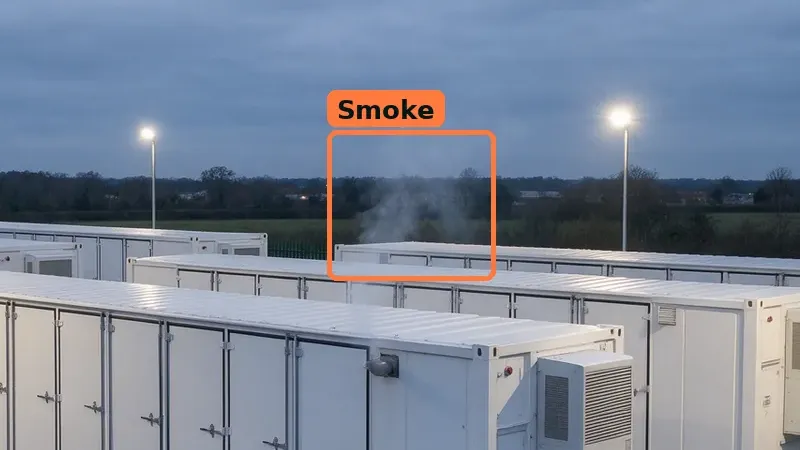
Battery energy storage sites are usually unmanned, fenced and remote, with rows of identical containers that nobody looks at for days. Inside each container the battery management system and the off-gas detectors do the first and most important job. What they cannot do is show anyone what is happening outside: smoke drifting from a vent, a fire spreading towards the next container, or someone cutting through the fence at 3am. That is the gap a camera layer fills.
This page explains how Woodcock AI adds that layer, where it fits next to the systems you already have, and what to check before you plan cameras for a new or existing BESS site. If you also run solar, see our solar farm and battery storage page.
Why add camera smoke detection to a BESS site?
The battery management system watches cell voltage, current and temperature. Off-gas detection looks for the gases a failing cell gives off, often before any smoke appears. Both are inside the enclosure, and both are essential. Camera smoke detection does not replace either of them.
What cameras add is sight. A camera on a pole or the fence can see the outside of every container in a row, the gaps between them, the transformer and switchgear, and the fence line. When smoke appears outside an enclosure, the system marks it in the frame and sends the alert with a short clip, so whoever is on call can see straight away whether it is a real fire, which container it is coming from, and whether it is spreading.
The national fire guidance makes the same point about not relying on one system. The NFCC grid-scale battery energy storage planning guidance describes off-gas detection as helpful early warning that should not be relied on alone, and expects appropriate automatic detection, such as smoke, gas or radiant heat detectors, plus continuous combustible gas monitoring within every BESS enclosure. A camera layer sits outside those enclosures and gives people a picture of the whole compound.
How do cameras cover multiple containers?
One well-placed camera can watch a full row of containers. You draw polygon detection zones on the camera view that follow the outline of each row, the aisle between rows, or a single high-value enclosure. Smoke is only reported inside the zones you choose, and each zone can carry its own name, so the alert says which row it came from rather than just which camera.
- Row zones follow the roofline and base of each container row, so smoke from vents and doors is caught where it starts.
- Aisle zones cover the gravel between rows, where smoke tends to collect and drift.
- Equipment zones cover the transformer, switchgear and inverters at the end of the rows.
- Per-camera schedules let you set when each camera reports, for example smoke all day and night with intrusion only out of hours.

Battery sites have their own sources of false alarms: steam and warm air from cooling units, floodlights switching on at dusk, rain, low sun on white container walls. Woodcock AI uses self-learning models that are fitted to each camera’s scene during set-up and keep improving from your site’s footage, so normal activity on your site is far less likely to be reported as smoke.
Can the same cameras detect intruders?
Yes. Battery sites hold copper cable and expensive equipment, and an intruder near the containers is a safety risk as well as a security one. The same cameras that watch for smoke can run intrusion detection and line-crossing detection. You draw a virtual line along the fence or a zone round the compound, and the system alerts when a person or vehicle crosses it, while ignoring animals, swaying grass and headlights on a nearby road.

Because the alert arrives with a clip, the person on call can decide in seconds whether to send a keyholder, call the police or simply note it. Each alert also has a feedback button, so anything that should not have been reported helps the model learn your site.
Will it alert us at an unmanned site?
Yes. That is what it is built for. When smoke, fire or an intruder is detected, Woodcock AI sends an app alert with a short clip and an email alert to the people you choose, at any hour. Alerts can go to your own operations team, a contractor and the site owner at the same time. If you want a monitoring centre to receive and act on alerts, an alarm receiving centre (ARC) connection is available as an optional add-on.
On site, a detection can also trigger a siren and strobe, so anyone nearby is warned and an intruder knows they have been seen. The NFCC guidance expects external audible and visual warnings that are clearly visible to arriving fire crews; your installer and fire engineer decide how the camera layer ties into that.

Can it link to our fire panel?
Yes. Woodcock AI can link to a fire panel, so a confirmed smoke or fire detection from the cameras becomes an input to your existing fire detection and alarm system. How that input is used, for example as a pre-alarm or to start a cause-and-effect sequence, is decided by your fire engineer and set up by your installer during commissioning. The cameras add information; they do not override the system your fire strategy depends on.
Can we use existing perimeter cameras?
Usually, yes. Woodcock AI connects to your cameras or recorder over ONVIF or RTSP, so the pole and fence cameras many BESS sites already have for security can also be used for smoke detection. What matters is the view: the camera needs to see the containers and the air above them, not just the fence. During a site assessment we check each existing view and tell you which ones work for smoke, which work for intrusion, and where an extra camera would close a gap.
For new sites or gaps, we supply pre-configured Hikvision ColorVu turret and bullet smoke cameras, which give a colour picture in low light. Hardware is UKCA, CE and US certified. Woodcock AI provides design, supply and installation, or works through your installer.

What do planners, fire services and insurers expect?
National planning guidance on GOV.UK encourages applicants for battery storage of 1 MWh or more to engage with the local fire and rescue service before submitting a planning application, and to consider the NFCC guidance (Planning Practice Guidance, renewable and low carbon energy, paragraph 033). The NFCC guidance, approved for publication in December 2025 and replacing the 2023 version, lists questions fire services may ask, including how the BESS will be monitored and how the fire and rescue service will be alerted.
A camera layer helps you answer those questions with something visible: named zones round every row, alerts with a clip to named people, and a siren and fire-panel link. It does not replace the enclosure detection the guidance expects. Insurers ask similar questions about detection, monitoring and response; our guide to what insurers expect from fire detection covers them in more detail, and our page on lithium-ion battery fires explains why early sight of smoke matters.
How do we get started?
- 1Site assessment. We review your layout and existing camera views, remotely or on site.
- 2Design. We agree camera positions, row and fence zones, schedules and who gets which alerts.
- 3Connect and tune. Cameras are connected over ONVIF or RTSP, siren and fire-panel links are set up, and the models are fitted to each view.
- 4Go live. Alerts start with a clip in the app and by email, and keep improving from your feedback.
Coming next: Ask your cameras Coming soon, early 2027 will let you search footage in plain words.
Plan the camera layer for your BESS site
Tell us about your site and we will show you which views work for smoke and intrusion, and where the gaps are.
Related pages
Frequently asked questions
Does camera smoke detection replace off-gas detection at a BESS site?
No. Off-gas detection and the battery management system work inside the enclosure and are essential. Camera smoke detection adds a visual layer outside, spotting smoke around containers and the perimeter and sending a clip so people can see what is happening.
Can cameras cover multiple containers?
Yes. One well-placed camera can watch a full row. You draw polygon zones round each row, aisle or piece of equipment, and alerts name the zone as well as the camera.
Will it alert us at an unmanned site?
Yes. Detections send an app alert with a clip and an email alert to the people you choose, at any hour. A connection to an alarm receiving centre is available as an optional add-on, and a siren and strobe can sound on site.
Can it link to our fire panel?
Yes. A camera detection can become an input to your fire detection and alarm system. Your fire engineer decides how it is used, and your installer sets it up during commissioning.
Does it also detect intruders?
Yes. The same cameras can run intrusion and line-crossing detection along the fence and round the compound, alerting on people and vehicles while ignoring animals and moving grass.
Can we use existing perimeter cameras?
Usually, yes. Woodcock AI connects to existing cameras or recorders over ONVIF or RTSP. A site assessment checks which views can see the containers well enough for smoke detection.
Last reviewed 29 October 2026