

Farm CCTV that spots barn fires, intruders and vehicles
A farm CCTV system with AI watches your cameras for smoke in hay barns, people in machinery sheds and fuel stores, and vehicles at the gate, then sends the clip to your phone and by email. Per-camera schedules keep it quiet while you work, and a detection can sound a siren on the yard.
Last updated 30 October 2026. Farms are hard places to protect. Buildings are spread out, often a long way from the house, and full of things that burn or sell: hay and straw, diesel, fertiliser, tractors, quads, tools and GPS kits. Lanes run past at all hours, and the people who look after it all are usually out working or asleep. This page explains what a farm CCTV system with AI detection does, where to point cameras, how it handles a working yard full of people, vehicles and animals, and what it cannot do.
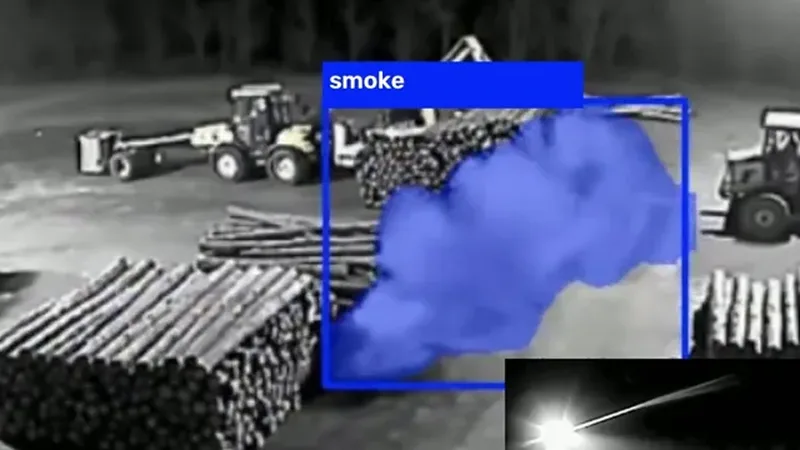
About the clip above. It is real Woodcock AI footage from a rural timber yard at night, not a farm, with tractors, loaders and log stacks under floodlights. Smoke rises between two stacks and the AI outlines its shape and labels it as smoke. The small inset shows the raw camera view. The clip has no sound.
What does a farm CCTV system with AI actually do?
An ordinary CCTV system records. Someone has to watch it, or look back after something has happened. A CCTV system with AI detection checks every frame for you and tells you when something matters, while it is happening.
Woodcock AI connects to IP cameras over RTSP or ONVIF, including the cameras many farms already have, and runs detection on an edge server on site or on a cloud server. On a farm, the detections that matter most are:
- Smoke and fire in hay and straw barns, machinery sheds, workshops, fuel stores and around the yard. See smoke and fire detection cameras.
- Intrusion: a person inside a zone you have drawn, such as the mouth of a machinery shed or a fuel store, during the hours you choose. See intrusion detection.
- Line crossing: someone crossing a line you draw on a gate, a fence or a track. See line-crossing detection.
- Vehicles: a car, pickup or tractor coming up the lane or through the gate out of hours. See vehicle detection.
- PPE (hard hats & hi-vis) in working areas where they are required, such as a building project or a contractor’s compound, by day.
When a detection happens inside a zone and inside its schedule, you get an alert in the app with a short clip, and an email. The clip matters on a farm. A notification that just says “motion” at 2am means getting dressed and driving across the farm to check. A clip lets you see in seconds whether it is smoke, a person by the diesel tank, or a neighbour’s van turning in the gateway.
Three things make AI detection practical on a farm:
- Polygon detection zones. You draw the exact shape each camera should watch: the hay stack, the shed mouth, the fuel compound, the gateway. Anything outside the shape, such as the field beyond or the road, is ignored. See polygon detection zones.
- Per-camera schedules. The barn camera watches for smoke all day and night. The shed and gate cameras arm for people and vehicles after work stops. The yard camera can check for PPE in working hours.
- Self-learning. Every farm has its own dust, low sun, headlights on the lane, steam from a muck heap and moving shadows. The system learns what is normal for each camera, which cuts the false alerts that make people stop looking.
What is changing in farm fires and rural crime?
Insurer NFU Mutual says the cost of farm fires involving crops, buildings and equipment rose 18% in 2025, with fires on agricultural vehicles on top of that. It lists arson, lightning and electrical faults as the main known causes, and says the risk to buildings, stored crops, machinery and livestock is often made worse by how far farms are from the nearest fire station.
Rural crime is changing too. The overall cost of rural crime claims to NFU Mutual fell by 6% in 2025, but the insurer describes the crime as more organised, with gangs targeting high-value kit. Its 2026 Rural Crime Report, covered by NFU Online, found that the cost of agricultural vehicle theft claims rose 18%, quad bike and ATV theft 31% and livestock theft nearly 30%, while GPS theft costs fell by 80%. NFU Mutual agents reported that 29% had seen farmers change how they farm, or leave farming altogether, because of crime.
The government’s summary of responses on the Equipment Theft (Prevention) Act estimates that between 900 and 1,200 quad bikes and ATVs are stolen each year in England and Wales. NFU Mutual has also funded ANPR cameras with police forces on rural roads. Cameras that watch the gate and the yard on your own farm fill a different gap: they tell you, not just the police, while it is happening.
Nobody should read those numbers as a reason to confront thieves or fight a fire. They are a reason to find out sooner. On a farm, the difference between seeing the first smoke and seeing a barn on fire is often the difference between a few lost bales and a lost building, and the time a fire engine needs to reach a remote yard makes early warning more valuable, not less.
Can CCTV detect a barn fire early?
Yes, once the fire shows itself as smoke or flame that a camera can see. AI smoke detection watches the video for the shape, movement and colour of smoke and fire inside the zones you draw, and reports it with the clip. In a hay or straw barn, a camera looking along the stack sees smoke when it first escapes from the bales, often long before anyone on the farm would notice it from the house.
What a camera cannot do is see heat building inside a stack. Hay baled too wet heats up as it ferments. Devon and Somerset Fire and Rescue Service explains that hay stored with more than about 22% moisture is at higher risk of spontaneous combustion, that most hay fires happen within six weeks of baling, and that above 55°C a chemical reaction begins to produce flammable gas. It recommends a thermometer probe, checking daily from 65°C, and calling 999 at 100°C.
So the right answer is both. Probe new hay, especially in the first six weeks. Use the camera as the eye that never sleeps, so that if a stack does break out, at 3am or while everyone is at the market, someone knows straight away.

Smoke detection in a barn works best when:
- The camera has a clear view of the stack and the space above it. Mount it high, looking along the bales rather than straight across them, and keep it away from the main loading door where dust and exhaust swirl.
- There is some light at night. Most modern cameras have infrared or colour night vision. Hikvision ColorVu cameras give a colour picture in low light, which helps smoke detection after dark. See Hikvision smoke detection cameras.
- The zone follows the stack. A polygon round the bales and up to the roof line means smoke there is reported, and a dusty tractor in the doorway is not.
- Electrics are maintained. Cameras, lights and chargers in a barn should be fitted and inspected by a competent electrician. Keep halogen lamps away from stacks; the fire service suggests replacing them with LEDs.
Camera detection is not a certified fire alarm. If your farm buildings are workplaces, the responsible person must carry out a fire risk assessment and provide suitable fire precautions. Cameras add early warning to that, especially in buildings without detectors and outside.
Which parts of a farm should AI cameras watch?
Start with the places where a fire would cost most and the things a thief would come for. On most farms that is five areas. Pick one to see how a camera is set up for it.
Which part of the farm are you checking?
Hay barns are where most farm fire losses start, from damp bales heating up, electrical faults, lightning or arson. Draw a zone round the stack and up to the roof line, keep the camera out of the dust from loading, and leave smoke detection on day and night. The alert names the barn and carries the clip.
Smoke, around the clock
Tractors, telehandlers, quads and tools sit in open-fronted sheds. An intrusion zone across the shed mouth, armed from evening to early morning, reports a person or vehicle there with the clip. A siren on the yard tells whoever it is they have been seen.
Armed when work stops
Diesel tanks and agrochemical stores attract thieves and are a serious fire risk. A line on the gate or fence, plus a zone on the tank, reports anyone crossing after hours. Lock tank outlets and keep the store away from hay and straw.
Line crossing at the gate
Most thefts need a vehicle. Vehicle detection on the gateway or the farm track, armed at night, reports a car, pickup or tractor coming in or going out, with the clip. Keep plates readable on a separate camera if you need them for the police.
Vehicles out of hours
In daylight the same yard camera can switch from security to safety. PPE detection can run in the zones where they are needed, such as round a building site or a grain store project, on a daytime schedule.
PPE checks by day
Drawn from NFU Mutual, Devon and Somerset Fire and Rescue Service and HSE guidance. Your insurer and fire risk assessment decide what is right for your farm.
Not every farm needs every camera. A small livestock unit may only need the hay barn and the yard. A large arable farm may need the grain store, machinery sheds, fuel, the workshop and several gates. In a site assessment we walk the farm with you, look at the cameras you already have, and suggest extra cameras only where there are gaps.
How does AI CCTV help stop machinery, quad and fuel theft?
Thieves rarely want to be seen. A farm that spots them early, warns them off and gets clips to the police is a harder target than one that finds the shed empty in the morning. AI CCTV helps in four ways:
- It sees them arrive. Vehicle detection on the gate or the track, armed at night, tells you a vehicle is on the farm before anyone reaches a shed.
- It sees them where they should not be. An intrusion zone across a shed mouth, or a line on the fuel store gate, reports a person there out of hours.
- It tells them they have been seen. A detection can trigger a siren on site, so the yard lights up with noise rather than leaving thieves to work in peace.
- It hands you evidence. Every alert carries a clip, so you can pass what happened, and when, to the police.

NFU Mutual’s advice on rural crime stresses layers: lock up, mark kit, keep keys out of vehicles, use trackers and immobilisers, and keep valuable machinery out of sight from the road. Cameras sit alongside those steps. They do not stop a determined gang on their own, but they shorten the time between someone arriving and you knowing about it.
For fuel, NFU Mutual’s fire prevention programme also recommends locking fuel tank outlets. A camera on the fuel store does two jobs: theft by night and fire at any hour.
One point of safety, which every police force and insurer will repeat: do not go out to confront people on your land. Watch the clip, call 999 if a crime is happening, and let the police deal with it. If you have a monitoring centre, it can do that for you.
Will livestock trigger false alerts?
This is the question every farmer asks, and the honest answer is that it depends on where the cameras look and when they are armed. We do not promise that animals will never cause an alert. What keeps alerts useful on a livestock farm is the set-up:
- Point cameras at buildings, stores and gates, not fields and pens. The things a farm needs protecting from fire and theft are mostly in and around buildings. A camera looking across a field full of sheep is the wrong tool for the job.
- Draw zones tightly. A polygon round the hay stack, the shed mouth or the fuel compound leaves out the paddock behind and the pen next door.
- Set schedules per camera. If cattle cross the yard at milking time, keep intrusion detection on that camera off at those hours, while smoke detection carries on.
- Let it learn. The self-learning AI adapts to what is normal on each camera, which cuts false alerts over time.
- Check the clip. Every alert has one, so a false alert takes seconds to dismiss rather than a trip across the yard.
Smoke detection is a different case from intrusion. Animals moving in a shed do not look like smoke, but dust from bedding, steam from a muck heap or breath on a cold morning can. Zones and self-learning are there for exactly that.
How do per-camera schedules work on a working farm?
A farm is busy by day and empty by night, but not on a timetable that suits an office alarm. Lambing, harvest and contractors change the hours. With Woodcock AI, each camera has its own schedule, and each detection type on that camera can follow it.
A typical set-up looks like this:
- Barn cameras run smoke and fire detection around the clock. Fire does not keep office hours.
- Machinery shed and workshop cameras arm intrusion from the end of the working day until early morning.
- Fuel and chemical stores watch the gate line all the time, because nobody should be in there unless they are meant to be.
- The farm gate watches for vehicles at night, when no deliveries are expected.
- Working areas can run PPE detection in the day, where you need it.
You can change the hours in the app when the season changes. At harvest, for example, you might push the shed schedule later in the evening, so drivers bringing machinery back do not set it off.
Can it alert me at night, and can it sound a siren?
Yes. When a detection happens inside a zone and inside its schedule, Woodcock AI sends an alert to the app with the clip, and an email, to the people you choose. A detection can also trigger a siren on site and link to a fire panel, so the warning reaches the yard as well as your phone.
For farms where nobody wants to be woken for every alert, a monitoring centre (ARC) is an optional add-on. Operators watch the clip and follow the plan you agree with them. That might mean calling the police for a vehicle in the yard at 3am, or the fire service for smoke in a barn.
Your response plan matters as much as the alert. Agree who receives which alerts, who calls whom, and where keys and water supplies are. The fire service’s farm safety advice also asks farms to keep entrances clear for fire engines and to plan how livestock would be moved out of buildings in a fire. Do not put yourself at risk to save animals or kit.
Can I use my existing farm cameras?
Usually, yes. Woodcock AI works with any IP camera or recorder that provides an RTSP or ONVIF stream, including Hikvision, which many farms already have. In a site assessment we check each camera’s view, resolution, night performance and stream, and suggest new cameras only where there are gaps.
Where new cameras are needed, we can supply Hikvision ColorVu turret and bullet cameras, pre-configured for smoke and fire detection, UKCA and CE certified. Woodcock AI is sold direct or through installers, so if you already work with a local security installer, they can fit and look after the cameras.
Farms bring practical questions that an office does not:
- Power. Cameras need power at the building, usually over the network cable. Outbuildings without mains need planning.
- Network. Buildings far from the house may need a point-to-point wireless link or a cable run to bring the cameras back to the recorder or edge server.
- Internet. Alerts and clips need a connection to reach your phone. Many farms use broadband at the house or a 4G or 5G router. We check signal and bandwidth in the site assessment.
- Weather and dirt. Outdoor cameras need to be weatherproof, mounted out of reach of machinery, and cleaned now and then. Cobwebs and dust on a lens are the most common cause of a poor picture.
Our CCTV bandwidth and storage calculator helps you size the connection, and the how it works page covers set-up step by step.
What fire safety steps should every farm take?
Cameras are one layer. Most farm fires are prevented, or kept small, by simple habits. Drawing on NFU Mutual, the fire service, Defra’s farm fires guidance and HSE’s farm safety leaflet:
- Have a fire plan. Know how you would raise the alarm, get people out, meet the fire service and move livestock.
- Store hay and straw away from other buildings. NFU Mutual recommends at least 10 metres from buildings holding fuel, agrochemicals or machinery, and the fire service recommends stacks at least 10 metres apart.
- Bale dry and probe new hay. Most hay fires happen within six weeks of baling.
- Maintain electrics. Have wiring, lights and chargers checked, especially in barns and older buildings.
- Control hot work. Welding and grinding near straw, dust or fuel is a common cause of fire. See our guide to hot works fire risk.
- Keep it tidy. Clear rubbish, old pallets and spilled fuel; keep machinery clean of chaff and dust.
- Lock fuel outlets and keep the store away from stacks.
- Keep the entrance clear so a fire engine can get in, and know where your water supplies are.
Are there grants for farm security?
Sometimes, but schemes change often and depend on where you farm and what the money is for. In England, start with the GOV.UK page on funding for farmers, growers and land managers, which lists the current schemes. Wales, Scotland and Northern Ireland have their own. Check the rules before you buy anything, because some schemes only pay for items bought after an application is approved. Your farm adviser, land agent or insurer can also tell you what applies to you.
What are the limits of AI farm CCTV?
- It needs a view. A camera cannot see inside a stack, behind a closed door or round a corner. Placement is everything.
- It needs some light. In total darkness without infrared, there is nothing to see. Most cameras have night vision, and ColorVu cameras help in low light.
- It needs a connection to alert you. If the internet drops, alerts cannot reach your phone until it is back.
- It is not a certified fire alarm. It adds early warning; it does not replace a fire risk assessment, detectors where they are required, or common sense.
- Animals and weather can cause alerts. Good zones, schedules and self-learning keep them down; the clip makes the rest quick to check.
We also have a feature for asking your cameras questions on the way: Ask your cameras is coming soon, early 2027. Everything else on this page is available now.
Farms share a lot with other rural and industrial sites. See our pages on industrial sites and solar farms and battery storage, or browse all sectors.
Sources
- NFU Mutual, Farm fires.
- NFU Mutual, Rural crime.
- NFU Online, NFU Mutual Rural Crime Report (May 2026).
- NFU Mutual, Risk management programme for the prevention of fires on farms (PDF).
- Devon and Somerset Fire and Rescue Service, Storing hay safely and Fire safety on farms.
- Defra, Farm fires: advice on farm animal welfare (PDF).
- HSE, Farmwise: your essential guide to health and safety in agriculture and Agriculture.
- GOV.UK, Fire safety in the workplace.
- GOV.UK, Equipment Theft (Prevention) Act: summary of call for evidence responses and conclusion.
- GOV.UK, Funding for farmers, growers and land managers.
We have summarised these sources in our own words. Always read the current versions. This page is general guidance, not fire engineering or security advice; your fire risk assessment, insurer and the police decide what is right for your farm.
Looking at CCTV for your farm?
Book a site assessment and we will walk the barns, sheds, stores and gates with you, check the cameras you have, and plan zones, schedules and who gets which alert. Or ask for a live test on your cameras first: we connect two or three of them for about a fortnight.
Related pages
Frequently asked questions
Can CCTV detect a barn fire early?
Yes, once smoke or flame is visible to a camera. AI smoke detection watches a zone round the stack and sends an alert with the clip as soon as smoke appears. It cannot see heat inside a stack, so keep probing new hay, especially in the first six weeks after baling.
Will livestock trigger false alerts?
It depends on where cameras look and when they are armed. Point cameras at buildings, stores and gates rather than fields and pens, draw tight zones, and set per-camera schedules so intrusion is off when animals move through the yard. Self-learning cuts false alerts over time, and every alert has a clip so you can check in seconds.
Can I use my existing farm cameras?
Usually, yes. Woodcock AI works with IP cameras and recorders that provide an RTSP or ONVIF stream, including Hikvision. In a site assessment we check each view and its night picture, and suggest new cameras only where there are gaps.
Can it alert me at night?
Yes. Alerts go to the app with the clip, and by email, to the people you choose, at any hour the camera is armed. A monitoring centre (ARC) is an optional add-on if you want operators to watch the clip and act on your plan.
Can it sound a siren?
Yes. A detection can trigger a siren on site and link to a fire panel, alongside the app alert with the clip and the email.
Are there grants for farm security?
Sometimes, but schemes change often and depend on where you farm. In England, check the GOV.UK funding for farmers page for current schemes; Wales, Scotland and Northern Ireland have their own. Check the rules before buying, and ask your adviser or insurer.
Last reviewed 30 October 2026