

Car dealership security: protecting the forecourt, keys and compound out of hours
Car dealership security means stopping vehicles, keys and parts being stolen from the forecourt, showroom and compound, mostly at night. The basics are strict key control (keys locked away, logged and never left in cars), shielding keyless fobs, blocking forecourt exits, good lighting and keeping vehicles off the fences. AI on the CCTV cameras you already have adds detection: polygon zones over the display rows and lines across entrances and gates flag people and vehicles out of hours, with the clip in the alert.

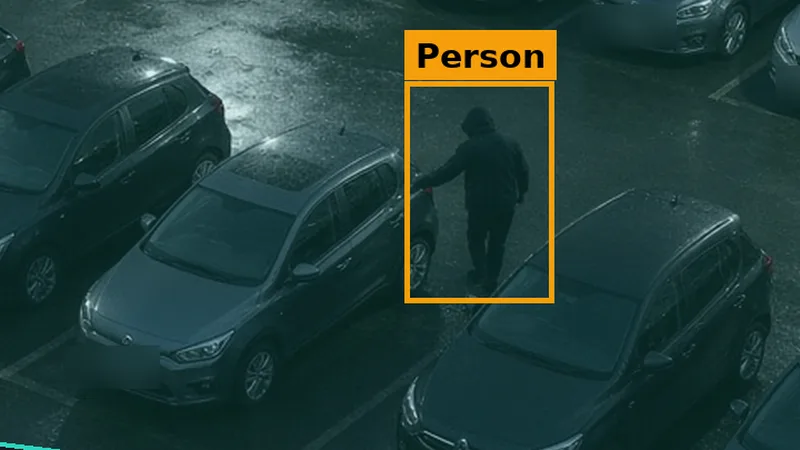
Last updated 31 October 2026. A car dealership keeps its most valuable stock outside, in rows, in full view of the road, and leaves it there every night. Thieves know that. Some walk the forecourt trying doors. Some come for the keys, breaking into the showroom or office to find them. Some arrive with equipment to defeat keyless entry and drive cars away without a key ever leaving the building. Others take wheels, badges, catalytic converters or parts from stock in the compound. This guide sets out the main risks for UK car dealerships, what the official figures show, what police and counter-terrorism security advisers recommend for keys, layout and fences, and how AI on the CCTV cameras a dealership already has can watch the forecourt, compound and gates out of hours.
It is written for dealer principals, site and aftersales managers, used car lot owners and the security installers who work with them. It gives no prices: what a site needs depends on its layout, its cameras and its stock.
What are the main security risks for a car dealership?
Every dealership is different, but most face the same four risks, and most of them happen when the site is closed.
- Vehicle theft. Cars driven off the forecourt or out of the rear compound. Keyless models can be taken without the key if its signal can be reached, and any car can be taken if the key is left in it or on a hook nearby.
- Key theft. Break-ins to the showroom, sales office or service reception to find keys. Once the keys are gone, the cars follow.
- Theft from vehicles. Wheels, tyres, badges, lights, catalytic converters, batteries and anything left inside, taken from stock in the rows or the compound.
- Damage and fire. Vandalism to cars and showroom glass, and fires in workshops, valeting bays, bin stores and skips. Electric vehicles on charge add their own considerations, which our vehicle yards and dealerships page covers.
What do the figures show about vehicle and business crime?
Vehicle crime remains common, even though recorded offences have been falling. The Office for National Statistics’ Crime in England and Wales: year ending June 2026 bulletin, published on 22 October 2026, reports that police recorded vehicle offences decreased by 7%, to 312,231 offences. That police category covers theft or unauthorised taking of a vehicle, aggravated vehicle taking, theft from a vehicle and interfering with a vehicle, and it does not separate private cars from commercial stock.
The Home Office’s Crime and Policing Act 2026 serious crime factsheet gives more detail. It says police recorded a total of 375,048 vehicle-related thefts in the year ending September 2024, including 188,517 thefts from a vehicle and 132,412 thefts of a motor vehicle. The same factsheet notes the Crime Survey for England and Wales estimate of 726,000 vehicle-related thefts in the year ending September 2023.
For businesses, the Home Office’s 2023 Commercial Victimisation Survey (CVS) found that an estimated 26% of all business premises in England and Wales, around 409,000, were victims of at least one crime it measures in the previous 12 months. Theft was the most common, at 14% of premises, followed by burglary including attempts and vandalism, at 8% each. Vehicle-related theft is one of the crimes the survey measures.
The CVS groups businesses by the UK Standard Industrial Classification. Its wholesale and retail sector is section G, which the ONS defines as wholesale and retail trade and the repair of motor vehicles and motorcycles, so it includes car sales and repair. That sector had the highest crime prevalence of the commercial sectors in the 2023 survey, with 41% of premises experiencing a crime it measures in the previous 12 months. The survey does not publish a separate figure for dealerships, so treat 41% as the picture for the wider sector, not a dealership rate.
How do thieves steal cars with keyless entry?
A keyless car on the forecourt is only as safe as the place its key is kept overnight. Keyless entry lets a driver unlock and start a car while the fob stays in a pocket. The car looks for the fob’s signal nearby. Police.uk explains that thieves use a device to fool the car into thinking the key is close, so it unlocks and starts, and that they only need to be within a few metres of the key to pick up its signal. The Home Office factsheet describes the devices as ones that manipulate the signal from remote locking devices, such as signal jammers and signal amplifiers.
The Home Office factsheet gives a sense of scale. It says the Metropolitan Police estimates that electronic devices are used in approximately 60% of vehicle theft in London, and that the Crime Survey for England and Wales found the offender had manipulated the signal from a remote locking device in 36% of vehicle thefts between April 2019 and March 2020.
What does the Crime and Policing Act 2026 change?
The Crime and Policing Act 2026 creates two new offences aimed at these devices: possessing an electronic device for use in vehicle theft, and importing, making, adapting or supplying one. The Home Office factsheet gives a maximum penalty of five years in prison, an unlimited fine, or both. When we checked legislation.gov.uk on 31 October 2026, section 149, which creates the offences, was shown as prospective, meaning not yet in force; check the current status before relying on it. The law does not change what a dealer needs to do to keep keys safe.
How should a dealership control its keys?
Key control is the single most important part of dealership security, because almost every way of stealing a car is easier with its key. ProtectUK, the Counter Terrorism Policing protective security service, advises in its site security guidance that vehicle keys should be stored in a secure locker with security codes, and should not be left in vehicles, on hooks in the office or anywhere easily accessible. Police.uk’s advice on keeping burglars out of a business adds that keys should not be left on the premises, should be held only by designated staff, and that a list of keyholders should be kept.
- Lock every key away at closing. A key safe or electronic key cabinet, away from outside walls and windows, with access limited to named staff.
- Log every key out and in. A daily count at closing shows straight away if a key has not come back.
- Shield keyless fobs. Police.uk suggests signal-blocking pouches for keyless fobs and checking them every few months to make sure they still work. A shielded box or cabinet does the same for a whole rack of keys.
- Keep keys away from the cars. The further the keys are from the forecourt, the harder their signal is to reach.
- Reprogramme keys on used stock. Police.uk advises getting keys reprogrammed when a second-hand car changes hands, so no old key still works.
- Control spare keys and trade plates. Treat them like the main keys: logged, locked and counted.
Cameras help here as well. A camera on the door to the key safe room or the sales office, with a zone armed outside opening hours, flags anyone inside that area at night, which is exactly what a key burglary looks like.
How should the forecourt and compound be laid out?
Layout decides how easy it is to get a car off the site. ProtectUK advises that vehicles, trailers and other material should not be parked near or up against fences, gates and walls, because they can be used as climbing aids or as cover from CCTV cameras and security patrols. It also recommends access control at entrances and physical barriers kept in good repair. Police.uk’s business advice adds sufficient lighting, pruning bushes that give cover, keeping wheelie bins away from walls where they could be climbed, and anti-ram bollards, which may need planning approval.
- Block the exits at night. A barrier, a lockable post or a car parked across each forecourt exit means a stolen car cannot simply be driven out.
- Put the most valuable cars inside. Keep high-value and keyless stock in the showroom or the locked compound overnight, not on the front row.
- Keep the fence line clear. Leave a gap between parked cars and the fence so they cannot be used to climb in or to hide behind.
- Light the rows and the entrances. Lighting deters, and it lets cameras see detail at night. Aim it at the site, not at the road or the cameras.
- Lock the compound. A rear compound with a strong gate, kept shut and locked out of hours, is a much harder target than open rows.
Our out-of-hours site security checklist turns this into a closing routine.
Where should cameras watch on a dealership?
Most dealerships already have CCTV, but it is often set up to record rather than to detect. Before adding anything, mark on a site plan what each camera actually sees, by day and at night. Anything no camera sees is a gap.
- The display forecourt. The rows of cars facing the road. Cameras should see along the rows, not just across the front.
- Entrances and exits. Every way a vehicle can get on or off the site, including side roads and service entrances.
- The rear compound and its gate. Often the most valuable stock, and often the darkest part of the site.
- The showroom doors, sales office and key safe room. The route a burglar takes to the keys.
- Workshop doors, valeting bays and bin stores. Where parts are stored and where fires most often start.
- Prep and handover bays. Cars waiting for collection, often with paperwork and keys nearby during the day.
How does AI on existing CCTV protect a forecourt?
Recording-only CCTV shows what happened after the car has gone. AI detection watches the picture live and tells someone while it is happening. Woodcock AI connects to the IP cameras and recorders a site already has, over RTSP or ONVIF, including Hikvision, and runs on an edge server on site or on a cloud server. On each camera view you draw the rules for that part of the site.
- Polygon zones. A shape with as many corners as you need, drawn over the display rows, the compound or the key safe room. A person or vehicle inside it while it is armed raises an alert. Because a polygon follows the shape of the rows, it can leave the pavement and the road outside, so passers-by do not set it off.
- Line crossing. A line across the forecourt entrance, the compound gate or along a fence. You choose which direction counts, so a vehicle driving onto the forecourt after closing raises an alert and the last member of staff driving out does not.
- Vehicle detection and intrusion detection. Only people and vehicles count. A vehicle in the compound or a van stopping on the forecourt at night is flagged; rain, shadows and sweeping headlights are not.
When a rule is broken, an alert goes to the app with a snapshot and the clip, and by email, with an AI description of what the camera saw, such as “one person walking along the second row of cars, trying door handles, no vehicle in view”. Woodcock AI can also send alerts to a monitoring centre (ARC) as an optional add-on.
The system is self-learning. It learns each camera on your site, so the reflections on the showroom glass and the headlights from the main road become part of the normal view, and every detection has a feedback button: marking an alert as correct or false feeds into retraining for your site. Woodcock AI has been in development for years and is now running on customer sites across the UK.
Vehicle detection is not number plate recognition. Woodcock AI flags that a vehicle is where it should not be, and the clip shows what it was and what it did. It does not read plates or identify people.
Coming next: Ask your cameras Coming soon, early 2027, which will let you ask the system questions about what your cameras have seen.
How does this look on different dealership sites?
Franchised dealers, independent used car lots and back-of-house prep yards each have their own pattern. Choose a site type to see what to watch for.
Which kind of site are you protecting?
A franchised dealership usually has a showroom and display forecourt on a main road, a workshop, and a fenced rear compound for new stock, part exchanges and cars waiting to be prepared. The forecourt is the public face of the site, so it needs zones over the display rows that only arm after closing, and an inbound line across the entrance. The rear compound is where the most valuable new stock often sits overnight, so a line across its gate and along its fence can stay armed all night. Cameras at the showroom doors and the office window cover the route to the keys.
Showroom, forecourt and rear compound
Independent used car lots are often open to the road, with stock parked close to the pavement and little or no fence at the front. That makes the display rows themselves the boundary. A polygon zone that hugs the rows, and leaves the pavement and road outside, flags a person or vehicle among the cars at night without reacting to every passer-by. A line across the entrance, armed after closing, flags a vehicle driving on. Parking a car or a barrier across the entrance at night helps too. See our vehicle yards and dealerships page.
Roadside rows with open frontage
Preparation centres, storage compounds and overflow yards hold cars waiting for valeting, repair, photography or delivery. They are often away from the showroom, unstaffed at night and backed onto by other units, a railway or waste ground. A line along the fence top, armed around the clock, flags anyone coming over, and zones over the rows flag someone walking between the cars. Our perimeter intrusion detection guide covers fences in more depth.
Back-of-house compound
Each part of the site gets its own zones and lines, with its own schedule.
Many dealer groups run all three: a showroom on the main road, a used car site nearby and a prep centre on an industrial estate. Each site can have its own zones, lines and schedules, with alerts going to the right person for that site.
How do the security options compare?
No single measure secures a dealership. The table compares the usual options on what they do, their strengths and what to watch out for. It is deliberately general; what matters is how each one fits your site, your stock and who can respond.
| Measure | What it does | Strengths | Watch out for |
|---|---|---|---|
| Key safe and key log | Locks keys away and records who has them | Removes the easiest way to steal a car; cheap to run well | Only works if every key goes back at closing, every day |
| Signal-blocking pouches or boxes | Shields keyless fobs so their signal cannot be picked up | Simple protection for keyless stock overnight | Must be checked regularly; police.uk suggests every few months |
| Barriers, bollards and blocking cars | Physically stop a car being driven off the forecourt | Delay, which buys time for a response | Fixed anti-ram bollards may need planning approval; daily routine |
| Lighting | Lights the rows, entrances and compound at night | Deters, and lets cameras see detail | Glare into cameras and onto neighbours; keep it pointed at the site |
| Intruder alarm | Detects entry to the showroom, offices and workshop | Protects the keys and the building | Does not cover the forecourt or compound outside |
| Recording-only CCTV | Records what happened | Evidence after the event | Nobody sees it until the morning; the car has already gone |
| Guards or patrols | A person on site or visiting at set times | A human presence and a fast response while there | Ongoing cost; a patrol only sees the site while it is there |
| AI on existing CCTV | Recognises people and vehicles in zones and crossing lines you draw, on a schedule | Covers forecourt, compound and gates at once; the alert includes the clip | Cameras need a clear view and enough light or infrared at night |
The measures work best together. Key control removes the easiest way to steal a car. Barriers and layout delay a thief. Detection on the cameras tells someone while it is happening, and the clip shows them what they are dealing with. Our comparisons of AI CCTV and security guards and AI CCTV and remote monitoring go into the response options in more detail.
What about fire in workshops and bin stores?
Dealerships are not only at risk from theft. Workshops hold oils, fuels, solvents and batteries; valeting bays use chemicals; bin stores and skips fill with packaging and waste; and cars are parked close together. A fire that starts in a bin store at night can spread to the stock beside it before anyone sees it.

Woodcock AI also detects smoke and flame on the same cameras, so a camera watching the compound or the workshop yard can raise a smoke alert as well as an intrusion alert. Our smoke and fire detection page explains how that works. It is an early warning that adds to, and does not replace, the fire alarm and fire risk assessment the site already needs.
How do you avoid false alarms on a forecourt?
A forecourt is a hard place for older motion detection. Glossy paintwork and glass reflect every passing headlight, wet tarmac shimmers, bunting and price boards move in the wind, and people walk past on the pavement all evening. Motion detection that reacts to any change in the picture sends alerts all night, and people soon stop looking at them.
- Detect people and vehicles, not movement. AI that recognises objects ignores reflections, rain and moving bunting.
- Keep the road out of the zone. Draw polygons that follow the rows and stop short of the pavement.
- Use direction on lines. An inbound-only line at the entrance ignores staff leaving.
- Match the schedule to the opening hours. So late-working staff, valeters and early deliveries do not trigger alerts.
- Give feedback. Marking false alerts helps the system learn each camera.
Our guide to reducing CCTV false alarms goes through each cause in detail.
How should a dealership schedule work?
A dealership is busy in the day with sales, service and deliveries, and should be empty at night. Schedules let each rule match that pattern.
- Forecourt zones are armed from closing until opening, with different hours on Sundays and bank holidays when opening times change.
- The entrance line is armed after closing, when nobody should drive on.
- The rear compound fence can often stay armed around the clock, because nobody should climb in at any time.
- The key safe room is armed whenever the showroom is closed.
Plan for transporter deliveries and early valeting crews. If they arrive before opening, start the schedule later on those days or tell the keyholder what to expect.
What should happen when an alert fires?
An alert is only useful if someone acts on it. Agree, before the cameras go live, who gets which alerts at which hours, and what they should do.
- Check the clip. The alert arrives with the clip, so a keyholder can see in seconds whether it is someone on the forecourt or a fox.
- Call 999 if a crime is in progress. Do not go to the site alone or challenge anyone.
- Use a monitoring centre for police response. The National Police Chiefs’ Council’s Police Requirements for Security Systems (March 2024) say police response to remotely monitored systems depends on a unique reference number (URN), which needs a compliant system and monitoring centre. Systems without one have no guaranteed police response, and three false calls in a rolling 12 months can see response withdrawn from a system that has one.
- Keep the clip. Save the footage for the police and your insurer.
- Review and fix. Mark the alert correct or false, and close any gap it showed.
For many dealers, the first response is a keyholder or a mobile patrol who checks the clip and calls the police if needed; the larger groups often use a monitoring centre.
How does data protection apply to dealership CCTV?
Dealership cameras see customers, staff, visitors and the public road. CCTV that captures people is covered by data protection law, and the Information Commissioner’s Office guidance on video surveillance expects you to have a clear purpose, to tell people with signs before they enter the area being recorded, to keep footage only as long as you need it for that purpose and to keep it secure. Where cameras are used to monitor staff, or the processing is likely to be high risk, the ICO expects a data protection impact assessment.
Polygon zones help. A zone that covers only the forecourt rows keeps detection to your own site even when the camera sees past it. Woodcock AI detects people and vehicles in zones and on lines, and smoke and flame. It does not use facial recognition, identify who anyone is or read number plates. Our AI CCTV and GDPR guide covers this in more detail.
How do you get started?
Start with the keys and the closing routine, because they cost least and matter most. Then look at the cameras you have: what they cover, what they see at night and where cars, keys or parts have gone missing before.
Our site assessment looks at the cameras already on your site, the forecourt, compound and gates most at risk, and the zones, lines and schedules that would cover them. It also tells you honestly where a camera cannot do the job. If you want to see it working first, we can run a live test on your cameras: we connect two or three of them for about a fortnight, so you see alerts from your own forecourt before you decide. We can also arrange an on-site demo.
What are the limits of cameras on a forecourt?
- A camera needs a view. It cannot watch a row of cars it does not point at, or see behind a building or a transporter.
- It needs light or infrared at night. Check what each camera actually sees in the dark and in rain.
- It needs power and a connection. If either goes off, cameras and alerts stop.
- It detects; it does not delay. Barriers, locked gates and key control still have to slow thieves down.
- It does not read number plates or identify people. It flags people and vehicles in zones and on lines; the clip shows what happened.
- Someone has to respond. An alert is only useful if someone acts on it.
Sources
- Office for National Statistics, Crime in England and Wales: year ending June 2026 (22 October 2026).
- Home Office, Crime and Policing Act 2026 factsheets: serious crime.
- legislation.gov.uk, Crime and Policing Act 2026, section 149 (status checked 31 October 2026).
- Home Office, Crime against businesses: findings from the 2023 Commercial Victimisation Survey.
- ProtectUK, Site security.
- Police.uk, Keep burglars out of your business and Preventing car and vehicle theft.
- National Police Chiefs’ Council, Police Operational Advice and Security Industry Requirements for Response to Security Systems (March 2024).
- Information Commissioner’s Office, Guidance on video surveillance, including CCTV.
We have summarised these sources in our own words. Always read the current versions in full. This page is general guidance, not legal, insurance or security advice; your insurer, the police, your monitoring centre and a competent installer decide what applies to your site.
Want to know when someone is on your forecourt tonight?
Book a site assessment and we will look at the cameras on your site and plan zones, lines and schedules for the forecourt, compound and gates. Or ask for a live test on your cameras first: we connect two or three of them for about a fortnight.
Related pages
Frequently asked questions
How do you stop cars being stolen from a dealership forecourt?
Start with the keys: lock them away, log them in and out, shield keyless fobs and never leave them in cars or on hooks. Block forecourt exits at night, keep high-value stock inside, light the rows and keep cars off the fences. AI on existing cameras then flags people and vehicles on the forecourt out of hours.
How do thieves steal keyless cars?
Police.uk explains that thieves use a device to fool the car into thinking its key is close by, so it unlocks and starts. They only need to be within a few metres of the key. Keeping keys far from the cars, in signal-blocking pouches or a shielded cabinet, makes this much harder.
Is it illegal to have a device for stealing keyless cars?
The Crime and Policing Act 2026 creates offences of possessing, importing, making, adapting or supplying electronic devices for vehicle theft, with a maximum of five years in prison, an unlimited fine, or both. When we checked on 31 October 2026, the section creating them was not yet in force.
Can existing dealership CCTV detect intruders at night?
Often, yes. AI on existing IP cameras can flag a person or vehicle in a polygon zone over the display rows or compound, or crossing a line at the entrance or gate, on a schedule. It needs a clear view and enough light or infrared at night.
Does Woodcock AI read number plates?
No. Woodcock AI detects people and vehicles in zones and on lines, and smoke and flame. It flags that a vehicle is somewhere it should not be, and the clip shows what happened, but it does not read number plates or identify people.
Does Woodcock AI need new cameras for a dealership?
Usually not. It connects to existing IP cameras and recorders over RTSP or ONVIF, including Hikvision, and runs on an edge server on site or on a cloud server. A site assessment shows where an extra camera would help.
Last reviewed 31 October 2026