

Commercial burglary: see them at the fence, not in the morning
To prevent commercial burglary, make your premises look and feel well protected, slow down anyone trying to get in, and find out straight away when someone is on site after hours. That means good lighting, tidy grounds and visible cameras; security-rated doors, shutters, locks and fences; a monitored alarm; and CCTV that alerts you when a person or vehicle enters a zone or crosses a line after you have locked up. The Home Office found that 8% of business premises experienced a burglary or attempt in a year.

Last updated 31 October 2026. Business premises are often easier to break into than homes. They stand empty every night and weekend, many sit on estates where nobody lives, and they hold the things burglars want: tools, stock, metal, IT equipment, cash and vehicle keys. This guide covers what the latest figures show about burglary against businesses, how a commercial burglary usually unfolds, the measures police and crime prevention bodies recommend, where cameras should watch, and how AI detection on your existing CCTV can tell you someone is on site after hours while there is still time to act.
What counts as commercial burglary?
In England and Wales, burglary is defined in section 9 of the Theft Act 1968. In short, a person commits burglary if they enter a building, or part of a building, as a trespasser intending to steal, cause grievous bodily harm or do unlawful damage, or if, having entered as a trespasser, they steal or try to steal, or cause or try to cause grievous bodily harm. Commercial or non-residential burglary is simply burglary of a building that is not a home: a warehouse, a factory, an office, a shop, a workshop, a farm building or a site cabin.
The definition matters in practice. Someone climbing your fence and taking materials from an open yard may be committing theft rather than burglary, because they have not entered a building. Someone forcing the roller shutter and walking into the unit is committing burglary, even if they are disturbed before they take anything. For prevention, the distinction matters less than the route: in almost every case the person has to cross your boundary, reach a door, shutter or window, and leave again with what they came for.
Scotland uses different law, where the equivalent offence is housebreaking with intent to steal, or theft by housebreaking. The prevention advice in this guide applies across the UK.
How common is burglary against businesses?
The best picture of crime against businesses comes from the Home Office’s Commercial Victimisation Survey. In the 2023 survey, an estimated 26% of business premises in England and Wales, around 409,000, were victims of at least one of the crimes it covers in the previous 12 months, unchanged from 2022. Theft was the most common crime, experienced by 14% of premises, followed by burglary including attempts (8%), vandalism (8%) and assaults or threats against staff or customers (7%). Premises in the wholesale and retail sector had the highest rate, with 41% experiencing some crime.
Police recorded figures tell a similar story about scale. The Office for National Statistics reported in its bulletin for the year ending June 2026 that police recorded burglary, which includes both residential and non-residential burglaries, fell by 6% to 222,304 offences. A fall is welcome, but that is still more than 600 burglaries a day across England and Wales, and the recorded figure only includes crimes that were reported.
Many business crimes are not reported at all. In the 2023 survey, the most common reason premises gave for not reporting a crime, given by 54%, was that it was too trivial or not a matter for the police. That matters for prevention: a site that has had a few small break-ins in a shed or a cabin, never reported, may be on someone’s list for a bigger visit.
The survey also looked at how often the same premises were hit. Burglary was one of the crimes most often experienced only once in the year, by 64% of burglary victims. The flip side is that over a third of burglary victims were hit more than once. Once burglars know a site is easy, they often come back, sometimes for the goods that replaced the ones they took.
What does a burglary cost a business?
The obvious cost is what was taken. In the 2023 survey, food, unpaid services, clothing, IT and electrical goods and alcohol were among the items most often stolen in thefts, burglaries and robberies, and 69% of premises that experienced theft described the financial impact as moderate or severe. On industrial and trade sites the list is different: power tools, cable, metal, plant, vans, parts and stock waiting to be shipped.
The hidden costs are often larger. A forced shutter or a smashed door has to be repaired and the building made secure before anyone can leave it again. Stock has to be counted, orders delayed and customers told. IT equipment taken in a burglary can mean lost data as well as lost hardware. Staff arriving to find a break-in lose a morning, and sometimes their sense of safety at work. If keys or vehicle fobs are taken, locks and vehicles may need to be dealt with too.
Then there is insurance. Claims can raise premiums and excesses at renewal, and repeated claims can make cover harder to find. Insurers may also ask what has changed since the last break-in, which is easier to answer with a clear plan.
How does a commercial burglary usually happen?
Every burglary is different, but police advice describes a familiar pattern. Burglars often look at a site first, sometimes from the road, sometimes by walking in during the day. The National Business Crime Centre advises explaining to staff why they should keep an eye out for suspicious people or vehicles, to stop people ‘casing’ the premises. They look for the way in that is least overlooked: a rear door, a side passage, a roller shutter round the back, a window hidden by bushes, or a fence with pallets stacked against it.
They come back when the site is empty, usually at night or at the weekend. Some arrive on foot and climb in; others bring a van to carry goods away. Getting in might mean forcing a shutter, levering a door, breaking a window or going through the roof. Once inside, they look for what they came for and anything else portable. The National Business Crime Centre notes that commercial burglars often plan to leave by a different route from the way they came in, so it should be as hard to get out as it is to get in.
Often the first anyone knows is when the first member of staff arrives in the morning. By then the burglars have had all night. The weak point for the burglar is time on site: getting over the fence, getting through the door, finding the goods and loading them. If someone knows straight away that there is a person at the shutter or a van in the yard, there is a chance to act.
What security measures stop commercial burglary?
Police and crime prevention bodies give consistent advice. The police guidance Keep burglars out of your business, the National Business Crime Centre, Secured by Design and forces such as Avon and Somerset Police all describe a mix of physical security, alarms, lighting, cameras and good habits.
Make the site look and feel protected
- Keep the outside tidy. Police advice is to keep the exterior in good order, and to store wheelie bins, pallets and anything else that could be used to climb away from walls and fences.
- Light it. Good lighting, especially around loading areas, doors and yards, makes it harder to work unseen and gives cameras a clearer picture. Dusk-to-dawn lighting and lights that come on when someone approaches are both suggested by police.
- Cut back cover. Prune bushes and trees near doors and windows so nobody can hide in them, and keep the view from the road and from cameras clear.
- Show what is there. Cameras in view and signs saying CCTV is in use help deter. Secured by Design says CCTV with appropriate signage can provide a good deterrent to intruders.
Make it hard to get in
- Security-rated doors, windows and shutters. Police and Secured by Design recommend tested, security-rated products. Externally fitted shutters and grilles may need planning permission.
- Lock every door. Service doors, fire exits and roof hatches are common ways in. Lock them overnight, as far as fire safety allows, and check them at close.
- Vehicle access. Gates on the yard and, where ram raids are a risk, anti-ram bollards. The National Business Crime Centre notes that blocking vehicle access makes a site less attractive to burglars who depend on vehicles to drive stock away.
- Keep valuables out of sight. Move high-value goods away from windows, lock stockrooms, leave tills open and empty, and keep cash in a safe that is bolted down or banked.
Find out quickly
- A monitored alarm. Police advice is to use an alarm company accredited by the NSI or SSAIB. Avon and Somerset Police also suggest considering fogging systems that activate when the alarm goes off.
- CCTV that works. Police.uk advises keeping CCTV operational, covering vulnerable areas and producing good-quality images. Secured by Design says systems should cover vulnerable areas at the relevant times, including at night, and have 31 days of recording and storage for evidential purposes.
- CCTV that alerts. Cameras that only record show you what happened. Avon and Somerset Police suggest considering smart CCTV that links to an app on your phone so you can monitor the property remotely. AI detection goes further by deciding when something is worth your attention.
- Keys and keyholders. Control who has keys, keep an up-to-date keyholder list, and make sure someone can attend out of hours.
The 2023 survey found that the measures businesses mentioned most often were about monitoring and preventing entry to the premises when closed. That is the right focus. Most of the measures above either make getting in slower or make it more likely that someone notices. The rest of this guide is about the noticing.
Where should cameras watch?
Start with the places a burglar has to go. They have to cross the boundary, reach a way in, and get the goods out. On most premises that gives a short list: the fence line, the gate and the entrance apron, the loading shutters, the rear and side doors, any windows out of sight of the road, and the yard where stock or materials sit.
What kind of premises are you protecting?
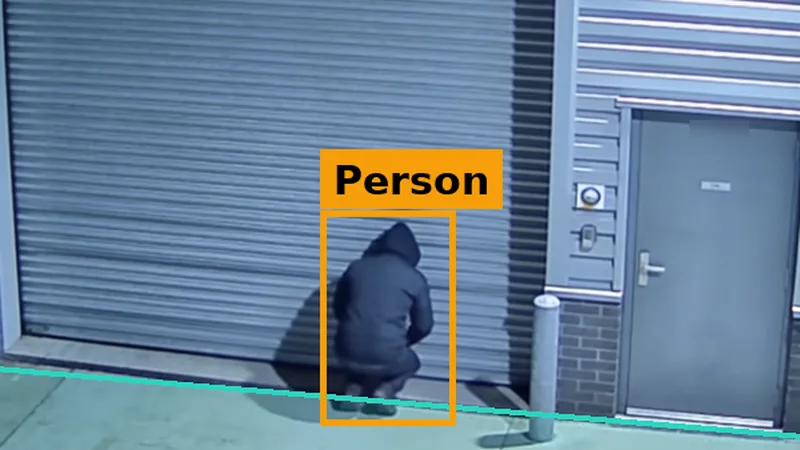
Warehouses and industrial units hold stock, tools and machinery in one place, often on estates that are empty at night. Roller shutters, side doors and roof lights are the usual weak points, and the National Business Crime Centre warns that commercial burglars often plan to leave by a different route from the way they came in, and advises shutting off the power to loading bay shutters overnight. Draw a zone over the loading apron and another inside along the main aisles, armed when the last person locks up. A person at the shutter at 2am becomes an alert with a clip, while the shutter is still down.
People inside or on the apron after hours
Open yards keep materials, plant, vehicles and stock outside, sometimes behind nothing more than a fence. Police advice is to keep the outside tidy, store bins and pallets away from fences so they cannot be used to climb, and light the vulnerable areas. A line drawn neatly along the fence tops flags anyone crossing it, and a zone over the stock area flags anyone walking among it after hours. Keep the zones inside your own boundary so passers-by on the pavement do not set them off.
Line crossing on the fence, people in the yard
Offices, shops and trade counters are usually entered at the back, through a rear door, a fire exit or a window in a side passage where nobody can see. Police advice includes security-rated doors and windows, locks on service doors, and keeping high-value items out of sight from windows. A zone on the rear path catches someone trying the door, and the clip shows what they are carrying. Inside, leave tills open and empty, and keep cash in a safe that is bolted down or banked.
People at rear doors and windows
Most commercial burglaries that take more than a laptop need a vehicle to carry the goods away. The National Business Crime Centre advises controlling vehicle access to delivery areas, and police advice mentions anti-ram bollards where ram raids are a risk. A line on the gateway, armed out of hours, flags a vehicle coming in when it should be shut. It is not number plate recognition, but it shows what arrived, when and which way it went.
Vehicles crossing the gate line after hours
Each area gets its own zone or line and its own schedule, armed when you lock up and disarmed when work starts.
Many businesses already have cameras recording to a recorder in the office. If they are IP cameras, or the recorder supports RTSP or ONVIF, AI detection can usually be added to them. Where there are gaps, such as a fire exit down a side passage or a yard behind the unit, a site assessment will show where one or two extra cameras would help most. Make sure cameras have power and a connection overnight, and that each area is lit well enough for a clear picture at night.
Protect the recorder too. The National Business Crime Centre points out that local recording is of no use if the storage is stolen along with everything else. Keep the recorder in a locked room or cabinet, and consider a copy of key clips off site.
Think about the approach as well as the door. A camera that sees the fence or the gate gives you warning before anyone reaches the building, and catches the vehicle the goods will be loaded into. Keep public roads, pavements and neighbours’ property out of your zones, for privacy and to keep alerts focused on your own site.
How does AI detection on CCTV help prevent burglary?
Ordinary CCTV records. Unless someone is watching live, footage is usually looked at after the break-in, when the stock has gone. That can help the police, but it does not stop the burglary. Woodcock AI watches the camera feeds for you and raises an alert when something you care about happens, so someone can act while the intruders are still outside the building or only just inside.
- Intrusion detection. Flags a person in a zone you draw, such as the loading apron, the rear door path or the warehouse floor, outside working hours. See intrusion detection.
- Line crossing. Flags a person or vehicle crossing a line you draw, such as the top of the fence or the yard gateway. See line-crossing detection.
- Vehicle detection in zones. Flags a vehicle entering a zone, such as the gate apron or the loading bay, when the site should be shut. It is not number plate recognition. See vehicle detection.
- Polygon zones and schedules. You draw each zone to fit the area, such as the apron but not the road beside it, and set when it is armed. The yard can be armed at six and the rear door at seven, each to suit the way the site works. See polygon detection zones.
- Self-learning. The system learns from feedback on alerts at your site, so it gets better at telling real events from things that are not, such as headlights on a shutter or a fox in the yard. See self-learning AI.
- Smoke and fire detection. The same cameras can flag visible smoke and flame. Burglaries and fires are sometimes linked, and bin stores and yards are common places for fires to start. See smoke and fire detection.
Each alert goes to the app with a short clip, and by email, so the owner, the site manager, the keyholder or the security firm can see in seconds what is happening. Detection runs on an edge server on site or on a cloud server, and connects to IP cameras and recorders over RTSP or ONVIF, including Hikvision. Woodcock AI detects people and vehicles; it does not identify who anyone is. You will also soon be able to ask your cameras questions about what happened on site; Ask your cameras is coming soon, early 2027.
AI alerts work alongside an intruder alarm rather than replacing it. An alarm tells you a door or a space inside has been breached. A camera alert can tell you earlier, when someone is still at the fence, the gate or the shutter, and the clip shows what is actually happening, which helps whoever is deciding whether to attend or call the police.
The difference is time. A break-in found at 7am has had all night to finish. An alert at 01:46 showing a person crouched at the shutter gives someone the chance to call the police before the shutter is open.
Will I get alerts every time a cat walks past?
Not if the zones and schedules are set up well. Old motion-detection systems flagged any change in the picture, from a moving branch to rain on the lens, and people soon stopped looking. AI detection looks for specific things, such as a person or a vehicle, inside a zone you have drawn or crossing a line, during the hours you have set.
Three things keep alerts useful. First, zones: draw them over the apron, the door path or the fence, not the whole picture, and leave out the road and the pavement. Second, schedules: arm each zone only when nobody should be there, and plan in cleaners, late deliveries and early starts. Third, feedback: mark alerts as useful or not, and the self-learning system uses that to improve at your site. Our guide to reducing CCTV false alarms goes into more detail.
Some false alerts will still happen, especially in the first days while zones and schedules are tuned. The aim is that when your phone goes off at night, it is worth looking at.
What happens when you report a burglary to the police?
Police responses vary by force and by what is happening. In the 2023 survey, premises that reported crime most often said the police attended the scene (45% of such premises, for at least one crime), gave a crime reference number (29%) or acknowledged the report (28%), while 20% said the police did nothing or very little. Satisfaction was mixed: 41% were dissatisfied with the police response and 35% satisfied.
Two things improve the odds. The first is speed: a 999 call about a break-in that is happening now, with a clear description of where and what, is a different call from a report the next morning. The second is evidence: a clip with a clear picture, the right date and time, and a note of which way people went. The National Business Crime Centre points out that the date and time need to be part of the recording before video can be used in a prosecution, and Secured by Design recommends recognition-quality images. Footage only helps if it can be found and exported quickly, so make sure more than one person knows how.
What should happen when an alert fires at night?
Agree the plan before you need it. Who gets alerts at night and at weekends? Who attends, and when? When is it a 999 call? Who boards up a broken door?
- Check the clip. It shows within seconds whether it is a fox, a cleaner back for a forgotten bag, or a person at the shutter.
- Call 999 if a crime is in progress. Give the address, where on site, and what you can see: how many people, what vehicle, which way they are heading. Report it afterwards on 101 or online if it has already happened.
- Never confront intruders. Do not go into the building alone. Use a keyholder response service or a security firm, and wait for the police.
- Report and record. Save the clip, report the crime, tell your insurer, and secure the building. Make a list of what was taken, with serial numbers where you have them.
After a break-in, look at how they got in and how they left. Fix that first, then check whether the same weakness exists elsewhere on site. Burglars who found it easy once may come back.
Do I need a security guard, an alarm or cameras?
It depends on the site, the value at risk and how quickly someone can respond. Avon and Somerset Police list an SIA-licensed guard, a monitoring station with remote access, and an accredited CCTV system among the options for protecting commercial property. A guard gives a physical presence but is expensive to keep on every night, and one person cannot see every corner of a large site. An alarm is essential for most premises but only tells you once someone is in. AI alerts on existing CCTV fill the gap, by watching the outside of the building and telling the right person, or the guard, where to look. Our comparison of AI CCTV and security guards covers the trade-offs.
How do you get started?
Start with the ways in: the fence, the gate, the shutters, the rear doors and any hidden windows. Check what cameras you already have, how they record, whether they can see those places at night, and whether the recorder is protected. Then plan zones, lines and schedules for each area, and agree who gets which alert.
Our site assessment looks at the cameras already on site, the routes burglars are likely to use, and the zones, lines and schedules that would cover them. If you want to see it working first, we can run a live test on your cameras: we connect two or three of them for about a fortnight, so you see the alerts on your own site before you decide. An on-site demo is also available.
For businesses with several units, depots or branches, the same approach scales. Each site gets its own zones and schedules, and alerts can go to the manager responsible for that site, a security firm, or both.
What about privacy and data protection?
If your cameras capture people, data protection law applies. The Information Commissioner’s Office has guidance on CCTV and video surveillance. Have a clear purpose, point cameras at your own property as far as possible, put up signs, keep footage only as long as you need it, keep it secure, and be ready to handle requests for footage. Secured by Design also advises avoiding the street scene where you can. Our guide to GDPR and AI CCTV covers this in more detail.
Polygon zones help here too. Drawing zones on your own yard, doors and fence, and leaving public roads, pavements and neighbours’ land out, keeps alerts focused where they should be. Staff should know that cameras are in use and what they are for.
What are the limits?
- A camera needs a view. It cannot see a door hidden behind a wall or a roof with no camera on it.
- It needs light or a camera that works in the dark. Check what your cameras see at night.
- It needs power and a connection. If the power or internet goes off, cameras and alerts stop. Plan for this.
- It does not replace locks, alarms or doors. It tells you something is happening; physical security slows it down.
- It does not read number plates or identify people. It flags people and vehicles in zones and on lines; the clip shows what happened.
- Someone has to respond. An alert is only useful if someone acts on it.
Sources
- Home Office, Crime against businesses: findings from the 2023 Commercial Victimisation Survey.
- Office for National Statistics, Crime in England and Wales: year ending June 2026 (22 October 2026).
- Police.uk, Keep burglars out of your business.
- National Business Crime Centre, Commercial burglary (PDF).
- Secured by Design, CCTV security advice.
- Avon and Somerset Police, Securing your commercial property.
- legislation.gov.uk, Theft Act 1968, section 9.
- Information Commissioner’s Office, CCTV and video surveillance guidance.
We have summarised these sources in our own words. Always read the current versions in full. This page is general guidance, not legal, insurance or security advice; your insurer, the police and a competent security adviser decide what applies to your premises.
Worried about a break-in?
Book a site assessment and we will look at the cameras on site and plan zones, lines and schedules for the fence, the gate, the shutters and the rear doors, plus who gets which alert. Or ask for a live test on your cameras first: we connect two or three of them for about a fortnight.
Related pages
Frequently asked questions
How do I protect my business from burglary?
Make the site look protected with lighting, tidy grounds and visible cameras; slow intruders down with security-rated doors, shutters, locks and fences; fit a monitored alarm; and use CCTV that alerts someone when a person or vehicle enters a zone or crosses a line after you have locked up.
How common is burglary against businesses?
In the Home Office 2023 Commercial Victimisation Survey, 8% of business premises in England and Wales experienced a burglary or attempted burglary in the previous year. Police recorded 222,304 burglaries, homes and businesses together, in the year ending June 2026, down 6%.
What is the legal definition of burglary?
In England and Wales, section 9 of the Theft Act 1968 covers entering a building or part of a building as a trespasser intending to steal, cause grievous bodily harm or do unlawful damage, or stealing or causing such harm after entering as a trespasser.
Does CCTV stop business burglaries?
Visible CCTV with signs helps deter, and good footage helps the police. Recording alone usually shows what happened afterwards. CCTV with AI detection can alert you when someone is at the fence, the gate or the shutter after hours, so someone can act before the building is entered.
Where should CCTV cameras go on a business premises?
Cover the ways in and out: the fence line, the gate and entrance apron, loading shutters, rear and side doors, windows out of sight of the road, and the yard where stock is kept. Keep public roads and neighbours out of view as far as possible, and protect the recorder.
Can Woodcock AI work with the cameras I already have?
Usually, yes. It connects to IP cameras and recorders over RTSP or ONVIF, including Hikvision, and runs on an edge server on site or on a cloud server. It flags people, vehicles, line crossings, smoke and flame in zones you draw.
Last reviewed 31 October 2026
Vandalism is as common as burglary against business premises. See our vandalism prevention guide.