

Vandalism: see them at the shutter, not in the morning
To prevent vandalism at business premises, make the site look cared for and watched, make it harder to damage, and find out quickly when someone is on site after hours. That means good lighting, tidy grounds and visible cameras; shutters, grilles, tougher glazing and anti-graffiti coatings; prompt repair and graffiti removal; and CCTV that alerts you when a person or vehicle enters a zone or crosses a line after closing. The Home Office found that 8% of business premises experienced vandalism in a year.

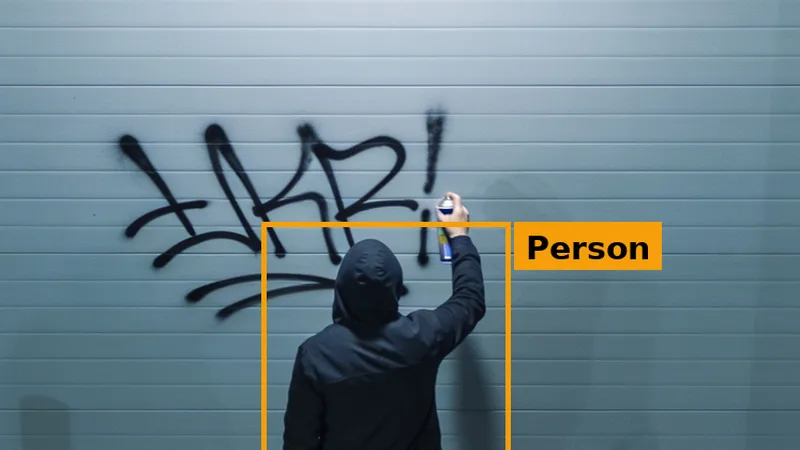
Last updated 31 October 2026. Vandalism costs businesses far more than the price of a can of spray paint. A tag on a shutter, a smashed pane in a showroom, a kicked-off van mirror or a bent fence panel all have to be cleaned, repaired or replaced, and while the damage stays in place it tells everyone passing that nobody is looking after the site. This guide covers what counts as vandalism and criminal damage in UK law, what the latest figures show, why some sites are targeted again and again, the measures police recommend, where cameras should watch, and how AI detection on your existing CCTV can tell you someone is on site after hours while there is still time to act.
What counts as vandalism or criminal damage?
Vandalism is not a separate offence in England and Wales. It is criminal damage under section 1 of the Criminal Damage Act 1971. In short, a person commits criminal damage if, without lawful excuse, they destroy or damage property belonging to someone else, either intending to do so or being reckless about whether it would be destroyed or damaged. Police.uk describes vandalism as property being maliciously destroyed or damaged, frequently without theft being involved.
The Act also sets out more serious forms. Under section 1(2), it is an offence to destroy or damage property intending to endanger life, or being reckless about whether life would be endangered, and this applies even to your own property. Under section 1(3), criminal damage by fire is charged as arson. That is why vandalism and arson often go together in police advice: the same person who smashes a window or breaks into a bin store may set fire to what is inside. Our arson prevention guide covers that side.
Is graffiti criminal damage?
Yes. The police advice service Ask the Police confirms that graffiti is an offence of criminal damage and can be reported to your local force via 101. Under section 43 of the Anti-social Behaviour Act 2003, an authorised officer of a local authority can give a penalty notice to someone they have reason to believe has committed a graffiti or fly-posting offence in the authority’s area. Section 54 of the same Act makes it an offence to sell an aerosol paint container to a person under 16.
Scotland has its own law, where the equivalent offences are vandalism under the Criminal Law (Consolidation) (Scotland) Act 1995 and malicious mischief at common law. The prevention advice in this guide applies across the UK.
How common is vandalism against businesses?
The best picture of crime against business premises comes from the Home Office’s Commercial Victimisation Survey. It measures a specific set of crimes: burglary, vandalism, vehicle-related theft, robbery, assaults or threats, theft and fraud. In the 2023 survey, an estimated 26% of premises in England and Wales, around 409,000, were victims of at least one of these crimes in the previous 12 months. Theft was the most common, at 14% of premises, followed by burglary including attempts (8%), vandalism (8%) and assaults or threats against staff or customers (7%). Premises in the wholesale and retail sector had the highest rate, with 41% experiencing at least one crime.
Put another way, roughly one business premises in twelve is damaged by vandals in a typical year. Avon and Somerset Police make the same point in their vandalism advice for businesses, citing Home Office data that almost 8% of commercial premises fall victim to criminal damage each year, and calling vandalism a persistent issue for UK businesses.
Wider figures from the Office for National Statistics show the long-term direction. Its bulletin for the year ending June 2026 reports that the Crime Survey for England and Wales estimated around 656,000 incidents of criminal damage, no statistically significant change on the year before. That is 46% lower than the 1.2 million estimated in the year ending March 2016, and 81% below the peak of 3.4 million in the year ending December 1995. The survey counts crimes against households, not businesses, but it shows how far criminal damage has fallen over time.
Police recorded crime does include offences against businesses. Police in England and Wales recorded 435,285 criminal damage offences in the year ending June 2026, no change on the 434,846 of the year before. That is still more than 1,100 recorded offences a day, and many incidents are never reported: a tag that is painted over, or a cracked pane replaced without a call to the police, never appears in any figure.
What does vandalism cost a business?
The direct cost is the repair. Replacing a large pane of shopfront glass, respraying a shutter, straightening or replacing fence panels, fixing a smashed cabin window or a van mirror: each job means a call-out, materials and time. Some damage, such as etched glass or paint on brickwork, is hard to remove without specialist cleaning.
The indirect costs are often larger. A broken window has to be boarded before the site can be left. A damaged van is off the road and jobs are rescheduled. A shop with graffiti across the shutter looks less inviting to customers the next morning. Staff arriving to find damage lose time and sometimes their sense of safety at work. Damage to locks, fences and gates can also leave the site open to theft until it is fixed.
Then there is the knock-on effect on insurance. Small claims for damage can raise premiums and excesses, and many businesses absorb the cost rather than claim, which is one reason the true cost of vandalism is hard to measure. Repeated damage at the same site is also a warning sign: it can be a precursor to break-ins or deliberate fires.
Why do vandals pick some sites and not others?
Most vandalism is opportunist. People damage what is easy to reach, where they think nobody is watching and where there is little chance of being interrupted. Police advice returns to the same few factors again and again.
- Nobody around. Industrial estates, depots, building sites and closed shops are empty at night and at weekends. Police.uk notes that a property that cannot be seen from the street can be a more tempting target.
- Dark corners. Unlit loading bays, side passages and car parks let people work unseen. Avon and Somerset Police recommend motion-sensor floodlights in places such as loading bays and car parks.
- Things lying around. Police.uk puts it simply: rubbish attracts rubbish. Ladders, wheelie bins, pallets and loose materials can be used to climb, to throw or to damage property.
- Damage left in place. A site that already has graffiti or broken glass looks uncared for, and others are more likely to add to it.
- Blank surfaces. Police.uk notes that white walls attract vandals with spray cans; plain shutters and hoardings facing a busy route do the same.
The common thread is that vandals, like most offenders, do not want to be seen or caught. Anything that makes a site look watched and well kept, and anything that means someone actually finds out while they are there, makes it less attractive.
What measures help prevent vandalism?
Police advice for businesses and for property generally is consistent. Avon and Somerset Police, police.uk and Secured by Design describe a mix of physical protection, lighting, tidy grounds and cameras.
Make the building harder to damage
- Roller shutters and grilles. Shutters cover windows and doors when the premises are closed, and fixed or retractable grilles can protect vulnerable side or rear windows. Externally fitted shutters may need planning permission, so check with your council.
- Tougher glazing. Avon and Somerset Police suggest polycarbonate or acrylic sheeting so glass does not shatter on impact. Police.uk mentions security film, which makes glass harder to smash.
- Doors and locks. Multi-point locks and steel latch guard plates stop doors being levered or the lock being jammed.
- Anti-graffiti coatings. Coatings that stop paint and marker from bonding make it quicker and cheaper to clean signs, shutters and metal enclosures.
Make the site look cared for and watched
- Lighting. Police.uk recommends dusk-till-dawn, low-level white lighting in vulnerable areas, mounted at least three metres up in vandal-resistant casings. Bright, even lighting also helps cameras capture clear images.
- Tidy grounds. Lock away wheelie bins and outdoor furniture, which Avon and Somerset Police note can be used to climb onto a roof or damage property, and clear loose materials, ladders and pallets.
- Visible cameras. Avon and Somerset Police advise positioning CCTV at least 2.5 to 3 metres above the ground, out of reach to help prevent tampering, covering entry points and blind spots. Secured by Design says cameras in high-crime areas may need vandal-resistant housings and should not be easily accessible.
- Clear boundaries. A fence, wall or planting that marks where your property starts, with nothing next to it that can be used to climb over.
Repair quickly and find out early
- Fix damage fast. Clean graffiti, replace broken glass and repair fences as soon as you can, so the site does not look neglected.
- CCTV that alerts. Recording shows what happened. Alerts tell someone while it is happening, so they can check the clip and call the police.
- A response plan. Decide who gets alerts out of hours, who attends and when to call 999.
Where should cameras watch for vandalism?
Start with the places that get damaged and the routes people take to reach them. On most business sites that means the frontage with its glass and shutters, any parked vehicles, cabins and plant, bins and pallets, and the fence line round the back.
Where is your site most exposed?
Glazed frontages, roller shutters and signs face the street, which is why they are the most common targets for graffiti, scratching and broken glass. Avon and Somerset Police suggest roller shutters, external grilles on vulnerable side or rear windows, polycarbonate or acrylic sheeting so glass does not shatter, and an anti-graffiti coating on signs and metal enclosures. A zone drawn on the paving or apron in front of the glass, armed from closing time, flags anyone standing at it, while the pavement beyond stays out of the zone.
People at glass, doors and shutters after closing
Parked vans and cars are easy to damage: mirrors kicked off, tyres let down, panels scratched, windows smashed. Damage to a work van also means a vehicle off the road and jobs missed. Draw a zone over the parking area, armed when the last van returns, so anyone walking between the rows at night is flagged. Vehicle detection in zones flags a car or van pulling in after hours. It is not number plate recognition, but the clip shows what arrived and when.
People and vehicles among parked vans
Building sites are empty every night and weekend, with cabins, plant and materials behind temporary fencing. Damage ranges from smashed cabin windows to graffiti on hoardings and plant interfered with. A zone on the ground in front of the cabins and another over the plant parking area, armed after the last person leaves, catches someone at the windows. Many sites already have cameras on poles that can be connected; where they do not, a site assessment shows where one or two would help most.
People at cabins, plant and materials
Fences and gates get bent, cut or pushed in, sometimes just for the sake of it and sometimes as the way in for more damage. Police advise keeping bins, ladders and anything else that could be used for climbing tidied away and locked up. A line drawn neatly along the fence tops flags anyone crossing it, and a zone over the yard flags anyone walking among the stock or pallets after hours, so a pushed-in panel is spotted that night rather than the next morning.
Line crossing on the fence, people in the yard
Each part of the site gets its own zone or line, with its own schedule, armed when you lock up and disarmed when work starts.
Many businesses already have cameras recording to a recorder in the office. If they are IP cameras, or the recorder supports RTSP or ONVIF, AI detection can usually be added to them. Mount cameras high and out of easy reach, as police advise, and make sure each area is lit well enough for a clear picture at night.
Keep the zones on your own property. A frontage camera will often see the pavement and the road; drawing the zone on your apron or forecourt, not the whole picture, means people walking past do not set off alerts, and keeps cameras focused where they should be for privacy.
How does AI detection on CCTV help?
Ordinary CCTV records. Footage is usually looked at the next morning, after the damage is done. That can help the police, but it does not stop the damage. Woodcock AI watches the camera feeds for you and raises an alert when something you care about happens, so someone can act while the person is still on site.
- Intrusion detection. Flags a person in a zone you draw, such as the apron in front of the shutters, the forecourt by the glass or the ground by the cabins, outside working hours. See intrusion detection.
- Line crossing. Flags a person or vehicle crossing a line you draw, such as the top of the rear fence or the yard gateway. See line-crossing detection.
- Vehicle detection in zones. Flags a vehicle entering a zone, such as the van park, when the site should be shut. It is not number plate recognition. See vehicle detection.
- Polygon zones and schedules. You draw each zone to fit the area, such as the forecourt but not the pavement beside it, and set when it is armed. See polygon detection zones.
- Self-learning. The system learns from feedback on alerts at your site, so it gets better at telling real events from things that are not, such as headlights sweeping across a shutter. See self-learning AI.
- Smoke and fire detection. The same cameras can flag visible smoke and flame, which matters because vandalism and deliberate fires often go together. See smoke and fire detection.
Each alert goes to the app with a short clip, and by email, so the owner, the site manager, a keyholder or a security firm can see in seconds what is happening. Detection runs on an edge server on site or on a cloud server, and connects to IP cameras and recorders over RTSP or ONVIF, including Hikvision. Woodcock AI detects people and vehicles; it does not identify who anyone is. You will also soon be able to ask your cameras questions about what happened on site; Ask your cameras is coming soon, early 2027.
The difference is time. Graffiti found at 7am has had all night to dry. An alert at 01:12 showing someone at the shutter gives a chance to call the police while they are still there, and a clip with the time, the place and the direction they went.
Will people walking past set it off?
Not if the zones and schedules are set up well. Old motion detection flagged any change in the picture, from a moving branch to rain on the lens. AI detection looks for specific things, such as a person or a vehicle, inside a zone you have drawn or crossing a line, during the hours you have set.
For vandalism this matters more than most, because frontages face the street. Draw the zone on your own apron, forecourt or car park and leave the pavement out, so passers-by are ignored and someone stepping up to the glass is not. Arm each zone only when nobody should be there, allowing for cleaners and early starts. Mark alerts as useful or not, and the self-learning system uses that feedback to improve at your site. Our guide to reducing CCTV false alarms has more detail.
How do you report vandalism and get graffiti removed?
If someone is damaging your property now, call 999. Ask the Police advises that where the suspect has left, the crime is not in progress and there is no danger to life, you should contact your local force on 101 or online. Give as much detail as you can: how many people, the extent of the damage, when it happened, and whether you have images or footage.
For graffiti, report it to the police as criminal damage, and to your council. Ask the Police explains that local authorities are responsible for cleaning graffiti from public buildings and fixtures, can also clean it from private buildings, and can bill the owner for the work. Many councils have an online form for reporting graffiti. Whoever does it, remove graffiti quickly: tags left in place tend to attract more.
Before cleaning or repairing, photograph the damage and save the clip. Your insurer may want them, and the police will need them if anyone is identified later. Make sure the recording carries the correct date and time, and that more than one person knows how to export footage.
What should happen when an alert fires at night?
Agree the plan before you need it. Who gets alerts at night and at weekends? Who checks the clip? When is it a 999 call? Who boards up a broken window or arranges graffiti removal?
- Check the clip. It shows within seconds whether it is a fox, a delivery driver in the wrong place, or someone with a spray can.
- Call 999 if damage is happening now. Give the address, where on site and what you can see.
- Never confront anyone. Do not go to the site alone. Use a keyholder service or a security firm, and wait for the police.
- Record and repair. Save the clip, photograph the damage, report it, tell your insurer if needed, and get it fixed or cleaned quickly.
After an incident, look at where the person came from and what they could reach. Move bins, lock away ladders, add lighting, or extend a zone so the same spot is covered next time.
How do you get started?
Walk the site after dark. Note the glass, shutters, signs, vehicles, cabins and fences that face a route people use, and the places that have been damaged before. Check what cameras you already have, whether they can see those places at night, and whether they are high enough to be out of reach.
Our site assessment looks at the cameras already on site, the parts of it most exposed to damage, and the zones, lines and schedules that would cover them. If you want to see it working first, we can run a live test on your cameras: we connect two or three of them for about a fortnight, so you see alerts on your own site before you decide. An on-site demo is also available.
What about privacy and data protection?
If your cameras capture people, data protection law applies. The Information Commissioner’s Office has guidance on CCTV and video surveillance. Have a clear purpose, point cameras at your own property as far as possible, put up signs, keep footage only as long as you need it, keep it secure, and be ready to handle requests for footage. Secured by Design also advises against capturing the street scene unless you comply with the ICO’s requirements. Our guide to GDPR and AI CCTV covers this in more detail.
Polygon zones help here. Drawing zones on your own forecourt, yard and fence, and leaving pavements, roads and neighbours’ land out, keeps alerts where they should be.
What are the limits?
- A camera needs a view. It cannot see a wall round a corner with no camera on it.
- It needs light or a camera that works in the dark. Check what your cameras see at night.
- It needs power and a connection. If either goes off, cameras and alerts stop.
- It does not replace shutters, glazing or repairs. It tells you something is happening; physical measures make damage harder.
- It does not read number plates or identify people. It flags people and vehicles in zones and on lines; the clip shows what happened.
- Someone has to respond. An alert is only useful if someone acts on it.
Sources
- Home Office, Crime against businesses: findings from the 2023 Commercial Victimisation Survey.
- Office for National Statistics, Crime in England and Wales: year ending June 2026 (22 October 2026).
- legislation.gov.uk, Criminal Damage Act 1971, section 1.
- legislation.gov.uk, Anti-social Behaviour Act 2003, section 43 and section 54.
- Police.uk, Protect your property against vandalism.
- Avon and Somerset Police, Protecting against vandalism.
- Ask the Police, What is the law with regards to graffiti?
- Secured by Design, CCTV security advice.
- Information Commissioner’s Office, CCTV and video surveillance guidance.
We have summarised these sources in our own words. Always read the current versions in full. This page is general guidance, not legal, insurance or security advice; your insurer, the police and a competent security adviser decide what applies to your premises.
Tired of cleaning up after vandals?
Book a site assessment and we will look at the cameras on site and plan zones, lines and schedules for the frontage, the vehicles, the cabins and the fence, plus who gets which alert. Or ask for a live test on your cameras first: we connect two or three of them for about a fortnight.
Related pages
Frequently asked questions
How can a business prevent vandalism?
Make the site look cared for and watched with lighting, tidy grounds and visible cameras mounted out of reach; protect glass and doors with shutters, grilles, tougher glazing and anti-graffiti coatings; repair damage and remove graffiti quickly; and use CCTV that alerts someone when a person or vehicle is on site after closing.
Is vandalism a crime in the UK?
Yes. In England and Wales vandalism is criminal damage under section 1 of the Criminal Damage Act 1971: destroying or damaging property belonging to another without lawful excuse, intending to or being reckless about it. Damage by fire is charged as arson.
Is graffiti criminal damage?
Yes. Graffiti is criminal damage and can be reported to the police. Councils can issue penalty notices for graffiti under the Anti-social Behaviour Act 2003, and it is an offence to sell aerosol paint to anyone under 16.
How common is vandalism against businesses?
In the Home Office 2023 Commercial Victimisation Survey, 8% of business premises in England and Wales experienced vandalism in the previous year, as many as experienced burglary. Police recorded 435,285 criminal damage offences in the year ending June 2026.
Who removes graffiti from business premises?
Councils clean graffiti from public buildings and fixtures and can clean it from private buildings, billing the owner. Many businesses arrange their own cleaning. Either way, photograph it and report it first, then remove it quickly so it does not attract more.
Can Woodcock AI work with the cameras I already have?
Usually, yes. It connects to IP cameras and recorders over RTSP or ONVIF, including Hikvision, and runs on an edge server on site or on a cloud server. It flags people, vehicles, line crossings, smoke and flame in zones you draw.
Last reviewed 31 October 2026