

Vacant property security for empty commercial buildings
An empty building is at its most exposed in the weeks after the tenant leaves. Insurers often treat a property as unoccupied after 30 days and then expect weekly recorded inspections, the building secured, combustibles cleared and services off. Good vacant property security layers locks and boarding with fast detection: AI on the CCTV already on site flags anyone crossing a fence, entering a yard or approaching a door, and spots smoke or flame, with a clip on your phone to act on.

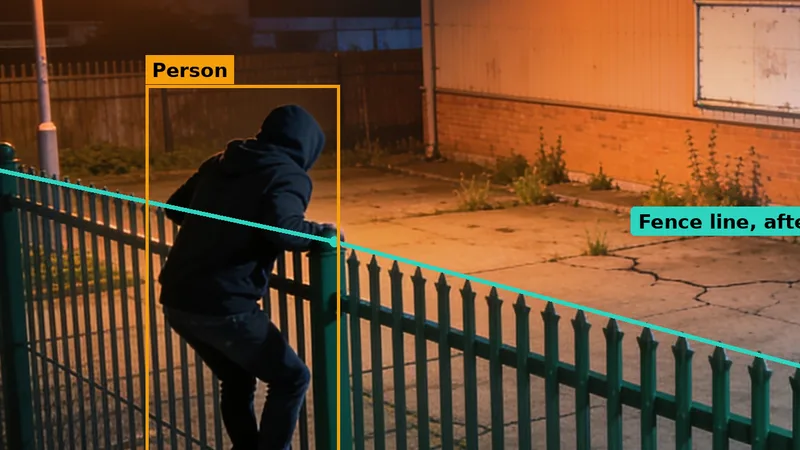
Last updated 31 October 2026. When a tenant moves out, a business closes or a site is cleared for redevelopment, the building does not stop needing protection. It needs more. Nobody is there to notice a forced door, a burst pipe, a fire in the bins or people moving in. This guide covers what makes empty buildings a target, what insurers usually expect once a property is unoccupied, the dates that matter for insurance and business rates, the law on squatters and trespassers, and how AI detection on the cameras you already have can tell you the moment someone gets in, rather than when the next inspection finds the damage.
Why are empty buildings targeted?
Because nobody is watching. An occupied building has people coming and going, lights on, deliveries, and someone who would notice a broken window within the hour. An empty one has none of that. The signs that a building is empty are easy to read from the street: no cars, post or leaflets piling up, weeds in the yard, a letting board on the fence. Anyone looking for somewhere to break into, strip, sleep, party or set alight can see it too.
The RICS Property Journal article Insuring empty property sums up the extra risks plainly: a small water leak left unchecked can become a major issue, and an empty building is more likely to attract vandals, arsonists and squatters, while metals in the building fabric appeal to thieves. Losses, and the claims that follow, can be significant. That is why insurers treat empty buildings differently, and why standard insurers are not always keen to cover them.
The common threats are easy to list:
- Break-ins and theft. Cable, copper pipe, boilers, roof lead, fittings and anything left behind.
- Vandalism. Smashed windows, graffiti and damage that makes the building harder to let or sell.
- Arson. Rubbish set alight against a door, or a fire started inside. Our arson prevention guide covers the national figures on deliberate fires.
- Squatters and unauthorised occupation. People moving in, which can take weeks and legal action to resolve.
- Fly-tipping. An empty yard or car park becomes somewhere to dump waste. See our fly-tipping CCTV guide.
- Trespass and injury. People climbing on roofs or exploring a derelict building, and getting hurt.

The picture above shows how quickly an empty site starts to look tired. A bent pale on a side gate, never repaired because nobody is there, is an invitation. Most of the damage done to empty buildings starts with small, visible signs that nobody is responding.
What does your insurer expect when a building is empty?
First, to be told. RICS stresses that there is an ongoing duty to disclose anything that could affect cover, and that owners or brokers must notify insurers when a property becomes empty so the insurer can decide whether to keep covering it. Policyholders do not automatically have to switch policies, but they do have to have the conversation.
There is no single industry rule for when a building counts as empty. RICS notes that insurers tend to regard 30 days as the point at which a property is deemed unoccupied. From then on, cover may be restricted, standard unoccupancy conditions applied, or excesses increased. For buildings that will stay empty a long time, it is common for cover to be cut back to fire, lightning, explosion and aircraft, known as FLEA cover, with accidental damage removed.
Partly empty buildings catch people out. A multi-let estate or a shopping centre with a few vacant units may be subject to the same unoccupancy conditions for those units, so it is important to know exactly what is let and what is not.
RICS lists the kind of extra information insurers may want for an empty building. Is it being inspected, and how often? Are the central services drained and turned off? Is a fire or security alarm working, what type, and how is it monitored? Is there CCTV? Is a security firm patrolling? Are the buildings secured and boarded up?
The flip side is useful. RICS also points out that precautions beyond the policy conditions, such as a secure fenced and gated site that is difficult to get into, could prove favourable to the terms you are offered. Telling your broker what you have in place, including cameras that raise alerts rather than just record, is worth doing.
What are typical unoccupied buildings conditions?
Every policy is different, so the only conditions that matter are the ones in your own wording. But the same themes come up again and again. Insurance law firm Fenchurch Law, in Unoccupied Buildings conditions: a trap for the unwary, gives typical examples for commercial policies: the empty property, or the empty part of it, must be inspected once a week, often with a record of each inspection kept; it must be secured against illegal entry; it must be kept free of combustible material; and it must be disconnected from mains services.
Fenchurch Law explains why the detail matters. If a condition is written as a condition precedent to the insurer’s liability, it has to be complied with absolutely, and any breach can let the insurer deny the claim. If it is not, the question becomes whether the breach prejudiced the insurer. The Insurance Act 2015 also has a bearing on whether an unrelated breach can be relied on, but there is little case law on how that applies to unoccupancy conditions. The safe course is simple: know your conditions and be able to prove you met them.
RICS adds practical tips of its own. Check how your policy defines unoccupied. Board up windows if the building will be empty for any length of time. Seal the letterbox so nobody can push lit rags through it. Turn off services. Clear away anything that can be taken, used or cause injury. And keep proof of every visit: RICS suggests that if you do not have CCTV, you take a date-stamped photograph each time, and that proof of a daily visit from a security firm is better still.
That last point is where cameras help most. A camera that only records leaves you with hours of footage nobody watched. A camera with AI detection gives you a log of every person or vehicle that came onto the site, with a short clip and a time for each one, alongside the record of your own inspections.
What dates matter once a building is empty?
Two clocks start running when a building empties: the insurance clock and the business rates clock.
On insurance, as above, many policies treat a building as unoccupied after around 30 days, but your wording decides. Notify your broker as soon as you know the building will be empty, not when the 30 days are up.
On business rates in England, GOV.UK explains empty property relief: you do not have to pay business rates on an empty property for three months from when it becomes empty, and after that most businesses must pay full rates. Industrial premises, such as warehouses, are exempt for a further three months. Listed buildings and some other categories get extended relief until they are reoccupied.
There is also a reoccupation rule. Since 1 April 2024, under the Non-Domestic Rating (Unoccupied Property) (England) (Amendment) Regulations 2024, a property has to be occupied for 13 weeks, rather than the old six weeks, before a fresh period of empty property relief can start. Short lets of a few weeks no longer reset the clock.
The practical point is that many empty buildings sit for months, and the costs keep running. The longer a building is empty, the more it matters that you hear about problems early, before a small leak or a broken window becomes a stripped building or a fire. Rates rules differ in Scotland, Wales and Northern Ireland, so check with your council.
What can you do about squatters?
GOV.UK’s guide Squatting and the law covers England and Wales. Squatting in a residential building, such as a house or flat, is a crime. Squatting in a non-residential building or on land is not in itself a crime, but damaging the property is, and it is usually a crime not to leave when told to by the owner, the police, the council or a repossession order.
If people have moved into your property, GOV.UK explains how to remove squatters. You can apply for an interim possession order, but only if it has been 28 days or less since you found out the property was squatted. After that you need an ordinary claim for possession. GOV.UK is also clear that you must not try to remove squatters yourself using force or the threat of force; that is a crime too. It advises calling the police if you see someone breaking into anywhere.
This is why knowing quickly matters so much. It is far simpler to deal with someone breaking in tonight, with a clip showing them forcing the door, than with people who moved in three weeks ago and were only found at the next inspection. An alert at the moment of entry gives you the choice to call the police while it is happening. The clip, with its time, is a record of what happened and when.
Are you liable if a trespasser gets hurt?
Possibly. The Occupiers’ Liability Act 1984, section 1, covers the duty an occupier owes to people other than visitors, which includes trespassers. A duty arises if the occupier is aware of a danger, or has reasonable grounds to believe it exists; knows or has reasonable grounds to believe someone is, or may come, into the vicinity of that danger; and the risk is one the occupier can reasonably be expected to offer some protection against.
The Act also says that the duty can, in an appropriate case, be met by taking reasonable steps to warn of the danger or discourage people from incurring the risk. Fragile roofs, open pits, unstable structures and stripped stairwells on an empty site are the kind of hazards to think about. If you know people are regularly getting onto the roof, that knowledge matters.

Cameras do not replace fixing or fencing off hazards, warning signs or barriers. But they show you whether people are getting in, where, and how often, which helps you decide what to secure first. A roof zone armed day and night, for example, tells you at once if someone is up there, so you can call the police before anyone falls. This is general information, not legal advice; talk to your solicitor and insurer about your own site.
Which kind of empty property is it?
The right camera plan depends on the building. A warehouse between tenants, a factory that has closed, a cleared plot and an empty shop each have different weak points. Choose the closest match below to see where to focus.
What kind of empty property?
A warehouse waiting for its next tenant is often the easiest to protect, because the cameras are already there and nobody should be in the yard at all. Arm the yard, the dock doors and the car park around the clock. A van that drives in at midnight, or a person walking along the dock doors, is an alert with a clip on your phone. Warehouses get a further three months of empty rates relief in England, so the gap can run to six months before the bill and the risk both grow.
People and vehicles, 24/7
A closed factory has metal, cable and fittings worth stealing, and windows and doors that get tested. Boarding helps, but someone working at a rear door or a boarded window for twenty minutes is exactly what an alert should catch. Draw a zone round each door and the boarded ground-floor windows, and arm them all the time. The clip shows whether it is a curious passer-by or someone with tools.
People, 24/7
A cleared site has little to steal, but it attracts fly-tipping, trespass, off-road bikes and fires, and the landowner still owes a duty to people who might get hurt there. A line along the top of the hoarding flags anyone climbing in, while a zone over the access gate catches vehicles. The road outside is left out, so passing traffic never sets off an alert.
Line on the hoarding
An empty shop or office often has a rear yard, service door and bins out of sight of the street. That is where people sleep rough, get in, or set rubbish alight. A zone on the rear door picks up people at night, and smoke and fire detection watches the bins and doorway around the clock. RICS also suggests sealing the letterbox so lit rags cannot be pushed through.
People at night, fire 24/7
Each building gets its own zones and schedules. While nobody is working there, most can stay armed day and night.
Many sites are a mix. An industrial estate may have one empty unit next to three busy ones, in which case the zones and schedules need to cover the empty unit around the clock without alerting on the neighbours’ staff and deliveries. That is what drawing polygon zones on your own part of the site is for.
Where should cameras watch on an empty site?
Think about how someone would get in, where they would go once inside the boundary, and what they would want. On most empty commercial sites, that gives a short list:
- The boundary. A line along the top of the front fence or hoarding flags anyone climbing over. Lines work best where the fence is in clear view and well lit.
- Gates and side access. Side gates, alleyways and gaps in the fence are where people come and go out of sight of the road.
- The yard and car park. With nobody working there, any person or vehicle in the yard is worth knowing about, day or night.
- Doors, shutters and ground-floor windows. The places people try to force. A zone round each one catches the attempt, not just the aftermath.
- The roof. Roof lead, plant and skylights attract thieves, and roofs are where trespassers get hurt.
- Bins, pallets and the rear door. Where rubbish gets set alight. Smoke and fire detection can watch these around the clock.
Most of this can often be done with the cameras already on the building. A tenant leaving rarely means the cameras come down. If the recorder and cameras stay, and they support RTSP or ONVIF, AI detection can usually be added to them. If parts of the site are blind, a site assessment will show where one or two extra cameras would close the gaps.
One practical point: insurers often expect services to be switched off, but cameras, recorders and the connection need power. Check with your insurer and electrician how to keep a supply to the security equipment while the rest is isolated, and make sure the internet connection stays live, because alerts need it to reach phones.
How does AI detection on existing CCTV help?
Ordinary CCTV records. On an empty building, that usually means footage nobody looks at until something has already gone wrong. Woodcock AI watches the camera feeds for you and raises an alert when something you care about happens, so you can act while it is happening.
- Intrusion detection. Flags a person in a zone you draw, such as the yard, a doorway or the roof. See intrusion detection.
- Line crossing. Flags a person crossing a line you draw, such as the top of a fence or hoarding. See line-crossing detection.
- Vehicle detection in zones. Flags a vehicle entering the yard or car park. It is not number plate recognition. See vehicle detection.
- Smoke and fire detection. Flags visible smoke and flame, such as rubbish set alight by a door. See smoke and fire detection.
- Polygon zones and schedules. You draw each zone to fit the area, such as the yard but not the pavement, and set when it is armed. While a building is empty, most zones can be armed all the time. See polygon detection zones.
- Self-learning. The system learns from feedback on alerts at your site, so it gets better at telling a real person or vehicle from things that are not. See self-learning AI.
Each alert goes to the app with a short clip, and by email, so the keyholder, the agent or the security firm can see in seconds what is going on. Detection runs on an edge server on site or on a cloud server, and connects to IP cameras and recorders over RTSP or ONVIF, including Hikvision. Woodcock AI detects people and vehicles; it does not identify who anyone is.
The difference this makes on an empty building is time. A recorded break-in found at the weekly inspection gives you a week-old crime scene. An alert at 02:14 gives you the chance to call the police while the person is still in the yard. In the coming months, you will also be able to ask your cameras questions; that feature, Ask your cameras, is coming soon, early 2027.
Can CCTV help with weekly inspections?
It can support them, but it does not replace them. If your policy says the building must be inspected weekly, someone has to go and inspect it. Cameras cannot see a slow leak inside a wall, a damp ceiling or a failed board on a back window out of view.

Where cameras help is in three ways. First, between visits: something that happens on Tuesday night is known about on Tuesday night, not the following Monday. Second, focus: the alert history tells the inspector where people have been trying to get in, so the visit checks those doors and windows first. Third, records: alongside the inspection log, the clips show what happened on the site and when, which is useful if you ever need to show your insurer what happened.
A simple routine works well. The inspector checks the alert history before the visit, walks the outside, checks every door and shutter, looks inside for water and damage, clears any post and rubbish, and records the visit with the date, time and anything found. Any damage goes to the insurer straight away, and to the police if it is crime.
What other security measures does an empty building need?
Cameras are one layer. Insurers and RICS also expect the building itself to be secure and the site to be cleared of anything that helps an intruder or a fire.
- Secure the building. Lock and check every door and shutter, board ground-floor windows if the building will be empty for a while, and seal the letterbox.
- Secure the boundary. Repair fences and gates, lock gates, and block vehicle access to yards where you can.
- Clear it. Remove waste, pallets, bins and anything combustible from inside and around the building. Remove anything worth stealing that you can.
- Turn off services. Drain water systems and isolate services, keeping a supply to alarms and cameras if your insurer agrees.
- Keep the alarm working. If there is an intruder or fire alarm, keep it maintained and monitored, and tell your broker how.
- Make it look looked after. Clear post, cut back weeds, remove graffiti quickly. A building that looks watched is less inviting.
- Plan the response. Decide who gets which alert, who attends, and when the police are called. Some owners use a keyholding or guarding firm to attend; AI alerts make their visits targeted.
What should happen when an alert fires?
Agree the plan before the building empties. Who receives alerts at night? Who attends? When is it a police matter? Who tells the insurer? Writing it down avoids a missed alert at 2am because everyone assumed someone else had it.
- Check the clip. It shows within seconds whether it is a fox, a person walking past the fence or someone with tools at the door.
- Call the police if a crime is in progress. A break-in happening now is a police matter. Do not go in alone.
- Call 999 for fire. If the clip shows smoke or flame, call the fire service first.
- Inspect. Check the building the next morning, or as soon as it is safe, and secure anything that was damaged.
- Record and report. Save the clip, log what happened, and tell your insurer and the police if there was damage or a crime.
How do you get started on an empty building?
Start before the tenant leaves if you can. Check what cameras and recorders are on site, who owns them, and whether they stay when the tenant goes. Confirm power and internet will stay on for the security equipment. Then talk to your broker about the conditions that will apply, and plan zones and schedules for the empty period.
Our site assessment looks at the cameras already there, the weak points of the building and site, and the zones, lines and schedules that would cover them. If you want to see it working first, we can run a live test on your cameras: we connect two or three of them for about a fortnight, so you see the alerts on your own site before you decide. An on-site demo is also available.
For owners and agents with several empty buildings, the same approach scales: each site gets its own zones and schedules, and alerts can go to whoever is responsible for that building.
What about privacy and data protection?
If your cameras capture people, data protection law applies, even on an empty site. The Information Commissioner’s Office has guidance on CCTV and video surveillance. Have a clear reason for the cameras, point them at your own property as far as possible, put up signs, keep footage only as long as you need it, keep it secure, and be ready to deal with requests for footage. Our guide to GDPR and AI CCTV covers this in more detail.
Polygon zones help: drawing detection zones on your own land and leaving the public pavement and road out keeps alerts focused on your property.
What are the limits?
- A camera needs a view. It cannot see inside rooms it does not cover or round the back of a building with no camera. Placement decides what it can see.
- It needs power and a connection. If the electricity or internet is cut off, cameras and alerts stop. Plan for this when services are isolated.
- It does not replace inspections. Your policy may require physical inspections. Cameras support them; they do not stand in for them.
- It does not read number plates. It flags vehicles and people; the clip shows what happened.
- It sees visible smoke and flame. It does not detect heat, and it does not replace a fire alarm.
- Someone has to respond. An alert is only useful if someone acts on it. Plan who that is.
Sources
- RICS Property Journal, Insuring empty property (May 2019).
- Fenchurch Law, Unoccupied Buildings conditions: a trap for the unwary (January 2020).
- GOV.UK, Business rates relief: empty property relief.
- legislation.gov.uk, Explanatory Memorandum to the Non-Domestic Rating (Unoccupied Property) (England) (Amendment) Regulations 2024.
- GOV.UK, Squatting and the law, including removing squatters.
- legislation.gov.uk, Occupiers’ Liability Act 1984, section 1.
- Information Commissioner’s Office, CCTV and video surveillance guidance.
We have summarised these sources in our own words. Always read the current versions. Business rates and squatting rules above apply to England, or England and Wales; Scotland and Northern Ireland have their own. This page is general guidance, not legal, insurance or security advice; your policy wording, broker, solicitor and council decide what applies to your building.
Got a building about to go empty?
Book a site assessment and we will look at the cameras already on site and plan zones, lines and schedules for the empty period, plus who gets which alert. Or ask for a live test on your cameras first: we connect two or three of them for about a fortnight.
Related pages
Frequently asked questions
When is a commercial property classed as unoccupied for insurance?
It depends on your policy wording. There is no industry standard, but RICS notes insurers tend to treat a property as unoccupied after 30 days, after which cover may be restricted or extra conditions apply. Tell your broker as soon as you know.
What do insurers usually require for an empty building?
Typical conditions include weekly inspections with a record kept, securing the building against illegal entry, removing combustible material and disconnecting mains services. Insurers may also ask about alarms, CCTV, patrols and boarding.
How long do you get business rates relief on an empty property?
In England, three months from when it becomes empty, and a further three months for industrial premises such as warehouses. Since April 2024 it must be reoccupied for 13 weeks before relief can start again.
Is squatting in a commercial building a crime?
In England and Wales, squatting in a non-residential building is not in itself a crime, but damaging the property is, and refusing to leave when told to usually is. You can apply for an interim possession order within 28 days of finding out.
Can CCTV replace weekly inspections of an empty building?
No. If your policy requires inspections, someone still needs to visit. AI alerts tell you about intrusions between visits, show where to focus, and give a timed record of what happened.
Can Woodcock AI use the cameras already on an empty building?
Usually, yes, as long as they stay on site with power and internet. It connects to IP cameras and recorders over RTSP or ONVIF, including Hikvision, and runs on an edge server on site or on a cloud server.
Last reviewed 31 October 2026