

Construction site fire safety: prevent, detect, respond
Construction site fire safety means planning out the causes of fire before work starts: controlling hot work, keeping waste and flammables away from the building and the fence, securing the site against arson, and having a way to warn people and fight a small fire. HSE guidance HSG168 and the insurers’ Joint Code of Practice set the standard. After hours, when nobody is there, AI detection on the site CCTV can flag smoke, flame and intruders with a clip on your phone.

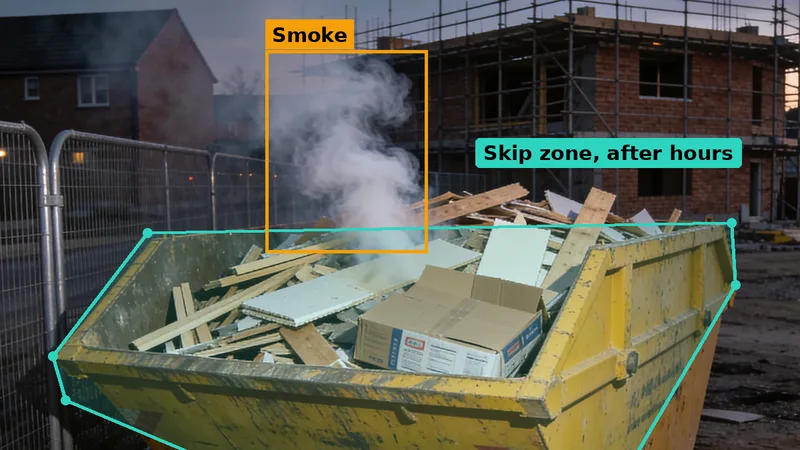
Last updated 31 October 2026. A building under construction is at its most vulnerable to fire. The permanent fire protection it will one day have, such as compartment walls, fire doors, sprinklers and alarms, is either not yet installed or not yet working. At the same time the site is full of things that burn: timber, packaging, insulation, fuel and gas. Add hot work, temporary electrics and a boundary that is only a line of hoarding, and it is easy to see why fire is one of the biggest risks on a build. This guide covers what causes construction site fires, who is responsible, what HSE and the Joint Code of Practice expect, how to prevent arson, the checks needed after hot work and at the end of each day, and where AI detection on the site CCTV fits.
What causes fires on construction sites?
HSE’s guidance HSG168 Fire safety in construction estimates that there are hundreds of construction fires every year in the UK. It describes most of them as low-occurrence, high-consequence events: any one site is unlikely to have a serious fire, but when one happens it can spread quickly, put many people at risk, and cause damage on and off site ranging from tens of thousands to millions of pounds, along with long delays to the programme.
The causes come up again and again in HSE and insurer guidance:
- Hot work. Welding, cutting, grinding, brazing and torch-on roofing throw sparks and heat into places where dust, packaging or timber can catch. Some materials smoulder for a long time before they ignite, which is why the checks after hot work matter so much.
- Arson. HSG168 calls arson a real, substantial problem and risk on all sites, and gives setting fire to external skips as an example. Building sites are easy to get into after dark and full of things to set alight.
- Temporary electrics and equipment. Overloaded temporary supplies, damaged cables, heaters, drying equipment and battery chargers. HSG168 also flags lithium-ion batteries, used in tools, plant and chargers, as a fire risk to plan for.
- Waste and smoking. Offcuts, cardboard, plastic wrap and insulation build up quickly. A discarded cigarette near a skip or a pile of packaging is enough.
- Flammable liquids and gases. LPG for roofing and heating, acetylene and oxygen for cutting, fuel for plant, and solvents, adhesives and paints.
Two things make construction different from a finished building. The first is change: a site in week four looks nothing like the same site in week forty, so the fire risk assessment has to keep up. The second is time. For much of every day and all of every weekend, the site is empty. A fire that starts at 6pm on a Friday can burn for a long time before anyone passing by notices it.
Who is responsible for fire safety on a construction site?
Several pieces of law apply at once. HSE’s page on general fire safety in construction explains that the Regulatory Reform (Fire Safety) Order 2005 sets out the law on general fire safety on site. It requires a responsible person to carry out, and keep up to date, a fire risk assessment and to put appropriate measures in place to minimise the risk to life and property from fire. On a construction site, the responsible person will usually be the main or principal contractor in control of the site.
The Construction (Design and Management) Regulations 2015 add specific duties. Regulation 29 requires suitable and sufficient steps to prevent, so far as is reasonably practicable, the risk of injury from fire or explosion during construction work. Regulation 32 says that where necessary, suitable and sufficient fire-fighting equipment and fire detection and alarm systems must be provided in suitable places, examined and tested at suitable intervals, and properly maintained. Workers must be instructed in using fire-fighting equipment, and anyone doing work with a particular fire risk, such as hot work, must be suitably instructed first.
Clients and designers have duties too. Under CDM, the client must make suitable arrangements for managing the project, and designers should design out fire risks where they can, for example by sequencing works so that walls are closed in quickly and the permanent fire protection goes in as early as possible. HSG168 sets out the role of each dutyholder in detail.
HSE lists five steps for the fire risk assessment: identify the hazards (how a fire could start and what could burn), identify the people at risk, evaluate and act to remove or reduce the risks, record, plan and train, and review regularly as the site changes. Means of escape, a way of giving warning, and a way of fighting fire are the key issues it asks you to cover.
What does the Joint Code of Practice require?
The Joint Code of Practice on the Protection from Fire of Construction Sites and Buildings Undergoing Renovation is published by the Fire Protection Association and produced through RISCAuthority, the insurers’ research scheme. First published in 1992, it is now in its 10th edition, with amendments in January 2023 and May 2025. It is meant to be read alongside HSG168. Its objective is fire prevention, mostly achieved by designing out risks, taking simple precautions and following safe working practices.
The Joint Code matters commercially because insurers often make it a condition of cover. HSG168 itself notes that on larger projects insurers will normally require compliance with it, and that firms may struggle to arrange cover on higher-risk projects unless they can show good fire safety standards. If your policy refers to the Joint Code, a breach can put a claim at risk, so read the policy wording and talk to your broker.
Among other things, the Joint Code expects:
- A site fire safety plan, covering the risk assessment, emergency procedures, hot work, waste control and security measures against arson.
- Weekly checks, including testing the fire alarm and inspecting escape routes, fire points and fire-fighting equipment.
- A permit-to-work system for hot work, with a fire watch afterwards.
- Security measures to keep intruders out, from hoarding and lighting to alarms and guarding.
- Fire detection in temporary buildings, such as site cabins, and where flammables are stored.
- Waste removed at least daily and kept away from the building, cabins and stores.
The code also defines high fire risk sites. These include high-rise sites, large projects, large timber frame buildings, and sites with significant potential for loss of life or property. High-risk sites are expected to do more, especially out of hours.
How do you prevent arson on a construction site?
Arson is where security and fire safety meet. HSG168 is clear that CDM requires measures to prevent unauthorised access to the site, and it lists the measures to consider. They include perimeter fencing or hoarding; securing openings in the building; out-of-hours patrols or a permanent security presence; security lighting; CCTV monitoring, including possible thermal imaging cameras; intruder alarms; liaison with the local police; secure storage or removal of flammable materials and gas cylinders; and storing materials and waste inside the perimeter, in secure compounds or away from the fence, noting that skips are often a target.

The Joint Code adds practical detail. Hoarding should be continuous, with the entrance locked outside working hours. Access to upper levels via scaffolding should be prevented. Flammable liquid and LPG stores should be fenced and signed. Lighting is recommended. Where guards are used, they should be properly licensed, with the security firm certified to a recognised scheme. Intruder alarms and automatic fire detection are strongly encouraged in temporary buildings. The code also asks site managers to be alert to fires started by people working on the site, and to review security when work is suspended, because a paused site is easier to target.
On high fire risk sites, the Joint Code asks you to consider detector-activated, remotely monitored video surveillance, a permanent security presence, or both. Your insurer may expect a particular standard of system and monitoring, so ask them what they want to see before you choose.
None of this is complicated, but it has to be done every day. A locked gate is only useful if it is locked, and a skip is only safe if it is emptied and kept away from the fence. Cameras with AI detection help with the part that is hardest to staff: knowing what happens on site between the last person leaving and the first person arriving.
Where should cameras watch on a construction site?
Start with where a fire is most likely to start, and where an intruder is most likely to go. On most sites that gives a short list: the boundary, the skips and waste, the welfare cabins, the gas and fuel store, the timber and materials, the roof and any area where hot work happened that day.
Which part of the site?
HSE notes that timber frame construction needs significant additional fire measures, and the Joint Code makes its security section mandatory on timber frame sites. An open frame burns fast, and once it is alight there is little anyone on site can do. Keep cylinders and flammables in a compound well away from the frame, turn off power out of hours except to fire, security and life-safety systems, and draw a zone over the frame and the timber stacks so smoke or flame inside them is an alert, not a morning discovery.
Smoke and flame after hours, people at night
Site cabins hold heaters, kettles, chargers and drying rooms full of wet clothing. The Joint Code expects automatic fire detection in cabins used for cooking or drying clothes, and where cabins sit inside the building or within 10 metres of it, fire detection to BS 5839-1. Cameras do not replace that. They add a view of the compound: a person walking round the cabins at midnight, or smoke from a doorway or vent while the alarm panel is in an empty office.
People after hours, smoke and fire
Gas cylinders and flammable liquids should be locked in a fenced, signed store, kept inside the site perimeter and well away from the building. On timber frame sites the Joint Code asks for at least 20 metres. Nobody should be at the cage at 2am, so a zone round it can stay armed day and night outside working hours, with an alert and a clip of anyone who comes close.
People, 24/7
Torch-on roofing, welding and grinding are some of the most common causes of site fires, and some materials smoulder for a long time before they flare. HSG168 asks for hot work to finish two hours before the end of the day, with a continuous fire watch for at least an hour afterwards. A camera on the roof or hot-work area keeps watching once the fire watch has signed off and the site has emptied.
Smoke and flame after the crew leaves
Each area gets its own zone and schedule, armed when the site shuts and disarmed when work starts.
Many sites already have cameras for security, often on temporary towers or the hoarding, recording to a site recorder. If they are IP cameras or the recorder supports RTSP or ONVIF, AI detection can usually be added to them. Where there are gaps, such as a skip bay out of view or a gas cage behind a cabin, a site assessment will show where one or two extra cameras would help. As the build progresses, zones can be redrawn: the timber stack moves, the roof goes on, the scaffold comes down.
What fire checks are needed after hot work?
Hot work is one of the biggest causes of construction fires, and the danger does not end when the torch goes off. HSG168 explains that some combustible materials can smoulder for a significant period after work has finished before they ignite. It asks that all hot works are completed two hours before the end of the working day, so that the right fire checks can be carried out before everyone leaves.
HSG168 asks for a continuous fire watch of the hot work area for at least an hour after the end of hot work, followed by at least one more check two hours after the work ended. The fire watch should include areas where the work might have breached walls, floors and ceilings, because a fire can start out of sight on the other side. The Joint Code sets a similar timeline: a continuous fire watch for at least an hour, then further checks at intervals of no more than 20 minutes for at least another hour, and possibly up to three hours or more depending on the work and the materials.
HSG168 also says smouldering can still develop into a fire after a longer period, and that security staff should be told to check former hot work areas, ideally using thermal imaging equipment. Thermal cameras see heat, which makes them good for finding a hot spot before it bursts into flame.
AI detection on ordinary CCTV does something different. Woodcock AI looks for visible smoke and flame in the camera image. It does not detect heat, so it is not a substitute for a thermal check or for the fire watch itself. What it adds is an extra pair of eyes on the area for the rest of the night: if smoke rises from the roof two hours after the last check, the alert goes to the site manager or the security firm with a clip, instead of being seen by a passer-by when the fire is already through the roof.
Keep the permit-to-work system at the centre. The permit should set the location, times and precautions for the work, including the fire watch, and only someone with clearly assigned authority should issue and close it. If cameras are watching hot-work areas, note on the permit which camera covers the area, so whoever receives an alert knows exactly where to look.
What should the end-of-day fire check cover?
The Joint Code expects an end-of-day fire check, and checks overnight, at weekends and over holidays where there is 24-hour security. HSG168 asks that combustible waste is not allowed to build up and is stored carefully until disposal, particularly at the end of the day, for example in lockable metal skips. A practical end-of-day routine includes:
- Hot-work areas. Confirm the fire watch is complete and record the final check.
- Waste. Clear offcuts and packaging, and make sure skips are away from the building, cabins and the fence. The Joint Code asks for waste to be removed from the workplace at least once a day, and on façade removal work, for combustible insulation waiting to leave site to be kept in a closed skip that is secure outside working hours.
- Flammables and gas. Return cylinders and fuel to the locked store. Do not leave them in the building or on the roof overnight.
- Electrics. Switch off temporary power, heaters and chargers that do not need to stay on. On timber frame sites the Joint Code asks for power to be off out of hours except for fire, security and life-safety systems.
- Smoking areas. Check the shelter and make sure it is nowhere near a skip or materials store.
- Security. Lock the gates, secure openings, remove or board access to scaffolding, and switch on security lighting.
- Cameras. Check the zones are armed for the night and the right people will get alerts.
A short checklist signed by the last person off site gives you a record for the insurer and makes it easy to see what was missed if something does go wrong.
How does AI detection on site CCTV help?
Ordinary site CCTV records. Unless someone is watching it live, the footage is usually only looked at after something has happened. Woodcock AI watches the camera feeds for you and raises an alert when something you care about happens, so someone can act while it is still small.
- Smoke and fire detection. Flags visible smoke and flame in zones such as skips, the timber stack, the frame or the roof. See smoke and fire detection and our guide to outdoor fire detection.
- Intrusion detection. Flags a person in a zone you draw, such as the cabins, the gas cage or the scaffold. See intrusion detection.
- Line crossing. Flags a person crossing a line you draw, such as the top of the hoarding. See line-crossing detection.
- Vehicle detection in zones. Flags a vehicle entering the site after hours. It is not number plate recognition. See vehicle detection.
- Polygon zones and schedules. You draw each zone to fit the area, such as the skip bay but not the road, and set when it is armed. Zones can be armed when the site shuts and disarmed when work starts. See polygon detection zones.
- Self-learning. The system learns from feedback on alerts at your site, so it gets better at telling real events from things that are not. See self-learning AI.
During the working day, the same cameras can help with site rules. Woodcock AI offers PPE (hard hats & hi-vis) detection, so a site can see when someone walks through the gate without a safety helmet or vest. Our guide to PPE detection on CCTV explains how it works.

Each alert goes to the app with a short clip, and by email, so the site manager, the security firm or the keyholder can see in seconds what is happening. Detection runs on an edge server on site or on a cloud server, and connects to IP cameras and recorders over RTSP or ONVIF, including Hikvision. Woodcock AI detects people and vehicles; it does not identify who anyone is. You will also soon be able to ask your cameras questions about what happened on site; Ask your cameras is coming soon, early 2027.
The difference on a building site is time. A fire found by the first worker through the gate on Monday morning has had a whole weekend to grow. A smoke alert at 17:48 on Friday, forty minutes after the site closed, gives someone the chance to call 999 while the fire is still in a skip.
Can cameras replace the fire alarm, fire watch or security guards?
No, and they should not be sold that way. Each part of site fire safety does a different job:
- The site fire alarm warns the people on site to get out. CDM regulation 32 and the Joint Code expect it where necessary, tested regularly. Cameras do not sound an evacuation alarm.
- Fire detection in cabins and stores is expected by the Joint Code, in some cases to BS 5839-1. Cameras add to it; they do not replace it.
- The hot-work fire watch is a person checking the area, often with a thermal camera. AI detection on CCTV sees visible smoke and flame, not heat.
- Security guards and patrols can respond in person. Cameras with AI can make their patrols more focused, and can cover sites or times where a guard is not on site, but the decision on guarding belongs to your risk assessment and your insurer.
What AI detection on CCTV does well is watch a lot of places at once, all night, without getting tired, and tell the right person quickly with a clip they can check. That makes it a strong extra layer on top of the measures HSG168 and the Joint Code already ask for.
What should happen when an alert fires?
Agree the plan before work starts and write it into the site fire safety plan. Who gets alerts at night and at weekends? Who attends? When is it a 999 call? Who tells the client and the insurer?
- Check the clip. It shows within seconds whether it is steam from a vent, a fox at the hoarding, or smoke from a skip.
- Call 999 for fire. If the clip shows smoke or flame, call the fire service first and give the site address and access point.
- Call the police if a crime is in progress. Never go in alone to confront intruders.
- Meet the fire service. If you can get there safely, meet crews at the gate with keys and the site plan, and tell them where gas cylinders and flammables are stored.
- Record and report. Save the clip, log what happened, and report to the client, the insurer and, where required, HSE.
Practise it. A night-time alert that nobody knows how to handle is not much better than no alert at all.
How do you get started on a construction site?
Start at the planning stage if you can. Look at what cameras the site will have, who installs them, and how they connect. Make sure there will be power and an internet connection for the cameras and recorder out of hours, especially if temporary power is switched off at night. Then plan zones and schedules for each phase of the build, and agree who gets which alert.
Our site assessment looks at the cameras already on site, the areas where fire and intrusion are most likely, and the zones, lines and schedules that would cover them. If you want to see it working first, we can run a live test on your cameras: we connect two or three of them for about a fortnight, so you see the alerts on your own site before you decide. An on-site demo is also available.
For contractors running several sites, the same approach scales. Each site gets its own zones and schedules, and alerts can go to the manager responsible for that site, the security firm, or both.
What about privacy and data protection?
If your cameras capture people, data protection law applies. The Information Commissioner’s Office has guidance on CCTV and video surveillance. Have a clear purpose, point cameras at the site as far as possible, put up signs, keep footage only as long as you need it, keep it secure, and be ready to handle requests for footage. Tell workers how the cameras are used, including any PPE detection during the day. Our guide to GDPR and AI CCTV covers this in more detail.
Polygon zones help here too: drawing zones on the site and leaving the public pavement and road out keeps alerts focused on your own land.
What are the limits?
- A camera needs a view. It cannot see inside a closed cabin, behind a stack of boards or round the back of a building with no camera. Placement decides what it can see.
- It sees visible smoke and flame. It does not detect heat, and it does not replace a fire alarm, fire detection in cabins, or a thermal check after hot work.
- It needs power and a connection. If temporary power or the internet goes off, cameras and alerts stop. Plan for this.
- The site changes. Zones need redrawing as the build progresses. Build it into the weekly checks.
- It does not read number plates. It flags vehicles and people; the clip shows what happened.
- Someone has to respond. An alert is only useful if someone acts on it.
Sources
- HSE, General fire safety in construction.
- HSE, HSG168 Fire safety in construction (3rd edition, 2022), PDF.
- legislation.gov.uk, CDM 2015 regulation 29 and regulation 32.
- Fire Protection Association, Joint Code of Practice on the Protection from Fire of Construction Sites and Buildings Undergoing Renovation (10th edition, Amendment 2, May 2025).
- Information Commissioner’s Office, CCTV and video surveillance guidance.
We have summarised these sources in our own words. Always read the current versions in full. This page is general guidance, not legal, insurance or fire safety advice; your fire risk assessment, your insurer and a competent fire safety adviser decide what applies to your site.
Planning fire safety for a site?
Book a site assessment and we will look at the cameras on site and plan zones, lines and schedules for skips, cabins, stores, roofs and the boundary, plus who gets which alert. Or ask for a live test on your cameras first: we connect two or three of them for about a fortnight.
Related pages
Frequently asked questions
Who is responsible for fire safety on a construction site?
Under the Regulatory Reform (Fire Safety) Order 2005, the responsible person must carry out and update a fire risk assessment. HSE says this will usually be the main or principal contractor in control of the site. CDM 2015 adds duties for clients, designers and contractors.
What is HSG168?
HSG168 Fire safety in construction is HSE guidance for CDM dutyholders on managing fire risk during design and construction. The 3rd edition was published in 2022. It covers risk assessment, hot work, arson, escape, warning and fire-fighting.
What is the Joint Code of Practice for construction sites?
It is the Fire Protection Association’s Joint Code of Practice on the Protection from Fire of Construction Sites and Buildings Undergoing Renovation, produced with insurers through RISCAuthority. Insurers often make compliance a condition of cover. The current version is the 10th edition, amended in May 2025.
How long should a fire watch last after hot work?
HSG168 asks for a continuous fire watch for at least an hour after hot work ends, then at least one more check two hours after. The Joint Code adds checks at least every 20 minutes for at least another hour, possibly longer. Finish hot work two hours before the end of the day.
How do you stop arson on a building site?
HSG168 lists measures including continuous fencing or hoarding, securing openings, patrols or a security presence, lighting, CCTV, intruder alarms, police liaison, locking away flammables and gas, and keeping skips and waste away from the fence.
Can Woodcock AI work with the cameras already on a construction site?
Usually, yes. It connects to IP cameras and recorders over RTSP or ONVIF, including Hikvision, and runs on an edge server on site or on a cloud server. It flags smoke, flame, people and vehicles in zones you draw.
Last reviewed 31 October 2026