

Lithium-ion battery storage and charging: fire safety at work
To store and charge lithium-ion batteries safely at work, add them to your fire risk assessment, inspect stock on arrival, keep it segregated, quarantine damaged packs, and charge only in a dedicated, ventilated area with packs at least 45cm apart. Keep larger stock in separated rooms or outside stores at least 3 metres away, and make sure a fire is detected and reported when nobody is there.

Last updated 30 October 2026. Lithium-ion batteries are now in almost every workplace: cordless tools in the workshop, scanners and handsets in the warehouse, e-bikes in the staff shelter, and pallets of battery-powered products in stock. Most of the time they are perfectly safe. But when a lithium-ion cell fails, it can go from a wisp of vapour to an intense, hard-to-fight fire in minutes, and it often happens on charge, overnight, with nobody around. This guide pulls together what the UK Warehousing Association (UKWA), the Fire Protection Association (FPA), GOV.UK, London Fire Brigade (LFB) and the Health and Safety Executive (HSE) ask of businesses that store and charge these batteries, and how camera smoke and fire detection fits in.
Why do lithium-ion batteries catch fire?
A lithium-ion battery stores a lot of energy in a small space. Inside each cell, a thin separator keeps the two electrodes apart. If that separator is damaged, or the cell is overcharged, overheated or badly made, the cell can start to heat itself. This is called thermal runaway. As the temperature climbs, the cell vents flammable and toxic gases, and the heat spreads to the next cell, and the next. The result is a fire that can produce jets of flame, throw out burning debris and reignite hours later, even after it looks to be out.
The main triggers are well known:
- Physical damage. A pack that has been dropped, crushed, punctured or got wet may look fine and then fail days later. GOV.UK guidance says damaged, bulging, smelly or leaking packs are extremely high risk.
- Charging. The GOV.UK guidance for premises says the risk is highest while a battery is charging. Using the wrong charger, overcharging or charging a damaged pack all raise the risk.
- Poor-quality or modified products. Cheap replacement packs and chargers, and e-bike conversion kits, have featured in many fires.
- Heat. Storing packs near heaters, in direct sun or under roof lights, or in a hot unventilated room, adds to the risk.
For a business, the hard part is that the failure can start in a single pack in a corner of the building. If it happens in the working day, someone usually sees or smells it. If it happens at 11pm in a locked charging room, it may only be found when it has spread.
What does the law say about storing lithium-ion batteries at work?
There is no single UK law written just for lithium-ion battery storage, and the FPA notes that there are currently no specific UK or European guidelines for the fire protection of lithium-ion battery storage. But the general duties apply in full:
- The Regulatory Reform (Fire Safety) Order 2005 (and the equivalent rules in Scotland and Northern Ireland) requires the responsible person to carry out a fire risk assessment and keep it up to date. The GOV.UK premises guidance says a new hazard, such as charging e-bikes or scooters on site, means the assessment should be revisited.
- The Health and Safety at Work etc. Act 1974 applies to the people who handle, charge and move batteries. HSE’s leaflet INDG139 covers using electric storage batteries safely.
- Waste rules apply once a battery is damaged or end-of-life. A damaged pack you are getting rid of is hazardous waste and needs a licensed carrier. Waste sites have their own requirements, covered in our page on lithium-ion battery fires in waste.
- Your insurance policy. Many insurers now ask specific questions about battery stock and charging. The UKWA guidance tells operators to speak to their insurer before changing battery volumes.
In practice, this means your fire risk assessment should name every place batteries are stored or charged, say how much is there, and set out the controls for each. Our AI risk assessment page and template can help you structure the site-security side of that work.
How common are lithium-ion battery fires?
National figures for workplace battery fires are not published as a single number, but the e-bike and e-scooter data shows how the problem has grown. London Fire Brigade said on 28 January 2026 that it attended 206 e-bike and e-scooter fires across London in 2025, a record, made up of 171 e-bike fires and 35 e-scooter fires. That is an average of 17 a month, up from 171 in 2024 and 179 in 2023. Two people died in those fires in 2025, and five have died since 2023.
The Office for Product Safety and Standards (OPSS) collects reports from fire and rescue services. Its 2025 summary lists 267 e-bike and e-scooter fires notified, 214 of them from LFB. In 88% of them, the battery was the source of ignition. The detail that matters most for storage is the charging split: 32% of the fires happened while the battery was on charge, 34% happened when it was not charging, and in 33% it was not known. Of the 217 e-bike fires, 82 (38%) involved conversion kits. OPSS stresses that the data is voluntary, so it cannot be used to estimate national totals.
The lesson is that a charging policy on its own is not enough. Packs that are just sitting on a shelf, in a van or in a bike shelter can fail too, especially if they have been damaged.
What happens when stored batteries catch fire?
Recent UK incidents show how quickly a battery fire can take a building. On 12 July 2026, eight fire engines and around 60 firefighters were called to an e-bike and e-scooter workshop on Camberwell Road in Walworth, south London. The first of 28 calls came in at 04:38. The building was destroyed, around 35 people were evacuated from nearby, and the fire was under control by 07:09. Nobody was hurt. LFB said the fire was believed to have been caused by the catastrophic failure of an e-scooter lithium-ion battery.
In September 2024, six fire engines and around 40 firefighters attended a pedicab storage unit and workshop on Union Street in Southwark. The ground floor was destroyed and one person was taken to hospital. The likely cause was the catastrophic failure of multiple lithium batteries.
In April 2026, 27 fire engines were sent to a fire at an electricals recycling warehouse in Thetford, Norfolk. The incident commander told the BBC that “the majority of the fire is the result of lithium-ion batteries”, and that in an open-plan warehouse “the fire is able to extend across the entire warehouse floor”.

Two of these three started at night or in the early morning. In each case, the building was badly damaged before the fire was under control. A smaller store, a better-separated charging area or an earlier alert might have changed the outcome.
How should lithium-ion battery stock be stored?
On 24 September 2026, the UKWA published Safe Storage of Small Lithium-Ion Batteries: Guidance for Operators, alongside separate guidance from the UK Material Handling Association on larger traction batteries. The UKWA note covers small batteries, the kind found in consumer goods, tools and personal mobility devices. It does not cover electric vehicle packs, traction batteries or battery energy storage systems. Its core advice, summarised on the UKWA guidance page, is:
- Inspect on receipt. Check battery consignments when they arrive for damage, swelling, leaks or heat, and refuse or quarantine anything suspect.
- Segregate and label. Keep batteries apart from general stock and mark the storage area clearly.
- Handle returns and damaged batteries separately. Have a quarantine point and a clear process for packs that may be damaged.
- Take care with charging. Decide where and how batteries are charged, and control it.
- Plan the emergency response. Evacuation and a call to the fire and rescue service come first.
- Keep records and train staff. Know what you hold and where, and make sure people know what to do.
- Talk to your insurer. Before you take on more battery stock, agree it with them.
The FPA’s RISCAuthority document RE2: Lithium-ion Battery Use and Storage (January 2023) goes further on quantities. For small, incidental stock in a sprinklered building, it suggests no more than 20 square metres of floor area, stacked no more than 1.8 metres high, with 3 metre aisles, and batteries at 60% state of charge or less. Above that, you need sprinkler protection designed for battery storage, no more than three tiers or 4.5 metres high and nothing stored above. Where there are no sprinklers, RE2 points to dedicated rooms with 2-hour fire-rated separation, or external non-combustible containers at least 3 metres from other buildings, with smoke detection, ideally combined smoke and carbon monoxide.
Insurers add practical detail. Aviva’s risk guidance notes that new stock usually arrives at 30% charge or less for transport, and suggests a separate building or fire-rated storeroom where you can, or at least 5 metres from other free-standing goods if you cannot. It also advises against storing batteries under roof lights and against repacking them.
Which battery area are you checking?
Most guidance agrees that charging is when a battery is most likely to fail. Use a dedicated area that is not used for anything else, with chargers that match the battery, one wall socket per charger and no extension leads. Keep packs at least 45cm apart unless you use fireproof separators, keep the area ventilated and free of other combustibles, and avoid charging overnight with nobody there.
Highest-risk activity
UKWA asks operators to check battery consignments when they arrive, segregate them from general stock and label the storage area. Keep stock in its original packaging, away from roof lights and heat sources. FPA RE2 sets small limits for incidental stock in sprinklered areas; above that you need specific protection or separate storage, so agree volumes with your insurer.
Inspect and segregate
Damaged, swollen, smelly or leaking packs are the highest risk of all. Never charge or use them. Move them to a marked quarantine point away from other stock and exits, ideally in a non-combustible container, and arrange collection by a licensed waste carrier. Treat customer returns as suspect until they have been checked.
Quarantine straight away
If staff bring e-bikes or e-scooters to work, decide where they may be parked and charged. London Fire Brigade guidance prefers a dedicated outside location, otherwise a fire-resisting separated space that is not on an escape route. You may decide to allow storage but not charging, and only allow charging with the charger supplied.
Charge outside if you can
Where there are no sprinklers, RE2 points to separate rooms with 2-hour fire separation, or external non-combustible containers at least 3 metres from other buildings. Keep the store away from exits and openings, give fire crews access, isolate its power from outside and plan for firewater run-off.
Keep 3m clear
Drawn from UKWA (2026), FPA RE2 (2023), GOV.UK premises guidance (2024), LFB GN103 and HSE INDG139. Your insurer and fire risk assessor may set different limits for your site.
What should you do with damaged or returned batteries?
Damaged batteries are the single biggest risk on most sites. A pack that was dropped from a pallet, crushed by a trolley or came back from a customer “not working” may be close to failing. GOV.UK guidance says damaged packs should not be permitted on premises at all, and every source agrees they should never be charged.
A simple process works for most businesses:
- Spot it. Train staff to look for swelling, splits, scorch marks, leaks, heat or a sweet chemical smell.
- Stop using it. Take the pack off charge if it is safe to do so, and do not try to repair it.
- Move it to quarantine. Use a marked area away from other stock, exits and combustible materials, ideally a non-combustible container with a lid, outdoors or in a fire-resisting room.
- Record it. Note what it is, where it came from and when it went into quarantine.
- Get it collected. Use a licensed waste carrier, and do not let quarantine stock build up.
Quarantine points are often in a back room or a corner of the yard that nobody visits. That makes them exactly the kind of place where a fire can grow unseen. Watch them.
How do you set up a safe battery charging area?
Charging is where most businesses can make the biggest difference. HSE’s INDG139 asks for a dedicated, well-ventilated charging area, with no smoking and no hot work nearby, no charging under light fittings or near other ignition sources, and chargers that are right for the battery. The GOV.UK premises guidance adds:
- enough wall sockets that nobody needs extension leads or adaptors;
- at least 45cm between packs on charge, unless fireproof separators are used;
- charging areas that are not used for anything else, and kept free of rubbish and combustible materials;
- metal lockers or cabinets for charging, ideally outside the building;
- power that can be isolated from outside the area, so firefighters can cut it safely;
- a plan for firewater run-off.
Think about timing too. Many businesses charge tools and handsets overnight because that is when they are not in use. That is also when there is nobody to notice a pack overheating. Where you can, charge during the working day and take packs off charge before the building is locked. Where overnight charging is unavoidable, make sure the area has detection that will raise the alarm with someone who can act, not just sound in an empty building. Our hot works fire risk guide covers another common out-of-hours ignition source in workshops.
Can staff charge e-bikes and e-scooters at work?
More staff now commute on e-bikes and e-scooters, and many want to charge them at work. The GOV.UK guidance for premises and London Fire Brigade’s guidance note GN103 on charging and storing electric-powered personal vehicles set out the options.
- Prefer outside. LFB prefers a dedicated external location for storage and charging. If that is not possible, use a fire-resisting separated space.
- Keep escape routes clear. Do not store or charge e-bikes in corridors, stairs or anywhere that forms part of a single escape route.
- Ground level, with an outside door. A store at access level with direct access to the outside is easier for firefighters to reach. Basements may need more protection.
- Signs and information. Mark the area so fire crews know e-bikes may be on charge there.
- Set rules. You may decide to allow storage but not charging, to require the charger that came with the bike, and to ban conversion kits and damaged packs.
Whatever you decide, write it into your fire risk assessment and tell staff. A shelter outside the building with good lighting and a camera that covers it gives you most of the benefit at low cost.
What fire detection do battery storage and charging areas need?
RE2 recommends smoke detection, ideally combined smoke and carbon monoxide, in battery stores. A fire alarm protects the people in the building, and that has to come first. But most battery fires start when the building is empty, and an alarm sounding in an empty unit only helps if it reaches someone. Ask three questions of whatever system you use:
- Does it cover every battery area? Goods-in, the stock bay, the charging room, quarantine, the returns bench, the e-bike shelter and any outside store.
- Who does it tell, and how fast? A keyholder, a monitoring centre or both, at any hour.
- Can they see what is happening? A clip lets the keyholder check the alert, call 999 with the right information and tell crews where to go.
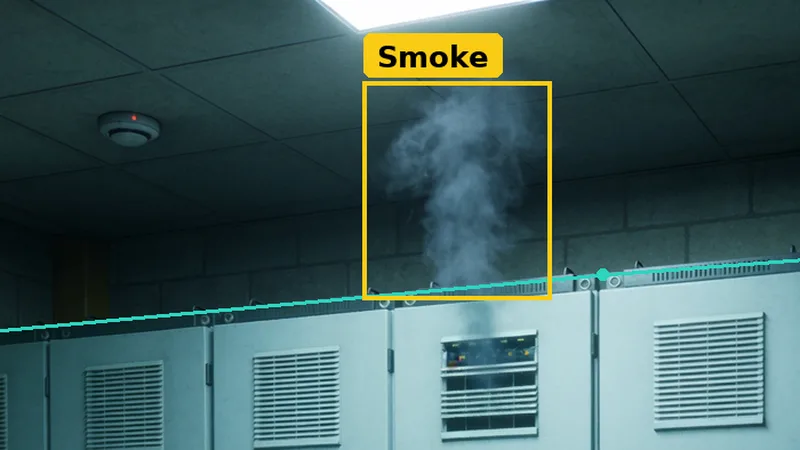
Cameras are a useful second layer here. A ceiling detector in a charging room only reacts once smoke reaches it. A camera watching the cabinets can see smoke rising from a particular cabinet or pack, and send a clip showing exactly where. Outdoors, in an e-bike shelter or round a container, there may be no detector at all. Cameras cannot see inside a closed steel cabinet, so point them at the vents, doors and the space around, and keep the cabinet’s own protection where it has it.
What should you do if a lithium-ion battery catches fire?
The UKWA guidance is clear that the first response to a battery fire is to evacuate and call the fire and rescue service. Battery fires are hard to put out with hand-held extinguishers, give off toxic smoke and can reignite. Unless it is safe and you are trained, do not try to tackle it.
- Get people out and keep them well away and upwind of the smoke.
- Call 999 and tell the operator that lithium-ion batteries are involved, and how many.
- Meet the crews with the site plan, keys, the location of the store and how to isolate the power.
- Contain run-off where you can, since firewater from battery fires is contaminated.
- Watch afterwards. Damaged packs can reignite hours or days later, so keep the area watched and get them removed by a specialist.
Write the plan down with names and clear roles: who receives the alert, who goes to site, who meets the fire service and who calls the insurer. Practise it. A plan that only exists in one manager’s head will not work at 2am.
Lithium-ion battery storage checklist
Use this list to walk round your site. Each item comes from the guidance above; tick it off, or write down what you will do about it in your fire risk assessment.
- Inventory. We know every place on site where lithium-ion batteries are stored, charged, returned or disposed of, and roughly how many are in each.
- Assessment. Our fire risk assessment names each of those areas and has been updated since we started storing or charging batteries in them.
- Insurer. We have told our insurer what we hold, and agreed any increase before it happens.
- Goods-in. Battery deliveries are checked on arrival, and suspect consignments go straight to quarantine.
- Segregation. Battery stock is kept apart from general goods in a labelled area, in its original packaging, away from heat sources and roof lights.
- Quantities. Stock in each area is within the limits agreed with our insurer and assessor, and larger amounts are in a separated room or outside store.
- Quarantine. There is a marked quarantine point for damaged and returned packs, in a non-combustible container, and it is emptied regularly by a licensed carrier.
- Charging. Charging happens only in dedicated, ventilated areas, with the right chargers, one wall socket each, no extension leads and packs at least 45cm apart.
- Timing. We avoid charging overnight with nobody on site, or we have detection that reaches a person if we must.
- E-bikes. We have a written policy on staff e-bikes and e-scooters, and they are stored and charged away from escape routes.
- Detection. Every battery area is covered by detection that raises the alarm in working hours and when the site is closed.
- Response. Staff know to evacuate and call 999, crews can reach the store, and power can be isolated from outside.
- Training and records. Staff who handle batteries have been trained, and we keep records of stock, quarantine and incidents.
If several of these are not yet in place, start with charging and quarantine. They are where most workplace battery fires begin, and they are usually the cheapest to fix.
Where does Woodcock AI fit?
Woodcock AI turns the CCTV you already have into AI smoke and fire detection. It connects to your existing cameras or recorder over ONVIF or RTSP, so cameras already pointing at your goods-in, racking, charging room and yard can start watching for smoke and flame without being replaced.
- Polygon detection areas. Draw a shape round each cabinet row, stock bay, quarantine point or shelter, so every alert names the area in your fire risk assessment. See polygon detection zones.
- Self-learning, fitted to each scene. Each camera’s model is fitted to its own view and learns from that site’s normal footage, including charger lights, door movement and reflections on steel. Read about our self-learning AI.
- Years of development, in use today. Woodcock AI has been developed over several years and runs on real UK industrial, logistics and waste sites.
- Alerts that reach a person. App alerts with a clip and email come as standard, with an alarm receiving centre (ARC) and call alerts as optional add-ons. Per-camera schedules keep smoke and fire detection on around the clock, with intrusion or line-crossing alerts round outside stores once the site is closed.
- Evidence for your assessment. Each alert keeps its time, area and clip, and we run smoke tests on site at commissioning, so you can show your insurer and assessor that detection works on your cameras.
Camera detection does not replace a fire alarm, good storage, charging rules or a quarantine process. It adds a layer that watches every battery area, all night, and tells someone straight away. For how it works, see our AI smoke and fire detection camera page and our guide to video smoke detection on existing CCTV. For sector detail, see warehousing and logistics, industrial sites and battery energy storage.
Which sources is this page based on?
- UK Warehousing Association, UKWA launches lithium-ion battery guidance note and Safe Storage of Small Lithium-Ion Batteries: Guidance for Operators (24 September 2026).
- Fire Protection Association, RISCAuthority, RE2: Lithium-ion Battery Use and Storage (January 2023).
- GOV.UK, E-cycle and e-scooter batteries: managing fire risk for premises (1 February 2024).
- London Fire Brigade, GN103: Charging and storage for electric-powered personal vehicles (September 2023).
- Health and Safety Executive, INDG139: Using electric storage batteries safely.
- London Fire Brigade, Record number of e-bike and e-scooter fires across London in 2025 (28 January 2026); Shop fire, Walworth (July 2026); Fire at pedicab storage unit, Southwark (September 2024).
- Office for Product Safety and Standards, Fires in e-bikes and e-scooters: 2025.
- BBC News, Thetford warehouse fire (April 2026).
- Aviva Risk Solutions, Lithium-ion batteries: storage and transit.
We have summarised these documents in our own words. Always read the current versions. This page is general guidance, not legal or fire engineering advice; your fire risk assessor and insurer decide what is right for your premises.
Storing or charging lithium-ion batteries?
Book a site assessment and we will look at your cameras, the goods-in, stock, charging and quarantine areas in your fire risk assessment, and how alerts should reach your keyholders. Or ask for a live test on your cameras first: we connect two or three of them for about a fortnight.
Related pages
Frequently asked questions
How should lithium-ion batteries be stored at work?
Inspect them on arrival, keep them in original packaging, segregated from general stock in a labelled area away from heat and roof lights, and quarantine any damaged packs. FPA RE2 limits small stock in sprinklered areas to about 20 square metres and 1.8 metres high; larger amounts need specific protection or a separate store.
How far apart should batteries be when charging?
GOV.UK guidance for premises says packs on charge should be at least 45cm apart unless fireproof separators are used. Charge in a dedicated, ventilated area with one wall socket per charger, no extension leads and nothing else stored nearby.
Is it safe to charge batteries overnight at work?
It is the riskiest pattern, because a failure happens with nobody there to see it. Where you can, charge during the working day. If overnight charging is unavoidable, use a separated area and detection that alerts a keyholder or monitoring centre, not just a sounder in an empty building.
What should I do with a damaged lithium-ion battery?
Stop using it, never charge it, and move it to a marked quarantine point away from other stock and exits, ideally in a lidded non-combustible container. Record it and have it collected by a licensed waste carrier as soon as possible.
Can employees charge e-bikes at work?
You can allow it, but add it to your fire risk assessment. London Fire Brigade prefers a dedicated outside location or a fire-resisting separated space that is not on an escape route. Many employers allow storage but not charging, or charging only with the original charger.
Do I need to tell my insurer about lithium-ion battery stock?
Yes, in most cases. The UKWA guidance for operators says to speak to your insurer before changing battery volumes, and many insurers now ask specific questions about battery storage, charging and detection.
Can CCTV detect a lithium-ion battery fire?
Camera smoke and fire detection can spot smoke or flame in a battery store, charging room or shelter and send an alert with a clip. It cannot see inside a closed cabinet, so cameras watch vents, doors and the area around. It adds to a fire alarm rather than replacing it.
Last reviewed 30 October 2026