

Plant and machinery theft: deter, detect, recover
To prevent plant and machinery theft, make your site hard to get into, make machines hard to move, make them easy to trace, and find out quickly when someone is on site. That means fencing, locked gates and lighting; immobilisers, locks and keys kept off the machine; marking, registration and trackers; and CCTV that alerts you when a person or vehicle enters the yard after hours. NFU Mutual reported agricultural vehicle theft claims up 18% in 2025.

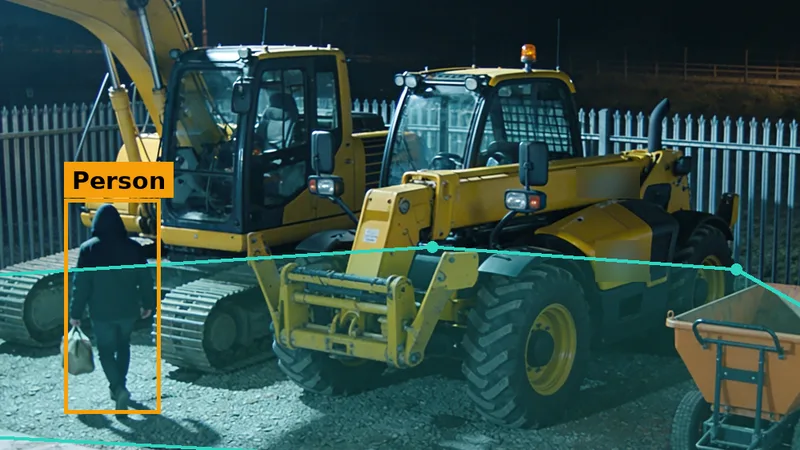
Last updated 31 October 2026. Plant and machinery are some of the most valuable things on a farm, a construction site or a hire depot, and much of it is left outside overnight. A mini excavator, a telehandler or a quad bike can be loaded onto a trailer and gone in minutes, and with it goes a day’s work, a contract deadline or a season’s planning. This guide covers what thieves target and why, what the latest UK figures show, the security measures police and insurers recommend, where cameras should watch, and how AI detection on your existing CCTV can tell you someone is in the yard while there is still time to act.
Why is plant and machinery such a target?
From a thief’s point of view, plant has a lot going for it. It is valuable, it is often parked in the open, and much of it is built to be moved. Compact machines such as mini excavators, dumpers and small rollers fit on an ordinary trailer. Keys are often left in a cab, a toolbox or an unlocked cabin. Sites are empty for long stretches: every night, every weekend and over holidays.
Stolen machines can be sold on quickly, broken for parts or shipped abroad. Farm vehicles are targeted in the same way, and so is the kit that goes with them. GPS guidance screens and receivers can be lifted out of a cab in seconds. Attachments such as breakers and buckets, power tools, batteries and diesel are taken too, often in the same visit.
The cost is more than the machine itself. A stolen excavator means a hire replacement, a delay on site, a missed completion date, a rise in premiums, and the time spent on the claim. On a farm, losing a tractor or a telehandler at the wrong time of year can hold up feeding, harvest or spraying. NFU Mutual’s reports describe rural crime as having an emotional cost too, with farmers changing how they work, or leaving farming, because of repeated thefts.
What do the latest UK figures show?
The best regular picture of rural and farm machinery theft comes from NFU Mutual, the rural insurer, which publishes an annual Rural Crime Report based on its claims. Its 2026 report, covering 2025 and reported by NFUonline on 28 May 2026, found that the overall cost of rural crime fell by 6% in 2025. Theft of farm vehicles went the other way: the cost of agricultural vehicle theft claims rose by 18%, and the cost of quad and ATV theft rose by 31%. The cost of GPS theft fell by 80%.
Farmers Weekly’s analysis of the same report breaks the vehicle figures down further, with the cost of tractor theft up 8% and of telehandler theft up 38%. It also points out that the figures are based on NFU Mutual’s claims, scaled up to estimate the whole market, and that some crimes, such as arson and fly-tipping, are not counted, so they are likely to underestimate the true cost.
For a longer view, NFU Mutual’s 2025 report, covering 2024, showed falls in the cost of agricultural vehicle theft and GPS theft, but rises in the cost of tractor and trailer theft. The pattern from year to year is not simple. When one type of kit becomes harder to steal, thieves move on to another.
Construction plant tells a similar story. The CESAR plant and agricultural theft report for the first half of 2025, produced with the police National Construction and Agricultural Theft Team (NCATT), recorded 969 machines reported stolen on the police national systems in January to June 2025, compared with 919 in the same period of 2024. Those are only the thefts recorded with enough detail to be counted, so again the real number will be higher.
Behind the numbers are organised groups as well as opportunists. Police units such as the NaVCIS agriculture and plant team work with forces, insurers and manufacturers to trace stolen machines. That work matters, but recovery is always harder than prevention, and a recovered machine may have been damaged or stripped.
How do plant thefts usually happen?
Every theft is different, but the pattern police and insurers describe is familiar. The site is looked over first, sometimes from the road, sometimes by someone posing as a buyer, a walker or a contractor. Thieves arrive after dark or very early in the morning, usually with a vehicle and a trailer, a pickup or a lorry. They get in by cutting a fence panel, breaking a gate lock or simply driving through an open gateway. Machines are started with a key found on site, a duplicate or by bypassing the ignition, then driven or dragged onto the trailer. The whole thing can take minutes.
The weak point for the thief is the time between arriving and leaving. If someone knows straight away that there is a person in the plant park or a vehicle at the gate, there is a chance to act: switch on lights, call the police, warn a keyholder, or at least capture a clip that helps the investigation. If the first anyone knows is when the morning shift finds an empty space, that chance has gone.
Farms have particular weak points. Many have several buildings spread over a wide area, open-fronted sheds, public footpaths and lanes running close to the yard, and machinery left in fields during busy periods. The NFU’s theft advice encourages farmers to think about every way in and out, and to treat their yard as a business premises, not just a home.
What security measures stop plant theft?
Police and insurers recommend the same core approach: make it hard to get in, hard to move the kit, easy to trace it, and quick to find out when something is wrong. NFU Mutual’s security advice, the NFU’s theft guidance and CESAR all point to a mix of physical, mechanical and electronic measures.
Make it hard to get in
- Secure the boundary. Good fencing, locked gates, and earth banks, ditches or posts on field entrances to stop vehicles driving straight in.
- One way in. Keep a single, controlled entrance where you can, and keep gates shut and locked when the site is closed.
- Lighting. Security lighting on the yard, sheds and plant park makes it harder to work unseen and gives cameras a better picture.
- Signs. Visible signs for CCTV, marking and tracking tell thieves the site is not an easy one.
Make it hard to move
- Immobilisers and keys. Fit immobilisers where they are available, never leave keys in the cab, and lock keys in a key safe inside a secure building.
- Physical locks. Wheel clamps, track locks, hitch locks and locked fuel caps all add time.
- Park it well. Park machines inside a secure building or compound where you can, nose to nose or blocked in by larger kit, with buckets and booms lowered. Keep compact plant away from the fence.
- Trailers. A trailer left on site is an invitation. Lock it, clamp it or move it out of reach.
Make it easy to trace
- Mark and register. Use a recognised marking and registration scheme such as CESAR for plant and farm machinery, and forensic marking on tools and GPS kit.
- Trackers. A tracking device gives police a far better chance of finding a stolen machine.
- Records. Keep photos, serial numbers and engine numbers for every machine and attachment, stored off site.
Find out quickly
- CCTV that alerts. Cameras that only record show you what happened. Cameras with AI detection tell you while it is happening.
- Alarms and keyholders. Agree who responds at night and at weekends, and how.
- Neighbours and police. Join local farm watch or business crime schemes, and report suspicious vehicles and people.
Where should cameras watch on a yard or farm?
Start with the places a thief has to go. They have to get in, they have to reach the machines, and they have to get the machines out. On most sites that gives a short list: the gate and the entrance apron, the fence line, the plant park or machinery shed, the tool store and fuel, and the route out.
Which part of your site?
NFU Mutual’s figures show tractors, telehandlers, quads and ATVs are all being targeted, and an open-fronted shed next to a quiet lane is an easy place to start. Park the most valuable machines at the back, block them in with other kit, take keys into the house, and draw a zone over the shed floor so anyone walking in at night is an alert with a clip on your phone. The same zone can watch for smoke from the bales and machinery.
People after hours, smoke and fire
Temporary mesh fencing is quick to put up and quick to get over. A line drawn along the top of the panels flags a person crossing it after hours, and leaves people walking past on the pavement out. Pair it with lighting and clear signs, and keep compact plant away from the fence line so it cannot be loaded over or through a cut panel in a few minutes.
Line crossing when the site is shut
Steel containers hold breakers, saws, generators, attachments and fuel. They are often attacked with cutting tools, which takes time and makes noise. A zone in front of the doors catches someone working at the locks long before they are through. Fit good locks and a lock box, and keep the container in a camera view, not tucked out of sight behind the cabins.
People, 24/7 outside working hours
Most machines leave on a trailer or lorry, so a vehicle at the gate at midnight matters. Vehicle detection in a zone on the gate apron flags a van, pickup or lorry arriving after hours. It is not number plate recognition, but the clip shows what arrived and when. Keep gates locked, and do not leave a loaded trailer or a low-loader parked just inside them.
Vehicles after hours
Each area gets its own zone and schedule, armed when the yard shuts and disarmed when work starts.
Many yards and farms already have cameras, recording to a recorder in the office or the house. If they are IP cameras or the recorder supports RTSP or ONVIF, AI detection can usually be added to them. Where there are gaps, such as a shed out of view or a container behind a building, a site assessment will show where one or two extra cameras would help most. Make sure cameras have power and a connection overnight, and that lighting is good enough for a clear picture.
Think about the approach as well as the yard. A camera that sees the lane or track up to the gate gives you a few extra seconds of warning. Keep public roads and footpaths out of your zones, both for privacy and to keep alerts focused on your own land.
How does AI detection on CCTV help prevent plant theft?
Ordinary CCTV records. Unless someone is watching it live, the footage is usually looked at after the theft, to find out how it happened. That can help the police, but it does not save the machine. Woodcock AI watches the camera feeds for you and raises an alert when something you care about happens, so someone can act while the thieves are still on site.
- Intrusion detection. Flags a person in a zone you draw, such as the plant park, the machinery shed or the area in front of the tool store. See intrusion detection.
- Vehicle detection in zones. Flags a vehicle entering a zone, such as the gate apron or the yard, outside working hours. It is not number plate recognition. See vehicle detection.
- Line crossing. Flags a person crossing a line you draw, such as the top of the fence or a field entrance. See line-crossing detection.
- Polygon zones and schedules. You draw each zone to fit the area, such as the shed floor but not the lane beside it, and set when it is armed. Zones can be armed when the yard shuts and disarmed when work starts. See polygon detection zones.
- Self-learning. The system learns from feedback on alerts at your site, so it gets better at telling real events from things that are not, such as headlights on a wall or a cat on the fence. See self-learning AI.
- Smoke and fire detection. The same cameras can flag visible smoke and flame. That matters because machines and sheds are sometimes set alight, either to cover a theft or as vandalism. See smoke and fire detection.

Each alert goes to the app with a short clip, and by email, so the owner, the site manager, the security firm or the keyholder can see in seconds what is happening. Detection runs on an edge server on site or on a cloud server, and connects to IP cameras and recorders over RTSP or ONVIF, including Hikvision. Woodcock AI detects people and vehicles; it does not identify who anyone is. You will also soon be able to ask your cameras questions about what happened on site; Ask your cameras is coming soon, early 2027.
The difference is time. A theft found by the first person into the yard at 7am has had all night to finish. An alert at 02:14 that shows a person walking up to the telehandler gives someone the chance to call the police while the machine is still on site.
Will I get alerts every time a fox walks past?
Old motion-detection systems were famous for this. Any change in the picture, from a moving branch to a passing car’s headlights, set them off, and people soon stopped looking at the alerts. AI detection is different because it looks for specific things, such as a person or a vehicle, inside a zone you have drawn, during the hours you have set.
Three things keep the alerts useful. First, zones: draw them over the plant park, the shed or the gate apron, not the whole picture, and leave out the lane and the footpath. Second, schedules: arm each zone only when nobody should be there, so the working day does not fill your phone. Third, feedback: mark alerts as useful or not, and the self-learning system uses that feedback to improve at your site. Our guide to reducing CCTV false alarms goes into more detail.
Some false alerts will still happen, especially in the first days while zones and schedules are being tuned. The aim is that when your phone goes off at night, it is worth looking at.
What does the Equipment Theft (Prevention) Act change?
The Equipment Theft (Prevention) Act 2023 received Royal Assent on 20 July 2023. It applies in England and Wales only. It gives the government powers to make regulations so that certain new equipment has to be protected before it is sold. The original idea was immobilisers and forensic marking on new quad bikes and ATVs, with powers to extend similar rules to other agricultural and commercial equipment, including power tools.
The government published its response to the call for evidence in October 2025. It said it will bring in regulations requiring forensic marking of all new ATVs, with the details registered on a property database, and the same for new removable GPS units used in agricultural and commercial settings. It decided not to require immobilisers on new ATVs because of concerns about vehicle type approval, and not to extend the rules to other large machinery or to power tools. The Act does not take effect until the secondary legislation commences.
For owners, the practical point is that the Act is about new kit and about tracing stolen kit. It does nothing for the tractor already in your shed, the excavator in your yard or the breaker in your container. Marking, registration, immobilisers, physical security and alerts are still up to you, and they help whether or not the regulations are ever extended.
What will my insurer expect?
Insurers vary, so read your policy wording and talk to your broker or insurer before you change anything. Some policies set conditions for plant and machinery, such as keys being removed and kept securely, immobilisers being set, machines being parked in a locked compound or building, or trackers being fitted to high-value kit. If a condition is not met, a claim can be reduced or refused.
Insurers are also interested in prevention, and NFU Mutual’s advice to customers stresses layers of security rather than one product. Being able to show that you have marking, registration, good physical security and CCTV that alerts someone at night is likely to help when you talk to your insurer about cover.
Keep records. A list of machines with serial numbers, photographs and marking details, a note of where keys are kept, and a log of security checks all make a claim easier and help the police if something is stolen.
What should happen when an alert fires at night?
Agree the plan before you need it. Who gets alerts at night and at weekends? Who attends, and when? When is it a 999 call? Who tells the insurer?
- Check the clip. It shows within seconds whether it is a deer, a neighbour checking stock, or a person walking up to the telehandler.
- Call 999 if a crime is in progress. Give the address, the access point, and what you can see: how many people, what vehicle, which way they are heading.
- Never confront thieves. Plant thieves are often organised and may be violent. Use lights, alarms or a keyholder response service, and wait for the police.
- Report and record. Save the clip, report the theft to the police with serial numbers and marking details, tell your insurer and, if the machine is registered, the scheme it is registered with.
Practise it. An alert at 2am that nobody knows how to handle is not much better than no alert at all.
How do you get started?
Start with the kit that would hurt most to lose and the places it is kept. Check what cameras you already have, how they record, and whether they can see the gate, the fence, the plant park or shed, and the tool store. Check the lighting at night. Then plan zones and schedules for each area, and agree who gets which alert.
Our site assessment looks at the cameras already on site, where thieves are most likely to come in, and the zones, lines and schedules that would cover them. If you want to see it working first, we can run a live test on your cameras: we connect two or three of them for about a fortnight, so you see the alerts on your own site before you decide. An on-site demo is also available.
For businesses with several depots, compounds or farms, the same approach scales. Each site gets its own zones and schedules, and alerts can go to the manager responsible for that site, a security firm, or both.
What about privacy and data protection?
If your cameras capture people, data protection law applies. The Information Commissioner’s Office has guidance on CCTV and video surveillance. Have a clear purpose, point cameras at your own land as far as possible, put up signs, keep footage only as long as you need it, keep it secure, and be ready to handle requests for footage. Our guide to GDPR and AI CCTV covers this in more detail.
Polygon zones help here too. Drawing zones on your yard and leaving public lanes, footpaths and neighbours’ land out keeps alerts focused where they should be.
What are the limits?
- A camera needs a view. It cannot see inside a closed shed, behind a stack of bales or round the back of a building with no camera. Placement decides what it can see.
- It needs light or a camera that works in the dark. Poor lighting means a poor picture. Check what your cameras see at night.
- It needs power and a connection. If the power or the internet goes off, cameras and alerts stop. Thieves sometimes cut them. Plan for this.
- It does not read number plates. It flags vehicles and people in zones; the clip shows what happened.
- It does not stop a machine moving. Immobilisers, locks and trackers still matter.
- Someone has to respond. An alert is only useful if someone acts on it.
Sources
- NFUonline, NFU Mutual Rural Crime Report 2026 (28 May 2026).
- Farmers Weekly, Analysis: rural crime down overall but hotspots persist.
- NFU Mutual, Rural Crime Report 2025 (PDF).
- CESAR and NCATT, Plant and Agricultural Theft Report, Q1 and Q2 2025.
- NaVCIS, Agriculture and plant.
- GOV.UK, Equipment Theft (Prevention) Act: summary of call for evidence responses and conclusion.
- NFU, Theft on farm: advice and support.
- Information Commissioner’s Office, CCTV and video surveillance guidance.
We have summarised these sources in our own words. Always read the current versions in full. This page is general guidance, not legal, insurance or security advice; your insurer, the police and a competent security adviser decide what applies to your site.
Worried about plant or machinery theft?
Book a site assessment and we will look at the cameras on site and plan zones, lines and schedules for the gate, the fence, the plant park, sheds and stores, plus who gets which alert. Or ask for a live test on your cameras first: we connect two or three of them for about a fortnight.
Related pages
Frequently asked questions
What is the best way to prevent plant theft?
Use layers. Secure the boundary and gates, keep keys off the machines and fit immobilisers and locks, mark and register kit and fit trackers, and use CCTV that alerts someone when a person or vehicle enters the yard after hours.
Is farm machinery theft rising?
NFU Mutual’s Rural Crime Report 2026 found the overall cost of rural crime fell 6% in 2025, but the cost of agricultural vehicle theft claims rose 18% and the cost of quad and ATV theft rose 31%. Farmers Weekly reported the cost of telehandler theft up 38%.
How many construction machines are stolen in the UK?
The CESAR and NCATT report for the first half of 2025 recorded 969 machines reported stolen on police national systems, compared with 919 in the same period of 2024. Many thefts are not recorded in enough detail to be counted.
What does the Equipment Theft (Prevention) Act do?
It allows regulations in England and Wales requiring forensic marking and database registration of new quads, ATVs and removable GPS units. The government dropped immobiliser requirements and other machinery and tools. It is not in force until regulations commence.
Can CCTV stop plant theft?
Recording alone usually shows what happened afterwards. CCTV with AI detection can alert you when a person enters the plant park, a vehicle arrives at the gate or someone crosses the fence after hours, so someone can call the police while thieves are still on site.
Can Woodcock AI work with the cameras I already have?
Usually, yes. It connects to IP cameras and recorders over RTSP or ONVIF, including Hikvision, and runs on an edge server on site or on a cloud server. It flags people, vehicles, line crossings, smoke and flame in zones you draw.
Last reviewed 31 October 2026