

Car park security: protecting decks, entrances and vehicles out of hours
Car park security means preventing theft from and of vehicles, vandalism, misuse and vehicle fires in multi-storey, surface and staff car parks, most of which happens after dark. The police-backed Safer Parking scheme looks for good management, lighting, surveillance and cleanliness, with cameras covering entrances, exits, help points, stairs and ramps. AI on the CCTV cameras you already have adds live detection: polygon zones over the bays, lines at ramps and barriers, and smoke and flame detection, with the clip in every alert.

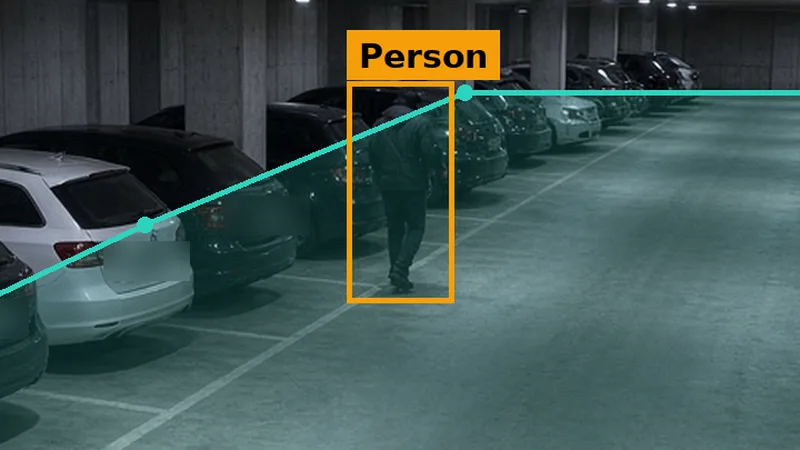
Last updated 31 October 2026. A car park is a strange place to secure. It is open to the public, full of other people’s property, often busy in the day and empty at night, and built with ramps, pillars, stairwells and corners that make it hard to see from one end to the other. Car parks attract theft from cars, vehicle theft, vandalism, graffiti and people using them for things they were not built for. And when a car catches fire in a covered or multi-storey car park, the fire can spread from vehicle to vehicle in a way few other buildings see. This guide sets out the main risks for UK car parks, what the official figures show, what the police-backed Safer Parking scheme and two major UK car park fires teach, where cameras should watch, and how AI on the CCTV cameras a car park already has can watch the decks, ramps and entrances out of hours.
It is written for car park operators, facilities and estates managers, retail and leisure park managers, councils, businesses with staff car parks and the security installers who work with them. It gives no prices: what a car park needs depends on its layout, its cameras and how it is used.
What are the main security risks in a car park?
Every car park is different, but most face the same four kinds of risk. They hit the people who use the car park first, then the operator, through complaints, damage, insurance claims and reputation.
- Theft from vehicles. Windows smashed for bags, laptops, tools and anything else left on show, and parts such as wheels and catalytic converters taken from parked cars.
- Vehicle theft. Cars, vans and motorbikes taken from the bays, usually at night and often without anyone seeing it happen.
- Damage and misuse. Vandalism to cars, pay machines, barriers and lighting; graffiti on walls and stairwells; gatherings, racing on empty decks and rough sleeping in stair cores. Some of this is antisocial rather than criminal, but all of it puts people off using the car park.
- Vehicle fire. Usually accidental, sometimes deliberate. In the open a burning car is usually one burning car; on a covered deck it can be the start of something much bigger, as the two fires later in this guide show.
People’s safety matters too. Users walking back to their cars late at night, staff locking up and patrols checking quiet levels all need to feel, and be, safe. Much of what follows helps with that as well as with crime.
What do the figures show about vehicle crime in car parks?
Vehicle crime remains one of the most common crimes in England and Wales, even though it has been falling. The Office for National Statistics’ Crime in England and Wales: year ending June 2026 bulletin, published on 22 October 2026, reports that police recorded vehicle offences decreased by 7%, to 312,231 offences. That police category covers theft or unauthorised taking of a vehicle, aggravated vehicle taking, theft from a vehicle and interfering with a vehicle.
The ONS also publishes Nature of crime: vehicle-related theft tables from the Crime Survey for England and Wales, which ask victims where and when it happened. In the year ending March 2025, about 6% of all vehicle-related thefts happened in car parks other than at home or work, and about 3% in work car parks. Most happened near the victim’s home, on the street or on a driveway, where cars spend most nights. So car parks are not where most vehicle crime happens. But a single car park holds hundreds of cars, often belonging to people who are away for hours, and the crime that does happen there is concentrated in one place, under one operator.
The same tables show when it happens. In the year ending March 2025, about 78% of vehicle-related thefts happened in the dark, and about 80% in the evening or at night. That matches what most car park operators see: the quiet hours are the risky hours.
There is also evidence that how a car park is run makes a difference. Police Crime Prevention Initiatives (Police CPI), which now runs the police-backed Safer Parking scheme, says the scheme has achieved a reduction in crime of up to 80% in accredited car parks. That is the scheme’s own figure, across all the measures it requires, not a figure for any one product.
What is the Safer Parking scheme?
Safer Parking, long known as Park Mark, is the police-backed standard for car park security in the UK. For many years the British Parking Association ran it on behalf of the police, and its management returned to direct police oversight, under Police CPI, from 1 April 2026. Police CPI describes it as the only police-backed security benchmark for car parks, and says it forms an integral part of planning and tender requirements for new car parks.
The scheme’s assessment guidelines (the 2019 edition, published by the British Parking Association) say assessors check that the facility is properly managed and maintained and has appropriate levels of surveillance, lighting, signage and cleanliness. In our own words, the points most relevant to cameras are:
- Surveillance should cover all areas. It can be natural (open views and passers-by), formal (CCTV, staff and patrols) or both. Natural surveillance is the most effective; where it cannot be achieved, CCTV, on-site management or patrols can be used.
- Where there is CCTV, cameras should at least cover the vehicle and pedestrian entrances and exits and any help points. Where there are too many pedestrian entrances to cover, the guidelines suggest cameras at ground-floor lift lobbies, stairwells and ramps to protect the upper levels.
- New car parks should have CCTV, or at least the ducting to add it later.
- Long-stay car parks need more. The guidelines single out airports and railway stations, where operators should consider additional measures such as CCTV or a physical presence.
- CCTV must comply with data protection law, and cameras open to damage should be protected.
The guidelines make one more point worth noting for anyone with recording-only CCTV. For the scheme, a car park counts as closed when the operator reduces its security, which includes reducing patrols, staff on site or active monitoring of CCTV. Cameras that nobody is watching are a lower level of security, and the scheme treats them that way.
How should a car park be designed and managed for security?
Most car park security is about design and management, and the scheme guidelines go into detail. The main points, summarised:
- Straight rows and open views. The guidelines say parking spaces should be arranged in straight rows where possible, to aid surveillance and avoid blind spots, and that the building structure should not create recesses or block surveillance.
- Lighting. The guidelines note that increased lighting in dark areas can reduce the public’s fear of crime and the opportunity for it. Light the bays, ramps, stairs, lift lobbies and pay machines, and fix failed lamps quickly.
- Close off what is not needed. Where a car park is much bigger than its use, the guidelines say the parking area should be reduced, permanently or temporarily. A closed level or roof is easier to watch than an empty open one.
- Restrict access through openings. Grilles, bars or glazing on external wall openings, especially on the ground and lower floors, stop people walking in where they should not.
- Landscaping. No dense foliage between 1 and 2.5 metres high, so nobody can hide in it.
- Keep it clean and repaired. The guidelines say quick removal of graffiti can deter further damage, and a cared-for car park reassures users.
ProtectUK, the Counter Terrorism Policing protective security service, gives similar advice for sites in its site security guidance: access control measures at all entrances, barriers such as walls and fences kept in good repair, and CCTV, whose primary purpose it describes as detecting suspicious activity. Our out-of-hours site security checklist turns this into a closing routine.
Why are vehicle fires in car parks such a risk?
Two UK fires show what can happen when a single car catches fire in a multi-storey car park. Both started accidentally in one vehicle, and in both more than a thousand vehicles were lost.
Kings Dock, Liverpool, 31 December 2017
Merseyside Fire and Rescue Service’s Significant Incident Report describes an eight-storey car park next to the Echo Arena, holding around 1,600 cars and near capacity on the day. A parked car caught fire on an upper floor. The service’s timeline records the first signs of smoke from the vehicle on the car park’s internal CCTV at 16:29, a steady stream of smoke at 16:33, the first signs of flame at 16:37, and the first call to the fire and rescue service at 16:42. The report says 1,150 vehicles are thought to have been destroyed, and that the potential for severe, fast fire spread in a near-full multi-storey car park had been identified in a BRE report in 2010. The service’s fire investigation report found the fire was accidental, caused by an electrical or mechanical defect in the car.
London Luton Airport Terminal Car Park 2, 10 October 2023
Bedfordshire Fire and Rescue Service’s Significant Incident Report describes a five-storey, open-sided car park with 2,700 spaces, opened in 2019. At 20:42, CCTV captured a car at the ticket barrier with light smoke coming from it. The driver carried on up to the third floor, where the fire took hold. The fire service received the first call at 20:47. The report says the fire spread to involve 1,352 vehicles and led to a partial collapse of the structure, and signs of imminent structural collapse led the incident commander to withdraw firefighters from the building, leaving only external firefighting. The service found the cause was accidental, most probably an electrical fault or component failure in the engine bay. The car was diesel, not a hybrid or electric vehicle, and the report says there is no evidence that electric vehicles parked in the car park had a detrimental impact on the outcome.

Bedfordshire’s report says that if a suitable sprinkler system had been installed, it may have changed and delayed the pattern of fire spread, and it recommends a national change to make automatic fire suppression mandatory in new open-sided multi-storey car parks. That is a matter for building design and regulation, not for cameras.
Where do cameras fit?
In both fires, the first visible sign was smoke from one car, and in both it was caught on the car park’s own CCTV. We do not claim a camera alert would have changed either outcome; that would depend on who received it, how fast they acted and what the building could do. The lesson is narrower: in a car park, the first sign of a vehicle fire is often smoke that a camera can already see.
Woodcock AI detects smoke and flame on the same cameras that watch for people and vehicles, so a camera on a covered deck can raise a smoke alert, with the clip, as well as an intrusion alert. It is an early warning that adds to, and does not replace, the fire detection, suppression, fire risk assessment and emergency plan a car park needs. Our guide to video smoke detection on existing CCTV explains how it works, and our arson prevention guide covers deliberate fires.
Where should cameras watch in a car park?
Most car parks already have CCTV, but it is often set up to record rather than to detect, and it often grew camera by camera without a plan. Before adding anything, mark on a plan of each level what each camera actually sees, by day and at night. Anything no camera sees is a gap.
- Vehicle entrances and exits. Every lane, including any service or emergency access. The scheme guidelines treat these as the minimum.
- Pedestrian entrances, stair cores and lift lobbies. Especially on the ground floor, where they protect the levels above.
- The decks. Cameras that look along the rows, not just across the aisles, so a person between cars is in view.
- Ramps and the roof level. The roof is often the quietest level and the one most used for gatherings and misuse.
- Pay machines and help points. Targets for damage and theft, and where users go when they need help.
- Plant rooms, bin stores and service doors. Places where fires start and people should not be.
- EV charging bays. Busy, valuable equipment, and a place many operators want covered.
How does AI on existing CCTV protect a car park?
Recording-only CCTV shows what happened after someone reports it. AI detection watches the picture live and tells someone while it is happening. Woodcock AI connects to the IP cameras and recorders a car park already has, over RTSP or ONVIF, including Hikvision, and runs on an edge server on site or on a cloud server. On each camera view you draw the rules for that part of the car park.
- Polygon zones. A shape with as many corners as you need, drawn over the bays on a deck, the roof level, a plant room door or a closed section. A person or vehicle inside it while it is armed raises an alert. Because a polygon follows the shape of the bays, it can leave out the open side, the pavement or the street beyond.
- Line crossing. A line across a ramp, a barrier lane or a fence. You choose which direction counts, so a vehicle driving up to a closed roof level raises an alert and one driving down and out does not.
- Vehicle detection and intrusion detection. Only people and vehicles count. A person walking a closed deck at night is flagged; headlights sweeping across pillars, shadows and rain blowing in are not.
- Smoke and flame detection. On the same cameras, around the clock, for the vehicle fires described above.
When a rule is broken, an alert goes to the app with a snapshot and the clip, and by email, with an AI description of what the camera saw, such as “one person walking slowly along a row of parked cars, looking into windows, no vehicle moving”. Woodcock AI can also send alerts to a monitoring centre (ARC) as an optional add-on.
The system is self-learning. It learns each camera on your site, so the headlights on the ramp and the light that flickers on level 2 become part of the normal view, and every detection has a feedback button: marking an alert as correct or false feeds into retraining for your site. Woodcock AI has been in development for years and is now running on customer sites across the UK.
Vehicle detection is not number plate recognition. Woodcock AI flags that a vehicle is where it should not be, and the clip shows what it was and what it did. It does not read number plates, check permits or identify people, so it does not replace any parking enforcement or payment system a car park uses.
Coming next: Ask your cameras Coming soon, early 2027, which will let you ask the system questions about what your cameras have seen.
How does this look in different kinds of car park?
Multi-storey car parks, surface and retail park car parks and staff car parks each have their own pattern. Choose a type to see what to watch for.
Which kind of car park are you protecting?
A multi-storey car park has many hiding places: rows of cars on each deck, ramps between levels, stair cores, lift lobbies and a roof level that is often quiet even when the car park is busy. Zones over the bays on each deck, armed when the car park is closed or quiet, flag anyone walking between cars. A line across the top of the ramp to the roof flags a vehicle going up when that level should be shut. Smoke and flame detection on the same cameras watches the decks around the clock, because a covered deck is where a car fire is hardest to see from outside.
Decks, ramps, stairs and roof
Surface car parks at retail parks, leisure sites and stations are open and easy to reach on foot, and they empty quickly when the businesses close. That makes the bays themselves the area to watch. A polygon zone over the bays, leaving the pavement and the access road out, flags a person or vehicle among parked cars at night without reacting to every passer-by. A line across each vehicle entrance, armed after closing, flags vehicles coming in, and a camera on the pay machines and help points covers the places the scheme guidelines single out.
Open bays, entrances and edges
A business car park is often fenced, with a barrier at the entrance and the building alongside. It is busy at shift change and empty at night, when vehicles left overnight, pool cars and vans are most exposed. An inbound line at the barrier, armed outside working hours, flags a vehicle coming in when nobody should. A line along the fence flags anyone climbing over, and a zone over the bays covers people walking between cars. Our line crossing page explains how direction works.
Barriers, fences and the building
Each deck, entrance and fence gets its own zones and lines, with its own schedule.
Many operators run more than one kind: a town-centre multi-storey, surface car parks at the edge of town and a staff car park at the office. Each site can have its own zones, lines and schedules, with alerts going to the right person for that site.
How do the security options compare?
No single measure secures a car park. The table compares the usual options on what they do, their strengths and what to watch out for. It is deliberately general; what matters is how each one fits your car park, its users and who can respond.
| Measure | What it does | Strengths | Watch out for |
|---|---|---|---|
| Lighting | Lights bays, ramps, stairs and entrances | Deters, reassures users and lets cameras see detail | Dark corners, failed lamps and glare into cameras |
| Layout and maintenance | Straight rows, open views, clean and repaired | Fewer hiding places; a cared-for site deters misuse | Needs a routine; damage and graffiti left in place invite more |
| Barriers and access control | Controls vehicle and pedestrian entry | Limits who is inside after closing | People can still walk in through stairs and open sides |
| Staff and patrols | A person on site or visiting at set times | Human presence and help for users | Ongoing cost; a patrol only sees the level it is on |
| Recording-only CCTV | Records what happened | Evidence after the event | Nobody sees it until someone reports a crime |
| Live-monitored CCTV | An operator watches the screens | A person can act on what they see | One person cannot watch every camera at once |
| AI on existing CCTV | Recognises people, vehicles, smoke and flame, in zones and on lines you draw, on a schedule | Watches every deck and entrance at once; the alert includes the clip | Cameras need a clear view and enough light or infrared at night |
The measures work best together. Design and lighting reduce the chances. Barriers and closed levels limit who is inside. Detection on the cameras tells someone while it is happening, and the clip shows them what they are dealing with. Our comparison of AI CCTV and security guards covers the response options in more detail.
How do you avoid false alarms in a car park?
A car park is a hard place for older motion detection. Headlights sweep across pillars and walls every time a car turns, lights flicker, low sun and wet floors throw reflections, and rain and leaves blow in through open sides. Motion detection that reacts to any change in the picture sends alerts all night, and people soon stop looking at them.
- Detect people and vehicles, not movement. AI that recognises objects ignores headlights, shadows and rain.
- Keep the street out of the zone. Draw polygons that follow the bays and stop short of open sides and pavements.
- Use direction on lines. A line at the ramp that only counts vehicles going up ignores everyone leaving.
- Match the schedule to the opening hours. So cleaners, late shift workers and early travellers do not trigger alerts.
- Give feedback. Marking false alerts helps the system learn each camera.
Our guide to reducing CCTV false alarms goes through each cause in detail.
How should a car park schedule work?
Some car parks close at night; others are open all hours but quiet in the small hours. Schedules let each rule match that pattern.
- Deck zones are armed when the car park is closed, or in the quietest hours if it stays open, with different hours at weekends and for events.
- The roof ramp line is armed whenever the roof level is shut.
- Plant rooms, bin stores and service doors can stay armed around the clock, because nobody should be there without a reason.
- Smoke and flame detection stays on all the time.
Plan for cleaners, maintenance crews, cash collections and events. If they are expected at a set time, fit the schedule round them or tell whoever receives the alerts what to expect.
What should happen when an alert fires?
An alert is only useful if someone acts on it. Agree, before the cameras go live, who gets which alerts at which hours, and what they should do.
- Check the clip. The alert arrives with the clip, so a duty manager or patrol can see in seconds whether it is someone breaking into a car or a cleaner on an early start.
- Call 999 if a crime is in progress or there is a fire. Do not go alone or challenge anyone. For a fire, follow the car park’s emergency plan.
- Use a monitoring centre for police response. The National Police Chiefs’ Council’s Police Requirements for Security Systems (March 2024) say police response to remotely monitored systems depends on a unique reference number (URN), which needs a compliant system and monitoring centre. Systems without one have no guaranteed police response, and three false calls in a rolling 12 months can see response withdrawn from a system that has one.
- Keep the clip. Save the footage for the police, the car’s owner and insurers, within your data protection rules.
- Review and fix. Mark the alert correct or false, and close any gap it showed.
How does data protection apply to car park CCTV?
Car park cameras see members of the public, staff and anyone passing. CCTV that captures people is covered by data protection law, and the Information Commissioner’s Office guidance on video surveillance expects you to have a clear purpose, to tell people with signs before they enter the area being recorded, to keep footage only as long as you need it for that purpose and to keep it secure. Where the processing is likely to be high risk, the ICO expects a data protection impact assessment. The Safer Parking guidelines also require CCTV to comply with data protection law, and say a system may need registering with the ICO.
Polygon zones help. A zone over the bays keeps detection to the car park even when a camera on an open side sees the street beyond. Woodcock AI detects people and vehicles in zones and on lines, and smoke and flame. It does not use facial recognition, identify who anyone is or read number plates. Our AI CCTV and GDPR guide covers this in more detail.
How do you get started?
Start with the basics the Safer Parking scheme checks: lighting, layout, cleanliness and a clear management plan. Then look at the cameras you have: what they cover, what they see at night, and where crime, damage or misuse has happened before.
Our site assessment looks at the cameras already in your car park, the decks, ramps and entrances most at risk, and the zones, lines and schedules that would cover them. It also tells you honestly where a camera cannot do the job. If you want to see it working first, we can run a live test on your cameras: we connect two or three of them for about a fortnight, so you see alerts from your own car park before you decide. We can also arrange an on-site demo.
What are the limits of cameras in a car park?
- A camera needs a view. It cannot see past a pillar, a van or the end of a ramp it does not point at.
- It needs light or infrared at night. Check what each camera actually sees in the dark, and with headlights shining into it.
- It needs power and a connection. If either goes off, cameras and alerts stop.
- It detects; it does not stop anyone. Barriers, closed levels and lighting still have to do that.
- It does not replace fire safety systems. Smoke detection on cameras is an early warning on top of the fire detection, suppression and emergency plan the car park needs.
- It does not read number plates or identify people. It flags people and vehicles in zones and on lines; the clip shows what happened.
- Someone has to respond. An alert is only useful if someone acts on it.
Sources
- Office for National Statistics, Crime in England and Wales: year ending June 2026 (22 October 2026).
- Office for National Statistics, Nature of crime: vehicle-related theft, year ending March 2025 tables (Crime Survey for England and Wales).
- Police Crime Prevention Initiatives, Strengthening the Safer Parking Initiative.
- British Parking Association, Safer Parking Scheme Assessment Guidelines (2019).
- Merseyside Fire and Rescue Service, Kings Dock Car Park Significant Incident Report and Incident Investigation Team report.
- Bedfordshire Fire and Rescue Service, Significant Incident Report: London Luton Airport Terminal Car Park 2 and Fire at airport car park started accidentally.
- ProtectUK, Site security.
- National Police Chiefs’ Council, Police Operational Advice and Security Industry Requirements for Response to Security Systems (March 2024).
- Information Commissioner’s Office, Guidance on video surveillance, including CCTV.
We have summarised these sources in our own words. Always read the current versions in full. This page is general guidance, not legal, fire safety, insurance or security advice; the police, your fire risk assessor, your insurer, your monitoring centre and a competent installer decide what applies to your car park.
Want to know when someone is on a closed deck tonight?
Book a site assessment and we will look at the cameras in your car park and plan zones, lines and schedules for the decks, ramps and entrances, with smoke and flame detection on the same cameras. Or ask for a live test on your cameras first: we connect two or three of them for about a fortnight.
Related pages
Frequently asked questions
How do you make a car park more secure?
Start with design and management: straight rows, good lighting, no hiding places, closed levels at quiet times, quick repairs and graffiti removal, and a clear plan for staff or patrols. Cameras should cover entrances, exits, help points, stairs and ramps. AI on existing cameras then flags people and vehicles on closed decks and smoke from vehicles, with the clip in the alert.
What is the Safer Parking scheme?
Safer Parking, long known as Park Mark, is the police-backed award for car parks, now run under Police Crime Prevention Initiatives. Assessors check that a car park is properly managed and maintained, with appropriate surveillance, lighting, signage and cleanliness. Police CPI says accredited car parks have seen crime reductions of up to 80%.
Where should CCTV cameras go in a car park?
At least on every vehicle and pedestrian entrance and exit and any help points, as the Safer Parking guidelines set out, plus ground-floor lift lobbies, stairwells and ramps to protect the upper levels. Cameras on decks should look along the rows, and pay machines, plant rooms and the roof level need covering too.
Can CCTV detect a car fire in a multi-storey car park?
AI on existing cameras can detect smoke and flame, so a camera on a covered deck can raise an alert with the clip. In the Kings Dock and Luton fires, the first smoke was caught on the car park’s own CCTV. Camera detection is an early warning that adds to the fire detection, suppression and emergency plan a car park needs.
Does Woodcock AI read number plates?
No. Woodcock AI detects people and vehicles in zones and on lines, and smoke and flame. It flags that a vehicle is somewhere it should not be, and the clip shows what happened, but it does not read number plates, check permits or identify people.
Does Woodcock AI need new cameras for a car park?
Usually not. It connects to existing IP cameras and recorders over RTSP or ONVIF, including Hikvision, and runs on an edge server on site or on a cloud server. A site assessment shows where an extra camera would help.
Last reviewed 31 October 2026