

Fire detection in NRW fire prevention plans (Wales)
In Wales, Natural Resources Wales (NRW) regulates waste site fire plans, called fire prevention and mitigation plans. Its guidance expects early fire detection at any time of day or night, proportionate to your risks, with design, installation and maintenance covered by a UKAS-accredited scheme. Woodcock AI adds smoke and fire detection to existing CCTV.

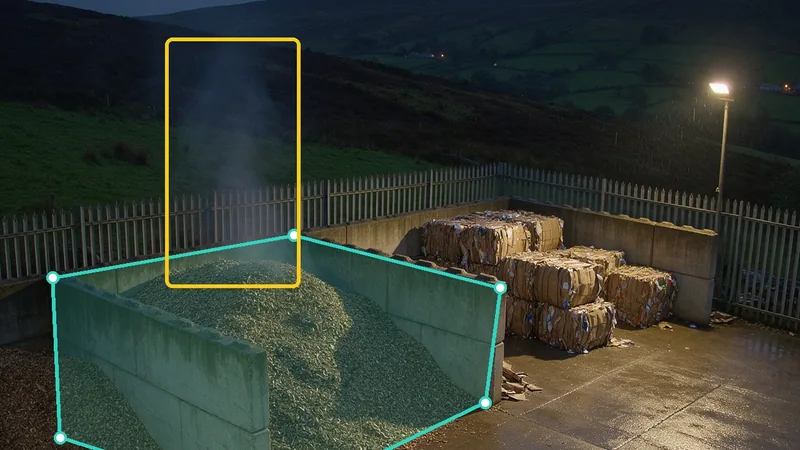
If your waste site is in Wales, the Environment Agency’s fire prevention plan guidance is not the document your regulator works from. Natural Resources Wales publishes its own guidance, and while the two overlap a great deal, the wording on fire detection is not identical. This guide sets out what NRW asks for, how it differs from the EA, and what to write in the detection section of your plan. It is for site managers, compliance leads and consultants preparing or reviewing a plan for an NRW permit.
What does NRW ask for on fire detection?
NRW’s guidance on fire prevention and mitigation plans (last updated 7 October 2026, checked by us on 30 October 2026) has a section on fire detection. In summary, it says you should:
- have adequate procedures in place to detect a fire in its early stages, at any time of the day or night, so you can reduce its impact
- seek competent advice on the potential installation of a fire detection system
- make your detection system proportionate to the nature and scale of your waste activities and the associated risks
- make sure the design, installation and maintenance are covered by an appropriate UKAS-accredited third-party certification scheme
- talk to your insurer, because many insurers have their own requirements and failing to meet them may invalidate your insurance
The guidance gives examples of appropriate automated systems: smoke and heat detectors including temperature probes, CCTV visual flame detection systems, and spark, infrared and ultraviolet detection. It was written with South Wales, Mid and West Wales, and North Wales Fire and Rescue Services, and it says you must be able to put your plan into action at any time.
How does NRW’s guidance differ from the EA’s?
The table compares the two documents on the points that matter most for fire detection. The England column is taken from the GOV.UK guidance on fire prevention plans for environmental permits (section 13), and the Wales column from NRW’s guidance. Both are summarised in our own words.
| Topic | England (Environment Agency) | Wales (Natural Resources Wales) |
|---|---|---|
| Name of the plan | Fire prevention plan (FPP) | Fire prevention and mitigation plan |
| Who shaped the guidance | Published by the Environment Agency on GOV.UK | Written by NRW with the three Welsh fire and rescue services |
| Early detection | You must have procedures to detect a fire in its early stages | You should have adequate procedures to detect a fire early, at any time of the day or night |
| Raising the alarm | Your plan must show how detection raises the alarm during working hours and when the site is closed | Detection at any time of the day or night; arrangements outside working hours are also covered under arson and security |
| Proportionate detection | Proportionate to your activities and risks; can be automated or manual | Proportionate to the nature and scale of your activities and risks |
| Example automated systems | Smoke and heat detectors including temperature probes; CCTV visual flame detection; spark, infrared and ultraviolet detection | The same three examples |
| Certification | An appropriate third-party certification scheme (such as UKAS) or a recognised standard (such as a British Standard), with evidence in the plan | An appropriate UKAS-accredited third-party certification scheme for design, installation and maintenance |
| Advice and insurers | Not mentioned in the detection section | Seek competent advice; talk to your insurer, as failing its requirements may invalidate cover |
| Alternative measures | Show you still meet the three objectives (likelihood, extinguish within 4 hours, spread) | Show no increase in four risks: likelihood of fire, impact of emissions, resources needed by NRW and responders, and clean-up costs |
The practical upshot: if you have an English plan and a site in Wales, do not simply rename it. Rework it against NRW’s guidance, and check the certification wording in particular, because NRW refers specifically to a UKAS-accredited scheme. For the English version in full, see our guide to EA fire prevention plan detection requirements.
When do you need a plan? NRW’s guidance says that on a standard rules permit you do not need to submit a plan, but you must have one in place before you start operating. For a new bespoke permit you must submit one with your application, and for a variation you need one if the change increases your fire risk. Check the guidance for your permit type.
What detection does NRW expect on site?
NRW does not prescribe one technology. It asks for detection that is proportionate, and it expects you to explain your choice. A good detection section names every storage and process area, says how each one is watched, and says what happens when something is found. NRW also expects the plan to sit within your accident management plan, as a separate document and part of your written management system.

Three parts of the guidance are worth reading alongside the detection section:
- Self-heating. Where waste can self-combust, NRW suggests monitoring with a thermal probe or thermal camera. Camera smoke detection watches the surface of a stack, so it does not replace temperature monitoring inside the pile.
- Plant and hot exhausts. NRW suggests a fire watch or visual check at regular intervals and at the end of the working day. Camera detection can support that watch after staff leave, and the alert log shows what was seen.
- Arson and security. NRW lists security fencing, intruder alarms and CCTV, and asks you to consider arrangements outside working hours.
The guidance also covers storage times, pile sizes, separation and the quarantine area. Your detection layout should follow that layout, so if bays move, update both your plan and your detection zones. NRW expects you to review the plan after a fire, when you take new waste types or larger volumes, and when you add new infrastructure or plant, and to test your fire prevention and mitigation equipment periodically.
Can camera smoke detection be part of an NRW plan?
It can. NRW lists CCTV visual flame detection among the appropriate automated systems, so camera-based detection is a recognised option. Whether a particular system suits your site is something your plan has to show, with the competent advice and certification NRW asks for. Check with NRW and with your insurer before you rely on any one system.
Many sites use camera detection alongside other measures rather than instead of them. Cameras are useful where point detectors struggle: open yards, outdoor bays, tall stacks and large halls. They also give you a short clip of each event, which helps your team decide what to do and gives you a record for your plan. Industry guidance such as WISH Forum’s WASTE 28, which NRW’s guidance refers to, describes video smoke detection as one of several detector types on waste sites.
Per-camera schedules matter here. NRW asks for detection at any time of the day or night, so smoke and fire alerts should not switch off when the yard closes. Intrusion and line-crossing alerts, on the other hand, are usually wanted only when the site is shut, so staff and vehicles do not trigger them during the working day.
What about remote and rural sites?
Many permitted sites in Wales sit in valleys, on farms or on upland roads, a long way from the nearest fire station and from the people who hold the keys. NRW’s guidance says you must be able to implement your plan at any time, and that many sites keep a copy in an emergency services box at the site entrance so the fire and rescue service and NRW can reach it.

For a remote site, the detection section of the plan should answer a few practical questions. These are our suggestions, not NRW requirements:
- Who gets the alert? Name the roles, not just the system. Include a second person for holidays and nights.
- How long to reach site? Say how quickly a keyholder can get there to meet the fire and rescue service and open the gate.
- Can they see what is happening first? A clip on the phone lets the keyholder judge the situation on the way.
- Does the alert get out? Check that your site’s internet connection and power to the cameras are reliable, and test alerts regularly.
- Can the cameras see at night? Check each view after dark, with the lighting you actually have.
- What if nobody can be reached? Consider an alarm receiving centre (ARC) to handle alerts around the clock.
How do I write the detection section?
Our fire prevention plan detection template gives full example wording for England. You can adapt it for Wales by using NRW’s plan name, NRW’s certification wording and the day-or-night detection requirement. The short example below shows the shape of a detection section written for an NRW plan. Replace everything in square brackets and check it against the current NRW guidance.
Example wording for the detection section
Fire detection [Site name] has procedures to detect a fire in its early stages at any time of the day or night. Our detection is proportionate to the wastes we store and treat: - [Area, e.g. wood chip bay 1]: [detection method, e.g. camera smoke and flame detection on camera 2] - [Area, e.g. baled card store]: [detection method] - [Quarantine area]: [detection method] We took competent advice on our detection from [name or organisation] on [date]. The design, installation and maintenance of [system] are covered by [name of UKAS-accredited third-party certification scheme]; evidence is at appendix [x]. When a fire is detected, [system] alerts [role] by [method]. Out of hours, [role] can reach site within [time] and will meet the fire and rescue service at the gate. A copy of this plan is kept in the emergency information box at the site entrance. We have discussed our detection and suppression arrangements with our insurer, [name], on [date].
Before you submit or update the plan, run through our fire prevention plan checklist. If you are still assessing your fire risks, our waste site fire risk assessment guide is the place to start, and our guide to whether your insurer requires fire detection CCTV covers the insurance side.
Where does Woodcock AI fit?
Woodcock AI turns the CCTV you already have into AI fire and smoke detection. It connects to your cameras or recorder over ONVIF or RTSP, so a camera that already looks at a bay, stockpile or gate can start watching for smoke and fire without being replaced.
- Polygon detection areas. Draw a shape round each bay, stack or quarantine area so every alert names the area in your plan. See polygon detection zones.
- Self-learning, fitted to each scene. Models are fitted to each camera’s view and trained on that site’s normal footage, which matters for rain, mist and changing light on exposed sites. Read about our self-learning AI.
- Built over years, in use today. Woodcock AI has been developed over several years and runs on real UK sites.
- Alerts that reach a remote keyholder. App alerts with a clip and email as standard, with an alarm receiving centre (ARC) as an optional add-on. Per-camera schedules keep smoke and fire detection on around the clock, with line-crossing alerts on the gate when the site is closed.
- Records for your plan. Every alert keeps its time, area and clip, and we run smoke tests on site at commissioning.
See how it works on our AI smoke and fire detection camera page, or read how it is used on waste and recycling sites.
Which sources is this guide based on?
- Natural Resources Wales, Fire prevention and mitigation plans (page last updated 7 October 2026; checked 30 October 2026).
- GOV.UK, Environment Agency, Fire prevention plans: environmental permits (last updated 11 January 2021; checked 30 October 2026).
- WISH Forum, WASTE 28: Reducing fire risk at waste management sites (issue 3, March 2020).
We have summarised these documents in our own words. Always read the current version and follow your permit. This page is general guidance, not legal or regulatory advice; NRW decides what is acceptable for your site.
Writing or reviewing a plan for a site in Wales?
Book a site assessment and we will look at your cameras, the areas your plan needs covered and how alerts should reach your keyholders. Or ask for a live test on your cameras first.
Related pages
Frequently asked questions
Does NRW use the same FPP guidance as the EA?
No. NRW publishes its own guidance on fire prevention and mitigation plans, written with the three Welsh fire and rescue services. It overlaps with the Environment Agency’s guidance and lists the same three types of automated detection, but the plan name, wording and certification requirement differ. Use NRW’s guidance for sites in Wales.
What detection does NRW expect?
Adequate procedures to detect a fire in its early stages at any time of the day or night, proportionate to the nature and scale of your activities and risks. NRW asks you to seek competent advice, and says design, installation and maintenance must be covered by an appropriate UKAS-accredited third-party certification scheme.
Can camera smoke detection be part of an NRW FPP?
Yes, it can form part of your detection. NRW lists CCTV visual flame detection among appropriate automated systems. Your plan must show the system suits your site, with competent advice and the certification NRW asks for, so check with NRW and your insurer first.
Who do I contact at NRW?
Use the NRW contact page or the officer handling your permit. To report an environmental incident, use NRW’s incident reporting page. For fire safety advice, contact your local fire and rescue service: South Wales, Mid and West Wales, or North Wales.
Do insurers in Wales ask for anything extra?
We are not aware of insurer rules that apply only in Wales. NRW’s guidance does warn that many insurers have specific requirements for detection and suppression, and that failing to meet them may invalidate your insurance, so talk to your insurer before you install anything.
Last reviewed 30 October 2026