

Solar panel fire safety: rooftop PV on commercial buildings, warehouses and farms
To keep rooftop solar safe from fire, get the basics right: a competent, certified installer, a non-combustible roof covering where possible, gaps in the array at fire walls, DC isolators and connectors fitted and matched properly, inverters somewhere ventilated and reachable, and an inspection at least once a year with records kept. Tell your fire risk assessor, insurer and local fire service the system is there, with a PV sign and a fire service switch. Then make sure someone sees the first smoke on the roof, where nobody is looking: smoke detection on a camera view of the array can send an alert with the clip within minutes, day or night.

Last updated 2 November 2026. Look down on almost any UK business park, distribution centre or farm from the air and you will see solar panels. Large flat roofs are unshaded, out of the way and already paid for, which makes them ideal for solar. A warehouse roof can carry thousands of panels, a school roof a few hundred, a barn roof a long run of them facing south. The panels quietly cut the electricity bill, and most of the people who work in the building never think about them again.
That is the point, and it is also the problem. A rooftop solar system is an electrical installation spread across a surface that nobody walks on and nobody watches. It carries direct current from the moment the sun comes up, through hundreds of connections, along cables and through switches and inverters, many of them sitting a few centimetres above a roof membrane and the insulation beneath it. Almost all of these systems never cause a problem. But when one does, the first sign is usually a thin wisp of smoke from under a panel row, on a roof that nobody can see from the ground floor.
This guide is for owners, managers and fire safety leads of UK commercial buildings with solar on the roof or over the car park: warehouses and distribution centres, factories and workshops, offices and retail units, schools and colleges, hospitals and care settings, farms and estates. It covers how often solar fires happen and how fast that number is growing, why rooftop systems catch fire and which parts fail, what happened in a run of place-named fires in 2025 and 2026 and when they started, how a fire behaves under and across a roof array, the standards and recommendations that apply, what the law expects of the responsible person, design choices that cut the risk, inspection and maintenance, hot work, the security side, what firefighters need from you, and how detection on the cameras you already have can cover the roof itself.
We cover solar farms, battery storage and the fire risks of warehouses in their own pages, and link to them rather than repeat them: solar farms and battery storage, lithium-ion battery storage fire safety and warehouse fire safety. Where we use figures, they come from fire services, government research, insurers and published codes of practice, with links at the end. Where we give advice, it is general guidance, not a fire risk assessment or an electrical inspection of your building.
How common are solar panel fires in the UK?
Solar panel fires are still rare compared with the number of systems installed. There are now more than two million solar installations in the UK, and the great majority run for years without incident. But rare is not the same as negligible, and the trend is moving the wrong way, especially on business premises.
There is no single official count. Fire services in England record the cause and location of each fire they attend, but there is no fixed category for solar panels. The government has published an ad hoc statistic that searches the free-text notes on fire incident records for words such as solar panel and photovoltaic. It comes with clear warnings: it depends on what each crew happened to write, not every fire and rescue service is included in every year, and the most recent year was only partly covered when it was published. It is useful for spotting a trend, not for an exact count.
The clearest recent picture comes from the insurer QBE, which sent Freedom of Information requests to UK fire and rescue services in February 2026 and published the results in August 2026. The services that replied reported 91 fires involving solar panels in 2022, 131 in 2023, 155 in 2024 and 212 in 2025. That is a rise of 133% in three years. Over the same period, according to the government’s solar deployment statistics quoted by QBE, the number of installations rose from about 1.27 million to about 1.93 million, a rise of 52%. Fires grew more than twice as fast as the number of systems.
Some of that rise will be better recording, as crews learn to note when panels are involved. Some will be the simple fact that systems installed in the boom years of the early 2010s are now more than ten years old, with connectors, isolators and cables that have been through a decade of sun, frost and wind. And some will be the speed of new installation, which has put more systems in the hands of more installers, of varying experience, in a short time.
What matters most for a business is where the fires are happening. QBE’s figures show homes are still the largest group, with 102 fires in 2025, up from 87. But fires on commercial buildings rose from 33 to 48, an increase of 46%, and fires on industrial buildings more than doubled, from 6 to 14. Fires at solar farms fell slightly, from 16 to 14. Commercial and industrial roofs were the fastest-growing group.
Local figures tell the same story. Essex County Fire and Rescue Service, answering an information request in March 2026, listed 14 incidents involving solar panels across its area from 2022 to 2025. These are small numbers in any one county, which is why it is easy for a single site to think it will never happen there. But each of those incidents was a building that had to be evacuated, a roof that had to be reached, and a business that had to deal with the damage afterwards.
The direction of travel is clear. The government’s Solar Roadmap, published in June 2025, sets out plans to increase solar sharply across the UK, and puts commercial and industrial rooftops at the heart of that growth. More panels on more business roofs means more connectors, more isolators and more inverters, and so more chances for one of them to fail. QBE also found that the number of solar fires that spread beyond the solar system itself, to the roof or the building, rose from 33 in 2022 to 88 in 2025.
None of this is a reason not to have solar. It is a reason to treat a rooftop system as what it is: a large electrical installation on top of a building, which needs to be designed, installed, inspected and watched with the same care as any other part of the building’s fire safety.
Why do rooftop solar systems catch fire?
Most people imagine a solar fire starting in a panel. In practice, the panels themselves are rarely where it begins. The risk sits in the parts that carry the direct current, or DC, that the panels produce: the connectors that join panels and cables together, the cables themselves, the DC isolator switches, and the inverter that turns DC into the alternating current the building uses.
DC behaves differently from the mains electricity most people are used to. A poor connection in a DC circuit can produce a sustained arc, a spark that does not go out on its own, and arcs and high-resistance joints produce a lot of heat in a very small space. On a roof, that space is often a plastic connector lying in a cable tray or on the membrane, or a switch box fixed to a frame, with nothing nearby to notice the heat.
The QBE figures for 2025 show where the fires started when fire services recorded it. DC cabling and connectors were involved in 49 fires, up from 26 the year before, the panels themselves in 36, battery banks in 23 and inverters in 19. The rise in connector and cabling fires is the most striking change.
Older research points the same way. A study by BRE for the government, summarised in the joint code of practice RC62, looked at 46 incidents in detail and found that DC isolators were the component most often at fault, in 49% of cases, followed by DC connectors in 20% and inverters in 19%. DC cable accounted for 7% and the panels for just 4%. The same work found that installation problems were the most common root cause, ahead of faulty products. The earlier BRE work for the government, published as Fire and solar PV systems: investigations and evidence, reached a similar view about poor installation.
Put simply, most solar fires start where two things have been joined together, or where the current is switched, and the most common reason is that the job was not done quite right. Typical problems include:
- Mismatched connectors. Plugging one maker’s connector into another that looks the same but is not designed to fit it can leave a poor contact that heats over time.
- Connectors not fully closed or crimped badly. A joint that is slightly loose or badly crimped may work for months before it starts to overheat.
- Water getting in. Connectors and switch boxes left lying in water, or with seals that have failed, corrode and heat up.
- Cable damage. Cables rubbing on sharp edges, trapped under frames, chewed by animals or left loose to flap in the wind.
- Too many isolators. RC62 notes that separate DC isolators, when the inverter already has its own, add extra connections and extra points that can fail.
- Inverters that cannot breathe. Vents blocked by stock, dust, leaves or nests, or inverters fitted in hot, cramped spaces.
- Age and weather. Years of heat and cold, storms, birds and dirt slowly loosen what was once a good joint.
Batteries are a separate issue. More commercial systems now include battery storage, which brings the risk of thermal runaway, a fast, self-feeding fire that gives off flammable and toxic gases. QBE’s figures show 23 fires involving battery banks in 2025. If your system has batteries, our guide to lithium-ion battery storage fire safety covers what to do about them.
There are also causes from outside the system: contractors doing hot work near the panels, wind-blown litter, leaves and nests building up underneath, vandalism, and fires set deliberately by intruders. We come back to each of these below.
Rooftop solar fires in 2025 and 2026: six UK cases
Figures only tell part of the story. These six fires, each reported by a fire service, a council or the press, show what a rooftop solar fire looks like in practice. We have summarised them from public reports and linked to them at the end. In several, the cause had not been confirmed when they were reported, and we say so where that applies.
A large store in Wembley, 16 October 2025
London Fire Brigade was called at 10:35 to a fire on the roof of a large retail store on Drury Way in Wembley. Around 100 solar panels on the roof were alight. Around 250 people were evacuated from the store. Five fire engines and around 30 firefighters attended, and a 32-metre turntable ladder was used as a water tower to reach the roof. The fire was out by 12:44. The brigade said it believed the fire was caused by resistive heating, the build-up of heat in an electrical connection, in the solar panels.
A primary school in Brantham, Suffolk, 30 March 2026
Suffolk Fire and Rescue Service was called at 13:09 to a fire at Brooklands Catholic Primary School on Palfrey Heights in Brantham. The fire was in the roof and spread into the building. The stop message, meaning the fire was under control, was sent at 14:27. The fire was later reported as linked to the solar panels on the roof.
A warehouse in Bedford, 25 May 2026
Bedfordshire Fire and Rescue Service was called at 13:18 on Monday 25 May to a fire affecting solar panels on the roof of a warehouse at Caxton Court, Caxton Road, in Bedford. The fire involved panels on a roof of about 50 by 30 metres. Crews in breathing apparatus used an extended hose reel, a thermal imaging camera and an aerial ladder platform, and the gas, electricity and solar supplies were isolated with the help of engineers. The fire was recorded as accidental.
Sidegate Primary School, Ipswich, 24 June 2026
Staff at Sidegate Primary School in Ipswich smelled smoke during the afternoon. About 650 pupils and 100 staff were evacuated and four fire engines attended. The fire service said the cause was beyond reasonable doubt a solar panel on the roof. Suffolk County Council then took the precaution of switching off the solar panels at about 80 schools with systems installed between 2011 and 2016 while they were checked, noting that a fire at a school in East Bergholt in August 2025 had also been linked to solar panels.
A farm building in Marton, Shropshire, 25 June 2026
Shropshire Fire and Rescue Service was called at about 13:29 to a fire in an agricultural building of about 20 by 20 metres at Marton, near Baschurch. The fire involved an electrical solar panel inverter. Five appliances from Oswestry, Shrewsbury and Wem attended, and crews used hose reels and thermal imaging cameras.
A hospital unit in Malton, North Yorkshire, 8 July 2026
North Yorkshire Fire and Rescue Service was called at about 11:16 to a fire at the Springwood unit on the Malton hospital site. Fifteen patients were evacuated safely, with no injuries, but the building was destroyed. The fire service said the fire most likely started at a solar panel on the roof.
When do rooftop solar fires start?
Most guidance on fire and security for commercial buildings is written around the night: the empty building, the locked gate, the arsonist in the yard. Rooftop solar is different. In five of the six fires above, the call came between 10:35 and 13:29, and the sixth was reported in the afternoon. Every stated time falls in the middle of the day.
That makes sense. Solar panels only produce electricity when light falls on them, and they produce most around the middle of the day. That is when the most current flows through every connector, isolator and inverter, and so when a poor joint gets hottest. Six cases are too few to be sure of the pattern, and night-time fires do happen, but the logic and the cases point the same way: a rooftop solar system is most likely to start a fire while the building is open and busy.
That has two practical consequences. First, any detection that covers the roof needs to run all day, not just at night. Plenty of camera systems are set up to alert only out of hours, when nobody is on site; that would miss most of these fires. Second, being open does not mean someone will notice. In Ipswich, staff smelled smoke; in Wembley, the fire had reached around 100 panels. On a busy weekday, nobody inside a warehouse or school is looking at the roof, and a wisp of smoke from under a panel row looks like nothing from the car park.
The night still matters for a different reason. Roofs attract cable thieves and vandals, and an empty site after dark is when intruders can reach a roof, damage panels or set fires. We cover that in the security section below.
How a fire behaves under a solar array
A fire under a row of panels is not the same as a small fire on an open roof. In February 2026 the government published a review of the research on fires involving solar panels on roofs, prepared by OFR Consultants for the Building Safety Regulator, part of the Health and Safety Executive. It covers panels added to existing roofs and panels built into the roof itself, and its findings matter for anyone with a large array.
The review found that the panels change how a fire behaves on the roof below. A panel sits a short distance above the roof surface, and that gap acts like a channel. Heat and flame from a fire underneath are trapped against the panel and pushed sideways along the roof, rather than rising away. The research it brings together measured heat flux, the amount of heat hitting the roof surface, of up to 50 kilowatts per square metre beneath arrays. Standard test methods used to classify how roofs behave in a fire from outside, such as BS EN 13501-5, consider 12.5 kilowatts per square metre. Under some arrays, the roof was facing about four times the heat it was tested for.
The review also found that, below a critical gap height between panel and roof, flame could spread up to 38 times faster than on the same roof without panels. It concluded that the current guidance in Approved Document B, and the roof fire tests it relies on, do not capture this effect, because they were not written with solar arrays in mind.
Three further points from the review matter for fire safety on the day:
- The system stays live. As long as light falls on the panels, they produce DC electricity. Switching off the mains, or even isolating the inverter, does not make the cables between the panels and the first switch safe. Firefighters have to treat the array as live.
- The array gets in the way. Rows of panels make it harder for firefighters to walk across a roof, reach the seat of the fire or cut ventilation openings, and they can cover roof lights and smoke vents that are part of the building’s fire strategy.
- Batteries add hazards. Where a system includes battery storage, the risks of thermal runaway, toxic gases and reignition come on top of the roof fire itself.
The review recommends non-combustible roof coverings under arrays, fire-resistant construction where arrays are fitted, clearer guidance on the gap between panel and roof and on breaking arrays into sections, and new test methods that reflect real arrays. Until those arrive, it is up to building owners, designers and installers to apply the recommendations that already exist, most of which are set out in RC62.
For a building with a combustible roof, such as a membrane over foam insulation, or a farm building with timber or old sheeting, this is the main reason a small fault can turn into a large fire. A connector that overheats on a concrete slab with nothing around it may scorch and stop. The same connector on a membrane over insulation, under a panel that traps the heat, can start a fire that runs along the roof faster than anyone can climb up to it.
RC62 and the standards for solar fire safety
The most complete set of recommendations for fire safety with solar on UK buildings is RC62, a joint code of practice from RISCAuthority, the research body funded by insurers, and MCS, the certification scheme for small-scale renewables, produced with Solar Energy UK and published by the Fire Protection Association. Version 2 was published in February 2023. It is written mainly for commercial and industrial buildings, and insurers often expect it to be followed.
RC62 works through each stage of a system’s life. Among its main points:
- Design and installation by competent people. Systems should be designed and installed by competent, certified installers, to BS 7671, the wiring regulations, and to the relevant product and installation standards.
- The roof. Where possible, panels should go on roofs with a non-combustible covering, classed A1 or A2-s1,d0 under BS EN 13501-1. Where the roof is combustible, the risk needs to be assessed and managed.
- Separation. Arrays should be laid out so a fire cannot run straight across a compartment wall in the building below. RC62 recommends a gap of at least 2.5 metres between the panels either side of a compartment wall, reduced to 1.2 metres only where the roof is non-combustible and the risk of fire spreading across is low.
- Inverters and isolators. Inverters, isolators and distribution boards should be in places that are ventilated, reachable and away from combustible materials, and automatic fire detection should cover all areas inside buildings where they are installed.
- Fewer joints. Avoid separate DC isolators where the inverter already provides isolation, because each extra joint is another possible point of failure.
- Commissioning. Systems should be inspected and tested on completion to BS EN 62446-1, with the records handed over.
- Maintenance. Systems on commercial buildings should be inspected at least once a year, with maintenance to BS EN IEC 62446-2, and checked again after storms.
- Firefighters. Clear signs, a way for firefighters to isolate the system, and information about the layout should be provided, and the local fire service invited to visit.
RC62 also points to the IET’s code of practice for grid-connected solar systems and to Solar Energy UK’s operation and maintenance guidance. It mentions infrared thermography and drone surveys as ways to find hot spots, and the growing use of data and AI to predict faults before they happen. If you are responsible for a building with solar, RC62 is worth reading in full; it is free to download.
The installer you use should be certified under a recognised scheme, such as MCS for smaller systems, and should be able to show how they have followed RC62. The QBE report makes the same points: use certified installers, have the system inspected and cleaned every year, make sure firefighter switches and any arc-fault detection are easy to reach, avoid combustible roofs or provide separation, use quality DC connectors, and inspect after extreme weather.
What the law expects of the responsible person
In England and Wales, fire safety in most business premises falls under the Regulatory Reform (Fire Safety) Order 2005. Scotland and Northern Ireland have their own equivalent law. The Order places duties on the responsible person, usually the employer, or the owner or occupier who controls the premises.
The responsible person must carry out a suitable and sufficient fire risk assessment, take the fire precautions it identifies, and keep the assessment under review, especially when something significant changes. A new solar system on the roof is a significant change. So is battery storage added later, a change of roof covering, or a run of faults on an existing system.
In practice, that means the fire risk assessment should say that the system is there, where its parts are, what the risks are, and how they are controlled. It should cover how the system is maintained and by whom, how it can be isolated, how firefighters will be told about it, how the roof can be reached, and how a fire on the roof would be detected and raised. A roof fire that the building’s alarm cannot see until it has spread inside is a gap the assessment needs to address.
New installations, and changes to roofs, are also covered by the Building Regulations. Approved Document B sets out the fire safety guidance for buildings in England, including how roofs should perform against fire from outside. As the government’s review notes, that guidance was not written with large solar arrays in mind, which is why RC62 and your insurer’s requirements matter as well.
The electrical side has its own rules. The Electricity at Work Regulations 1989 require electrical systems at work to be kept safe, and the solar system is part of the building’s electrical installation. Your electrical contractor should be able to show it has been inspected and tested.
Finally, if you lease the building, check who is responsible for the system. In some cases the landlord or a third party owns and maintains the panels under a power purchase agreement, while the tenant runs the building. Fire safety duties can fall on more than one party, and they need to talk to each other.
Design choices that cut the fire risk
Many of the most important decisions are made before the first panel goes up. If you are planning a new system, or replacing an old one, these are the points to raise with your designer, installer and insurer.
- The roof covering. A non-combustible roof, or a non-combustible layer beneath the array, is the single most effective way to stop a small fault turning into a roof fire. Where the roof is combustible, discuss alternatives with your insurer before you commit.
- The gap between panel and roof. The research shows that small gaps make fire spread faster. Your designer should be able to explain how the mounting system was chosen with this in mind.
- Breaking the array up. Large unbroken arrays let a fire run. Gaps at compartment walls, walkways through the array and space around roof lights and smoke vents limit spread and give firefighters access.
- Cable routes. DC cables should be protected, supported and kept short where possible, and should not run through areas where a fire would trap people or reach stock.
- Where the inverters go. Inverters should be somewhere ventilated, easy to reach and away from stock, waste and other combustibles. Indoors, the room should have fire detection. Outdoors, they should be protected from weather and impact.
- Isolation. Plan how the system will be switched off in an emergency, where the switches are, and how firefighters will find them.
- Batteries. If you add storage, keep it separate from the main building where possible, ventilated and reachable, and follow the maker’s and insurer’s rules.
- Seeing the roof. Think about how anyone would know if something went wrong up there. A camera that can see the array, the cable runs and the inverters is much easier to plan in at the start than to add later.
Inverters, car park canopies and barn roofs
Not all solar sits on a flat warehouse roof. The inverters are often on a wall or in a compound at ground level, many sites now have solar canopies over the car park, and farms often have panels on pitched barn roofs. Each needs its own view and its own detection.
Where is your solar?
Most solar fires start in the parts that carry DC current: isolators, connectors and inverters. Keep inverters where they are ventilated, reachable and away from stock, with fire detection in any room they are in. A camera on an outside inverter wall or compound, with smoke detection on all the time, covers the kit where it sits.
Where the DC current comes down
Solar canopies put panels, cables and inverters over parked cars, often in a corner of the site nobody watches. Keep the canopy in a maintenance plan, keep the cable runs protected, and keep the canopy in view of a car park camera with smoke detection running all the time.
Solar over parking bays
Barns, older sheds and pitched roofs often have combustible materials close to the panels, with hay, straw or machinery underneath. Keep the array in view of a yard camera, keep stores clear of the inverter, and use smoke detection on the roof view all day and night.
Farm and older buildings
Each part of the system gets a view that suits it: inverter walls and compounds, car park canopies, and roof arrays seen from a plant room, a taller building or a yard pole.
Inspection and maintenance
A solar system is often sold as something you fit and forget. For fire safety, that is the wrong way to think about it. Connectors loosen, seals age, cables get damaged, inverters clog with dust and debris build up under the panels. Most of these problems can be found by a competent person long before they cause a fire, but only if someone looks.
- At least once a year. RC62 recommends that solar systems on commercial and industrial buildings are inspected at least annually by a competent person, following the IET’s code of practice and BS EN IEC 62446-2. The more often a system is checked, the sooner problems are found.
- Thermal surveys. Infrared thermography, from the roof or from a drone, shows connectors, isolators and panels running hotter than they should. It is one of the best ways to find a failing joint before it starts a fire.
- Electrical tests. Routine tests, such as insulation resistance, help find damaged cables and water getting into the system.
- After bad weather. Check the system after storms, high winds, heavy snow and lightning, which can loosen fixings, damage cables or shift panels.
- Keep it clear. RC62 says windblown litter and leaves should not be allowed to build up around or under panels. The gaps under panels can also trap nests, foliage and moss. All of it is fuel sitting next to live connectors.
- Inverters. Keep vents clear and the area around inverters free of stock, packaging and waste. Check them for warning lights, error codes and unusual noise or heat.
- Switches. Test isolators and any fire service switch during routine maintenance, and record the results.
- Records. Keep the design, commissioning and test certificates, maintenance reports, thermal survey results and any repairs. Your insurer and your fire risk assessor will want to see them, and so will a fire investigator if the worst happens.
Monitoring data from the inverter can help too. A sudden drop in output from one string, or repeated faults, can be an early sign of a problem. But monitoring will not tell you about smoke, and it will not tell anyone on the roof or in the car park that something is wrong.
Older systems need particular attention. Many commercial and school systems were fitted in the years after the feed-in tariff began in 2010. As Suffolk County Council’s decision to switch off and check systems at around 80 schools from that period shows, the age of a system is now a risk factor in its own right. If you have an older system with no recent inspection records, book one.
Hot work and contractors on the roof
Roofs with solar are working roofs. Roofers repair membranes, plumbers and heating engineers work on plant, electricians work on the system and other services, and window and gutter cleaners pass through. Any of them can damage cables or connectors, and some bring heat with them.
RC62 recommends that, unless it is unavoidable, no hot work such as welding, flame cutting or torch-on roofing should take place in or near the area of the solar system. Where it must happen, it should be done under a written permit to work, following RISCAuthority’s RC7 recommendations for hot work. That means checking the area before work starts, covering or protecting nearby combustibles, keeping extinguishers to hand, keeping a fire watch during the work and for a period afterwards, and checking again before the site is left.
RC62 also says that contractors arriving on site should be told how the fire alarm sounds and what to do if they hear it or find a fire. Make sure anyone working on the roof knows the panels are there, knows which parts are live in daylight, and knows not to stand on, lean on or move panels and cables. For more on permits and fire watches, see our guide to hot works fire risk.
A camera that can see the roof helps here too. It gives you a record of who was on the roof and when, and smoke detection keeps watching the work area after the contractor has gone, which is when hot work fires often take hold.
The security side: theft, vandalism and arson
Rooftop solar is not only a fire risk; it is something people want to steal and damage. RC62 notes that a solar installation contains a notable amount of copper and aluminium, which makes it attractive to thieves, and that insurers expect security in proportion to that risk. It also records cases of panels being deliberately damaged with catapults and air rifles, and says the risk is higher for commercial and industrial buildings that are closed at weekends and holidays.
Theft from a roof is harder than theft from a solar farm: the equipment is high up, and most buildings are occupied during the day. But warehouses, factories and farm buildings are often empty at night and at weekends, with roof ladders, low roofs, stacked pallets and wheelie bins that give a way up. Cable runs and inverters at ground level are easier still. For more on cable and copper theft, see our guide to metal theft prevention.
Security and fire are linked. A cut or damaged cable, a broken panel or a forced isolator box can become a fire risk long after the intruder has gone. And RC62 reminds owners not to forget deliberate fire raising, from outside by intruders or from inside, pointing to RISCAuthority’s RC48 on arson prevention. A fire set against a wall, in a bin store or under a canopy can reach the solar system quickly.

Practical steps include:
- Lock or guard roof access ladders, and keep bins, pallets and skips away from walls and low roofs.
- Keep inverter compounds and cable runs at ground level fenced, locked and lit.
- Use cameras on the routes up to the roof, with lines or zones that are armed when the site is closed.
- Check for damage after any intrusion, and have the system inspected if panels, cables or isolators have been touched.
This is where the different hours matter. Smoke detection on the roof should run all day and all night. Lines and people zones on ladders and inverter compounds usually only need to run when the site is closed, so they do not alert every time a member of staff or a contractor walks past during the day.
What firefighters need from you
When firefighters arrive at a building with solar on fire, they face a hazard they cannot switch off. The panels produce DC electricity whenever light falls on them. RC62 points out that this includes floodlights used to light the fire ground at night, and that it continues even when the mains supply has been isolated. Many older systems have no way to isolate the DC cables on the roof at all.
The fire service’s job is much easier, and safer, if you have prepared. RC62 recommends:
- A clear sign. Solar is not always obvious from the ground. A prominent ‘PV on the roof’ sign, at least 100 mm by 100 mm, should be displayed at the consumer units or the supplier’s cut-out.
- A fire service switch. On commercial systems, where required by the wiring regulations or by your insurer, a switch in a prominent place, away from the array, that firefighters can use to isolate the DC side of the system. It should be tested during routine maintenance.
- Information. Plans showing where the panels, cables, isolators, inverters and any batteries are, kept where firefighters can find them, along with the other information the fire service will need about the premises.
- A visit. For large installations, invite the local fire service to visit and familiarise themselves with the site.
On the day, someone from the site should meet the crews, tell them the building has solar, show them the switches and plans, and tell them what they know about where the fire started. A clip showing the first smoke, and where it came from, can save time.
Why the roof is a blind spot
Most commercial buildings have fire detection inside: smoke detectors in the warehouse, heat detectors in the kitchen, perhaps beam or aspirating detection in a high bay, and RC62 recommends detection in any room that houses inverters or isolators. That is all essential, and nothing in this guide replaces it. But none of it looks at the roof.
A fire under a panel row starts outside the building. The smoke rises into open air and blows away. The indoor alarm will only sound once the fire has burned through the membrane and insulation and smoke has reached the inside, by which time the roof is involved and the fire may be spreading under the array. Before that, the only way it gets noticed is if someone happens to look up, or smell it, as the staff did in Ipswich.
Inverter monitoring and arc-fault protection can help, where they are fitted, by flagging electrical faults. But they do not see smoke, and on many older systems they are not there at all. Thermal surveys find problems before they become fires, but only on the day of the survey.
That leaves a gap: the first few minutes of a fire, on a roof, in daylight, when the building is busy and nobody is looking. It is exactly the gap that video smoke detection on a camera with a view of the roof can fill. The camera sees the first grey wisp rising from under a row, the software recognises it as smoke rather than cloud, dust or a passing bird, and an alert with the clip goes to the people who need to know, while the fire is still small. For how this works with the cameras you already have, see our guide to video smoke detection on existing CCTV, and for outdoor areas generally, outdoor fire detection.
Be clear about the limits. A camera only detects smoke it can see. It will not see a fault inside a closed isolator box until smoke comes out, and at night it depends on there being enough light or infrared for the camera to see smoke at all. It does not replace good design, competent installation, arc-fault protection, inspection or the building’s fire alarm. It is an extra layer that covers the part of the building nobody else is watching.
Where to put cameras to see a roof with solar
Most sites already have cameras pointing at the yard, the gates and the car park. Few have one that can see the roof. Getting a useful view usually means using a high mounting point, and there are four common options.
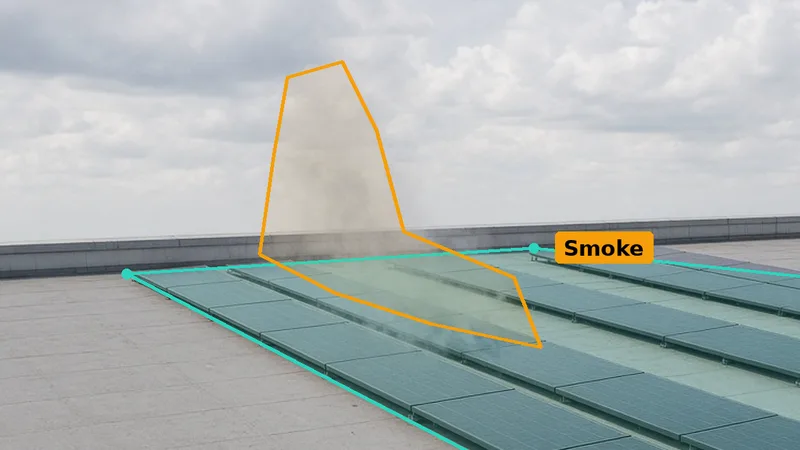
- On a plant room or roof structure. A camera on a plant room, lift motor room or stair tower can look along the rows of panels, as in the view at the top of this page. It gives the best view of the array itself.
- On a taller building next door. On a site with several buildings, a camera on the tallest can look down across the roof of a lower one.
- On a yard pole. A camera on a tall pole in the yard can look across a pitched roof or the edge of a flat one, which works well for barns and smaller units.
- On the inverter wall or compound. A camera covering the inverters at ground level watches the part of the system where many fires start, and also covers the compound and cable runs for security.
A few practical points. Keep the panels, cable runs and inverters in view, rather than sky. Avoid pointing a camera straight into the sun for much of the day. Think about night: if smoke detection is to work after dark, the view needs enough light or infrared. Check that the camera, its mount and its cable are safe to reach for maintenance and do not create a new fire or access risk. And remember that a camera on a roof can see a long way, so check that it is not looking into neighbours’ windows or gardens; the ICO’s guidance on video surveillance explains what you need to consider.
Car park canopies are usually easier: an existing car park camera may already see them, or can be moved to do so. Farms often already have a camera on a pole in the yard that can be turned to include the barn roof. On many sites, the cameras you need are already there.
Detection schedules: all day for smoke, out of hours for intruders
Because rooftop solar fires tend to start in daylight, smoke detection on the roof, the inverters and any canopy should run all the time. This is different from the way many sites set up their cameras, with alerts only at night. Security zones and lines are different again: they are most useful when the site is closed.
With Woodcock AI, you draw a polygon zone around each part of the system the camera can see, such as the array, the inverter wall or the canopy, and set smoke detection on it to run all day and night. You draw a line across the foot of the roof ladder and a people zone round the plant room or inverter compound, and arm them from closing time to opening time. Each camera can have several zones and lines with different schedules, so the same camera can watch for smoke all day and for intruders at night.
When the alert comes in, and after a fire
An alert is only useful if someone acts on it. Decide in advance who gets alerts during the day and who gets them at night, and what each of them should do. Put it in your fire emergency plan.
- Check the clip. Look at the clip and snapshot. Is it smoke from the array, or steam from a vent, dust or a bonfire beyond the fence?
- Call 999 if it is smoke. Do not wait to be sure it is a fire. Tell the fire service the building has solar panels and, if you can, where on the roof the smoke is.
- Evacuate. Raise the alarm and follow your evacuation plan. Do not send anyone onto the roof.
- Isolate if safe. If it is safe to do so, isolate the system at the inverter and any fire service switch, and the mains at the intake, as your plan sets out. Remember that the panels and the cables to the first switch will still be live.
- Meet the crews. Have someone meet the fire service with the plans and the clip.
After a fire, or after any incident that damages the system, keep everyone off the roof and away from the array, and treat the system as live. Do not switch anything back on. RC62 recommends that a damaged system is made safe and inspected by a competent person before it is used again. Keep the clips, alerts, maintenance records and photographs; your insurer and any fire investigator will want them, and they help find the cause.
What insurers look for
Insurers have watched solar fires rise, and many now ask specific questions about rooftop systems, particularly on large commercial and industrial buildings. RC62 itself comes from the insurers’ research body, and many insurers expect it to be followed.
Expect questions about who designed and installed the system and whether they were certified, the commissioning and test records, how often the system is inspected and by whom, whether thermal surveys are done, what the roof is made of and how the array is laid out, where the inverters and any batteries are, how the system is isolated, and how a fire would be detected. Some insurers apply conditions to cover or to the terms. QBE’s recommendations in its 2026 report cover the same ground: certified installers, annual inspection, accessible firefighter switches and arc-fault detection, separation or non-combustible roofs, quality connectors and checks after extreme weather.
Talk to your insurer or broker before you install, before you add batteries and before renewal. Being able to show maintenance records and a way of detecting roof fires quickly puts you in a better position. For more, see our guide to what insurers expect from fire detection.
A solar fire safety checklist
Use this as a starting point for a conversation with your installer, electrician, fire risk assessor and insurer. It is general guidance, not an assessment of your building.
| Area | Main risk | First steps | What cameras and AI add |
|---|---|---|---|
| DC isolators and connectors | Heating and arcing at poor joints | Competent install, matched connectors, yearly checks, thermal survey | Smoke detection on the roof view, always on |
| Inverters | Overheating, blocked vents | Ventilated, reachable, away from stock, fire detection in the room | Smoke detection on the inverter wall or compound |
| The roof itself | Fire spread under and across the array | Non-combustible covering, gaps at fire walls, walkways | A smoke zone drawn round the whole array |
| Batteries | Thermal runaway | Ventilated, separated, reachable, maker’s rules | Smoke and flame detection on the battery area |
| Contractors | Hot work and damage | Tell them about the panels, permit to work, fire watch | Clips of work on the roof, smoke watched afterwards |
| Roof access | Theft, vandalism, arson | Locked ladders, clear bins from walls, lighting | A line on the ladder and a people zone at night |
| Firefighters | Live DC, unknown layout | PV sign, fire service switch, plan, crew visit | Clips showing where the fire is when crews arrive |
- Is the system in your fire risk assessment, emergency plan and building records?
- Do you have the design, certification and commissioning records?
- Has it been inspected by a competent person in the last twelve months, and after the last big storm?
- Has it had a thermal survey?
- Are leaves, litter and nests cleared from around and under the panels?
- Are inverters ventilated, reachable and clear of stock and waste, with detection in any room they are in?
- Is there a PV sign at the meter, a fire service switch if required, and a plan for firefighters?
- Do contractors know the panels are there, and is hot work controlled by permit?
- Are the routes up to the roof secured, and watched when the site is closed?
- Can a camera see the array, the inverters and any canopy, with smoke detection running all day and night?
How Woodcock AI helps with solar fire safety
Woodcock AI connects to existing IP cameras over RTSP or ONVIF and runs on an edge server on site or on a cloud server. It adds smoke, flame, people and vehicle detection to the cameras you already have. You draw polygon zones that fit the shape of each roof array, inverter wall or canopy rather than a rough box, draw lines across ladders and gates, and set schedules so smoke detection runs all day and night while security zones are armed only when the site is closed. When something happens, an alert with a snapshot and short clip goes to the phones of the people you choose, and an AI description says what the camera saw.
Woodcock AI is self-learning, so it gets better at telling the normal from the unusual on each camera over time, such as the steam from a roof vent that comes and goes every morning. It is the result of years of development and is now in use on real sites in the UK. For how the same approach fits other sites, see our pages on warehousing and logistics, solar farms and battery storage and polygon detection zones. Ask your cameras, a way to ask the system questions about what it has seen, is Coming soon, early 2027.
Ways to start
Start with a site assessment. We look at your roofs, inverters and any car park canopies, which cameras you have and what each one sees by day and at night, and show where smoke zones, people zones and lines would help. Or ask for a live test on your cameras: we connect two or three of your existing cameras for about a fortnight, so you can see the alerts for yourself before deciding.
Sources
- QBE Europe, Solar panel fires increasing at more than double the rate of installations (August 2026, based on Freedom of Information responses from UK fire and rescue services).
- GOV.UK, Fire safety: thermal exposure to roofs from fires involving photovoltaic panels (executive summary), OFR Consultants for the Building Safety Regulator, updated February 2026.
- RISCAuthority and MCS with Solar Energy UK, RC62: Recommendations for fire safety with PV panel installations, version 2, 2023.
- GOV.UK, Fire incidents involving solar panels, BRE research for the government.
- GOV.UK, Number of fires in England with solar panel or photovoltaic panel mentioned in the additional information free text.
- GOV.UK, Solar Roadmap, Department for Energy Security and Net Zero, June 2025, and Energy Trends: UK renewables (solar PV deployment).
- legislation.gov.uk, Regulatory Reform (Fire Safety) Order 2005.
- Essex County Fire and Rescue Service, EIR 1806, solar panel incidents, March 2026.
- Incident reports: London Fire Brigade (Wembley), Suffolk Fire and Rescue Service (Brantham), Bedford Today (Bedford), BBC News (Ipswich) and Suffolk County Council, Border Counties Advertizer (Marton), North Yorkshire Fire and Rescue Service and BBC News (Malton).
- Information Commissioner’s Office, Guidance on video surveillance, including CCTV.
We have summarised these sources in our own words. Always read the current versions in full. This page is general guidance, not a fire risk assessment, an electrical inspection, or legal or insurance advice; your installer, electrician, fire risk assessor, insurer and fire service can advise on your own building.
Would anyone see the first smoke on your roof?
Book a site assessment and we will look at your roofs, inverters and car park canopies, and what your cameras can see by day and at night, and show where smoke zones, people zones and lines would help, or ask for a live test on your cameras.
Related pages
Frequently asked questions
Are solar panel fires common in the UK?
They are rare compared with the more than two million systems installed, but rising. Fire services that answered QBE’s 2026 information requests reported 212 fires involving solar panels in 2025, up from 91 in 2022, a rise of 133% while installations rose about 52%. Fires on commercial and industrial buildings grew fastest.
What causes most solar panel fires?
Most start in the parts that carry DC current rather than the panels themselves. A BRE study of 46 incidents, cited in RC62, found DC isolators at fault in 49% of cases, DC connectors in 20% and inverters in 19%, with poor installation the most common root cause. Damage, debris, age and hot work add to the risk.
When do solar panel fires usually start?
Panels produce most current around the middle of the day, which is when a poor connection gets hottest. In six UK rooftop fires from October 2025 to July 2026 that we looked at, every stated time fell between mid-morning and the afternoon. Smoke detection on a roof should run all day, not only at night.
Can firefighters switch off solar panels?
Not completely. Panels produce DC electricity whenever light falls on them, even under floodlights, so the panels and the cables to the first switch stay live after the mains is off. RC62 recommends a PV sign at the meter, a fire service switch on commercial systems where required, plans for firefighters and a site visit.
How often should commercial solar panels be inspected?
RC62 recommends that systems on commercial and industrial buildings are inspected at least once a year by a competent person, following the IET code of practice and BS EN IEC 62446-2, and again after storms. Thermal surveys help find hot connectors early. Keep the records for your insurer and fire risk assessor.
Can existing CCTV cameras detect smoke from rooftop solar panels?
Yes, if a camera can see the roof. Woodcock AI connects to existing IP cameras over RTSP or ONVIF and runs on an edge server on site or on a cloud server. Polygon smoke zones round the array, inverters or canopy can run all day and night. It adds to, and does not replace, fire alarms and inspection.
Last reviewed 2 November 2026
Solar on barns and farm buildings, and the wider farm fire risk: see our farm fire safety guide.