

Warehouse fire safety: racking, waste, batteries, arson and out-of-hours detection
Warehouse fire safety means a suitable fire risk assessment by the responsible person, then acting on it: keeping waste down and storage tidy, leaving clear space above and around stacks, controlling battery charging, securing outside storage against arson, and having working detection, warning, escape routes and an emergency plan. Many warehouse fires start or grow when few people are on site. AI on existing CCTV can add smoke and flame alerts, with a clip, from the cameras already watching the aisles, the yard and the roof.

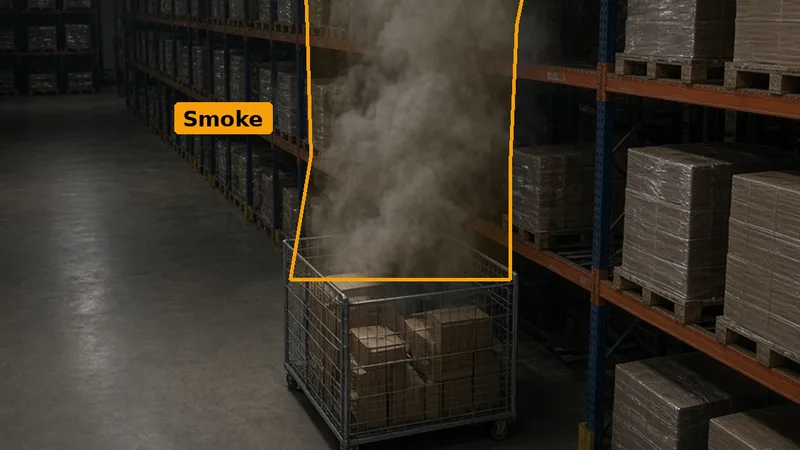
Last updated 1 November 2026. A warehouse is one of the hardest buildings to keep safe from fire. It holds more fuel per square metre than almost any other workplace: cardboard, plastic wrap, pallets, packaging, and stock that is often made of plastic or packed in it. It stores that fuel high, in racking that can carry a fire to the roof in minutes. It charges batteries for the trucks and equipment that move the stock. It keeps waste, pallets and trailers in the yard outside. And for long stretches of every week, at night, at weekends and over holidays, it may be empty or nearly empty, with nobody on site to see the first wisp of smoke.
When a warehouse fire takes hold, the results are severe. In 2026 alone, fire services across the UK sent dozens of engines and hundreds of firefighters to warehouse fires in Birmingham, Enfield, Brent, Barking, Bristol, Wembley, Melton Mowbray and Beccles. Whole buildings were lost, neighbours were evacuated from their homes, main roads were closed for hours, and businesses next door were damaged. In one case in Scotland, by contrast, a sprinkler system had already controlled the fire before crews arrived, and firefighters finished the job with a single jet.
This guide covers warehouse fire safety for owners, operators, logistics and distribution businesses, landlords of industrial units, facilities managers and anyone who is the responsible person for a warehouse in the UK. It sets out the latest figures, the 2026 cases, who is responsible in law, how to carry out and keep up a fire risk assessment, the main hazards area by area, from racking and waste to battery charging, rooftop solar and arson in the yard, and how detection works in a large building. It ends with where AI on the cameras a warehouse already has can help: smoke and flame alerts with a clip, around the clock, from the aisles, the yard and the roof.
It is general guidance, not a substitute for a fire risk assessment by a competent person, advice from your fire alarm designer, or the requirements of your insurer and your local fire and rescue service.
Where do warehouse fires start?
Every warehouse is different, from a single unit on an industrial estate to a distribution centre the size of several football pitches. But the government’s guide to fire safety in factories and warehouses, fire service incident reports and insurers all point to the same four places, again and again.
Stock and storage. Most warehouse stock will burn, and much of it is packed in cardboard and plastic that burns readily. Stored high in racking, with narrow vertical gaps between pallets, it gives fire a chimney to climb. A fire that would stay small on the floor of an office can reach the roof of a racked warehouse before anyone has found an extinguisher.
Waste and packaging. Warehouses produce a constant stream of waste: flattened boxes, stretch wrap, strapping, broken pallets and dunnage. When it builds up beside packing benches, in corners, against walls or in cages and skips outside, it is fuel waiting for a source of heat, whether that is a faulty light, a hot work job, a discarded cigarette or a deliberate act.
Batteries and charging. Electric trucks, pallet movers, cleaning machines and handheld devices all need charging. Lead-acid batteries give off hydrogen when they charge. Lithium-ion batteries can fail and burn fiercely, and some warehouses also store, return or ship lithium-ion products, from e-bikes and tools to phones and laptops, some of them damaged.
Arson and the yard. Pallets, waste cages, bins, skips and parked trailers in the yard are easy targets, and a fire outside can spread into the building through cladding, doors and roof lights. Deliberate fires in industrial premises are recorded every year, and the yard is usually where they start.
Behind all four sits a fifth factor: time. A fire that starts while people are working nearby is usually found and dealt with quickly. A fire that starts when the building is empty can burn for a long time before anyone outside notices.
How many fires are there in warehouses and industrial premises?
The government publishes detailed fire statistics for England every year. The data tables do not count warehouses on their own. Instead, warehouses and bulk storage are part of a wider category of industrial premises, which also includes manufacturing and processing sites, vehicle repair, public utilities and laboratories. It is the closest official measure available.
In 2025/26, fire and rescue services in England attended 1,806 primary fires in industrial premises, according to the fire statistics data tables (FIRE0304). That was up from 1,669 the year before, and it made industrial premises one of the largest categories of fires in buildings other than homes, out of 13,679 such fires in total.
Of those 1,806 fires, 169 were recorded as deliberate, and the rest as accidental or cause not known. 183 spread to involve the whole building, and 56 were in roofs and roof spaces. Primary fires are the more serious fires: those in buildings, vehicles and outdoor structures, or involving casualties, rescues or five or more fire engines. These are not bin fires.
The same table shows how far each fire spread. The most common outcome was that the fire was limited to the item that was first ignited, in 576 cases. In another 402, there was no fire damage at all. That is what happens when a fire is found early, by people nearby, an alarm, a sprinkler or a quick-thinking member of staff. But in 183 cases the fire took the whole building, about one in ten, and another 42 spread across two or more floors.
The difference between those outcomes is mostly time: how long the fire burned before it was found, and how quickly someone acted. A fire limited to a pallet of returns is an incident report. The same fire found an hour later can be the end of the building and the business in it.
Over the longer term, the number of fires in industrial premises has fallen, from 2,134 in 2015/16 to around 1,700 to 1,800 a year since. Deliberate fires have fallen too, from 263 to 169. But the number that took the whole building has not fallen in the same way. There were 172 in 2015/16, 130 in 2024/25 and 183 in 2025/26. Fewer fires start, but those that do still destroy buildings.
Across all buildings other than homes, the fire and rescue incident statistics for the year ending June 2026 recorded 13,111 fires, down from 14,037 the year before. The average response time to those fires was 9 minutes 14 seconds, up from 8 minutes 31 seconds ten years earlier. That is the time from the call to the first engine arriving. It does not include the time it took someone to notice the fire and call.
What happened in warehouse fires in 2026?
The figures are national. The cases below are individual warehouse and storage fires reported by fire services and the press in 2026. They are named by place, not by business, and the details come from the published reports, which are linked in the sources at the end.
Tyseley, Birmingham, January. West Midlands Fire Service was called at 19:13 on 7 January to a significant fire at a large storage unit on an industrial estate in Tyseley: a two-storey brick-built building, measuring about 100 metres by 40 metres. Crews attended in under five minutes, but the whole building was involved. Fourteen fire engines, three hydraulic platforms and more than 75 personnel attended, and eight engines were still there the following morning.
Scotland, April. At 08:15 on 7 April, the Scottish Fire and Rescue Service was called to a fire in a recycling warehouse measuring about 200 metres by 100 metres, involving dry recycling material. As BAFSA reported, the building’s sprinkler system had already activated and controlled the fire before crews arrived. Firefighters put out what remained with one jet, and the stop message came at 08:35, twenty minutes after the call.
Crews Hill, Enfield, May. Twelve fire engines and around 80 firefighters from London Fire Brigade and Hertfordshire Fire and Rescue Service were called to a fire near Crews Hill at 20:10 on 2 May. A range of three warehouses was destroyed. The brigade took more than 20 calls, and the fire was under control by 00:19 the next morning.
Neasden, May. At 23:20 on 26 May, London Fire Brigade received the first of 25 calls about a fire next to the North Circular Road. A ground-floor workshop was destroyed and the fire spread to offices above and to the roof. Twelve engines and around 80 firefighters worked through the night, with turntable ladders used as water towers, and the fire was under control at 02:05.
Oxgate Lane, Brent, June. The brigade took the first of more than 85 calls at 21:14 on 11 June about a fire in a two-storey multi-use warehouse on a business park. At its height, most of the structure and its roof were alight. Twenty-five fire engines and around 150 firefighters responded, around 70 people from a neighbouring residential block were evacuated to a rest centre, and the road was closed. The fire was under control at 05:02 the next morning and was not being treated as suspicious.
Ripple Road, Barking, August. At 12:47 on 12 August, the brigade took the first of 15 calls about a fire in a two-storey warehouse on an industrial estate. Twenty engines and around 125 firefighters attended, with extra crews mobilised so firefighters could rest in the heat. A number of cylinders were removed and cooled, because some cylinders can explode when exposed to heat. The building had been evacuated before the brigade arrived, part of the A13 was closed, and the fire was under control at 18:10.
Emery Road, Brislington, Bristol, September. A major fire broke out at an industrial unit at around 2.30pm on 1 September. Sixteen fire engines attended, a 200-metre cordon was put in place, people were evacuated and roads stayed closed into the next day. The Bristol Post reported that emergency services confirmed the fire was started deliberately.
Alperton Lane, Wembley, September. At 14:47 on 6 September, the brigade took the first of 13 calls about a fire at a two-storey warehouse. Ten engines and around 70 firefighters attended, half of the ground floor was destroyed, and the fire was under control at 18:24.
Dalby Road, Melton Mowbray, September. The alarm was raised at 20:13 on 7 September at a two-storey warehouse, 25 metres by 50 metres, that Leicestershire Fire and Rescue Service said was known to contain a large quantity of combustible liquids and other potentially dangerous chemicals. As BBC News reported, ten fire appliances, aerial ladders and two water carriers were sent, and crews worked through the night to stop the fire spreading to nearby buildings.
London Road, Beccles, September. Fourteen crews were sent from 12:52 on 14 September to a fire at a 40 by 90 metre plastic packaging warehouse that spread to neighbouring businesses. One industrial unit was destroyed, another severely damaged and a third moderately damaged. The fire service informed the UK Health Security Agency and the Environment Agency as a precaution, according to BBC News.
High Street, Willesden, October. At 09:19 on 10 October, the brigade took the first of 21 calls about a fire in the ground-floor storeroom of a retail warehouse. Four engines and around 25 firefighters attended. The storeroom was destroyed and part of an external transformer was damaged. The fire was out by 10:48.
Water Road, Wembley, October. At 02:18 on 15 October, the brigade took a call about a warehouse fire. Twelve engines and around 80 firefighters attended, part of the ground floor was damaged, and the fire was under control at 04:07.
When do warehouse fires happen?
Look at when those twelve fires were reported and a pattern appears. Six came during the working day, between 08:15 and 14:47. Six came in the evening or at night, between 19:13 and 02:18.
Daytime fires are not harmless. Beccles and Barking both began in the middle of the day and still involved large buildings. But the night fires in this list share something. Tyseley, Crews Hill, Brent and Neasden were all large fires by the time crews were working on them, with whole buildings, roofs or several warehouses involved. At Brent, the brigade took more than 85 calls, a sign of how visible the fire already was from outside.
When a warehouse is empty, the first people to notice a fire are often neighbours, drivers on a nearby road or passers-by who see smoke or flames from outside. By then the fire has usually been burning for some time. That gap, between the start of a fire and the moment someone knows about it, is the gap that the rest of this guide is about closing: by reducing the chance that a fire starts, by limiting how far it can spread, and by making sure that someone is told as early as possible, at every hour.
Who is responsible for fire safety in a warehouse?
In England and Wales, fire safety in workplaces is governed by the Regulatory Reform (Fire Safety) Order 2005, usually called the Fire Safety Order. Scotland and Northern Ireland have their own legislation with similar duties. The Order places duties on the responsible person: in a workplace, the employer, and otherwise whoever has control of the premises, such as the owner or occupier. GOV.UK’s guide to workplace fire safety sets out the basics.
The responsible person must carry out a fire risk assessment, or have one carried out, and keep it under review. They must put in place and maintain the fire safety measures it identifies, plan for an emergency, and give staff information, instruction and training. Where more than one business shares a building, such as a multi-let warehouse or a unit on an estate with a landlord who controls the common areas, each responsible person must cooperate and coordinate with the others.
Since 1 October 2023, changes made by section 156 of the Building Safety Act 2022 have strengthened these duties in England. All responsible persons must now record their completed fire risk assessment in full, including all the findings, not just the significant ones, and record the identity of the person or organisation who carried it out. They must share relevant fire safety information with any incoming responsible person, such as a new tenant, and cooperate and coordinate with other responsible persons. Certain offences under the Order now carry unlimited fines.
For warehouses this matters in practice. A tenant who leaves a unit should hand over what the next occupier needs to know. A landlord who controls the yard, the roof or a shared fire alarm needs to agree with each tenant who is responsible for what, and who will be told when something happens out of hours.
How do you carry out a warehouse fire risk assessment?
The government’s guide, Fire safety risk assessment: factories and warehouses, is still the most detailed official source for warehouses. It sets out five steps: identify the fire hazards, identify the people at risk, evaluate, remove, reduce and protect from risk, record, plan, inform, instruct and train, and review.
Identify the hazards. Look for sources of ignition, such as electrical equipment, lighting, heaters, battery chargers, hot work and smoking, and for sources of fuel, such as stock, packaging, waste, pallets and anything flammable. Look for sources of oxygen, too, including ventilation systems that could feed a fire and any oxidising materials.
Identify the people at risk. In a warehouse that means staff on each shift, drivers waiting in the yard or the drivers’ room, visitors, cleaners, and contractors. The guide also points to seasonal and temporary workers, who may not know the building, and to anyone working alone or in remote parts of the site.
Evaluate, remove, reduce and protect. Remove hazards where you can, reduce the ones you cannot, and then protect people with detection and warning, escape routes, emergency lighting, signs, fire-fighting equipment and, where needed, sprinklers.
Record, plan, inform, instruct and train. Write the assessment down in full, prepare an emergency plan, and make sure everyone knows what to do.
Review. Look at the assessment again regularly, and whenever something changes: new stock, more racking, a new mezzanine, a new charging area, rooftop solar, a change of tenant, or a change in how many people are on site and when. Peak seasons, when warehouses fill to the roof and bring in temporary staff, are a common trigger.
A competent fire risk assessor, with experience of warehouses, is worth the investment for any site of size. Ask them to look at the yard and the roof as well as the inside of the building, and at what happens at night as well as during the day.
How should stock and racking be stored?
How goods are stored decides how quickly a fire spreads and how hard it is to fight. The government guide is blunt about racking. It says that fires in the vertical flues of 10-metre-high racking frequently reached the top within two minutes, and that fire spreads upwards fast through rolls of material stored on end and through gaps between pallets.
- Leave space above. Keep at least 1 metre clear between the top of the stack and the ceiling, or the lighting, and more where your sprinkler design or insurer requires it.
- Keep aisles wide. The guide suggests aisles at least 2.5 metres wide between blocks of stored goods, to slow fire spreading from one block to the next.
- Keep away from walls. Leave at least 0.5 metres between stored goods and internal walls.
- Keep sprinklers clear. Sprinkler heads must not be shielded by racking or stock, and in-rack sprinklers must be protected from damage.
- Keep doors and shutters clear. Fire doors and fire shutters must not be obstructed, and their closing area must be kept free.
- Separate the worst. Store particularly hazardous goods apart. The guide lists tyres, plastics, foodstuffs high in sugar or oil, combustible fibres, paper, hanging garments, carpets, pesticides, flammable liquids and gases, reactive chemicals and aerosols, among others.
A fire that reaches the top of a rack can spread along the underside of the roof and drop burning material onto the stock below. That is why the guidance on clear space, sprinkler heads and segregation matters so much more in a warehouse than in most other buildings.
What housekeeping rules matter most?
Good housekeeping is the cheapest fire safety measure there is, and the one most easily lost on a busy day. A warehouse that clears its waste every shift, keeps its aisles clear and stores nothing in its voids has far less fuel for a fire than one that does not.
- Clear waste every shift. Flattened cardboard, wrap, strapping and broken pallets out of the building and into a secure compound, not piled by the packing benches or the doors.
- Nothing in the voids. The guide says voids, including spaces under mezzanines and roof voids, should not be used for storage.
- Plan for peaks. Seasonal stock, promotions and returns can fill a building beyond what its layout and fire protection were designed for. Plan where extra stock will go before it arrives.
- Watch the returns. Returned goods, especially electrical items, may be damaged. Give them a defined, tidy area, not a corner of the loading bay.
- Control smoking. Provide a designated smoking area well away from stock, waste and the building, and enforce it.
- Check the electrics. Inspect and test electrical installations and equipment, and keep stock and waste clear of lights, heaters and distribution boards.
How should outside storage and waste be managed?
The yard is part of the fire risk assessment, and often the weakest part. Waste cages, wheeled bins, skips, pallet stacks, parked trailers and outside stock all burn, and the government guide is clear about where they belong.
- Away from the building. Goods, pallets and vehicles stored outside should be kept well away from the building, and from openings such as doors and roof lights.
- Bins in a compound. Wheeled bins should be secured in a compound, so they cannot be moved against the building or set alight there.
- Skips never against the building. The guide says skips should never be placed against the building.
- Nothing against the fence. Pallets stacked against a perimeter fence give someone a way over it, and a fire on the other side can spread to them.
- Trailers parked with gaps. Loaded trailers parked tight against the loading doors carry a fire straight into the building.
Our waste fire facts page covers fires at sites that store or handle waste.
How do you reduce the risk of arson at a warehouse?
In 2025/26, 169 primary fires in industrial premises in England were recorded as deliberate. The government guide warns that storage areas are vulnerable to arson, and its advice on outside storage, bins and skips is largely about denying an arsonist something to light against the building. The Brislington fire in September was confirmed as started deliberately.
- Secure the perimeter. Fences, gates and locks that work, with gates shut and locked outside working hours.
- Remove the fuel. Nothing that burns stacked against the walls, under canopies or by the doors. Waste in locked compounds, emptied often.
- Light the yard. Light the yard, the loading areas and the waste compound, so cameras can see and anyone approaching can be seen.
- Secure the building. Letterboxes, vents and gaps under doors are routes for burning material. Close and secure doors, shutters and windows at the end of the day.
- Know when it is happening. A camera on the yard that tells someone a person is among the pallets at night, while they are still there, gives time to act.

In the scene above, a person is crouched by the pallet stack against the outside wall at night, long after the yard should be empty. A people zone drawn over the stacks, armed from 19:00 until the first shift arrives, sends an alert with the clip while they are still there, and smoke detection on the same view watches the stacks all night. Our guide to arson prevention with CCTV goes into more detail.
How should battery charging be managed?
Most warehouses charge batteries every day, for the trucks and pallet movers that move stock, for cleaning machines, and for handheld scanners and devices. The government guide says charging areas should be in a well-ventilated area, away from combustible materials. The HSE’s guidance on using electric storage batteries safely explains why: charging lead-acid batteries gives off hydrogen and oxygen, and a poorly ventilated charging area can build up an explosive atmosphere.
- A dedicated area. Charge in one set place, designed for it, not wherever there is a socket.
- Ventilation. Make sure the area is well ventilated, as the HSE guidance describes.
- Nothing combustible nearby. Keep stock, waste and packaging well clear.
- Signs and rules. Mark the area, keep sources of ignition out, and train staff in safe charging and what to do if a battery overheats.
- Maintain the equipment. Inspect chargers, leads and batteries, and take damaged ones out of use.
What about lithium-ion batteries and returns?
Lithium-ion batteries are now in a large share of the goods warehouses handle, from e-bikes and power tools to phones, laptops and toys, and in many of the trucks and devices warehouses use. When they fail, they can overheat, give off toxic and flammable gases and burn intensely.
Essex County Fire and Rescue Service advises businesses to include lithium-ion batteries in their fire risk assessment, to provide a designated, well-ventilated and monitored charging area, to store batteries in fire-resistant cabinets or areas, and to train staff never to touch a smoking battery, but to evacuate and call 999. It cites a fire in September 2023 at a warehouse in Great Notley, which started in an area where used lithium-ion batteries were stored, smoke-logged the building and needed more than 50 firefighters.
The government’s guidance on e-cycle and e-scooter batteries for premises adds that damaged, swollen or leaking batteries are an extremely high fire risk. For warehouses that handle returns, that means a defined area for returned battery goods, away from other stock and waste, inspected regularly, with damaged items isolated. Our guide to lithium-ion battery storage fire safety covers this in depth.
Do rooftop solar panels increase the fire risk?
Many warehouse roofs now carry solar panels. They are large, flat and unshaded, which makes them ideal for solar, and also out of sight. Most installations never cause a problem, but when one does, it can start a fire on a roof nobody is looking at.
Research by BRE’s National Solar Centre for the government, published as Fire and solar PV systems: investigations and evidence, examined 80 fire incidents involving solar panels. It found that 58 were caused by the solar system itself, and 22 of those were serious fires. Where the root cause could be found, poor installation was the most common, in 21 cases, ahead of design faults in 6 and product faults in 3. DC isolators and connectors featured again and again.
For warehouse operators, the lessons are to use competent designers and installers, to have the system inspected and maintained, to know where it can be isolated and to share that with the fire service, and to have a way of seeing the roof. A camera on a yard pole, or on a taller part of the building, that keeps the roof line in view lets smoke and flame detection watch the panels all day and night. In 2025/26, 56 fires in industrial premises in England were in roofs and roof spaces.
What about flammable liquids, gases and chemicals?
Some warehouses store goods that are dangerous in their own right: flammable liquids, aerosols, gas cylinders, oxidisers and other chemicals. These add duties under the Dangerous Substances and Explosive Atmospheres Regulations 2002 as well as the Fire Safety Order.
The 2026 cases show why. At Melton Mowbray, the fire service said the warehouse was known to contain a large quantity of combustible liquids and other potentially dangerous chemicals. At Barking, crews removed cylinders from the scene and cooled them, because some cylinders can explode when exposed to heat. At Beccles, the fire service told the UK Health Security Agency and the Environment Agency about the fire.
- Know what you hold. Keep an up-to-date list of dangerous substances, quantities and locations.
- Separate them. Store incompatible substances apart, and dangerous substances away from general stock and exits.
- Limit quantities. Keep only what you need, in suitable containers and stores.
- Tell the fire service. Make the list and a site plan available to crews when they arrive, for example in a premises information box.
What about hot work and contractors?
Hot work, such as welding, cutting, grinding and roofing with torches, is a known cause of fires in warehouses, often during maintenance, fit-outs and repairs to racking, roofs and doors. It should be controlled by a permit system, with combustible materials removed or protected, fire extinguishers to hand, and a fire watch during and after the work, because smouldering material can take time to ignite. Our guide to hot works fire risk sets out a full permit process.
Contractors are among the people at risk the government guide identifies. They may not know the building, its escape routes or its alarm. Brief them, sign them in and out, and check their work areas when they leave.
How should escape routes work in a large warehouse?
In a large building, the distance to a way out matters. For new buildings and building work in England, Approved Document B gives maximum travel distances for storage buildings. In normal-hazard storage, the limit is 25 metres where there is only one direction to escape, and 45 metres where there is more than one. In higher-hazard areas it falls to 12 metres and 25 metres.
Approved Document B applies to new buildings, extensions and material changes of use. For existing warehouses, the fire risk assessment decides whether escape routes are adequate, and racking changes, mezzanines and new walls can all make routes longer. Keep routes clear, signed and lit, with emergency lighting that is tested, and make sure exit doors can be opened easily from inside without a key whenever people are in the building.
When are compartments and sprinklers needed?
Approved Document B also limits the size of compartments in new storage buildings. Under Table 8.1, a single-storey storage building without sprinklers can have a floor area of up to 20,000 square metres, with no limit where sprinklers are fitted. For multi-storey storage buildings, the limit on each compartment is 20,000 cubic metres without sprinklers and 40,000 cubic metres with them. Separately, sprinklers are needed in any building where the top storey is more than 30 metres above ground.
Many warehouses are fitted with sprinklers for property protection, often at the insurer’s request, even where building regulations do not require them. The Scottish case in this guide shows what they can do: the sprinklers had controlled a fire in a 200 by 100 metre recycling warehouse before crews arrived, and firefighters finished the job with one jet. Sprinklers need to match the stock, the storage height and the racking, so a change of use or a new storage layout may need a fresh look at the design.
How is fire detected in a large warehouse?
Almost every warehouse needs a way of detecting fire and warning the people inside. In a very small unit, that might be a simple manual system, where someone who discovers a fire breaks a call point. In most warehouses, the fire risk assessment will call for automatic detection, designed, installed, tested and maintained by competent people, as the government guide sets out.
Point detectors on the ceiling detect smoke or heat at one spot. They are the most common, and they work well in ordinary rooms. In a tall warehouse, smoke from a small fire low in the racking can cool and spread out before it reaches the roof, so it may take longer to reach them.
Beam detectors send a beam of light across a large space and detect smoke that crosses it. Aspirating systems draw air through pipes to a sensitive detector, and can sample at different heights, including inside racking. Both are designed for large, tall and open spaces.
Heat detection and sprinklers respond once a fire is producing significant heat. Sprinklers control or put out the fire as well as detecting it, and the alarm they raise can be passed on to an alarm receiving centre.
Video smoke and flame detection uses cameras and software to recognise smoke and flame in the image. It sees smoke where a camera looks, wherever that smoke is, including outside in the yard and on the roof, where ordinary detectors cannot go. Our guide to video smoke detection on existing CCTV explains how it works.
Each has a place, and they work best together. The fire alarm designer and the fire risk assessor decide what the building needs. Camera-based detection can add a view of the places the fire alarm does not cover, and a picture of what is happening, but it does not replace the fire alarm.
Why does the time of day matter so much?
When a warehouse is staffed, a fire is likely to be seen, smelled or heard within moments, and the alarm raised. When it is empty, everything depends on how the fire is detected, and on what happens next.
If the fire alarm is connected to an alarm receiving centre, the centre can call the fire service and the keyholder. But the fire service has to deal with very large numbers of false alarms: the fire and rescue statistics recorded 178,003 fire false alarms due to apparatus in England in the year ending June 2026. Each fire and rescue service sets its own policy for responding to automatic fire alarms. Check how yours responds to alarms from your premises, and what it expects from you.
If the alarm is not connected, or if the fire starts outside the building, in the yard or on the roof, the first warning may be a call from a neighbour or a passer-by. At Brent, the brigade took more than 85 calls. By the time a fire is visible from a road, it has usually been growing for a while, and then it takes time for crews to arrive: an average of 9 minutes 14 seconds for fires in buildings other than homes in the year ending June 2026.
Every minute between the start of a fire and someone knowing about it is a minute in which it can grow. That is why out-of-hours detection, and a clear plan for who is told and what they do, matter so much in warehouses.
What should the emergency plan cover?
The emergency plan sets out what happens when there is a fire. In a warehouse it needs to work for every shift, for weekends and holidays, and for times when nobody is on site.
- Raising the alarm. How the alarm is raised, how staff, drivers and visitors are warned, including in noisy areas, and who calls 999.
- Getting out. Escape routes, assembly points, and how you account for everyone, including drivers, visitors and contractors who signed in.
- Meeting the crews. Who meets the fire service, with site plans, a list of hazardous materials, the location of solar isolators, gas and power shut-offs, and keys.
- Out of hours. Who is told about a fire or an alarm at night, in what order, who goes to site, and what they do when they get there. Never send someone alone into a building that may be on fire.
- Training and drills. Train staff, including temporary and agency workers, and run drills on each shift.
At Barking, the building was evacuated before the brigade arrived and nobody was hurt. That is what a plan that works looks like.
What do insurers look for?
Warehouse insurers look closely at fire risk, because warehouse fires can be very large losses. Expectations vary between insurers and sites, but they are likely to ask about a current fire risk assessment, good housekeeping and waste control, storage that follows the guidance on clear space and segregation, managed battery charging, a hot work permit system, a maintained fire alarm with a monitored signal, sprinklers where the risk calls for them, and security to deter arson, including outside storage kept away from the building.
Talk to your broker or insurer before you change how the building is used or protected, and keep records of maintenance, testing, training and inspections. Our guide to insurer expectations for fire detection covers this in more detail.
Why is a warehouse hard to protect with ordinary CCTV?
Most warehouses already have CCTV: on the gate, the yard, the loading doors and inside the aisles. But recording-only CCTV is built for looking back. It records a fire, or a person in the yard, so you can see what happened afterwards. Nobody watches the screens at 2am.
Ordinary motion alerts do not help much either. Yards are full of movement at night: headlights, foxes, birds, rain, wind in loose wrap and lights on timers. A system that alerts on all of it is switched off within weeks. And motion detection does not recognise smoke at all.
Where should cameras watch at a warehouse?
Start with the cameras you already have, and what they can see by day and by night. The places that matter most for fire are usually the same four.
- The aisles and the returns. Racking ends, returns cages and areas where damaged goods are kept, from a camera that sees along the aisle.
- The yard. Waste cages, bins, skips, pallet stacks and parked trailers, and the walls they sit beside.
- The roof. From a camera on a yard pole or a taller part of the building, if the roof carries solar panels or plant.
- The charging and packing areas. Where batteries are charged and where cartons, wrap and waste build up.
Cameras need a clear view, enough light or infrared at night, power and a network connection. A site assessment will show which existing cameras can do the job and where a new view would help.
How can AI on existing CCTV help at a warehouse?
Recording-only CCTV shows what happened after the event. AI detection tells someone while it is happening, in time to act. Woodcock AI connects to the IP cameras and recorders already on site, over RTSP or ONVIF, including Hikvision, and runs on an edge server on site or on a cloud server (an edge server needs only a power socket and a network connection).
- Smoke and flame. Smoke and flame detection on every camera that sees the aisles, the returns cage, the packing and charging areas, the yard and the roof, around the clock, indoors and out.
- Polygon zones. Draw an area of any shape on a camera’s view, around the pallet stacks, the waste compound or the trailer park, and detect people only inside it. A zone can follow the stacks exactly and leave out the path to the drivers’ room.
- Lines. Draw a line along the fence or across the yard gate, and alert when a person crosses it, in the direction you choose.
- People and vehicles. Detect people and detect vehicles moving in a zone, ignoring foxes, birds, rain and passing headlights.
- Schedules. Arm each people rule for the hours that make sense, such as the yard stacks from the end of the last shift, and leave smoke on all the time.
- Alerts with the clip. Alerts arrive in the app and by email with a short clip and an AI description, so a shift manager or a keyholder can see in seconds whether it is steam, a driver, someone among the stacks, or smoke.
The system is self-learning. It learns each camera, what is normal on that view and what is not, and marking an alert as correct or false feeds into retraining for your site. Woodcock AI has been in development for years and is now running on customer sites across the UK.
Woodcock AI does not read number plates or identify people. It tells you that there is smoke at the returns cage at 02:41, or a person by the pallet stacks at night, with the clip; what happens next is up to you.
Coming next: Ask your cameras Coming soon, early 2027, which will let you ask the system questions about what your cameras have seen.
What does detection look like in different parts of a warehouse?
Each part of a warehouse has its own risks and its own camera views. Choose an area to see how detection might be set up there.
Which part of the warehouse are you protecting?
Waste cardboard, wrap and pallets build up outside, often against the wall. A camera on the yard sees the cages, the bins and the stacks. Smoke detection runs at every hour, and a people zone over the stacks, armed when the yard should be empty, flags someone among them at night, which is where many deliberate fires start.
Waste cages, bins, skips, pallet stacks and the fence line
Rooftop solar adds connectors, cables and isolators across a roof nobody looks at. A camera on a yard pole, or on a taller part of the building, that keeps the roof line in view lets smoke and flame detection watch the panels all day and night, so the first sign reaches someone on the ground.
The roof line and the panels, seen from a yard pole or a neighbouring building
Packing areas hold cartons, wrap and tape next to printers, heaters and chargers. Charging areas hold batteries that can fail. Smoke detection on a camera above the benches, or on the charging bay, runs all the time, including between shifts and over weekends, when the area is empty.
Packing benches, carton stacks, and the battery charging area
The yard, the roof and the packing area each get their own camera views and schedule, with smoke detection on all three.
How does AI detection compare with other measures?
No single measure makes a warehouse safe from fire. The table compares the main approaches. Most sites use several together.
| Measure | What it does | Strengths | Watch out for |
|---|---|---|---|
| Housekeeping and storage rules | Keeps waste down, aisles clear and stacks below the ceiling | Removes fuel and slows spread; costs little | Slips at peak times, when the building is fullest |
| Fire alarm with point detectors | Detects smoke or heat at the ceiling and raises the alarm | Required in most warehouses and designed to standards | In tall spaces smoke can spread out below the roof before it reaches the detectors; the yard and the roof are outside it |
| Beam and aspirating detection | Detects smoke across large or tall spaces, or draws air to a sensitive detector | Built for big open buildings and high racking | Needs specialist design, testing and maintenance; still inside the building only |
| Sprinklers | Water applied automatically over a fire | Controls or holds a fire before crews arrive, as in the Scottish case in this guide | Must match the stock and storage height; heads must not be shielded by racking |
| Alarm receiving centre | Passes the fire alarm signal on when nobody is on site | A response out of hours | Check how your fire service responds to automatic fire alarms from your type of premises |
| Recording-only CCTV | Records the yard, the doors and the aisles | Evidence for the fire investigation and the insurer | Nobody sees the smoke at 3am until someone reviews the footage |
| AI on existing CCTV | Recognises smoke, flame, people and vehicles, in zones you draw, on a schedule | Covers the yard, the roof and the aisles at once; the alert includes the clip | Cameras need a clear view, power, a connection and enough light or infrared at night; it does not replace the fire alarm, sprinklers or a fire risk assessment |
How do you keep false alerts down at a warehouse?
A warehouse is a busy and changeable place for a camera. Sweepers raise dust, engines idle at the loading doors, heaters and vents give off steam, rain and low sun change the picture, and shutters open and close. A system that alerts on all of that will be ignored.
- Choose views carefully. Avoid cameras pointing straight into low sun or at vents and exhausts where you can.
- Draw tight zones. Cover the stacks, the compound or the cage, not the route drivers use to the office.
- Use schedules. Arm people rules only when nobody should be there, and switch them off for deliveries, cleaning and planned contractor visits.
- Recognise people, not motion. Detecting people and vehicles, rather than any movement, removes foxes, birds, rain and headlights.
- Mark alerts. Mark each alert as correct or false. The system learns each camera’s view over time.
Our guide to reducing CCTV false alarms goes into more detail. The aim is a handful of alerts a week that each matter, not dozens a night that nobody reads.
What detection schedule suits a warehouse?
Every warehouse keeps different hours, from a single day shift to round-the-clock operations. But the pattern is the same: people rules where and when nobody should be there, and smoke and flame detection on everything, all the time.
In this example, shifts run from 06:00 to 22:00. The yard stacks and bins are armed for people from 19:00 to 06:00, because the yard is quiet once the last trailers have gone. The loading doors are armed from 22:00 to 05:00, between the last departure and the first arrival. Smoke and flame detection, including the roof view, never switches off, because fires start on shift and off it, as the 2026 cases show.
Start with a cautious schedule, look at the alerts for a fortnight, and adjust. Our out-of-hours security checklist covers the same thinking for other sites.
What should happen when an alert comes in?
An alert is only useful if someone acts on it. Before the cameras go live, agree who receives alerts for each area, at what hours, and what they do.
- Alert. The alert arrives in the app and by email, with the clip and an AI description.
- Check. Watch the clip. Is it steam, dust, a driver, someone in the yard, or smoke?
- Act. For a fire, call 999 and follow the emergency plan. For a person on site at night, follow the security plan you agreed: a keyholder, a security patrol or a monitoring centre, and the police for a crime in progress.
- Review. Mark the alert, note what happened, and fix what it showed: waste left by a wall, a gate left open, a charger left running next to cartons.
Police response to intruder alarms is governed by the National Police Chiefs’ Council requirements for security systems, and police response to an alarm system with a unique reference number is withdrawn after three false calls in a rolling 12 months. Alerts that come with a clip, checked by a person before anyone calls, help keep calls for real incidents.
What should you do after a fire?
After a fire, the first priority is people: everyone accounted for, the building made safe, and the fire service in charge until it hands the site back. Then:
- Report it. Get the fire service incident details and tell your insurer promptly.
- Save the clips. Export and keep the footage before the recorder overwrites it, and note the times. Fire investigators and insurers will want it.
- Make safe. Have the structure, racking, electrics and solar system checked before people go back in, and deal with damaged stock and smoke contamination.
- Review. Update the fire risk assessment, look again at storage, waste, charging and hot work, and check what the cameras could and could not see.
- Tell people. Tell staff, tenants and neighbours what happened and what has changed.
What about privacy and data protection?
Cameras in a warehouse see staff, drivers and visitors at work. Under UK GDPR, the organisation running the cameras is responsible for the footage. The ICO’s guidance on video surveillance sets out what to do.
- Tell staff. Explain why the cameras are there, what they detect and how footage is used, and consult where your policies require it.
- Focus. Point cameras at the stock, the yard, the roof and the routes, not at rest areas, changing rooms or toilets.
- Signs. Put up clear signs saying CCTV is in use and who runs it.
- Retention. Keep footage only as long as you need it, and delete it after that.
- Assessment. Carry out a data protection impact assessment where the cameras are likely to be high risk to privacy.
Smoke and flame detection watches for smoke and flame, not for how people work. People zones belong in places where nobody should be at night, such as the yard stacks after the last shift. Woodcock AI does not use facial recognition, identify who anyone is or read number plates. Our guide to AI CCTV and GDPR in the UK covers this in more depth.
How do you get started?
Start with the basics: a current fire risk assessment, recorded in full, that covers the yard and the roof as well as the inside; waste cleared every shift; clear space above and around stock; managed battery charging; outside storage away from the building; a maintained fire alarm; and an emergency plan that works at night. Then look at what your cameras can already see.
Our site assessment looks at the cameras already covering your aisles, yard, roof, charging and packing areas, what each one can see by day and night, and where zones would go. To see it working first, we can run a live test on your cameras: we connect two or three of them for about a fortnight. We can also arrange an on-site demo.
What are the limits?
AI on existing cameras is useful, and it is not magic. It is worth being clear about what it cannot do.
- It only sees what the cameras see. A fire deep inside a rack, behind stock or in a closed room may only show once smoke rises into view.
- It needs light. At night, cameras need lighting or infrared to see well.
- It needs power and a network. If the power or the network goes down, so do the cameras and the alerts.
- It detects; it does not put fires out. Sprinklers, fire-fighting equipment and the fire service do that.
- It does not replace the fire alarm or the fire risk assessment. Keep the building’s fire safety measures maintained as the assessment requires. Cameras add a view of the places they do not cover.
- Someone has to respond. An alert at 2am is only useful if someone sees it and acts.
Sources
- GOV.UK, Fire statistics data tables, table FIRE0304 (primary fires in other buildings by property type and extent of spread, England), 2015/16 to 2025/26.
- GOV.UK, Fire and rescue incident statistics: England, year ending June 2026.
- HM Government, Fire safety risk assessment: factories and warehouses.
- GOV.UK, Fire safety in the workplace: your responsibilities, and Fire safety responsibilities under section 156 of the Building Safety Act 2022.
- GOV.UK, Approved Document B (fire safety), Volume 2: buildings other than dwellings, Tables 2.1 and 8.1.
- Health and Safety Executive, Using electric storage batteries safely (INDG139).
- Essex County Fire and Rescue Service, lithium-ion battery risks for businesses (May 2025); GOV.UK, E-cycle and e-scooter batteries: managing fire risk for premises.
- BRE National Solar Centre, Fire and solar PV systems: investigations and evidence, via GOV.UK.
- West Midlands Fire Service, Tyseley incident (January 2026); BAFSA, sprinklers bring Scottish warehouse fire under control (2026).
- London Fire Brigade incident reports: Crews Hill and Neasden (May 2026), Brent (June 2026), Barking (August 2026), Alperton Lane, Wembley (September 2026), Willesden and Water Road, Wembley (October 2026).
- Bristol Post, major fire at Brislington (September 2026); BBC News, Melton Mowbray warehouse fire and Beccles packaging warehouse fire (September 2026).
- National Police Chiefs’ Council, Police Operational Advice and Security Industry Requirements for Response to Security Systems (March 2024).
- Information Commissioner’s Office, Guidance on video surveillance, including CCTV.
We have summarised these sources in our own words. Always read the current versions in full. This page is general guidance, not legal, fire safety, building regulations, insurance or security advice; your fire and rescue service, your fire risk assessor, your fire alarm designer, your insurer and your installer can advise on your own building.
Want to know about smoke in the yard tonight?
Book a site assessment and we will look at the cameras covering your aisles, returns, packing and charging areas, yard and roof, and plan smoke and flame detection around the clock, with people zones for the yard at night, or ask for a live test on your cameras.
Related pages
Frequently asked questions
Who is responsible for fire safety in a warehouse?
The responsible person under the Regulatory Reform (Fire Safety) Order 2005: the employer, or whoever controls the premises, such as the owner or occupier. Where landlords and tenants share a site, each must cooperate and coordinate. Since October 2023 in England, the fire risk assessment must be recorded in full, with the name of whoever carried it out, and fire safety information must be passed to any incoming responsible person.
How often should a warehouse fire risk assessment be reviewed?
Regularly, and whenever something significant changes: new racking or mezzanines, different stock, a new battery charging area, rooftop solar, a change of tenant, or a change in shifts and staffing. Seasonal peaks, when the building fills up and temporary staff arrive, are a common reason to look again. Many organisations also set a fixed review date, such as every year.
How much space should be left above stock in a warehouse?
The government guide for factories and warehouses says at least 1 metre should be left clear between the top of stored goods and the ceiling or the lighting, and that sprinkler heads must not be shielded by racking or stock. It also suggests aisles at least 2.5 metres wide and 0.5 metres between stored goods and internal walls. Your sprinkler design and your insurer may require more.
Do warehouses need sprinklers?
It depends on the building. For new storage buildings in England, Approved Document B links sprinklers to compartment size and height: without sprinklers, a single-storey storage building is limited to 20,000 square metres, and any building with a top storey over 30 metres needs them. Many warehouses have sprinklers for property protection at their insurer’s request even where they are not required.
Where should battery charging happen in a warehouse?
In a dedicated, well-ventilated charging area, away from stock, waste and packaging, with sources of ignition kept out, clear signs and rules, and trained staff. The HSE explains that charging lead-acid batteries gives off hydrogen. Fire services advise including lithium-ion batteries in the fire risk assessment, storing them in fire-resistant areas and keeping damaged packs apart.
Can existing warehouse CCTV detect smoke?
Often, yes. Woodcock AI connects to existing IP cameras and recorders over RTSP or ONVIF, including Hikvision, and runs on an edge server on site or on a cloud server. It detects smoke and flame on the aisles, yard and roof views the cameras already have, at every hour, with a clip in each alert. It adds to the fire alarm and sprinklers; it does not replace them.
Last reviewed 1 November 2026