

Farm fire safety: barns, hay, straw and machinery
To keep a UK farm safe from fire, carry out a fire risk assessment, store hay and straw dry and in stacks at least 10 metres apart and away from buildings, livestock, fuel and machinery, probe new hay for heating, keep machinery clean and serviced, lock away fuel and chemicals, plan to move livestock and meet the fire service, and make sure a fire on the yard is seen in minutes, day or night.

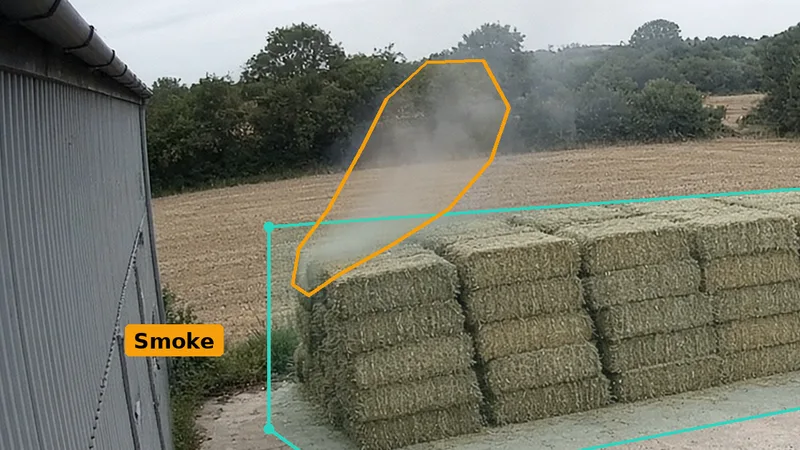
Last updated 2 November 2026. Every farm in the UK holds the makings of a big fire. A stack of big square straw bales at the edge of the yard. A barn full of this year’s hay. A cattle shed bedded deep in straw. A combine harvester parked under cover after a long day, still hot and dusted with chaff. A diesel tank, a fertiliser store, a workshop with a welder and a grinder, and a grain dryer that runs through the night in August. Most days none of it causes any trouble. But when a fire does start, a farm gives it everything it needs to grow: tonnes of dry fuel, buildings close together, often nobody nearby, a long drive for the fire engines and not much water when they get there.
The numbers are stark. Cheshire Fire and Rescue Service says around 1,600 farm buildings are destroyed by fire in the UK each year, and NFU Mutual’s fire prevention programme puts the figure at 1,700 farm buildings, along with 66,000 areas of grassland. Both say a large share of farm fires are started deliberately. In 2026 alone, firefighters led hundreds of sheep and calves out of a burning hay shed in County Down, moved 1,600 pigs from beside a burning straw shed in Shropshire, and spent days pulling apart smouldering stacks in Dorset and Lancashire.
This guide is for farmers, farm managers, estate managers, contractors and anyone else responsible for fire safety on a UK farm, from a small livestock holding to a big arable or mixed business. It explains what burns on a farm and why farm fires get so big, how hay heats up and catches fire on its own, how to store and site hay and straw, what the law expects, how to deal with machinery, harvest, hot work, electrics, fuel and fertiliser, how to plan for livestock and help the fire service, and how deliberate fires happen and how to make them harder. It looks at ten real farm fires from 2026 and what they had in common. The final sections cover where cameras fit in, and how AI smoke and intruder detection on the cameras you already have can make sure a fire in the stackyard or a shed is seen in minutes rather than when someone happens to notice it.
It is general guidance, not a fire risk assessment of your farm. Your local fire and rescue service, a competent fire risk assessor, your insurer and the Health and Safety Executive can all help with your own premises, and we link to the original guidance throughout so you can read it in full.
What burns on a farm
Fire services and insurers keep coming back to the same few things. Almost every serious farm fire involves at least one of them, and the biggest involve several at once.
- Hay and straw. Stored in stacks in the open, in Dutch barns and open-sided sheds, in enclosed barns and in livestock buildings as bedding and feed. Dry straw catches light easily and burns fast. Hay that was baled too damp can heat up and catch fire on its own, weeks after it went into the barn. A big stack can burn and smoulder for days.
- Machinery. Combines, tractors, balers, forage harvesters and telehandlers. They work in dusty conditions, get hot, and collect chaff, straw and oil round the engine, exhaust and bearings. Three of the ten fires we looked at from 2026 began with a combine harvester, and another involved a tractor.
- Fuels and chemicals. Diesel and petrol tanks, oils and lubricants, gas cylinders for heaters and welding, fertilisers, sprays and other agrochemicals. Some make a fire much worse; others create hazards for the firefighters who have to tackle it.
- The buildings. Old timber barns, steel portal frame sheds, workshops, grain stores, poultry and pig units, stables and the farmhouse itself. Many farms also have holiday lets, a farm shop or a café, which bring visitors and members of the public onto the site.
Why farm fires get so big
A fire in a town centre warehouse is usually spotted fast, by passers-by, neighbours or an alarm, and the fire service is minutes away with hydrants on every street. A farm is different in almost every way, and Humberside Fire and Rescue Service sums up the problem: farms are often in isolated locations with a poor water supply, which means fires can get out of control and burn for days.
Distance. Many farms are miles from the nearest fire station, down lanes and tracks that can be hard to find and hard to get a fire engine along. Every minute it takes to get there is a minute the fire has to grow. Fire services ask farms to make themselves easy to find, with a clearly signed entrance, and to give an exact location when they call, using what3words or a grid reference.
Water. A fire engine carries a limited amount of water. Hydrants may be a long way off or absent altogether, so crews often have to bring water bowsers, run water shuttles or draw from ponds, rivers and tanks. That takes time and people. Fire services ask farms to know where their water supplies are and tell crews when they arrive.
Fuel load. Few other workplaces store hundreds of tonnes of something as flammable as dry straw in one place. Once a stack or a barn full of bales is well alight, there is little firefighters can do but stop it spreading and let it burn down, or pull it apart with machinery and put it out piece by piece. That is why so many farm fires last for days.
Livestock. Animals cannot get themselves out. Moving hundreds of cattle, sheep or pigs away from a fire takes people, gates, vehicles and somewhere to put them, and it has to happen while the fire is still being fought. The fire service will help where it can, but its first job is the fire. A farm with a plan for its animals is in a much better position.
Nobody there. Most of the time, the people on a farm are spread out across fields, in the milking parlour or at market, or asleep in the farmhouse. Large parts of the farmyard go unwatched for hours. A fire that starts in a stack at three in the afternoon can be well developed by the time anyone looks that way, and one that starts at three in the morning may only be seen when it lights up the sky.
Cheshire Fire and Rescue Service adds a business point that every farmer should take seriously: it says 40% of businesses that suffer a serious fire never trade successfully again. A farm that loses its winter feed, its machinery or its livestock housing can face a very hard year, even with good insurance.
The farm fire year
The risk changes with the seasons. In spring, dry grass, burning off and lambing sheds full of straw and heat lamps are the main concerns. Harvest brings combines, balers and field fires, often in the hottest, driest weeks of the year, along with grain dryers running for long hours. In the weeks after harvest, newly made hay is at its most likely to heat up in the barn. In winter, livestock are housed on straw beside the feed and bedding they need, and barns are at their fullest.
Ten farm fires in 2026
These are ten UK farm fires from 2026, reported by fire and rescue services and local news. We include them because they show what farm fires look like in practice, not to criticise anyone involved. We have not named the farms or the people who run them, and the causes of several had not been reported when we looked.
- Banbridge, County Down, 2 April 2026. Northern Ireland Fire and Rescue Service was called at about 21:00 on a Thursday to a large fire in a hay shed used to house sheep, on a farm near Banbridge. Firefighters led about 300 sheep and 30 calves to safety. Around 50 firefighters and six appliances attended, and the fire was believed to have been caused by accidental ignition, the BBC reported.
- Compton Pauncefoot, Somerset, 14 July 2026. Devon and Somerset Fire and Rescue Service received several 999 calls at 11:36 reporting a combine harvester on fire in a field. Two fire engines and a water bowser were sent at first, and two more engines were requested once crews found the vehicle and field well alight. The combine was destroyed and about 600 metres by 100 metres of field was damaged. The cause was accidental.
- Wickham Bishops, Essex, 14 July 2026. Crews were called at 16:39 the same day after a combine harvester caught fire on Langford Road. The BBC reported that the fire badly damaged 44 acres (18 hectares) of crops, hay bales and stubble, and that crews managed to stop it spreading to nearby properties.
- Fareham, Hampshire, 27 July 2026. Hampshire and Isle of Wight Fire and Rescue Service had multiple emergency calls shortly before 5pm to a fire involving agricultural machinery on Meon Road. The fire began with a combine harvester, spread from one field to a second, and grew to about 30 hectares of standing crop. Around 40 firefighters attended, and farm machinery was used to create fire breaks.
- Wickham, Hampshire, early August 2026. In a report published on 4 August, the same fire service described a large fire involving about 50 tonnes of hay, a tractor and a barn. The tractor and bales were completely damaged and the barn about half damaged. The fire was believed to have been caused by an electrical fault in the tractor.
- Boningale, near Albrighton, Shropshire, 5 August 2026. The emergency services were alerted at around 11.25am to a fire in a large straw shed. About 1,600 pigs were in two sheds nearby. The Shropshire Star reported that they were first corralled into fields and then moved onto wagons to be taken elsewhere, with fellow farmers and livestock hauliers turning up to help, and that the pigs were all fine the next morning.
- East Lulworth, Dorset, 15 August 2026. Dorset and Wiltshire Fire and Rescue Service was called at 03:03 on a Saturday to a fire in a barn containing 2,000 bales of hay and a derelict outbuilding. Around 60 firefighters were involved, the fire was believed to have been started deliberately, and the service expected to be there for several days.
- Kimbolton, Cambridgeshire, 28 August 2026. Crews were called on a Friday evening to about 200 tonnes of straw on fire off Stow Road, the BBC reported, and people nearby were told to keep their windows and doors closed because of the smoke.
- Euxton, Lancashire, 23 September 2026. Lancashire Fire and Rescue Service was called at 11:20pm on a Wednesday to a barn about 40 metres by 20 metres containing about 250 tonnes of straw. At its height the incident involved eight fire engines, with a water bowser and a drone. Crews worked through the next day to stop the fire spreading to nearby buildings and to fertiliser, cattle feed and fuel, and heavy machinery was used to dig out and remove burning and smouldering straw.
- Blubberhouses, North Yorkshire, 21 October 2026. Crews from Harrogate and Summerbridge were called at 12:27 to straw on fire in a barn housing 100 calves. The fire was about 2 metres by 3 metres. The calves were evacuated, and none was injured, the York Press reported.
The Blubberhouses fire is the one to remember. A small fire in straw, found early, in a barn full of calves, ended with the calves safe and the barn standing. The same fire found an hour later could have been a very different story.
What the ten fires had in common
Ten fires are not a statistical sample, and we do not draw conclusions about causes from them. But reading the reports side by side, a few patterns stand out, and they match what fire services and insurers say in their guidance.
Hay and straw turned fires into long incidents. Eight of the ten involved hay or straw, whether in a stack, a barn, a shed or a field. Where large quantities were involved, at East Lulworth, Kimbolton and Euxton, crews were there for many hours or days, and at Euxton heavy machinery had to dig the straw out of the barn.
Machinery started several of them. Three of the fires began with a combine harvester, two of them on the same July day, and a fourth, at Wickham, was believed to have been caused by an electrical fault in a tractor, which then involved 50 tonnes of hay and a barn. Machinery fires in the field can quickly spread to crops and stubble.
Animals were close by. At Banbridge, Boningale and Blubberhouses, livestock had to be moved, and in each case it worked out. That took firefighters, fellow farmers and hauliers, and it is far easier when the fire is found early and there is a plan.
When they started
Eight of the reports gave a call time. They run from 03:03 at East Lulworth to 23:20 at Euxton, with most of the harvest fires in the middle of the day and afternoon, when machines were working, and three after dark, when the yard is usually empty and everyone is in bed.
Both halves of that picture matter. In the daytime the farmer may be nearby, but often in a field or a tractor cab with no view of the yard or the stacks. At night, a fire in a stack or a shed may not be seen until it is big enough to light up the sky or a neighbour smells the smoke. Either way, the earlier someone knows, the more there is to save.
What the law expects on a farm
Many farmers assume fire safety law is for factories, shops and offices. It is not. In England and Wales, the Regulatory Reform (Fire Safety) Order 2005 applies to almost all non-domestic premises, and North Yorkshire Fire and Rescue Service’s farm fire safety booklet is clear that this includes farm buildings where people work: barns, packing sheds, milking parlours and workshops, as well as holiday lets and farmhouses used for bed and breakfast. The private family home is not covered, but the working farm round it is.
The Order puts the duty on the “responsible person”, usually the employer or whoever has control of the premises, which on most farms means the farmer, the farming business or the estate. Humberside Fire and Rescue Service points out that the responsible person must carry out a fire risk assessment and take the precautions it identifies, and that failing to comply can lead to prosecution. Scotland has equivalent duties under Part 3 of the Fire (Scotland) Act 2005, and Northern Ireland under the Fire Safety Regulations (Northern Ireland) 2010. The details differ, but the expectation is the same: work out what could go wrong, deal with it, and plan for a fire.
Fire safety on a farm also sits inside wider health and safety law. The Health and Safety Executive expects every farm to assess its risks, and its guidance says that if you employ five or more people you must write down the significant findings. HSE’s leaflet on safe working with bales in agriculture covers stack building, power lines and sources of ignition, and fire services point farmers to the Control of Substances Hazardous to Health (COSHH) rules for chemicals and to the Dangerous Substances (Notification and Marking of Sites) Regulations 1990, known as NAMOS, for larger stores of dangerous substances.
A farm fire risk assessment in five steps
The government’s five-step checklist works well for a farm. It does not need to be complicated, but it does need to be honest, and it should be done by someone who knows the farm and has the time to walk round it properly, ideally once in daylight and once after dark.
- Identify the hazards. Sources of ignition such as machinery, electrics, heaters, lamps, hot work, bonfires and, sadly, arsonists. Sources of fuel such as hay, straw, fuel, oils, gas, chemicals, rubbish and the buildings themselves. Sources of oxygen are everywhere on a farm, so the focus is on the first two.
- Identify the people at risk. Family, employees, relief workers and contractors, visitors to holiday lets, a farm shop or an open day, people using footpaths, neighbours, and the firefighters who would come to deal with a fire. Many fire services also ask farmers to think about livestock here.
- Evaluate, remove or reduce, and protect. Take away or reduce what you can, for example by moving a stack away from a building or a road, and protect against what is left with separation, security, detection, fire fighting equipment and a plan.
- Record, plan, inform and train. Write down what you found and did, make an emergency plan, and make sure everyone who works on the farm knows it, including seasonal staff and contractors.
- Review. Look again regularly and whenever something changes: a new building, new machinery, a new enterprise, more stock, or a change in how and where hay and straw are stored.
North Yorkshire’s booklet adds an arson checklist that every farm can use alongside the five steps. It asks, among other things, whether hay and straw are removed from fields as soon as possible, whether they are stored away from fuels, agrochemicals and machinery, whether stacks are of a reasonable size and at least 10 metres apart, whether fuel tank outlets are padlocked, and whether security lighting or CCTV is provided. We come back to those points later.
How hay catches fire on its own
Most fires need someone or something to start them. Hay is different. Hay that is baled before it is dry enough keeps living, in a sense: plant cells and the bacteria and fungi in the bale carry on working, and that activity produces heat. A little heating is normal, but in damp hay the heating can run away, and once the inside of a bale or a stack gets hot enough, it can catch fire with nobody near it. This is called spontaneous combustion or self-heating, and fire services warn about it every summer.
Devon and Somerset Fire and Rescue Service explains that hay with a moisture content above about 22% is at a higher risk of spontaneous combustion, and that it is most likely within six weeks of baling. Cheshire Fire and Rescue Service says hay above 18% moisture can ferment, and NFU Mutual’s fire prevention programme gives guide figures for safe baling: small bales at 18 to 20% moisture, larger bales at 16 to 18%. The bigger and denser the bale, the drier it needs to be, because heat has less chance to escape from the middle.
Checking hay for heating
The only reliable way to know whether hay is heating is to measure it. Fire services and NFU Mutual recommend a hay temperature probe, a long metal probe with a thermometer that is pushed deep into a bale or stack. NFU Mutual’s programme says heating usually happens in the middle or lower bales of a stack, and suggests leaving the thermometer in for 15 minutes to get a true reading. Cheshire Fire and Rescue Service advises checking new hay within the first six weeks. Devon and Somerset gives a ladder of temperatures and what to do at each.
- 65°C. The danger zone begins. Check the temperature every day.
- 70°C. More dangerous. Check every four hours.
- 80°C. Critical. Remove the hay or dismantle the stack, well away from buildings and other stores, so the heat can escape.
- 85°C. Hot spots or pockets are likely, and they may burst into flame when exposed to the air.
- 100°C. Hay is very likely to ignite. Call 999.
Two warnings sit alongside that ladder. First, moving very hot hay can make things worse: Devon and Somerset warns that hot pockets may burst into flame when exposed to the air, and NFU Mutual’s programme says that at the highest temperatures you should call the fire service and not move the hay. Once a stack is very hot, get the fire service involved before anyone starts pulling it apart. Second, your nose is a useful early warning: Devon and Somerset says a caramel smell or a musty, mouldy smell suggests the hay is heating.
A camera cannot see heat building inside a stack, so it does not replace a probe. What it can do is see the first smoke when heating does turn into fire, often on a part of the yard nobody is looking at. That is the moment where minutes count.
Storing and siting hay and straw
Where and how you store hay and straw is the single biggest fire safety decision on most farms. A well placed stack can burn without taking anything else with it. A badly placed one can take a barn, the machinery inside it and the animals next door.
Fire services are remarkably consistent on the basics. North Yorkshire, Essex and NFU Mutual all say stacks should be at least 10 metres apart, so a fire in one does not spread to the next, and North Yorkshire adds 10 metres from buildings. Hay and straw should be stored separately from fuels, agrochemicals and machinery, and separately from livestock. North Yorkshire also asks that stacks be of a reasonable size, which is easy to forget when space is short and the harvest is good, and HSE’s bale leaflet says that once stacks are built, fertilisers, fuel and other materials that could be a source of ignition should not be stored nearby.
Where to put a stack
North Yorkshire’s booklet adds detailed advice on where outdoor stacks should go, and much of it is about arson and accidents rather than self-heating:
- Away from public access and roads. Stacks beside roads and public footpaths are exposed to discarded cigarettes, broken glass and arson. HSE’s bale leaflet makes the same point. Northamptonshire Fire and Rescue Service goes further, asking farmers to keep bale stacks out of sight where possible.
- Clear of overhead power lines. Not under or within 10 metres of power lines, both for fire and because of the risk of electrocution when building and loading the stack. HSE gives the same 10 metre figure.
- Not over underground services or hydrants. A stack built over a gas pipe, a water main or a hydrant makes things harder for everyone, including the fire service.
- In line with the prevailing wind. So that a fire in one stack is less likely to blow onto the next or onto buildings.
- Away from bonfires and hot work. HSE says not to do work that could start a fire, such as welding or using a blow torch, near stacks, and not to allow smoking near them.
Field stacks and bales left in fields after harvest are a particular target. North Yorkshire’s checklist asks whether hay and straw are removed from the field as soon as possible, and Northamptonshire asks farmers to be vigilant about hay bale and field fires through the summer. A row of big bales along a field edge by a lane is exactly the kind of thing that gets set alight on a warm evening.
Inside buildings, the same separation principles apply. Keep hay and straw in buildings of their own where you can, rather than in the same shed as machinery or animals. Leave space between the top of a stack and any lights in the roof, and use lamps that run cool. Keep the floor round the stack clear of loose straw, and the area round the outside of the barn clear of rubbish, pallets and old bales. Check stacks after heavy rain, because water getting into a stack can start it heating even if it went in dry.
Machinery and harvest
Farm machinery spends its working life in the conditions most likely to start a fire: hot engines and exhausts, belts and bearings running for hours, dust and chaff everywhere, and dry crops all round. Humberside Fire and Rescue Service asks farmers to keep machinery clean of hay, straw, oil and grease, and NFU Mutual lists working machinery at harvest, and machinery striking flints and stones, among the common causes of farm fires.
Most of the precautions are ordinary good maintenance. Blow down or brush off chaff and dust from engines, exhausts and around bearings regularly through the day, not only at the end of it. Keep machines serviced, with special attention to bearings, belts, electrics and fuel lines. Fix oil and fuel leaks. Keep a working fire extinguisher on every combine and tractor, and make sure the people driving them know how to use it. HSE’s bale leaflet adds that bale elevator engines should be kept free of straw and debris, with a guard or shield to stop bales and loose material falling onto the engine.
Where machines are parked matters as much as how they are kept. A combine that has worked all day goes back to the yard hot, and fires can start after the machine has been switched off. Cheshire Fire and Rescue Service advises parking vehicles well away from buildings, and the Wickham fire in August shows why: an electrical fault in a tractor was believed to have started a fire that involved the tractor, about 50 tonnes of hay and a barn. Park harvest machinery away from hay and straw stores and, where you can, apart from each other, so one fire does not take the whole fleet.
Harvest day
In the field, NFU Mutual suggests having a tractor and cultivator ready to cut a fire break, and a full water bowser near where harvesting is going on. Humberside suggests creating fire breaks in standing crops where appropriate. At Fareham in July, farm machinery was used to create fire breaks as a fire that started with a combine spread across two fields. A neighbour with a cultivator can save a crop, but only if the fire is seen early and everyone knows to stay safe and leave the fire itself to the fire service.
Have a phone with you, and know exactly where you are. Fields rarely have postcodes, so fire services ask callers to give a what3words address or a grid reference. Agree with everyone working at harvest what happens if a machine catches fire: get out, get clear, call 999, and only tackle a small fire if it is safe.
Which part of the farm?
Straw bedding, hay racks and feed stores sit right beside the animals in winter. Keep big stores of hay and straw out of livestock buildings, keep electrics checked, and plan how you would move the stock. A camera inside the shed with smoke detection all day and night watches the bedding bays while you sleep.
Straw bedding and housed stock
Machines come back hot, dusty and covered in chaff, and are parked next to each other and often next to bales. Clean them down, keep them serviced and park them away from stacks where you can. A yard camera on the shed front with smoke detection running all the time sees the first smoke from an engine bay.
Combines, tractors, balers
Dryers run long hours in the harvest season, often overnight, and dust and chaff build up round the burner and the intake. Keep them clean and serviced and follow the maker’s guidance. A smoke zone round the dryer and its intake, watched all day and night, adds a set of eyes when nobody is in the yard.
Drying season and stored grain
Each part of the farm gets a view that suits it: livestock sheds from inside, machinery sheds from across the yard, and grain stores and dryers from a building end or a pole.
Planning for livestock
Animals are often what makes a farm fire so distressing, and so dangerous. People take risks to save animals, and moving frightened livestock near a fire is hard and slow. Fire services repeatedly ask farmers to plan for their animals before anything happens. Essex Fire and Rescue Service asks farmers to be prepared to evacuate livestock, Humberside asks them to have an animal evacuation plan, and Cheshire suggests calling your vet as part of the response.
Start with separation. Essex and North Yorkshire both say hay and straw should be stored separately from livestock. Bedding and a few days’ feed in a shed is unavoidable, but the main stores should be in their own building, away from where animals are housed. Then plan the move: which gates and pens animals would go through, where they would go, who would help, and how you would get large numbers onto lorries if they had to leave the farm altogether.
The Boningale fire in August shows what a plan can achieve under pressure. With a large straw shed on fire close to two sheds holding about 1,600 pigs, the pigs were first corralled into fields and then moved onto wagons, with fellow farmers and livestock hauliers turning up at short notice to help, and the operation was finished late that night. At Banbridge in April, firefighters led about 300 sheep and 30 calves to safety. At Blubberhouses in October, 100 calves were got out of a barn with a straw fire, uninjured. In each case, there was time to get the animals out. Finding a fire early is what buys that time.
Fuel, fertiliser and chemicals
Most farms hold diesel, and many hold petrol, oils, gas cylinders, fertilisers, sprays and other agrochemicals. None of these should be anywhere near hay, straw or machinery stores. Devon and Somerset and Humberside fire services both ask farmers to store fuels, chemicals and hazardous materials securely and clearly labelled, well away from other buildings, to store only what they need, and to complete a COSHH assessment.
Fertiliser needs particular care. Humberside asks farmers to store it in a clean place where it cannot be contaminated, away from other flammable materials, and as securely as possible, reporting any suspected theft to the police at once. Any fertiliser not needed for the programme should be looked at to decide whether it is worth keeping.
Larger stores bring legal duties. Under the NAMOS Regulations, sites storing 25 tonnes or more of dangerous substances must notify the fire and rescue service and display hazard warning signs, and North Yorkshire’s booklet reminds farmers of this. Humberside notes a further requirement to notify the fire service of any site storing 150 tonnes or more of relevant ammonium nitrate fertilisers, where the nitrogen content is above 15.75% by weight. Whatever the quantity, the fire service needs to know what is stored and where when it arrives, because it changes how crews tackle a fire. At Euxton in September, crews spent hours stopping a straw barn fire spreading to nearby fertiliser, cattle feed and fuel.
Arson and security
A large share of farm fires are started deliberately. Cheshire Fire and Rescue Service says around 40% of farm fires are started deliberately, and NFU Mutual’s programme says about half. Devon and Somerset and Humberside both say many farm fires are caused by arson. The East Lulworth barn fire in August, which began at 03:03 and involved around 60 firefighters, was believed to have been started deliberately.
Arson on farms ranges from bored young people setting light to bales by a road, to people covering up theft, to targeted attacks. What they all have in common is easy access to something that burns, at a time when nobody is watching. That is why the prevention advice from fire services is mostly about access, storage and being seen.

Making arson harder
Humberside’s advice on preventing arson at farms is a good summary. Lock sheds and buildings. Keep fuels, chemicals, pesticides and fertilisers locked away. Repair or replace damaged fencing and gates. Display security notices and use security alarms and lighting. Some farmers use dogs or geese to give early warning of intruders. Get rid of rubbish safely and regularly, so there is nothing lying about to start a fire with.
Storage is security too. Remove hay and straw from fields as soon as possible after harvest. Keep stacks away from roads and footpaths and, as Northamptonshire suggests, out of sight where possible. Keep them a reasonable size and at least 10 metres apart, so that if one is set alight the fire does not take the rest. North Yorkshire’s checklist asks whether security lighting or CCTV is provided and whether an intruder alarm is linked to a monitoring service. For more on keeping thieves and trespassers off the farm, see our rural crime prevention guide and our page on arson prevention with CCTV.
Hot work in the workshop and the yard
Welding, grinding and cutting are part of everyday life on a farm, from repairing a trailer to fixing a gate. Devon and Somerset puts it bluntly: it only takes one spark landing on dry materials to start a fire. Hot work should only be done in clear areas, well away from flammable substances and from buildings used to store hay and straw.
Cheshire Fire and Rescue Service’s farm guide gives three simple rules: remove straw, dust and oily rags within 10 metres of where you are working; take lighters, aerosol cans and other flammable items out of your pockets; and stay in the area for at least 30 minutes after finishing to check for smouldering material. A spark that lands in a gap in the wall or a pile of chaff can smoulder for a long time before it flames, often after everyone has gone in for tea. HSE’s bale leaflet adds that work which might create a risk of fire, such as welding or using a blow torch, should not be done near stacks. Contractors doing hot work on the farm should follow the same rules, and our hot works fire risk guide covers permits and fire watches in more detail.
The workshop itself needs looking after. NFU Mutual’s programme suggests using fixed heaters rather than portable ones and limiting the amount of flammable paints and solvents kept there. Keep it tidy, keep oily rags in a metal bin with a lid, and keep it separate from hay and straw stores.
Electrics and lighting
Farm electrics have a hard life: dust, damp, rodents, livestock and machinery all take their toll on cables, sockets and fittings, and many farm buildings have wiring that has been added to over decades. Devon and Somerset and Humberside both ask farmers to carry out regular electrical safety checks, especially where hay or straw is stored, and never to leave anything running or switched on unnecessarily.
Lighting deserves special attention. Devon and Somerset advises leaving enough space between the top of a stack and electrical roof lighting, and its guidance on storing hay suggests replacing halogen lamps with LED ones, which run much cooler. Heat lamps for lambs, piglets and chicks are another risk: keep them securely fixed, away from bedding, and check them regularly. Battery chargers, electric fence units and power tools left on charge in sheds are worth a look too. HSE’s bale leaflet reminds farmers that electrical wiring inside barns must be suitable, safe and properly insulated so that it does not act as a source of ignition. The Wickham fire in August, believed to have started with an electrical fault in a tractor, is a reminder that vehicles are electrical equipment too.
Helping the fire service
When a fire starts, the most important thing is to get everyone to a safe place and call 999. Devon and Somerset, Humberside and Essex fire services all list the same details to give the operator, and having them ready can save minutes.
- The exact location. The full address and postcode, and for fields and remote buildings, a what3words address or an Ordnance Survey grid reference. Fire services suggest downloading a location app such as what3words or OS Locate before you need it.
- What is involved. Hay, straw, machinery, fuel, gas cylinders, chemicals, fertiliser, and whether animals are in or near the buildings.
- Access. Any problems getting fire engines to the fire, such as narrow tracks, low bridges, locked gates or soft ground.
- Water. Whether there are hydrants, ponds, rivers, tanks or reservoirs nearby, or whether water will be a problem.
Then make yourself known to the crews when they arrive. North Yorkshire asks farmers to send someone to the farm entrance to meet the fire engines, with a torch and high visibility clothing at night, to guide them in. Clear access routes, open gates, and move vehicles that are in the way. Once everyone is safe, the fire services suggest preparing to evacuate livestock if the fire spreads and being ready to use farm machinery to help move hay and straw if the crews ask for it. Stay away from the fire itself unless you are asked to help.
A fire box at the farm gate
North Yorkshire’s booklet suggests keeping a fire box at the farm entrance: a weatherproof box holding the information crews need, so they do not have to rely on finding the right person in the middle of a fire.
It should include a map of the farm showing buildings and their uses, where water supplies are, where livestock are housed, and where fuel, gas, chemicals and fertiliser are kept. Keep it up to date as things change through the year, and make sure family and staff know where it is. A clearly signposted entrance, which Devon and Somerset and Humberside also ask for, helps crews find the farm in the first place, particularly at night.
After a fire
Big straw and hay fires do not end when the flames go out. At East Lulworth the fire service expected to be on site for several days, and at Euxton crews worked alongside the farmer for well over a day to dig out and remove smouldering straw so remaining hot spots could be found and put out. Keep people and animals away from the remains, because burnt stacks and buildings can collapse and can reignite.
Get animals that were near the fire checked by a vet, even if they seem fine, since smoke can affect them. Tell your insurer as soon as you can, take photographs, and keep records of what was lost. Think about your neighbours, since smoke from a big straw fire can affect people living nearby for hours, as at Kimbolton. Then review your fire risk assessment: what started the fire, why it spread as far as it did, how it was found and how long that took, and what you would change.
Why the farmyard is a blind spot
Most farm buildings have no fire detection at all. Some have smoke alarms in the farmhouse, a fire alarm in a holiday let or the farm shop, or heat detection in a poultry unit, but the barns, the stackyard, the machinery shed and the cattle sheds are usually unwatched. Even where detectors exist, a detector in a barn roof cannot see a stack burning in the open, and dust, damp and open sides make ordinary indoor detectors hard to use in many farm buildings.
So on most farms, a fire is found by a person. During the working day, that might be the farmer, if they are in the yard and looking the right way, or a member of staff, a delivery driver or a neighbour. At harvest, everyone may be in the fields. At night, the first anyone knows may be the glow in the sky, the smell of smoke, a call from a passing driver or animals making a noise. At Fareham, Fire Control took multiple emergency calls; at Compton Pauncefoot, several. Calls from the public are vital, but they tend to come once a fire is big enough to be seen from a distance.
Cameras change that, because many farms already have them, looking at the yard, the stackyard, the sheds, the fuel tank and the entrance, usually for security. With AI detection added, a camera that can see a stack or a shed watches for smoke and flame on that view all day and all night, and sends an alert with a short clip when it sees something. It is important to be clear about what this does and does not do. Cameras cannot see heat building up inside a stack, so they do not replace hay probes, and they do not replace a fire alarm where one is needed, the separation distances or anything else in this guide. What they add is early sight of smoke, flame or someone in the wrong place, at any time, on parts of the farm nobody is watching.
Where to put cameras on a farm
Most farms with cameras already have some that can see the stackyard, the main sheds or the yard. The question is whether the views are good enough, by day and at night, to see smoke starting in the places that matter most.
- Watch the stacks from across the yard. A camera on the end of a building, looking across at the stackyard, sees the whole face of the stacks and the ground round them. Mount it high and fixed, out of reach, and away from the stacks themselves so it is not lost in a fire.
- Look inside livestock sheds. A camera inside a cattle, sheep or pig shed, looking along the bedding bays, sees both the animals and the straw, and many farmers already use them at calving and lambing. Keep cameras and their cables protected from animals, dust and damp.
- Cover the front of the machinery shed. A view of the open front of the shed sees smoke from machines parked there after work, which is when many machinery fires start.
- Include the dryer, the fuel and the entrance. A view of the grain dryer through the drying season, the fuel tanks and chemical store, and the farm entrance covers fire and security in one go.
- Think about night. Check every view after dark. Infrared or yard lighting matters, and so does avoiding glare from floodlights or vehicle headlights.
Data protection law applies to CCTV. The ICO publishes guidance and a self-assessment checklist for organisations covering installation, operation, public awareness and signage, and the government’s Surveillance Camera Code of Practice sets out good practice principles. Point cameras at your own farm, avoid neighbouring homes, public footpaths and roads where you can, and use signs. Cameras covering holiday lets or the farmhouse need particular care.
Detection schedules: smoke all the time, people at night
Different kinds of detection suit different times. Smoke and flame detection on the stacks, sheds and dryer should run all day and all night, because a fire can start at any time, and the daytime fires of 2026 show that being busy elsewhere on the farm is no protection. People and line detection is useful after dark, but would alert constantly during the day when people, tractors and stock are moving round the yard.
A typical arrangement is smoke at the stackyard, inside the livestock sheds and at the machinery shed on all the time, with a line along the stackyard and a people zone at the fuel store armed from, say, 20:00 to 06:00. Every farm is different, and schedules should follow how yours actually works, including early milking, late harvesting and lambing nights, when someone may be up and about at all hours.
When the alert comes in
An alert is only as good as what happens next. Decide in advance who receives alerts for each part of the farm, what they should do, and who they should call. On a family farm that might be two or three phones. On a bigger business, it might include the farm manager and a stockperson who lives on site. Write it down and test it.
- Check the clip. Look at the snapshot and the short clip with the alert. Is it smoke, or dust, steam or a bonfire you knew about? Where is it, and what is near it?
- Call 999. If there is a fire, call the fire service straight away. Give the exact location, what is involved, whether animals are near it, and any access or water problems.
- Get people safe. Make sure nobody is in or near the burning building or stack. Do not go into a burning building for animals or machinery.
- Prepare to move stock. If animals are nearby and it is safe, start getting them away from the fire, and call in the help you planned for.
- Meet the crews. Send someone to the farm entrance to meet the fire service, with the fire box information, and show them the clip if it helps.
What insurers look for
Farm insurers look closely at fire, because farm fires are frequent and can be very large. NFU Mutual publishes a fire prevention programme for farms, and its points about hay moisture, stack separation, machinery and security are the kind of thing an insurer or a risk surveyor will ask about. Expect questions about how and where hay and straw are stored, whether stacks are separated from buildings and each other, how machinery is kept and parked, how fuel and chemicals are stored, and how the farm is secured.
Good records help: the fire risk assessment, the hay temperature log, electrical checks, machinery servicing and the security arrangements. So does being able to show how a fire in the stackyard or a shed would be found when nobody is there. For more, see our guide to what insurers expect from fire detection, and our page on farm CCTV grants for help with the cost of security on farms.
A farm fire safety checklist
Use this checklist as a starting point. It does not replace a fire risk assessment, and the right precautions for your farm depend on what you store, where and how much. The table summarises the main parts of a farm covered in this guide.
| Area | Main risk | First steps | What cameras and AI add |
|---|---|---|---|
| Hay and straw stacks | Self-heating, arson, fire spread | Dry before storing, probe new hay, stacks 10 m apart and from buildings | Smoke detection on the stackyard, always on |
| Barns and stores | Electrical faults, heating hay, hot work | Electrical checks, LED lamps, space below roof lights | Smoke zones drawn round the bays |
| Livestock housing | Fire reaching animals | Keep stores apart, plan routes, line up help | Smoke detection inside the shed at night |
| Machinery | Hot engines, chaff, bearings | Clean, service, park apart, water at harvest | Smoke seen on the shed front after work |
| Fuel and chemicals | Fire spread, theft, hazards for crews | Lock, separate, label, tell the fire service | People zone at the fuel store at night |
| Yard and boundaries | Arson, trespass | Lock gates, light yards, clear bales from fields | A line along the stackyard after dark |
| Firefighters | Finding the farm, water, access | Location app, signed entrance, fire box, someone at the gate | Clips showing where the fire is |
- Have you done, recorded and recently reviewed a fire risk assessment that covers every building where people work, including holiday lets and the farm shop?
- Is hay dry before it is stored, and do you probe new hay for heating through the first six weeks and keep a log?
- Are stacks a reasonable size, at least 10 metres apart and away from buildings, roads, footpaths and power lines?
- Are hay and straw stored separately from fuels, chemicals, fertiliser, machinery and livestock?
- Is machinery cleaned of chaff, dust and oil, serviced, fitted with an extinguisher and parked away from stores?
- At harvest, is there water, a tractor and cultivator ready for a fire break, and a way to give an exact location?
- Is hot work done in clear areas, with 10 metres cleared and a 30 minute check afterwards?
- Are electrics checked, lamps cool-running and kept clear of stacks, and nothing left running unnecessarily?
- Are fuel tanks, chemicals and fertiliser locked, labelled and separated, and does the fire service know what you store?
- Is there a plan for moving livestock, a signed entrance and a fire box at the gate?
- Who would notice a fire in the stackyard or a shed at 3pm during harvest, or at 3am, and how quickly?
How Woodcock AI helps with farm fire safety
Woodcock AI connects to existing IP cameras over RTSP or ONVIF and runs on an edge server on site or on a cloud server. It adds smoke, flame, people and vehicle detection to the cameras you already have. You draw polygon zones that fit the shape of each stack, bedding bay, shed front or dryer, rather than a rough box, draw lines along the stackyard and the yard entrance, and set schedules so smoke detection runs all day and night while security zones are armed only after dark. When something happens, an alert with a snapshot and short clip goes to the phones of the people you choose, and an AI description says what the camera saw.
Woodcock AI is self-learning, so it gets better at telling the normal from the unusual on each camera over time, such as dust blowing off a trailer, steam from a muck heap or a tractor coming and going. It is the result of years of development and is now in use on real sites in the UK. It watches for smoke, flame and people: it cannot see heat inside a stack, and it supplements rather than replaces the precautions in this guide. For how the same approach fits other parts of rural life, see our pages on farm CCTV for fire and intrusion, biomass fuel stores, equestrian yard security and outdoor fire detection. Ask your cameras, a way to ask the system questions about what it has seen, is Coming soon, early 2027.
Ways to start
Start with a site assessment. We look at your stackyard, barns, livestock sheds, machinery shed and dryer, which cameras you have and what each one sees by day and at night, and show where smoke zones, people zones and lines would help. Or ask for a live test on your cameras: we connect two or three of your existing cameras for about a fortnight, so you can see the alerts for yourself before deciding.
Sources
- legislation.gov.uk, Regulatory Reform (Fire Safety) Order 2005, Fire (Scotland) Act 2005, Fire Safety Regulations (Northern Ireland) 2010 and Dangerous Substances (Notification and Marking of Sites) Regulations 1990.
- GOV.UK, Fire safety risk assessment: 5-step checklist and Fire safety in the workplace.
- Health and Safety Executive, Agriculture: risk assessment and INDG125: Safe working with bales in agriculture.
- North Yorkshire Fire and Rescue Service, Farm fire safety booklet (PDF).
- Cheshire Fire and Rescue Service, Farms, barns and stable safety (PDF).
- NFU Mutual, Risk management programme for the prevention of fires on farms (PDF).
- Devon and Somerset Fire and Rescue Service, Fire safety on the farm and Storing hay safely.
- Humberside Fire and Rescue Service, Fire safety on the farm; Essex County Fire and Rescue Service, Fire safety advice for farms; Northamptonshire Fire and Rescue Service, Farmers urged to be vigilant to avoid hay bale and field fires (September 2024).
- Incident reports: BBC (Banbridge), Devon and Somerset Fire and Rescue Service (Compton Pauncefoot), BBC (Wickham Bishops), Hampshire and Isle of Wight Fire and Rescue Service (Fareham) and (Wickham), Shropshire Star (Albrighton), Dorset and Wiltshire Fire and Rescue Service (East Lulworth), BBC (Kimbolton), Lancashire Fire and Rescue Service (Euxton) and York Press (Blubberhouses).
- Information Commissioner’s Office, CCTV and video surveillance, and GOV.UK, Amended Surveillance Camera Code of Practice (in effect from 12 January 2022).
We have summarised these sources in our own words. Figures for farm fires vary between sources and years, so read the current versions in full. This page is general guidance, not a fire risk assessment, or legal or insurance advice; your fire and rescue service, fire risk assessor, insurer and the HSE can advise on your own farm.
Would anyone see smoke at your stackyard at 3am?
Book a site assessment and we will look at your stackyard, barns, livestock sheds and machinery shed, and what your cameras can see by day and at night, and show where smoke zones, people zones and lines would help, or ask for a live test on your cameras.
Related pages
Frequently asked questions
How far apart should hay and straw stacks be?
Fire services, HSE and NFU Mutual guidance say stacks should be at least 10 metres apart, and North Yorkshire Fire and Rescue Service adds at least 10 metres from buildings. Keep stacks a reasonable size, away from roads and footpaths, separate from fuel, chemicals, machinery and livestock, and never under or within 10 metres of overhead power lines.
At what temperature is hay a fire risk?
Devon and Somerset Fire and Rescue Service says the danger zone begins at 65°C, when hay should be checked daily. At 70°C check every four hours, at 80°C it is critical and the hay should be moved away from buildings, and at 100°C call 999. Use a hay probe deep in the stack, especially in the first six weeks.
Does fire safety law apply to farms?
Yes. In England and Wales the Regulatory Reform (Fire Safety) Order 2005 applies to farm buildings where people work, such as barns, packing sheds, milking parlours, holiday lets and farmhouses used for bed and breakfast. The responsible person must carry out a fire risk assessment. Scotland and Northern Ireland have equivalent laws.
How many farm fires are started deliberately?
Sources vary. Cheshire Fire and Rescue Service says around 40% of farm fires are started deliberately, and NFU Mutual says about half. Removing bales from fields quickly, keeping stacks away from roads and out of sight, locking up fuel and chemicals, lighting yards and using CCTV all make deliberate fires harder.
What should I tell 999 about a farm fire?
Give the exact location, using what3words or a grid reference for fields and remote buildings, what is involved such as hay, straw, fuel, chemicals or animals, any access problems for fire engines, and where water can be found. Then send someone to the farm entrance to meet the crews and prepare to move livestock if it is safe.
Can CCTV detect a fire in a hay stack?
Cameras cannot see heat building up inside a stack, so they do not replace hay probes or a fire risk assessment. What AI on existing farm cameras can do is watch stacks, sheds and the yard for smoke and flame all day and night, and send an alert with a clip. Woodcock AI runs on an edge server on site or on a cloud server.
Last reviewed 2 November 2026