

Fire detection camera cost: what drives the price
The cost of AI fire detection cameras depends on how many areas need covering, whether your existing RTSP or ONVIF cameras can be used, whether new pre-configured Hikvision ColorVu cameras are needed, installation, and integrations such as sirens or a fire panel. A Woodcock AI site assessment gives you an exact quote.

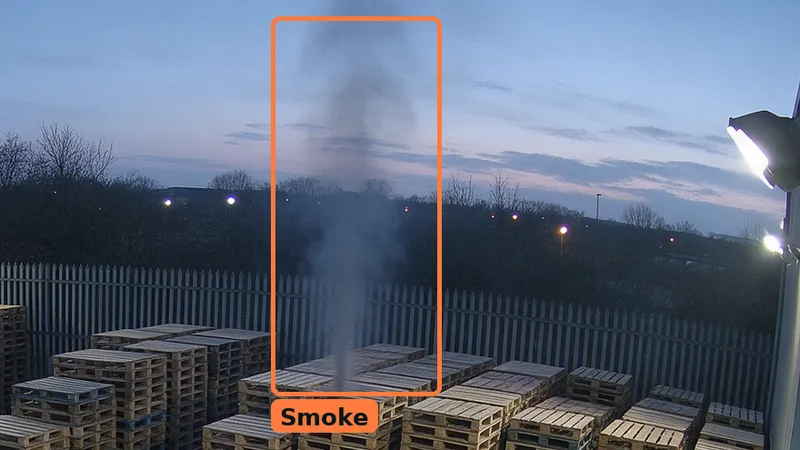
We do not publish a price list, because two sites rarely need the same thing. A yard with good cameras already in the right places needs far less than a new building with none. What we can do is explain what shapes the cost, so you know what to have ready and where the money goes. This page covers the factors, the existing-camera question, installation, buying direct or through your installer, and how to get an accurate quote.
What drives the cost of fire detection cameras?
Six things shape almost every quote. Most are about your site rather than the software, which is why a short assessment matters more than a list price.
Areas to cover
The number of storage bays, stockpiles, buildings and yards you want watched, and how big they are.
Existing cameras
How many of your current cameras have a usable view and stream over RTSP or ONVIF.
New cameras
Whether any gaps need a new camera, and whether a turret or bullet suits each one.
Installation
Mounting heights, poles or brackets, cable runs, power and network work.
Integrations
Sirens, a link to your fire panel, or an alarm receiving centre (ARC) as an optional add-on.
Detections
Which detections you want on each camera: smoke and fire, intrusion, line crossing, PPE (hard hats & hi-vis) or vehicles.
Two sites with the same number of cameras can still end up with quite different quotes. A compact yard with cameras on the building already pointing at the bays might need no new hardware at all. A long, open site with stockpiles at the far end might need a pole, a new camera and a cable or network run to reach it.
Is it cheaper to use my existing CCTV?
Often, yes. Woodcock AI connects to your cameras or recorder over ONVIF or RTSP, so a camera that already looks at the right area can start detecting smoke and fire without being replaced. That usually means less hardware to buy and less installation work.
It depends on the view, though. For reliable detection a camera needs to see the area you care about, at a sensible distance, with enough light or a good night picture. A camera pointed at a gate will not watch the bale store behind it, however good it is. At the assessment we check each existing view and mark which ones can be used as they are.

Where a camera is needed, we supply Hikvision ColorVu turret and bullet cameras, pre-configured for smoke and fire detection before they arrive. ColorVu cameras are built to show colour at night, which helps your team see what an alert is about. See our Hikvision smoke detection camera page for how turret and bullet models suit different areas.
Your recorder normally stays where it is. Your footage keeps recording as it does today, and the AI adds detection and alerts on top. If you want to check whether your network can carry the extra streams, try our CCTV bandwidth and storage calculator.

What adds cost to an installation?
Installation is usually where quotes differ most. The main items are:
- Mounting. A camera on an existing wall bracket is quick. A new pole, or a camera high on a building that needs access equipment, takes longer.
- Cabling and power. Long cable runs across a yard, or areas with no power nearby, add work.
- Network. Some sites need a switch, extra network ports or a better link to reach far corners.
- Integrations. Wiring an alert to a siren on site or to an input on your fire alarm panel adds a small amount of electrical work.
- Access and timing. Working around live operations, or in restricted areas, can affect how long the visit takes.

Alerts themselves go out by app, with a short clip, and by email to the people you choose. An alarm receiving centre (ARC) connection is an optional add-on if you want a monitoring centre to act on alerts too, and it is included in the quote only if you ask for it.
We offer an end-to-end design, supply and install service: site survey, design, supply, installation, commissioning, go-live and ongoing support. During commissioning we run smoke tests on site, so you see the system detect before we hand it over.
Can I buy through my installer?
Yes. Woodcock AI is sold direct and through CCTV installers and resellers. If you already have an installer you trust, they can fit and support the system while Woodcock AI runs on the cameras. If you would rather deal with one company, we can design, supply and install it ourselves.
Installers who want to offer AI detection to their own customers can read about our white-label AI CCTV programme.
What are you paying for beyond the cameras?
The cameras are only part of it. The value is in what the system does with the picture, and that is where Woodcock AI differs from basic motion alerts:
- Polygon detection areas. You draw a shape round each bay, stockpile or quarantine area, so alerts name the area and ignore the parts of the view that do not matter. See polygon detection zones.
- Self-learning, fitted to each scene. The models are fitted to each camera’s view, trained on that site’s normal, no-incident footage and on synthesised smoke. Read more about our self-learning AI.
- Years of development, now in use. Woodcock AI has been built over several years and is running on real UK sites today.
Per-camera schedules let you choose when each detection is active, for example intrusion only when the site is closed, while smoke and fire watching carries on around the clock.
How do I get an accurate quote?
Book a site assessment. It is the quickest way to an exact figure, because it answers each of the questions above for your site rather than guessing.
- 1Book a site assessment. Tell us about the site and what you want to protect.
- 2Share what you have. A list of your cameras and recorder, and a site plan if you have one (a fire prevention plan drawing is ideal).
- 3Agree areas and detections. We mark which cameras can be used, where any gaps are and which detections each camera needs.
- 4Get your quote. A written quote for using your existing cameras, new ColorVu cameras, or both.
- 5Install and commission. We fit, set the zones, smoke-test on site and go live. You can also ask for a live test on your cameras or an on-site demo first.
What to have ready. Camera makes and models if you know them, the recorder make, a rough site plan, your opening hours and who should receive alerts. If your site has a fire prevention plan, our FPP detection section template shows the detail an officer will look for.
Want a figure for your site?
Book a site assessment and we will look at your cameras, mark any gaps and give you a written quote.
Related pages
Frequently asked questions
How much does a fire detection camera cost?
It depends on your site. The main factors are how many areas need covering, how many existing cameras can be used, whether new cameras are needed, installation and integrations. We do not publish a price list; a site assessment gives you an exact quote.
Is it cheaper to use my existing CCTV?
Often, yes. Woodcock AI connects to your cameras or recorder over ONVIF or RTSP, so a camera with a suitable view can start detecting smoke and fire without being replaced. New cameras are only suggested where there is a gap.
What adds cost to an installation?
Mostly site work: new poles or high mounting points, long cable runs, power and network work, and wiring alerts to a siren or fire panel. An alarm receiving centre (ARC) connection is an optional add-on.
Can I buy through my installer?
Yes. Woodcock AI is sold direct and through CCTV installers and resellers, so your installer can fit and support the system, or we can design, supply and install it for you.
How do I get an accurate quote?
Book a site assessment. Share your camera list, recorder details and a site plan if you have one, agree the areas and detections you need, and you get a written quote for your site.
Last reviewed 29 October 2026
Ready for a figure? Here is how to get an AI CCTV installation quote.