

Builders’ merchant security: know someone is in the yard tonight, not when the stock count is short
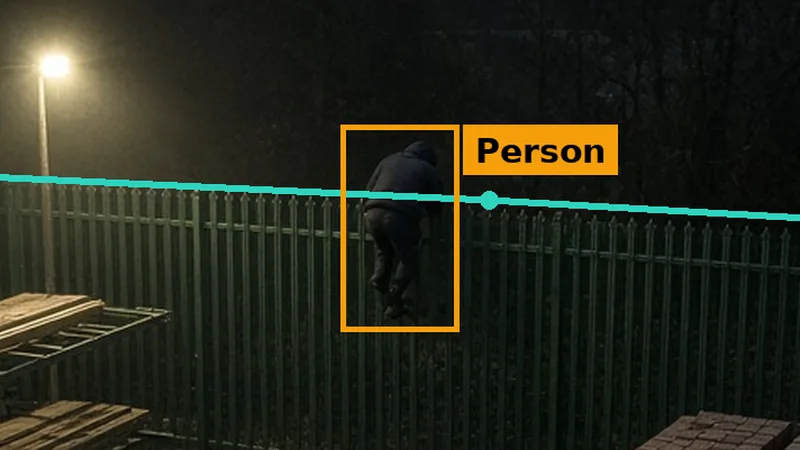
Builders’ merchant and timber yard security after hours means knowing when someone is in the yard who should not be. Merchants sit in the sector the Home Office found most exposed: 41% of wholesale and retail premises in England and Wales were hit by crime in the 2023 Commercial Victimisation Survey. Yards are full of resaleable stock and empty every night. AI detection on existing CCTV flags a person crossing the fence, a vehicle in the yard or timber shed after closing, or smoke rising from a timber stack, and sends the clip to the app and by email.

Last updated 31 October 2026. A builders’ merchant or timber yard is busy from first light. Trade customers queue at the counter, vans and pickups load in the yard, delivery lorries come and go, and the timber shed fills and empties all day. Then the branch closes, the gate is locked, and an open yard full of timber, sheet materials, bricks, blocks, bagged aggregates, insulation, plumbing stock and tools sits empty until morning. This guide covers why merchants’ yards are targeted, what the published figures say, how to put cameras to work after closing, how to spot smoke in a timber stack early, and how AI alerts on the CCTV you already have tell someone while something is happening, rather than the next morning.
It is written for branch managers, regional and operations managers, independent merchants, timber yard owners and the security installers who look after them. It does not cover locks, alarms or fire systems in detail; your insurer, the fire and rescue service, the police and a competent installer decide what applies to your site.
How big is the merchant sector, and how exposed is it?
The Builders Merchants Federation (BMF) is the trade association for builders’, timber, plumbing and heating and other building materials merchants. According to the BMF’s membership figures as of 1 September 2025, reported by Professional Builders Merchant, its 521 merchant members, 74 of them in Ireland, operate from just over 5,600 branches across the UK and Ireland. Its 1,010 member companies, including suppliers and service firms, employ nearly 193,000 people.
Most of those branches have the same basic layout: a trade counter and showroom at the front, an open yard behind it, and some kind of covered timber store, often a drive-through shed with open sides so customers can pull in and load. That layout is good for trade and bad for security. The most valuable, most portable stock is outdoors or in open-sided buildings, much of it out of sight of the road, and the branch is usually empty from early evening until early morning.
Merchants also sit in the part of the economy the Home Office finds most exposed to crime. The 2023 Commercial Victimisation Survey (CVS) for England and Wales groups merchants with other wholesale and retail premises, and that sector had the highest rate of crime of any group in the survey.
What does crime against merchants look like?
In the 2023 CVS, an estimated 26% of all business premises in England and Wales, around 409,000, were victims of at least one of the crimes it measures in the previous 12 months. Theft was the most common crime, experienced by 14% of premises, followed by burglary including attempts (8%), vandalism (8%) and assaults or threats against staff or customers (7%). Premises in the wholesale and retail sector were hit hardest: 41% experienced some crime in the year.
The survey also shows how the sector splits. Retail premises suffer more robbery and violence: 9% of retail premises experienced robbery, against 2% of wholesale premises, and 12% of retail premises experienced assaults or threats, against 6% of wholesale. For a merchant with a trade counter, the daytime risks are mostly the counter’s problem. The yard’s problem is mostly at night: theft of stock, burglary of stores and sheds, damage to gates and fences, and the occasional deliberate fire.
Three other CVS findings are worth knowing:
- The cost is real. Half of premises hit by crime (50%) reported a direct financial loss, and 69% of victims of theft said it had a moderate or severe financial impact on the business.
- Burglary is often a one-off, but not always. 64% of burglary victims were hit once in the year, which means more than a third were hit more than once. Once a yard is known to be easy, people come back.
- Reporting and response are patchy. 55% of premises hit by crime reported at least one crime to the police. Of premises that reported a crime, 45% said the police attended the scene, and 41% of premises were dissatisfied with the response, against 35% who were satisfied.
Put together, the message for a merchant is simple: you are in a high-risk sector, a successful theft costs real money, and you cannot rely on finding out after the event and expecting the police to recover the stock. What helps most is knowing at the time.
Why are merchants’ yards targeted after hours?
A merchant’s yard holds exactly what the building trade uses every day. That is the point of a merchant, and it is also why yards are targeted. Stock is standard, unmarked and easy to sell on or use: lengths of timber, sheets of ply and OSB, insulation boards, roofing materials, copper pipe and fittings, bagged cement and plaster, power tools and fixings.
The demand comes from the same place as the trade. In research NFU Mutual carried out with 500 tradespeople in January 2026, 36% said they or an employee had experienced site theft in the last 12 months. 32% had experienced theft from a vehicle, 12% had had a vehicle stolen, and 11% had been victims of business premises crime. Tools and materials taken from sites and vans are the same tools and materials a merchant keeps in stock, in bulk, in one place.
NFU Mutual’s advice to tradespeople includes not stockpiling high-value materials such as lead and copper, storing portable items in a robust, lockable store that is fixed in place, and checking before leaving that alarms are on, cameras face the right direction and security lights work. A merchant cannot avoid holding stock, but the same principles apply: keep the highest-value items locked away, keep the yard visible, and make sure cameras are actually watching what matters.
Several features of a typical yard make it easy for an intruder:
- Long fences out of sight. Timber racking, stacked pallets and sheds often back onto the boundary, hiding the rear fence from the road and from the branch.
- Open-sided buildings. A drive-through timber shed is designed so a vehicle can drive in and load. At night, that works just as well for a thief.
- Heavy stock, loaded by vehicle. Thieves bring a van or a pickup, so the vehicle in the yard is often the first sign of trouble.
- Industrial estate locations. Many branches sit on estates that are deserted at night, with few passers-by to notice anything.
- Seasonal darkness. In autumn and winter, the yard is dark for hours before closing and long after it.
What should a merchant’s yard security include?
Good security on a merchant’s site is layered. Each layer does a different job, and the layers work best together.
- Fence and gate. A sound palisade or weldmesh fence and a strong, locked yard gate mark the boundary and slow people down. Check them regularly for gaps, cut panels and damage, and keep stock away from the fence where it could be used as a ladder.
- Locked stores. Keep the highest-value stock, such as copper, brass fittings, power tools and fixings, in a locked cage or building, not in the open yard.
- Lighting. Light the yard, the timber shed and the fence well enough for the cameras to see, and keep fittings working.
- Cameras. Cover the gate, the fence, the yard bays, the timber shed and any cage or store, with a clear view at night. Recordings help afterwards; they do not stop anything on their own.
- Alerts. Tell someone at the time when a person or vehicle is where they should not be, or when smoke appears.
Most branches already have the first three layers. The gap is usually the fourth. A typical merchant has a dozen or more cameras recording to a recorder in the branch, and nobody watches them at night. When something happens, someone finds out the next morning, then spends an hour scrolling through footage to see how it happened.
What does AI add to CCTV you already have?
AI detection watches the camera feeds for you. Woodcock AI connects to the IP cameras and recorders a branch already has, over RTSP or ONVIF, including Hikvision, and runs on an edge server on site or on a cloud server. You draw polygon zones and lines on each camera view, choose what each one watches for, and set when it is armed. When something happens, an alert goes to the app with a snapshot and the clip, and by email.
On a merchant’s site, the useful detections are:
- Line crossing along the yard fence and across the gate, for anyone coming over or through.
- Intrusion: a person in a zone such as the materials yard, the timber shed or the cage after closing.
- Vehicle detection: a car, van or lorry in a zone, such as the yard, the shed floor or outside the gate.
- Smoke and fire, on outdoor and indoor views, all the time.
Each alert comes with an AI description of what the camera saw, such as “one person climbing the rear fence beside the timber racks, no vehicle in view”. The system is self-learning: it gets better at telling the difference between a real event and the things your cameras see every night, such as headlights sweeping across the yard from the road, rain on the lens, or a fox. Woodcock AI has been in development for years and is now running on customer sites across the UK.
Coming next: Ask your cameras Coming soon, early 2027, which will let you ask the system questions about what your cameras have seen.
Where should cameras watch on a merchant’s site?
Every branch is different, but most yards have the same four areas to protect after closing. Choose one to see what to watch for.
Which part of your branch worries you most?
Most merchants’ yards sit behind a palisade or weldmesh fence, often with timber racking or stacked pallets backing onto it. That puts long stretches of fence out of sight of the road and the trade counter. A line drawn along the top of the fence flags anyone crossing it at any hour. Because nobody should come over the fence even during trading hours, this line can stay armed around the clock.
Line crossing, 24 hours a dayThe yard gate is where customers drive in to collect and where delivery lorries come and go all day. After closing, a vehicle at the gate stands out. A line across the drive just inside the gate, armed outside trading hours, flags a vehicle coming through, whether the gate was forced or left open. A zone outside the gate shows a vehicle waiting there. Vehicle detection is not number plate recognition, but the clip shows what arrived and when.
Vehicles arriving after closing
Drive-through timber sheds are open-sided by design, so customers can pull in and load. That also means anyone can drive in at night. A polygon zone over the shed floor, armed from closing until opening, flags a person or a vehicle stopping between the racks. That is the moment lengths of timber or sheets of ply are being loaded, not the next morning when the stock count does not add up.
Vehicles and people among the racks
The open materials yard holds pallets of bricks, blocks, bagged aggregates, insulation and roofing, often in bays that cannot be seen from the road. Heavy stock means a thief needs a vehicle close by. A zone over the bays, armed out of hours, flags a vehicle entering or stopping there, and a person walking between the pallets.
Vehicles at the pallets out of hours
Each part of the site gets its own zone or line, with its own schedule, set around your trading hours.
Two other areas are worth covering. A locked cage or store holding copper, brass, tools and fixings deserves its own zone, armed outside trading hours, because it holds the stock that is easiest to sell. And the trade counter building itself, if a camera can see its doors and the shutter, can have a zone over the apron in front of them.
Leave the public road, the customer car park and neighbours’ land out of your zones. People walk past on the pavement and cars pull into the car park in the evening; neither is a reason to wake someone up. Drawing zones carefully around the parts of the site you control keeps alerts to the things that matter, and helps with data protection too.
How do schedules work around trading hours?
A merchant’s yard is legitimately busy all day and should be empty all night. That makes schedules the most important setting. Each zone and line has its own, so you can match them to the branch’s trading hours and the times staff are on site.
- Yard, shed and cage zones are armed from when the last member of staff leaves until the first arrives, for example 18:00 to 06:30 on weekdays, with longer hours on Saturday afternoons, Sundays and bank holidays.
- The fence line can stay armed 24 hours a day, because nobody should come over the fence at any time.
- Smoke and fire detection stays on all the time.
Plan for the exceptions. Early deliveries, a late collection by arrangement and staff working on a stocktake all need thought, either by adjusting the schedule for that night or by agreeing that the person who gets the alert will check the clip and recognise them. A lorry at 06:45 is probably a delivery. A van in the materials yard at 02:00 is not.
How do you spot a fire in a timber stack early?
Timber yards are full of fuel. The Health and Safety Executive’s introduction to fire safety says fires need three things, a source of ignition, a source of fuel and oxygen, and lists wood, paper, plastic, loose packaging materials and waste rubbish among the sources of fuel. A merchant’s yard has all of them: stacks of sawn timber, sheet materials, pallets, plastic wrapping, cardboard, insulation and skips of offcuts.
The ignition sources on a yard are familiar too: a discarded cigarette by the back of the shed, a fault in a charger or electrical equipment, hot work during maintenance, a vehicle left with a hot exhaust against a stack, and deliberate fire setting. Arson is a particular risk on sites that are empty at night; our arson prevention guide covers it in more detail.

Under the Regulatory Reform (Fire Safety) Order 2005, the responsible person must make a suitable and sufficient assessment of fire risks (article 9). In Scotland, the Fire (Scotland) Act 2005 and the Fire Safety (Scotland) Regulations 2006 apply. The Home Office’s guide Fire safety risk assessment: factories and warehouses is published to help responsible persons for storage premises meet those duties. HSE’s advice is to keep sources of ignition and fuel apart, keep good housekeeping so rubbish does not build up, and consider how to detect fires and warn people quickly.
The hard part on a timber yard is detection. Indoor smoke detectors work under a ceiling, but an open-sided shed has a high roof and wind blowing through, and an outdoor stack has no ceiling at all. Smoke drifts away before it reaches any point detector. A camera, on the other hand, can see smoke rising from a stack or drifting out of a shed. Video smoke detection on the cameras you have watches for that, day and night, and sends the clip with the alert, so whoever receives it can see where the smoke is and how much there is before calling 999.
Practical steps help as much as detection: keep stacks separated with clear gaps between them, keep stock away from the boundary fence, empty skips of offcuts and packaging regularly, keep smoking well away from the yard, and control hot work with a permit. Our guides to outdoor fire detection and video smoke detection on existing CCTV go further.
What about vehicles in the yard after closing?
On a merchant’s site, a vehicle in the wrong place at the wrong time is often the clearest sign of theft. Sheets of ply, lengths of timber and pallets of blocks are heavy, so they leave by van, pickup or lorry. During the day, vehicles are everywhere and that is normal. After closing, any vehicle inside the yard, in the timber shed or reversed up to the bays is worth an alert.
Vehicle detection flags a car, van or lorry entering or stopping in a zone. It is not number plate recognition and does not read plates; the clip shows what the vehicle looked like and when it arrived, which is what the police will want. A zone outside the gate can flag a vehicle waiting there at night, which may be someone weighing up the site before trying the gate. Our guides to plant and machinery theft and fuel theft cover the vehicles and fuel many merchants keep on site.
How do you protect copper, tools and the cage?
The highest-value stock on most branches is small and easy to carry: copper pipe and cylinders, brass fittings, power tools, fixings and, at some branches, lead. These should be in a locked cage or a secure building. A camera on the cage door, with a zone armed outside trading hours, flags anyone approaching or entering after closing. If the cage is inside a building, a zone over the shutter or door from the outside does the same job.
Metal theft is a wider problem for anyone holding copper, lead or cable. Our metal theft prevention guide covers it in detail.
How does this work across several branches?
Many merchants run more than one branch, and some run dozens. Each branch can have its own zones, lines and schedules, set to its own trading hours, and alerts can go to the people responsible for that branch, a regional manager, a keyholding service or a central team. Because Woodcock AI works with the cameras and recorders already installed, a group with a mix of camera brands and ages across its branches can usually connect them all without replacing them.
A sensible approach is to start with the branches that have the most trouble, or the most valuable stock, and learn from them. The zones and schedules that work at one branch become a starting point for the next.
How does data protection apply to customers and staff on camera?
CCTV that captures people is covered by data protection law. The Information Commissioner’s Office guidance on video surveillance expects you to have a clear purpose, to be open about it with signs, to keep footage only as long as you need it, to keep it secure, and to respond to requests for footage from people who appear in it. Customers, drivers and staff are all on camera at a busy branch.
AI detection fits that well. Zones cover only the parts of the site you choose, the main use is after closing when the yard should be empty, and alerts are about events, not about watching people. Woodcock AI detects people and vehicles in zones and on lines, and smoke and flame. It does not use facial recognition, identify who anyone is, or read number plates. Tell staff how the system works and update your privacy notice. Our AI CCTV and GDPR guide covers this in more detail.
What should happen when an alert fires?
An alert is only useful if someone acts on it. Before switching anything on, agree who gets which alert, when, and what they do.
- Check the clip. Open the alert, watch the clip and read the AI description. Is it a fox, a member of staff, a late delivery, or someone who should not be there?
- Call 999 if a crime or a fire is happening now. Give the branch address and say which part of the yard. Use 101 to report a crime after the event.
- Never confront anyone. Nobody should go to the yard alone, or approach intruders. Wait for the police.
- Record and review. Save the clip, report what happened, check stock, and fix the weak point, whether that is a cut fence panel, a dark corner or a gate left unlocked.
What should a merchant’s security review cover?
- Fence and gate. Walk the boundary. Look for gaps, damaged panels and stock stacked where it could be climbed.
- Stock layout. Keep high-value stock locked away, and keep stacks clear of the fence.
- Lighting. Check the yard, shed and fence are lit well enough for the cameras.
- Cameras. Check each one has a clear picture at night, and that the gate, fence, yard bays, timber shed and cage are covered.
- Zones and schedules. Set them to your trading hours and decide who gets which alert.
- Fire. Review the fire risk assessment, the separation of stacks, skips and smoking, and how a fire in the yard at night would be found.
- Signs and notices. Check CCTV signs are in place and the privacy notice is up to date.
Our out-of-hours site security checklist and commercial burglary prevention guide go into more detail on each layer.
How do you get started?
Start with the cameras you have. Note which parts of the yard, the fence, the timber shed and the cage they cover, what they see at night, and where they record. Note the places where trouble has happened before.
Our site assessment looks at the cameras already on your branch, the parts of the site most at risk, and the zones, lines and schedules that would cover them, set around your trading hours. If you want to see it working first, we can run a live test on your cameras: we connect two or three of them for about a fortnight, so you see alerts on your own yard before you decide. We can also arrange an on-site demo.
What are the limits?
- A camera needs a view. It cannot see a fence, a bay or a stack it does not point at, or the back of a rack it cannot see past.
- It needs light or a camera that works in the dark. Check what your cameras see at night.
- It needs power and a connection. If either goes off, cameras and alerts stop.
- It does not see inside a closed stack or building. Smoke detection works on what the camera can see, such as smoke rising from a stack or drifting out of a shed.
- It does not replace locks, alarms, fire systems or a fire risk assessment. It adds an early warning from what cameras can see.
- It does not read number plates or identify people. It flags people and vehicles in zones and on lines, and smoke and flame; the clip shows what happened.
- Someone has to respond. An alert is only useful if someone acts on it.
Sources
- Professional Builders Merchant, BMF forecast pinpoints building materials growth for 2025, but outlook uncertain (22 September 2025), for BMF membership figures as of 1 September 2025.
- Home Office, Crime against businesses: findings from the 2023 Commercial Victimisation Survey.
- NFU Mutual, Tips for tradespeople to prevent theft and protect your wellbeing, citing research with tradespeople in January 2026.
- Health and Safety Executive, Introduction to fire safety.
- Home Office, Fire safety risk assessment: factories and warehouses.
- legislation.gov.uk, Regulatory Reform (Fire Safety) Order 2005, article 9.
- Information Commissioner’s Office, Guidance on video surveillance, including CCTV.
We have summarised these sources in our own words. Always read the current versions in full. This page is general guidance, not legal, insurance, fire safety or security advice; your insurer, the fire and rescue service, the police and a competent adviser decide what applies to your site.
Want to know when someone is in your yard tonight?
Book a site assessment and we will look at the cameras on your branch and plan zones, lines and schedules for the gate, fence, yard, timber shed and cage, set around your trading hours. Or ask for a live test on your cameras first: we connect two or three of them for about a fortnight.
Related pages
Frequently asked questions
How can a builders’ merchant improve yard security after hours?
Keep the fence and gate in good repair, keep stock away from the fence, lock high-value stock such as copper and tools in a cage, light the yard and timber shed, and use CCTV that alerts someone at the time when a person crosses the fence, a vehicle is in the yard after closing, or smoke appears.
How often are merchants and other wholesale premises hit by crime?
In the Home Office 2023 Commercial Victimisation Survey, 41% of wholesale and retail premises in England and Wales experienced crime in the previous 12 months, the highest rate of any sector, against 26% of all business premises.
Can CCTV detect smoke from a timber stack outdoors?
Video smoke detection watches the camera picture for smoke and flame, so it can flag smoke rising from a stack or drifting out of an open-sided shed, where point smoke detectors under a roof may not pick it up. It works on what the camera can see.
Can AI CCTV work around a merchant’s trading hours?
Yes. Each zone and line has its own schedule, so yard, timber shed and cage zones can be armed from closing until opening, while the fence line and smoke detection stay on all the time.
Does Woodcock AI identify customers or read number plates?
No. It detects people and vehicles in zones and on lines, and smoke and flame. It does not use facial recognition, identify who anyone is, or read number plates.
Can Woodcock AI work with the cameras a branch already has?
Usually, yes. It connects to IP cameras and recorders over RTSP or ONVIF, including Hikvision, and runs on an edge server on site or on a cloud server. Alerts go to the app with a snapshot and by email.
Last reviewed 31 October 2026