

Warehouse security: protecting stock, docks, trailers and yards out of hours
Warehouse security means protecting the building, the stock inside it, the docks and the yard, and the loaded trailers parked there, from break-ins, cargo theft and fire, most of which happens at night and at weekends. The basics are one controlled gate, secure docks and doors, good lighting, trailers kept away from fences, waste kept away from the building, and a clear plan for who responds. AI on the CCTV cameras already on site then flags people, vehicles and smoke in zones and on lines out of hours, with the clip in every alert.

Last updated 1 November 2026. A warehouse is a box full of other people’s goods with a yard full of loaded trailers outside it. In the daytime and on the evening shift it is busy: lorries arriving and leaving, doors opening and closing, drivers waiting at the gatehouse and pickers in the aisles. At night and at the weekend many warehouses go quiet. The doors are shut, the yard holds trailers loaded for Monday, and the long blank walls at the back of the building are out of sight of anyone. That is when most warehouse crime happens, and when a fire in a pallet stack or a waste skip can take hold before anyone sees it.
This guide sets out the main security risks to UK warehouses and distribution centres, what the official and industry figures show, how cargo crime works in yards and trailer parks, what police design guidance and government fire safety guidance say, where cameras should watch, and how AI on the CCTV cameras already on site can watch the gate, the docks, the yard and the aisles out of hours. It is written for warehouse and site managers, logistics and third-party logistics (3PL) operators, transport managers, facilities and loss prevention teams, landlords of logistics units and the security installers who work with them. It gives no prices: what a warehouse needs depends on its layout, its cameras and who can respond.
What are the main security risks to a warehouse?
A small unit storing building supplies and a million square foot distribution centre with its own gatehouse have little in common. But most warehouses face the same four kinds of risk, and most of them peak when the site is quiet.
- Break-ins to the building. Dock doors and shutters forced, side and fire exit doors attacked, and roofs, roof lights and vents used as a way in, usually on the sides of the building that nobody passes at night. High-value stock such as electronics, tobacco, alcohol, clothing and tools is the usual target, but thieves also take whatever is easy to carry and sell.
- Cargo theft from the yard. Curtains slashed on parked trailers so the load can be looked at and picked through, and whole loaded trailers driven away by a tractor unit that has no business being there. A trailer loaded on Friday for a Monday delivery can sit in the yard for two nights and a day.
- Theft of stock and equipment. Pallets of goods, roll cages, pallet trucks, batteries, fuel and tools taken from the yard, the dock area or the building itself, sometimes by people who know the site.
- Fire. Stacked goods, packaging, idle pallets and waste burn quickly, and in high racking a fire can climb to the roof in minutes. Many warehouse fires start outside, in a pallet stack or a skip against a wall, by accident or deliberately.
These risks overlap. Someone in the yard at night to steal from a trailer may also set fire to the pallets to cover their tracks, and a damaged door or vent left unrepaired after an attempt is an invitation to come back. That is why warehouse security works best when it is planned for the whole site, from the gate to the back fence, rather than door by door.
What do the figures show about warehouse and cargo crime?
There are no official crime figures for warehouses as such, and freight crime is hard to count. The specialist unit that collects the figures is NaVCIS Freight, part of the National Vehicle Crime Intelligence Service, which manages the UK Freight Crime database and collects data from police forces, insurers and loss adjusters. On its freight page NaVCIS says it processed 3,424 individual crime notifications from police services and industry partners in 2025, with an estimated cost-price loss of 65 million pounds, and responded to 1,373 enquiries.
Fleet News reported the detail from the NaVCIS 2025 figures in its report on the year. More than half of incidents (1,831, or 54%) happened at independent parking locations such as industrial estates and lay-bys, and 699 (20%) at motorway service stations. Curtain slashing was the most common method, with 915 cases (26.9%). There were 176 reports of trailer hook-up thefts, in which criminals clone tractor units, drive into empty or scarcely staffed yards and steal loaded trailers, and NaVCIS said these were on the rise. The most vulnerable regions were the West Midlands, East Yorkshire and Humberside, the South East and the East Midlands.
Two cautions come with those figures. First, they rely on notifications from police and industry, and there is no dedicated Home Office crime code for freight crime, so many incidents are simply recorded as theft from a motor vehicle and never reach the count. Second, the 2024 figures were higher (4,879 notifications), but NaVCIS warns against reading that as a fall, because of the way the figures are collated. Either way, cargo crime is organised, and yards with loaded trailers are on the list.
Crime against business premises in general is better measured. The Home Office’s 2023 Commercial Victimisation Survey interviewed premises across all business sectors in England and Wales, including wholesale and transport.
The survey found that 26% of business premises, an estimated 409,000, had experienced at least one crime in the 12 months before interview. By type, 14% experienced theft and 8% burglary including attempts. Only 55% of victim premises reported at least one crime to the police, and only 34% reported every crime; of those that did not report, the most common reason was that the incident was too trivial. The wholesale and retail sector had a higher rate, with 41% of premises a victim of crime, though the Home Office links that mainly to premises being open to the public, which most warehouses are not. Police recorded figures from the Office for National Statistics’ Crime in England and Wales: year ending June 2026 bulletin show burglary, residential and non-residential together, fell by 6% to 222,304 offences.
Under-reporting matters for a warehouse. If an attempt on a dock door or a slashed curtain is never reported, the police cannot see that the same yard has been visited three times in a month, and nor can the landlord or the neighbouring units.
Why are warehouses such a target?
Part of the answer is scale. A report by Savills for the UK Warehousing Association, published in April 2024, found that warehouse units over 100,000 sq ft in Great Britain now total just under 690 million sq ft, up 22% in three years. Third-party logistics firms are the largest group of occupiers, with 128 million sq ft. More warehouse space means more stock in transit, more trailers in yards and more large buildings on the edge of towns with long, quiet perimeters.
The other part is layout. Warehouses are designed for lorries and racking, not for being watched:
- Long blank walls. Secured by Design notes that many industrial units and warehouses have long runs of windowless walls at the rear and sides, usually with at least one recessed emergency exit door, which can present opportunities for burglary, graffiti and arson.
- Many doors. A distribution centre may have dozens of dock doors, plus level-access doors, fire exits and personnel doors, each one a way in if it is left open or attacked.
- Openings at night. The same guide warns that automatic vents, opening windows and pressure relief panels on modern warehouse buildings, which may open at night to pre-cool the building, can cause security problems if they open while it is unoccupied.
- A yard that never empties. Trailers, tractor units, pallets, cages and waste skips sit outside overnight and over weekends, often against the fence or the building.
- Quiet hours. A site that runs two shifts on weekdays and nothing at the weekend is busy for some hours and completely empty for others. Thieves know which is which.
How does cargo crime happen in warehouse yards?
Cargo crime is the part of warehouse security that many site managers think of last, because the goods are already on a trailer and, on paper, may already belong to the haulier or the customer. But a trailer stolen from your yard, or a load picked through after its curtain was slashed overnight, is still a loss on your site, and it is still your gate, your fence and your cameras that failed to see it.
NaVCIS describes the main methods, and Fleet News set out when each tends to happen:
- Curtain slashing. Thieves cut the curtain on a curtain-sided trailer to see what is inside, and then return with a van or come back the next night for anything worth taking. It was the most common method in 2025 and, according to NaVCIS, typically happens on weekday nights.
- Trailer hook-ups. A tractor unit, sometimes cloned to look like a legitimate one, drives into a yard, couples up to a loaded trailer and drives away. NaVCIS said these thefts target empty or scarcely staffed yards, were on the rise in 2025 and usually happen over the weekend and at weekend nights.
- Jump-ups. Thieves climb onto a stationary trailer, often while a driver is making a delivery. These were normally on weekday mornings, in line with delivery times, with tobacco a prime target.
The pattern matters for a warehouse. A yard that runs two shifts on weekdays is watched, at least loosely, by the people working in it. The same yard from Friday evening to Monday morning, with loaded trailers parked for the first deliveries of the week, is exactly the empty or scarcely staffed yard that hook-up thieves look for. Fleet News also reported NaVCIS calls for more secure truck parking, such as sites accredited by the Park Mark Freight scheme, a set of standards for secure lorry parking areas.
Practical steps in the yard are mostly about making a trailer hard to take and quick to notice:
- Park loaded trailers in view of the gatehouse and the cameras, not against the back fence, and nose to nose or against a wall where the rear doors cannot be opened.
- Fit kingpin locks and wheel clamps to loaded trailers left over the weekend, and keep a written record of which trailers are in the yard and when they are due to leave.
- Keep tractor units locked, keys controlled and fuel tanks protected; a unit left in the yard is an easy way to move a trailer.
- Check every vehicle in and out at the gate against a booking, and treat an unbooked tractor unit at night as a reason to look.
- Walk the yard at the start of every shift, looking for cut curtains, broken seals and trailers that have moved.
None of these needs new technology. What they do need is someone who knows, at 23:14 on a Saturday, that a tractor unit is reversing under a trailer nobody booked out. That is where detection on the yard cameras comes in, covered below.
What does police design guidance say about warehouse security?
Secured by Design (SBD), the police-owned initiative that sets security standards for buildings, publishes a Commercial Guide. The 2025 edition has sections on access control, deliveries, vehicle doors, parking and blank elevations that apply directly to warehouses.
- One main entrance. The guide says the main site entrance is the first line of defence against trespass and the focus for controlling all access, with other entrances kept to a minimum and all of them controlled.
- Secure deliveries. It asks for deliveries to be secure, notes that monitoring by video surveillance systems may be necessary, and suggests a secure delivery compound where the risk calls for it, with advice from a police Designing Out Crime Officer.
- Vehicle doors. Vehicular delivery doors should be certified to recognised security standards, such as LPS 1175 or STS 202, at the levels the guide sets out.
- Delivery routes and parking. The route from the site entrance to reception, visitor parking and delivery points should be as short as possible and open to view, staff parking should be in view of occupied offices, and parking areas should follow the Park Mark criteria where appropriate.
- Gates and bollards. Where vehicle access is controlled with bollards and gates, the fire and rescue service should still be able to get in.
- Blank walls. The guide notes that long windowless rear and side elevations, often with a recessed emergency exit, can present opportunities for burglary, graffiti and arson and that it is sensible to keep trespassers away from buildings to prevent unauthorised entry, graffiti, arson and other damage.
- Night-time openings. Automatic vents and windows that open at night to cool the building are a security risk if they open while the building is empty.
ProtectUK, the government counter-terrorism and security advice service, gives advice that fits a yard well in its site security guidance for goods vehicle operators: control access with fences, gates and security codes; keep vehicle keys in a secure locker, never in the vehicle or on a hook in the office; make every visitor and contractor sign in; and strictly control the movement of unauthorised vehicles on site, for example by allowing pre-arranged deliveries only. For a new warehouse, the cheapest time to get this right is at the design stage. For an existing one, the same points make a useful checklist for a walk around the site.
Why is fire part of warehouse security?
Fire is not a crime in itself, but in a warehouse the two are closely linked, and the same cameras can watch for both. The government’s fire safety risk assessment guide for factories and warehouses makes three points that matter here.
- Fire spreads fast in racking. The guide explains that in high racking fire spreads vertically, and that in tests with goods stored on 10m high racking, fires started in the vertical flues frequently reached the top of the racking within two minutes.
- Storage layout slows it. It suggests a minimum clear space of 1m between the top of stacks and the ceiling or lights, aisle widths of at least 2.5m to restrict spread, storage kept away from walls, and hazardous goods segregated. It lists idle pallets among the things that can add to the risk.
- Arson is the biggest lever. The guide says that, of all the risk-reduction measures, the most benefit may come from efforts to reduce the threat from arson. Its suggestions include lighting the outside of the premises and securing the perimeter, securing entry points, removing rubbish, never placing skips against the building, keeping bins in a compound, reporting suspicious people, removing entry rights from staff who leave, and making sure that alarm and detection systems are monitored and acted on.
Many of those arson measures are the same as the security measures in the rest of this guide: a lit, secure perimeter, controlled access, waste away from the building, and detection that somebody responds to. Smoke and flame detection on the cameras that already cover the yard and the pallet store adds a way to see a fire starting outside, before it reaches the building and before an internal detector would notice anything.

Smoke and flame detection on cameras supports a fire risk assessment and the fire alarm system; it does not replace either. If you see or are alerted to a fire, call 999. Our fire detection cameras for warehouses page covers this in more depth.
Where should cameras watch at a warehouse?
Most warehouses already have cameras, usually more than people think: on the gatehouse, over the dock doors, along the yard, at the fuel tank and inside over the dispatch area. What most of them lack is a plan. Before adding anything, mark on a site plan what each camera actually sees, by day and at night, and what it records. Anything no camera sees is a gap.
- The gate and the entrance road. Every vehicle and pedestrian way in, including any emergency or contractor access. This is where an unbooked vehicle arrives.
- The dock apron and dock doors. The strip in front of the doors, where someone on foot tries a seal or a shutter out of hours.
- The yard and trailer park. Wherever loaded trailers wait, especially at weekends, and wherever tractor units are left.
- The perimeter. The rear and side fences, and the blank walls of the building with their recessed fire exits.
- The pallet store, waste and skips. For people, vehicles and smoke.
- Fuel tanks, charging areas and equipment parking. Wherever valuable or flammable things are left outside overnight.
- Inside. Racking aisles, the high-value cage, the dispatch area and the doors from the inside, for intruders out of hours and for smoke and flame.
Check each camera at night, not just in daylight. A dock camera that is perfect on the afternoon shift may be blinded by the dock lights after dark, or see nothing beyond the first row of trailers. Moving or adding a camera is sometimes the cheapest improvement on the whole site.
How does AI on existing CCTV protect a warehouse?
Recording-only CCTV shows what happened after a missing trailer or a forced door is found in the morning. AI detection watches the picture live and tells someone while it is happening. Woodcock AI connects to the IP cameras and recorders already on the site, over RTSP or ONVIF, including Hikvision, and runs on an edge server on site or on a cloud server. On each camera view you draw the rules for that part of the warehouse.
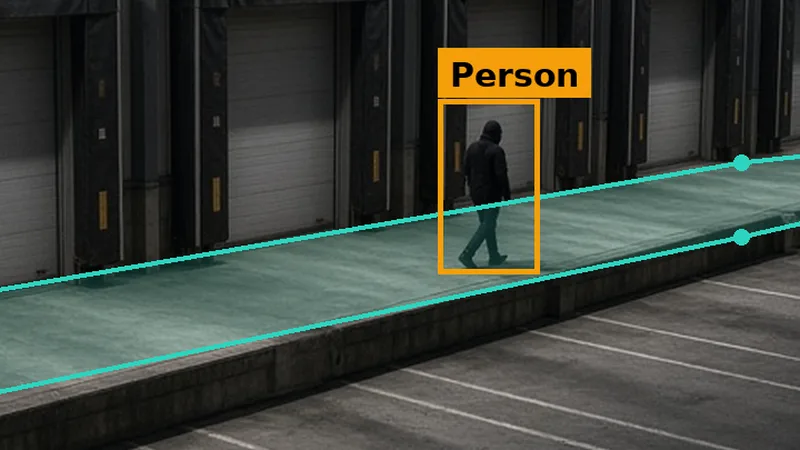
- Polygon zones. A shape with as many corners as you need, drawn over the dock apron, the trailer park, the pallet store or a racking aisle. A person or vehicle inside it while it is armed raises an alert. Because a polygon follows the shape of the area, it can leave out the yard roadway, the public road or the neighbouring site.
- Line crossing. A line across the entrance road, the yard exit or along the back fence. You choose which direction counts, so a vehicle driving in overnight raises an alert and one leaving does not, or a trailer leaving the yard at the weekend does and one arriving does not.
- Intrusion detection and vehicle detection. Only people and vehicles count. A person walking along the dock doors at 01:52 is flagged; headlights on the road, shadows, rain and a flapping trailer curtain are not.
- Smoke and flame detection. On the same cameras, around the clock, for the pallet, skip and racking fires described above.
When a rule is broken, an alert goes to the app with a snapshot and the clip, and by email, with an AI description of what the camera saw, such as “one person on foot walking along the dock doors, stopping at door 9 and looking at the seal, no vehicle moving”. Alerts can go to different people for different parts of the site: the gatehouse for the gate, the transport manager for the trailer park, the site manager for the building, or a monitoring centre (ARC) as an optional add-on.
The system is self-learning. It learns each camera on your site, so the shunter that parks in the same spot every night and the dock lights that switch on and off become part of the normal view, and every detection has a feedback button: marking an alert as correct or false feeds into retraining for your site. Woodcock AI has been in development for years and is now running on customer sites across the UK.
Vehicle detection is not number plate recognition. Woodcock AI flags that a vehicle is where it should not be, and the clip shows what it was and what it did. It does not read number plates or identify people, so it does not replace the gatehouse, a booking system or any access control the site uses.
Coming next: Ask your cameras Coming soon, early 2027, which will let you ask the system questions about what your cameras have seen.
How does this look in different parts of the warehouse?
Choose a part of the site to see how zones and lines would be set up there.
Which part of the warehouse are you protecting?
The gate is where every lorry, van and car should arrive, and on most warehouse sites it is the only way in for a vehicle. A line across the entrance road just inside the gate, set to count vehicles coming in and armed overnight, flags a vehicle arriving when no collection or delivery is booked, while traffic leaving is ignored. Lines along the fence behind the warehouse flag someone climbing over at the quiet back of the site, and a zone over the gatehouse approach covers people arriving on foot. Our perimeter intrusion detection guide covers fences and gates in more detail.
Entrance roads, barriers, fences
The yard is where loaded trailers wait overnight and over the weekend, and where curtain slashing and trailer hook-ups happen. A zone over the trailer park, armed when no trailer should be moving, flags a tractor unit coupling up or a person walking between the trailers. A zone over the dock apron flags someone at the dock doors after the evening shift. Fuel tanks and parked vehicles in the same yard can sit in the same zones; our fuel theft prevention guide covers diesel theft.
Loaded trailers, parked vehicles, docks
Inside, the risk out of hours is someone who has got in through a door, a roof light or a vent, or someone who stayed behind. Cameras over the racking aisles, the high-value cage and the dispatch area, armed after the last shift leaves, flag a person moving where nobody should be. The same cameras watch for smoke and flame in the racking, where fire spreads fast. Our fire detection cameras for warehouses page covers fire inside the building.
Racking aisles, cages, high-value stock
Each gate, yard and aisle gets its own zones and lines, with its own schedule.
How do the security options compare?
No single measure secures a warehouse. Physical security slows people down, people on site respond, and detection tells them when and where to look. This table compares the main approaches in general terms.
| Measure | What it does | Strengths | Watch out for |
|---|---|---|---|
| Fencing, gates and barriers | Defines the site and channels vehicles to one entrance | Slows intruders and stops vehicles driving straight in | Gates left open for a late arrival, gaps in fences, trailers parked against them |
| Doors, shutters and dock seals | Physically secures the building and the docks | Delay and resistance to attack | Dock doors left part-open, vents and roof lights, doors propped for air |
| Intruder alarm | Detects entry into the building when set | Well understood; can lead to police response with a URN | Covers inside only; nothing in the yard, on the trailers or at the fence |
| Gatehouse or patrols | A person on site or visiting at set times | Human presence, checks and a fast local response | Ongoing cost; one person cannot see the gate, the yard and the back fence at once |
| Recording-only CCTV | Records what happened | Evidence after the event | Nobody sees it until a missing trailer or a slashed curtain is found in the morning |
| Live-monitored CCTV | An operator watches the screens | A person can act on what they see | One person cannot watch every camera on a large site all night |
| AI on existing CCTV | Recognises people, vehicles, smoke and flame, in zones and on lines you draw, on a schedule | Watches every dock, yard and aisle at once; the alert includes the clip | Cameras need a clear view and enough light or infrared at night |
Most warehouses end up with a mix. A gatehouse that is staffed on weekday shifts, with an intruder alarm on the building and AI detection on the cameras watching the yard, the docks and the fence the rest of the time, covers far more than any one of them alone.
How do you avoid false alarms at a warehouse?
A warehouse yard is a hard place for older motion detection. Lorries arrive and turn with their headlights sweeping across the docks, dock lights and yard lights switch on and off, rain and wind move trailer curtains, stretch wrap and loose packaging, and night shifts, drivers, cleaners and keyholders come and go at all hours. Motion detection that reacts to any change in the picture sends alerts all night, and people soon stop looking at them.
- Detect people and vehicles, not movement. AI that recognises objects ignores headlights, shadows, rain and moving curtains.
- Keep roadways out of the zone. Draw polygons that follow the dock apron and the trailer park and stop short of the yard roadway and the public road.
- Use direction on lines. A line at the gate that only counts vehicles coming in ignores everyone leaving.
- Match each schedule to the shifts. A dock that works until 22:00 and a trailer park that is quiet all weekend need different hours.
- Give feedback. Marking false alerts helps the system learn each camera.
Our guide to reducing CCTV false alarms goes through each cause in detail.
How should a warehouse schedule work?
Few warehouses have one set of hours. Some run around the clock on weekdays and stop at the weekend, some have a quiet night shift with only the docks working, and peak season changes everything. Schedules let each rule match the part of the site it covers.
- The dock apron is armed from the end of the evening shift until the first booked arrival.
- The trailer park is armed whenever no trailer should be moving, which for many sites means all weekend and bank holidays.
- The gate line is armed overnight for inbound vehicles, when no arrival is booked.
- Inside aisles and the high-value cage are armed after the last shift leaves and the building is locked.
- Smoke and flame detection stays on all the time.
Plan for the people who are meant to be there: early arrivals, shunters, cleaners, maintenance contractors and keyholders. If they are expected at a set time, fit the schedule round them or tell whoever receives the alerts what to expect. In peak season, review the schedules when the shift pattern changes.
What should happen when an alert fires?
An alert is only useful if someone acts on it, and on a large site it is easy for the gatehouse, the transport office and the site manager each to assume someone else will. Agree, before the cameras go live, who gets which alerts at which hours, and what they should do.
- Check the clip. The alert arrives with the clip, so a gatehouse officer, keyholder or duty manager can see in seconds whether it is someone at the dock doors or a driver arriving early.
- Call 999 if a crime is in progress or there is a fire. Do not go alone or challenge anyone, and do not try to stop a vehicle leaving with a trailer. For a fire, follow the site’s emergency plan.
- Use a monitoring centre for police response. The National Police Chiefs’ Council’s Police Operational Advice and Security Industry Requirements for Response to Security Systems (March 2024) say police response to remotely monitored systems depends on a unique reference number (URN), which needs a compliant system and monitoring centre. Systems without one have no guaranteed police response, and for intruder alarm systems with a URN, three false calls in a rolling 12 months means police response is withdrawn.
- Report it. The figures above show how much business crime goes unreported, and freight crime has no crime code of its own. Report each incident to the police with the clip, and make sure cargo losses reach the haulier, the insurer and, through them, the national freight crime figures.
- Tell the people who need to know. The haulier whose trailer was attacked, the landlord, and neighbouring sites on the same estate, so they can check their own yards.
- Review and fix. Mark the alert correct or false, and close any gap it showed.
What part do staff and drivers play?
Many warehouse losses involve someone who knows the site: which trailers are loaded with what, which door does not lock properly, when the yard is empty. Good procedures make that harder and make problems quicker to notice.
- Keys and codes. Keep keys for vehicles, doors and the gate in a secure locker, record who has them, and change codes and remove access when someone leaves. Both the fire safety guide and ProtectUK make this point.
- Visitors and drivers. Sign every visitor, contractor and driver in and out, give them a pass, and keep visiting drivers in a waiting area rather than wandering the warehouse.
- Bookings. Allow pre-arranged deliveries and collections only, and check each vehicle against a booking at the gate.
- Seals and checks. Record seal numbers on loaded trailers, check them at the start of each shift and before departure, and look for cut curtains and moved trailers.
- End of shift. A simple closing routine for the last person out: dock doors shut and locked, shutters down, vents and roof lights closed, waste moved away from the building, the alarm set.
- Speaking up. Make it easy to report a broken lock, a gap in the fence or a stranger in the yard, and act on what is reported.
Cameras and alerts support these routines rather than replacing them. An alert on the dock apron at 01:52 is far more useful if the closing routine at 22:00 confirmed that every door was shut.
How does data protection apply to warehouse CCTV?
Warehouse cameras see staff, agency workers, drivers, visitors and anyone passing on the public road. CCTV that captures people is covered by data protection law, and the Information Commissioner’s Office guidance on video surveillance expects you to have a clear purpose, to tell people with signs before they enter the area being recorded, to keep footage only as long as you need it for that purpose and to keep it secure. Where the processing is likely to be high risk, the ICO expects a data protection impact assessment. Tell staff how cameras are used, and be clear that security cameras are there to protect the site, not to monitor individual performance.
Polygon zones help here too. A zone over the dock apron or the trailer park keeps detection to that area, even when the camera can see the public road or the next site. Woodcock AI detects people and vehicles in zones and on lines, and smoke and flame. It does not use facial recognition, identify who anyone is or read number plates. Our AI CCTV and GDPR guide covers this in more detail.
How do you get started?
Start with the basics the design guide, ProtectUK and the fire safety guide set out: one controlled gate, secure docks and doors, good lighting, keys locked away, visitors signed in, trailers parked in view, waste and skips away from the building, and pallets stored safely. Then map the cameras already on the site: what each one covers, what it sees at night, and where crime, cargo loss or damage has happened before. Our out-of-hours site security checklist and commercial burglary prevention guide help with the building itself.
Our site assessment looks at the cameras already on your warehouse, the gate, docks, yard and aisles most at risk, and the zones, lines and schedules that would cover them. It also tells you honestly where a camera cannot do the job. If you want to see it working first, we can run a live test on your cameras: we connect two or three of them for about a fortnight, so you see alerts from your own site before you decide. We can also arrange an on-site demo.
What are the limits of cameras at a warehouse?
- A camera needs a view. It cannot see behind a row of trailers, round the end of the building or into an aisle it does not point at.
- It needs light or infrared at night. Check what each camera actually sees in the dark, including the far end of the trailer park and the back fence.
- It needs power and a connection. If either goes off, cameras and alerts stop, so protect the recorder, the network and the power supply.
- It detects; it does not stop anyone. Fences, gates, locks, kingpin locks and shutters still have to do that.
- It does not replace fire safety systems. Smoke detection on cameras is an early warning on top of the fire alarm, sprinklers where fitted, the fire risk assessment and the emergency plan.
- It does not read number plates or identify people. It flags people and vehicles in zones and on lines; the clip shows what happened.
- Someone has to respond. An alert is only useful if someone acts on it.
Sources
- National Vehicle Crime Intelligence Service, NaVCIS Freight.
- Fleet News, Number of cargo thefts from HGVs revealed in new report (reporting NaVCIS figures).
- Savills for the UK Warehousing Association, UKWA Report 2024: The Size and Make-Up of the UK Warehousing Sector (April 2024).
- Home Office, Crime against businesses: findings from the 2023 Commercial Victimisation Survey.
- Office for National Statistics, Crime in England and Wales: year ending June 2026 (22 October 2026).
- Secured by Design, Commercial Guide 2025.
- GOV.UK, Fire safety risk assessment: factories and warehouses.
- ProtectUK, Site security (goods vehicle operators).
- National Police Chiefs’ Council, Police Operational Advice and Security Industry Requirements for Response to Security Systems (March 2024).
- Information Commissioner’s Office, Guidance on video surveillance, including CCTV.
We have summarised these sources in our own words. Always read the current versions in full. This page is general guidance, not legal, fire safety, insurance or security advice; the police, your fire risk assessor, your insurer, your monitoring centre and a competent installer decide what applies to your site.
Want to know when someone is on your docks or in your trailer park tonight?
Book a site assessment and we will look at the cameras on your warehouse and plan zones, lines and schedules for the gate, the docks, the yard and the aisles, with smoke and flame detection on the same cameras. Or ask for a live test on your cameras first: we connect two or three of them for about a fortnight.
Related pages
Frequently asked questions
How do you secure a warehouse?
Start with the site as a whole: one controlled gate, secure docks, doors and shutters, good lighting, keys locked away, visitors and drivers signed in, loaded trailers parked in view, and waste and skips kept away from the building. Cameras should cover the gate, the docks, the yard and trailer park, the perimeter and the aisles. AI on existing cameras then flags people, vehicles and smoke out of hours, with the clip in every alert.
How do you stop trailers being stolen from a warehouse yard?
Park loaded trailers in view of the gatehouse and cameras, fit kingpin locks or wheel clamps over weekends, keep tractor unit keys locked away and check every vehicle at the gate against a booking. NaVCIS says trailer hook-up thefts target empty or scarcely staffed yards, usually at weekends, so a zone over the trailer park armed when no trailer should move, with an alert and clip, closes that gap.
What is curtain slashing?
Curtain slashing is when thieves cut the curtain of a curtain-sided trailer to see what it is carrying and steal some or all of the load. NaVCIS recorded 915 cases in 2025, the most common type of freight crime notification, and it typically happens on weekday nights. It affects trailers parked in yards and at lorry parks as well as on the road.
Can CCTV detect a fire in a warehouse?
AI on existing cameras can detect smoke and flame, so a camera covering the pallet store, the skips, the yard or a racking aisle can raise an alert with the clip. It is an early warning that adds to the fire alarm, the fire risk assessment and the emergency plan the warehouse needs; it does not replace them. Keeping skips and waste away from the building matters just as much.
Does Woodcock AI read number plates?
No. Woodcock AI detects people and vehicles in zones and on lines, and smoke and flame. It flags that a vehicle is somewhere it should not be, such as a tractor unit in the trailer park at the weekend, and the clip shows what happened, but it does not read number plates or identify people.
Does Woodcock AI need new cameras at a warehouse?
Usually not. It connects to existing IP cameras and recorders over RTSP or ONVIF, including Hikvision, and runs on an edge server on site or on a cloud server. A site assessment shows which cameras already cover the gate, docks, yard and aisles, and where moving or adding a camera would help.
Last reviewed 1 November 2026