

Industrial estate security: protecting units, yards and shared areas out of hours
Industrial estate security means protecting a group of units, their yards and the shared roads, entrances and empty units between them from break-ins, theft, fly-tipping, damage and fire, most of which happens out of hours. Because landlords, managing agents and tenants each control part of an estate, the best results come from a shared plan: one controlled entrance, light and clear signs, cameras on every way in, and AI on the CCTV cameras already there to flag people, vehicles and smoke in zones and on lines, with the clip in every alert.

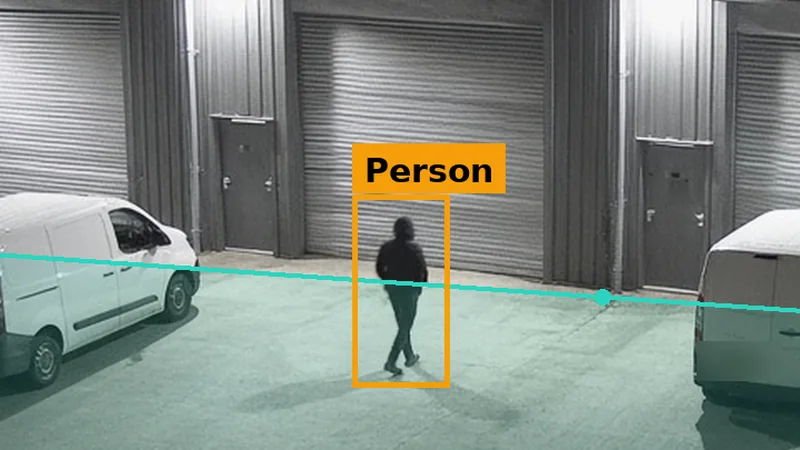
Last updated 31 October 2026. An industrial estate is a hard place to secure, because nobody owns all of it. The landlord owns the roads, the entrance, the landscaping and the empty units. A managing agent may run the estate day to day. Each tenant runs their own unit, their own yard and often their own alarm and cameras, and keeps their own hours. In the daytime the estate is busy with lorries, vans, staff and visitors. At night and at weekends it is often completely empty, with valuable stock in the yards, vans parked outside the units, waste in the bin stores and perhaps a unit or two standing vacant. That mix is why industrial estates and business parks attract break-ins, theft from yards and vehicles, fly-tipping, damage and the occasional fire that spreads from one unit to the next.
This guide sets out the main risks on UK industrial estates and business parks, what the official figures show, who is responsible for what when several businesses share a site, what police design guidance and fire safety guidance say, where cameras should watch, and how AI on the CCTV cameras already on the estate can watch the entrance, the yards, the shared areas and the empty units out of hours. It is written for estate landlords and owners, managing agents and property managers, tenants on multi-let estates, business crime reduction partnerships and the security installers who work with them. It gives no prices: what an estate needs depends on its layout, its cameras and who can respond.
What are the main security risks on an industrial estate?
Every estate is different. A modern business park with a staffed gatehouse and one barrier-controlled entrance has little in common with an older estate of brick terraces, open roads and several ways in. But most face the same four kinds of risk, and most of them happen when the estate is quiet.
- Break-ins to units. Roller shutters forced or cut, side and rear doors attacked, and roofs and skylights used as a way in, often on the units at the back of an estate where nobody passes at night. Units holding tools, electronics, metal, vehicle parts or finished stock are the usual targets.
- Theft from yards and vehicles. Materials, cable, metal, pallets, plant and tools stored outside; fuel from vehicles and tanks; vans broken into for tools; trailers and whole vehicles taken. Much of what an industrial business owns is kept in the yard, not inside the unit.
- Misuse of shared and vacant areas. Fly-tipping on the estate road, in the back service road and on the forecourts of empty units; gatherings and car meets on empty roads at night; graffiti and damage; and people getting into vacant units.
- Fire between units. Bins, skips, pallets and waste stored against walls catch fire, by accident or deliberately, and on a terrace of units a fire in one yard can quickly become a fire in several businesses.
These risks feed each other. A vacant unit with a broken shutter attracts people and rubbish; dumped rubbish against a wall is something to set alight; a fire or a break-in on one unit unsettles every tenant on the estate. That is why estate security works best when it is planned for the estate as a whole, not unit by unit.
What do the figures show about crime against business premises?
There are no official crime figures for industrial estates as such, but there are good figures for crime against business premises. The Home Office’s 2023 Commercial Victimisation Survey interviewed business premises across England and Wales, including manufacturing, construction, and transport and storage, all of which are common on industrial estates.
The survey found that 26% of business premises, an estimated 409,000, had experienced at least one crime in the 12 months before interview, no change on the year before. By type, 14% experienced theft, 8% burglary including attempts, 8% vandalism and 7% assaults or threats. Anti-social behaviour was a problem too: 8% of premises experienced it, most often groups hanging about, street drinking and intimidating behaviour.
Reporting is patchy. Just over half (55%) of victim premises reported at least one crime to the police, and only around a third (34%) reported every crime. Of those that did not report, 54% said the incident was too trivial. That matters on an estate: if each tenant sees only the attempt on their own unit and does not report it, nobody, including the police and the landlord, sees the pattern across the estate.
Police recorded figures tell the same story from the other side. The Office for National Statistics’ Crime in England and Wales: year ending June 2026 bulletin reports that police recorded burglary, residential and non-residential together, fell by 6% to 222,304 offences. Burglary has been falling for years, but for the business that is broken into, that is little comfort.
The survey also asked what premises do to prevent crime. The most commonly mentioned measures were about the monitoring and prevention of entry to the premises when closed, with outside measures such as security lighting, CCTV, gates and fences among them. Only 11% of premises were members of a crime prevention network, such as a Business Watch, a Farm Watch or a business crime reduction partnership. On an estate, that is one of the easiest gaps to close.
Who is responsible for security on a shared estate?
On a single-occupier site the answer is simple. On a multi-let industrial estate or business park, responsibility is split, and the split is usually set out in the leases and the service charge rather than in any security plan.
- The landlord or owner usually controls the estate roads, the entrance and any gates, the perimeter, the landscaping, the lighting on the common parts, the shared bin stores and any vacant units. Estate-wide CCTV, where there is any, is usually theirs.
- The managing agent, where there is one, runs the common parts day to day under the service charge: repairs, lighting, gates, cleaning, fly-tip clearance and any estate security contract.
- Each tenant usually secures their own unit and their own yard: shutters, doors, alarms, their own cameras and what they store outside.
- The estate as a whole benefits from things no single party owns: shared intelligence about what is happening, a joint view of who responds out of hours, and membership of a local Business Watch or crime reduction partnership.
The gaps are where these overlap. A tenant’s camera may see the estate road but nobody watches it. The landlord’s camera at the entrance may record a van arriving at 03:00, but nobody looks until a tenant reports a break-in in the morning. A vacant unit belongs to the landlord, but the tenant next door is the one who notices the shutter has been forced. Mapping who watches what, and who is told when something happens, is the first step.
Fire safety on shared premises
Fire safety law expects people who share premises to work together. In England and Wales, article 22 of the Regulatory Reform (Fire Safety) Order 2005 says that where two or more responsible persons share, or have duties in respect of, premises, each must co-operate with the others, take reasonable steps to co-ordinate the fire safety measures they take, and inform the others of the risks to people from their part of the premises. The current version of the article also expects each responsible person to take reasonably practicable steps to find out whether anyone else shares responsibility for the premises, to tell the others their name and a UK address, and to say which part of the premises they consider themselves responsible for, and to keep a record of what they have done. Scotland and Northern Ireland have their own fire safety law.
The government’s fire safety risk assessment guide for factories and warehouses puts it simply: in multi-occupied buildings all those with some control must co-operate, and you need to consider the risk generated by others in the building. On a terrace of units with shared walls and shared yards, that applies in practice as well as in law. Your fire risk assessor decides what applies to your premises; this guide does not replace that advice.
What does police design guidance say about industrial estates?
Secured by Design, the police crime prevention initiative, publishes a Commercial Guide (the 2025 edition) that covers all commercial premises, in its own words from small storage units to multi-use business parks. It stresses that there is no one size fits all, and that the advice of a police Designing Out Crime Officer, based on a crime risk analysis of the site, should be sought early. The points most relevant to an estate, summarised in our own words:
- The main entrance is the first line of defence. The guide says the main site entrance is the first line of defence against trespass, and that other entrances should be kept to a minimum and all of them controlled. Larger sites need a secure emergency vehicle access point for fire engines, and the guide says such roadways can be blocked by retractable bollards or gates as long as the fire and rescue service has a key.
- Site maps and unit numbers. The guide recommends a site map at the entrance to an industrial estate showing road names and unit numbers, protected from graffiti and next to a lay-by, and clear unit numbering visible from the estate roads, which it notes is too often absent on existing estates. Clear numbering helps emergency services and responders find the right unit at night.
- Clear signs. Clear signs from the entrance help, because, as the guide notes, people found wandering around the forecourts of industrial buildings will often say they could not find their way.
- Open views. Routes, parking and service areas should be in view of occupied offices where possible, and deliveries and compounds should be secure.
- Cameras. The guide says normal practice is for video surveillance to observe all vehicular and pedestrian entrances as a minimum, that an operational requirement should be drawn up before buying a system, and that cameras should work with the lighting and landscaping. It also notes that video surveillance is not a solution to every problem: a recording-only system is an investigative tool, whereas a monitored one allows a real-time reaction.
ProtectUK, the Counter Terrorism Policing protective security service, gives similar advice in its site security guidance: access control at all entrances, barriers such as walls and fences kept in good repair, vehicles and trailers not parked where they help someone over a fence, and CCTV whose main purpose is to detect suspicious activity. Our perimeter intrusion detection guide goes into fences and gates in more detail.
How do you stop a fire spreading between units?
Fires on industrial estates often start outside, not inside. The government’s fire safety risk assessment guide for factories and warehouses gives, as an example of a deliberate fire, an arson attack involving setting fire to external rubbish bins placed too close to the building, and says that for many premises the most benefit may come from efforts to reduce the threat from arson. On a terrace of units, a bin fire against one wall is a risk to every business along it.
The guide’s arson measures, summarised in our own words, translate directly to an estate:
- Keep bins and skips away from buildings. Do not place skips next to the building, and keep bins in a secure compound away from walls. On an estate, that means a shared bin store sited away from the units, not a row of bins along the terrace.
- Remove combustible waste regularly. Pallets, packaging and waste build up quickly in yards and back service roads. Fly-tipped rubbish counts too.
- Light the outside and secure the perimeter where practical. And secure entry points, storage areas and unused parts of the site.
- Do not park vehicles or store goods next to windows or doors. They help fire spread and can help someone get in.
- Make sure fire detection is monitored and acted on. And encourage staff to report suspicious people, and remove access from people who no longer need it.

Cameras fit in at the start of that chain. Woodcock AI detects smoke and flame on the same cameras that watch for people and vehicles, so a camera covering a bin store, a yard or the back service road can raise a smoke alert with the clip as well as an intrusion alert. It is an early warning that adds to, and does not replace, the fire detection, fire risk assessment and emergency plan each unit and the estate need. Our arson prevention guide covers deliberate fires, and our guide to video smoke detection on existing CCTV explains how smoke detection works.
How do you stop fly-tipping and problems with vacant units?
Fly-tipping is one of the most visible problems on industrial estates, especially on back service roads, dead ends and the forecourts of empty units. Defra’s Fly-tipping statistics for England, 2024 to 2025 show councils dealt with 1.26 million incidents, up 9% on the year before. Of those, 52,000 were the size of a tipper lorry load or larger, up 11%, and they alone cost councils 19.3 million pounds to clear.
Those figures mostly cover public land. Defra notes that incidents cleared by private landowners are not included, and that most fly-tipping on private land goes unreported. An industrial estate road is often private land, so waste dumped on it, or in a vacant yard, is usually for the landlord, and ultimately the service charge, to clear. Our fly-tipping CCTV guide covers what helps, including the evidence councils and the police need.
Vacant units are the other weak point. An empty unit has nobody opening up in the morning, nobody noticing a forced shutter and no lights on in the evening. It can attract fly-tipping, people getting in, metal and cable theft, and fires. The landlord is usually responsible for it, but the tenants next door feel the effects. Our vacant property security guide covers empty buildings in detail; on an estate, the basic steps are to keep the unit secure and looking cared for, clear any rubbish quickly, and make sure someone is told when anyone goes near it.
Where should cameras watch on an industrial estate?
Most estates already have cameras, but they are often a patchwork: the landlord’s cameras at the entrance, each tenant’s cameras on their own unit, and gaps everywhere in between. Before adding anything, mark on a plan of the estate what each camera actually sees, by day and at night, and who owns it. Anything no camera sees is a gap.
- Every entrance. Vehicle and pedestrian, including any service or emergency access. The design guide treats these as the minimum.
- The estate roads and shared parking. So a vehicle arriving at night, or stopping where it should not, is in view.
- Unit yards and frontages. The aprons in front of the shutters, the yards where stock is kept, and the side and rear doors.
- Rear fences and back service roads. The quietest parts of most estates, and often where break-ins and fly-tipping start.
- Vacant units. Their forecourts, yards and doors, around the clock.
- Bin stores and waste areas. For fly-tipping, people and smoke.
- Fuel tanks, plant and vehicle parking. Wherever valuable things are left outside overnight.
Tenants’ own cameras can be part of the plan. A camera on one unit that looks along the estate road watches the shared area as well as the tenant’s frontage, as long as the tenant agrees and the alerts go somewhere useful.
How does AI on existing CCTV protect an industrial estate?
Recording-only CCTV shows what happened after someone reports it. AI detection watches the picture live and tells someone while it is happening. Woodcock AI connects to the IP cameras and recorders already on the estate, over RTSP or ONVIF, including Hikvision, and runs on an edge server on site or on a cloud server. On each camera view you draw the rules for that part of the estate.
- Polygon zones. A shape with as many corners as you need, drawn over a unit’s yard, the apron in front of a terrace, a vacant forecourt or the bin store. A person or vehicle inside it while it is armed raises an alert. Because a polygon follows the shape of the yard, it can leave out the estate road, the public road or a neighbouring unit.
- Line crossing. A line across the estate entrance, a back service road or along a rear fence. You choose which direction counts, so a vehicle driving onto the estate overnight raises an alert and one leaving does not.
- Intrusion detection and vehicle detection. Only people and vehicles count. A person walking along the shutters at 02:00 is flagged; headlights on the road, shadows, rain and blowing litter are not.
- Smoke and flame detection. On the same cameras, around the clock, for the bin, skip and yard fires described above.
When a rule is broken, an alert goes to the app with a snapshot and the clip, and by email, with an AI description of what the camera saw, such as “one person walking slowly past the shutters of three units, stopping at a side door, no vehicle moving”. Alerts can go to different people for different parts of the estate: the managing agent for the entrance and common parts, each tenant for their own yard, or a monitoring centre (ARC) as an optional add-on.
The system is self-learning. It learns each camera on your site, so the lorry that parks up on the estate road every night and the security light that switches on and off become part of the normal view, and every detection has a feedback button: marking an alert as correct or false feeds into retraining for your site. Woodcock AI has been in development for years and is now running on customer sites across the UK.
Vehicle detection is not number plate recognition. Woodcock AI flags that a vehicle is where it should not be, and the clip shows what it was and what it did. It does not read number plates or identify people, so it does not replace any access control or barrier system an estate uses.
Coming next: Ask your cameras Coming soon, early 2027, which will let you ask the system questions about what your cameras have seen.
How does this look in different parts of the estate?
The entrance and estate roads, the unit yards, and the vacant units and shared areas each need different rules. Choose a part of the estate to see what to watch for.
Which part of the estate are you protecting?
The entrance is where every vehicle arrives and leaves, and on many estates it is the only way in for a lorry or a van. A line across the estate road just inside the entrance, set to count vehicles coming in and armed overnight, flags a vehicle driving onto the estate when every unit is shut, while traffic leaving is ignored. A zone over the shared parking areas and lay-bys flags vehicles stopping where nobody should be at night. Because the zone and the line follow the estate road, the public road and pavement beyond the gate stay out of the detection area.
Gates, barriers and shared roads
Most estate crime targets what is in and behind the units: stock in the yards, materials, metal, plant, vans parked overnight and the units themselves. Zones over each yard apron and rear yard, armed outside that tenant’s working hours, flag a person or vehicle among the stock. A line along a rear fence flags someone climbing over it, and the same cameras watch for smoke from bins, pallets and waste stored outside. Our line crossing page explains how direction works.
Fences, shutters and yard stock
A vacant unit is a gap in the estate: nobody opening up in the morning, nobody noticing a broken shutter, and a forecourt that looks like somewhere to dump a van load of rubbish. A zone over its forecourt and yard, armed around the clock, flags any person or vehicle there. Zones over the shared bin compound and the back service road do the same for the parts of the estate that belong to nobody in particular. Our vacant property security guide covers empty buildings in more detail.
Empty units, bin stores, back roads
Each entrance, yard and empty unit gets its own zones and lines, with its own schedule.
Most estates have all three, and many landlords and managing agents look after several estates. Each estate, and each part of it, can have its own zones, lines and schedules, with alerts going to the right person for that area.
How do the security options compare?
No single measure secures an industrial estate. The table compares the usual options on what they do, their strengths and what to watch out for. It is deliberately general; what matters is how each fits your estate, your tenants and who can respond.
| Measure | What it does | Strengths | Watch out for |
|---|---|---|---|
| Perimeter fencing and gates | Defines the estate and controls the ways in | Slows intruders and channels vehicles to one entrance | Gates left open, gaps in fences and climbing aids against them |
| Lighting and signs | Lights roads, yards and entrances; site maps and unit numbers | Deters, helps emergency services and lets cameras see detail | Failed lamps, dark back roads and glare into cameras |
| Unit-level security | Shutters, doors, alarms and each tenant’s own cameras | Protects what is inside each unit | Every tenant does it differently; shared areas fall between them |
| Mobile patrols or a gatehouse | A person on site or visiting at set times | Human presence, checks and a fast local response | Ongoing cost; a patrol only sees where it is at that moment |
| Recording-only CCTV | Records what happened | Evidence after the event | Nobody sees it until a tenant reports a break-in in the morning |
| Live-monitored CCTV | An operator watches the screens | A person can act on what they see | One person cannot watch every camera on an estate at once |
| AI on existing CCTV | Recognises people, vehicles, smoke and flame, in zones and on lines you draw, on a schedule | Watches every yard, road and empty unit at once; the alert includes the clip | Cameras need a clear view and enough light or infrared at night |
The measures work best together. Design, fencing, lighting and signs reduce the chances. Unit-level security protects what is inside. Detection on the cameras tells someone while it is happening, across the whole estate at once, and the clip shows them what they are dealing with. Our comparison of AI CCTV and security guards covers patrols and response in more detail.
How do you avoid false alarms on an estate?
An industrial estate is a hard place for older motion detection. Lorries and cars sweep their headlights across the units, security lights switch on and off, rain and wind blow litter and leaves across the yards, and early shifts, deliveries, cleaners and keyholders come and go at all hours. Motion detection that reacts to any change in the picture sends alerts all night, and people soon stop looking at them.
- Detect people and vehicles, not movement. AI that recognises objects ignores headlights, shadows and rain.
- Keep roads out of the zone. Draw polygons that follow the yards and stop short of the estate road, the public road and neighbouring units.
- Use direction on lines. A line at the entrance that only counts vehicles coming in ignores everyone leaving.
- Match each schedule to each tenant. A bakery that starts at 04:00 and an office that closes at 17:30 need different hours on their yards.
- Give feedback. Marking false alerts helps the system learn each camera.
Our guide to reducing CCTV false alarms goes through each cause in detail.
How should an estate schedule work?
Few estates have one set of hours. Some tenants work shifts, some open at weekends, and some are closed from Friday evening to Monday morning. Schedules let each rule match the part of the estate it covers.
- Unit yards are armed outside that tenant’s working hours, with different hours at weekends and bank holidays.
- Vacant units and their yards stay armed around the clock, because nobody should be there without a reason.
- The entrance line is armed overnight, when no vehicle is expected to arrive.
- Bin stores and back service roads can be armed out of hours, for people, vehicles and fly-tipping.
- Smoke and flame detection stays on all the time.
Plan for the people who are meant to be there: shift workers, keyholders, cleaners, deliveries and contractors. If they are expected at a set time, fit the schedule round them or tell whoever receives the alerts what to expect.
What should happen when an alert fires?
An alert is only useful if someone acts on it, and on a shared estate it is easy for everyone to assume someone else will. Agree, before the cameras go live, who gets which alerts at which hours, and what they should do.
- Check the clip. The alert arrives with the clip, so a keyholder, patrol or duty manager can see in seconds whether it is someone climbing a fence or a tenant on an early start.
- Call 999 if a crime is in progress or there is a fire. Do not go alone or challenge anyone. For a fire, follow the unit’s and the estate’s emergency plans.
- Use a monitoring centre for police response. The National Police Chiefs’ Council’s Police Operational Advice and Security Industry Requirements for Response to Security Systems (March 2024) say police response to remotely monitored systems depends on a unique reference number (URN), which needs a compliant system and monitoring centre. Systems without one have no guaranteed police response, and for intruder alarm systems with a URN, three false calls in a rolling 12 months means police response is withdrawn.
- Report it. The survey figures above show many business crimes go unreported. Reporting each incident, with the clip, helps the police see the pattern on your estate.
- Tell the others. Let the landlord, the managing agent and neighbouring tenants know, so they can check their own units.
- Review and fix. Mark the alert correct or false, and close any gap it showed.
How can tenants and landlords work together?
The estates that cope best with crime tend to be the ones where people talk to each other. A few simple steps help:
- Agree a shared plan. One map of the estate showing the cameras, who owns them, what they cover and who gets the alerts.
- Share incidents quickly. A group for tenants, the agent and the landlord, so an attempt on one unit warns the rest.
- Join a network. A local Business Watch or business crime reduction partnership links the estate to the police and to other businesses nearby. The survey found only 11% of premises belong to one.
- Talk to the police. A Designing Out Crime Officer can advise on the layout, fencing, lighting and entrances, as the design guide recommends.
- Keep the estate cared for. Clear fly-tips, fix lights and fences, remove graffiti and keep vacant units looking occupied.
How does data protection apply to estate CCTV?
Estate cameras see tenants’ staff, visitors, drivers and anyone passing on the public road. CCTV that captures people is covered by data protection law, and the Information Commissioner’s Office guidance on video surveillance expects you to have a clear purpose, to tell people with signs before they enter the area being recorded, to keep footage only as long as you need it for that purpose and to keep it secure. Where the processing is likely to be high risk, the ICO expects a data protection impact assessment. On a shared estate, agree who is responsible for each camera’s footage and who can see it.
Polygon zones help here too. A zone over a tenant’s yard keeps detection to that yard, even when the camera can see the next unit or the public road. Woodcock AI detects people and vehicles in zones and on lines, and smoke and flame. It does not use facial recognition, identify who anyone is or read number plates. Our AI CCTV and GDPR guide covers this in more detail.
How do you get started?
Start with the basics the design guide and fire safety guide set out: one controlled entrance, clear signs and unit numbers, good lighting, bins away from buildings, rubbish cleared quickly, and vacant units kept secure. Then map the cameras already on the estate: who owns them, what they cover, what they see at night, and where crime, fly-tipping or damage has happened before. Our out-of-hours site security checklist and commercial burglary prevention guide help with each unit.
Our site assessment looks at the cameras already on your estate, the entrances, yards and empty units most at risk, and the zones, lines and schedules that would cover them. It also tells you honestly where a camera cannot do the job. If you want to see it working first, we can run a live test on your cameras: we connect two or three of them for about a fortnight, so you see alerts from your own estate before you decide. We can also arrange an on-site demo.
What are the limits of cameras on an industrial estate?
- A camera needs a view. It cannot see behind a parked lorry, round the end of a terrace or into a yard it does not point at.
- It needs light or infrared at night. Check what each camera actually sees in the dark, including the back roads.
- It needs power and a connection. If either goes off, cameras and alerts stop, and on an estate the cameras may be on several different tenants’ supplies.
- It detects; it does not stop anyone. Fences, gates, shutters and lighting still have to do that.
- It does not replace fire safety systems. Smoke detection on cameras is an early warning on top of the fire detection, fire risk assessment and emergency plans the units need.
- It does not read number plates or identify people. It flags people and vehicles in zones and on lines; the clip shows what happened.
- Someone has to respond. An alert is only useful if someone acts on it.
Sources
- Home Office, Crime against businesses: findings from the 2023 Commercial Victimisation Survey.
- Office for National Statistics, Crime in England and Wales: year ending June 2026 (22 October 2026).
- Secured by Design, Commercial Guide 2025.
- Legislation.gov.uk, Regulatory Reform (Fire Safety) Order 2005, article 22.
- GOV.UK, Fire safety risk assessment: factories and warehouses.
- Defra, Fly-tipping statistics for England, 2024 to 2025.
- ProtectUK, Site security.
- National Police Chiefs’ Council, Police Operational Advice and Security Industry Requirements for Response to Security Systems (March 2024).
- Information Commissioner’s Office, Guidance on video surveillance, including CCTV.
We have summarised these sources in our own words. Always read the current versions in full. This page is general guidance, not legal, fire safety, insurance or security advice; the police, your fire risk assessor, your insurer, your monitoring centre and a competent installer decide what applies to your estate.
Want to know when someone is in a yard on your estate tonight?
Book a site assessment and we will look at the cameras on your estate and plan zones, lines and schedules for the entrance, the yards and the empty units, with smoke and flame detection on the same cameras. Or ask for a live test on your cameras first: we connect two or three of them for about a fortnight.
Related pages
Frequently asked questions
How do you secure an industrial estate?
Start with the estate as a whole: one controlled entrance, clear signs and unit numbers, good lighting, fences and gates kept in repair, bins away from buildings, rubbish cleared quickly and vacant units kept secure. Cameras should cover every entrance, the estate roads, the yards and the empty units. AI on existing cameras then flags people, vehicles and smoke out of hours, with the clip in every alert.
Who is responsible for CCTV on an industrial estate?
It depends on the leases. The landlord or managing agent usually looks after the entrance, estate roads, common parts and vacant units, and any estate-wide cameras. Each tenant usually secures their own unit and yard. The best results come from one shared plan showing who owns each camera, what it covers and who gets the alerts.
Can CCTV help stop fly-tipping on an industrial estate?
Yes. A zone over a back service road, a bin store or a vacant forecourt, armed out of hours, flags a vehicle stopping there, and the alert includes the clip. Defra notes that most fly-tipping on private land goes unreported, so on a private estate road the landowner usually pays to clear it.
Can cameras detect a fire spreading between units?
AI on existing cameras can detect smoke and flame, so a camera covering a bin store, a yard or a terrace can raise an alert with the clip. It is an early warning that adds to the fire detection, fire risk assessment and emergency plans each unit needs, and moving bins and skips away from buildings matters just as much.
Does Woodcock AI read number plates?
No. Woodcock AI detects people and vehicles in zones and on lines, and smoke and flame. It flags that a vehicle is somewhere it should not be, and the clip shows what happened, but it does not read number plates or identify people.
Does Woodcock AI need new cameras on an estate?
Usually not. It connects to existing IP cameras and recorders over RTSP or ONVIF, including Hikvision, and runs on an edge server on site or on a cloud server. Cameras owned by the landlord and by tenants can both be used, with their agreement. A site assessment shows where an extra camera would help.
Last reviewed 31 October 2026
A single large warehouse or distribution centre rather than a multi-let estate? See our warehouse security guide.