

Biomass fuel store fire detection
Biomass fuel stores catch fire through self-heating in large or damp heaps, dust, burn-back along the fuel feed and hot ash. AI smoke and fire detection on the CCTV you already have watches the bunker, feed, bays and ash area day and night and sends the clip to your phone. It adds early warning to your fire alarm; it does not replace it.

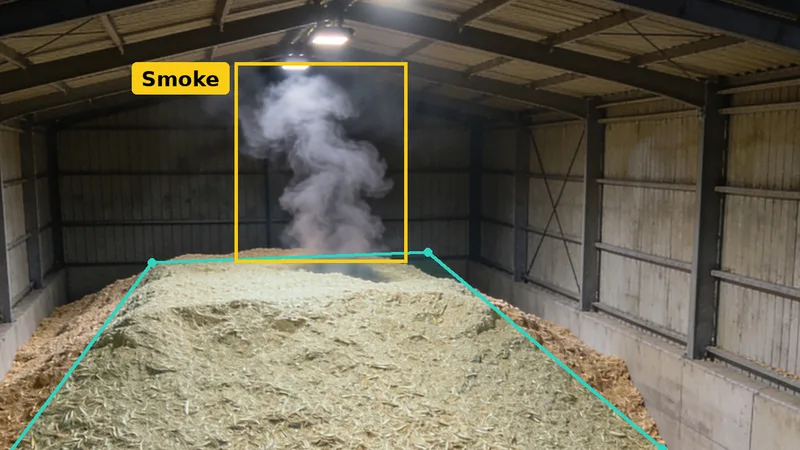
Last updated 31 October 2026. A biomass boiler is only as safe as the fuel that feeds it. Behind every boiler there is a store of wood chip, pellets or logs: a bunker under a walking floor, a pellet silo, a hopper, or a row of covered bays in the yard. That store holds a lot of dry, burnable material, often in a building nobody visits between deliveries. This page explains how fuel store fires start, what the official guidance says, where cameras should look, and how AI smoke and fire detection on your existing CCTV fits alongside your fire alarm, your boiler’s own protection and good housekeeping.
Who needs to think about biomass fuel store fires?
More sites than most people expect. Ofgem’s annual report on the Non-Domestic Renewable Heat Incentive shows 22,638 accredited installations in Great Britain as at 31 March 2026. Of those, 17,419 were solid biomass boilers, about 77% of the total, with 4,640 MW of capacity between them. The scheme is closed to new applicants, so those figures do not include boilers fitted outside it.
Those boilers heat country estates, farms, schools, care homes, hotels, sawmills, factories, leisure centres and district heat networks. Some are small, with a pellet hopper next to the boiler. Others burn thousands of tonnes of chip a year and take deliveries by the lorry load. Fuel suppliers, wood yards and processors that make chip and pellets hold even more.
Across all of them, the same pattern repeats. The fuel store is close to the boiler, it is full of combustible material, and it is quiet for long stretches. Staff come in to check the boiler or take a delivery, then leave. If a heap starts to smoulder at two in the morning on a Sunday, there may be nobody on site to notice for hours.
How do biomass fuel stores catch fire?
Four causes come up again and again in the official guidance and in fire safety advice for biomass sites.
- Self-heating. Wood chip and other biomass keep changing after they are cut. Moisture, microbes and slow chemical reactions produce heat. In a large or tall heap, especially of damp material, that heat cannot escape, and the inside of the pile warms up over days or weeks. The HSE’s guidance on wood pellet fuel says bulk piles with high moisture content can self-heat and, after a long period, combust spontaneously.
- Dust. Handling pellets and chip wears them down into fine dust. Forest Research notes that pellet abrasion creates fine dust and the risk of an explosive mixture. The HSE says pellets are combustible and that dispersed dust can cause a dust explosion.
- Burn-back. On an automatic boiler, fuel travels from the store along a screw or conveyor. If fire travels back from the boiler along that feed, it can reach the store. Boilers have burn-back protection for this reason, and it needs to be maintained.
- Hot ash. Ash from the boiler can hold heat for a long time after it looks cold. Emptied into the wrong container, or too close to a building, it can set fire to bins, skips or the building itself.
Arson and carelessness add to this. An open-fronted bay in a farmyard, or a pellet store behind a school, is easy to reach. A dropped cigarette, a hot works job on the plant room, or a fire set deliberately can all start in or next to the fuel. Our guide to hot works fire risk covers the maintenance side.
What does the official guidance say?
There is no single rulebook for biomass fuel stores. Several pieces of guidance apply, depending on the size of the site and what it does.
- Fire safety law. In England and Wales, the person responsible for a workplace must carry out a fire risk assessment, put fire precautions in place and plan for emergencies. GOV.UK’s page on workplace fire safety sets out those duties. Scotland and Northern Ireland have their own equivalent law.
- Dust and explosive atmospheres. The Dangerous Substances and Explosive Atmospheres Regulations 2002 (DSEAR) cover combustible dusts as well as gases and liquids. Employers must identify dangerous substances, assess the risks, put controls in place and prepare for emergencies.
- Confined spaces and carbon monoxide. The HSE explains that pellets give off carbon monoxide as they oxidise, so an enclosed pellet hopper or silo can become low in oxygen and toxic. It describes one sealed ship’s hold where carbon monoxide reached about 1% and oxygen fell below 1% within 18 days of loading. That makes some fuel stores confined spaces.
- Storage. Forest Research advises good air flow to stop temperatures building, turning large stores regularly, and, citing US and Danish advice, keeping chip heaps below 8 to 10 metres high.
- Insurers. RISCAuthority, the research scheme run by the Fire Protection Association for UK insurers, publishes RC64, Recommendations for fire safety with small biomass installations. It covers the selection, storage, handling and use of biomass fuels.
Insurer guidance for biomass boilers commonly covers the same practical points: separating the fuel store from the boiler and from other buildings, maintaining burn-back protection, emptying ash into lidded metal containers kept away from buildings, turning chip stores, and fitting fire detection designed to BS 5839-1. Ask your own insurer which of these apply to your policy. Our guide to insurer expectations on fire detection covers the wider picture.
Do you need a fire prevention plan for a biomass store?
Only some sites do. If you hold an environmental permit and store combustible waste, the Environment Agency’s fire prevention plan guidance applies in England. That guidance lists biomass among the combustible wastes it covers, and it is the reason many wood recycling and fuel processing sites have a plan.
For those sites, the guidance says combustible waste should be stored for no longer than six months. Where piles at the maximum size are kept for more than three months, it expects extra measures to manage self-combustion, such as temperature monitoring. It also defines self-combustion and sets out pile sizes, separation distances and the detection the plan must describe.
A school or hotel burning clean virgin wood chip in its own boiler is usually not a permitted waste site, so the plan rules do not apply directly. The principles are still useful: keep stock rotating, keep heaps a sensible size, check temperatures in big stores, and have a way of spotting a fire early. If your site does need a plan, our fire prevention plan detection template and our guide to EA fire prevention plan detection requirements explain how camera detection is described in one.
Where should cameras watch on a biomass site?
Start with the places fire starts, then the places people get in. On most boiler sites that means six areas. Choose one to see what the camera watches and why.
Which part of the site?
The bunker or silo is where most of the fuel sits, and where self-heating has time to build. A camera high on the wall, looking along the heap, watches the surface for smoke. The zone is drawn round the heap and between the push walls, so dust kicked up at the delivery door or the walking floor is left out. Fuel stores are often shut for days at a time, which is exactly when an early clip matters.
Smoke and fire, 24/7
The fuel feed, the screw or conveyor that carries chip or pellet from the store to the boiler, is where burn-back happens if fire travels back from the boiler. Your boiler’s own burn-back protection is the main defence. A camera over the feed and the hopper adds a second pair of eyes: smoke at a joint, a glow at the hopper, or smoke building in the plant room.
Smoke at the feed
Many estates and farms dry chip and logs in open-fronted bays. Each bay gets its own zone, so you know which heap the smoke is coming from, and roads, roofs and trees are left out. Outdoor bays bring mist, rain and steam off fresh fuel; self-learning means the system learns what is normal on each camera.
Each bay, its own zone
Hot ash is one of the simplest ways for a biomass site to catch fire. Ash that looks cold can hold heat for a long time. Lidded metal bins, kept well away from buildings, are the rule; a zone round the ash pad means smoke from a bin left open, or emptied too soon, is flagged straight away.
Smoke from the bins
Fuel stores attract the curious and the careless as well as thieves: a cigarette dropped by a trespasser, a fire set in a bay, or tools taken from the plant room. A line along the gate and an intrusion zone on the yard, armed at night, tell you when someone is there who should not be.
People after hours
Each area runs its own detections and its own schedule. Smoke and fire run day and night.
Not every site has all six. A small pellet boiler may have a hopper and an ash bin and nothing else. A large chip-fired heat network may have a reception hall, a walking-floor bunker, a conveyor gallery and an outdoor stockpile. The principle is the same: a camera that can see each place a fire could start, with a zone drawn round it.
Two practical points about placement. First, smoke rises, so cameras mounted high and looking across or down the heap see it earliest. Second, the camera needs to see the surface of the fuel, not just the door. A camera on the outside wall pointing at a closed bunker door will not see a smouldering heap inside.
Does AI smoke detection replace a fire alarm in a fuel store?
No. A fire alarm system designed to BS 5839-1 is a certified life-safety system, and your fire risk assessment and insurer decide what you need. AI smoke and fire detection on CCTV is an extra layer of early warning. It does not replace the alarm, the boiler’s burn-back protection, sprinklers or suppression where fitted, or temperature probes in large heaps.
Each layer sees something different:
- The fire alarm senses smoke or heat at the detector head, inside the building. In a tall bunker or an open-fronted bay, smoke can take time to reach a detector, or drift away before it does.
- Temperature probes in the heap see heat building inside the pile, often well before any smoke reaches the surface. For large stores held for a long time, they are the right tool for self-heating.
- AI on your CCTV sees visible smoke and flame anywhere a camera can see, indoors or out, and sends you the clip. It covers outdoor bays, ash areas and yards where an alarm detector cannot work.
Being honest about the limits matters here. A camera cannot see heat building deep inside a heap. It sees smoke when it reaches the surface, and flame when it appears. That is still often much earlier than anyone on site would notice, especially at night or at the weekend, and the clip tells you straight away whether it is steam off fresh fuel, dust from a delivery, or real smoke.
Can you use the cameras you already have?
Usually, yes. Many biomass sites already have CCTV, fitted for security or to watch deliveries, recording to a box that is only checked after something has happened. Woodcock AI connects to IP cameras and recorders over RTSP or ONVIF, including Hikvision and most other mainstream makes, and detection runs on an edge server on site or on a cloud server.
Where a store has a dust hazard, camera placement is a job for your installer and your DSEAR assessment. In many stores the simplest answer is to mount the camera outside the zoned area, looking in through an opening or across from a wall. Where a camera has to go inside a zoned area, your installer chooses equipment rated for that zone. Woodcock AI works with the stream from whichever camera they fit.
When smoke or flame appears inside a zone, you get an alert in the app with a short clip, and an email. A detection can also trigger a siren on site, and an alarm receiving centre (ARC) can follow your response plan if you use one. See smoke and fire detection cameras for how detection works across sites.
What makes Woodcock AI suited to a fuel store?
Three things matter most on biomass sites:
- Polygon detection zones. You draw the exact shape each camera should watch: the top of the heap, the feed and hopper, each bay, the ash pad. Flues, roads, delivery doors and the sky are left out. See polygon detection zones.
- Self-learning. Fuel stores are dusty, outdoor bays get mist and rain, and fresh chip can steam on a cold morning. The system learns what is normal on each camera, which cuts the false alerts that make people stop looking.
- Years of development, now in use. Woodcock AI has been developed over several years and is in use today on working waste, recycling and industrial sites, where combustible stockpiles are the daily risk.
Wood recycling sites face the same stockpile risks at a larger scale; our wood recycling page covers them, and green waste and composting covers self-heating in windrows.
Can the same cameras help with safety by day?
Yes. On larger sites, a loading shovel or telehandler moves fuel from the bays to the bunker, lorries tip deliveries, and staff work on foot around them. In working hours, PPE (hard hats & hi-vis) detection can check the zones you choose, such as the tipping apron or the bay fronts.

That gives each camera two jobs. At night it watches the fuel for smoke. By day it helps you check that site rules are followed where people and plant mix. Smoke and fire detection carries on in the background either way.
How do schedules work around deliveries and boiler checks?
Each camera has its own schedule, and each detection type on that camera can follow it.
- Smoke and fire on the bunker, feed, bays and ash area run around the clock. Fires do not keep office hours.
- People and vehicles on the yard and gate arm in the evening and stay armed until the first person is due, and all weekend on a site that is shut. See intrusion detection, line-crossing detection and vehicle detection.
- PPE runs in working hours on the zones where staff and plant mix.
You change the hours in the app whenever the routine changes, such as during the heating season, when deliveries are more frequent, or over a holiday shutdown, when the store sits full and unattended.
What should happen when smoke is seen in the store?
Plan the response before you need it. The alert is only useful if the right person sees it and knows what to do.
- Who gets the alert. Pick the keyholders for each area and time of day. The boiler engineer may want the plant room; the site manager may want everything.
- What they check. The clip shows in seconds whether it is steam, dust or smoke. If it is smoke, call 999 and follow your fire plan.
- Who goes in. Nobody should enter an enclosed fuel store alone or without the right precautions. The HSE’s confined space guidance applies, and a smouldering store can hold carbon monoxide. Leave it to the fire service.
- What the fire service needs. Where the store is, what fuel it holds, how much, and where the isolation points for the boiler and feed are.
Our guide to outdoor fire detection covers detection on yards and stockpiles in the open, and the farm CCTV page covers barns, straw and silage on farms with biomass boilers.
What are the limits?
- A camera needs a view. It cannot see inside a sealed silo, behind a closed door or deep inside a heap. Placement decides what it can see.
- It sees smoke at the surface. Self-heating inside a heap is best caught by temperature probes and good stock rotation.
- It is not a certified alarm. It adds early warning. It does not replace your fire alarm, burn-back protection, suppression or your insurer’s requirements.
- Steam and dust can look like smoke. Tight zones and self-learning keep false alerts down, and the clip makes the rest quick to check.
- Alerts need a connection. The app and email need internet to reach phones, so we check the connection in the site assessment.
We also have a feature for asking your cameras questions on the way: Ask your cameras is coming soon, early 2027. Everything else on this page is available now.
Sources
- Ofgem, Non-Domestic Renewable Heat Incentive Scheme Year 15 Annual Report (2026).
- HSE, Wood pellet bio-fuel (confined spaces).
- HSE, Dangerous Substances and Explosive Atmospheres Regulations (DSEAR).
- Forest Research, Woodfuel storage.
- Environment Agency, Fire prevention plans: environmental permits.
- RISCAuthority (Fire Protection Association), RC64: Recommendations for fire safety with small biomass installations (2019).
- GOV.UK, Workplace fire safety: your responsibilities.
We have summarised these sources in our own words. Always read the current versions. This page is general guidance, not fire engineering or legal advice; your fire risk assessment, DSEAR assessment and insurer decide what your site needs.
Want early warning on your fuel store?
Book a site assessment and we will look at the cameras you already have over the bunker, feed, bays, ash area and yard, and plan zones, schedules and who gets which alert. Or ask for a live test on your cameras first: we connect two or three of them for about a fortnight.
Related pages
Frequently asked questions
What causes fires in biomass fuel stores?
The main causes are self-heating in large or damp heaps, combustible dust from handling pellets and chip, burn-back from the boiler along the fuel feed, and hot ash. Arson and hot works add to the risk.
Can wood chip catch fire on its own?
Yes. The HSE says bulk piles with high moisture content can self-heat and, after a long period, combust spontaneously. Forest Research advises air flow, turning large stores and keeping chip heaps below 8 to 10 metres high.
Does AI smoke detection replace a fire alarm in a biomass store?
No. A fire alarm designed to BS 5839-1, burn-back protection and temperature probes in large heaps stay in place. AI smoke and fire detection on CCTV adds early warning and sends the clip to your phone.
Do biomass stores need a fire prevention plan?
Only sites with an environmental permit that store combustible waste, which the Environment Agency guidance says includes biomass. Those sites must follow its storage times, pile sizes and detection rules.
Can cameras go inside a dusty fuel store?
That depends on your DSEAR assessment. Often the camera is mounted outside the zoned area looking in; where it must go inside, your installer chooses equipment rated for that zone. Woodcock AI works with the stream from either.
Can Woodcock AI use our existing CCTV?
Usually, yes. It connects to IP cameras and recorders over RTSP or ONVIF, including Hikvision, and runs on an edge server on site or on a cloud server.
Last reviewed 31 October 2026