

Fire detection for wood recycling yards
Wood recycling yards need fire detection that works day and night, because stockpiles can self-heat and fires often start after the site has closed. EA rules and Wood Recyclers’ Association guidance list CCTV visual flame detection as an option alongside temperature checks. Woodcock AI adds smoke and fire detection to the CCTV you already have.

Last updated 30 October 2026. Waste wood is one of the most common combustible wastes on permitted sites, and the rules for storing it are some of the most detailed. This page explains what the Environment Agency and the Wood Recyclers’ Association (WRA) ask of wood recycling yards and wood chip stores, where fires tend to start, and how camera-based smoke and fire detection fits into your fire prevention plan (FPP).
Why do wood recycling yards catch fire?
Waste wood is dry, bulky and stored in large volumes, and once a stack is burning deep inside it is very hard to put out. The WRA’s guide to writing waste wood fire prevention plans (March 2020), produced in consultation with the Environment Agency, the National Fire Chiefs Council and the WISH Forum, asks operators to plan for several separate ignition routes:
- Self-heating. Some wood can heat up on its own when it generates heat faster than the heat can escape. Left alone, the temperature keeps rising until the material ignites. Fine fractions and long storage times make this more likely.
- Hot plant. Dust and fines settle on hot exhausts and engine parts. The guide singles out the hour after plant and machinery are switched off as a high-risk time.
- Arson and vandalism. Security measures such as fencing, intruder alarms and CCTV must cover the hours when the site is closed.
- Hot works. Welding and cutting need a permit to work and a fire watch for a suitable period afterwards.
- Contaminants in the waste. Gas canisters and batteries arriving mixed in with wood need to be identified and kept away from the stacks.
Several of these routes have one thing in common: the fire starts when nobody is watching. That is why the detection section of a wood yard FPP matters so much, and why it has to work outside working hours as well as during them. Our waste site fire risk assessment guide walks through how to assess each area of the yard.
What do the EA rules say about storing waste wood?
If your permit requires a fire prevention plan, the Environment Agency’s fire prevention plans guidance sets the standard measures. For wood, the key ones are maximum stack volumes by fraction size, a maximum stack height of 4 metres, and a separation distance of at least 6 metres between stacks and from the site boundary, buildings and other combustible materials. Many smaller wood treatment sites operate under the SR2022 No 8 standard rules for waste wood treatment, which write similar limits directly into the permit.
Standard maximum stack volume for waste wood
Pallets, boards and demolition timber before crushing. Stacks no higher than 4 metres and at least 6 metres apart, unless your plan justifies alternative measures.
Pre-crushed wood and coarse chip. Stacks no higher than 4 metres and at least 6 metres apart, unless your plan justifies alternative measures.
Fine chip, sawdust and fines, the fraction most prone to self-heating. Stacks no higher than 4 metres and at least 6 metres apart, unless your plan justifies alternative measures.
From the EA fire prevention plan guidance (section 9.2) and the SR2022 No 8 standard rules. Your own permit may set different limits.
The SR2022 No 8 standard rules also require weekly monitoring of the surface and internal temperature of each stack, temperature monitoring when loads are first deposited, and trained staff able to access the site and move wood within 30 minutes of the detection of smoke or a fire. That last condition is easy to overlook: detection is only useful if it reaches someone who can get to the yard in time.

The WRA guide also reminds operators that waste wood should not be stored for more than 6 months, that stock must be rotated on a first in, first out basis, and that you need a clear way of recording what is stored where. Good records make it much easier to show your regulator that the stack sizes on your site plan match what is actually in the yard.
What changed in the WRA’s 2025 guidance?
In September 2025 the WRA published updated FPP guidance for waste wood storage sites, reviewed by the Environment Agency’s senior fire adviser. The WRA said in its launch announcement (15 September 2025) that the update followed a sharp fall in fires at waste wood sites and an increase in bespoke permits that are more flexible than standard FPPs. The guidance sets out alternative measures that have been agreed in approved plans since 2019:
| Topic | WRA FPP guide (2020) | Agreed alternatives (2025 update) |
|---|---|---|
| Stack height, unprocessed or pre-crushed | 4 metres | Up to 6 to 8 metres with enhanced controls such as continuous thermal monitoring |
| Separation | 6 metres between stacks | Reduced (3 to 4 metres in some cases) with fire-resistant barriers or walls and enhanced detection and suppression; none needed for a 2-hour firewall |
| Storage time | 1 month unless turned or processed | 3 to 6 months with temperature monitoring and increased stock rotation |
| Fire detection | Visual checks, alarm systems, smoke detectors | Thermal imaging, automated alerts, 24/7 monitoring; CCTV may also be suitable, as may recorded physical checks or remote monitoring |
| Suppression | Extinguishers, hydrants | Sprinklers, water cannons and automated suppression, especially when linked to an automatic monitoring system |
The pattern is clear. Wherever an approved plan relaxes a standard measure, it does so by adding better detection, monitoring or suppression. The WRA also notes that creating fire breaks in a burning stockpile depends on prompt detection and intervention, especially outside operational hours, and that detection systems should be documented and supported by the manufacturer for out-of-hours response. Alternative measures still have to meet the three FPP objectives: minimise the likelihood of a fire, aim to put any fire out within 4 hours, and stop it spreading.
Talk to your regulator first. The WRA recommends engaging early with the Environment Agency and your local fire and rescue service before relying on alternative measures. Every site is assessed on its own risks, so what was approved elsewhere may not be accepted for yours.
What fire detection does a wood yard need?
Section 13 of the EA guidance says you must have procedures to detect a fire in its early stages, and your plan must show how the detection system raises the alarm both during working hours and when the site is closed. It must be proportionate to your activities and risks, and it can be automated or manual. The examples of appropriate automated systems are smoke and heat detectors including temperature probes, CCTV visual flame detection systems, and spark, infrared and ultraviolet detection. Design, installation and maintenance must be covered by an appropriate third-party certification scheme (such as UKAS) or meet a recognised standard, and if neither applies you must show you can still meet the three objectives. Our guide to EA fire prevention plan detection requirements covers this section in full.
For waste wood, no single method covers everything, because the two main risks show up in different places:
- Heat inside a stack builds slowly and out of sight. The WRA guide says you need to monitor the whole pile, not just the surface, for example with a probe that takes readings from inside it, and suggests assuming a trigger temperature of 50°C unless you have specific evidence for another figure.
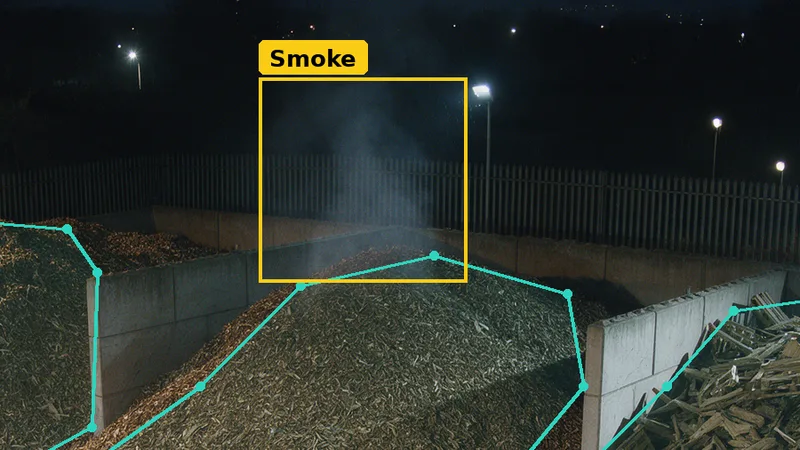
- Smoke and flame appear at the surface, often at night, and can start anywhere: on a stack, at the shredder, at the fence line or in a skip of rejects. A camera watching the yard sees all of these at once.
A practical detection section for a wood yard therefore combines regular temperature monitoring of the stacks, camera smoke and flame detection across the yard, a recorded fire watch after plant is switched off, and a response plan that gets trained staff to the wood within 30 minutes. If you store wood indoors, the same detection duty applies: the WRA guide points out that detection is required whether you operate inside or outside.
How do you catch a fire after the yard has closed?
Most wood yards are busiest in the day and empty at night. The risky moments are the hour after the shredder and loading shovels stop, and the long hours when the gate is locked. A fire watch at close-down covers the first. For the rest, you need something that keeps watching and tells a person straight away.

With camera-based detection, each stack, bay and machine parking area can be its own detection zone. When smoke or flame appears in a zone, the alert goes to the duty keyholder’s phone with a short clip, so they can see what is happening before they set off. Email alerts go to the wider duty list, and an alarm receiving centre (ARC) can be added for sites where nobody is on call overnight. Our out-of-hours site security checklist covers the security side of a closed site.
How quickly do you need to respond?
Under the SR2022 No 8 standard rules, trained staff must be able to access the site, plant and machinery and move wood as necessary within 30 minutes of the detection of smoke or a fire. Bespoke permits set out their own response arrangements in the FPP, and the EA guidance aims for any fire to be put out within 4 hours. Either way, the clock starts when the fire is detected, so detection that only works while staff are on site is not enough.
Write the response into the plan with names, roles and travel times: who receives the alert, who goes to site, how they get in, what plant they use to pull a burning section away, and where the quarantine area is. The WRA guide also asks you to have a hot spot procedure for stacks that are heating up, starting with a risk assessment and moving on to closer monitoring, isolating the affected material, or cooling it in place or in the quarantine area. Our fire prevention plan checklist and FPP detection template help you get this down on paper.
What about wood chip stores and indoor fuel bays?
Wood chip made for biomass fuel is often held in open-fronted sheds or bunkers before it leaves site. The same principles apply: limit how much you store and for how long, monitor temperature, keep plant and ignition sources away, and make sure detection reaches someone when the building is empty. Inside a shed, a camera watching the face of the pile can see smoke building in the roof space and flame on the surface, and polygon detection areas let you watch the pile without alerting on lights or vehicles at the door.

Check your insurer’s requirements too. Many insurers have their own expectations for detection and suppression in combustible waste stores; our guide to whether your insurer requires fire detection CCTV explains what to ask.
Where does Woodcock AI fit on a wood yard?
Woodcock AI turns the CCTV you already have into AI smoke and fire detection. It connects to your existing cameras or recorder over ONVIF or RTSP, so the cameras that already overlook your stacks, bays and shredder can start watching for smoke and flame without being replaced.
- Polygon detection areas. Draw a shape that follows the edge of each stack, bay or machine parking area, so every alert names the area on your FPP site plan. See polygon detection zones.
- Self-learning, fitted to each scene. Each camera’s model is fitted to its own view and learns from that site’s normal footage, which matters in a yard full of dust, drizzle, floodlight glare and moving plant. Read about our self-learning AI.
- Years of development, in use today. Woodcock AI has been developed over several years and runs on real UK waste and industrial sites.
- Alerts that reach a keyholder. App alerts with a clip and email as standard, with an alarm receiving centre (ARC) as an optional add-on. Per-camera schedules keep smoke and fire detection on around the clock, with intrusion or line-crossing alerts on the fence once the site is closed.
- Records for your plan. Each alert keeps its time, area and clip, and we run smoke tests on site at commissioning so you have evidence that the system works on your cameras.
Camera detection does not replace temperature monitoring of your stacks, and it does not replace a life-safety fire alarm. It adds a layer that watches the whole yard, all night, and tells someone straight away. For how it works in detail, see our AI smoke and fire detection camera page and our guide to video smoke detection on existing CCTV. For other waste sites, see AI CCTV for waste and recycling, waste transfer stations and recycling plants.
Which sources is this page based on?
- GOV.UK, Environment Agency, Fire prevention plans: environmental permits (last updated 11 January 2021; checked 30 October 2026).
- GOV.UK, Environment Agency, SR2022 No 8: generic risk assessment, waste wood treatment (checked 30 October 2026).
- Wood Recyclers’ Association, Writing waste wood fire prevention plans (March 2020).
- Wood Recyclers’ Association, Updated FPP guidance for waste wood storage sites (September 2025) and launch announcement (15 September 2025).
- WISH Forum, WASTE 28: Reducing fire risk at waste management sites (issue 3, March 2020).
We have summarised these documents in our own words. Always read the current versions and follow your permit. This page is general guidance, not legal or regulatory advice; your regulator decides what is acceptable for your site.
Running a wood recycling yard or wood chip store?
Book a site assessment and we will look at your cameras, the stacks and bays your plan covers, and how alerts should reach your keyholders. Or ask for a live test on your cameras first: we connect two or three of them for about a fortnight.
Related pages
Frequently asked questions
Is CCTV acceptable fire detection for a waste wood FPP?
It can be part of it. The EA fire prevention plan guidance lists CCTV visual flame detection systems among appropriate automated systems, and the WRA’s 2025 guidance says CCTV may be suitable alongside thermal imaging and monitoring. Your plan must show the system suits your site and meets the certification wording, so check with your regulator.
What is the maximum stack height for waste wood?
Under the EA standard measures and the SR2022 No 8 standard rules, 4 metres. The WRA’s 2025 guidance notes that some approved plans allow 6 to 8 metres for unprocessed or pre-crushed wood with enhanced controls such as continuous thermal monitoring, reduced storage times and better suppression.
How far apart should wood stacks be?
At least 6 metres from each other and from the site boundary, buildings and other combustible materials, unless an appropriate fire wall is used. The WRA’s 2025 guidance says some approved plans have reduced this to 3 to 4 metres with fire-resistant barriers and enhanced detection and suppression.
Can a camera detect self-heating inside a wood stack?
No. Heat deep inside a stack is not visible to an ordinary camera, which is why the guidance asks for temperature monitoring of the whole pile, for example with probes. A camera sees smoke and flame once they reach the surface, and watches every stack at once, day and night.
How fast must staff respond to smoke at a wood yard?
Under the SR2022 No 8 standard rules, trained staff must be able to access the site and move wood within 30 minutes of the detection of smoke or a fire. Bespoke permits set their own arrangements in the FPP, which aims for any fire to be put out within 4 hours.
Does Woodcock AI need new cameras?
Usually not. Woodcock AI connects to existing cameras or recorders over ONVIF or RTSP. At a site assessment we check whether your current views cover the stacks, bays and machine areas in your plan, and suggest extra cameras only where there are gaps.
Last reviewed 30 October 2026
Also storing tyres? See fire detection for tyre recycling sites.