

WEEE recycling CCTV that spots battery fires and yard intruders
A WEEE recycling site with AI CCTV gets an alert with the clip, in the app and by email, the moment cameras see smoke or flame at a small appliance bay, the shredder infeed or the battery quarantine area, and when people or vehicles enter the yard out of hours. It works on most existing IP cameras.

Last updated 30 October 2026. Waste electrical and electronic equipment is one of the hardest waste streams to keep from catching fire. Kettles, toasters, vapes, laptops, power tools, toys and phones arrive mixed together, and many still hold a lithium-ion battery that nobody removed. Crush one in a cage, a loader bucket or a shredder and it can start a fire in seconds. At the same time, the metal in fridges, cookers and cable makes WEEE yards a target for theft after dark. This page explains what AI CCTV does on a WEEE site, where to point cameras, how it fits your fire prevention plan and permit, and what it cannot do.
What does AI CCTV do on a WEEE recycling site?
An ordinary CCTV system records. Someone has to watch it live, or look back after something has gone wrong. A CCTV system with AI detection checks every frame for you and tells you when something matters, while it is happening.
Woodcock AI connects to IP cameras over RTSP or ONVIF, including cameras most WEEE sites already have, and runs detection on an edge server on site or on a cloud server. On a WEEE site, the detections that matter most are:
- Smoke and fire at small mixed WEEE bays, cages and stillages, the shredder and its conveyors, the battery quarantine area, baled plastics and the dismantling hall. See smoke and fire detection cameras.
- Intrusion: a person inside a zone you have drawn, such as the fridge yard or a cable store, during the hours you choose. See intrusion detection.
- Line crossing: someone crossing a line you draw across a gate, a fence or the mouth of a bay. See line-crossing detection.
- Vehicles: a van or car coming in or going out after hours. See vehicle detection.
- PPE (hard hats & hi-vis) at the tipping floor and the dismantling benches, by day.
When a detection happens inside a zone and inside its schedule, you get an alert in the app with a short clip, and an email. The clip is what makes it useful. A message that says “motion on camera 4” at 2am means a drive to site. A clip shows you in seconds whether it is smoke from a pile of small appliances, a fox, or a van in the yard.
Three things set Woodcock AI apart, and they matter more on a WEEE site than almost anywhere else:
- Polygon detection zones. You draw the exact shape each camera should watch: the bay, the hopper, the quarantine cage, the gateway. Anything outside the shape, such as the tipping floor or the road beyond the fence, is ignored. See polygon detection zones.
- Self-learning. Every WEEE site has its own dust, sparks from cutting, headlights and steam. The system learns what is normal for each camera, which cuts the false alerts that make people stop looking.
- Years of development, now in use. Woodcock AI has been developed over several years and is in use on working waste, recycling and industrial sites today.
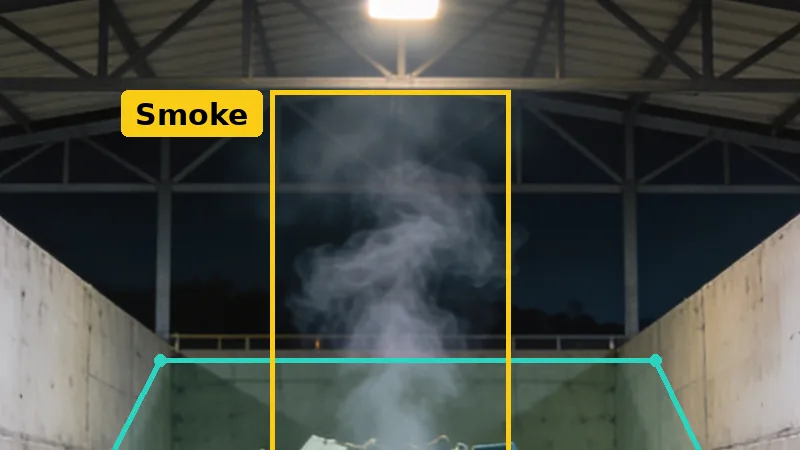
About the picture above. It shows how an alert looks on a small mixed WEEE bay at night: a teal zone drawn round the pile, and the smoke boxed and labelled. The phone shows the alert as it arrives, with the clip and a short AI description.
Why do WEEE sites have so many fires?
The short answer is hidden batteries. Small electricals, vapes and toys often reach a recycling site with the battery still inside. A lithium-ion cell that is crushed, punctured or shorted can heat up very quickly, vent flammable gas and set light to the plastics around it. WEEE is full of plastics, so a small battery fire in a cage can become a bay fire, and a bay fire can reach the building.
The numbers have risen year after year. Data from Environmental Services Association members, published by the National Fire Chiefs Council, showed the share of their fires caused or suspected to be caused by lithium-ion batteries rising from 21% in 2016-17 to 38% of 670 fires in 2019-20. A 2021 report for the ESA by Eunomia put lithium-ion batteries behind about 48% of waste fires in the UK, around 201 fires a year, at an estimated cost of about 158 million pounds a year.
More recent figures point the same way. Material Focus reported in May 2024 that there had been over 1,200 battery fires in bin lorries and waste sites across the UK in the previous year, up 71% from around 700 in 2022, and that 94% of councils responding said these fires were increasing. It estimated that 1.1 billion electrical items with hidden lithium-ion batteries are thrown away each year.
Those figures cover the whole waste industry, not only WEEE sites. But WEEE sites are where many of those hidden batteries end up, so they sit at the sharp end of the problem. The point of AI CCTV is not to stop batteries arriving. It is to tell you within moments when one starts a fire, so a small fire can be dealt with safely before it becomes a big one.
What do the EA fire prevention plan and WEEE appropriate measures expect?
Most permitted WEEE treatment sites in England need a fire prevention plan that meets the Environment Agency’s fire prevention plan guidance. The guidance applies to WEEE, and says it covers all WEEE including any batteries inside it. For WEEE that contains plastics, it sets a maximum pile volume of 450 cubic metres, and like other combustible wastes, piles should be no more than 4 metres high and 20 metres long or wide. It expects combustible waste to be moved on within six months, a quarantine area for burning or suspect loads, and a plan for how a fire will be detected and dealt with.
The Environment Agency’s WEEE appropriate measures for permitted facilities go further on storage and handling. In the storage, segregation and handling section, they expect batteries removed from WEEE to be stored separately in suitable containers, such as leakproof, lidded and labelled ones, lithium-ion batteries to be recognised as a fire hazard, and maximum storage capacity to be set and kept to as pile sizes and tonnages.
Batteries must also come out before treatment. The WEEE evidence and national protocols guidance says batteries must be removed before items are treated, and the regulatory position statement RPS 295 covers removing batteries, plugs and power cables from WEEE at household waste recycling centres. In practice some batteries still slip through, hidden inside toys, vapes and sealed devices. That is why the shredder and the small WEEE bays need watching.
Where does AI CCTV fit? The fire prevention plan guidance asks you to show how you will detect a fire, and how quickly, in the areas where waste is stored and treated, including out of hours. Camera detection can be part of that answer, alongside the measures the guidance expects, such as pile limits, separation, quarantine and suppression. It is not a certified fire alarm and does not replace any detection your permit or fire risk assessment requires. Your plan should say what each system does. See our guides to EA FPP fire detection requirements and the fire prevention plan checklist.
Which parts of a WEEE site should AI cameras watch?
Start with the places a hidden battery is most likely to start a fire, then the things a thief would come for. On most WEEE sites that means the small mixed WEEE bays, the shredder infeed, the battery quarantine area, the fridge and large appliance yard, and the gate. Pick one to see how a camera is set up for it.
Which part of the site are you checking?
Shredders and the conveyors that feed them are where a missed battery is most likely to be crushed and catch fire. A zone on the hopper and the first part of the belt, with smoke detection on day and night, reports smoke there with the clip. Keep the zone off the tipping floor, where dust from loading would otherwise be in view.
Smoke, around the clock
Removed batteries wait in lidded, labelled containers before they leave site. A camera on the cage watches for smoke all the time and for people out of hours. If a damaged cell starts to vent, the alert names the cage and carries the clip, so the right person can check it and follow the fire plan.
Smoke and people
Fridges, freezers, washing machines and cookers are stored outside in rows, often near the fence. They attract theft for scrap metal. An intrusion zone on the yard, armed after work stops, reports a person among the rows with the clip.
People after hours
Most thefts need a vehicle. Vehicle detection on the gateway, armed at night, reports a van coming in or going out, and a line across the gate reports anyone crossing on foot. Keep plates readable on a separate camera if you need them for the police.
Vehicles and line crossing
In working hours the same camera can switch from fire to safety. PPE (hard hats & hi-vis) detection checks the zones you choose, such as the dismantling benches or the tipping floor, on a daytime schedule.
PPE checks by day
Drawn from Environment Agency guidance for WEEE sites. Your permit, fire prevention plan and insurer decide what is right for your site.
Not every site needs every camera. A small site that bulks and sends on small WEEE may only need the bays, the quarantine area and the gate. A large treatment plant may need the shredder line, the picking cabins, baled plastics, the fridge plant and several gates. In a site assessment we walk the site with you, look at the cameras you already have, and suggest extra cameras only where there are gaps.
How do you watch small mixed WEEE bays and cages?
Small mixed WEEE is the stream most likely to hide a battery. It is also where a fire has the most to burn, because the items are mostly plastic. A camera looking along a bay, or across a row of cages and stillages, can see smoke as soon as it escapes from the pile.
- Draw the zone round the pile, not the floor. A polygon that follows the top and sides of the pile means smoke there is reported, and a loader driving past is not.
- Keep smoke detection on at all hours. Battery fires do not wait for night. Some start when a load is tipped or moved; others start hours later in a quiet bay.
- Look along, not straight down. Mounting the camera high and looking along the bay gives the best view of smoke rising above the pile, and keeps the lens out of the worst of the dust.
- Give it some light at night. Most modern cameras have infrared or colour night vision. Hikvision ColorVu cameras give a colour picture in low light, which helps smoke detection after dark. See Hikvision smoke detection cameras.
Good housekeeping still does most of the work. Keep piles within the limits in your plan, keep the separation distances clear, and move small WEEE on regularly. The camera is the eye that never sleeps, so that if something does catch, someone knows straight away.
Can AI CCTV spot a fire at the shredder?
Yes, once the fire shows itself as smoke or flame a camera can see. The shredder and its infeed conveyor are where a missed battery is most likely to be crushed. A camera on the hopper and the first part of the belt watches for smoke day and night and reports it with the clip, whether the line is running or stopped.
Two points make shredder cameras work well. First, keep the zone tight, on the hopper and belt rather than the tipping area, so loading dust stays out of view. Second, think about what happens next. A detection can trigger a siren on site and link to a fire panel, so the warning reaches the hall as well as phones. Your fire plan should say who stops the line, who checks, and when to call 999.
A camera cannot see inside the shredder chamber or under a conveyor cover. If your line has suppression or detection fitted inside, the camera adds a view of the infeed and the area around the machine, and a clip that shows how the fire started. That clip is useful for your own review and for your insurer.
How should a battery quarantine area be watched?
The appropriate measures expect removed batteries to be stored separately in suitable containers. That is usually a cage or bunded area with lidded, labelled bins and drums, away from the main piles. It is also one of the places on site most likely to see a fire, because a damaged or poorly packed cell can heat up and vent some time after it was removed.
A camera on the quarantine area should run smoke detection around the clock, and intrusion after hours, because nobody should be in there at night. The zone should follow the cage, so traffic on the yard outside is ignored. If a bin starts to smoke, the alert names the area and carries the clip, so the right person can check from their phone before deciding what to do.
Our lithium-ion battery fires page covers how battery fires start and spread on waste sites, and the lithium-ion battery storage guide covers storage layouts, charging and separation in more detail.
How do per-camera schedules work on a WEEE site?
A WEEE site is busy by day and empty by night. Some areas need watching for fire all the time. Others only matter out of hours. With Woodcock AI, each camera has its own schedule, and each detection type on that camera can follow it.
- Small WEEE bays, the shredder infeed and battery quarantine run smoke and fire detection around the clock.
- The fridge and large appliance yard arms intrusion from the end of the working day until early morning.
- The gate watches for vehicles and anyone crossing the line at night, when no deliveries are expected.
- The dismantling benches and tipping floor can run PPE detection in working hours.
You can change the hours in the app at any time, for example when you add a late shift or open on a Saturday.
How does AI CCTV help stop theft from WEEE yards?
Fridges, freezers, cookers, washing machines, cable and circuit boards all hold metal worth stealing. Thieves often cut a fence, walk the rows on foot, and come back with a van. AI CCTV helps in four ways:
- It sees them arrive. Vehicle detection on the gate, armed at night, tells you a vehicle is coming in or going out before anything is loaded.
- It sees them where they should not be. An intrusion zone on the fridge yard, or a line along the fence, reports a person there out of hours.
- It tells them they have been seen. A detection can trigger a siren on site, so the yard fills with noise rather than leaving thieves to work in peace.
- It hands you evidence. Every alert carries a clip, so you can pass what happened, and when, to the police.
The cameras that watch the yard for people at night can watch the same rows for smoke, so one view covers both risks.
One point of safety, which every police force and insurer will repeat: do not go to site to confront people. Watch the clip, call 999 if a crime is happening, and let the police deal with it. If you have a monitoring centre, it can do that for you.
What happens when the cameras detect smoke at night?
When a detection happens inside a zone and inside its schedule, Woodcock AI sends an alert to the app with the clip, and an email, to the people you choose. A detection can also trigger a siren on site and link to a fire panel, so the warning reaches the site as well as phones.
For sites where nobody wants to be woken for every alert, a monitoring centre (ARC) is an optional add-on. Operators watch the clip and follow the plan you agree with them, such as calling the fire service for smoke in a bay or the police for a vehicle in the yard.
Your response plan matters as much as the alert. The fire prevention plan guidance expects you to say how a fire will be dealt with, including out of hours. Agree who receives which alerts, who calls whom, how the fire service gets in, and where water supplies are. Never send anyone in to fight a fire that is beyond what they are trained and equipped to deal with safely.
Can the same cameras check PPE by day?
Yes. On a working day, the cameras on the tipping floor and the dismantling benches can switch from watching for fire to watching for safety. PPE (hard hats & hi-vis) detection checks the zones you choose, on a daytime schedule, and reports when someone in the zone is missing either.
That gives one camera two jobs. Overnight it watches the hall for smoke. By day it helps you check that the rules on the floor are being followed. Smoke detection carries on in the background either way.
Will dust, sparks and steam cause false alerts?
Any system that looks for smoke has to cope with things that look a bit like it. On a WEEE site that means dust when loads are tipped or shredded, sparks from cutting and grinding, steam and exhaust, and headlights or low sun. We do not promise that nothing will ever cause a false alert. What keeps alerts useful is the set-up:
- Draw zones tightly. A polygon round the pile or the hopper leaves out the tipping floor and the loader route.
- Plan around hot work. Cutting and grinding should be controlled by a permit in any case. See our guide to hot works fire risk.
- Set schedules per camera. If a camera looks at a busy loading area, keep intrusion off in working hours while smoke detection carries on.
- Let it learn. The self-learning AI adapts to what is normal on each camera, which cuts false alerts over time.
- Check the clip. Every alert has one, so a false alert takes seconds to dismiss rather than a trip to site.
Can I use my existing cameras?
Usually, yes. Woodcock AI works with any IP camera or recorder that provides an RTSP or ONVIF stream, including Hikvision, which many WEEE sites already have. In a site assessment we check each camera’s view, resolution, night performance and stream, and suggest new cameras only where there are gaps.
Where new cameras are needed, we can supply Hikvision ColorVu turret and bullet cameras, pre-configured for smoke and fire detection, UKCA and CE certified. Woodcock AI is sold direct or through installers, so if you already work with a security installer, they can fit and look after the cameras.
A few practical points come up on most WEEE sites:
- Dust and dirt. Lenses near the shredder and tipping floor need cleaning now and then. A dirty lens is the most common cause of a poor picture.
- Mounting. Keep cameras high and out of reach of loaders and grabs, and away from where they would be hit by falling material.
- Network and power. Cameras on the yard may need cable runs or a wireless link back to the recorder or edge server.
- Internet. Alerts and clips need a connection to reach phones. We check bandwidth in the site assessment.
Our CCTV bandwidth and storage calculator helps you size the connection, and the how it works page covers set-up step by step.
What fire safety steps should every WEEE site take?
Cameras are one layer. Most WEEE fires are prevented, or kept small, by good practice on the ground. Drawing on the Environment Agency’s fire prevention plan guidance and WEEE appropriate measures:
- Check loads on arrival. Look for items with batteries still in, and for damaged or swollen batteries, and take them out before treatment.
- Store removed batteries apart in suitable lidded, labelled containers, in a quarantine area away from the main piles.
- Keep piles within limits. For WEEE with plastics, no more than 450 cubic metres, 4 metres high and 20 metres long or wide, with the separation your plan sets.
- Move waste on. Combustible waste should not stay on site for more than six months.
- Keep a quarantine area where a smouldering or suspect load can be moved and dealt with.
- Control hot work and keep cutting and grinding away from combustible waste.
- Keep access clear so the fire service can get in, and know where your water supplies are.
- Plan detection. Say in your fire prevention plan how a fire will be detected in each area, by day and out of hours.
If your site is a workplace, the responsible person must also carry out a fire risk assessment and provide suitable fire precautions. Our waste site fire risk assessment guide walks through it.
What are the limits of AI CCTV on a WEEE site?
- It needs a view. A camera cannot see inside a pile, a shredder chamber or a closed container. Placement is everything.
- It needs some light. In total darkness without infrared, there is nothing to see. Most cameras have night vision, and ColorVu cameras help in low light.
- It needs a connection to alert you. If the internet drops, alerts cannot reach phones until it is back.
- It is not a certified fire alarm. It adds early warning; it does not replace your fire prevention plan, a fire risk assessment, or detection and suppression where they are required.
- Dust and hot work can cause alerts. Good zones, schedules and self-learning keep them down; the clip makes the rest quick to check.
We also have a feature for asking your cameras questions on the way: Ask your cameras is coming soon, early 2027. Everything else on this page is available now.
WEEE sites share a lot with other waste sites. See our pages on recycling plants, waste transfer stations, plastics recycling and scrapyards, or the whole waste and recycling section.
Sources
- Environment Agency, Fire prevention plans: environmental permits.
- Environment Agency, WEEE: appropriate measures for permitted facilities, including waste storage, segregation and handling.
- Environment Agency, Removing batteries, plugs and power cables from WEEE at HWRCs: RPS 295.
- GOV.UK, WEEE evidence and national protocols guidance.
- Material Focus, Over 1,200 battery fires in bin lorries and waste sites across the UK in the last year (May 2024).
- Eunomia for the Environmental Services Association, Cutting lithium-ion battery fires in the waste industry (2021).
- National Fire Chiefs Council, Lithium-ion battery waste fires costing UK over 100m a year.
- GOV.UK, Fire safety in the workplace.
We have summarised these sources in our own words. Always read the current versions. This page is general guidance, not fire engineering or legal advice; your permit, fire prevention plan, fire risk assessment and insurer decide what is right for your site.
Running a WEEE site?
Book a site assessment and we will walk the bays, shredder line, quarantine area, yard and gate with you, check the cameras you have, and plan zones, schedules and who gets which alert. Or ask for a live test on your cameras first: we connect two or three of them for about a fortnight.
Related pages
Frequently asked questions
Can AI CCTV detect a battery fire in WEEE?
Yes, once the fire shows as smoke or flame a camera can see. AI smoke detection watches the zones you draw round small WEEE bays, cages, the shredder infeed and the battery quarantine area, and sends an alert with the clip, in the app and by email, as soon as smoke appears.
Does camera detection meet the EA fire prevention plan?
It can be part of how your plan shows a fire will be detected, especially out of hours. It is not a certified fire alarm and does not replace pile limits, separation, quarantine or any detection and suppression your permit or fire risk assessment requires. Your plan should say what each system does.
What are the EA pile limits for WEEE?
For WEEE containing plastics, the Environment Agency fire prevention plan guidance sets a maximum pile volume of 450 cubic metres, with piles no more than 4 metres high and 20 metres long or wide. Combustible waste should be moved on within six months, and a quarantine area is expected.
Will dust and sparks cause false alerts?
They can, which is why the set-up matters. Tight polygon zones round piles and hoppers, schedules per camera, and self-learning that adapts to each view keep false alerts down. Every alert carries a clip, so a false one takes seconds to dismiss.
Can it help stop theft from the fridge yard?
Yes. Intrusion detection on the yard and vehicle detection on the gate, armed after hours, report people and vans with the clip. A detection can also trigger a siren on site. Never confront intruders; call 999 and let the police deal with it.
Can I use my existing cameras?
Usually, yes. Woodcock AI works with IP cameras and recorders that provide an RTSP or ONVIF stream, including Hikvision. In a site assessment we check each view and its night picture, and suggest new cameras only where there are gaps.
Last reviewed 30 October 2026
Running council recycling centres? See household waste recycling centre CCTV.