

Fire detection for plastics recycling sites
Plastics recycling sites need fire detection that raises the alarm day and night, because plastics burn hotter than most wastes. EA rules cap plastics piles at 750, 450 or 300 cubic metres depending on piece size, and EA guidance lists CCTV visual flame detection among suitable systems. Woodcock AI adds smoke and fire detection to the CCTV you already have.

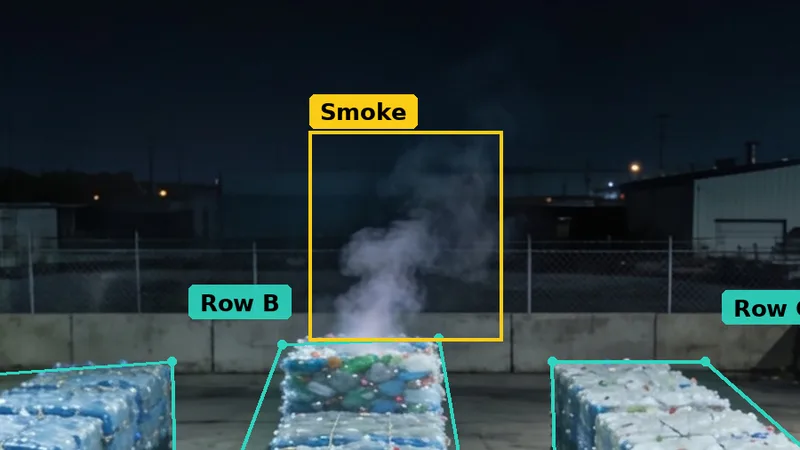
Last updated 30 October 2026. Plastics recycling sites hold a lot of fuel in a small space. Bottle bales wait for a reprocessor, film is baled for export, and flake and regrind sit in bays and bulk bags until they are sold. Plastics also burn hotter than most other wastes, so a fire that is not found early can be very hard to stop. This page explains what the Environment Agency (EA), Natural Resources Wales (NRW) and the WISH Forum ask of sites that sort, bale, shred or store plastics, and how camera smoke and fire detection fits into your fire prevention plan (FPP).
Which plastics sites need a fire prevention plan?
If your environmental permit includes a condition about fire, or you store combustible waste under a permit, you will usually need an FPP that meets the EA’s fire prevention plans guidance. That guidance names plastics as one of the combustible wastes it covers, and it gives plastics their own row in the table of maximum pile sizes. In Wales the equivalent is a fire prevention and mitigation plan under NRW guidance.
Plastics turn up at several kinds of site, and each holds them in a different form:
- Material recovery facilities, where mixed recycling is sorted and plastics are baled by polymer and colour.
- Plastics recovery facilities, which take mixed plastics from sorting plants and split them into grades.
- Reprocessors, which wash, shred and granulate bottles, pots, tubs, trays and film into flake, regrind or pellets.
- Film and agricultural plastics collectors, which bale silage wrap, stretch film and other films for reprocessing or export.
- Transfer stations and merchants, which bulk up and store baled plastics before they move on.
If your site handles mixed waste before plastics are pulled out, our pages on recycling plants and waste transfer stations cover the reception halls and sorting lines.
Why do plastics recycling sites catch fire?
Your FPP needs a control for each likely cause of fire. At a plastics site, these are the ones that come up most often in the guidance:
- Batteries in the feed. Lithium-ion batteries, vapes and small electricals end up in mixed recycling. When a baler, shredder or loading shovel crushes one, it can catch fire inside a bale or a pile. The EA asks every FPP to describe how it reduces the fire risk from incorrectly disposed batteries, and to include them in waste acceptance checks. See our page on lithium-ion battery fires at waste sites.
- Hot output from shredders and granulators. Size reduction makes heat. The EA says you must let heat from treatment such as shredding escape so that the waste is cool before you form it into piles.
- Dust, fines and fluff. Light plastic film and fines build up under conveyors, around granulators and in corners. Your plan must say how often you inspect and clean to stop this build-up.
- Self-heating in old stock. The EA notes that the chance of self-combustion rises when combustible waste sits at the maximum pile size for more than 3 months, and that fine particles are more prone to it.
- Hot works and plant. Welding and cutting on balers and conveyors need a permit to work and a fire watch afterwards, especially at the end of the day. Mobile plant that is not being used must be kept away from combustible waste.
- Arson. A yard full of bales is an easy target. The EA asks for security fencing, intruder alarms and CCTV, with arrangements for outside working hours.
Most of these causes share one feature. They do not need anyone to be on site. A battery inside a bale or a warm pile of regrind can begin to smoke in the middle of the night. Our waste site fire risk assessment guide shows how to assess each storage area and process line.
Why do plastics fires burn so hot?
The WISH Forum’s WASTE 28 guidance (issue 3, March 2020) is based on large-scale burn tests of real waste. It splits combustible wastes into two groups. General wastes such as wood, paper and RDF reached maximum burn temperatures of about 850 to 950°C. Plastics and rubber burned at up to about 1,200°C, and in the baled plastics test the surface temperature sometimes went above 1,200°C, which is hotter than the melting point of aluminium.
That heat travels. WISH reports that a burning stack of plastic bales melted a data-logger 10 metres away and blistered the paint on a cabin nearly 30 metres away. Because of this, the WISH separation distances for plastics are wider than for general wastes. WISH also warns that walls built from bales of scrap metal, which can work between paper bales, may be of little use between plastic bales, because a metal bale wall that starts to melt can fall over.
For fire detection, the lesson is simple. A plastics fire grows fast and the heat it gives off makes it harder to get close. The minutes between the first wisp of smoke and the arrival of a keyholder decide how much stock you lose.
What happens when a plastics store catches fire?
On 23 May 2025, Northamptonshire Fire and Rescue Service declared a major incident at a recycling warehouse in Rushden. Crews were called shortly before 6.30am and found a fire involving a large quantity of plastic. At one point there were 12 fire engines, three aerial appliances, two water bowsers and a high-volume pump at the scene. Neighbouring premises were evacuated, roads on the estate closed and nearby residents were asked to keep their windows and doors shut. A week later the service said the cause was accidental: spontaneous combustion of an ignition source that could not be identified. The BBC reported the incident commander saying it was likely to be a battery.
A second case shows what poor storage does. In May 2024 the BBC reported the sentencing of the people behind an unpermitted plastics recycling site near Redcar, which burned down in April 2020. EA officers had warned them that the plastic bales were packed so tightly together that they were a fire risk, and the advice was ignored. The cause of the fire was never found, but the court heard that the way the plastic was stored made the fire hard to fight and let it spread quickly.
Neither fire was started by somebody on a night shift. That is the gap a fire prevention plan has to close: finding a fire while it is still small, at any hour.

What are the EA pile limits for plastics?
If your permit requires an FPP, section 9 of the EA guidance sets the standard maximum pile sizes. For plastics the limit depends on the size of the pieces:
- Loose and larger than 150mm: 750 cubic metres.
- 30 to 150mm, or baled: 450 cubic metres.
- Smaller than 30mm: 300 cubic metres.
Plastics under 30mm have one of the tightest limits in the table. Paper and cardboard of the same size, for comparison, can go up to 450 cubic metres. The EA also says you should store waste in its largest form where you can, because reducing particle size increases the risk of self-combustion. So, where you have the choice, keep material as whole items or bales until you are ready to process it.
What form is your plastic in?
Whole bottles, film and rigid items stored loose can go in piles of up to 750 cubic metres, the largest the EA allows for plastics. The EA asks you to store waste in its largest form where you can, because smaller pieces are more likely to self-combust.
Bales and coarsely shredded plastics are limited to 450 cubic metres per pile. Bales stored for more than 3 months need a temperature sampling plan covering at least 10% of them. WISH advises interlacing plastic bales like brickwork.
Flake, regrind and other plastics under 30mm have the tightest limit: 300 cubic metres. Let shredded and granulated output cool before it goes on a pile, and keep fines and dust under control.
Natural Resources Wales sets 6 months for baled and non-shredded waste, 3 months for shredded waste and 1 month for combustible fines and dusts. Stacks should be no higher than 4 metres or four bales, whichever is lower.
Every pile must also be no more than 4 metres high and 20 metres long or wide, with 6 metres of separation or a suitable fire wall. From the EA fire prevention plan guidance (sections 8 and 9) and NRW guidance. Your own permit may set different limits.
The general limits apply to every pile as well. No pile may be more than 4 metres high or more than 20 metres long or wide. Piles must be at least 6 metres apart and 6 metres from the site boundary, buildings and other combustible material, unless you use a suitable fire wall with at least 120 minutes of fire resistance. You must also keep a quarantine area that can hold at least 50% of your largest pile, with 6 metres of clear space around it. Our guide to EA fire prevention plan detection requirements covers the detection side of the same guidance.
How long can you store plastics?
Section 8 of the EA guidance says combustible waste must be stored for less than 6 months, and you must follow the first in, first out principle. If you keep waste at the maximum pile size for more than 3 months, you must show what extra measures you will use to prevent self-combustion, such as monitoring temperatures. For bales stored that long, the plan must set out a sampling protocol covering at least 10% of the bales.
Plastics markets rise and fall, and stock can build up when prices drop or an export route closes. The EA expects you to plan for this. Your FPP must show how you will manage seasonal changes in supply or demand, consider the worst case when storing waste for longer over the summer, and cover planned and unplanned shutdowns. A month when bales cannot be sold is exactly when piles grow, stock ages and the fire risk rises.
In Wales, NRW’s fire prevention and mitigation plan guidance sets maximum storage times by form: 6 months for non-shredded and for baled or compacted waste, 3 months for shredded waste and 1 month for combustible fines and dusts. Our guide to NRW fire prevention plan detection covers the Welsh rules.
How do you control fire risk on the process line?
Shredding and granulating change the fire risk twice: they make heat, and they turn bales into small pieces with tighter pile limits. The EA guidance asks for a few things that apply directly to a plastics process line:
- Cool before piling. Let heat from shredding escape so that the material is cool before you form it into piles, and reduce the proportion of fines.
- Housekeeping. State how often you inspect and clean to stop loose waste, dust and fluff building up, and the procedures you use.
- Plant and equipment. Run a maintenance and inspection programme for static and mobile plant, fit vehicles with fire extinguishers and park mobile plant away from combustible waste when it is not in use.
- Hot works. Use a permit to work and keep a fire watch for a suitable time after hot works end, particularly at the end of the working day.
- Acceptance checks. Write procedures for waste acceptance checks, including for lithium batteries, and use a quarantine area where needed.

Flake and regrind are where the 300 cubic metre limit bites. A bay that holds a busy week of output can reach the limit quickly, and finished bulk bags often sit next to the bays. Count both when you work out pile volumes, and keep the separation or fire walls between them.
Should plastics be stored indoors?
Indoor storage keeps material dry and out of sight, but WASTE 28 is cautious about plastics inside buildings. Because plastics and rubber burn at higher temperatures, they are more likely to spread fire to buildings and plant. WISH says enhanced, high-specification detection and suppression should be given careful consideration if you store plastics or rubber inside, and that the most practical approach may be not to store them indoors at all, if that is practical and your permit allows it.
WISH also warns about changes of use. A bunker designed for wood that later holds plastics carries a much higher fire load, and a sprinkler or deluge system specified for wood is very likely to be ineffective against a plastics fire. If you change what you store, or where, review your fire systems at the same time. Your insurer is likely to ask the same questions, and our guide to when insurers require fire detection CCTV covers what they tend to look for.
How should plastic bales be stacked?
WASTE 28 explains that bales stacked directly on top of each other can leave vertical gaps that act like chimneys and drive a faster, hotter burn. Interlacing the bales like bricks in a wall breaks those chimneys up, and WISH says you should consider this in particular for baled plastics and rubber, because their burn temperatures are higher. In the WISH tests, interlacing slowed fire growth within the stack, which could give firefighters a better chance in the early stages. NRW gives the same advice for baled plastics.
Stability matters too. NRW says stacks more than four bales high may become unstable and collapse, which is dangerous in normal work and during a fire. It asks for a maximum height of 4 metres or four bales, whichever is lower, and a maximum width of 20 metres, or 10 metres if a stack can only be reached from one side.
Stacking also affects what cameras can see. A camera that looks along the top and the open faces of each row sees smoke soon after it breaks out of a bale. A camera that only sees the end of a long block may miss the far side. At a site assessment we look at each row and bay against your FPP site plan, not just at how many cameras you have.
What fire detection does a plastics site need?
Section 13 of the EA guidance says you must have procedures to detect a fire in its early stages, and your plan must show how the detection system raises the alarm both during working hours and when the site is closed. It must be proportionate to your activities and risks, and it can be automated or manual. The examples of suitable automated systems are smoke and heat detectors including temperature probes, CCTV visual flame detection systems, and spark, infrared and ultraviolet detection. Design, installation and maintenance must be covered by an appropriate third-party certification scheme or meet a recognised standard; if neither applies, you must show you can still meet the three objectives of the plan. The EA also asks you to describe where your CCTV and alarms are.
WASTE 28 is candid about the limits of detection. In its fire tests, the detection systems found fires at the surface of a stack, but none was effective at detecting a deep-seated fire when the waste had small pieces or was flexible, with few air spaces. Flake, regrind and baled film fit that description. That is why temperature checks and camera detection do different jobs:
- Heat inside a pile or bale builds slowly and out of sight. Temperature checks and the sampling protocol in your plan cover this.
- Smoke and flame appear at the surface, often at night, sometimes in a corner of the yard far from the office. A camera that watches every row and bay sees all of them at once.
- People who should not be there are the start of an arson attack. Fence and gate alerts after closing give you a chance to act before anything is lit.
For a wider view of the options, see our guide to thermal cameras and AI CCTV for an FPP.
How do you protect a plastics yard at night?
Many plastics sites run one or two shifts and are empty overnight and at weekends. For those hours you need something that keeps watching and tells a person straight away, and something that warns you when someone climbs the fence.

With camera detection, each bale row, flake bay, the process line and the quarantine area can be its own detection zone. When smoke or flame appears in a zone, the alert goes to the duty keyholder’s phone with a short clip, so they can see what is happening before they set off. Email alerts go to the wider duty list, and an alarm receiving centre (ARC) or call alerts can be added for sites where nobody is on call overnight. Our out-of-hours site security checklist covers the security side of a closed site.
How quickly do you need to respond?
The EA guidance says you must be able to move waste into the quarantine area as soon as possible or, at most, within 1 hour of a fire starting. That hour only works if somebody knows about the fire. With plastics burning as hot as WISH measured, the time it takes to get the first person and the first machine to the scene matters even more.
Write the response into the plan with names, roles and travel times. Say who receives the alert, who goes to site and how they get in. Name the plant they will use to pull stock away from a burning row, say where the quarantine area is, and explain how firewater will be contained. Our FPP detection template and fire prevention plan checklist help you set this out.
Where does Woodcock AI fit at a plastics recycling site?
Woodcock AI turns the CCTV you already have into AI smoke and fire detection. It connects to your existing cameras or recorder over ONVIF or RTSP, so the cameras that already overlook your bale rows, flake bays and fences can start watching for smoke and flame without being replaced.
- Polygon detection areas. Draw a shape that follows the edge of each bale row, bay or quarantine area, so every alert names the area on your FPP site plan. See polygon detection zones.
- Self-learning, fitted to each scene. Each camera’s model is fitted to its own view and learns from that site’s normal footage. That matters in a yard of shiny, translucent bottle bales, with floodlight glare, steam from wash lines, rain and reflections. Read about our self-learning AI.
- Years of development, in use today. Woodcock AI has been developed over several years and runs on real UK waste and industrial sites.
- Alerts that reach a keyholder. App alerts with a clip and email come as standard, with an alarm receiving centre (ARC) and call alerts as optional add-ons. Per-camera schedules keep smoke and fire detection on around the clock, with intrusion or line-crossing alerts on the fence once the site is closed.
- Records for your plan. Each alert keeps its time, area and clip. We run smoke tests on site at commissioning, so you have evidence that the system works on your cameras.
Camera detection does not replace temperature checks, a life-safety fire alarm, or the suppression a building needs. It adds a layer that watches every row and bay, all night, and tells someone straight away. For how it works in detail, see our AI smoke and fire detection camera page and our guide to video smoke detection on existing CCTV. For other waste sites, see AI CCTV for waste and recycling, RDF and SRF bale storage, tyre recycling sites and wood recycling yards.
Which sources is this page based on?
- GOV.UK, Environment Agency, Fire prevention plans: environmental permits (last updated 11 January 2021; checked 30 October 2026).
- Natural Resources Wales, Fire prevention and mitigation plans (checked 30 October 2026).
- WISH Forum, WASTE 28: Reducing fire risk at waste management sites (issue 3, March 2020).
- Northamptonshire Fire and Rescue Service, Major incident declared as firefighters tackle blaze at Rushden recycling warehouse (23 May 2025).
- Northamptonshire Fire and Rescue Service, Cause of fire at Rushden recycling warehouse determined as accidental (30 May 2025).
- BBC News, Battery likely started huge recycling site blaze (30 May 2025).
- BBC News, Green energy entrepreneurs sentenced after fire (20 May 2024).
We have summarised these documents in our own words. Always read the current versions and follow your permit. This page is general guidance, not legal or regulatory advice; your regulator decides what is acceptable for your site.
Sorting, baling or reprocessing plastics?
Book a site assessment and we will look at your cameras, the rows, bays and process areas your plan covers, and how alerts should reach your keyholders. Or ask for a live test on your cameras first: we connect two or three of them for about a fortnight.
Related pages
Frequently asked questions
What is the maximum pile size for plastics under an EA fire prevention plan?
It depends on piece size. The EA standard measures allow 750 cubic metres for loose plastics larger than 150mm, 450 cubic metres for baled plastics or pieces of 30 to 150mm, and 300 cubic metres for plastics under 30mm. Every pile must also be no higher than 4 metres and no longer or wider than 20 metres.
How long can plastic bales be stored?
The EA says combustible waste must be stored for less than 6 months, with extra measures such as temperature monitoring beyond 3 months at the maximum pile size, including sampling at least 10% of bales. In Wales, NRW sets 6 months for baled waste, 3 months for shredded waste and 1 month for fines and dusts.
Why are plastics a higher fire risk than other wastes?
In the WISH Forum burn tests, plastics and rubber burned at up to about 1,200°C, compared with about 850 to 950°C for wood, paper and RDF. The extra heat travels further, so separation distances are wider and metal bale walls may not hold.
Is CCTV acceptable fire detection for a plastics site FPP?
It can be part of it. The EA fire prevention plan guidance lists CCTV visual flame detection systems among suitable automated systems. Your plan must show the system suits your site, raises the alarm when the site is closed and meets the certification wording, so check with your regulator.
Can a camera see heat building inside a pile of flake?
No. Heat deep in a pile or bale is not visible to an ordinary camera, and WISH found that none of the systems it tested reliably detected deep-seated fires in fine or flexible waste. Temperature checks cover that risk. A camera sees smoke and flame once they reach the surface, across every row and bay at once.
Should plastic bales be interlaced?
WISH and NRW both suggest interlacing bales like brickwork, particularly for plastics, because it breaks up the vertical gaps that act as chimneys and slows fire growth within the stack. It does not reduce the separation distances you need.
Does Woodcock AI need new cameras?
Usually not. Woodcock AI connects to existing cameras or recorders over ONVIF or RTSP. At a site assessment we check whether your current views cover the rows, bays and quarantine area in your plan, and suggest extra cameras only where there are gaps.
Last reviewed 30 October 2026