

Business alarm systems: a UK guide to grades, police response and CCTV
A business alarm system in the UK is usually an intruder alarm graded to BS EN 50131 and PD 6662, most often Grade 3 for commercial premises, with movement detectors, door contacts, a control panel, an external sounder and signalling to a monitoring centre or your own keyholders. Police response needs a police-compliant installer and monitoring centre, a URN, confirmation and at least two keyholders, and can be withdrawn after three false calls in 12 months. Check the signalling before the landline switch-off on 31 January 2027, and remember the alarm usually protects only the inside of the building.

Last updated 2 November 2026. Most businesses in the UK have an intruder alarm. In the Home Office Commercial Victimisation Survey, a working alarm was the most common crime prevention measure at business premises, found at 73% of them, ahead of security locks and external CCTV. Yet many owners could not say what grade their alarm is, who it actually tells when it goes off, whether the police will come, or what will happen to it when the old copper phone network is switched off on 31 January 2027. Those four questions decide whether the alarm protects the business or simply makes a noise in an empty street.
2026 has been a year of change for business alarms. The National Police Chiefs' Council published updated Police Requirements for Security Systems for 2026, which set the rules for police response to intruder and hold-up alarms in England, Wales and Northern Ireland. Openreach and the other phone networks are moving every line to digital, and alarms that still signal over the old network need to be checked and, in many cases, upgraded before the deadline. And the latest figures show that alarms are doing their job inside buildings while yards, vans, roofs and stock outside often go unwatched.
This guide is for owners, managers, facilities teams and security leads at industrial units, warehouses, shops, offices, garages, depots, clubs and business parks across the UK. It explains what a business alarm system is made of and the four main ways an alarm can tell someone, what the latest crime figures say, and what seven real alarm activations in 2026 had in common. It sets out intruder alarm grades and why the weakest part decides the grade, how signalling works and why most insurers ask for two paths, and how police response works under the 2026 requirements: Type A and Type B, the URN, keyholders, confirmation and the false alarm rules that can take response away. It then covers the landline switch-off, monitoring and keyholding, choosing an installer, insurers, the law on noisy alarms and hold-up alarms. The final sections look at what an alarm usually cannot see, and how AI people, vehicle and smoke detection on the cameras you already have can watch the outside while the alarm protects the inside.
It is general guidance, not legal or insurance advice. The police requirements change from time to time and each force publishes its own details, so check with your installer, your monitoring centre, your insurer and the alarms administrator for your police force before you make decisions about your own premises.
What a business alarm system is
When people talk about a business alarm system, they usually mean an intruder alarm: a set of detectors around a building, connected to a control panel that decides when something is wrong and raises the alarm. Some businesses also have a hold-up alarm, a button or device that staff press when they are threatened, and almost every business has a fire alarm, which is a separate system with its own rules. This guide is about intruder alarms and, briefly, hold-up alarms. For smoke and fire seen by cameras outside, see our guides to outdoor fire detection and bin store fire safety.
A modern intruder alarm has six main parts. The control panel is the brain. It knows which detectors are armed, logs every event, sets and unsets the system and sends signals. The detectors notice that someone is there: passive infrared movement detectors on walls and ceilings, dual-technology detectors that combine infrared with microwave, magnetic contacts on doors and windows, shock sensors on frames and safes, glass-break sensors and, at higher risk premises, beams across openings or roof voids. Keypads and fobs are how staff set and unset the system, each with their own user code so the panel records who did what.
The warning devices are the sounder and strobe on the outside wall, often in a box with the installer's name on it, and sounders inside the building. The signalling is how the panel tells someone: a dialler or app that alerts the owner and staff, or an alarm transmission system that sends signals over one or two paths to a monitoring centre. Finally, there is power: a mains supply with a standby battery inside the panel and the sounder, which keeps the system working through a power cut and needs to be tested and replaced on time.
Each of those parts can be good or poor. A panel with old firmware, detectors pointing at a heater, a keypad by a door that never closes properly or a battery that died two winters ago can make a well-planned system unreliable. That is why the British and European standards for intruder alarms, and the police and insurer rules built on them, care about every component and about how the system is installed, maintained and used, not just about what was fitted on the first day.

Inside a warehouse, a detector at the end of each aisle and contacts on every door mean the alarm will notice someone who gets in. Placement matters. Detectors need a clear view, away from heaters, fans, roller doors that move in the wind, stock that is stacked in front of them and lights that flick on and off. Anti-masking detectors raise a fault if someone sprays or covers them, which is why they are expected at higher grades. A good installer will walk the building with you, ask what happens at night and at weekends, and design around how you actually use it.
Bells only, self-monitored, monitored and police response
The biggest difference between business alarms is not the make of the panel or the number of detectors. It is who gets told when the alarm goes off, and what they can do about it. There are four broad options.
A bells-only alarm makes a noise and flashes a strobe on site and does nothing else. It may scare off an opportunist and alert neighbours, but nobody is told directly. At night on an industrial estate or a business park, there may be nobody to hear it. Police will not attend a bells-only alarm just because it is ringing out, unless someone at the scene reports a crime in progress, and councils can act if it sounds for too long and annoys neighbours.
A self-monitored alarm adds a dialler or an app. When the alarm goes off, it sends a notification or makes an automated call to the owner and named staff. This is common at small shops and offices. It works well when the people on the list answer at 02:00 and know what to do. It is only as good as the people on the list, and it does not give you police response: the police treat a report from you as a call like any other and decide what to send.
A keyholder-monitored alarm signals to an alarm receiving centre, a monitoring centre that operates around the clock. The operators see the signal, check what kind it is and contact your keyholders, or a commercial keyholding company that you pay to attend. Many businesses choose this even if they cannot or do not want police response, because someone is always watching for the signal and working through the list.
A police response alarm is a monitored alarm that meets the police requirements. It is installed and maintained by a police-compliant company, signals to a compliant monitoring centre, has confirmation, two or more trained keyholders and a Unique Reference Number, a URN, issued by the police. When a confirmed alarm comes in, the monitoring centre passes it straight to the police control room. This is what the police call a Type A system. Everything else is Type B, and the rules for both are covered below.
What the figures say about business crime
The Home Office Commercial Victimisation Survey is the main national survey of crime against business premises in England and Wales. Its 2023 results, the latest published, estimated that 26% of business premises, around 409,000, had been a victim of crime in the previous 12 months. Theft was the most common offence type, at 14% of premises, followed by burglary, including attempts, and vandalism, at 8% each, and assaults or threats against staff or customers at 7%. Wholesale and retail premises were hit hardest, with 41% experiencing crime.
Burglary is often a one-off for the premises that suffer it: in the 2023 survey, 64% of burglary victims experienced it only once in the year, so roughly a third were hit more than once. That pattern is familiar to anyone who has been burgled. Once a site is known to have something worth taking and a way in, it is often tried again within weeks, which is why the days after a break-in are the right moment to review the alarm, the outside and the cameras together.
The 2022 survey asked premises about their security. A working alarm was the most common measure, at 73% of premises, followed by security windows or door locks at 66% and external CCTV at 63%. When asked what they had changed after an experience of crime, the most common answers were installing alarms and having staff monitor the premises as part of their role, both at 15%, followed by installing gates at 11%. Alarms are what businesses reach for first, and with good reason. They are proven, they are insured against and the police and insurers understand them.
What happens after crime is reported matters too. In the 2023 survey, 55% of premises that experienced crime had reported at least one incident to the police. Of those that reported, 35% were satisfied with the police response and 41% were dissatisfied, and the most common reason for dissatisfaction, given by 63%, was that the police never came or did not do anything. Police recorded burglary in England and Wales, residential and non-residential together, fell by 6% to 222,304 offences in the year to June 2026, according to the Office for National Statistics.
None of this means that alarms do not work. It means that an alarm that tells the right people, with enough information for them to act quickly, gets a better response than one that simply sounds. A police response alarm with a URN gets priority because the police have agreed standards with the industry for how it is built and run. A self-monitored alarm gets a response only if the owner can tell the police that a crime is in progress. Seeing what is happening is often what makes the difference.
Seven break-ins and attempts in 2026
Reports from police forces and local news across the UK in 2026 show what usually happens when an alarm goes off at a business. The businesses are not named here.
West Bridgford, Nottinghamshire, 26 August. Police attended a shared office building at around 22:30 after an intruder alarm sounded. Officers found the building had been entered through a broken window, searched the area and arrested two men seen walking up a ramp from the car park. Officers said they believed the pair had broken in to see what they could steal and fled empty-handed when the alarm went off.
Chester, 24 April. Shortly after 02:30, police were called to an alarm activation at a convenience store and found the front entrance had been smashed open. A man was found creeping away from the store with a basket of stolen alcohol and was arrested at the scene. The store's own CCTV later showed him breaking the door. Items had also been taken from a van parked nearby the same night. He was jailed for eight months.
Scunthorpe, 1 June. Officers received notification of an intruder alarm activation at a high street travel agency overnight, and patrols with a police dog unit attended within minutes. They found the building insecure and items missing. A man was found a short distance away with items, including cash in different currencies, and was arrested and later charged. The branch closed for a day.
Belfast, 27 July. At a city centre coffee shop, a group pushed a wheelie bin up to the front of the premises and one man kicked in the window and climbed inside. He took the tips and tried to force the till before the intruder alarm sounded and he fled back through the window. One of the owners was on holiday abroad. The security company called him to say the alarm was going off, and he checked the cameras remotely, saw that someone had broken in and then had to find people in Belfast to deal with it. The till had been ripped out and a day of trading was lost. Two men were arrested and bailed.
Haverfordwest, Pembrokeshire, 18 January. Police were called at around 00:45 to an intruder alarm at a golf club, and officers arrived six minutes later to find a forced break-in and stock missing from the club shop. Control room staff searched for vehicles in the area, which led officers to a second golf club in Carmarthen that had also been hit. A van with false plates was stopped on the A48 shortly after 02:00 with the stolen goods inside, and two men were later jailed.
Hoylake, Merseyside, 2 March. Just before 01:20, police were notified that an intruder alarm had been activated at a post office. Officers found damage to the front door and that the smoke alarm had also been activated. A number of males were believed to have entered, a small amount of cash was taken and they left in a car.
Ashford, Kent, June. On an industrial estate, someone saw suspicious behaviour around a parked lorry overnight and called 999. Police arrived within minutes and arrested three men, seizing a knife, balaclavas and gloves. The lorry was outside, so no building alarm was involved: the response depended on a person happening to see what was going on.
Look at those cases together and a pattern appears. In each case where the alarm sounded, it did so once someone was already inside, after a window or door was broken. Police often arrived quickly, especially where the alarm was monitored, and in several cases made arrests. But the damage was already done: broken glass, a smashed door, stock or cash taken, a day of trading lost. Several started outside, at a wheelie bin pushed to a window, a van in the street or a lorry on an estate, in places the building alarm does not cover. In Belfast, the owner's first move was to check the cameras to find out what was really happening.
Intruder alarm grades explained
Intruder alarms in the UK are designed and installed to the European standard BS EN 50131, together with the British document PD 6662, which applies it in the UK. The standard sorts systems into four security grades, from Grade 1 at the bottom to Grade 4 at the top, based on how determined and well equipped an intruder is expected to be. Each piece of equipment is marked with the grade it meets.
Grade 1 is a very low standard, roughly equivalent to a do-it-yourself kit. Insurer guidance says it is not acceptable to protect premises where an alarm is a condition of insurance. Grade 2 is acceptable for low risks only: most homes and some low risk commercial premises. It does not need certain features that UK businesses have come to expect, such as a large event log in the panel, recording which user did what, and stopping detectors from being turned to face the wall while the system is unset. Grade 2X is a UK addition in PD 6662 for Grade 2 systems installed without remote signalling, where the premises are attended.
Grade 3 is the grade found in most commercial premises in the UK. Insurer guidance describes it as the grade of choice for intruder alarms in commercial premises and the safe default for installers who are not sure what an insurer requires. The key difference from Grade 2 is anti-masking: movement detectors that can tell when they have been covered or sprayed to stop them working, and report it. Grade 4 is for high security risks, such as premises that would once have needed the older high security standard, and relatively few are required by insurers.
Choosing the grade should start with a risk assessment: what is on the premises, how attractive it is to thieves, how isolated the site is, how long it is empty and what the insurer says. Insurer guidance notes that the choice is partly subjective and that a lower grade is sometimes quoted for competitive reasons, which can cost the business more later if the insurer asks for an upgrade. If you are not sure, ask your insurer or broker what they need before you accept a quote.
The overall grade of a system is set by its lowest-graded part. A Grade 3 panel with Grade 3 detectors and one Grade 2 keypad, or a Grade 2 sounder, is a Grade 2 system. The installation certificate should show the grade of the system and the notification option. If it does not, or if parts have been added or swapped over the years, ask your maintainer to confirm the grade in writing.
Signalling: sounders, paths and dual path
The standards call it notification: how the alarm tells someone. BS EN 50131 sets out notification options, labelled A to D, which mix warning devices, meaning sounders and strobes, with alarm transmission systems, meaning remote signalling to a monitoring centre. Option A is two remote-powered warning devices plus single-path signalling. Option B is one self-powered warning device plus single-path signalling. Option C is dual-path signalling with no warning device required, and option D is single-path signalling with no warning device required. Many systems have more than the minimum.
The transmission path is graded too. Alarm transmission systems are graded from ATS 1 to ATS 6 under BS EN 50136-1, mainly by how quickly a failure of the path is reported to the monitoring centre. In the examples given in insurer guidance, a Grade 2 system with option B signalling must report a path failure within 25 hours, at ATS 2; a Grade 3 system within five hours, at ATS 4; and a Grade 4 system within three minutes, at ATS 5. The faster a cut line is reported, the less time an intruder has.
Dual-path signalling sends alarms over two separate routes, for example a fixed broadband line and a mobile network, so that if one is cut or fails, the other still works and the failure itself is reported. Insurer guidance says that most insurers will require dual signalling, and that dual path will almost always be needed on a commercial installation that wants police response with confirmation. Insurers often look for at least ATS 4 or better. If your alarm still sends signals over a single phone line, it is worth asking why, and what will happen when that line is switched to digital.
Signalling also matters for keyholder alarms and self-monitored alarms. An app alarm that depends on the shop's broadband router will not send anything if the router has no power or the line has been cut. A dialler that relies on a single mobile signal may struggle in a steel-clad building. Test the signalling regularly, and ask your installer what the panel does when a path fails.
Police response under the 2026 requirements
Police response to alarms in England, Wales and Northern Ireland follows the National Police Chiefs' Council Police Requirements for Security Systems, updated for 2026. Scotland is outside the scope of that document, so in Scotland ask your installer about the current Police Scotland policy. Each force also has an alarms administrator who issues URNs and handles the paperwork, and some forces add their own local details.
The requirements split alarms into two types. Type A systems are remotely monitored alarms installed and maintained by a police-compliant company, signalling to a compliant monitoring centre, with a URN issued by the police. Activations from Type A systems are passed by the monitoring centre to the police, now usually through an electronic link called ECHO, Electronic Call Handling Operations, rather than by a phone line. Type B systems are everything else: bells only, diallers, app alarms, systems from non-compliant installers and systems that have lost their URN.
For Type B, the requirements say that police attendance needs an indication that an offence is in progress, from a person at or near the scene, such as a keyholder, a neighbour or a passer-by. They also say that CCTV, audio or other technology added to a Type B system will not promote it to Type A. In other words, the police will consider a report from someone who can see a crime is happening, but they will not treat the alarm itself as a call for help.
For Type A, the URN is the key. It is issued by the police and remains the property of the police. Most forces charge an administration fee when a URN is issued, which should be shown in the quote from your installer. Once a URN is issued, the system gets Level 1 response, which the requirements describe as an immediate or urgent police response, though they also make clear that attendance cannot be guaranteed, because it depends on other demands on the police at the time. Response is reduced to Level 3, keyholder response only, if the system has too many false alarms.
To get a URN, you need a compliant installer and monitoring centre, the system installed to the right standards, the application forms and certificate sent to the police, and at least two keyholders. Your installer usually handles the paperwork. Changes to the original application, such as a new maintainer or monitoring centre, must be notified to the police within 28 days, and the URN can be transferred to another compliant company if your installer stops trading or loses its approval. A URN is confidential: keep it with your alarm records.
Keyholders: the people who go to site
Every police response alarm must have at least two keyholders, and the requirements are specific about what they must be able to do. Each keyholder must be trained to operate the alarm, have the keys and codes they need, be contactable by phone, and be able to attend within 20 minutes of being told about an activation, with their own transport. A keysafe at the premises is not an acceptable substitute for a keyholder. Businesses can use a commercial keyholding company, which must be aware of Security Industry Authority licensing rules and the BS 7984-1 standard for keyholding and response.
The rules are enforced. If keyholders are called and fail to attend twice in 12 months, police response can be withdrawn for three months. Keyholders are also asked not to contact the police about an activation unless they are at the premises and can confirm that a crime has been committed or is in progress, because the alarm system and monitoring centre already handle the signal.
Keyholding is the part of an alarm that most businesses think about least. The names on the list may have left the company, moved house or changed numbers. The person who lives nearest may not want to drive to an industrial estate at 03:00 on their own, and should not be asked to go inside. A good rule is to review the keyholder list every quarter, test that each person answers, and agree in writing what they will do when they arrive: wait for the police in the car with the doors locked, watch from a safe distance, and never go in alone if there is any sign that someone is still inside. If you see a crime in progress, call 999.
Keyholders are much better placed if they know what they are driving towards. A notification that says an alarm has gone off in the warehouse tells them very little. A clip that shows two people climbing the rear fence at 01:40 and walking towards the van compound tells them it is real, how many people there are and which way they went, so they can call 999 from the car instead of going to look. That is where cameras outside add to the alarm inside, covered later in this guide.
Confirmed alarms and why they matter
Confirmation means that the system can tell the difference between a single trigger, which may be a false alarm, and evidence that an intrusion is really happening. It is set out in BS 8243, the British standard for confirmation of intruder and hold-up alarms, and it is part of the standards that police-compliant installers work to. Ask your installer which form of confirmation your system has, if any: unconfirmed systems that lose police response must be upgraded to confirmation to get it back.
There are three forms of confirmation. Sequential confirmation is when two separate detectors trigger within a confirmation window, which is set at not less than 30 minutes and not more than 60 minutes. A movement detector in the office and then a door contact on the stockroom is treated as confirmed. Audio confirmation is when sound from the premises is sent to the monitoring centre, so operators can listen. Visual confirmation is when images are sent to the monitoring centre from cameras linked to the alarm.
Confirmation matters for two reasons. First, it makes the signal the police receive more reliable. Second, it is the main route back to police response after it has been lost. For you, the business, it also changes what happens on the night: a confirmed alarm is a much clearer sign that people are inside, and your keyholders should act on it as such, which means waiting for the police rather than going in.
Visual confirmation in BS 8243 is a specific thing: images sent from the alarm system to a monitoring centre under the standard. It is not the same as an owner looking at the shop's CCTV on their phone, however useful that is. If you want visual confirmation for police response, your alarm installer and monitoring centre need to design it in. Separate AI detection on your cameras, like Woodcock AI, does not count as alarm confirmation and does not change your alarm type.
False alarms: the rules that can cost you police response
False alarms are a big burden on the police and the reason the requirements exist. For intruder alarms with a URN, the 2026 requirements set out a clear ladder, counted over a rolling 12 months. After two false calls, the customer is advised in writing, with a copy to the maintaining alarm company, recommending urgent remedial action. After three false calls, Level 3 applies and police response is withdrawn, not less than 14 days from the date of the withdrawal letter. The maintaining company then tells the monitoring centre to stop passing alarms to the police.
Withdrawal is not the end. To get police response back, the cause of the false alarms needs to be found and fixed. Unconfirmed systems must be upgraded to confirmation to DD243:2004 or the current BS 8243. Confirmed systems need the cause identified and remedial action taken, with a period of 90 days free of false calls, unless an additional method of confirmation is installed. There is no requirement to upgrade to PD 6662 to regain police response. If reinstatement has not started within six months of withdrawal, the URN is deleted and the business has to start again.
Most false alarms have ordinary causes. The most common is user error: a member of staff who sets the alarm and then goes back in for their coat, a new starter who has not been shown the exit route, a cleaner with the wrong code. Doors and windows that do not quite shut, a roller shutter that moves in the wind, balloons and banners in a shop, stock stacked too close to a detector, heaters and air conditioning, insects in a detector, birds in a warehouse, pets in a flat above a shop and failing batteries all play their part. Many false alarms happen at opening and closing times.
The fixes are mostly simple. Train every user and keep the list of users and codes up to date. Walk-test the exit route and set a sensible exit time. Keep detectors clear. Get the system maintained on time, and ask the maintainer to look at the event log after every false alarm. If false alarms keep happening, ask for a review of the design, detector types and positions, and of confirmation. The requirements also limit remote resets: a maximum of two remote resets are permitted, in line with BS 8473, so a system that keeps going off will soon need an engineer on site.
Keep a simple log of every activation: date, time, what caused it, who attended and what was done. It helps your maintainer find patterns, it shows the police that you take it seriously, and it is the evidence you need if you ever have to apply for reinstatement. Your monitoring centre can usually provide a report too.
The landline switch-off and your alarm
The UK's old analogue phone network, the Public Switched Telephone Network, and the ISDN lines that many businesses use are being retired. Communications providers are moving landlines to digital technology that runs over an internet connection. GOV.UK guidance says most customers are expected to have made the switch by the end of January 2027, and Openreach says that by 31 January 2027 all traditional phone lines will be going digital, with lines that have not switched by then liable to be moved to a limited emergency voice service. Some providers offer an interim landline-only service for people without broadband, so the exact timing depends on your provider, but for business alarms the safe assumption is that a line-based alarm needs to be sorted out now.
The change matters because many alarms, especially older ones, send their signals over a phone line, either with a dialler or with a line-based alarm transmission system. GOV.UK specifically mentions burglar alarms, lift alarms and card payment systems among the devices that businesses use on landlines, and notes that providers will not know which devices are connected to their network. It is up to the business to review what is plugged into its lines and whether it needs upgrading, replacing or an adaptor.
There is a second issue: power. The old copper line carried power from the exchange, so a phone or some line equipment could keep working in a power cut. Digital lines do not carry power, so the router and any equipment connected to it need their own supply and will stop in a power cut unless there is a battery or generator backup. The Ofcom guidance on emergency access during power cuts is aimed at people who depend on their landline. Business alarms need their own plan: an alarm whose panel battery lasts for hours but whose only signalling path runs through a router that stops when the power goes is not much of an alarm.
What to do now is straightforward. Ask your alarm company, in writing, what your panel signals over and what happens to it on the switch-off. If it uses a single phone line, ask for a quote to move to digital signalling, ideally dual path with a mobile route as the second path. Make sure the router, any network switch the alarm depends on and the alarm itself have battery backup. After any change to the lines, ask for a full signalling test to the monitoring centre, and keep the result. Do the same for lift lines, door entry systems, fire alarm signalling and anything else that uses a landline.
Monitoring centres and keyholding companies
If your alarm is monitored, the signal goes to an alarm receiving centre, also called a monitoring centre. Under the police requirements, monitoring centres handling police response alarms must comply with BS 5979 Category II or BS EN 50518 Category I, and where a police force is connected to ECHO, activations and updates are sent through the ECHO hub rather than by phone. When an alarm comes in, the operators check the type of signal, any confirmation, the instructions on your file and the keyholder list, then contact the police if appropriate and your keyholders in the order you have given.
A keyholding company is a business that holds your keys and sends someone to attend alarms for you, check the premises, meet the police or an engineer and secure the building afterwards. It is regulated: keyholding and response staff need a Security Industry Authority licence, and BS 7984-1 sets out how keyholding and response services should be run. The police requirements remind businesses that if licensing rules stop a keyholding company attending within 20 minutes, other keyholders must be registered so that the requirements are still met.
Commercial keyholding is a good option for businesses where staff live a long way from the site, or where owners do not want staff driving to an empty industrial estate in the small hours. Ask the company how long they usually take to attend, what they do on arrival, whether they will go inside, how they report back and how they handle a site where people may still be present. Make sure your monitoring centre has their details as well as your own staff.
Some businesses also pay a remote video monitoring centre to watch their cameras. That is a different service: operators watch camera images when the cameras detect something, and can talk to intruders through speakers and call the police. Our comparison of AI CCTV and remote CCTV monitoring explains how it differs from AI detection on your own cameras, which sends alerts straight to you and your team.
Choosing an alarm installer
The installer you choose decides much of what your alarm can do. If you want police response, the installer must be police-compliant, which in practice means certified by a UKAS-accredited certification body, such as the National Security Inspectorate, NSI, or the Security Systems and Alarms Inspection Board, SSAIB, for the installation and maintenance of intruder alarms, and on the compliant list for your police force. NSI Gold and Silver companies are inspected against the relevant standards. Insurers often ask for certified installers whatever kind of response you choose.
Ask every installer for a written survey and risk assessment, a design that shows where each detector and sounder will go, the grade of the system and of each part, the notification option, the signalling paths and their ATS category, the confirmation method, how the system will cope with the landline switch-off and what maintenance and fault response are included. Compare like with like. A quote for a Grade 2 system with a single path is not comparable with one for a Grade 3 system with dual path, however similar they look.
Once the alarm is installed, ask for the installation certificate, keep the handover pack with the user guide and codes list, and make sure everyone who sets the alarm is trained. Book maintenance visits as your installer, the standards and your insurer require, and do not let them lapse. Keep a record of every visit. If you take over premises with an existing alarm, do not assume it works: ask a certified company to survey it, find out what grade it is, whether it has a URN that can be transferred and whether it will survive the switch-off.
What your insurer expects
For many businesses, the alarm is a condition of insurance. Commercial property and contents policies often say that an alarm of a certain grade, installed by a certified company, must be set whenever the premises are closed, must be maintained under contract and must be monitored, sometimes with police response. If the alarm is not set when a break-in happens, or police response has been withdrawn and the insurer was not told, a claim can be reduced or refused.
Insurer risk guidance asks questions such as: is the installer approved by an independent inspectorate, what standard and grade has the alarm been installed to, what grade of alarm transmission system is used, was a risk assessment completed, and does the system have a URN with Level 1 police response? Insurer guidance notes that Grade 3 is generally regarded as a minimum for commercial risks and that insurers will generally look for a minimum of ATS 4 Plus signalling.
Read the alarm wording in your own policy, which may be called an alarm warranty or alarm condition, and check it against what you actually have. Tell your insurer or broker if police response is withdrawn, if the alarm is faulty or out of action, if you change installer or if you are planning an upgrade for the switch-off. Many insurers will also take an interest in what you have done outside the building, such as fences, gates, lighting and cameras, especially for yards with stock or vehicles.
Alarms, neighbours and the law on noise
A business alarm that sounds for hours is a nuisance to neighbours and can lead to action by the council. In England and Wales, the Clean Neighbourhoods and Environment Act 2005 gives councils powers in relation to intruder alarms. An authorised officer can enter premises, though not by force, to silence an alarm that has been sounding continuously for more than 20 minutes or intermittently for more than an hour, if it is likely to give people living or working nearby reasonable cause for annoyance. A council can declare an alarm notification area, where people responsible for premises with an alarm must nominate a key-holder and tell the council.
The police requirements point the same way. They say any external audible sounder should cut out after 20 minutes, and that alarms causing annoyance under the 2005 Act may result in prosecution. They also say that in some police force areas, commercial premises may be required to have their warning devices delayed for up to 10 minutes, where the force considers it can get officers there in that time, so that intruders are more likely to be caught inside. Businesses in a delay area can apply to have the requirement waived.
Scotland and Northern Ireland have their own noise law. Wherever you are, the practical rules are the same: make sure the sounder cuts out after 20 minutes, fix false alarms quickly, give the council keyholder details if asked and make sure someone actually responds when the alarm goes off.
Hold-up alarms for shops and counters
A hold-up alarm, or personal attack alarm, is a button or device that staff use to call for urgent help when they are threatened. The police requirements say hold-up alarms may be used to summon urgent police assistance when a person is threatened or is in fear of immediate personal violence, and must not be used for anything else. Shops, petrol station kiosks, post office counters, pharmacies, cash offices and late-night businesses often have them.
Hold-up alarms have a shorter false alarm ladder than intruder alarms. A hold-up alarm with a URN gets Level 1 response until two false calls in a rolling 12 months. After the first false call, the customer is advised in writing. After the second, Level 3 applies and police response is withdrawn, not less than 14 days from the date of the letter. To restore response, confirmation is mandatory, and call-back by telephone as the only method of confirmation will not be accepted for reinstatement of systems in commercial premises.
Most hold-up false alarms come from devices pressed by accident, devices in the wrong place or staff who have not been trained. Use dual-action devices that need two buttons pressed together, place them where staff can reach them without being seen but not where they will be knocked, train every member of staff and test them as your installer advises. A hold-up alarm is not for shoplifting with no threat of violence or for a disturbance outside. For those, call 999 if it is an emergency, or use the non-emergency number.
What a business alarm usually cannot see
Most business alarms protect the building. Detectors watch the rooms, contacts watch the doors and windows, and the system goes off when someone gets inside. That is exactly what they are designed to do, and they do it well. But much of what businesses lose is outside: vans and lorries in the yard, containers and sheds, plant and tools, stock stacked in the open, fuel, cable, catalytic converters, bikes, scrap and the building itself, from roofs to walls to rear doors.
The 2026 cases show it. In Belfast, the wheelie bin was pushed to the window before the alarm knew anything. In Chester, a van parked near the store was emptied the same night. In Ashford, the lorry on the industrial estate was outside any building and depended on someone happening to see what was going on. External detectors and beams can be added to an alarm, but they are harder to set up outside, where wind, weather, animals and moving vegetation cause false alarms, and few business alarms have them.
Outside is also where you would most like warning. An alarm that sounds once someone is inside the building is a good alarm. Knowing someone is in the yard, at the fence or on the roof a few minutes earlier, while they are still deciding where to go in, gives you and the police more time, and often means the window is not broken at all. That is the gap that cameras with AI detection are best placed to fill.
Think about your site in layers. The first layer deters: lighting, signs, good locks, gates, fences, keeping bins locked away from walls and windows, keeping roofs and drainpipes hard to climb and keeping stock and vehicles out of sight. The second layer detects people outside: cameras with AI detection watching the yard, the fence line and the roof. The third layer detects people inside: the graded intruder alarm. The fourth layer responds: keyholders, the monitoring centre and the police. Each layer covers some of the gaps the others leave.
Where AI on your cameras fits alongside the alarm
Most businesses that have an alarm also have CCTV. In the Commercial Victimisation Survey, 63% of premises had external CCTV. But recorded CCTV only records. Nobody is usually watching the screens at 01:40, so the footage is looked at the next morning, after the alarm company has called, the keyholder has driven to site and the window has been boarded up. AI detection on the cameras you already have changes that. It watches the camera views continuously and sends an alert with a short clip when it sees a person, a vehicle, or smoke or flame, in a place and at a time you have chosen.
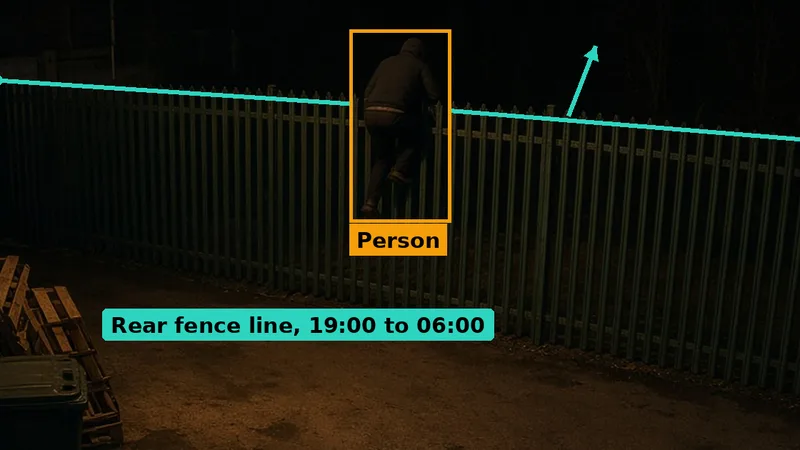
The key is to set it up around the outside, where the alarm cannot see. You draw a polygon zone that fits the shape of the yard, the van compound, the rear yard of the shop or the office car park, rather than a rough box that also covers the street. You draw a line along the rear fence or across the gate, with a direction, so that only someone crossing into the site counts. You add a vehicle zone at the gate or in the compound. And you set a schedule, for example from 19:00 to 06:00, so the zones are armed only when the site is shut. During the working day, people and vans in the yard are normal and nobody needs an alert.
When something happens, the alert goes to the phones of the people you choose, with a snapshot, a short clip and an AI description of what the camera saw: for example, one person climbing the rear fence near the van compound at 01:40. The person on call can see straight away whether it is real, how many people there are and which way they are heading. If a crime is in progress, they call 999 and give the address, the location on the site and a description. They do not go to the site on their own to look.
Used alongside the alarm, this gives you two kinds of information at once. The alarm tells you that a detector inside has triggered, which is what the police requirements and your insurer care about. The camera alert tells you what is happening outside, often minutes before anyone reaches the building, and what the people look like and where they went. For a keyholder deciding what to do at 01:40, or an owner abroad looking at their phone like the coffee shop owner in Belfast, that is the information that matters.
It helps with false alarms too. If the alarm goes off at 03:00 and the camera alerts show nothing outside and nobody at the doors, the keyholder has something to go on when they speak to the monitoring centre. That does not change how the alarm or the police treat the activation, and it does not replace a visit when one is needed, but it means fewer wasted drives in the dark and a better picture of what set the alarm off. It also helps when the alarm is down for repair or after a withdrawal of police response, when the outside of the site is still watched.
Different kinds of site
Each kind of business site has its own outside. Choose a kind of site below to see what it usually leaves unwatched and how zones on the cameras could help.
Which kind of site?
Industrial units and warehouses usually have a Grade 3 alarm inside, signalled to a monitoring centre, and a yard outside with vans, trailers, containers and stock that the alarm does not cover. Keep the yard gated and lit, nothing stacked against the fence, and keys and fuel locked away. A line on the fence and people and vehicle zones over the yard, armed when the site is shut, send the clip while someone is still outside.
Yards, vans, containers and fences
Shops and high-street businesses often have the alarm on the shop floor and doors, with the stockroom, rear yard and flat roofs behind. Keep bins chained or locked away from walls, guard drainpipes and low roofs, and fit good locks to rear doors. A zone over the rear yard, armed after closing, shows the first person in the yard rather than the broken window in the morning.
Rear yards, roofs and service doors
Offices and business parks are empty at night and at weekends, often with shared alarms, glazed frontages and car parks. Agree with the landlord or the other tenants who the keyholders are, check the shared alarm signalling before January 2027, and keep side doors closed. A zone over the frontage and car park after hours shows who is outside before anyone attends.
Frontages, car parks and side doors
Each kind of site gets zones that suit it: yards and fences at units, rear yards at shops, and frontages and car parks at offices.
What AI on your cameras is not
It is important to be clear about what this is not. Woodcock AI is not an intruder alarm. It is not graded under BS EN 50131 or PD 6662, it does not have a URN and it does not get police response. Adding AI detection, CCTV or any other technology to a Type B alarm does not make it Type A, and the police requirements say so. It does not replace your alarm, your signalling, your keyholders or your monitoring centre, and your insurer's alarm conditions still apply. It watches only what your cameras can see, so blind spots, dark corners and areas with no camera stay blind.
What it does is add warning outside the building, where the alarm usually has none, and make the alarm itself more useful by showing what is going on when it sounds. Many businesses find that the combination of a well-maintained graded alarm inside and AI detection on the cameras outside covers the ways their site is most often attacked.
Cameras and privacy
If your cameras capture people, UK GDPR and the Data Protection Act 2018 apply. Have a clear purpose for each camera, put up signs, keep recordings only as long as you need them and carry out a data protection impact assessment for new or changed systems. Point cameras at your own site, not at neighbouring homes and gardens. AI detection does not change the basic rules, but it should be included in your assessment. Our guide to AI CCTV and GDPR in the UK covers this in more detail, and the Information Commissioner's Office has guidance on video surveillance.
Business alarm checklist
The table below summarises what to check about your alarm and where cameras and AI add something. The checklist after it gives a quick test of where your site stands.
| Question | What to check | Where to find it | What cameras and AI add |
|---|---|---|---|
| Grade | Grade of the system and of every part | Installation certificate | Nothing: grading is for the alarm |
| Signalling | Paths, ATS category, what happens after the switch-off | Certificate, installer, monitoring centre | A separate alert route to your phone |
| Police response | Type A or B, URN, response level | URN letter, installer | Nothing: a clip does not change the type |
| Keyholders | Two names, trained, 20 minutes away | Monitoring centre records | A clip so they know what they face |
| False alarms | How many in the last 12 months, and why | Monitoring centre, maintainer | Fewer wasted trips for the outside |
| Outside | Yard, fence, roof, vehicles, stock | A walk round at night | Zones and lines armed after hours |
| Fire outside | Bins, skips, pallets and stock by walls | Your fire risk assessment | Smoke and flame detection in camera views |
- Do you have the installation certificate, and does it show the grade of the system and the notification option?
- Do you know whether your alarm is bells only, self-monitored, keyholder monitored or police response, and does that match what your insurer expects?
- If you have police response, do you know your URN, and how many false alarms you have had in the last 12 months?
- Do you have at least two trained keyholders who answer their phones and can attend within 20 minutes, and do they know not to go in alone?
- Do you know what your alarm signals over, and what will happen to it on the landline switch-off?
- Do the router and the alarm have battery backup, and has the signalling been tested since your lines last changed?
- Is the alarm maintained on time by a certified company, and does someone look at the event log after every false alarm?
- Does the external sounder cut out after 20 minutes, and has the council got your keyholder details if it asks for them?
- If you have a hold-up alarm, are the devices dual action and is every member of staff trained?
- Would anyone know someone was in your yard, at your fence or on your roof at 01:40, before the alarm went off?
How Woodcock AI works with your business alarm
Woodcock AI connects to existing IP cameras and runs on an edge server on site or on a cloud server. It adds people and vehicle detection, and smoke and flame detection, to the cameras you already have, so there is no need to replace them. You draw polygon detection zones that fit the shape of the yard, the van compound or the rear yard, draw lines along fences and across gates, and set schedules so the zones are armed only when the site is shut. When something happens, an alert with a snapshot and short clip goes to the phones of the people you choose, and an AI description says what the camera saw.
Woodcock AI is self-learning, so it gets better over time at knowing what is normal on each camera, such as a cleaner leaving late or a delivery van that always arrives at 05:30. It is the result of years of development and is now in use on real sites in the UK. Because it also detects smoke and flame, the same cameras that watch the yard for people can spot a fire in a skip or a bin store at night, when the intruder alarm is set and the fire alarm inside the building cannot see it. It works alongside your intruder alarm and your monitoring arrangements rather than replacing them. For more on intruder detection, see AI intrusion detection, and for particular kinds of site, our guides to industrial estate security, warehouse security and shop security. Ask your cameras, a way to ask the system questions about what it has seen, is Coming soon, early 2027.
Ways to start
Start with a site assessment. We look at your site from the outside in: where people get in, where vehicles, stock and containers sit, which cameras you have and what each one sees by day and at night, and show where people zones, lines and vehicle detection would help alongside your alarm. Or ask for a live test on your cameras: we connect two or three of your existing cameras for about a fortnight, so you can see the alerts for yourself before deciding. We are also happy to arrange an on-site demo.
Sources
- National Police Chiefs' Council, Police Requirements for Security Systems 2026 (document), via Police Security Systems: NPCC security systems policy.
- Protector Insurance, Risk management guidance: intruder alarm systems (PDF).
- Home Office, Crime against businesses: findings from the 2023 Commercial Victimisation Survey and findings from the 2022 Commercial Victimisation Survey.
- Office for National Statistics, Crime in England and Wales: year ending June 2026.
- Openreach, The Big Switch Off and digital phone lines for businesses; GOV.UK, UK transition from analogue to digital landlines; Ofcom, guidance on access to emergency organisations during a power cut (PDF).
- legislation.gov.uk, Clean Neighbourhoods and Environment Act 2005: powers in relation to alarms; GOV.UK, Noise nuisances: how councils deal with complaints.
- National Security Inspectorate, intruder alarm systems and information for insurers.
- Incident reports: West Bridgford Wire (West Bridgford), Cheshire Constabulary (Chester), TTG (Scunthorpe), Belfast Live (Belfast), Tenby Today (Haverfordwest), Wirral Globe (Hoylake) and Kent Local News (Ashford).
- Information Commissioner's Office, CCTV and video surveillance, and GOV.UK, Amended Surveillance Camera Code of Practice.
We have summarised these sources in our own words. The police requirements are updated from time to time, each police force adds its own details and Scotland is outside the NPCC document, so read the current versions and check with your installer, monitoring centre and police alarms administrator. This page is general guidance, not legal or insurance advice; your installer, insurer and solicitor can advise on your own premises. In an emergency, always call 999.
Would anyone know someone was in your yard at 01:40, before the alarm went off?
Book a site assessment and we will look at your site from the outside in, at what your cameras can see by day and at night, and show where people zones, lines and vehicle detection would help alongside your alarm, or ask for a live test on your cameras.
Related pages
Frequently asked questions
What grade of intruder alarm does a business need?
Most commercial premises in the UK have a Grade 3 alarm under BS EN 50131 and PD 6662, which insurer guidance describes as the grade of choice for commercial premises. Grade 2 is for low risks only, and Grade 4 for high security risks. The grade should come from a risk assessment and what your insurer requires, and the lowest-graded part sets the grade of the whole system, so check the certificate.
Will the police respond to my business alarm?
Only Type A alarms get a promised police response: installed and maintained by a police-compliant company, monitored by a compliant centre, with at least two keyholders and a URN issued by the police. Even then, attendance cannot be guaranteed. Bells-only, dialler and app alarms are Type B, and the police need a person at the scene reporting a crime in progress. Adding CCTV does not turn a Type B alarm into Type A.
How many false alarms before police response is withdrawn?
Under the NPCC 2026 requirements, an intruder alarm with a URN gets a warning letter after two false calls in a rolling 12 months, and police response is withdrawn after three, not less than 14 days from the withdrawal letter. Hold-up alarms are withdrawn after two. To get it back, the cause must be fixed, and confirmation added or 90 days clear shown. If reinstatement has not started within six months, the URN is deleted.
Will my alarm work after the landline switch-off?
Not necessarily. Openreach says all traditional phone lines will be going digital by 31 January 2027, and alarms that signal over an old phone line may stop sending signals. Ask your alarm company what your panel signals over, upgrade to digital or dual-path signalling if needed, give the router and alarm battery backup, and have the signalling tested after any change to your lines.
What are the rules for alarm keyholders?
For police response, you need at least two keyholders who are trained to operate the alarm, can be contacted by phone and can attend within 20 minutes with their own transport. A keysafe is not acceptable instead. If keyholders fail to attend twice in 12 months, response can be withdrawn for three months. Keyholders should never go inside alone; if they see a crime in progress, they should call 999.
Can AI on my CCTV replace a business alarm?
No. AI detection on cameras is not a graded intruder alarm, does not get a URN and does not get police response. It adds warning outside the building, where most alarms cannot see, sending an alert with a clip when a person or vehicle enters a zone after hours. Woodcock AI runs on an edge server on site or on a cloud server and works alongside your alarm, keyholders and monitoring centre.
Last reviewed 2 November 2026
Your installer’s grade starts from a risk assessment; to write your own: see our security risk assessment guide and template.