

Bin store fire safety: communal bin stores, chutes and compounds
Bin store fire safety means stopping fires starting in communal and commercial bin stores, keeping them from reaching the building, and spotting them early. Refuse fires are the largest single type of secondary fire in England, more than half of them deliberate. The basics are a store that is separated from the building, shut and lit, with bins kept at least 2m from walls outside and skips about 6m away, no side waste, collections that keep up, nothing hot or battery-powered thrown in the bins, and a fire risk assessment that covers the store. AI on existing CCTV adds alerts with a clip when smoke or flame appears at the bins at any hour, and when a person is in the bin store or climbing into a compound at night. It does not replace the fire alarm, and it does not recognise faces.

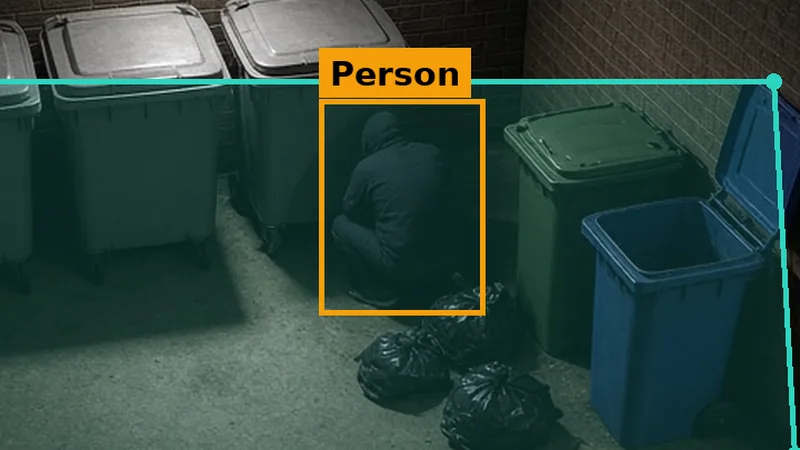
Last updated 1 November 2026. Every block of flats has one. So does almost every shop, pub, hotel, school and office: a room, a cage or a fenced corner where the rubbish waits for collection. In a block of flats it is often a brick store on the ground floor, beside the main entrance, with a row of large wheeled bins, a light on a timer and a door that residents are meant to close. Behind a parade of shops it is a mesh compound full of commercial bins and flattened cardboard. In an older tower block it is a small room at the foot of a chute that runs past every floor.
Nobody thinks of the bin store as a fire risk until it catches fire. Yet refuse fires are the largest single type of outdoor fire that fire and rescue services in England attend: more than grass and woodland fires, and more than half of them started on purpose. Most are small and are put out in minutes. Some are not. In 2026 alone, bin store fires in this guide spread into the ceiling and electrics of a communal hallway, damaged the water tank of a block of more than a hundred flats, filled a stairwell with black smoke as residents fled, and spread to a roof and to the house next door.
This guide covers bin store fire safety for blocks of flats, managing agents, housing providers and businesses with a bin compound: the figures, recent cases, how a bin fire reaches a building, the causes, who is responsible, what the building regulations and fire services say about design and distances, how to run a bin store safely, and how AI on a building’s existing CCTV can spot smoke and people at the bins, and where it cannot.
Why are bin stores a fire risk?
A bin store is a room full of fuel. Household and commercial waste is mostly paper, card, plastic packaging, food and textiles, held in large plastic bins that burn readily themselves. Recycling bins are, if anything, worse: dry card and plastic with plenty of air between them. Put several large bins together in a small enclosed room, often with a timber door, cables running through the ceiling and the main exit next door, and a small fire can become a serious one quickly.
- Deliberate fires. More than half of refuse fires in England are recorded as deliberate. Bin stores are easy to get into, nobody is watching at night, and the bins are full of things that light easily.
- Careless fires. Cigarette ends, hot ash from a wood burner or a barbecue, and smouldering coals tipped into a bin before they are cold.
- Batteries. Lithium-ion batteries and disposable vapes thrown away with the household rubbish can catch fire when they are crushed or damaged.
- Other causes. Gas canisters and aerosols, items dumped in the store by people who do not live there, and faulty lighting or electrics in the store itself.
What makes a bin store dangerous is not only that fires start there, but where it is. Building regulations treat a refuse store as a place of special fire hazard for a reason. A store at the foot of a block of flats sits below the windows and balconies of the flats above, and may be next to the stair or the main entrance that residents use to escape. A chute connects it to every floor. Outdoors, a bin left against a wall, under the eaves or beside a door can set fire to the building itself.
This guide is about the bins and the stores that hold them. For arson more widely, including skips and outbuildings, see our guide to arson prevention. For waste dumped beside the bins, see our fly-tipping guide, and for detecting fires outdoors more generally, our guide to outdoor fire detection.
How many bin and refuse fires are there in England?
The Home Office publishes detailed fire statistics for England. Fires are split into primary fires, in buildings, vehicles and some outdoor structures, or involving casualties, and secondary fires, which are smaller outdoor fires such as grassland, derelict buildings and refuse. A bin fire that stays in the bin is usually recorded as a secondary fire; one that spreads into the building becomes a primary fire, and appears in the dwelling or building figures instead.
In the year ending March 2026, according to the government’s fire statistics data table FIRE0303, fire and rescue services in England attended 102,549 secondary fires. Of those, 47,305 were fires in refuse, refuse containers and refuse sites: 46% of all secondary fires, and the largest single category by some distance. 26,138 of them, 55%, were recorded as deliberate; the remaining 21,167 were accidental or of unknown cause.
Grassland, woodland and crop fires, the ones that make the news in a hot summer, came second at 36,933. Then came other outdoor fires at 16,168, derelict buildings at 1,606 and derelict vehicles at 537. Bins and refuse outnumber everything else, every year, whether the summer is wet or dry.
The number has stayed high for a decade. Refuse fires in England have run between about 42,000 and 53,000 a year since 2015/16, with a low of 41,977 in 2023/24 and a high of 52,982 in 2018/19. After two years of decline, they rose again in 2024/25 and 2025/26.
The deliberate share has fallen slowly. In 2015/16, 32,563 of 48,842 refuse fires were recorded as deliberate, about two in three. In 2025/26 it was 26,138 of 47,305, a little over half. That is still more than 70 deliberate refuse fires a day across England.
The government’s headline release for the year ending June 2026 gives the wider picture. Fire and rescue services attended 91,487 secondary fires in that year, down from 98,976 a year earlier; the release notes that hot, dry summers, such as those of 2018, 2022 and 2025, push outdoor fires up. The same release recorded 680 fires in purpose-built high-rise flats or maisonettes of ten storeys or more, almost the same as the year before. The average total response time to secondary fires was 9 minutes 55 seconds, and to primary fires 9 minutes 25 seconds: long enough for a bin fire to spread out of a store with a door left open.
The figures do not separate a wheelie bin outside a house from a bin store at the foot of a tower block, or a skip at a building site. They do show that, as a type of fire, bins and refuse are the biggest outdoor problem fire services face, and that most of these fires are set by somebody.
What do recent bin store fires look like?
Most bin fires are small. The ones below, all from 2026 and all reported by fire services, police or local press, show what happens when a fire in a communal bin store gets going. They are named by place only.
- Rushden, June. Just after midnight on 17 June, crews were called to a fire in the bin store of a block of flats on Aspen Close. The fire spread to the ceiling and electrics of the communal area. It was believed to have been started deliberately, and crews left the scene at about 01:30. (BBC News)
- Peterborough, July. At 09:55 on Saturday 18 July, crews were called to a bin store fire at a block of flats on Vicarage Farm Road. The fire damaged the block’s communal water tank. More than a hundred flats were left without water, and weeks later supply to around 300 residents had only partly been restored. The company managing the building said it believed nitrous oxide canisters had ignited in the bin store. (Cambridge News; BBC News)
- Liverpool, May. At 14:43 on Sunday 17 May, an automatic fire alarm brought four fire engines and an aerial appliance to an 11-storey block on Brookside Avenue. A bin was alight in the ground-floor bin store. Crews removed it, then checked the building for the spread of smoke and ventilated it. (Merseyside Fire and Rescue Service)
- Dundee, September. Shortly after 18:30 on Friday 4 September, a fire started in a bin store in the basement area of a block of flats on Kinghorne Road. Thick black smoke filled the close, and residents on the top floor had to get out. Police treated it as deliberate. (The Courier)
- Milton Keynes, January. At 20:19 on 2 January, crews were called to a small fire in a bin store on the ground floor of a high-rise building in Broughton. Two firefighters in breathing apparatus put it out with a hose reel, and a fan was used to clear the smoke. (Buckinghamshire Fire and Rescue Service)
- Coventry, February. Shortly before 01:45 on 25 February, a bin store fire in Willenhall was treated by police as arson, and an appeal for information followed. (Coventry Telegraph)
- Bridgwater, June. At about 01:30 on 22 June, a fire started in a bin store at the side of a property on Parkway and spread to the roof. The bin store was destroyed, and a neighbouring property was damaged. Four more fire engines were called, and the incident was not declared over until just before 12:30. (Somerset Leveller)
- Bristol, August. On 16 August, crews were called to a fire in the bin chute of an 11-storey tower in Redcliffe, with 88 flats. The fire was recorded as deliberate: something already alight had been thrown down the chute from an upper floor. Nobody was hurt and the block did not need to be evacuated. (Bristol Post)
One more case shows the other side. On 16 July, a wheelie bin caught fire in the ground-floor bin store of a low-rise block in Dorset. A single sprinkler head in the store operated and held the fire to the bin where it started, with only minimal smoke damage in that room, according to the British Automatic Fire Sprinkler Association.
The pattern is clear enough. Bin store fires happen at every hour of the day, but the ones recorded or believed to be deliberate in this guide, where a time was given, came at night or in the evening, when the store was dark, nobody was near it and residents were at home and, in most cases, asleep. The fires that did most damage got into something else: a ceiling, a roof, a water tank, a stairwell, a chute.
How does a bin fire spread to a building?
A burning bin on its own, in the open and well away from anything else, will usually burn itself out or be put out with a hose reel. The danger comes from what is next to it. A large plastic bin full of mixed waste burns hot and produces thick, toxic smoke, and in an enclosed store that smoke and heat have to go somewhere.
Look at a typical purpose-built block of flats. The bin store is on the ground floor, often beside the main entrance, because that is where residents walk past and where the collection lorry can reach. Above it are the windows and balconies of the lowest flats. Next to it, very often, are the stair, the lobby and the exit residents would use in a fire. Cables, pipes, meters and sometimes the water tank run through or near it. In older blocks, a refuse chute rises from the chute room through every floor.
- Up. Heat rises into the ceiling of the store, through gaps around cables and pipes, into ceiling voids and electrics. In Rushden, the fire spread to the ceiling and electrics of the communal area.
- Along. Smoke escapes through a door left open, or one that does not close properly, into the lobby and the stair. In Dundee, black smoke filled the close and top-floor residents had to get out.
- Through. A refuse chute, or a riser that carries services, can act as a flue, carrying fire and smoke between floors. The British Automatic Fire Sprinkler Association points to the risk of vertical fire spread in older blocks with chutes.
- Across. Outdoors, a bin against a wall, under eaves, beside a door or below a window can set fire to the building itself. In Bridgwater, a fire that started in a bin store at the side of a property spread to the roof and to the property next door.
There is a less obvious kind of spread, too. In Peterborough, the fire did its worst damage not to people or homes but to the building’s communal water tank, leaving more than a hundred flats without water for weeks. Anything in or close to a bin store, whether a tank, a meter cupboard, a cable run or the lift motor room, can be put out of action by a fire that never reaches a flat.
Smoke is the main danger to people. In many purpose-built blocks, residents are advised to stay put unless the fire is in their own flat or smoke reaches it, and a bin store fire at the foot of the stair can make the escape route impassable in minutes. That is why building regulations, covered below, put so much weight on separating the store from the stair and the rest of the building, and keeping its door away from exits and windows.
What causes bin store fires?
Fire services and the official statistics point to the same handful of causes. Most bin store fires come down to one of four things.
Deliberate ignition. More than half of refuse fires are recorded as deliberate. A store that is unlocked, unlit and full of loose bags and cardboard is an easy target. Four of the nine 2026 cases in this guide were recorded or treated as deliberate, or believed to be, and those with a reported time came at night or in the evening.
Hot waste. Cigarette ends, ash from wood burners and open fires, and barbecue coals that seem to be out but are not. Lancashire Fire and Rescue Service advises never putting hot coals in a bin. In a communal bin store, nobody knows what the last person threw in, or when.
Batteries. Lithium-ion batteries, in phones, power tools, e-cigarettes and disposable vapes, are thrown away with the household rubbish in large numbers. A damaged or crushed cell can overheat and catch fire, in the bin, in the lorry or at the waste site. The waste industry has tracked the problem for years.
According to figures from the Environmental Services Association, reported by the Guardian in August 2026, its members reported 1,518 fires in the year to March 2026, of which at least 541 were directly attributed to lithium-ion batteries, with a further 216 battery fires in bin lorries. Most of those fires happen after collection, but every one of those batteries passed through someone’s bin first. For more on batteries in waste, see our guide to UK waste battery fire statistics.
Canisters and aerosols. Gas canisters and aerosols can burst when heated, making a small fire worse. In the Peterborough fire, the company managing the building said it believed nitrous oxide canisters had ignited in the bin store; that had not been confirmed as the cause by the fire service at the time of reporting.
Behind all four sits the state of the store itself. Bags left on the floor because the bins are full, bulky waste dumped by people who do not live there, a door wedged open, a broken light: none of them start a fire, but all of them make one easier to start and quicker to grow.

Not every bin fire looks like a fire. A bin that is smouldering under a closed lid, or a fire inside a store with the door shut, may first show as grey smoke seeping from slatted doors, louvres or the gap under the door, as in the frame above. That is often the first visible sign from outside, and the moment when a call to 999 makes the biggest difference.
Who is responsible for bin store fire safety?
In England and Wales, fire safety in non-domestic premises, including the common parts of blocks of flats, comes under the Regulatory Reform (Fire Safety) Order 2005. The Order places duties on the responsible person. GOV.UK guidance explains that this can be the employer, the owner, the landlord, an occupier or anyone else with control of the premises, such as a facilities manager, building manager or managing agent.
The responsible person must carry out a fire risk assessment and review it regularly, put in place and maintain fire safety measures, and plan for an emergency. For a block of flats, the bin store is part of the common parts, so it belongs in the fire risk assessment. The Fire Protection Association notes that the Order’s duties cover communal areas and the protection of escape routes, and that competent assessors are expected to refer to guidance including British Standard 5906, the code of practice for waste management in buildings, which says that stored waste and recyclables are often the largest single source of combustible material within a building.
The Fire Safety (England) Regulations 2022, in force since January 2023, added duties for blocks of flats. In all multi-occupied residential buildings, the responsible person must give residents fire safety instructions and information about fire doors. In buildings over 11 metres, communal fire doors must be checked every three months and flat entrance doors every year. In high-rise buildings, there are further duties around information for the fire service. A bin store door that is also a fire door, between the store and the building, falls under those checks.
For a business, the position is simpler: the employer, owner or occupier in control of the premises is the responsible person, and the bin compound is part of the premises. Shared yards behind parades of shops and on industrial estates are a common grey area, where several occupiers use one compound and nobody is sure who is in charge of it. The fire risk assessment for each premises should say who controls the compound and who checks it. Scotland and Northern Ireland have their own fire safety law with similar duties.
The fire risk assessment is where bin store risks are written down and dealt with. A good one looks at where the store is, what it is built from, what it backs on to, how it is used, how often it is emptied, whether it is locked and lit, and whether bins outside are kept away from the building. It should be reviewed after a fire, after a change to the building, or when the way the store is used changes.
What do building regulations say about bin stores?
For new buildings and material alterations, building regulations apply. In England, the guidance for flats is Approved Document B, Volume 1. It has a short section on refuse chutes and storage, at paragraphs 3.59 to 3.62.
- British Standard 5906. Refuse storage chambers, refuse chutes and refuse hoppers should be sited and constructed in accordance with BS 5906.
- Fire-resisting separation. Refuse chutes and rooms for storing refuse should be separated from other parts of the building by fire-resisting construction: REI 30 where the top storey is no more than 5 metres above ground, and REI 60 above that.
- Not in escape routes. They should not be located within a protected stairway, a protected lobby or an evacuation shaft.
- Access from outside. Rooms containing refuse chutes, or used for storing refuse, should be approached directly from the open air, or through a protected lobby with at least 0.2 square metres of permanent ventilation.
- Away from exits and windows. Access openings to refuse storage chambers should not be sited next to escape routes or final exits, or near the windows of flats.
Approved Document B also lists refuse storage chambers among places of special fire hazard, which need fire-resisting walls. In blocks of flats with a top storey more than 11 metres above ground, sprinklers are expected in the flats, though not in the common areas. Many existing blocks were built before the current guidance, and some have stores in exactly the places it now advises against. The fire risk assessment is where those older layouts are looked at, and where extra measures may be needed to make up for them.
How far should bins be kept from a building?
Outdoor bins are a different problem. Most fire services give simple advice for bins outside a building, and it comes down to distance.
- Wheelie bins. Lancashire Fire and Rescue Service advises securely storing bins at least 2 metres away from any buildings if you can, and not placing them under covered areas such as porches attached to a building.
- Skips. Essex County Fire and Rescue Service advises that skips should never be placed against a building and should normally be at least 6 metres away from any part of the premises.
- Compounds. Essex also advises securing outdoor wheeled bins in a compound, so they cannot be moved next to the building and set on fire. The FPA notes that government fire risk assessment guidance for sleeping accommodation says the same.
- Larger stores. The FPA summarises European guidance from CFPA Europe as recommending that bins are secured 6 metres away from dwellings, or separated by a structure with 30 minutes’ fire resistance.
On a tight urban site, 6 metres is often impossible. That is where a fire-resisting store or a well-built compound has to do the work instead, and where the store’s door, its roof and what is above it matter most. A compound that stops bins being wheeled to the wall at 2am is worth more than a painted line that says where they should be.
How should a bin store be managed day to day?
Design sets the limits; day-to-day management decides whether a bin store is safe on a given night. Most fire service advice on bins comes down to four things, and they apply equally to a bin store under a block of flats and a compound behind a shop.
- Keep it shut. London Fire Brigade advises keeping communal bin stores secure and well lit. A lockable door or gate, with a key, fob or code for residents and the collection crew, keeps out most of the people who should not be there. Doors that have to be propped open for collections should be closed again afterwards, and self-closers should work.
- Keep it lit. Light at the door and inside the store deters people from hanging about, helps residents use it safely, and lets cameras see what is happening at night.
- Keep it clear. No bags on the floor, no bulky waste, no mattresses or furniture dumped beside the bins. London Fire Brigade also advises never storing rubbish, or anything that can catch alight, in corridors, stairwells or escape routes, which is where overflow from a full bin store tends to end up.
- Keep it emptied. Collections that keep pace with the building. Essex Fire and Rescue Service advises not letting waste build up, and planning regular collections where a lot of combustible waste is produced.
Regular checks make the difference. A caretaker, cleaner or managing agent who walks past the bin store on a schedule, notes a broken light, a jammed door or a pile of dumped bags and gets it fixed, removes most of the conditions that let a small fire start and grow. Record those checks alongside the fire door checks the 2022 regulations already require in many blocks, and look at them when the fire risk assessment is reviewed.
Residents and staff are part of the answer. The fire safety information you already give residents under the 2022 regulations is a good place to include a few lines on the bin store: bags in the bins, not on the floor; lids down and the door closed; nothing hot, no ash, no barbecue coals and no cigarette ends; batteries and vapes taken to a proper collection point rather than put in the bin; and who to tell about damage, dumped waste or anyone hanging around the store.
Dumped waste deserves its own mention. Bin stores and compounds attract fly-tipping, from a single bag to a sofa, and dumped waste is both a fire risk and a sign that a store is being used by people who should not be there. Our fly-tipping guide covers how to deal with it. Graffiti, broken doors and damaged bins are often the first signs that a store is being targeted; see our vandalism prevention guide.
What about bin chutes in older blocks?
Many tower blocks built from the 1950s to the 1970s have refuse chutes: a hopper on each floor, a vertical chute, and a chute room at the bottom where the waste falls into a large bin. They are convenient for residents, but they bring their own fire risks, as the Bristol fire in August showed.
- Things go down the chute alight. Cigarette ends, ash and, sometimes, something set alight deliberately. In Bristol, someone threw something on fire down the chute from an upper floor.
- The chute connects every floor. A fire in the chute room can send smoke up the chute, and the British Automatic Fire Sprinkler Association points to the risk of vertical fire spread in older blocks with chutes. Hopper doors on each floor should close properly and be kept shut.
- Blockages. Large bags and bulky items forced into the hopper can block the chute, leaving waste stuck in it and overflowing bags on landings.
- The chute room. The room at the bottom should be separated from the rest of the block, its door kept shut, and the bin under the chute swapped before it overflows.
Approved Document B says that refuse chutes, like refuse stores, should be built to BS 5906 and separated from the rest of the building by fire-resisting construction, and should not be inside a protected stairway or lobby. Some landlords have closed chutes altogether and moved to bin stores outside the block. Where chutes stay in use, the chute room is the single most important place to watch, because a fire there can affect every floor.
What about bin compounds at shops, pubs, hotels and schools?
Businesses have bin stores too, usually an outdoor compound at the back: a mesh or timber enclosure behind a shop, a yard behind a pub, a service area at a hotel, a cage beside a school kitchen. They are full of cardboard, packaging, food waste and general waste, and once the business closes they are usually dark and unwatched.
- Lock it. A gate that locks after close, and a fence or wall high enough that climbing in is obvious.
- Keep bins off the building. Bins, cages of cardboard and skips away from walls, doors, windows and eaves, at the distances fire services advise, or inside a compound that is itself away from the building.
- No fuel nearby. Essex Fire and Rescue Service advises never storing flammable liquids or LPG cylinders next to bins. Gas cages, fuel stores and generators should be well away from the compound.
- Cardboard. Flattened, bagged or baled, and collected often. A pile of loose card beside the bins is the easiest fire there is to start.
Our sector guides cover the bins as part of the wider site: see our guides to shop security, pub security, hotel security and school security.
What helps inside the bin store?
Some protection belongs inside the store itself. Whether it is needed, and what kind, is a matter for the building’s fire strategy and the fire risk assessment, but three measures come up again and again.
- Sprinklers. In the Dorset fire in July, a single sprinkler head in the ground-floor bin store operated and held the fire to the bin where it started, with minimal smoke damage. Sprinklers in bin stores are usually a design decision for new or refurbished buildings.
- Fire detection and alarms. In Liverpool in May, an automatic fire alarm raised the call to the bin store fire in an 11-storey block. Detection in the store or the common parts can call for help, depending on how the building’s alarm system is designed.
- Fire doors and sealing. A fire-resisting door that closes on its own, and gaps around cables and pipes sealed, keep a fire in the store long enough for it to be dealt with. In Rushden, the fire reached the ceiling and electrics of the communal area.
- Ventilation. Permanent ventilation, as Approved Document B describes for lobbies to refuse rooms, helps keep smoke out of the rest of the building.
None of these watches the bins outside, the compound at the back of the shop or the person in the store at 2am. Cameras can, and many bin stores already have one pointed at them.
What should you do if the bin store is on fire?
Put this in the fire safety information for residents and staff, and in the building’s emergency plan.
- Get people away from the store and out of any area where smoke is spreading, following the building’s evacuation plan.
- Call 999 and ask for the fire service. Give the address, say it is a bin store fire, and say whether it is inside the building, next to it or in a compound outside.
- Close the door to the store, or the doors between it and the rest of the building, only if it is safe to do so.
- Do not tackle it yourself. Lancashire Fire and Rescue Service advises people not to try to put out a wheelie bin fire themselves, because that is when many people get hurt. Do not try to move a burning bin.
Why are bin stores hard to protect with ordinary CCTV?
Many blocks of flats and most businesses already have cameras, and the bin store is often one of the places they cover, because of fly-tipping, vandalism and disputes over who put what in which bin. Most were fitted to record, so that something can be looked at afterwards. They record day and night to a recorder in a cupboard or a site office, and nobody is watching them live.
- Residents use the bins at all hours. People put rubbish out late at night and early in the morning. Motion detection that alerts on every movement at a bin store is useless, and is usually switched off.
- Nobody is watching. In a block of flats, there may be no concierge, and the managing agent’s office is miles away. Behind a shop, the staff have gone home.
- Fire alarms do not cover outdoor bins. A smoke detector inside the building needs smoke to reach it. A bin alight in an open compound or against an outside wall may not set anything off until the fire reaches the building.
What most bin stores need is for the cameras already pointed at them to tell someone when smoke appears, or when someone is in the store at 2am, and to stay quiet when a resident puts a bag out.
Where should cameras watch at a bin store?
Each camera should have a clear job. For bin store fire safety, four views matter most, and many buildings already cover at least one of them.
- The bin store front. The doorway and, where the view allows, the bins inside, close enough to see a person and to see smoke at the door.
- The compound. The gate, the fence line and the bins and cardboard inside, for people climbing in after close and for smoke at any hour.
- The chute room. The door and, where possible, the bin under the chute, in blocks that still have one.
- The approach. The paths to the store and the wall next to it, to see bins being moved towards the building.
How can AI on existing CCTV help with bin store fires?
Recording-only CCTV shows what happened after the event. AI detection tells someone while it is happening, in time to act. Woodcock AI connects to the IP cameras and recorders already on site, over RTSP or ONVIF, including Hikvision, and runs on an edge server on site or on a cloud server (an edge server needs only a power socket and a network connection).
- Smoke and flame. Smoke and flame detection on the cameras that see the bin store, the compound and the chute room, around the clock, indoors and out.
- Polygon zones. Draw an area of any shape on a camera’s view, around the inside of the bin store, its doorway or the compound gate, and detect people only inside it. A zone can follow the store exactly and leave out the path residents use to get home.
- Lines. Draw a line along the compound fence or gate, and alert when a person crosses it, in the direction you choose.
- People and vehicles. Detect people and detect vehicles moving in a zone, ignoring foxes, cats, gulls, rain and passing headlights.
- Schedules. Arm each people rule for the hours that make sense, such as the flats bin store from midnight until the morning, and leave smoke on all the time.
- Alerts with the clip. Alerts arrive in the app and by email with a short clip and an AI description, so a caretaker, a managing agent or a keyholder can see in seconds whether it is a resident with a bag, someone in the store, or smoke.
The system is self-learning. It learns each camera, what is normal on that view and what is not, and marking an alert as correct or false feeds into retraining for your site. Woodcock AI has been in development for years and is now running on customer sites across the UK.
Woodcock AI does not read number plates or identify people. It tells you that there is smoke at the bin store door at 19:12, or that a person is in the store at 02:34, with the clip; what happens next is up to you.
Coming next: Ask your cameras Coming soon, early 2027, which will let you ask the system questions about what your cameras have seen.
What does detection look like at different bin stores?
Each kind of bin store needs a different rule. A flats bin store needs a people zone at night and smoke all the time; a commercial compound needs a line on the gate; a chute room needs smoke detection on the bin under the chute. Choose a bin store to see an example.
Which kind of bin store are you protecting?
Bins are moved and set alight at night, and bin stores are often built next to the main exit. A zone over the inside of the store and its doorway, armed from midnight until the cleaners or the first residents are about, flags a person or a bin moving when nobody should be there. Smoke detection on the same view runs at every hour, because plenty of bin store fires start in the evening or the daytime.
The bin store, its doorway and the path in front of it
The compound behind a shop, pub, hotel or school is full of card, packaging and food waste, and is usually locked and dark after close. A zone along the gate and fence line, armed from closing until the first delivery, flags someone climbing in. Smoke detection on the bins catches a fire whether it was set or started by a cigarette end.
The compound gate, the fence line and the bins and cardboard inside
In a block with a refuse chute, anything dropped from an upper floor lands in the bin in the chute room, including things that are still alight. Smoke detection on a camera that sees the bin under the chute, or the chute room door, runs all the time. A people zone on the door at night flags someone going into a room that only the caretaker and the collection crew need.
The chute room door, the bin under the hopper and the corridor outside
A flats bin store, a commercial compound and a chute room each get their own zones, with their own schedule, and smoke detection on all three.
These are examples, not a fixed set. The right rules for any building depend on its layout, its cameras and how residents and staff use the bins, and a site assessment starts from what each existing camera can see.
How does AI detection compare with other measures?
No single measure makes a bin store safe. The table sets out what each one does well and what it cannot do. Most buildings need several, and AI on existing cameras is one layer among them.
| Measure | What it does | Strengths | Watch out for |
|---|---|---|---|
| Store design and separation | Fire-resisting walls and doors between the store and the rest of the building | Holds a fire in the store long enough for people to leave and crews to arrive | Only works if doors are shut, holes for cables are sealed and the store is used as designed |
| Distance and compounds | Keeps outdoor bins away from walls, doors, windows and eaves | Simple, and fire services recommend it | Only works if bins stay where they belong; a bin dragged to a wall undoes it |
| Locks, lighting and housekeeping | Keeps strangers out, lights the store and removes loose waste | Removes most of the easy fires | Doors get propped open, lights fail and side waste builds up between checks |
| Sprinklers in the store | Controls a fire in the room where it starts | Held a 2026 bin store fire in Dorset to the bin where it started | Usually a design decision for new or refurbished blocks; does nothing for bins outside |
| Fire alarm and detectors | Detects smoke or heat inside the building or store and raises the alarm | Required in many buildings; can call for help | Point detectors need smoke to reach the ceiling; outdoor bins and open compounds are not covered |
| Recording-only CCTV | Records the bin store and the paths round it | Evidence after the event for the police and the insurer | Nobody sees the fire starting at 2am until someone reviews the footage |
| AI on existing CCTV | Recognises people, vehicles, smoke and flame, in zones you draw, on a schedule | Watches indoor stores, outdoor compounds and chute rooms at once; the alert includes the clip | Cameras need a clear view, power, a connection and enough light or infrared at night; it does not replace the fire alarm, and a fire inside a closed bin may show only when smoke escapes |
How do you keep false alerts down at a bin store?
We do not promise no false alerts. Cameras see the real world, which at a bin store includes residents with bags at midnight, cleaners, collection crews, foxes in the bins and gulls on the lids. But most false alerts come from a handful of causes, and most of them can be designed out.
- Tight zones. Draw people zones over the inside of the store and the compound gate, not over the paths and doors residents use.
- A dwell time. A resident putting a bag in a bin is there for seconds. Someone crouched among the bins, or moving them, is there for longer.
- People only. Alert on people, not on any movement, so animals, rain and headlights are ignored.
- Schedules that match the building. Arm people rules when nobody should be at the bins, and turn them off for cleaning and collection times.
- Steam, mist and dust. Check views that face a boiler flue, a kitchen extract or a dusty yard, where steam or dust can look like smoke, and adjust the area watched.
- Feedback. Mark each alert as correct or false; the system learns from it.
Our guide to reducing CCTV false alarms covers this in more depth.
What detection schedule suits a bin store?
A bin store’s schedule follows the people who use it. Smoke detection runs all the time, because bin fires start at every hour. People rules come on when nobody should be at the bins, and go off for collections and cleaning.
- Flats bin store: 00:00 to 05:30. After the late-night bags, until the first early risers. Some blocks will want it later or earlier.
- Commercial compound: 23:00 to 06:30. From after the last staff leave, until the first delivery.
- Chute room door: 23:00 to 06:00. When only the caretaker or crew would need to be in there, and they are not.
- Collection day: rules off. Turn people rules off for the collection window, or leave the zones out of the crew’s route.
- Smoke and flame: all day and night. The 2026 cases in this guide were reported at times from 09:55 in the morning to 01:45 at night.
What should happen when an alert comes in?
An alert is only as good as the response to it. Before the cameras go live, agree who gets alerts at what hours, what they should do, and who they call. For a block of flats, that might be a concierge, an on-call caretaker or the managing agent’s out-of-hours service; for a business, the keyholder.
- Check the clip. Is it a resident, a cleaner, a crew, someone who should not be there, or smoke?
- Call 999 if there is smoke or fire, or a crime in progress. Tell the fire service it is a bin store, where it is in relation to the building, and whether people are inside.
- Never confront anyone. Nobody should go to the bin store alone to tackle someone, or to try to put out a fire.
- Review. Mark the alert, save the clip, and fix what it showed.
Where a building also has a monitored intruder alarm, keep it working and well maintained. Under the National Police Chiefs’ Council requirements for security systems, police response to an alarm system with a unique reference number is withdrawn after three false calls in a rolling 12 months. Our out-of-hours site security checklist covers response planning in more detail.
What should you do after a bin store fire?
What happens in the hours and days after a bin store fire matters for residents, for any police investigation, for the insurer and for the next fire risk assessment.
- Report it. Keep the fire service incident details, and if the fire may have been deliberate, report it to the police and keep the reference.
- Preserve the clips. Save the footage from every camera that covers the store and the paths to it, before the recorder overwrites it.
- Make it safe. Check electrics, ceilings, fire doors, cable seals, water tanks and anything else the fire or smoke reached, before the store and the common parts are used again.
- Review. Update the fire risk assessment, fix how the fire started and how it spread, and tell residents what has changed.
What about privacy and data protection?
Cameras at a bin store see residents, staff, visitors and passers-by, often near front doors and windows. Under UK GDPR, the organisation running the cameras is responsible for the footage. The ICO’s guidance on video surveillance sets out what to do.
- Signs. Put up clear signs at the bin store saying CCTV is in use and who runs it.
- Focus. Point cameras at the bins, the store and the compound, not into flats, at front doors or at neighbours’ gardens.
- Tell residents. Explain in resident information why the cameras are there and how footage is used.
- Retention. Keep footage only as long as you need it, and delete it after that.
- Assessment. Carry out a data protection impact assessment where the cameras are likely to be high risk to privacy.
- Audio. Leave audio recording off by default.
Woodcock AI does not use facial recognition, identify who anyone is or read number plates. It detects people, vehicles, smoke and flame in the areas you choose, at the hours you choose. Our guide to AI CCTV and GDPR in the UK covers this in more depth.
How do you get started?
Start with the simplest steps: a bin store that is shut, lit and clear, bins kept away from the building outside, collections that keep up, a fire risk assessment that covers the store, and fire safety information for residents and staff that mentions the bins. Then look at what your cameras can already see.
Our site assessment looks at the cameras already covering your bin stores and compounds, what each one can see by day and night, and where zones would go. To see it working first, we can run a live test on your cameras: we connect two or three of them for about a fortnight. We can also arrange an on-site demo.
What are the limits?
AI on existing cameras is useful, and it is not magic. It is worth being clear about what it cannot do.
- It only sees what the cameras see. A fire smouldering under a closed lid, or inside a store with the door shut, may only show once smoke escapes.
- It needs light. At night, cameras need lighting or infrared to see well, which is one more reason to keep the bin store lit.
- It needs power and a network. If the power or the network goes down, so do the cameras and the alerts.
- It detects; it does not put out fires. Separation, fire doors, sprinklers where fitted, and the fire service do that.
- It does not replace the fire alarm. Keep the building’s fire alarm and detection maintained as the fire risk assessment requires. Cameras add an outside view.
- Someone has to respond. An alert at 2am is only useful if someone sees it and acts.
Sources
- GOV.UK, Fire statistics data tables: table FIRE0303, secondary fires by type and motive, England (published 22 July 2026).
- GOV.UK, Fire and rescue incident statistics: England, year ending June 2026.
- GOV.UK, Approved Document B (fire safety), Volume 1: Dwellings, paragraphs 3.59 to 3.62.
- GOV.UK, Fire Safety (England) Regulations 2022, and Fire safety in the workplace: your responsibilities.
- Fire Protection Association, Fire & Risk Management Journal, How to fire test a bin (September 2022).
- London Fire Brigade, Reducing arson risk; Lancashire Fire and Rescue Service, Wheelie bin safety; Essex County Fire and Rescue Service, Preventing arson: your business.
- The Guardian, lithium battery fires at waste and recycling centres, reporting Environmental Services Association figures (August 2026).
- Buckinghamshire Fire and Rescue Service, bin store fire in Broughton, Milton Keynes (January 2026); Coventry Telegraph, police appeal after a bin store arson in Willenhall (February 2026); Merseyside Fire and Rescue Service, bin fire on Brookside Avenue, Liverpool (May 2026).
- BBC News, fire at a block of flats in Rushden (June 2026); Somerset Leveller, properties damaged after a fire that started in a bin store in Bridgwater (June 2026).
- British Automatic Fire Sprinkler Association, Dorset bin room fire highlights the life safety benefits of sprinklers (August 2026).
- Cambridge News, bin store fire leaves flats without water in Peterborough (July 2026), and BBC News, residents still without full water supply (August 2026).
- Bristol Post, bin chute fire at a tower block in Redcliffe (August 2026); The Courier, bin store fire at flats on Kinghorne Road, Dundee (September 2026).
- National Police Chiefs’ Council, Police Operational Advice and Security Industry Requirements for Response to Security Systems (March 2024).
- Information Commissioner’s Office, Guidance on video surveillance, including CCTV.
We have summarised these sources in our own words. Always read the current versions in full. This page is general guidance, not legal, fire safety, building control, insurance or security advice; your fire and rescue service, your fire risk assessor, your building control body, your insurer, the police and your installer can advise on your own building.
Want to know when there is smoke at your bin store tonight?
Book a site assessment and we will look at the cameras covering your bin stores, compounds and chute rooms, and plan smoke detection around the clock with people zones, lines and schedules that leave residents and staff alone, or ask for a live test on your cameras.
Related pages
Frequently asked questions
Who is responsible for fire safety in a communal bin store?
The responsible person under the Regulatory Reform (Fire Safety) Order 2005: for a block of flats, usually the landlord, freeholder, management company or managing agent in control of the common parts; for a business, the employer, owner or occupier. They must cover the bin store in the fire risk assessment, keep fire safety measures maintained and plan for an emergency.
How far should bins be kept from a building?
Fire services commonly advise keeping wheelie bins at least 2 metres from buildings where possible, never under porches attached to a building, and skips normally at least 6 metres from any part of the premises. European guidance summarised by the Fire Protection Association suggests 6 metres from dwellings, or a structure with 30 minutes’ fire resistance between bins and building.
What do building regulations say about refuse stores in flats?
Approved Document B, Volume 1, paragraphs 3.59 to 3.62, says refuse stores and chutes should follow BS 5906, be separated from the rest of the building by fire-resisting construction (REI 30 or REI 60 depending on height), not be in a protected stairway or lobby, be reached from the open air or a ventilated protected lobby, and have their openings away from exits and flat windows.
How many bin and refuse fires are there in England?
In the year ending March 2026, fire and rescue services in England attended 47,305 fires in refuse, refuse containers and refuse sites, according to government table FIRE0303. That was 46% of all secondary fires, and 26,138 of them, 55%, were recorded as deliberate. The yearly total has stayed between about 42,000 and 53,000 since 2015/16.
Can CCTV detect a bin store fire?
Yes. AI smoke and flame detection on existing cameras can raise an alert with a clip from the first visible smoke at a bin store, a compound or a chute room, at any hour. A fire smouldering inside a closed bin or a shut store may only show once smoke escapes, and cameras add an outside view; they do not replace the building’s fire alarm.
Does Woodcock AI need new cameras to watch bin stores?
Usually not. It connects to existing IP cameras and recorders over RTSP or ONVIF, including Hikvision, and runs on an edge server on site or on a cloud server. A site assessment shows which cameras already see the bin stores and compounds, by day and night, and where a camera cannot do the job.
Last reviewed 1 November 2026
Cycle stores, scooter stores and car parks at the same block? See our block of flats security guide.