

Church security: lead theft, arson and break-ins out of hours
Church security means protecting church buildings, their roofs, contents and churchyards from metal theft, arson, break-ins and damage, most of all at night and on weekdays when nobody is there. The basics are locking up after dark, key control, removing climbing aids, anti-climb paint, a roof alarm, security lighting and a plan for what to do if lead is taken. AI on the cameras already at the church then flags people on the roof, vehicles at the gate and smoke by the walls, with the clip in every alert.

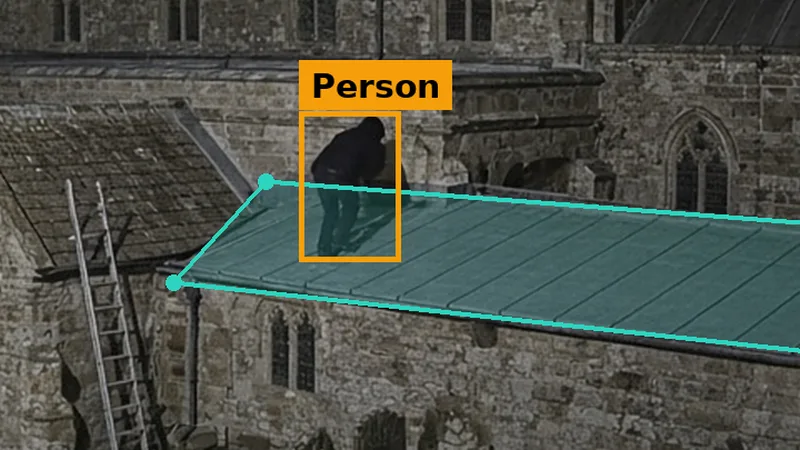
Last updated 1 November 2026. A parish church is one of the most valuable buildings in its community and one of the least watched. It may be open for a service on Sunday morning, a toddler group on Wednesday and a concert once a month, but for most of the week, and almost every night, nobody is there. It often stands in a churchyard behind walls and yew trees, away from the nearest house, with a lead roof, a vestry full of silver and a stack of bins by the wall.
Those empty hours are when lead and copper are stripped from church roofs, when vestries are broken into, when bins are set alight against the walls, and when the damage is not found until the rain comes through the ceiling. This guide covers the main risks to UK churches and other historic places of worship, what the figures show, what Historic England, the Church of England and the police advise, the permissions you need before fitting cameras, where cameras should watch, and how AI on the CCTV already at the church can watch the roof lines, the gate, the doors and the bins. It is written for churchwardens, parochial church councils, clergy, diocesan staff, trustees of other places of worship and their installers.
What are the main security risks to a church?
A medieval village church, a Victorian town church, a cathedral and a modern chapel look very different. But most of them face the same four kinds of risk, and almost all of those risks peak when the building is empty, which for most churches is most of the time.
- Metal theft. Lead and copper from the roof, and lead downpipes, hoppers, gutters and lightning conductors. Historic England says most metal stolen from church roofs is lead, and that the overwhelming majority of thefts target Church of England parish churches.
- Arson and fire. Fires set in bins, sheds and porches, fires started inside by people who have walked in through an open door, and accidental fires from candles, heaters and electrics, all in a building that may be empty for days.
- Break-ins and theft. The vestry, the safe, communion silver, candlesticks, sound and audiovisual equipment, tools, the collection and anything else of value, plus stone, statues and memorials from the churchyard.
- Damage and antisocial behaviour. Broken windows, graffiti, damage to memorials, litter, drug use and fires in the churchyard at night.
These risks overlap. Someone stripping lead from a roof may break a window or a gutter on the way up. Someone who walks in through an open door during the day may come back at night. A fire started in a bin against the vestry wall can reach the eaves and the roof timbers. That is why church security works best when it is planned for the whole site, from the lych gate to the top of the tower, rather than one measure at a time.
The cost of an incident is often far bigger than what was taken. A few hours on a roof can leave a church with water pouring through the ceiling onto medieval wall paintings, an organ or a timber floor, a long wait for repairs that need permission and specialist craftspeople, and a congregation that has to worship somewhere else. The Church of England says that most of its churches are listed buildings, so much crime against them will be classed as heritage crime: any offence which harms the value of heritage assets and their settings.
How many churches and historic places of worship are there?
The Church of England alone looks after a vast estate. The National Churches Trust’s Annual Review 2025–2026 says there are approximately 16,200 Church of England churches and cathedrals, that over 12,000 are listed for their architectural or historic importance, and that around 4,300 are listed at Grade I, making the Church of England responsible for about half of the Grade I listed buildings in England. The Church of England’s own figures are similar: over 16,000 church buildings in England, and 12,500 listed by Historic England.
Many of those buildings are already fragile. The same review says that 927 of the 969 places of worship on the 2025 Heritage at Risk Register are Church of England church buildings. A church that is already struggling with its roof and its rainwater goods has the most to lose if lead is stripped and the rain gets in.
The Church of England is only part of the picture. Roman Catholic, Methodist, Baptist, United Reformed, Orthodox and independent churches, the Church in Wales, the Church of Scotland and the churches of Northern Ireland, and synagogues, mosques, gurdwaras and temples all add thousands more places of worship. We found no single official national figure for crime against places of worship, so this guide uses guidance from Historic England and the Church of England, police figures and reported cases.
Why is lead stolen from church roofs?
Because it is valuable, there is a lot of it, it is easy to cut and carry, and the building is usually empty. Historic England’s guidance on the theft of metal from church roofs (HEAG306) is blunt about who does it: theft of metal from church roofs is frequently a serious and organised crime, often planned and researched, and it may involve modern slavery. It can happen during the day or night. Thieves may dress as legitimate workers in broad daylight, or strike in dark and wet weather when they are unlikely to be seen or heard.
Two more points from the same guidance matter for anyone planning cameras. First, thieves often remove lead in manageable quantities, which may lead to repeat visits to clear the site, so a first visit that is noticed can prevent the rest. Second, metal theft often causes great damage because it goes undetected for days or even weeks: on a church that is visited only on Sundays, the first sign may be water on the floor.
The problem has not gone away. The Church of England says the Scrap Metal Dealers Act 2013 has helped to reduce the incidence of metal theft, but that it is still seeing regular incidents of theft from church roofs. Rising metal prices make it worse. In its Rural Times newsletter for spring 2026, Hampshire and Isle of Wight Constabulary said that in the period December 2025 to February 2026, metal theft had increased by 114% compared with the same period the previous year. That figure covers all metal theft in the force area, not churches alone, but churches were among the targets.
Recent cases show the pattern:
- Droxford, Hampshire. In August 2026 the Meon Valley Times reported that thieves had targeted St Mary and All Saints Church overnight, stealing lead from the roof, and that police wanted to hear from anyone with CCTV footage.
- Easington, County Durham. The BBC reported in March 2026 that lead had been stolen from the roof of St Mary’s Church in three separate attacks, in May 2023, January 2025 and February 2026, and that the lead removal resulted in water ingress, which caused damage inside the church.
- Ansdell, Lancashire. In December 2025 Lancs Live reported that police said a church had been targeted on five separate occasions, with the offences happening in the early hours. The church had to install CCTV cameras, anti-vandal paint and motion sensor lights, and the police were given full access to live CCTV footage, including motion activation alerts.
- Christchurch, Dorset. After lead flashing was taken from a church, Dorset Police warned, as reported by the Bournemouth Echo, that thieves often target roof coverings, rainwater pipes and lightning conductors, and that if the church is listed this is also a heritage crime. They recommended gates, fences, bollards, security lights, CCTV and roof alarms, and asked people to be alert to vehicles or individuals claiming to carry out repairs.
Repeat visits, the early hours, and CCTV with alerts are the common threads. Our metal theft prevention guide covers metal theft from yards, sites and substations as well as churches.
What makes a church roof easy to reach?
Historic England’s guidance asks a set of questions that any churchwarden can answer by walking round the church after dark. Is there a side of the building with a low roof, porch or adjacent oil tank that would make it easy to gain access? Could a van or lorry be parked nearby? Is there a convenient wheelie bin, wheelbarrow or ladder in the churchyard? Is the church overlooked, or hidden from the nearest houses by trees and walls?
The answers point to the first, cheapest measures:
- Remove climbing aids. Lock away ladders, move wheelie bins and barrows away from the walls, and keep oil tanks and low structures from becoming a step up.
- Anti-climb paint. Historic England suggests anti-climb paint on drainpipes and roof guttering, not below a height of 2 metres, with signs warning that it has been applied.
- Mark the metal. Forensic marking makes stolen lead traceable, and signs saying it has been used deter thieves.
- A roof alarm. Historic England says wireless movement detectors are likely to be the most appropriate for protecting historic buildings, and that, depending on your insurance requirements, motion sensor alarm systems should be considered before CCTV.
- Security lighting. Particularly at roof level, but there may be good reasons why lighting is not feasible, for example if there are bats present, in which case take expert advice.
- Control vehicle access. A locked gate or bollards on the path that a van would use to reach the church.
Historic England says it does not consider fear of theft a justification for removing lead and copper roof coverings that are in good working order. Replacing a stolen roof with another material needs permission and the advice of your church buildings adviser, so the aim is to protect the roof you have.
How likely is a fire at a church?
Most traditional churches are not a high fire risk day to day, but when a fire does happen in an empty church it can be devastating. The fire safety guide for traditional church buildings published by the Institution of Fire Engineers Heritage Special Interest Group with Historic England says church buildings of traditional construction usually have a low fire risk, but that arson attacks and accidental fires do occur, and when churches are unoccupied there is a potential for serious fires to develop.
- Bins and sheds. The guide says sheds and external bins, particularly plastic ones, are a target for arsonists, so they should be sited away from windows, doors or eaves.
- Open doors. Many churches open their doors to visitors who are free to come and go without supervision, and the guide says video surveillance should be considered to discourage theft or arson attacks.
- Candles and chairs. The guide describes the fire at Peterborough Cathedral in November 2001, when an arsonist placed a votive candle in a stack of plastic chairs. The fire destroyed 200 of the chairs, and soot coated every surface of the building.
- Empty hours. Fire detection is invaluable for protecting unoccupied buildings when it is connected to an alarm receiving centre or to pagers held by churchwardens, but the guide warns that some fire and rescue services may not respond to automatic alarms, so a keyholder may need to investigate and then call 999.

A church is also covered by fire safety law. The guide says that in Anglican churches the parochial church council, as a body corporate, is the responsible person, and GOV.UK says the responsible person must carry out a fire risk assessment and review it regularly. That assessment should cover the outside of the building at night, not only the inside during services.
Cameras that already watch the churchyard can also watch for smoke and flame around the clock, by the bins, the sheds, the porch and the oil tank. Our arson prevention guide and outdoor fire detection guide cover how that works outdoors.
Why are churches more at risk during building works?
Historic England says buildings are particularly attractive to thieves when building work or scaffolding is on site. A scaffold is a ready-made way onto the roof; a contractors’ compound full of tools, cable and materials sits in the churchyard for weeks; and lorries and vans coming and going make a thief’s van look normal.
- Hoarding and fencing. The guidance suggests scaffolding is hoarded to a height of 3.5 metres to deter climbers, and that site fencing should be at least 2 metres high.
- Ladders. Remove or board scaffold ladders at the end of every working day.
- Who is on site. Ask the contractor for a list of who should be on site and when, so that a stranger in work clothes on a Saturday afternoon stands out.
- Hot work. Roof work with torches and burners is a fire risk. Agree a hot work permit and a fire watch afterwards with the contractor.
- Who gets the alerts. Agree in writing who receives camera alerts while the scaffold is up, and who calls whom.
A zone drawn over the scaffold and armed from the time the contractors leave until they return is one of the simplest and most useful things a camera can do during works. The example in the area chooser below shows how.
Do you need permission to fit CCTV to a church?
Usually yes. For Church of England churches, CCTV is covered by the faculty system rather than planning permission. The Faculty Jurisdiction Rules 2015 list the installation of closed circuit television for security purposes, and the installation of security and fire alarms, in List B of Schedule 1: matters that can go ahead without a full faculty once the archdeacon has been consulted and has given notice in writing. Under rule 3.3, the archdeacon must seek the advice of the Diocesan Advisory Committee, and can decide that a faculty is needed instead.
- What to submit. List B says details of cameras and other equipment, their proposed location and the location of any cable runs are submitted to the archdeacon.
- Privacy. Regard must be had to guidance from the Church Buildings Council on privacy and the protection of personal data.
- Electrics. Any work to an electrical installation must be done by someone whose work is covered by an accredited certification scheme.
- Fixings. The fire safety guide advises fixing cables into the mortar joints rather than the stone, so that the fabric of the building is not damaged.
- Cathedrals. The Church of England’s CCTV guidance says cathedrals should talk to their Fabric Advisory Committee.
Other denominations work differently. The fire safety guide explains that six major Christian denominations, the Church of England, the Church in Wales, the Roman Catholic Church, the Methodist Church, the United Reformed Church and the Baptist Union, are exempt from the usual listed building controls and run their own approval systems, while all other denominations and faith groups are subject to the normal controls, so a listed synagogue, mosque or chapel of another denomination may need listed building consent. Historic England also notes that permission may be required for prevention measures that alter or mark a historic building. Whatever your denomination, talk to your church buildings adviser before anything is fixed to the walls.
Using the cameras you already have can make this simpler. Adding AI detection to existing cameras changes what happens to the video, not what is fixed to the building (an edge server needs only a power socket and a network connection), although you should still tell your archdeacon or adviser what the system does and check that it fits the terms of the original approval.
Is there funding for security at places of worship?
Some places of worship can get help. The Protective Security for Faith Communities Scheme, previously called the Places of Worship Protective Security Scheme, helps eligible faith communities in England and Wales improve security at places of worship and associated faith community centres that are vulnerable to hate crime. Measures are recommended following a security assessment by experts and installed by the scheme’s delivery supplier, and they can include CCTV, window protection, secure fencing or gates and external lighting.
The scheme does not fund measures you have already bought or installed, and Jewish and Muslim sites are covered by other schemes, so check the current GOV.UK page for eligibility before you apply. Diocesan and denominational grants, heritage funders and local trusts may also help with roof alarms, lighting and repairs. Ask your diocese or church buildings adviser what is open to you.
Why are churches hard to protect?
A church is not a normal building. It is designed to be open, it is often old and fragile, it sits in a churchyard that the public may walk through, and it is looked after mostly by volunteers.
- Open by design. Many churches are open by day for prayer and visitors, and the Church of England encourages it. An open church is harder to secure than a locked one.
- Roofs and walls. Large lead roofs, low aisles and porches, buttresses and towers give many ways up and many places to hide.
- Isolation. Rural churches may be some distance from the nearest house, behind walls and old trees.
- Movement everywhere. Trees, bats, owls, foxes and the occasional visitor to a grave confuse simple motion detection.
- Volunteers. Churchwardens and keyholders have other lives, and nobody can watch a church all night.
- Heritage and privacy. Every fixing may need permission, and cameras must respect worship and private prayer.
Those are the reasons a church needs a plan for its cameras, rather than more cameras. ProtectUK’s site security advice starts from the same idea for any site: understand who should be there, control the ways in, and make sure anything unusual is seen and acted on.
Where should cameras watch at a church?
Many churches already have a few cameras, often at the main door, in the porch or over the car park, sometimes fitted after a theft. The question is whether they cover the places where things go wrong, and whether anyone sees the footage before Sunday. Walk round the church at dusk with the camera views on a phone and ask, for each risk, which camera would see it.
- The roof lines. Low aisle roofs, the porch roof, valley gutters, downpipes and the base of the tower, seen from a camera high enough to look along the roof rather than up at the gutter.
- The gate, lane and car park. Every vehicle that pulls in after dark, and especially any that stops close to the walls.
- The doors. The main door, the porch, the vestry and any side or boiler-house door.
- The bins, sheds and oil tank. Where fires are set and where climbing aids are found.
- Building works. Scaffolding, hoarding and the contractors’ compound, for as long as they are there.
Historic England says CCTV systems should be fit for purpose and capable of capturing suitable images during the hours of darkness, should comply with the latest British Standard, and should be installed and maintained by a company approved by the National Security Inspectorate or the Security Systems and Alarms Inspection Board. It also notes that CCTV is the most complex system to install, manage and maintain, which is why it matters that someone actually sees what the cameras see. Each camera needs power, a connection and enough light or infrared at night. Check what each one sees in fog, in rain and in winter, when the leaves are off the trees.
How does AI on existing CCTV protect a church?
Recording-only CCTV shows what happened after the churchwarden finds the rain coming through the roof. AI detection tells someone while it is happening, and in the case of lead theft that can mean before the first sheet is rolled up. Woodcock AI connects to the IP cameras and recorders already on site, over RTSP or ONVIF, including Hikvision, and runs on an edge server on site or on a cloud server.
- Polygon zones. Draw a zone of any shape over the aisle roof, the porch roof, the valley gutters, the vestry door or the bins, and leave out the windows, the public footpath, the neighbours’ gardens and the graves where people visit by day.
- Direction-aware lines. Draw a line across the gate or the car park entrance and choose which direction counts, so a vehicle driving in after dark raises an alert while traffic on the lane is ignored.
- People and vehicles. Detection counts people and vehicles, so owls, bats, foxes, pigeons and moving yew branches do not.
- Smoke and flame. The same cameras watch for smoke and flame around the clock, by the bins, the sheds, the porch and the oil tank.
- Schedules. Each zone and line has its own hours, so the roof can be armed day and night, the churchyard paths after the church is locked, and the gate overnight, all built round services and events.
- Alerts with the clip. Each alert arrives in the app and by email with a short clip and an AI description of what happened, so the churchwarden, keyholder or monitoring centre receiving it can decide quickly what to do.
The system is self-learning. It learns each camera, so the trees moving in the wind, the floodlights coming on and the bell ringers arriving for practice become part of the normal view, and marking an alert as correct or false feeds into retraining for your site. Woodcock AI has been in development for years and is now running on customer sites across the UK.
Woodcock AI does not read number plates or identify people. It flags that a person or vehicle is somewhere it should not be, and the clip shows what happened.
Coming next: Ask your cameras Coming soon, early 2027, which will let you ask the system questions about what your cameras have seen.
What does AI detection look like around a church?
The rules depend on the part of the site. Choose an area to see an example of how a camera there is set up and what an alert looks like. A roof alert is shown at the top of this page.
Which part of the church are you protecting?
Many roof thefts need a vehicle close by: lead is heavy, and thieves often take it in loads and come back. Historic England asks whether a van or lorry could be parked near the church. A line across the gate or the entrance to the car park, set to count vehicles coming in and armed overnight, flags a van pulling in after dark, while cars passing on the lane are ignored. A zone over the parking area flags someone on foot there at night. Our perimeter intrusion detection guide covers gates and lines in more detail.
Lych gate, lane, parking, verges
The churchyard is where people approach the doors, the vestry and the low roofs, and where antisocial behaviour, damage and fires in bins tend to start. A zone over the paths and the ground beside the north and south walls, armed after the church is locked, flags a person walking up to the vestry door, trying the porch or carrying a ladder. Draw it to leave out the public footpath, the neighbours’ gardens and any graves where people may be visiting by day, and set its hours to match the times the church is open.
Paths, porch, vestry and side doors
Historic England warns that buildings are particularly attractive to thieves when building work or scaffolding is on site. A scaffold is a ready-made ladder to the roof, and a contractors’ compound full of tools sits in the churchyard for weeks. A zone over the scaffold and the boards, armed from the time the contractors leave until they return, flags anyone on it at night. Agree with the contractor who receives the alerts and that scaffold ladders are removed or boarded each evening.
Scaffold, hoarding, contractors’ compound
Each roof, door, gate and works area gets its own zones and lines, with its own schedule.
How does AI detection compare with other church security measures?
No single measure protects a church on its own. Locking up and key control keep the building shut; anti-climb paint, removing climbing aids and marking the metal make the roof harder to strip and the metal harder to sell; roof alarms and lighting detect and deter; and cameras see what is happening. The table compares the usual options.
| Measure | What it does | Strengths | Watch out for |
|---|---|---|---|
| Locking up and key control | Keeps the building shut when nobody is there | Cheap and expected; the basis of everything else | Does nothing about the roof, the churchyard or the bins outside |
| Anti-climb paint and removing climbing aids | Makes downpipes, gutters and low roofs harder to climb | Low cost; recommended by Historic England | Only above 2 metres; may need permission; does not stop a ladder |
| Forensic marking of metal | Makes stolen lead and copper traceable | Helps the police link metal to your church; signs deter | Works mostly after the event |
| Roof alarm | Detects movement on the roof and raises an alarm | Recommended by police and Historic England; may be what your insurer expects | Needs a monitored response; wiring and fixings need permission |
| Security lighting | Lights the roof and the approaches at night | Deters, and helps cameras see | May disturb bats and neighbours; may need expert advice and permission |
| Recording-only CCTV | Records what happened | Evidence after the event | Nobody sees it until the rain comes through the ceiling |
| AI on existing CCTV | Recognises people, vehicles, smoke and flame, in zones and on lines you draw, on a schedule | Watches the roof lines, the gate, the doors and the bins at once; the alert includes the clip | Cameras need a clear view, power, a connection and enough light or infrared at night |
How do you stop false alarms on church cameras?
Churchyards are full of things that move. Yews and limes sway, ivy flaps, floodlights switch on and off, car headlights sweep across the walls, and owls, bats, foxes, deer and pigeons are out all night, especially at rural churches. A system that alerts on every pixel that changes soon gets ignored by the volunteers who receive it.
- Count only people and vehicles, so wildlife, trees and weather are ignored.
- Draw zones that leave out the noise: trees, ivy, the public footpath, the lane and the neighbours’ gardens.
- Use direction on lines, so only vehicles coming in through the gate count, not those passing on the lane.
- Set schedules that match the church’s week, so each zone is armed only when nobody is expected there.
- Use the feedback button to mark false alerts, so the system learns your site.
Our guide to reducing CCTV false alarms covers this in more detail.
How should detection schedules fit round services?
A church has a rhythm that a schedule can follow. Services, weddings, funerals, choir and bell practice, flower arranging, cleaning rotas, concerts and community groups bring people at known times; nights, and most weekdays, bring nobody. The cameras should be armed where and when nobody is expected, and quiet where people have every right to be.
- Roof zones: armed day and night, since nobody should be on the roof unless roof work has been booked. Historic England’s warning that thieves may dress as workers in broad daylight is the reason to keep the roof armed by day too.
- Churchyard paths and doors: armed from locking up until the church opens.
- Gate and car park: an inbound vehicle line armed overnight.
- Interior cameras: the Church of England’s CCTV guidance says interior cameras covering areas of public worship must be turned off during any form of service, while exterior cameras and cameras in areas not used for public worship should remain in operation during services. Build every service into the schedule.
- Smoke and flame outside: on around the clock, every day.
Review the schedules at Christmas, Easter and harvest, and whenever the pattern of services or events changes. A flower arranger at the porch on a Saturday morning is expected; a ladder against the aisle wall at 02:14 is not.
Who responds when an alert fires at night?
An alert is only useful if someone acts on it. Before the cameras go live, agree who receives which alerts and at what hours, what they should do, and who they call. For most parishes that is a rota of churchwardens and keyholders, a monitoring centre, or both, and the person receiving the alert may live some distance from the church.
- Check the clip first. The clip and the AI description usually show whether it is a person on the roof, a vehicle at the gate or smoke by the wall.
- Call 999 for a theft in progress or a fire. Historic England says that if the crime is in progress you should call the police immediately using 999, because this is a serious heritage crime and you should use the emergency number. Give the address, the way in, the part of the church and what you can see on the clip.
- Never go alone. A churchwarden should never go to confront thieves on a roof or in a dark churchyard. Wait for the police.
- Review every alert. Mark it correct or false, and fix what it revealed: a ladder left out, a bin by the wall, a dark corner or a schedule that does not match the week.
The National Police Chiefs’ Council requirements for security systems say police response to an intruder alarm with a unique reference number (URN) is withdrawn after three false calls in a rolling 12 months, another reason to keep false alerts down and to have alerts checked by a person before the police are called. Our out-of-hours site security checklist covers response planning for any site.
What should you do after lead is stolen?
Historic England’s guidance sets out what to do once a theft has happened, and the first priority is the weather, not the paperwork.
- Cover the roof. Historic England recommends tarpaulins or plastic sheeting as an emergency covering, and calls this a top priority, as even a small amount of rain ingress can cause a huge amount of damage very quickly. Use a competent roofer, not volunteers on ladders.
- Report it as a heritage crime. When you report the theft, say that the building is listed and ask for the incident to be recorded as a heritage crime, and keep the incident reference.
- Keep the evidence. Save the camera clips before they are overwritten, photograph the damage, and keep any marked metal offcuts.
- Tell the right people. Your archdeacon or church buildings adviser, your insurer, and your neighbours, who may have seen a van or heard noises.
- Plan the repair. Repairs to a listed roof need the right permissions and materials; talk to your adviser before deciding what goes back on.
Historic England adds that the sentencing guidelines for theft, criminal damage and arson now highlight the theft and damage of heritage assets, so good evidence and a heritage crime record matter.
How do you work with volunteers, neighbours and the police?
Church security depends on people more than on equipment. The Church of England’s security and crime prevention guidance puts the basics first.
- Lock up. The Church of England says lock your church after dark unless there is a service or someone present, and lock away valuables and money.
- Keys. Keep keys safe and maintain a list of keyholders. Change locks and codes when keys go missing.
- Neighbours. People who live near the church are its best watchers. Ask them to report vans, ladders, lights or noise at night, and to be wary of people claiming to carry out repairs, as Dorset Police advise.
- Graffiti and damage. Remove graffiti as soon as it is discovered, and repair damage quickly so the church does not look neglected.
- The police. Get to know your local neighbourhood or rural crime team and any heritage watch scheme in your area, and report every incident, however small.
- Volunteers watching cameras. The Church of England’s CCTV guidance says a Security Industry Authority licence will not be needed if the person overseeing the CCTV is a volunteer or a direct employee of the church.
Cameras support all of this. A clip of a van at the gate at 23:41 and a figure on the roof at 02:14 gives the police something to work with, and an alert with that clip gives a keyholder a reason to call 999 rather than wait until morning.
How does data protection apply to church CCTV?
Church cameras see worshippers, visitors, mourners at graves, children at groups and often public footpaths and neighbouring homes. The Church of England’s CCTV guidance sets out rules that suit any place of worship:
- Private prayer. Interior CCTV must not record any areas set aside for private devotions, where one would not expect to be filmed while praying.
- Services. Interior cameras covering areas of public worship must be turned off during any form of service.
- Signs. Signs must be placed at all pedestrian and vehicular entrances.
- Retention. All CCTV images must be retained for no longer than 31 calendar days from the date of recording, unless they are needed as evidence or for the investigation of an offence.
- Storage. Where recordings are stored on a cloud server, the Church of England says the storage should be located in the UK or the European Economic Area.
- Audio. It is difficult to justify audio recording.
- Impact assessment. A data protection impact assessment where the processing is likely to be high risk.
The Information Commissioner’s Office guidance on video surveillance expects the same things: a clear purpose, signs before people enter the recorded area, footage kept only as long as needed and kept secure. Polygon zones help: a zone over the roof watches the roof and not the people below it, windows can be masked out, and a footpath, a neighbour’s garden or a part of the churchyard where people visit graves can be left out entirely. Woodcock AI does not use facial recognition, identify who anyone is or read number plates. Our AI CCTV and GDPR guide has more.
How do you get started?
Start with the basics: lock up after dark, keep a list of keyholders, move bins and ladders away from the walls, apply anti-climb paint where it is allowed, mark the metal, talk to your insurer about a roof alarm, and make sure your fire risk assessment covers the outside of the building at night. Then map the cameras you already have: what each covers, what it sees at night, and where trouble has happened before.
Our site assessment looks at the cameras already at your church and the zones, lines and schedules that would cover the roof lines, the gate, the doors and the bins, and tells you honestly where a camera cannot do the job. To see it working first, we can run a live test on your cameras: we connect two or three of them for about a fortnight. We can also arrange an on-site demo. If your diocese or group looks after several churches, ask about watching them together. See how the same approach works for other buildings that stand empty for long periods in our vacant property security guide, and for schools in our school security guide.
What are the limits of cameras at a church?
- A camera needs a view. It cannot see behind a buttress, through a yew tree or onto a roof it does not look along.
- It needs light or infrared at night. Check what each camera actually sees in the dark, including the far side of the church and the top of the tower.
- It needs power and a connection. If either is cut, cameras and alerts stop.
- It detects; it does not stop anyone. Locks, anti-climb measures and roof alarms still have to do that.
- It does not replace fire or intruder alarms. Smoke detection on cameras is an early warning outside, on top of the fire risk assessment and the fire and intruder alarms your insurer expects.
- It does not read number plates or identify people. It flags people and vehicles in zones and on lines; the clip shows what happened.
- Someone has to respond. An alert is only useful if someone acts on it.
Sources
- National Churches Trust, Annual Review 2025–2026 (August 2026).
- Church of England, Our churches.
- Historic England, Theft of Metal from Church Roofs: Prevention and Response (HEAG306) (September 2021).
- Institution of Fire Engineers Heritage Special Interest Group and Historic England, Fire Safety for Traditional Church Buildings of Small and Medium Size.
- Church of England ChurchCare, CCTV and Security and crime prevention.
- The Faculty Jurisdiction Rules 2015, Schedule 1 (List B) and rule 3.3, legislation.gov.uk.
- GOV.UK, Protective Security for Faith Communities Scheme.
- Hampshire and Isle of Wight Constabulary, Rural Times, spring 2026.
- Meon Valley Times, Thieves target Droxford church in overnight lead theft (August 2026).
- BBC News, lead thefts from St Mary’s Church, Easington (March 2026).
- Lancs Live, lead thefts from a church in Ansdell (December 2025).
- Bournemouth Echo, Dorset Police warning to churches after lead theft in Christchurch.
- GOV.UK, Fire safety in the workplace.
- ProtectUK, Site security.
- National Police Chiefs’ Council, Police Operational Advice and Security Industry Requirements for Response to Security Systems (March 2024).
- Information Commissioner’s Office, Guidance on video surveillance, including CCTV.
We have summarised these sources in our own words. Always read the current versions in full. This page is general guidance, not legal, faculty, fire safety, insurance or security advice; your archdeacon and Diocesan Advisory Committee or your denomination’s buildings adviser, the police, your fire risk assessor, your insurer, your monitoring centre and a competent installer decide what applies to your church.
Want to know when someone is on your church roof tonight?
Book a site assessment and we will look at the cameras at your church and plan zones, lines and schedules for the roof lines, the gate, the doors and the bins, built round your services, with smoke and flame detection outside from the same cameras. Or ask for a live test on your cameras first: we connect two or three of them for about a fortnight.
Related pages
Frequently asked questions
How do you stop lead being stolen from a church roof?
Historic England advises removing climbing aids such as bins and ladders, applying anti-climb paint above 2 metres, marking the metal, controlling vehicle access, fitting a roof alarm and security lighting, and having a plan for what to do if a theft happens. Cameras with AI detection add an alert, with the clip, when someone is on the roof or a vehicle pulls in at night, so a keyholder can call 999 while it is happening.
Do you need permission to put CCTV on a church?
For a Church of England church, usually yes. CCTV and security alarms are in List B of the Faculty Jurisdiction Rules 2015: you consult the archdeacon, who takes the advice of the Diocesan Advisory Committee, and you can go ahead once you have written notice, unless a faculty is required. Other denominations have their own systems, and listed places of worship of other faiths may need listed building consent.
Can church CCTV record during services?
The Church of England says interior cameras covering areas of public worship must be turned off during any form of service, and interior cameras must never record areas set aside for private prayer. Exterior cameras and cameras in areas not used for public worship should stay on during services. A detection schedule can follow the same pattern.
What should you do if lead is stolen from your church?
If the theft is in progress, call 999, as Historic England describes it as a serious heritage crime. Afterwards, cover the roof with tarpaulin or sheeting as a top priority, report the theft and ask for it to be recorded as a heritage crime, save the camera footage, and tell your archdeacon or buildings adviser and your insurer.
How long can a church keep CCTV footage?
The Church of England says CCTV images must be kept for no longer than 31 calendar days from the date of recording, unless they are needed as evidence or for the investigation of an offence. It also expects signs at every pedestrian and vehicle entrance and, where cloud storage is used, storage in the UK or the European Economic Area.
Does Woodcock AI need new cameras at a church?
Usually not. It connects to existing IP cameras and recorders over RTSP or ONVIF, including Hikvision, and runs on an edge server on site or on a cloud server. A site assessment shows which cameras already cover the roof lines, the gate, the doors and the bins, and where moving or adding a camera would help.
Last reviewed 1 November 2026