

Flammable storage fire safety: gas cylinders, LPG, drums and IBCs
To store flammable gases and liquids safely at a UK workplace, assess them under DSEAR and in your fire risk assessment, keep the smallest amounts you need, and store cylinders, drums and IBCs outdoors where practicable in ventilated, secure, separated stores, with spills contained. Keep pallets, waste and other fuel away, control hot work, plan for the fire service, and watch each store so a fire nearby is seen in minutes.

Last updated 2 November 2026. Walk round almost any UK yard, workshop, farm or industrial unit and you will find somewhere that flammable things are kept. A cage of propane cylinders for site vehicles or the heaters. Acetylene and oxygen on a welding trolley. A row of drums of diesel, oil or solvent on a bund. An IBC of something that came with a hazard label. A steel cabinet of paint, thinners and aerosols. A few spare LPG bottles behind the canteen. Most of these stores sit quietly for years and never cause a problem.
But when a fire starts anywhere near one, everything changes. A fire that would have been a few burnt pallets becomes an incident with dozens of firefighters, cylinders being dragged clear and cooled, a cordon across the estate, roads closed and neighbours told to keep their windows shut. In 2026 alone, fires involving gas cylinders closed part of the A13 in east London, kept crews at an industrial site in Reading for almost seventeen hours, and threatened a farm building full of ammunition in Suffolk.
This guide is for owners, managers, health and safety leads and fire safety leads at UK workplaces that keep flammable gases or liquids: industrial units and workshops, builders’ merchants and yards, vehicle repairers and breakers, farms and estates, warehouses, manufacturers, waste and recycling sites, contractors’ compounds and anyone else with a cylinder cage or a drum store. It explains what the law asks of you, what the main guidance says about how to store gases and liquids, what recent fires show about how cylinders turn an ordinary fire into a major incident, and how to make sure that a fire near a store is seen quickly, at any hour.
It is general guidance, not a DSEAR assessment or a fire risk assessment of your site. The rules on separation, quantities and construction are detailed and depend on what you keep and how much. Your fire risk assessor, your gas supplier, your insurer and your local fire and rescue service can help with your own premises, and we link to the original guidance throughout.
What counts as a flammable store
The Dangerous Substances and Explosive Atmospheres Regulations 2002, usually shortened to DSEAR, use the term dangerous substances. The Health and Safety Executive’s guidance gives examples that will be familiar to most businesses: petrol, liquefied petroleum gas (LPG), paints, varnishes, solvents, and some dusts. In practice, most flammable stores at ordinary workplaces hold one or more of four kinds of thing.
- Gas cylinders. LPG (propane and butane) for site vehicles, heaters, cooking, roofing torches and process work. Acetylene and oxygen for welding and cutting. Other gases for particular jobs, from argon mixtures to refrigerants. Cylinders hold gas under pressure, or as a liquid under pressure in the case of LPG, and that pressure is what makes them so dangerous in a fire.
- Flammable liquids. Petrol and diesel in cans and drums, solvents, thinners, paints, inks, adhesives, cleaning products and oils. HSE guidance on storing them, HSG51, covers containers up to 1,000 litres, which takes in everything from small tins to drums and intermediate bulk containers, the 1,000 litre plastic tanks in a metal cage known as IBCs.
- Aerosols. Spray paints, lubricants, cleaners and adhesives. Each can is small, but a pallet or a cage of them holds a lot of flammable propellant, and burning cans can burst and travel.
- Flammable waste. Used rags and wipes, part-empty tins and drums, contaminated absorbent and empties waiting for collection. Waste is easy to forget, and it often ends up stored in the worst place, against a fence or a building wall.
One point catches people out. A nominally empty cylinder or drum is not empty. It still holds gas or vapour, and a drum that once held a flammable liquid can be more dangerous than a full one, because the space inside is filled with vapour and air. That is why the LPG industry’s storage code covers full and empty cylinders alike, and why a nominally empty container deserves the same care as a full one until it has been returned or collected.
Some businesses keep far larger quantities: bulk LPG tanks, fuel tanks, chemical warehouses or sites that fall under the Control of Major Accident Hazards Regulations. Those need specialist advice and their own guidance, and we touch on them only in passing. This guide is about the stores that ordinary businesses have, which is where most of the problems turn up.
Why cylinders change a fire
Most of the flammable things in a store do not start fires on their own. A drum of diesel or a cylinder of propane, stored properly and left alone, is very unlikely to catch fire. The danger is what happens when a fire starts nearby, in a stack of pallets, a skip, a vehicle, a hedge, a building or a pile of waste, and reaches the store.
As a cylinder heats up, the pressure inside rises. Cylinders have relief valves and are built to withstand a great deal, but a cylinder heated in a fire for long enough can fail. Kent Fire and Rescue Service sets out the consequences of a cylinder exploding in plain terms: travelling fireballs, projectile hazards, structural damage to nearby buildings, death and injuries, and impact on the community and business. A burning drum of solvent can split and release a pool of burning liquid. Plastic containers can melt. HSG51 warns that plastic containers involved in a fire can fail within a period of perhaps only ten minutes.
That is why firefighters treat cylinders so seriously. When crews arrive at a fire and are told there are cylinders on site, or find them, their priorities change. If they can safely reach them, they will move them away from the fire and cool them with water. If they cannot, they may have to fight the fire from further back, set up a hazard zone, evacuate neighbours and close roads, and cool the cylinders from a distance until they are sure they are safe.
The hazard zone
The size of the area affected can be the biggest cost of all. Kent Fire and Rescue Service warns that any fire involving acetylene will cause severe disruption and could involve a 200 metre radius hazard zone, for up to 24 hours. It lists what that can mean: people having to leave their homes, businesses closing, roads closed, including motorways, rail services suspended, and schools and hospitals closed and evacuated. When Royal Berkshire Fire and Rescue Service dealt with a fire involving gas cylinders at an industrial property in Reading in February 2026, a 200 metre cordon was put in place.
On a typical industrial estate, a 200 metre circle takes in a lot. It can cover the units either side and across the road, the estate road and the main road beyond it, car parks, other businesses’ stores and, in many towns, homes. Every business in it may have to stop work and send people away, through no fault of their own, while the fire service deals with a store that is not theirs. Where the fire started is often only a small part of the cost.
Acetylene
Acetylene, widely used for welding and cutting, has a particular reputation. It can decompose when heated, and a cylinder that has been in a fire can stay a hazard for some time after the flames are out. Kent Fire and Rescue Service says that every year, fire and rescue services attend hundreds of fires and incidents involving acetylene cylinders, and that the risk of explosion can last for up to 24 hours after a fire has been put out.
The British Compressed Gases Association (BCGA) explains how the fire service approach has changed. From 2003 until November 2012, fire and rescue services in the UK usually cooled acetylene cylinders involved in a fire with water for at least 24 hours, with a hazard zone of 200 metres maintained throughout, which often caused major disruption. Research coordinated by the BCGA with the HSE and others led to revised fire service guidance in November 2012, based on a one hour cooling and one hour monitoring protocol for acetylene cylinders exposed to direct fire. The BCGA says the national guidance is regularly updated but that protocol remains unchanged.
That is better news than it used to be, but it still means hours of disruption, and the protocol only starts once crews can reach and cool the cylinders. Kent Fire and Rescue Service suggests that businesses think about whether they need acetylene at all, listing alternatives such as arc welding, oxy-propane, TIG and MIG welding, mechanical cutting, and using a subcontractor for welding. If you do use it, it asks you to tell your local fire and rescue service, store only what you need, store cylinders upright, and store them securely outside when the building is not occupied.
Seven fires involving cylinders in 2026
These are seven UK fires from 2026, reported by fire and rescue services and local news, in which gas cylinders were part of the incident. We include them because they show what cylinders do to an ordinary fire, not to criticise anyone involved. We have not named the businesses, and the causes of most of these fires had not been reported when we looked.
- Reading, 1 February 2026. Royal Berkshire Fire and Rescue Service received reports of a fire at an industrial property on Milford Road at 11:56pm on a Sunday night. Crews from nine of its stations were sent, with an aerial ladder platform and command unit, and crews from Surrey, Hampshire and Isle of Wight, and Oxfordshire. They found a fire involving gas cylinders. One person was placed in the care of the ambulance service. A 200 metre cordon was put in place, and crews were on scene for about 16 hours and 46 minutes.
- Belvedere, south-east London, 4 March 2026. London Fire Brigade sent four fire engines and around 25 firefighters to a fire at a warehouse on Keats Road. About 50 wooden pallets and half of the external cladding on a one storey unit were destroyed, and the cladding on another unit was damaged. Five 18 kg cylinders on the site were removed by firefighters and cooled, the Brigade explaining that gas cylinders can explode when exposed to heat. The first call came at 16:20 and the fire was under control by 17:18. The Brigade believed the cause was combustibles placed too close to a heat source.
- Barking, east London, 7 April 2026. Around 80 firefighters were called to a fire on Ripple Road involving the roof of a commercial property and a number of outbuildings. A number of gas cylinders were removed and cooled. Residents were advised to keep doors and windows closed because of smoke, and there were long queues on the A13. The cause was unknown when reported.
- Wetherden, Suffolk, 22 April 2026. Suffolk Fire and Rescue Service was called at 1:46pm to a barn of about 15 metres by 15 metres storing workshop equipment and propane cylinders. Early reports said the fire was spreading to an adjacent building containing live ammunition. Crews from eight Suffolk stations attended, with Norfolk crews assisting, and their first focus was to remove the largest risks, the propane and the ammunition.
- Corby, Northamptonshire, 4 July 2026. Crews were called just before 10:50am to an industrial unit on The Grove. The fire spread through the roof and destroyed the unit, which held diesel fuel and gas cylinders, and firefighters worked to stop it spreading to neighbouring businesses, two of which suffered smoke damage. Crews from seven stations attended.
- Kirby Misperton, North Yorkshire, 30 August 2026. A fire started in two farm barns during a violent thunderstorm on a Sunday evening, with crews responding at 8:32pm. One barn was empty and the other held straw. North Yorkshire Fire and Rescue Service said crews set up a dam to cool three propane cylinders and monitored their temperature with a thermal imaging camera.
- Barnsley, South Yorkshire, 5 September 2026. Ten fire engines were sent to a fire thought to have broken out at a bus and coach breakers yard on Boulders Bridge Lane, Carlton, on a Saturday night. South Yorkshire Fire and Rescue Service described it as an extremely challenging incident, with gas cylinders present making conditions potentially dangerous for firefighters, and four engines were expected to stay for at least the next 24 hours.
What they had in common
None of the reports says the cylinders started the fire. In Belvedere the cause was combustibles near a heat source, at Kirby Misperton a thunderstorm, and in the others the cause had not been reported. What the cylinders did was make each incident bigger, longer or more disruptive: more crews, cooling and cordons, roads closed and neighbours affected.
Several of the fires also involved ordinary, burnable material next to the cylinders: pallets in Belvedere, workshop equipment in Wetherden, straw at Kirby Misperton, vehicles in Barnsley. That is the pattern fire services warn about. Gas cylinders and flammable liquids are rarely the first thing to burn, but they are often stored next to the first thing to burn.
And in nearly all of them, the size of the response tells its own story. A fire that is found when it is a smouldering pallet or a burning bin can often be put out with an extinguisher, or by the first crew to arrive. A fire that has reached a store of cylinders can take dozens of firefighters and many hours. The difference is usually measured in minutes.
When the fires started
The reports give call times for five of the seven fires. They range from mid-morning to almost midnight. Corby was reported just before 10:50am on a Saturday, Wetherden at 1:46pm, Belvedere at 16:20, Kirby Misperton at 8:32pm on a Sunday, and Reading at 11:56pm on a Sunday. No call time was given for Barking, though live news coverage ran into the late afternoon, and Barnsley was on a Saturday night.
Seven fires are far too few to draw conclusions about timing in general, and we are not suggesting that fires at flammable stores happen at any particular hour. What they do show is that there is no safe time. Some started during the working day, with people on site. Others started at weekends, in the evening or at night, when the site was likely to be empty and the first people to notice may have been neighbours or passers-by.
That has a practical consequence. Any arrangement for spotting a fire near a store has to work all the time: during the day, when people are busy and nobody is looking at the yard, and at night and weekends, when there is nobody there at all. It also matters for security, because an unattended store at night is where theft, tampering and arson happen. We come back to both later in this guide.
The law on storing flammable gases and liquids
There is no single law called the flammable storage regulations. Instead, a few pieces of law apply to almost every business that keeps flammable gases or liquids, and a set of HSE and industry guidance explains how to meet them in practice. Insurers and fire services will expect your arrangements to reflect all of it.
DSEAR
The Dangerous Substances and Explosive Atmospheres Regulations 2002 are the main law. HSE describes DSEAR as placing duties on employers, and on the self-employed, to protect people from risks to their safety from fires, explosions and similar events in the workplace, including members of the public who may be put at risk by work activity. HSE’s guidance says employers must:
- find out what dangerous substances are in their workplace and what the fire and explosion risks are;
- put control measures in place to either remove those risks or, where this is not possible, control them;
- put controls in place to reduce the effects of any incidents involving dangerous substances;
- prepare plans and procedures to deal with accidents, incidents and emergencies involving dangerous substances;
- make sure employees are properly informed about and trained to control or deal with the risks;
- identify and classify areas of the workplace where explosive atmospheres may occur, and avoid ignition sources in those areas.
HSE’s short guide to DSEAR, INDG370, explains that the regulations take a hierarchical approach. You should first consider whether you can remove the risk by replacing the dangerous substance with a safer one, or by using a different process. Where that is not reasonably practicable, it lists the control measures in order: reduce the quantity to a minimum, avoid or minimise releases, control releases at source, prevent an explosive atmosphere forming, including by ventilation, collect and contain any releases, avoid ignition sources, avoid conditions that could lead to danger, such as exceeding pressure or temperature limits, and keep incompatible substances apart.
For a typical store, that order translates into a series of plain questions. Do you need this substance at all, or is there a safer one? Do you need this much of it on site? Is it stored where a leak would disperse safely? Would a spill be contained? What could set it alight? What else is stored next to it? What would you do if it caught fire? Your answers, and what you do about them, form the core of your DSEAR risk assessment.
The Fire Safety Order
The Regulatory Reform (Fire Safety) Order 2005 applies to almost all non-domestic premises in England and Wales, with equivalent law in Scotland and Northern Ireland. It requires the responsible person, usually the employer or whoever controls the premises, to carry out a fire risk assessment and to put in place and maintain the fire precautions it identifies. The Order includes specific duties where dangerous substances are present.
Kent Fire and Rescue Service makes the point that the assessment should take account of the impact that a fire involving a cylinder might have on surrounding premises and people. In other words, it is not enough to think about the risk of a store catching fire. You also need to think about what happens to the neighbours, the road and the people on site if a fire nearby reaches it, and what you will tell the fire service when it arrives.
The two assessments overlap, and many businesses combine them or have the same person carry them out. What matters is that the stores are in them: where each one is, what it holds and how much, what is around it, how it is protected, how a fire near it would be found, and what happens next.
The guidance that explains how
DSEAR and the Fire Safety Order set out what must be achieved, but not exactly how. For that, most businesses turn to three documents, all free to download:
- HSG51, The storage of flammable liquids in containers. HSE’s guidance on storing flammable liquids in containers up to 1,000 litres, including drums, cans and IBCs, in the open air, in storerooms and in cabinets and bins. It covers separation distances, spill containment, ventilation, ignition sources, security, means of escape and firefighting.
- BCGA Code of Practice 44, The storage of gas cylinders. The British Compressed Gases Association’s code for storing gas cylinders of all kinds, revised in 2022. It sets out the principles of cylinder storage and refers to further BCGA guidance on separation distances and security.
- Liquid Gas UK Code of Practice 7, Storage of full and empty LPG cylinders and cartridges. The LPG industry’s code for storing LPG cylinders, which applies where the total quantity stored is more than 15 kg. We quote the 2021 edition, which is free to download. Liquid Gas UK published a new edition in September 2026, so check the current version before relying on any figure.
HSE also publishes guidance on LPG and, for larger sites, technical measures for handling drums and cylinders. If you keep larger quantities, or a site that may come under the Control of Major Accident Hazards Regulations, get specialist advice.
Storing flammable liquids: drums, cans and IBCs
HSG51 sets out a simple principle. The safest place to store flammable liquids in containers is usually outside, in the open air, in a well-ventilated area where a leak can disperse, away from buildings, boundaries and anything that could set it alight. If they have to be stored inside, it should be in a dedicated storeroom, a fire-resisting cabinet or bin, or a separate building, and only in the amounts needed.
Separation distances
For outdoor stores, HSG51 gives minimum separation distances between the store and buildings, site boundaries, process units and fixed sources of ignition. They depend on how much is stored. For a store of up to 1,000 litres, the distance is 2 metres. For between 1,000 and 100,000 litres, it is 4 metres. Above 100,000 litres, it is 7.5 metres. HSG51 also says the maximum stack size should be 300,000 litres, with at least 4 metres between stacks, and that containers should not be stored within a tank bund, or within 1 metre of the bund wall.
A fire wall can reduce these distances. HSG51 says it should be at least 2 metres high, and at least as high as the stack, and describes how far it should extend. Separation is about giving people time to escape and stopping a fire in one place spreading to another: from the building to the store, or from the store to the building.
Bunds and spills
A leaking drum or a split IBC can release a lot of liquid quickly. If it is flammable, a spill that spreads across a yard or under a building creates a much bigger fire risk than the drum on its own. HSG51 says outdoor stores should have spill containment, such as a bund, a sill or a drainage channel, that can contain at least 110% of the capacity of the largest container. It also notes that plastic containers involved in a fire may fail within perhaps only ten minutes, so spill containment needs to allow for a fire, not just a slow leak.
Keep spill kits close to drum stores, and keep the bund clear of rainwater, rubbish and old containers, so it still has room for a spill. Check drums and IBCs for damage, corrosion and leaks, especially plastic IBCs that have been outside in the sun for a long time or knocked by a vehicle. And make sure drains near the store cannot carry a spill, or burning liquid, away from the site.
Weeds, waste and housekeeping
Some of the most practical advice in HSG51 is about what surrounds the store. It says the area within 1 metre of the sill or bund should be kept substantially free of vegetation, that dead vegetation should be removed promptly, and that weedkillers that are themselves a fire risk, such as sodium chlorate, should not be used to control it. The same thinking applies to everything else that burns. Pallets, skips, bins, packaging, waste and vehicles do not belong next to a flammable store.
Storing gas cylinders
BCGA Code of Practice 44 sets out the basic principles for storing gas cylinders. Stores should be well ventilated, preferably outdoors, have adequate security and meet the separation distances in BCGA guidance. Every store should be based on a site-specific risk assessment, and the code refers to a separate security vulnerability risk assessment. HSE’s technical guidance on drum and cylinder handling also says the preferred method of storage is in the open air.
- Outdoors and ventilated. A leaking cylinder outside, in a mesh cage, disperses. The same leak inside a closed room or container can build up. Open-sided cages and compounds, with mesh fencing that does not block the air, are the norm.
- Upright and secure. Cylinders containing liquefied gases should be stored upright, so that a leak is of gas rather than liquid, and acetylene cylinders upright too. CP 44 says cylinders stored vertically should be no more than one cylinder high unless the store is designed for it, that every cylinder should be held securely so it cannot fall over, and that valves should be closed while cylinders are in store.
- Segregated and not overstocked. CP 44 says cylinder storage areas should be segregated from other stores, and that the risk assessment should consider the hazards of the gases and of other processes or stores nearby, including on neighbouring sites. It also advises avoiding excessive levels of stock.
- Lit and signed. CP 44 says stores should have adequate lighting, including where it is needed to help with security, and sets out the safety signs and warning notices a store needs.
- Damaged cylinders. Unserviceable cylinders should go back to the owner or gas supplier as soon as practicable, and cylinders that have been in a fire or exposed to high temperatures need specific handling under BCGA guidance.
LPG cylinders
LPG gets its own code because it is so widely used and because it is heavier than air, so a leak can sink and collect in drains, pits and low ground. Liquid Gas UK’s Code of Practice 7 says LPG containers should be stored in a well-ventilated area, outdoors where this is reasonably practicable, and it says LPG shall not be kept below ground level, for example in cellars, basements or pits, and that there should be no opening into buildings, cellars, underground services or pits within 2 metres of an LPG store.
The 2021 edition sets out separation for typical outdoor stores. For example, it says not more than 50 kg of LPG in cylinders should be stored within 3 metres of a vessel containing flammable liquid, a bund round a vessel of highly flammable liquid, vent pipes or dispensers for flammable liquids, compressed gas cylinders, cylinders containing dissolved gases such as acetylene, or explosive or combustible materials. For larger stores, the distances to buildings and boundaries depend on the quantity.
On security, the code says measures to prevent tampering and vandalism shall be taken, and that, unless otherwise protected, every LPG storage area shall be surrounded by a substantial fence at least 1.8 metres high to discourage trespassing or tampering. It describes a lockable compound of robust industrial wire mesh, welded panels or chain link as appropriate in many situations, and says compounds must have two or more exits, so people can escape. Any extra security measures must not interfere with the ventilation of the store.
When it has to be indoors
Not every business can keep everything outside. A workshop may need a cylinder on a trolley at the bench, a shop may sell aerosols and paints, a lab or a maintenance room may need small amounts of solvent. The guidance accepts that, but asks you to keep indoor quantities small, store them in fire-resisting cabinets or purpose-built rooms, keep them away from exits and ignition sources, and take them back to the outdoor store when they are not needed.
For acetylene, Kent Fire and Rescue Service asks businesses to store cylinders securely outside when the building is not occupied, and, if they are used inside, to keep the trolley close to an exit. Its reasoning is simple: if a fire starts in the building at night, a cylinder outside in a secure store is much less likely to be involved, and much easier for crews to deal with.
Keeping ignition sources away
DSEAR asks you to avoid ignition sources where flammable gases and liquids are stored and used. In practice that means no smoking or naked flames near stores, with clear signs and a set smoking place well away, electrical equipment that is suitable for the area, vehicles and chargers kept away, and hot work controlled. It also means thinking about heat. The Belvedere fire in March 2026 was believed to have been caused by combustibles placed too close to a heat source, and five 18 kg cylinders had to be pulled clear and cooled.
Drums and IBCs, steel stores and LPG compounds
Most sites have more than one kind of store, and each needs its own place, its own controls and its own view. The three most common are bunded drum and IBC stores, steel walk-in stores and cabinets, and LPG tanks and cylinder compounds.
What do you store?
Drums, IBCs and cans of fuel, solvent and paint need a bunded, ventilated store, away from buildings and boundaries, with spills kept in. Keep pallets and waste away, keep the vegetation down, and keep the store in view of a camera with smoke detection running all the time.
Flammable liquids outside
A steel store or fire cabinet keeps small amounts of flammable liquid and aerosols contained and locked. It still needs to sit away from buildings and fuel, with nothing stacked against it. A yard camera with smoke detection on the store and a people zone at night covers it where it sits.
Walk-in stores and cabinets
LPG is stored outdoors where practicable, in a fenced, ventilated compound with two exits, kept clear of other gases, flammable liquids and anything that burns. A camera on the compound with smoke detection all the time and a people zone at night watches the store and the fence.
Bulk tanks and cylinder cages
Each kind of store gets a view that suits it: drum and IBC bunds, steel flammables stores, and LPG tanks and cylinder cages, seen from a unit wall, a yard pole, a gatehouse or a fence post.
Security: theft, tampering and arson
A flammable store is a fire risk and a security risk at the same time, and the two are linked. Cylinders, fuel and solvents are worth stealing. A store left open, or a valve or tap tampered with, can cause a leak. And a fire set deliberately against a fence, in a skip or in a pile of pallets next to a store can do far more damage than the same fire anywhere else on the site. Both HSG51 and BCGA CP 44 treat security as part of the fire safety of a store, not as a separate subject.
HSG51 says you should prevent unauthorised access to stores, and protect them against trespass, tampering, vandalism and arson, with suitable fencing and lockable gates, keeping the area locked when it is not in use, with access to the keys restricted to authorised people. It goes on to say that, as necessary, you may consider additional security measures including CCTV, intruder alarms and security patrols. BCGA CP 44 says access to each cylinder store should be restricted to authorised people, that security arrangements should include controls to prevent unauthorised access, theft, tampering, arson and vandalism, and that access keys, cards or codes should be kept in a secure location and issued only to authorised people. Where a security perimeter is used, it should meet the ventilation requirements and be at least 1.8 metres high.
Security that does not block safety
There is a tension here, and the guidance is clear about how to resolve it. A store needs to be secure, but it also needs to be ventilated, so that a leak can disperse, and people need to be able to get out of it quickly in a fire. HSG51 says security measures should not compromise other safety requirements. It recommends fencing such as palisade, welded mesh and chain link, which does not obstruct ventilation and is made of non-combustible material, and says gates and doors that are fire exits should be readily openable whenever the compound or store is occupied. A solid hoarding or a tarpaulin wrapped round a cylinder cage may stop people seeing in, but it also stops the air moving.
HSG51 also covers escape from fenced compounds. It says a store within a fenced security compound should normally have at least two exits, well spaced apart, so that people can turn away from a fire and find a way out, although a single exit may be enough in small stores where no part is more than 25 metres from the exit, measured around the containers. Exits should open outwards and be immediately openable by people escaping.
The store at night
Most stores are busiest during the day and empty at night. That is when the security risks are greatest. A cylinder cage at the back of a yard, a drum store behind a unit or a steel store at the edge of a builders’ merchant can be out of sight of the road, the gatehouse and any neighbours. Someone climbing the compound fence, cutting the mesh or forcing a store door may not be noticed until the morning, when stock is missing or damage is found.

Good basic security goes a long way: a robust mesh fence, a decent padlock or lock, key control, lighting, and not leaving cylinders, cans or drums outside the store at the end of the day. Keep the store away from the site boundary where you can, so it cannot be reached from a public footpath or a neighbouring yard. Keep skips, pallets and waste away from it, so there is nothing ready to burn if someone does get close. And record what is in each store, so you can tell quickly whether anything has gone.
Cameras add something that fences and locks cannot: they tell you, at the time, that someone is there. A camera on the store with a people zone inside the compound and a line along the fence, armed when the site is closed, can send an alert with a short clip the moment someone crosses into the area. That gives a keyholder or a monitoring centre the chance to act, or to call the police, while it is still happening. The same camera, with smoke detection running all the time, will also see a fire started nearby.
Hot work near a store
Welding, cutting, grinding, brazing and roofing torches are among the most common causes of fires at workplaces, and they are often done close to where gases and liquids are kept: the welding bay next to the cylinder cage, the maintenance job on a building next to the drum store, the roofer’s torch on a unit with an LPG compound below. Some of the fires that start this way are found hours later, after the workers have gone home.
- A permit. Use a hot work permit for any work near a store, including by contractors. It should say what work is being done, where, what precautions are needed and who is responsible.
- Distance. Where you can, move the work away from the store, or move the cylinders, cans and drums away from the work, before it starts.
- Protection. Where nothing can be moved, shield the store with non-combustible screens and make sure sparks cannot reach it, including through gaps, drains and cladding.
- A fire watch. Keep someone watching the area during the work and for a period afterwards, and check again before the site is left. Many hot work fires smoulder for a long time before they show.
Smoke detection on a camera that can see the store adds a watch that does not go home. It does not replace a permit or a fire watch, but it carries on looking after the fire watch has finished and the site is empty. For more on hot work, see our guide to hot works fire risk.
Inventory, checks and records
You cannot manage a store if you do not know what is in it. A surprising number of sites cannot say, at short notice, how many cylinders they have, of what gases, or how many litres of what liquids are in the drum store. That matters for the DSEAR and fire risk assessments, for the insurer and, above all, for the fire service on the night.
- An inventory. A list of every store, what it holds, roughly how much, and where it is on a site plan. Update it when deliveries arrive and empties go back.
- Assessments. The DSEAR risk assessment and the fire risk assessment, and the actions from them.
- Routine checks. Regular checks of cages, fences, locks, bunds, drums, IBCs and cylinders for damage, leaks, corrosion and missing labels, and of the area round each store for weeds, waste and pallets. CP 44 includes a section on routine management checks of cylinder stores.
- Training. Who has been trained to handle cylinders and liquids, to use spill kits and extinguishers, and on what to do if there is a fire.
Keep a copy of the inventory and site plan somewhere the fire service can find it, such as a premises information box at the entrance, and make sure whoever meets the crews has it. Kent Fire and Rescue Service specifically advises acetylene users to keep plans of the location of their acetylene cylinders.
What firefighters need
Firefighters arriving at a fire need to know quickly whether there are cylinders or flammable liquids on site, what they are, how many and where. Without that, they have to assume the worst, which usually means a bigger cordon, more caution and a longer incident. With it, they can plan how to tackle the fire and, if it is safe, get cylinders out and cool them early, as crews did in Belvedere, Barking and Wetherden.
- Tell them in advance. Kent Fire and Rescue Service asks businesses that use acetylene to inform their local fire and rescue service. Many fire services welcome information about sites with significant quantities of gases or flammable liquids, and some will visit.
- Plans and signs. A site plan showing each store, and signs on stores and at the entrance, help crews find what they need.
- Access. Make sure gates can be opened quickly and keys are available. CP 44 says arrangements should be in place to allow a cylinder store to be unlocked in the event of an incident, and that store keys, cards or codes should be kept securely, with a log.
- Someone to meet them. On the night, someone from the site should meet the crews, tell them what is stored and where, and tell them what they know about where the fire started. A clip showing the first smoke, and where it came from, can save time.
After a fire
Once a fire involving cylinders is out, the hazard may not be. The fire service will decide when cylinders are safe and when people can return, and that can take some time, especially with acetylene. Do not go back into the area until the crews say so.
Do not use any cylinder that has been in a fire or exposed to heat, even if it looks undamaged. Tell your gas supplier, who will arrange to collect it; the BCGA’s guidance on cylinders in fires sets out the industry approach. Check drums, IBCs, cabinets and bunds for damage before using them again. Keep the clips, alerts, inventory and photographs, which your insurer and any fire investigator will want. Then review your DSEAR and fire risk assessments before restocking, and ask what would have helped the fire to be found sooner.
Why the outdoor store is a blind spot
Most fire detection on a commercial site is inside the buildings: smoke detectors and heat detectors wired to a fire alarm panel. That makes sense, but it leaves a gap. The places where the guidance says gases and liquids should be kept, outdoors, in the open air, away from buildings and towards the edge of the yard, are the places that indoor fire alarms do not cover. A smoke detector in a ceiling cannot see a pallet stack burning beside a cylinder cage 20 metres from the unit.
Some stores have gas detection, which can warn of a leak where it is fitted. But gas detection is about leaks, not fires in the material around a store, and many small stores do not have it. During the working day, someone will usually notice smoke in the yard. Out of hours, nobody may be looking at all, and the first anyone knows may be a neighbour’s call, a passing driver or the sound of a cylinder failing.
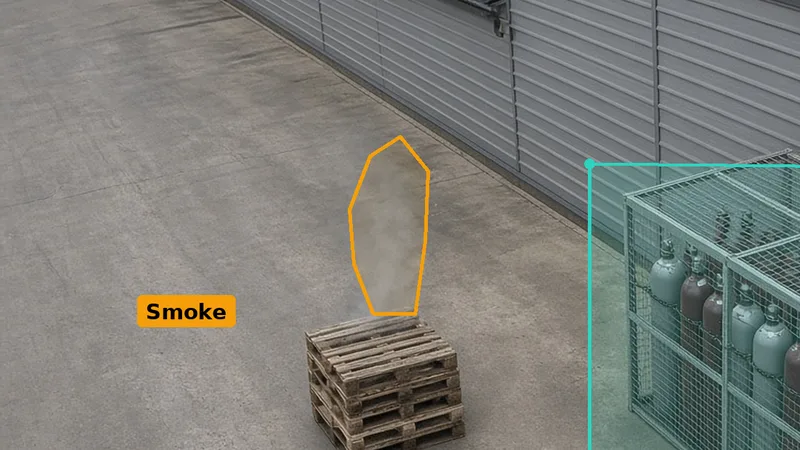
Cameras are different, because they already look at the yard. With AI detection added, a camera that can see a store watches for smoke and flame on that view all day and all night, and sends an alert with a short clip when it sees something. It is important to be clear about what this does and does not do. Cameras do not detect gas or vapour. They do not replace gas detection where it is needed, the DSEAR controls, the separation distances, the bunds or the fire alarm. What they add is early sight of smoke, flame or someone in the wrong place, at the store or close to it, at any time.
Where to put cameras to watch a store
Most sites with a cylinder cage, a drum store or a steel flammables store already have cameras that can see at least part of it. The question is whether the view is good enough, by day and at night, and whether it includes the area round the store, which is where many fires start.
- See the store and its surroundings. Aim to see the whole store and a margin of several metres round it, including any pallets, skips or vegetation nearby. A tight view of the cage door may miss a fire starting behind it.
- Mount high and fixed. A fixed camera mounted on a building wall, a pole or a gatehouse, looking down at the store, gives a stable view that detection works well on. Keep it out of reach of anyone climbing the fence.
- Think about night. Check the view after dark. Infrared or good site lighting matters, and so does avoiding glare from floodlights or headlights.
- Cover the approaches. For security, cover the gates, the fence line nearest the store and any route someone would use to reach it from outside the site.
- Keep electrics out of hazardous areas. Cameras and their cabling should not be installed inside any area classified as hazardous under DSEAR unless they are suitable for it. In most cases a camera mounted on a building or pole away from the store, looking at it, avoids the question altogether.
Data protection law applies to CCTV. The ICO publishes guidance and a self-assessment checklist for organisations covering installation, operation, public awareness and signage, and the government’s Surveillance Camera Code of Practice sets out good practice principles. Point cameras at your own site, avoid neighbouring property and public areas where you can, and use signs.
Detection schedules: smoke all the time, people when closed
Different kinds of detection suit different times. Smoke and flame detection at a store should run all day and all night, because a fire can start at any time and the consequences near cylinders are serious whenever it starts. People and line detection is useful when the site is closed, but would alert constantly during the working day when staff are collecting cylinders and drums.
A typical arrangement is smoke at the cylinder cage, drum store and steel store on all the time, with a line along the compound fence and a people zone inside the compound armed from, say, 18:00 to 07:00 and at weekends. Each site is different, and schedules should follow when your site is actually open, including early deliveries and late collections.
When the alert comes in
An alert is only as good as what happens next. Decide in advance who receives alerts for each store, what they should do, and who they should call. Write it down, make sure they have it on their phone, and test it.
- Check the clip. Look at the snapshot and the short clip with the alert. Is it smoke? Where is it, and how close is it to the store?
- Call 999. If there is a fire, call the fire service straight away. Tell them it is near gas cylinders or flammable liquids, which gases and liquids, roughly how many and where. That changes how they respond.
- Get people away. If anyone is on site, get them away from the store and out of the area. Remember that the hazard zone round a cylinder fire can be large.
- Do not fight it near cylinders. Only tackle a small fire if it is safe and you are trained, and never if cylinders are involved or being heated. Leave cylinders to the fire service.
- Meet the crews. Have someone meet the fire service with the site plan, the inventory and the keys, and show them the clip if it helps.
What insurers look for
Insurers of commercial sites tend to look closely at flammable stores, because they can turn a small fire into a large loss. Expect questions about what is stored and how much, how it is stored, separated and bunded, how it is secured, and how quickly a fire would be found and reported. Kent Fire and Rescue Service notes that your insurer may require you to tell them if you use acetylene on your premises.
Good records help: the inventory, the DSEAR and fire risk assessments, the routine checks and the security arrangements. So does being able to show how a fire at a store would be detected out of hours. For more, see our guide to what insurers expect from fire detection.
A flammable storage fire safety checklist
Use this checklist as a starting point. It does not replace a DSEAR risk assessment or a fire risk assessment, and the right controls for your site depend on what you store and how much. The table summarises the main types of store covered in this guide.
| Store | Main risk | First steps | What cameras and AI add |
|---|---|---|---|
| LPG and propane cylinders | Heated cylinders failing in a fire | Outdoors, fenced, ventilated, 3 m from other gases and liquids | Smoke detection on the cage, always on |
| Acetylene and oxygen | Hazard zones, long cordons | Upright, secured, outside when the building is empty | Smoke detection where cylinders are kept |
| Drums and IBCs | Spills, pool fires, plastic failing | Bunded store, separation distances, spill kit | A smoke zone drawn round the bund |
| Steel stores and cabinets | Fire spreading from outside | Nothing stacked against them, locked, labelled | Smoke detection on the store view |
| Surroundings | Pallets, waste and weeds catching | Keep the area clear, no sodium chlorate | Smoke seen in the gap next to the store |
| Compound and gates | Theft, tampering, arson | Mesh fence, locks, key control, lighting | A line on the fence and a people zone at night |
| Firefighters | Unknown contents and layout | Inventory, plan, tell the fire service, meet crews | Clips showing where the fire is when crews arrive |
- Do you have an up-to-date inventory of every store, what it holds and how much?
- Have you done, and recorded, a DSEAR risk assessment and a fire risk assessment that cover the stores?
- Are gases and liquids stored outdoors where possible, in well-ventilated stores, separated from buildings, boundaries and ignition sources?
- Are drums and IBCs bunded, and are bunds clean, intact and free of rainwater?
- Are cylinders upright, secured and with valves closed, and are different gases segregated as the guidance requires?
- Is the area round each store clear of pallets, waste, skips, bins and vegetation?
- Is each store secure, with mesh fencing, locks, key control and lighting, and does security leave ventilation and escape routes intact?
- Is hot work near stores controlled by permit, with a fire watch?
- Does the fire service know about your acetylene or other significant stores, and is there a site plan for crews?
- Who would notice a fire at each outdoor store at 2am, and how quickly?
How Woodcock AI helps with flammable storage fire safety
Woodcock AI connects to existing IP cameras over RTSP or ONVIF and runs on an edge server on site or on a cloud server. It adds smoke, flame, people and vehicle detection to the cameras you already have. You draw polygon zones that fit the shape of each cylinder cage, drum bund or steel store and the area round it, rather than a rough box, draw lines along compound fences and gates, and set schedules so smoke detection runs all day and night while security zones are armed only when the site is closed. When something happens, an alert with a snapshot and short clip goes to the phones of the people you choose, and an AI description says what the camera saw.
Woodcock AI is self-learning, so it gets better at telling the normal from the unusual on each camera over time, such as the steam from a vent or the dust kicked up by a delivery lorry. It is the result of years of development and is now in use on real sites in the UK. It watches for smoke, flame and people: it does not detect gas or vapour, and it supplements rather than replaces the controls in this guide. For how the same approach fits other sites, see our pages on industrial sites, construction and polygon detection zones. Ask your cameras, a way to ask the system questions about what it has seen, is Coming soon, early 2027.
Ways to start
Start with a site assessment. We look at your cylinder cages, drum stores and flammables stores, which cameras you have and what each one sees by day and at night, and show where smoke zones, people zones and lines would help. Or ask for a live test on your cameras: we connect two or three of your existing cameras for about a fortnight, so you can see the alerts for yourself before deciding.
Sources
- HSE, HSG51: Storage of flammable liquids in containers (PDF).
- HSE, Dangerous Substances and Explosive Atmospheres Regulations (DSEAR), and INDG370: Controlling fire and explosion risks in the workplace.
- legislation.gov.uk, Dangerous Substances and Explosive Atmospheres Regulations 2002 and Regulatory Reform (Fire Safety) Order 2005.
- HSE, Technical measures: gas cylinders and LPG.
- British Compressed Gases Association, CP 44: The storage of gas cylinders, Revision 1, 2022, and Cylinders in fires.
- Liquid Gas UK, Code of Practice 7: Storage of full and empty LPG cylinders and cartridges (2021), and its announcement of an updated edition (2026).
- Kent Fire and Rescue Service, Safer use of acetylene.
- Incident reports: Royal Berkshire Fire and Rescue Service (Reading), London Fire Brigade (Belvedere), MyLondon (Barking), Suffolk Fire and Rescue Service (Wetherden) and Farmers Guide, Northants Telegraph (Corby), Gazette & Herald (Kirby Misperton) and Bus & Coach Buyer (Barnsley).
- Information Commissioner’s Office, CCTV and video surveillance, and GOV.UK, Amended Surveillance Camera Code of Practice (in effect from 12 January 2022).
We have summarised these sources in our own words. Always read the current versions in full, including any newer editions of the codes of practice. This page is general guidance, not a DSEAR risk assessment, a fire risk assessment, or legal or insurance advice; your gas supplier, fire risk assessor, insurer and fire service can advise on your own site.
Would anyone see smoke at your gas store at 2am?
Book a site assessment and we will look at your cylinder cages, drum stores and flammables stores, and what your cameras can see by day and at night, and show where smoke zones, people zones and lines would help, or ask for a live test on your cameras.
Related pages
Frequently asked questions
What does DSEAR require for flammable storage?
DSEAR requires employers to find out what dangerous substances they have and the risks, remove or control those risks, reduce the effects of any incident, plan for emergencies, inform and train staff, and identify areas where explosive atmospheres may occur and avoid ignition sources there. Flammable gases such as LPG, solvents and paints are all covered.
Should gas cylinders be stored outside?
Where practicable, yes. Guidance from the HSE, the BCGA and Liquid Gas UK favours storing cylinders in the open air in a secure, well-ventilated store, away from buildings, boundaries, drains and ignition sources. LPG should never be kept below ground level, for example in cellars or pits. Indoor storage should be the minimum needed.
Why are acetylene cylinders so dangerous in a fire?
The direct heat of a fire can, in extreme cases, start decomposition of the acetylene inside a cylinder. Kent Fire and Rescue Service warns that the risk of explosion can last for up to 24 hours after the fire is out, and that this could mean a 200 metre hazard zone, closing roads, homes and businesses nearby.
How big should a bund for drums and IBCs be?
HSE guidance HSG51 says outdoor stores of flammable liquids in containers should have spill containment, such as a bund, sill or drainage channel, able to hold at least 110% of the capacity of the largest container. Keep bunds clean, intact and free of rainwater, and keep combustible material away from them.
What keeps fires away from a flammable store?
Keep pallets, packaging, skips, bins, waste and vegetation well clear of stores; separate stores from buildings, boundaries and ignition sources; control hot work with permits and a fire watch; and secure stores against trespass, tampering and arson. Many fires near cylinders start in material stacked beside the store.
Can CCTV detect gas leaks at a cylinder store?
No. Cameras cannot see gas or vapour, so they do not replace gas detection where it is needed or any DSEAR control. What AI on existing cameras can do is watch a store and the area round it for smoke, flame and people, all day and night. Woodcock AI runs on an edge server on site or on a cloud server.
Last reviewed 2 November 2026
Diesel, gas and fertiliser on farms: see our farm fire safety guide.