

Vehicle repair garage security: break-ins, stolen cars and workshop fires
Vehicle repair garage security means protecting a garage, MOT centre, body shop or tyre and exhaust centre, and the customer cars, keys, tools and equipment inside it, from break-ins, vehicle theft, catalytic converter theft and fire, most of all when the shutters are down and nobody is there. The basics are tight key control with keys locked away and counted every night, strong doors and shutters, a locked yard gate with cars parked so none can drive straight out, a clear and sound rear boundary, a monitored alarm, lighting, petrol, paints and gas cylinders stored safely, and a fire plan that covers damaged electric and hybrid vehicles. AI on existing CCTV adds alerts with a clip when a person comes over the back wall, tries a door or crouches by a customer car after closing, a car moves towards the gate at night, or smoke appears at the workshop doors.

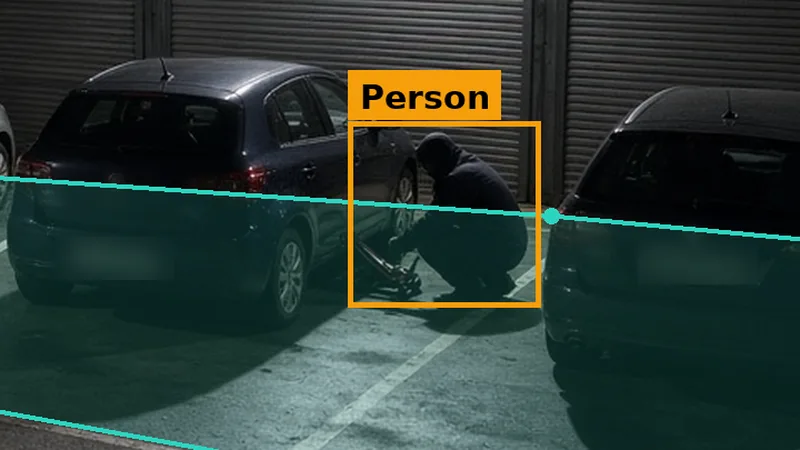
Last updated 1 November 2026. At six o’clock on a weekday evening, the shutters come down at thousands of independent garages across the UK. Inside are cars waiting for parts, cars booked in for an MOT first thing tomorrow, a body shop’s worth of half-finished repairs, and a key safe or a drawer holding every set of keys. Outside, on the forecourt and in the yard, more customer cars wait for collection. The last mechanic sets the alarm, locks the gate, and the site is empty for fourteen hours.
That is what makes a garage a target. Thieves who break in are often after the keys, because the keys turn a break-in into a car theft, sometimes several. Catalytic converters can be cut from the cars parked outside in minutes. Tools and diagnostic kit are worth stealing on their own. And because a workshop holds fuel, paints, gas cylinders, batteries and heat side by side, a fire that starts in one bay can take the whole building, and the customers’ cars with it. This guide covers the main risks to vehicle repair garages, MOT centres, body shops and tyre and exhaust centres in the UK: the figures and recent cases, what garages can do, the rules, where cameras should watch, and how AI on a garage’s existing CCTV can help.
What are the main security risks at a vehicle repair garage?
Garages range from a one-bay workshop under a railway arch to a multi-bay MOT and service centre with a body shop and a paint booth on an industrial estate. Some sit on a high street between shops and flats; others are in a farmyard or at the back of a petrol station. Whatever their size, most face the same four kinds of risk, and three of them are at their worst when the shutters are down and nobody is on site.
- Break-ins for keys. Doors, shutters and office windows forced so the thieves can search for car keys. A garage holds the keys to every car it is working on, and many it is not.
- Customer cars. Cars driven away with keys stolen in the break-in, or left where they stand with the catalytic converter, wheels or parts gone. The car belongs to a customer, which makes every loss a conversation nobody wants to have.
- Tools and kit. Hand tools, power tools, diagnostic tablets and scanners, tyre machines, welding sets and cash. Mechanics often own their own tools, so a theft hits individuals as well as the business.
- Fire. Petrol drained from tanks, hot work, paints and thinners, gas cylinders, batteries and damaged electric and hybrid vehicles, all in one building. A garage fire can start in the working day, while people are there, and still destroy the workshop.
Behind the first three is the same fact. A garage is busy from eight until six, and for the other fourteen hours it is a building full of other people’s cars and keys, with a forecourt that looks like any other car park. Many independent garages have no one living on site, and the owner may live miles away. For most of the night, the cars are watched by a fence, a gate, an alarm on the building and whatever cameras are on the walls.
This guide is about places where vehicles are repaired, serviced, tested and painted. Showrooms holding sales stock are covered in our car dealership security guide, and compounds holding cars and vans for recovery, auction or storage on our vehicle yards page.
What do the figures show about garages and vehicle crime?
There is no single official count of break-ins at garages, because the police record them as burglary and vehicle crime alongside everything else. But the figures that exist show how many garages there are, and how much vehicle crime and burglary there is around them.
- There are thousands of garages. The Driver and Vehicle Standards Agency’s MOT testing data lists 23,092 private MOT test stations in Great Britain in 2025 to 2026, with 66,925 nominated testers. That counts only the garages that test; many body shops, tyre centres and specialists do not, so the number of repair workshops is higher.
- Vehicle crime is still common. The Office for National Statistics reports that police recorded vehicle offences in England and Wales fell by 7% to 312,231 in the year ending June 2026.
- So is burglary. In the same year, police recorded burglary, which includes homes and non-residential premises such as businesses, fell by 6% to 222,304 offences.
Falling numbers are good news, but they are still large. And a garage concentrates the things vehicle thieves want: cars, keys, catalytic converters and parts, all in one place, all unattended at night. A single break-in at a garage can produce several vehicle thefts, as the cases below show.
How are garages broken into, and what is taken?
Reports of garage break-ins follow a pattern. A small group arrives in the small hours. They get into the workshop or the office, through a door, a shutter or a window. They look for keys, and then they look for the cars the keys fit. They leave in the customers’ cars, sometimes several at once, with whatever tools and cash they found on the way.
- Alyth, Perthshire (August 2026). At about 5am on a Saturday, thieves broke into a garage on Cambridge Street and took cash, several sets of keys and six vehicles, including an Audi S3, a Maserati, a Ford Transit and three motorbikes. Police appealed for information, and some of the vehicles were later recovered in Dundee.
- Linlithgow, West Lothian (February 2026). A BMW, a Skoda Octavia, tools and cash were stolen from a garage on Avonmill Road at around 2.15am on a Friday. Police said three men were seen in the area, one wearing dark clothing with his hood up.
- Blandford, Dorset (November 2025). At around 1am on a Saturday, four people got into an MOT garage at a business park on Higher Shaftesbury Road. A set of car keys was stolen and used to take a BMW parked at the garage, which was later found in Shaftesbury.
- Trentham, Stoke-on-Trent (July 2025). Police were called at 4am to a break-in at a service station garage. A Range Rover Evoque and a Land Rover Discovery were stolen, and other vehicles were left damaged. Both stolen cars were later recovered.
Three lessons stand out. The keys are the prize: at Alyth and Blandford, police said keys were taken in the break-in, and at Blandford the stolen key was used to drive away a car parked at the garage. Thieves take more than one vehicle when they can, and they do not mind whose it is. And in every case the vehicles were gone before anyone could stop them; some of those recovered were found miles away.
How should a garage control keys?
If the keys are the prize, key control is the first defence. Most of it costs time and habit rather than equipment, and all of it is in the garage’s own hands.
- A proper key safe. A locked key cabinet or safe, bolted to the structure, out of sight from the windows and the door, and not in the first room a thief reaches. A key box hanging by the reception desk is the first place anyone looks.
- Tag and log every key. Numbered tags, not registrations or customer names, and a simple log of which key is where. If the worst happens, the police need a list of every key on site and every car it fits.
- No keys in cars. Not on a seat, on a tyre, in the sun visor or on a shelf by the ramp, even for a car waiting for parts. Keys left in the cars on the forecourt make the break-in unnecessary.
- Count at closing. One person checks the keys against the log before the alarm is set, and nobody takes keys home without it being written down.
- Keyless cars. Many modern keys work by proximity. Keep them in a screened box or pouch inside the safe, and keep the safe away from the outside walls, where the cars are parked.
- Spare keys. Do not keep a customer’s spare unless you need it, and never in the same place as the main key.
Key control does not stop a break-in, but it can turn a six-car loss into a forced door and an untouched key safe. It also changes what a camera alert needs to catch: if the keys are hard to find, the thieves spend longer inside, and an alert at the door gives more time to act.
When do break-ins and fires happen at garages?
The garage break-ins in this guide all happened in the small hours. The St Helens catalytic converter thefts from parked ambulances were at around 11.20pm. Blandford was at around 1am, Linlithgow at around 2.15am, Trentham at 4am and Alyth at about 5am. Fire is different. The Little Walden workshop fire was reported at 12:22, the Wembley workshop fire at 17:09 and the Uddingston MOT centre fire at about 18:00, while the Tottenham maintenance workshop fire was reported at 22:51.
The pattern matters for planning. Theft happens when nobody is there, so detection for theft is armed after closing and through the night. Fire can start in the working day, from a job in progress, or just after closing, when a hot job, a charging battery or a smouldering rag has been left behind. That is why smoke detection on a garage’s cameras is on around the clock, and not only at night.
How do you protect customer cars parked outside overnight?
Few garages can fit every car inside at night. Cars waiting for collection, for parts or for tomorrow’s MOT are left on the forecourt, along the side of the building or in the yard, and some of them will be the most valuable things on the site. They face two risks: being driven away with stolen keys, and being stripped where they stand.
Catalytic converters are the clearest example. Police.uk says they are targeted because they contain valuable metals and can be removed in less than a minute, that the thefts happen most often in car parks, and that hybrid vehicles are most commonly targeted. A garage forecourt at night is a car park that nobody is watching, often with hybrids on it.
- The signs. Police.uk lists a vehicle being raised using a car jack and a loud drilling or cutting sound from underneath. Both are hard for anyone to hear at a garage on an industrial estate at 2am.
- Higher vehicles. Vehicles that sit high above the road are particularly vulnerable, the police say, because thieves can get underneath without jacking them up.
- Commercial vehicles. The police advice is to park them in a secure compound, and elsewhere in a well-lit, overlooked area, parked so the converter cannot easily be reached.
- Locks and marking. Locks or guards approved by the vehicle manufacturer and tested to Sold Secure Gold, and registering and forensically marking the converter, which makes it harder to sell on.
Thieves do not only target cars. In St Helens in September 2026, Merseyside Police appealed after catalytic converters were stolen from two ambulances parked at a site on College Street at around 11.20pm; the thefts were not discovered until 7am, and CCTV showed two men climbing over a fence. Recording-only cameras showed what had happened, nearly eight hours later.
For a garage, the practical steps are simple. Park the most vulnerable vehicles inside, or in the most visible, best-lit spots. Park others close together and close to the building, so nobody can get a jack under them easily. Keep vans and higher vehicles where they can be seen. And watch the parking area: a zone over customer parking, armed after closing, flags a person crouching by a car while the jack is still going under.
How do you secure the rear yard and boundary?
The front of most garages faces the road, and is lit and overlooked. The back is a different place: a yard with tyre stacks, scrap, waste oil, old parts and a gas store, backing onto other units, a lane, gardens or waste ground. That is where thieves who do not want to be seen from the road come in.
- A sound boundary. A wall, fence or palisade round the yard, checked regularly for gaps, loose panels and damage. A boundary is only as strong as its weakest stretch, and that is usually the one nobody walks past.
- A clear strip. Nothing stacked against the boundary on the inside or the outside: no tyres, pallets, bins, scrap or old cars. A stack of tyres by the back wall is a ready-made step in and out.
- Neighbours. Shared walls, flat roofs and yards next door are part of your boundary. Talk to your neighbours about what they store against the wall and whose cameras see what.
- Lighting. Light the yard and the back of the building, pointed down and away from the cameras and from neighbours’ windows.
ProtectUK’s site security guidance for vehicle operating centres and maintenance facilities makes the same points a garage should: control access to the site with fences, gates and security codes; store vehicle keys in a secure locker; and never leave keys in vehicles, on hooks in the office or anywhere easily accessible. For a garage, the boundary is the first layer, the building and the key safe are the next, and the cars are the last.
A line along the rear wall, armed all day and night, is one of the simplest detection rules a garage can have. Nobody should come over the back wall at any hour, so any person crossing it is worth an alert. Set the direction so that only crossings into the yard count, and leave out anything on the far side, such as a lane or a neighbour’s yard.
How should the gate and forecourt be secured?
Every car that is stolen from a garage has to leave by the gate or across the forecourt. A key stolen from the office is far less use if the car it fits cannot reach the road.
- A locked gate. Where the yard has a gate, shut and lock it at closing, every night. A gate left open for a late collection is an open door.
- Park cars in. Park cars so that none can drive straight out: the most valuable inside or at the back, and others nose to tail in front of them. Some garages park a van or a car with a flat battery across the exit.
- Posts and bollards. Fixed or lockable bollards in front of the shutters and across the forecourt make it harder to drive a car out, or to reverse a vehicle into the shutters.
- Lighting. Light the gate, the forecourt and the customer parking, so that cameras can see and anyone working on a car is in plain view from the road.
Garages with an open forecourt and no gate rely more on parking and posts, and on watching the forecourt. A zone over the forecourt exit, armed after closing, flags a vehicle moving towards the road when no car should move until morning. It cannot stop the car, but the alert arrives with the clip while the car is still on site.
How do you secure the workshop and the office?
The keys, the tools and the cash are inside, so the break-in starts at a door, a shutter or a window. Roller shutters are often the strongest part of the front; side doors, fire exits, office windows and the roof are often weaker.
- Doors and windows. Steel or solid doors with good locks on every entrance, including the side door and the fire exit, and office windows protected with bars, grilles or shutters where they face the yard.
- Shutters. Shutters down and locked at closing, with the controls inside. Lifting a shutter with a bar is quicker than many people think.
- An intruder alarm. A monitored alarm, set every night, covering the office, the key safe and the workshop. Test it, and keep the keyholder list current.
- Tools and kit. Diagnostic tablets, scanners and laptops locked away at night, and tool chests locked. Mark tools and equipment and keep a list of serial numbers.
- Cash. No cash on site overnight, and a sign that says so.
An alarm on the building and cameras outside work together. The alarm says someone is inside; the cameras say who is outside, how many, and whether they are at the door, the office window or the cars. A zone over the doors and the office, armed after closing, can raise an alert before the door gives way.
What about tools, parts and equipment?
Tools and equipment are a garage’s working capital, and many belong to the mechanics who use them. At Linlithgow, tools went with the cars. Parts waiting to be fitted, tyres in the store, and new and used batteries are all worth stealing, and a van backed up to the shutters can take a great deal in a few minutes.
- Lock it, mark it, list it. Lock tool chests and the parts store, mark tools and equipment with the business details, and keep a list with serial numbers and photographs.
- Diagnostics and laptops. Keep them in a locked cupboard or safe overnight, not on the bench.
- Tyres and parts outside. Store them inside or in a locked cage, not stacked against the boundary where they become a step.
- Scrap and waste. Keep scrap metal, old converters and used batteries locked away and collected regularly. A pile of scrap in the yard attracts attention.
Our metal theft prevention guide covers scrap, cable and metal theft in more depth, and our commercial burglary prevention guide covers the building.
How do you map a garage’s weak points?
Before buying anything, walk the site with a plan. Most garages have more ways in than the owner thinks, and the weak points are rarely at the front.
- The boundary. Every stretch of wall and fence, the gate, and anywhere a neighbouring roof, yard or lane meets your site.
- The building. Every shutter, door and window, including the fire exit, the office and the roof lights, and which of them can be seen from the road.
- The keys. Where they are kept, and how far a thief has to go inside to reach them.
- The cars. Where customer cars are parked overnight, which are hybrids or higher vehicles, and how each would leave the site.
- The fire risks. The fuel store, the paint store or booth, the gas cylinders, battery charging and any EV quarantine space.
Mark the cameras you already have on the same plan, and what each one actually sees at night. The gaps between the plan and the views are where to start. Our out-of-hours site security checklist gives a fuller list.
What should a garage’s closing routine include?
The cases in this guide share one thing: nobody was there. A short closing routine, done the same way every night by whoever leaves last, takes away much of what thieves rely on and many of the things that start fires.
- Keys. Counted against the log and locked in the safe. None in cars, none on hooks.
- Cars. The most valuable and vulnerable inside, the rest parked in, close together and close to the building.
- Fuel and gas. Drained petrol in the designated store, cylinders shut and stored, paints and thinners away.
- Hot work and power. No hot work in the last hour without a check afterwards. Battery chargers, heaters and compressors off unless they are meant to run.
- Doors, shutters and gate. All locked, the alarm set, and the gate shut.
A written checklist by the door, signed each night, makes the routine stick when the usual person is off.
How do fires start at garages and workshops?
Fire is the risk that can end a garage in an afternoon. The Health and Safety Executive says that fires and explosions cause serious property damage in motor vehicle repair and occasionally result in death or serious injury, and that most involve the mishandling of petrol when draining fuel tanks and lines, with other incidents during hot work.
- Little Walden, Essex (October 2026). A 1990s petrol campervan caught fire on a workshop’s MOT ramp. Crews were called at 12:22 on a Friday, and at the height of the blaze ten fire engines were there. Essex County Fire and Rescue Service said the fire was particularly challenging because of a limited water supply and the presence of acetylene cylinders. The workshop and an adjoining home were destroyed; two vehicles were a complete loss, and five or six cars in the car park were damaged by the heat. The fire was deemed accidental.
- Uddingston, South Lanarkshire (April 2026). Six fire engines were called at about 18:00 on a Monday to a fire that destroyed an MOT centre. Firefighters worked through the night to stop it spreading to an adjacent petrol station and a supermarket; the roof collapsed, and police said the fire was not believed to have been started deliberately. A customer later told the BBC that her car had still been up on a ramp inside.
- Tottenham, London (July 2026). Fifteen fire engines and around 100 firefighters were called at 22:51 to a fire at a vehicle maintenance warehouse on an industrial estate. Around 20 vehicles in the workshop were destroyed. The cause was under investigation.
- Wembley, London (August 2026). Eight fire engines were called at 17:09 to a car workshop fire that destroyed the workshop and damaged three adjoining units. London Fire Brigade said it was believed to be accidental, due to hot cutting works which ignited combustible items.

Two of these fires started in the working day, in front of the people who worked there, and still destroyed the building. Wembley started from hot cutting; Little Walden from a vehicle on the ramp. Uddingston started around closing time. In a workshop full of cars, fuel and cylinders, the minutes before anyone notices are the minutes that decide how much is lost.
What makes a garage fire start and spread?
A garage brings together everything a fire needs: fuel, heat and things that burn, including the cars themselves. The HSE’s guidance on motor vehicle repair sets out the main causes.
- Petrol. HSE says to always use a fuel retriever for draining tanks and lines, in particular after misfuelling, and never to drain petrol over or near a pit. Its leaflet on safe use of petrol in garages says drained petrol that is not going straight back into the vehicle should be stored in a designated, lockable, well-ventilated area, preferably outside the workshop, and never added to the waste-oil tank.
- Hot work. Any process that generates flames, sparks or heat, including welding, cutting, grinding and sawing. HSE suggests safer options such as cold cutting or cold repair techniques, or replacing parts rather than repairing them. The Wembley fire is a reminder of why.
- Paints and thinners. HSE warns against the inappropriate use of paints or thinners, for example to light rubbish fires or clean paint booths.
- Batteries. HSE’s introduction to motor vehicle repair warns of fire and explosion risks from battery gases, and to make sure batteries are not short-circuited.
- Gas cylinders. Acetylene, oxygen and other cylinders for welding and cutting. At Little Walden, acetylene cylinders made the fire harder to fight.
Prevention is in the workshop’s own hands: the right equipment for draining fuel, hot work done safely with a check afterwards, petrol, paints and cylinders stored properly, rubbish cleared daily, and a fire risk assessment that is kept up to date. Detection is about the time between a fire starting and someone knowing. A camera watching the workshop doors, the yard and the gas store, with smoke detection on around the clock, can raise an alert from the first visible smoke, including after the last person has gone home.
What about damaged electric and hybrid vehicles?
More garages now work on electric and hybrid vehicles, and some take in vehicles that have been in accidents or floods. HSE says the voltages in electric and hybrid vehicles are significantly higher than in other vehicles, and that their battery systems store significant amounts of energy that can give rise to explosion if not dealt with correctly.
Government guidance for recovery operators working with electric vehicles is useful for any garage that takes in a damaged one. It says a damaged battery can carry a risk of thermal runaway; that a vehicle with a suspected damaged high-voltage system should ideally be stored in an outside quarantine area, a suitable distance from anything else; that current industry guidance states a vehicle at risk of going into thermal runaway should ideally be kept 15 metres from anything else, though this may not always be achievable; and that vehicles which pose a fire risk should be monitored for up to 48 hours after an incident.
Monitoring for 48 hours is easy in the working day and hard at 3am. A camera on the quarantine space, with smoke and flame detection armed around the clock, means someone is told if smoke appears, whether or not anyone is there. Our lithium-ion battery storage fire safety guide covers battery fire risk in more detail.
What should you do if a fire breaks out at a garage?
Every garage needs a fire plan that every member of staff knows, and it should cover the hours when nobody is there as well as the working day.
- Call 999. Give the address and postcode, and tell the fire service what is inside: fuel, gas cylinders, the number of cars, and any electric or hybrid vehicles.
- Get everyone out. Staff and customers out and away from the building, to an assembly point away from the cars and the smoke.
- Stay back. Do not go back in for tools or cars, and never try to drive cars out through smoke.
- Meet the crew. Have a simple site plan ready, showing the gas cylinders, the fuel store, the paint store, the electrical isolators and any EV quarantine space.
- Out of hours. Agree who gets a smoke alert at night, who calls 999, and who goes to meet the crew with the keys.
Our hot works fire risk guide covers safe hot work and fire watches in more detail, and our guide to video smoke detection on existing CCTV explains how smoke detection on cameras works.
Which rules apply to garage security and CCTV?
Several sets of rules touch a garage’s security and fire safety, and none of them is optional.
- Fire safety. The person responsible for a workplace must carry out and review a fire risk assessment, put in place appropriate fire safety measures, and plan for an emergency.
- Dangerous substances. HSE says the Dangerous Substances and Explosive Atmospheres Regulations 2002 (DSEAR) require employers to assess the risk from using substances such as petrol and to eliminate or reduce the risk so far as is reasonably practicable.
- Health and safety. HSE’s guidance for motor vehicle repair covers fire and explosion, electric and hybrid vehicles, and the other hazards of a workshop.
- Data protection. Cameras that see staff, customers and passers-by are covered by UK GDPR and the ICO’s guidance, set out in the privacy section below.
None of these rules requires AI detection. But a fire risk assessment asks how a fire would be detected and how people would be warned, including out of hours, and a garage that knows what its cameras see can answer that question.
Why are garages hard to protect with ordinary CCTV?
Most garages already have cameras. Many were fitted for insurance, or after a previous break-in, and they record day and night to a recorder in the office. The trouble is not the cameras; it is that nobody is watching them at 2am. Recording-only CCTV shows what happened after the event, as the St Helens thefts showed, and the recorder is often in the same office the thieves are searching.
- Lots of movement in the day. Cars in and out, customers, deliveries and staff. Motion detection that alerts on every movement is useless in the working day and is usually switched off.
- Lots of nothing at night. At night, the problem reverses: foxes, cats, rain, wind and headlights from the road trigger basic motion alerts, and owners learn to ignore them.
- Cars block views. Customer cars, vans on ramps and tyre stacks hide parts of the yard, and the view changes every evening depending on where cars are parked.
- Nobody nearby. Many garages are on industrial estates or at the back of other premises, with nobody to hear a jack, a grinder or a shutter being forced.
- Fire in the day. Several of the fires in this guide started while people were working, which means a smoke alert matters around the clock, not only at night.
Monitored guarding and patrols help larger sites, but most independent garages cannot justify a guard every night. What they need is for the cameras they already have to tell someone when something that matters is happening, and to stay quiet when it does not.
Where should cameras watch at a garage?
Each camera at a garage should have a clear job. Most sites need cameras watching five places, and many already have cameras on at least three of them.
- Customer parking and the forecourt. The cars left outside overnight, wide enough to see someone crouching by a car, and lit at night.
- The rear yard and boundary. Along the back wall or fence, where people climb in, and over the tyre store, scrap and gas cage.
- The workshop doors and office. The shutters, the side door, the fire exit and the office windows, so anyone at the building is seen before they are inside.
- The gate or exit. The way out, to see any vehicle leaving when no vehicle should move.
- Inside the workshop. Over the bays, the paint area and the fuel and gas stores, for smoke, and so the key office is covered if someone gets in.
Cameras need light at night, either from good site lighting or from built-in infrared, and they need to see past where cars are usually parked. Fit them high enough to be hard to reach, and put the recorder somewhere other than the office where the keys are kept, or record off-site as well.
How can AI on existing CCTV help a garage?
Recording-only CCTV shows what happened after the event. AI detection tells someone while it is happening, in time to act. Woodcock AI connects to the IP cameras and recorders already on site, over RTSP or ONVIF, including Hikvision, and runs on an edge server on site or on a cloud server (an edge server needs only a power socket and a network connection).
- Polygon zones. Draw an area of any shape on a camera’s view, around customer parking, the forecourt exit or the workshop doors, and detect only inside it. A zone can follow the parking bays rather than a rough rectangle that takes in the road.
- Lines. Draw a line along the rear wall or the gate, and alert when a person or vehicle crosses it, in the direction you choose.
- People and vehicles. Detect people and detect vehicles moving in a zone, ignoring foxes, cats, rain and passing headlights.
- Smoke and flame. Smoke and flame detection on the cameras that see the workshop, the yard and the stores, around the clock.
- Schedules. Arm each rule for the hours that make sense: the rear wall all the time, the parking and gate after closing, smoke always.
- Alerts with the clip. Alerts arrive in the app and by email with a short clip and an AI description, so whoever gets one can see what is happening in seconds.
The system is self-learning. It learns each camera, what is normal on that view and what is not, and marking an alert as correct or false feeds into retraining for your site. Woodcock AI has been in development for years and is now running on customer sites across the UK.
Woodcock AI does not read number plates or identify people. It tells you that a person is in customer parking at 02:18, or that a vehicle is moving towards the gate at 03:22, with the clip; what happens next is up to you.
Coming next: Ask your cameras Coming soon, early 2027, which will let you ask the system questions about what your cameras have seen.
What does detection look like in each part of a garage?
Each part of a garage needs a different rule. The rear wall needs a line; the doors and office need a zone; the gate needs to know about vehicles. Choose an area to see an example.
Which part of the garage are you protecting?
Most garages back onto other units, a lane, gardens or waste ground. Thieves who cannot get in from the road come over the back wall, often using whatever is stacked against it: tyres, pallets, bins or scrap. A line along the rear wall, armed all day and night with direction set so only crossings into the yard count, flags someone coming over before they reach the doors.
Back walls, fences, shared boundaries, tyre stacks and the gas store
The keys are inside, so the break-in starts at a door. A zone over the shutters, the side door and the office window, armed after closing, flags a person at the building when nobody should be there. Draw it tight to the doors, and set it round your opening hours and any call-outs.
Roller shutters, side doors, the reception and the key office
Every stolen car has to leave by the gate or the forecourt. A zone over the gate and the exit, armed after closing, flags a vehicle moving there at night, or a person opening the gate. Leave the road, the pavement and the bus stop out of the zone.
The yard gate, the forecourt exit and the way to the road
The rear yard, the doors and the gate each get their own zones and lines, with their own schedule.
These are examples, not a fixed set. The right rules for any garage depend on its layout, its cameras and its hours, and a site assessment starts from what each existing camera can see.
How does AI detection compare with other measures?
No single measure protects a garage. The table sets out what each one does well and what it cannot do. Most garages need several, and AI on existing cameras is one layer among them.
| Measure | What it does | Strengths | Watch out for |
|---|---|---|---|
| Key control | A locked key safe, numbered tags, a log, and a count at closing | Takes away the thing most garage break-ins are after | Spare keys in drawers; keys left in cars waiting for parts; a safe that can be carried out |
| Doors, shutters and locks | Steel doors, good locks, roller shutters down and locked | Slows entry and makes noise | Side doors and office windows weaker than the shutters; shutters lifted with a bar |
| Gate, posts and parking | A locked yard gate, bollards, and cars parked so none can drive straight out | A stolen key is less use if the car cannot reach the road | Gates left open for a late collection; forecourts open to the road |
| Lighting | Lights the forecourt, the gate and the yard | Deters, and helps cameras see | Glare into cameras or neighbours’ windows; dark gaps behind vans and tyre stacks |
| Intruder alarm | Detects someone inside the workshop or office | Covers the building where the keys are | Does not cover the cars outside; police response can be withdrawn after repeated false calls |
| Converter locks and marking | Locks or guards on the converter, forensic marking | Slows the theft and helps trace the part | Only on cars whose owners have fitted them; customer cars change every day |
| Recording-only CCTV | Records what happened | Evidence after the event | Nobody sees it until the morning; hoods and gloves make identification hard |
| AI on existing CCTV | Recognises people, vehicles, smoke and flame, in zones and on lines you draw, on a schedule | Watches the cars, the doors, the gate and the back wall at once; the alert includes the clip | Cameras need a clear view, power, a connection and enough light or infrared at night; staff and animals can still cause some alerts |
How do you keep false alerts down at a garage?
We do not promise no false alerts. Cameras see the real world, and the real world includes early starts, late collections and weather. But most false alerts at a garage come from a handful of causes, and most of them can be designed out.
- Tight zones. Draw zones around the parking bays, the doors and the gate, not across the road or the pavement.
- People and vehicles only. Alert on people and vehicles, not on any movement, so animals, rain and headlights are ignored.
- Schedules that match the hours. Arm parking and gate rules after the last person leaves, and allow for the early starter.
- Direction on lines. Count only crossings into the yard, not someone walking along the lane outside.
- Feedback. Mark each alert as correct or false; the system learns from it.
- Tell the team. Staff who come in out of hours should know which cameras are armed, and who to tell.
Our guide to reducing CCTV false alarms covers this in more depth.
What detection schedule suits a garage?
A garage’s schedule follows its hours. Smoke detection runs all the time, because fires start in the working day too. Theft rules come on when the last person leaves and go off when the first arrives.
- Rear wall line: all day and night. Nobody should come over the back wall at any hour.
- Customer parking and the gate: 19:00 to 07:00. After closing and the last collection, until the first person arrives.
- Workshop doors and office: 18:00 to 08:00. From when the shutters come down.
- Smoke and flame: all day and night. Including the working day, when hot work, fuel and batteries are in use.
Adjust the times to the garage’s real hours, including Saturdays, bank holidays and the Christmas shutdown, when a garage can be empty for days.
What should happen when an alert comes in?
An alert is only as good as the response to it. Before the cameras go live, agree who gets alerts at what hours, what they should do, and who they call.
- Check the clip. Is it a person, a vehicle, smoke, or a member of staff who came back for something?
- Call 999 if a break-in or theft is in progress, or there is a fire. Tell the police or fire service what the clip shows, how many people and which way they went.
- Never confront anyone. Do not go to the site alone to tackle intruders. The police advice on catalytic converter thieves is not to approach suspects, as they have been known to use violence.
- Review. Mark the alert, save the clip, and fix what it showed.
If the garage has a monitored intruder alarm, keep it working and keep it well maintained. Under the National Police Chiefs’ Council requirements for security systems, police response to an alarm system with a unique reference number is withdrawn after three false calls in a rolling 12 months. Fewer false alarms keep the police response. Our out-of-hours site security checklist covers response planning in more detail.
What should a garage do after a break-in?
If the worst happens, what you do in the first few hours makes a difference to the police investigation and to your customers.
- Report it. Call the police, keep the crime reference, and give them the times, the clips and a list of every key on site and every car it fits.
- Preserve the clips. Save the footage from every camera before the recorder overwrites it, and do not touch anything the thieves may have handled.
- Tell the customers. Contact the owners of any car that was taken, damaged or whose keys are missing, and tell your insurer.
- Fix the gaps. Look at how they got in, how they found the keys and how the cars left, and fix those first.
Change locks and codes if keys or codes may have been taken, and recode or reprogramme any customer keys that went missing, in agreement with the owners.
Who needs to be involved?
Security at a garage is not only the owner’s job. Everyone who opens up, closes up or holds a key has a part.
- The owner or manager. Decides what is protected, who gets alerts and how they respond.
- Whoever closes up. Runs the closing routine and sets the alarm. If that changes on Saturdays, the routine still has to happen.
- The mechanics. Their tools are on site, and they know where keys and cars end up during the day.
- Neighbours. Other units, the petrol station or the flats over the road can see things you cannot, and may have cameras of their own.
- The insurer. Your insurer may have requirements for keys, alarms and cars kept overnight. Read the policy and ask.
What about privacy and data protection?
Cameras at a garage see staff, customers and sometimes the street. Under UK GDPR, the business is responsible for the footage. The ICO’s guidance on video surveillance sets out what to do.
- Focus. Point cameras at the site, not at neighbours’ homes, gardens or the public road beyond what you need.
- Signs. Put up clear signs saying CCTV is in use and who runs it.
- Retention. Keep footage only as long as you need it, and delete it after that.
- Assessment. Carry out a data protection impact assessment where the cameras are likely to be high risk to privacy.
- Audio. Leave audio recording off by default.
- Private areas. No cameras in toilets, changing areas or staff rest rooms.
Woodcock AI does not use facial recognition, identify who anyone is or read number plates. It detects people, vehicles, smoke and flame in the areas you choose, at the hours you choose. Our guide to AI CCTV and GDPR in the UK covers this in more depth.
How do you get started?
Start with the simplest steps: key control, the closing routine, parking cars in, clearing the boundary and fixing doors. Then look at what your cameras can already see.
Our site assessment looks at the cameras already at your site, what each one can see by day and night, and where zones and lines would go. To see it working first, we can run a live test on your cameras: we connect two or three of them for about a fortnight. We can also arrange an on-site demo.
What are the limits?
AI on existing cameras is useful, and it is not magic. It is worth being clear about what it cannot do.
- It only sees what the cameras see. Cars, vans and tyre stacks block views, and a camera pointed the wrong way will miss things.
- It needs light. At night, cameras need site lighting or infrared to see well.
- It needs power and a network. If the power or the network goes down, so do the cameras and the alerts.
- It detects; it does not stop. An alert does not lock a gate or stop a car. Locks, gates, posts and key control do that.
- It does not replace fire or intruder alarms. It adds to them. Keep both, and keep them maintained.
- Staff and animals. Staff working late and animals in the yard can still cause alerts, which schedules and zones keep down.
- Someone has to respond. An alert at 2am is only useful if someone sees it and acts.
Sources
- Driver and Vehicle Standards Agency, MOT testing data for Great Britain: MOT test stations and testers (2025 to 2026).
- Office for National Statistics, Crime in England and Wales: year ending June 2026.
- Health and Safety Executive, Motor vehicle repair: fire and explosion, Motor vehicle repair: introduction, Motor vehicle repair: electric and hybrid vehicles, and Safe use of petrol in garages (INDG331).
- GOV.UK, Recovery operators working with electric vehicles.
- Police.uk, Catalytic converter theft.
- Garagewire, police investigation after six vehicles stolen in Alyth garage break-in (August 2026), and STV News, six vehicles including motorbikes and a Maserati stolen during break-in at garage (August 2026).
- Edinburgh Evening News, West Lothian car theft appeal (February 2026).
- Dorset Police, appeal after a break-in at an MOT garage in Blandford (November 2025).
- Stoke Sentinel, two Land Rovers taken in Stoke-on-Trent (July 2025).
- St Helens Star, police issue appeal after catalytic converter thefts (September 2026).
- BBC News, car fire destroys Little Walden workshop and home (October 2026), drone images show aftermath of Uddingston MOT centre fire (April 2026), and a customer on her car inside the Uddingston garage (April 2026).
- London Fire Brigade, Fire at warehouse, Tottenham (July 2026), and Car workshop fire, Wembley (August 2026).
- GOV.UK, Fire safety in the workplace: your responsibilities.
- ProtectUK, Site security.
- National Police Chiefs’ Council, Police Operational Advice and Security Industry Requirements for Response to Security Systems (March 2024).
- Information Commissioner’s Office, Guidance on video surveillance, including CCTV.
We have summarised these sources in our own words. Always read the current versions in full. This page is general guidance, not legal, fire safety, health and safety, insurance or security advice; the police, your fire and rescue service, your fire risk assessor, HSE, your insurer, your monitoring centre and your installer can advise on your own site.
Want to know when someone is at a customer car on your forecourt tonight?
Book a site assessment and we will look at the cameras at your garage and plan zones, lines and schedules for customer parking, the rear yard, the workshop doors and the gate, with smoke detection around the clock, or ask for a live test on your cameras.
Related pages
Frequently asked questions
How do you stop cars being stolen from a garage?
Lock every key in a key safe out of sight, count the keys against a log every night and never leave keys in cars, park the most valuable cars inside and the rest so none can drive straight out, lock the yard gate, and keep a monitored alarm on the building. A camera zone over customer parking and the gate, armed after closing, flags a person at a car or a vehicle moving towards the exit at night.
Why do thieves break into garages?
Often for the keys. A garage holds the keys to every car it is working on, and in recent cases at Alyth and Blandford keys taken in a break-in were used to drive cars away. Tools, diagnostic equipment, cash and catalytic converters are also targets.
How do you stop catalytic converter theft from cars parked at a garage?
Police.uk advises parking in a well-lit, overlooked area or, for commercial vehicles, a secure compound, fitting a lock or guard approved by the manufacturer and tested to Sold Secure Gold, and marking and registering the converter. At a garage, parking vulnerable vehicles inside or close together near the building, and watching customer parking after closing, helps further.
What causes most fires in vehicle repair workshops?
The Health and Safety Executive says most fires and explosions in motor vehicle repair involve the mishandling of petrol when draining fuel tanks and lines, with other incidents during hot work such as welding and cutting. Paints and thinners, battery gases and damaged electric vehicles are also risks.
Will staff and customers set off AI camera alerts at a garage?
We do not promise that a member of staff, a customer or an animal will never cause an alert. Drawing tight zones around the parking bays, doors and gate, counting only people and vehicles, using direction on lines and arming theft rules only after closing keeps them down.
Does Woodcock AI need new cameras at a garage?
Usually not. It connects to existing IP cameras and recorders over RTSP or ONVIF, including Hikvision, and runs on an edge server on site or on a cloud server. A site assessment shows which cameras already cover customer parking, the rear yard, the doors and the gate, and where a camera cannot do the job.
Last reviewed 1 November 2026