

Fire detection for RDF and SRF bale stores
Sites that make, store or ship baled refuse derived fuel (RDF) and solid recovered fuel (SRF) need fire detection that raises the alarm day and night. EA rules cap RDF and SRF piles at 450 cubic metres, and EA guidance lists CCTV visual flame detection among suitable systems. Woodcock AI adds smoke and fire detection to the CCTV you already have.

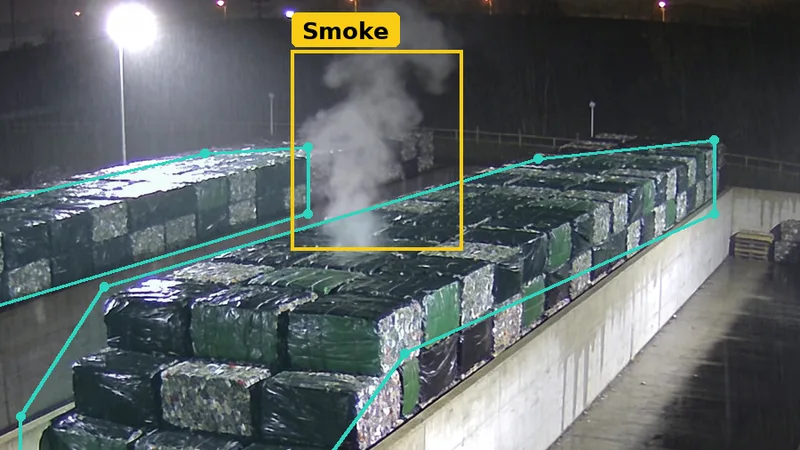
Last updated 30 October 2026. Refuse derived fuel (RDF) and solid recovered fuel (SRF) are made from residual waste that cannot be recycled. They are shredded, often baled and wrapped in plastic film, and then stored until they go to an energy-from-waste plant, a cement kiln or an export ship. While they wait, the bales are a large store of fuel, and some of the storage happens at quiet quaysides and closed yards. This page explains what the Environment Agency (EA), Natural Resources Wales (NRW), the RDF Industry Group and the WISH Forum ask of sites that store baled fuel, and how camera smoke and fire detection fits into your fire prevention plan (FPP).
What are RDF and SRF, and who stores them?
RDF and SRF are both fuels made from residual waste, such as the black-bag waste left after recycling and the residues from material recovery facilities. SRF is generally made to a tighter specification for a particular user, while RDF is a broader term. For fire planning the difference matters less than the form the material is in. The EA’s fire prevention plans guidance lists RDF and SRF among the combustible wastes it covers, and it treats loose, shredded and baled material as different forms with different limits.
Several kinds of site end up holding baled fuel:
- Producers, such as mechanical treatment plants and transfer stations that shred, bale and wrap residual waste.
- Interim stores, where bales wait for an off-taker’s delivery slot or a ship.
- Port and quayside stores, where bales are gathered for export.
- Off-takers, such as energy-from-waste plants and kilns, which hold a fuel buffer on site.
Each of these has the same basic problem. A lot of combustible material is packed into tight stacks, it is often stored outside, and nobody is on site for much of the night. If your site handles mixed residual waste before it is baled, our pages on waste transfer stations and recycling plants cover the reception halls and process lines.
Why do RDF and SRF bales catch fire?
The guidance documents point to a small number of causes, and your FPP needs a control for each one:
- Self-heating. RDF is mostly organic and plastic material. Over time, and especially if it is wet, it can heat up on its own. NRW lists RDF as at risk of self-combustion if it is stored for more than 3 months, and WISH notes that smaller particle sizes such as SRF and RDF deserve particular attention.
- Damaged wrap. The RDF Industry Group’s FPP guidance (June 2019) explains that tears in the wrap let oxygen in, which raises the chance of self-combustion. It recommends a cross-wrap system that seals the bale from all sides.
- Batteries and other hidden items. Residual waste can contain lithium-ion batteries and vapes that were thrown away in general waste. The EA guidance asks every FPP to describe how it reduces the fire risk from incorrectly disposed batteries. Our page on lithium-ion battery fires at waste sites covers this in detail.
- Solar heating. The EA’s appropriate measures say that if you store wrapped bales outside, your FPP must manage the risk from solar heating during hot weather.
- Arson. The EA guidance asks for security fencing, intruder alarms and CCTV, with arrangements for outside working hours, and asks you to describe where your CCTV and alarms are.
Most of these causes have one thing in common: they can start a fire long after the last person has left the yard. A bale that has been sitting still for weeks can still begin to smoke at three in the morning. Our waste site fire risk assessment guide shows how to assess each storage area.
What happens when a bale store catches fire?
Fires in baled waste tend to be large and long. In September 2023, letsrecycle.com reported that more than 300 tonnes of waste caught fire at an RDF facility in Chatham, Kent. Kent Fire and Rescue Service was called in the early hours, sent eight fire engines at the peak, and warned local residents to keep their windows closed.
A second Kent case shows how long such fires can last. In a news release of 30 January 2025, the EA described a warehouse in Margate that had been filled with thousands of plastic-wrapped bales of household and construction waste without an environmental permit. The building caught fire on 18 September 2018, and firefighters fought the blaze for 25 days. Roads and businesses closed and hospital operations were cancelled. The EA said that a permit would have required a plan to manage the risk of fire.
Both incidents involved bales that had been stored, not waste that was being processed. That is the gap a fire prevention plan has to close: finding a fire in a stack while it is still small, and at any hour.

What are the EA rules for storing RDF and SRF?
If your permit requires a fire prevention plan, the EA guidance sets the standard measures. For RDF and SRF, the maximum pile volume is 450 cubic metres in every form: loose material over 150mm, material between 30 and 150mm or baled, and material under 30mm. That is lower than the limits for several other wastes in the same table, such as paper and cardboard, which is why RDF piles often look small for the size of the yard.
The other standard limits apply to every pile. No pile may be more than 4 metres high or more than 20 metres long or wide. Piles must be at least 6 metres apart and 6 metres from the site boundary, buildings and other combustible material, unless a suitable fire wall is used. Fire walls must give at least 120 minutes of fire resistance. You must also keep a quarantine area that can hold at least 50% of your largest pile, with 6 metres around it.
The RDF Industry Group gives a worked example. Bales of 1.2 by 1.5 by 0.75 metres, weighing 1,000 kg each, give about 333 bales in a 450 cubic metre pile. Real bales are not perfect blocks and you need handling space, so the pile will take up more ground than the volume suggests, but the amount of fuel in it should stay the same.
The EA’s appropriate measures for non-hazardous waste facilities (section 4, updated 1 August 2023) add rules aimed at fuel bales. You must keep RDF and SRF storage times as short as possible, and you must run an auditable bale identification system so that bales leave in date order. Bales must be securely wrapped in high-density polyethylene (HDPE) membrane or an equivalent, inspected regularly and rewrapped if damaged. Securely wrapped bales can be stored outside unless your permit forbids it. All waste must be stored inside the secure area of the site.
How long can you store RDF bales?
The EA guidance says combustible waste must be stored for less than 6 months. If you keep waste at the maximum pile size for more than 3 months, you must show what extra measures you will use to prevent self-combustion, such as monitoring temperatures. The RDF Industry Group stresses a point that is easy to miss: the clock runs from when the fuel was made, not when it arrived at your site. Time at the producer, on the road and at a port all count. You should know how old the material is when it comes to you.
How old are your oldest bales?
Keep each pile within 450 cubic metres, 4 metres high and 20 metres long, with 6 metres of separation or a fire wall. Record every bale so you can ship them in date order.
The EA expects extra measures to prevent self-combustion, such as temperature monitoring. For bales, your plan must set out a sampling protocol covering at least 10% of bales, readings from the centre of bales and from bales in the middle of the pile, and how you will turn them.
Combustible waste must be stored for less than 6 months. The EA is unlikely to approve a plan that goes beyond this unless you can show the plan objectives are still met.
Natural Resources Wales sets 6 months for baled and compacted waste, 3 months for shredded waste and 1 month for fines and dusts, and lists RDF as at risk of self-combustion if stored for more than 3 months.
Count age from when the bale was made, not when it reached your site. From the EA fire prevention plan guidance (sections 8 and 9) and NRW guidance. Your own permit may set different limits.
In Wales, NRW’s fire prevention and mitigation plan guidance sets maximum storage times by form: 6 months for baled and compacted waste, 3 months for shredded waste and 1 month for combustible fines and dusts. Our guide to NRW fire prevention plan detection covers the Welsh rules.
How do you check bales for heat?
For bales stored for more than 3 months, section 8 of the EA guidance asks for more than a general promise to check temperatures. Your plan must show a sampling protocol that covers at least 10% of the bales, takes readings from the centre of bales and from bales in the centre of the pile, and explains how bales will be turned. The EA also notes that surface monitoring is unlikely to give an accurate core temperature, but can show localised heating and how temperatures are trending.
The RDF Industry Group adds practical advice for baled RDF. Regular surface monitoring should show self-heating as a small but measurable change at the surface within 24 hours. It does not recommend probing RDF bales, because a probe can let oxygen in and make self-combustion more likely. You need a trigger temperature in your plan, and it notes that 50°C is commonly used as a lower threshold. A bale above the trigger should be moved to quarantine, split and cooled; if it is below the trigger, it should be rewrapped.
The WISH Forum’s WASTE 28 guidance (issue 3, March 2020) is candid about the limits of detection. In its phase 3 fire tests, all the detection systems were effective at detecting a fire at the surface of a stack, but none was effective at detecting a deep-seated fire when the waste had a small particle size or was flexible, with few air spaces. That is why temperature checks and camera detection do different jobs, and why a good plan uses both.
How should RDF bales be stacked?
WASTE 28 explains that standard stacking, with bales directly on top of each other, can create vertical gaps that act like chimneys and drive a faster, more energetic burn. Interlacing the bales like bricks in a wall breaks up those chimneys. In the WISH tests, interlacing slowed fire growth within the stack, which could give firefighters a better chance in the early stages. It does not change the maximum heat a fully developed fire gives off, so it does not reduce separation distances.
WISH also notes that the cylindrical bales made by some RDF baling and wrapping machines are usually stacked interlaced for stability, so the chimney effect may already be reduced. Stability matters in its own right. NRW says that stacks more than four bales high may become unstable and collapse, which is dangerous both in normal working and during a fire, and it asks for a maximum stack height of 4 metres or four bales, whichever is lower.

Stacking also affects what cameras can see. A camera positioned to look along the top and the open faces of each stack sees smoke soon after it breaks out of the wrap. A camera that only sees the end of a long block may miss the far side. At a site assessment we look at each stack against your FPP site plan, not just at how many cameras you have.
What fire detection does an RDF store need?
Section 13 of the EA guidance says you must have procedures to detect a fire in its early stages, and your plan must show how the detection system raises the alarm both during working hours and when the site is closed. It must be proportionate to your activities and risks, and it can be automated or manual. The examples of appropriate automated systems are smoke and heat detectors including temperature probes, CCTV visual flame detection systems, and spark, infrared and ultraviolet detection. Design, installation and maintenance must be covered by an appropriate third-party certification scheme or meet a recognised standard; if neither applies, you must show you can still meet the three objectives of the plan. Our guide to EA fire prevention plan detection requirements covers this section in full.
The RDF Industry Group’s guidance turns this into the questions a regulator is likely to ask. Do you have CCTV on site? What is its specification, which areas does it cover and when does it operate? If something is detected out of hours, what happens next? A plan that can answer those questions clearly is much easier to approve.
For a bale store, the risks show up in different places, so no single method covers everything:
- Heat inside bales builds slowly and out of sight. Surface temperature checks and the sampling protocol in your plan cover this.
- Smoke and flame appear at the surface of a stack, often at night, sometimes in a corner of the yard far from the office. A camera that watches every stack sees all of them at once.
- People who should not be there are the start of an arson attack. Fence and gate alerts after closing give you a chance to act before anything is lit.
How do you protect a bale store at night?
Many bale stores are staffed only when bales arrive or leave. Port and quayside stores in particular can be quiet for days between ships. For the hours in between, you need something that keeps watching and tells a person straight away, and something that warns you when someone climbs the fence.

With camera detection, each stack, the quarantine bay and the loading area can be its own detection zone. When smoke or flame appears in a zone, the alert goes to the duty keyholder’s phone with a short clip, so they can see what is happening before they set off. Email alerts go to the wider duty list, and an alarm receiving centre (ARC) or call alerts can be added for sites where nobody is on call overnight. Our out-of-hours site security checklist covers the security side of a closed site.
How quickly do you need to respond?
The EA guidance says you must be able to move waste into the quarantine area as soon as possible or, at most, within 1 hour of a fire starting. That hour only works for you if somebody knows about the fire. For baled fuel there is an added risk. NRW and WASTE 28 both warn that breaking a bale open can let air in and start a fire, so hoses should be ready at the scene, and NRW notes that hand-held extinguishers are unlikely to be enough. WISH suggests a thermal imaging camera can help when breaking bales.
Write the response into the plan with names, roles and travel times. Say who receives the alert, who goes to site and how they get in. Name the plant they will use to pull bales away, say where the quarantine area is, and explain how firewater will be contained. The RDF Industry Group also asks whether you have fire-resistant material handlers and floodlights on site, or can hire them at short notice at any hour. Our FPP detection template and fire prevention plan checklist help you set this out.
Where does Woodcock AI fit at an RDF or SRF store?
Woodcock AI turns the CCTV you already have into AI smoke and fire detection. It connects to your existing cameras or recorder over ONVIF or RTSP, so the cameras that already overlook your stacks, bays and fences can start watching for smoke and flame without being replaced.
- Polygon detection areas. Draw a shape that follows the edge of each stack, bale block or quarantine bay, so every alert names the area on your FPP site plan. See polygon detection zones.
- Self-learning, fitted to each scene. Each camera’s model is fitted to its own view and learns from that site’s normal footage. That matters in a yard of shiny wrapped bales, floodlight glare, rain and sea mist. Read about our self-learning AI.
- Years of development, in use today. Woodcock AI has been developed over several years and runs on real UK waste and industrial sites.
- Alerts that reach a keyholder. App alerts with a clip and email come as standard, with an alarm receiving centre (ARC) and call alerts as optional add-ons. Per-camera schedules keep smoke and fire detection on around the clock, with intrusion or line-crossing alerts on the fence once the site is closed.
- Records for your plan. Each alert keeps its time, area and clip. We run smoke tests on site at commissioning, so you have evidence that the system works on your cameras.
Camera detection does not replace bale temperature checks, a life-safety fire alarm, or the suppression a building needs. It adds a layer that watches every stack, all night, and tells someone straight away. For how it works in detail, see our AI smoke and fire detection camera page and our guide to video smoke detection on existing CCTV. For other waste sites, see AI CCTV for waste and recycling, wood recycling yards and tyre recycling sites.
Which sources is this page based on?
- GOV.UK, Environment Agency, Fire prevention plans: environmental permits (last updated 11 January 2021; checked 30 October 2026).
- GOV.UK, Environment Agency, Non-hazardous and inert waste: appropriate measures for permitted facilities, section 4: waste storage (published 12 July 2021, updated 1 August 2023; checked 30 October 2026).
- Natural Resources Wales, Fire prevention and mitigation plans (checked 30 October 2026).
- RDF Industry Group, Residual waste fire prevention plan (FPP) guidance (June 2019).
- WISH Forum, WASTE 28: Reducing fire risk at waste management sites (issue 3, March 2020).
- GOV.UK, Environment Agency, Jail terms for men who ran Kent waste warehouse (30 January 2025).
- letsrecycle.com, Kent RDF fire saw 300 tonnes of waste alight (18 September 2023).
We have summarised these documents in our own words. Always read the current versions and follow your permit. This page is general guidance, not legal or regulatory advice; your regulator decides what is acceptable for your site.
Making, storing or shipping RDF or SRF?
Book a site assessment and we will look at your cameras, the stacks and bays your plan covers, and how alerts should reach your keyholders. Or ask for a live test on your cameras first: we connect two or three of them for about a fortnight.
Related pages
Frequently asked questions
What is the maximum pile size for RDF and SRF?
Under the EA standard measures, 450 cubic metres, whether the fuel is loose, shredded or baled. Every pile must also be no higher than 4 metres and no longer or wider than 20 metres, with 6 metres of separation or a suitable fire wall.
How long can RDF bales be stored?
The EA says combustible waste must be stored for less than 6 months, with extra measures such as temperature monitoring beyond 3 months at maximum pile size. The clock runs from when the fuel was made, so time at the producer and in transit counts.
Is CCTV acceptable fire detection for an RDF store FPP?
It can be part of it. The EA fire prevention plan guidance lists CCTV visual flame detection systems among appropriate automated systems. Your plan must show the system suits your site, raises the alarm when the site is closed and meets the certification wording, so check with your regulator.
Can a camera detect self-heating inside an RDF bale?
No. Heat inside a bale or deep in a stack is not visible to an ordinary camera, which is why the EA asks for temperature sampling of bales stored for more than 3 months. A camera sees smoke and flame once they reach the surface, and watches every stack at once, day and night.
Should RDF bales be probed for temperature?
The RDF Industry Group does not recommend probing RDF bales, because a probe can let oxygen in and raise the risk of self-combustion. It suggests regular surface monitoring instead, with a trigger temperature in the plan; it notes that 50°C is commonly used.
Can wrapped RDF bales be stored outside?
Yes, if they are securely wrapped and your permit does not forbid it, according to the EA appropriate measures. Your fire prevention plan must then manage the risk of solar heating in hot weather, and damaged wrap should be repaired.
Does Woodcock AI need new cameras?
Usually not. Woodcock AI connects to existing cameras or recorders over ONVIF or RTSP. At a site assessment we check whether your current views cover the stacks, bays and quarantine area in your plan, and suggest extra cameras only where there are gaps.
Last reviewed 30 October 2026