

Block of flats security: entrances, bike stores, car parks and escape routes
Block of flats security means protecting the common parts: communal entrances, cycle and scooter stores, car parks, roofs, plant rooms and escape routes. Most trouble happens at night, when bikes are taken, cars are targeted and batteries on charge catch fire. The basics are doors that close, stores that lock, good lighting and clear escape routes, with a responsible person who manages fire safety. AI on existing CCTV adds alerts with a clip for people where nobody should be at night, and smoke detection around the clock.

Last updated 1 November 2026. A block of flats is a strange thing to secure. It is dozens of private homes, each with its own front door, joined by spaces that belong to everybody and to nobody: the entrance hall, the stairs and corridors, the cycle store, the room where the mobility scooters charge, the car park under the building, the bin store, the roof. Residents look after their own flats. The common parts are looked after by a landlord, a freeholder, a management company or a managing agent, often from an office miles away, and checked on a visit every week or every month.
That is where most of the trouble happens. Bikes and e-bikes are taken from communal stores in the small hours. Cars are broken into, or set alight, in car parks under and beside the block. Someone who does not live there follows a resident through the front door. And, more and more, the most serious risk to a block is not a person at all but a battery: an e-bike or e-scooter on charge in a hallway, or a mobility scooter in a store beside the main exit, that catches fire at night and fills the only way out with smoke.
This guide covers block of flats security for landlords, freeholders, managing agents, housing providers, residents’ management companies and right to manage companies across the UK. It sets out the figures, recent cases from 2026, the risks area by area, who is responsible, what the fire safety rules for flats require, how to manage the common parts day to day, and where AI on the cameras a block already has can help: alerts with a clip when someone is in a store or a car park at night, and smoke detection around the clock, without watching residents going about their lives.
What are the main security risks at a block of flats?
Every block is different, but the same four areas come up again and again in police appeals, fire service incident reports and the questions residents ask their managing agents.
Entrances. A communal door with a fob reader and a self-closer is the first line of defence for every flat in the block. It only works if it closes and locks behind each person. Doors that are held for someone carrying shopping, propped for a delivery or a move, left on the latch because the closer is broken, or opened with a fob that was lost months ago all let people in who have no business there. Once inside, the stores, the corridors and the car park are often open to them.
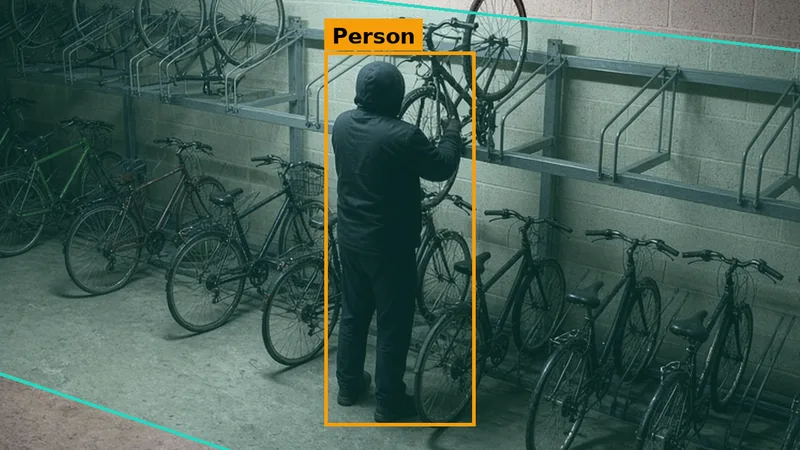
Bike stores. Cycle stores in blocks of flats are full of valuable bikes and e-bikes, packed close together, behind a door that many people can open, and rarely visited between midnight and the morning commute. Thieves who know this go from block to block. A store where they can work unseen for ten minutes is the store they choose.
Car parks. Car parks beside a block, and especially undercroft or podium car parks built under the flats, bring vehicle crime and a fire risk right up to the homes. A car broken into is a nuisance. A car set alight in an undercroft is a fire directly under bedrooms.
Escape routes. In most blocks the main stair and the corridors are the only way out. Anything stored or charged there, from a bike to a mobility scooter to bags of rubbish, can block the route or start a fire on it. Batteries are now the risk fire services talk about most.
Around those four sit the rest: roofs and plant rooms that should be locked, bin stores that attract fires, meter cupboards and service risers, and empty flats between tenancies. The thread that runs through all of them is time. Very little of this happens when the block is busy. It happens at night, when residents are asleep and nobody is watching the common parts.
How common are these problems?
There is no single national statistic for crime or fire in the common parts of flats. What the official figures do show is how often the things that happen there happen overall, and how many people live in flats.
In the year to June 2026, police in England and Wales recorded 56,256 bicycle thefts, down from 58,995 a year earlier, according to the Office for National Statistics police force area tables. Not all of them were from blocks of flats, but communal cycle stores are one of the places bikes are kept in the greatest numbers, often with the most value per square metre of any room in the building.
Bicycle theft is concentrated where people live in flats and cycle to work. London recorded 14,726 bicycle thefts, more than a quarter of the total and almost twice the next region, the South East. The British Transport Police recorded another 3,939. Every English region and Wales recorded well over a thousand.
The same tables show 153,229 residential burglaries, 312,231 vehicle offences and 457,556 offences of criminal damage and arson, all slightly down on the year before. The common parts of a block meet all of these: a forced cycle store door is burglary of a building other than a dwelling, a car broken into in the car park is a vehicle offence, and a door kicked in or a bin set alight is criminal damage or arson.
On fire, the Home Office’s statistics for England for the year to June 2026 record 26,367 dwelling fires, up slightly from 26,026, with 24,024 of them accidental. Fire and rescue services attended 680 fires in high-rise purpose-built flats, against 687, 734 and 759 in the three years before. Over five years that is 3,566 fires in high-rise flats, ten of them fatal, with ten deaths. Fires in dwellings caused 164 deaths, down from 218, and seven in ten of all fire deaths. The average response time to a dwelling fire was 8 minutes 16 seconds from the call. A fire that starts at night in a common part is growing before anyone calls at all.
And flats are a big part of how England lives. The English Housing Survey counts 25.6 million dwellings. Low-rise purpose-built flats make up 39% of social rented homes, 25% of private rented homes and 7% of owner occupied homes; high-rise purpose-built flats make up 7% of council homes and 3% of housing association homes. Add the converted houses split into flats, and millions of people rely on someone else to keep the front door, the stores and the stairs secure.
London Fire Brigade figures show where one fast-growing risk sits. The brigade attended a record 206 fires involving e-bikes and e-scooters in 2025, a fire on average every other day, and 129 between January and August 2026, against 145 in the same months of 2025. Many of those fires start in homes and in the common parts of blocks, where the batteries are stored and charged.
What do recent incidents at flats look like?
The figures are national. These are some of the incidents behind them from 2026, named by place only, from police, fire service and local press reports.
Manchester, April. Police appealed for information after two people entered the communal bike store of an apartment block on Great Ancoats Street at about 2am on 13 April and took two pedal bikes, as the Manchester Evening News reported.
Bristol, February. A man who entered the communal areas of apartment buildings to steal bikes was jailed for 32 months on 10 February for four counts of burglary. As well as the sentence, the court gave him an eight-year criminal behaviour order that bans him from entering any bicycle storage facility, and from multi-storey car parks, as Avon and Somerset Police reported. The case shows how one determined thief can work through a city’s blocks one store at a time.
Mapperley, Nottinghamshire, June. Two e-bikes were taken from the communal area of a shared house on Querneby Road between about 2:30am and 4:20am on 29 June, while the people who lived there were asleep, as the Gedling Eye reported.
Copthorne, West Sussex, August. Just before 1am on 14 August, a car fire below a flat on Worsell Drive spread into the home above. Four fire engines attended, the family escaped, and the fire was believed to have been started deliberately, as Sussex News reported. A car parked under or against a block of flats is a fire next to homes.
Bow, east London, September. An e-bike on charge in a communal hallway caught fire just before midnight on 24 September and destroyed the fourth-floor hallway of a seven-storey block. Firefighters rescued eight people. The fire blocked the residents’ main escape route, and the brigade said it was accidental. London Fire Brigade used the fire to repeat its advice: never store an e-bike or e-scooter on your means of escape, such as a hallway or by your front door; never charge one unattended or while you are asleep; and store them in a safe external location if possible, such as a garage or a shed.
Loughborough Junction, south London, August. At 00:37 on 31 August, an e-scooter battery fire destroyed half of a communal hallway in a house converted into flats. Crews wearing breathing apparatus led seven people out; one was treated at the scene and two went to hospital, according to London Fire Brigade.
Plymouth, September. At about 11:40pm on 6 September, a fire was started deliberately in a first-floor flat of a four-storey block in Greenbank. Around thirty older residents were evacuated, seven were rescued, two of them by ladder, and the communal areas were damaged by smoke, as the Plymouth Herald reported.
Hackney, east London, October. An e-scooter on charge caught fire inside a ground-floor flat on St Peter’s Way just before 9pm on 24 October and destroyed half of the flat. It is one of the many fires behind the brigade’s figures, as London Fire Brigade reported. It started inside a home, not the common parts, but it shows how quickly a battery fire takes hold in a flat.
Two patterns stand out. First, every incident with a reported time happened in the evening or at night, when residents were at home and in most cases asleep, and when nobody was in the common parts to notice. Second, the places involved are the ones this guide keeps returning to: bike stores, communal hallways and stairs, and cars under or beside the block. They are also the places a camera can see.
Where do the risks sit in a typical block?
Look at a typical purpose-built block from the side and the pattern is clear. The flats sit on the upper floors. The ground floor, and anything below it, holds almost everything that is shared: the entrance and lobby, the cycle store, the scooter or buggy store, the bin store, the meter cupboards, and often a car park under the building. The stair runs from top to bottom beside them, and in most blocks it is the only way out.
That layout puts the riskiest rooms in the building directly below the homes and next to the exit. A thief in the cycle store is a few metres from the stair. A battery fire in the scooter store is a few metres from the front door. A car fire in the undercroft is directly under the first-floor bedrooms. Converted houses are smaller but follow the same logic: the hallway is the escape route, the cycle store and the meter cupboard, all at once, which is why the Loughborough Junction fire in a communal hallway was so dangerous.
The upper floors have their own risks: corridors where things get stored, roof hatches and plant rooms that should be locked, and in older blocks refuse chutes. But for security and for early warning of fire, the ground floor and the car park are where to start.
How do you secure communal entrances?
The front door is the one part of block security every resident notices. Most people who have no business in a block do not break in. They walk in behind a resident, through a door held open for a delivery, or through one that does not close properly.
Doors that close and lock. Check self-closers and locks on every visit. A door that closes slowly, sticks on the frame or does not latch is open to anyone who waits a few seconds. Fire doors that open onto the stair or the street need the same care for fire safety reasons, and they are part of the checks covered later in this guide.
Fobs that are managed. Keep a list of fobs issued to each flat, cancel lost ones the same day and recover them when people move out. A block where dozens of old fobs still open the door has an access list nobody controls. Where the system allows it, give cycle store and car park access only to those who need it, and keep the logs.
Deliveries without propped doors. Parcels are one of the main reasons doors are held and propped. A parcel room, lockers or a clear arrangement with residents about deliveries reduces the number of times a courier needs to be let in, and the number of times a door is left open between drops.
Light and sight lines. Light the approach, the door and the area just inside. Keep planting low near the door so nobody can wait there unseen. A video door entry panel that shows who is at the door helps residents decide who to buzz in.
Talking to residents. Most tailgating happens because residents are polite. A short note in the lobby and in the resident information pack, asking people not to hold the door for anyone they do not know and to report doors that do not close, does more than any lock. It sits naturally alongside the fire safety information blocks must already give residents.
Cameras at the front door have a place, but a careful one. Residents walk past the entrance at all hours, and an alert every time someone comes home at 1am would be useless and intrusive. For the entrance and lobby, the most useful job a camera can do is watch for smoke on the escape route and record what happens, not raise alerts about people. The alerts belong on the places nobody should be at night.
How do you protect bike and e-bike stores?
The communal cycle store is the most targeted room in many blocks. Bikes are light, valuable, hard to trace once sold, and kept together in one place. E-bikes are worth more again. Thieves look for stores that are easy to enter, dark, out of sight of the flats and rarely visited at night.
A locked room beats a shelter. An enclosed store with solid walls, a solid door and a good lock is far harder to work in than an open shelter in a courtyard. If a block only has shelters, put them where the flats overlook them, light them, and fence or gate them so only residents can reach them.
Stands fixed to the floor. Stands and two-tier racks should be fixed so they cannot be unbolted, with a frame that lets residents lock the frame and a wheel, not just a wheel. Residents should use good locks; the store is the second line, not the first.
Access for those who cycle. Where the entry system allows it, give store access only to residents who keep a bike there. Fewer fobs that open the door means fewer people to follow in and a shorter list to check after a theft. Keep the access logs; they are often the first thing the police ask for.
Light and a camera that sees the racks. Most cycle store thefts take several minutes: cutting a lock, lifting a bike off a high rack, carrying it out. A camera that sees the racks, with enough light or infrared at night to show a person clearly, turns those minutes into a chance to respond. A camera that only sees the door outside records a figure leaving with a bike.
Remove abandoned bikes. Stores fill up with bikes nobody owns any more. Tag them, give notice, and clear them. A store with space is easier to keep tidy, and a full store hides what a thief is doing.
The cases from Manchester, Bristol and Mapperley all fit the same pattern: people entering a communal store or area at night, while residents were asleep, and leaving with bikes. In each one, the theft was found later. What would have changed the outcome was someone knowing while it was happening.
How do you manage e-bike and e-scooter fire risk?
E-bikes and e-scooters run on large lithium-ion batteries. When one fails, usually while charging, after damage, or because of a poor quality battery or charger, it can burn fiercely, give off toxic smoke and reignite after it seems to be out. In a flat or a communal hallway, that smoke can make the escape route unusable within minutes.
London Fire Brigade attended a record 206 fires involving e-bikes and e-scooters in 2025, a fire on average every other day. From January to August 2026 it attended 129, fewer than the 145 in the same months of 2025, but still more than one every two days. The Bow and Loughborough Junction fires in this guide both started in communal hallways; the Hackney fire started inside a flat.
The brigade’s advice is simple and directly relevant to anyone managing a block:
- Never store an e-bike or e-scooter on the means of escape, such as a hallway or by a front door.
- Never charge one unattended or while asleep.
- Store them in a safe external location if possible, such as a garage or a shed.
For a managing agent, that advice translates into a few practical steps. Make it clear, in the lease rules, the resident information pack and signs in the common parts, that e-bikes and e-scooters must not be kept or charged in corridors, stairs or lobbies. Check the common parts on every visit and follow up quickly when one appears. Where there is space, provide a separate store away from the escape route, ideally outside the building, and think about how it is watched. And treat the cycle store as a place where e-bikes will be kept, and possibly charged, whether that was the plan or not.
This is where security and fire safety meet. The same e-bike store that attracts thieves at 2am is the room where a battery is most likely to fail at 4am. A camera that watches that store for people at night can watch it for smoke at every hour.
What about mobility scooters?
Many residents rely on mobility scooters, and their needs come first. But scooters are large, are charged every night, and are often kept in the corridor outside a flat or in a ground-floor store next to the entrance, which is exactly where a fire does most harm.
The National Fire Chiefs Council guidance on mobility scooters in residential buildings is clear about the risk. A fire involving a Class 2 mobility scooter can produce enough toxic smoke to fully compromise a large corridor in under three minutes, and less with lithium-ion batteries. It lists the common causes as electrical faults, charging equipment and arson. It says storing or charging scooters on escape routes is not acceptable, that any external store should take security into account to prevent arson and theft, that blocks might consider cutting the power to charging points between 20:00 and 08:00, and that dedicated storage rooms should have detection linked to an alarm receiving centre.
The guidance asks building managers to work with residents, not against them: find out who has a scooter, provide somewhere safe to keep and charge it, and explain why the corridor is not that place. A dedicated store with good detection, good security and a camera that watches it for smoke at every hour is a practical answer for many blocks.
How do you secure car parks under and beside flats?
Car parks at blocks of flats come in two kinds: open car parks beside the building, and undercroft or podium car parks built under it. Both attract vehicle crime. The undercroft adds a fire risk that open car parks do not: a car fire there is a fire directly under people’s homes.
Gates that close. Gates and shutters should close behind each car. A gate that is left open, or that lets someone on foot slip in behind a car, turns a private car park into a public one. Check the closing time and the safety edges on every visit.
Even light. Light the whole deck, not just the entrance. Dark corners are where people work on cars, and where a camera sees nothing at night.
Nothing stored. Undercrofts fill up with things that should not be there: old furniture, tyres, boxes, dumped mattresses. All of it is fuel, and some of it is an invitation to set a fire. Keep the deck clear.
A car fire is a building fire. The Copthorne fire in August, a car fire below a flat that spread into the home above and was believed to have been started deliberately, shows why. The usual advice for car parks applies, as set out in our car park security guide, but in an undercroft the stakes are higher.

Smoke from an undercroft car park often shows first at the open sides of the deck, where it rolls out towards the light, before anyone on the floors above notices. A camera that sees the deck, or the edge of it, can raise the alarm from the first visible smoke, at any hour.
What about roofs, plant rooms and service areas?
Roofs, plant rooms, lift motor rooms, meter cupboards and service risers are parts of a block most residents never see. They hold valuable equipment and, in the case of roofs, a route to the top of the building. Nobody should be in them unannounced.
Keep roof hatches and doors locked, and alarmed where possible. Keep plant rooms and meter cupboards locked and clear of stored items, and check them on visits. Log keys out to contractors and back in again, so that if something goes wrong the list of people with access is short.
For these spaces a camera can do something it cannot do in the lobby: raise an alert for a person, because a person should not be there. A line or a zone on a roof hatch or a plant room door, armed at night, flags someone on the roof without disturbing anyone else in the block. Planned contractor visits can be scheduled around it.
How do you keep escape routes clear?
Every block’s fire strategy depends on people being able to get out, and on firefighters being able to get in. In most blocks that means one stair and the corridors leading to it. Anything that blocks those routes, or burns on them, puts everyone above it at risk.
Nothing stored. Bikes, e-bikes, scooters, buggies, bags of rubbish, furniture and boxes do not belong in corridors, stairs or lobbies. Whatever the rule, it needs to be clear, written down, and enforced on visits.
Fire doors that close. Doors onto the stair and the corridors, and flat entrance doors, hold back smoke only when they are shut. Check self-closers and seals, and fix damage fast.
Signs and lighting. Escape route signs and emergency lighting help residents get out in the dark, and in high-rise blocks the regulations require wayfinding signs that firefighters can read in low light.
At Bow, the e-bike fire in the fourth-floor hallway blocked the residents’ main escape route and eight people had to be rescued. A camera covering a corridor can watch for smoke without recording anything about who comes and goes, and can show a manager when a bike or scooter has appeared on the route again, at the next check of the footage.
What about the bin store?
Bin stores are one of the most common places for fires at blocks of flats, many of them started deliberately. They are often on the ground floor, next to the main entrance, and full of fuel. Our bin store fire safety guide covers bin stores, chutes and compounds in detail.
The short version: keep the store shut, locked and lit; keep bins away from exits, windows and walls outside; clear side waste and dumped items quickly; and watch the store for smoke at every hour. A camera that already sees the bin store, the cycle store or the car park can usually take on that job too.
Who is responsible for security and fire safety at a block of flats?
Responsibility for a block is shared in ways that confuse residents and, sometimes, managers. The short version is that fire safety in the common parts is a legal duty with a named person attached, and security is usually a matter for the lease and the landlord.
The responsible person. The Regulatory Reform (Fire Safety) Order 2005 applies to the common parts of blocks of flats in England and Wales. The responsible person is whoever controls those parts: usually the landlord, freeholder, managing agent or management company. They must carry out a fire risk assessment, put the fire safety measures it identifies in place, maintain them, and plan for an emergency.
Accountable persons in high-rise blocks. In England, buildings of at least 18 metres or seven storeys with at least two homes are higher-risk buildings under the Building Safety Act 2022. Their accountable persons, who can be the freeholder, the landlord, a management company, a residents’ management company, a right to manage company or a commonhold association, must manage the risks of fire spread and structural failure in the common parts, such as corridors, lobbies and staircases.
Managing agents. A managing agent can carry out the work, but accountability for high-rise blocks cannot be handed over; it stays with the accountable person.
Residents. Residents must be given fire safety information, and they have their part to play: keeping their own flat entrance doors shut, not storing things in the corridors, and reporting problems.
Security of the common parts, from cycle stores to car parks, is not usually governed by one statute in the same way. It is set by the lease, the landlord’s obligations, the service charge and, increasingly, insurers. In practice the same person, or the same managing agent, looks after both.
What do the Fire Safety (England) Regulations 2022 require?
The Fire Safety (England) Regulations 2022, in force since 23 January 2023, add duties for responsible persons in multi-occupied residential buildings in England. They scale with the height of the building.
- All multi-occupied residential buildings: give residents fire safety instructions and information about the importance of fire doors.
- Buildings over 11 metres: check communal fire doors at least every three months, and flat entrance doors at least once a year, as far as reasonably practicable.
- High-rise buildings (at least 18 metres or seven storeys): give the fire and rescue service floor plans and information about the external walls, provide a secure information box, install wayfinding signs visible in low light, check firefighting lifts and equipment monthly, and report faults lasting more than 24 hours.
None of this is about cameras. But every one of these checks is about the common parts, and the visits that carry them out are also the moments when a manager sees the bike in the corridor, the propped door and the open plant room. Cameras watching the stores and the routes between visits fill some of the gap.
What changes for higher-risk buildings?
High-rise residential buildings in England must be registered with the Building Safety Regulator. The government estimated in 2020 that there were around 12,500 of them. More than 3,500 were registered after the October 2023 deadline, according to Construction News.
Accountable persons for these buildings must report safety occurrences to the regulator, run a resident engagement strategy and keep the golden thread of information about the building. Security incidents in the common parts that affect fire safety, such as a fire in a cycle store or a damaged fire door, are part of that picture. Good records of what happened, and when, help.
How should the common parts be managed day to day?
Design and rules set the limits. Day-to-day management decides whether a block is secure and safe on a given night. Most of what goes wrong in the cases in this guide, from a store left open to a battery on a hallway, is the kind of thing a regular check can catch.
- Doors. Front doors, store doors and car park gates close and lock. Fire doors close fully on their own, with seals and closers intact.
- Escape routes. Nothing stored or charging in corridors, stairs or lobbies. Follow up the same day when something appears.
- Stores. Cycle, scooter and bin stores locked, lit and tidy, with abandoned items cleared on notice.
- Lighting. Every lamp, timer and emergency light working, inside and out.
- Roofs and plant. Hatches and plant rooms locked, and contractor keys accounted for.
- Records. What was found, what was done, and when. Records support the fire risk assessment, help insurers and help residents trust that someone is looking.
Residents are part of the answer. Most of them want a secure block as much as the managing agent does. Tell them what the rules are and why, give them an easy way to report a broken door or a bike in the corridor, and tell them what happened after an incident. A resident engagement strategy is a legal duty for high-rise blocks in England, and a good idea for every other block.
The gap that management cannot close on its own is the time between visits. A weekly visit sees the block for an hour a week. The cases in this guide happened in the other hours.
Why are blocks of flats hard to protect with ordinary CCTV?
Many blocks already have cameras. They record the entrance, the car park and sometimes the cycle store, onto a recorder in a cupboard. That footage is useful after the event: police ask for it, insurers ask for it, and it sometimes shows who was responsible. What it rarely does is help while something is happening.
There are three reasons. First, nobody is watching. A managing agent with dozens of blocks cannot watch live cameras, and few blocks have a concierge at night. Second, the cameras that do send alerts usually send them on motion, which at a block of flats means residents coming home, cleaners, foxes, rain and headlights in the car park, all night, every night. People soon stop looking. Third, the most important events, a person in the cycle store at 2am or smoke from a scooter store at 4am, look like nothing at all to a motion sensor: a small movement in one corner of the picture.
The result is the pattern in the cases above: the theft or the fire is found later, by a resident in the morning or by the fire service after the call. The cameras saw it. Nobody knew.
Where should cameras watch at a block of flats?
The best cameras for alerts are not always the ones at the front door. For a block of flats, start with the places nobody should be at night, and the places where fire is most likely to start.
- The cycle store or shelter. A view of the racks and the door, from inside if possible, close enough to see a person clearly at night.
- The car park. The bays, especially under the deck, and the gate or ramp. In an undercroft, the open sides of the deck too, where smoke first shows.
- The scooter or e-bike store. The inside of the store and its door, for smoke at every hour and people at night.
- The routes. The lobby, the stair and the corridors, for smoke only, with no people rules.
- The roof and plant. The hatch, the roof door or the plant room door, for people at night.
- The bin store. For smoke, and for people at night if the store is meant to be shut.
Many existing cameras already cover some of these. Others need a small change of angle, a little more light or infrared, or occasionally a new camera. A site assessment shows which.
How can AI on existing CCTV help at a block of flats?
Recording-only CCTV shows what happened after the event. AI detection tells someone while it is happening, in time to act. Woodcock AI connects to the IP cameras and recorders already on site, over RTSP or ONVIF, including Hikvision, and runs on an edge server on site or on a cloud server (an edge server needs only a power socket and a network connection).
- Smoke and flame. Smoke and flame detection on every camera that sees the stores, the car park and the escape routes, around the clock, indoors and out.
- Polygon zones. Draw an area of any shape on a camera’s view, around the cycle racks, the parking bays or the scooter store, and detect people only inside it. A zone can follow the store exactly and leave out the path residents use to get home.
- Lines. Draw a line across the car park ramp, a roof hatch or a courtyard gate, and alert when a person crosses it, in the direction you choose.
- People and vehicles. Detect people and detect vehicles moving in a zone, ignoring foxes, cats, rain and passing headlights.
- Schedules. Arm each people rule for the hours that make sense, such as the cycle store from midnight until the early commuters leave, and leave smoke on all the time.
- Alerts with the clip. Alerts arrive in the app and by email with a short clip and an AI description, so a caretaker, a managing agent or a keyholder can see in seconds whether it is a resident, someone at the racks, or smoke.
The system is self-learning. It learns each camera, what is normal on that view and what is not, and marking an alert as correct or false feeds into retraining for your site. Woodcock AI has been in development for years and is now running on customer sites across the UK.
Woodcock AI does not read number plates or identify people. It tells you that there is a person in the cycle store at 02:07, or smoke at the scooter store door at 04:26, with the clip; what happens next is up to you.
Coming next: Ask your cameras Coming soon, early 2027, which will let you ask the system questions about what your cameras have seen.
What does detection look like in different parts of a block?
Each part of a block needs different rules. Choose an area to see how the zones, the schedule and smoke detection might work there.
Which part of the block are you protecting?
Outdoor shelters in courtyards and car parks are easy to reach and hard to see from the flats. A zone over the shelter itself, armed from midnight until the early commuters leave, flags a person working at the stands when nobody should be there. Keep the path to the shelter outside the zone, so residents walking past do not trigger it. Smoke detection on the same view runs all night.
The shelter, the stands and the path to it
An undercroft puts cars directly below homes. A zone over the bays, armed in the small hours, flags someone at the cars rather than walking through to the stair. A line across the ramp or the gate flags someone coming in on foot after the gate has shut. Smoke and flame detection watches the whole deck, at every hour, because a car fire below a flat spreads upwards.
The parking bays, the ramp and the gate
Mobility scooters and e-bikes are charged and kept in a ground-floor room or an external store, often next to the entrance. Smoke detection on a camera that sees the inside of the store, or its door, runs all the time. A people zone on the store at night flags someone forcing the door or taking a scooter or bike when the store should be shut.
The store door, the inside of the store and the path outside
A cycle shelter, an undercroft car park and a scooter store each get their own zones and schedule, with smoke detection on all three.
How does AI detection compare with other measures?
AI on existing cameras is one layer among several. None of them replaces the others, and the right mix depends on the block, its fire strategy, its residents and its budget.
| Measure | What it does | Strengths | Watch out for |
|---|---|---|---|
| Doors, locks and fob access | Keeps people who do not live there out of the block and its stores | The first line for every block, and residents expect it | Doors get held, propped or left on the latch, and lost fobs keep working until someone cancels them |
| Lighting | Lights entrances, paths, stores and car parks | Cheap, puts off casual thieves and helps cameras at night | Bulbs fail, timers drift and nobody notices for weeks |
| Concierge or patrols | A person on site, or visiting, who checks and responds | Judgement, and a face residents know | One person cannot watch every store and car park at once, and few blocks have someone overnight |
| Fire alarm, detection and doors | Detects fire in the building, holds smoke back and warns as the fire strategy requires | Required and designed for the building; the core of fire safety | Outdoor stores, shelters and car parks may sit outside it, and it does not tell anyone about a theft |
| Recording-only CCTV | Records entrances, stores and car parks | Evidence for the police and the insurer after the event | Nobody sees the theft or the smoke at 3am until someone reviews the footage |
| Monitored CCTV | A remote centre watches alerts and can challenge or call for help | A human response at night | Only as good as the alerts it receives; motion detection floods operators with headlights and foxes |
| AI on existing CCTV | Recognises people, vehicles, smoke and flame, in zones you draw, on a schedule | Watches cycle stores, scooter stores and car parks at once; the alert includes the clip | Cameras need a clear view, power, a connection and enough light or infrared at night; it does not replace the fire alarm or a fire risk assessment |
How do you keep false alerts down at a block of flats?
A block of flats is a busy place, even at night. Residents come home from late shifts, cleaners arrive early, contractors visit, foxes and cats explore the stores, and car headlights sweep across the car park. A system that alerts on all of that will be ignored within a week.
- Draw tight zones. Cover the racks, the bays or the store, not the path to the front door. A resident walking past should not be inside a zone.
- Use schedules. Arm people rules only when nobody should be there, and switch them off for cleaning windows and planned contractor visits.
- Recognise people, not motion. Detecting people and vehicles, rather than any movement, removes foxes, cats, rain and headlights.
- Mark alerts. Mark each alert as correct or false. The system learns each camera’s view over time.
Our guide to reducing CCTV false alarms goes into more detail. The aim is a handful of alerts a week that each matter, not dozens a night that nobody reads.
What detection schedule suits a block of flats?
There is no single right schedule, because every block keeps different hours. But a pattern works for many: people rules on the stores and the car park in the small hours, when residents are asleep and nobody should be there, and smoke detection on everything, all the time.
In this example, the cycle store is armed from midnight until 05:30, before the early commuters. The undercroft car park is armed from 00:30 until 05:00. The scooter store door is armed from 23:00 until 06:00, because residents rarely need it overnight. A cleaning and contractor window from 08:00 to 12:00 has no people rules at all. And smoke and flame detection never switches off, because battery fires start at every hour, as the Bow, Loughborough Junction and Hackney fires show.
Start with a cautious schedule, look at the alerts for a fortnight, and adjust. Our out-of-hours security checklist covers the same thinking for other sites.
What should happen when an alert comes in?
An alert is only useful if someone acts on it. Before the cameras go live, agree who receives alerts for each block, at what hours, and what they do.
- Alert. The alert arrives in the app and by email, with the clip and an AI description.
- Check. Watch the clip. Is it a resident, a contractor, someone in the store, or smoke?
- Act. For fire, or a crime in progress, call 999. For anything else, follow the plan you agreed: a caretaker, a keyholder or a monitoring centre.
- Review. Mark the alert, note what happened, and fix what it showed: a door that does not close, a light that has failed, a battery on the escape route.
Police response to alarms is governed by the National Police Chiefs’ Council requirements for security systems, and police response to an alarm system with a unique reference number is withdrawn after three false calls in a rolling 12 months. Alerts that come with a clip, checked by a person before anyone calls, help keep calls to the police for real incidents.
What should you do after a theft or a fire?
After an incident, the first priority is people: residents safe, the building safe, and the emergency services informed. Then:
- Report it. Get a police crime reference or the fire service incident details. Insurers will ask for them.
- Save the clips. Export and keep the footage before the recorder overwrites it, and note the times.
- Make safe. Repair doors and locks, check electrics after a fire, and deal with smoke damage in the common parts.
- Review. Update the fire risk assessment, look again at storage and charging rules, and check what the cameras could and could not see.
- Tell residents. Say what happened, what has changed, and what you need from them.
For high-rise blocks in England, check whether the incident is a safety occurrence that must be reported to the Building Safety Regulator.
What about privacy and data protection?
Cameras at a block of flats see residents in the place where they live, their visitors and their children. That makes privacy more important here than almost anywhere. Under UK GDPR, the organisation running the cameras is responsible for the footage. The ICO’s guidance on video surveillance sets out what to do.
- Signs. Put up clear signs in the common parts saying CCTV is in use and who runs it.
- Focus. Point cameras at the stores, the car park bays and the routes, not into flats, at flat entrance doors or at windows.
- Tell residents. Explain in resident information why the cameras are there, what they detect and how footage is used.
- Retention. Keep footage only as long as you need it, and delete it after that.
- Assessment. Carry out a data protection impact assessment where the cameras are likely to be high risk to privacy.
- Audio. Leave audio recording off by default.
The way detection is set up matters as much as where the cameras point. People zones belong on the places where nobody should be at night, such as a store or the car park bays in the small hours, and never on the way residents get home. Smoke detection watches for smoke, not people. Woodcock AI does not use facial recognition, identify who anyone is or read number plates. Our guide to AI CCTV and GDPR in the UK covers this in more depth.
How do you get started?
Start with the simplest steps: doors that close and lock, fobs that are managed, stores that are locked, lit and tidy, escape routes kept clear of bikes, scooters and rubbish, a fire risk assessment that covers the common parts, and clear rules and information for residents. Then look at what your cameras can already see.
Our site assessment looks at the cameras already covering your cycle stores, car parks, scooter stores and routes, what each one can see by day and night, and where zones would go. To see it working first, we can run a live test on your cameras: we connect two or three of them for about a fortnight. We can also arrange an on-site demo.
What are the limits?
AI on existing cameras is useful, and it is not magic. It is worth being clear about what it cannot do.
- It only sees what the cameras see. A fire inside a flat, or inside a store with the door shut, may only show once smoke escapes into view.
- It needs light. At night, cameras need lighting or infrared to see well, which is one more reason to keep stores and car parks lit.
- It needs power and a network. If the power or the network goes down, so do the cameras and the alerts.
- It detects; it does not stop anyone. Doors, locks, fire doors, sprinklers where fitted, and the people who respond do that.
- It does not replace the fire alarm or the fire risk assessment. Keep the building’s fire safety measures maintained as the assessment requires. Cameras add a view of the places they do not cover.
- Someone has to respond. An alert at 2am is only useful if someone sees it and acts.
Sources
- Office for National Statistics, Crime in England and Wales: police force area data tables, year ending June 2026.
- GOV.UK, Fire and rescue incident statistics: England, year ending June 2026.
- GOV.UK, English Housing Survey 2024 to 2025: headline findings, Chapter 1.
- London Fire Brigade, e-bike and e-scooter fire figures (October 2026), and incident reports for Bow (September 2026), Loughborough Junction (August 2026) and Hackney (October 2026); Reducing arson risk.
- National Fire Chiefs Council, Mobility scooter guidance for residential buildings.
- GOV.UK, Safety in high-rise residential buildings: accountable persons; Construction News, higher-risk buildings registered after the October 2023 deadline (March 2026).
- GOV.UK, Fire Safety (England) Regulations 2022, and Fire safety in the workplace: your responsibilities.
- Manchester Evening News, appeal after bikes were taken from a communal bike store on Great Ancoats Street (2026); Avon and Somerset Police, man jailed after stealing bikes from flats in Bristol (February 2026); Gedling Eye, e-bikes stolen from a Mapperley home while residents slept (September 2026).
- Sussex News, family escape after a fire at a Copthorne flat (August 2026); Plymouth Herald, flats in Greenbank deliberately set on fire (September 2026).
- National Police Chiefs’ Council, Police Operational Advice and Security Industry Requirements for Response to Security Systems (March 2024).
- Information Commissioner’s Office, Guidance on video surveillance, including CCTV.
We have summarised these sources in our own words. Always read the current versions in full. This page is general guidance, not legal, fire safety, building safety, insurance or security advice; your fire and rescue service, your fire risk assessor, the police, your insurer and your installer can advise on your own building.
Want to know when someone is in the cycle store tonight?
Book a site assessment and we will look at the cameras covering your cycle stores, car parks, scooter stores and escape routes, and plan people zones and schedules that leave residents alone, with smoke detection around the clock, or ask for a live test on your cameras.
Related pages
Frequently asked questions
Who is responsible for security and fire safety at a block of flats?
Fire safety in the common parts is the duty of the responsible person under the Regulatory Reform (Fire Safety) Order 2005, usually the landlord, freeholder, management company or managing agent. In high-rise blocks in England, accountable persons under the Building Safety Act 2022 must also manage fire spread and structural risks. Security of the common parts is usually set by the lease and the landlord.
How do you stop bikes being stolen from a communal bike store?
Use a locked room rather than an open shelter where you can, with stands fixed to the floor, fob access only for residents who cycle, good lighting and a camera that sees the racks. Cancel lost fobs, clear abandoned bikes and remind residents to lock frames as well as wheels. An alert at night gives someone the chance to act while a theft is happening.
Can residents keep e-bikes or mobility scooters in the corridor?
Fire services advise against it. London Fire Brigade says never store an e-bike or e-scooter on a means of escape, such as a hallway or by a front door, and never charge one unattended or while asleep. NFCC guidance says storing or charging mobility scooters on escape routes is not acceptable, and suggests a dedicated store with detection linked to an alarm receiving centre.
What do the Fire Safety (England) Regulations 2022 require for blocks of flats?
All multi-occupied residential buildings must give residents fire safety instructions and fire door information. Buildings over 11 metres need quarterly checks of communal fire doors and annual checks of flat entrance doors. Buildings of 18 metres or seven storeys also need plans for the fire service, a secure information box, wayfinding signs and monthly lift and equipment checks.
Is CCTV in the common parts of flats allowed under GDPR?
Yes, if it is done properly. The organisation running the cameras is responsible for the footage under UK GDPR and should put up signs, aim cameras at stores, car parks and routes rather than into flats or at front doors, tell residents why the cameras are there, keep footage only as long as needed and carry out a data protection impact assessment where needed.
Does Woodcock AI need new cameras at a block of flats?
Usually not. It connects to existing IP cameras and recorders over RTSP or ONVIF, including Hikvision, and runs on an edge server on site or on a cloud server. A site assessment shows which cameras already see the cycle stores, car parks and scooter stores by day and night, and where a camera cannot do the job.
Last reviewed 1 November 2026