

Caravan storage security: theft, break-ins and fire at storage sites
Caravan storage security means protecting the caravans, motorhomes and campervans kept at a storage site, and the site itself, from whole-van theft, break-ins, contents theft, vandalism and fire, most of all when the gate is locked and nobody is there. The basics are a strong perimeter fence with the field side as strong as the road side, a gate locked 24 hours a day with a code or fob for each owner, vans in straight rows that can be seen, lighting, hitchlocks, wheel clamps and trackers on every van, gas handled by clear site rules, and a fire plan. AI on existing CCTV adds alerts with a clip when a person crosses the fence, a vehicle stops at the gate or reverses up to a van after hours, or smoke rises between the rows.

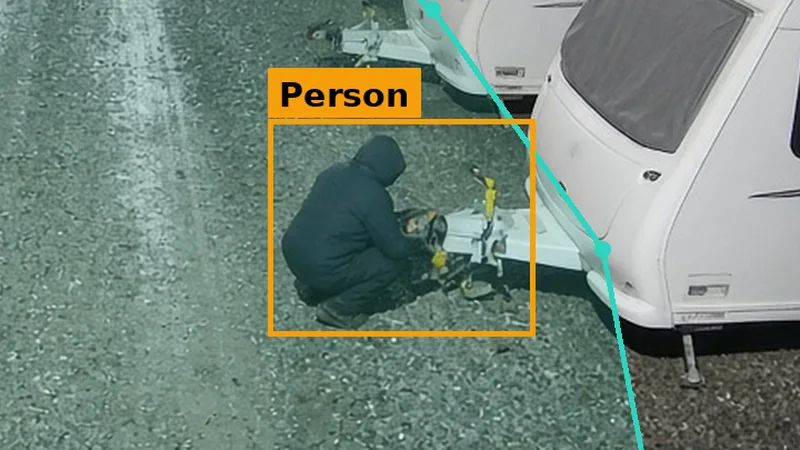
Last updated 1 November 2026. Drive past a caravan storage site on a winter evening and it looks like a quiet car park. Rows of white touring caravans and motorhomes stand nose to tail behind a fence, the gate is shut, the office is dark, and the nearest house may be a field away. Each van is somebody’s holiday, worth more than many family cars, and most of them will not be moved or even visited for weeks.
That is exactly what makes a storage site attractive to thieves. A caravan can be hitched to a car and towed away in minutes, a motorhome can be driven out, and gas bottles, televisions and cushions can be lifted from vans whose owners will not notice until spring. And because vans are parked closer together in storage than on any campsite, one fire can spread along a row. This guide covers the main risks to caravan and motorhome storage sites in the UK: the figures and recent cases, what site operators and owners can do, the rules, where cameras should watch, and how AI on a site’s existing CCTV can help.
What are the main security risks at a caravan storage site?
Storage sites range from a few pitches in a farmyard to purpose-built compounds holding hundreds of vans, some on industrial estates, some inside holiday parks and many on former agricultural land. Whatever their size, most face the same four kinds of risk, and all four are at their worst when the gate is locked and nobody is on site.
- Whole-van theft. A touring caravan hitched to a tow vehicle and taken through the gate, through the fence or across a field; a motorhome or campervan started and driven away. This is the most expensive loss, and the hardest to undo.
- Break-ins and contents theft. Doors and windows forced, and gas bottles, televisions, cushions, mattresses, bikes and even fixtures taken. Attempted thefts leave damaged doors, locks and panels even when nothing is stolen.
- The perimeter. Fences cut or lifted, hedges cut back, farm gates opened. A storage site is only as strong as its weakest stretch of boundary, and that is usually the one facing open fields.
- Fire. A fire in one van, a vehicle or a pile of rubbish spreading to the next van along, with gas cylinders and leisure batteries in the lockers and nobody there to see it start.
Behind all four is the same fact. A storage site is busy for a few hours at weekends and in the holiday season, when owners collect and return their vans, and empty for most of the rest of the year. Owners may visit once a month. The operator may live on site, live nearby or run several sites from an office elsewhere. For long stretches, the vans are watched by a fence, a gate and whatever cameras are on the poles.
This guide is about the storage site, the compound where vans are kept between trips. Holiday parks with people staying in caravans and lodges have different risks, covered in our holiday park security guide, and caravans kept on a driveway at home are mentioned only where the same lessons apply.
What do the figures show about caravan storage and theft?
There is no single official count of caravans and motorhomes stolen in the UK each year, because police forces record them as vehicle or trailer thefts alongside everything else. The figures that do exist come from the accreditation scheme for storage sites, from the industry’s identification scheme, from insurers and from owners themselves.
- Storage is in demand. The CaSSOA site storage set-up guide lists more than 500 CaSSOA storage sites in its 2026 membership data, and says most CaSSOA members report they are operating at 90% capacity or more. CaSSOA, the Caravan Storage Site Owners’ Association, has been accrediting sites since 1999.
- Accredited storage helps. The same guide says statistics indicate that caravans stored at CaSSOA accredited sites are less likely to be stolen than caravans stored at home or at unapproved storage locations.
- Stolen vans are still being recovered. CRiS, the caravan industry’s Central Registration and Identification Scheme run by the National Caravan Council, reported 254 stolen caravans recovered in 2025, and listed Thames Valley, Kent, Cheshire, Police Scotland and Cumbria among its 2025 search hotspots.
- Motorhomes are taken too. Members of one owners’ Facebook group, the Stolen Motorhome Database, reported more than 130 thefts of motorhomes and campervans in 2025, more than two a week. These are owners’ reports, not police figures, and the true number will differ.
Each of these numbers is partial. Recoveries are not the same as thefts, and many stolen vans are never found or are broken for parts. But together they show two things a site operator needs to know: the demand for secure storage is strong, and vans are still being stolen from storage, from driveways and from the roadside every week.
What do insurers see in caravan claims?
Insurers see the losses that owners actually claim for, and one specialist caravan insurer publishes a summary of its claims each year. In its review of the top caravan insurance claims of 2025, Caravan Guard said accidental damage made up 48% of the claims it settled, with 14% of claims in May and most between April and August, when vans are on the move.
Theft was a smaller share of claims, but around half of all theft claims involved the theft of the caravan itself, and the insurer said caravans were stolen from driveways and storage sites. In other theft claims, thieves targeted gas bottles, cushions and mattresses, windows and doors, televisions and even a cooker, and attempted thefts damaged doors, locks and panels. Among the smaller claims were vandalism after stones were thrown at a caravan in storage, and fire damage from neighbouring caravans in storage.
The insurer’s advice on storage is direct: choose a site with controlled access gates that are locked 24 hours a day, high perimeter fencing, and CCTV that is regularly monitored by security staff. For a site operator, that sentence is worth reading twice. It is what owners are being told to look for, and it is what their insurers may ask about.
How are caravans and motorhomes stolen from storage?
Reports of thefts from storage sites follow a pattern. The thieves arrive with a tow vehicle, or several, often at night. They get onto the site through the gate, the fence or a hedge. They defeat the locks on the van they want, hitch it up and leave, sometimes by the same route and sometimes across open land. Several vans are often targeted in one visit.
- Clay Cross, Derbyshire (February 2026). Two caravans were stolen from a caravan storage facility by a gang of up to eight people, Practical Caravan reported. They cut down hedges, used chainsaws and oxyacetylene torches on the hitchlock, and towed the caravans across three fields to a road. One was later traced after the tow car was tracked to Ingoldmells; its windows had been replaced with new etchings and a fake CRiS sticker had been fitted, but burn marks under the hitch cover gave it away.
- Willoughby, near Selby (May 2026). North Yorkshire Police appealed after thieves targeted four caravans in one go at a site on Dam Lane, at around 5.45pm on a Wednesday. The theft was botched and the offenders left in an unknown vehicle.
- Chelston, near Wellington, Somerset (August 2026). Police were called at around 11pm on a Sunday to a report that three motorhomes had been stolen from a business on Chelston Business Park. Gates were damaged, several other motorhomes were damaged, and all three stolen motorhomes were later recovered nearby.
- Wraysbury, Berkshire (July 2021). A storage yard where a caravan was kept was broken into in the early hours, about four hours after men had tried to steal a caravan from a garden in Sunninghill, cutting its chains and then returning to remove the hitch lock bolt.
Three lessons stand out. Thieves come equipped: chainsaws, cutting torches and tools to defeat locks. They are willing to go through the boundary, not just the gate. And they take more than one van when they can, so a site can lose several in a night. Each of these sites would have known what had happened only once someone noticed, and by then the vans were miles away.
What about vans stolen away from storage?
Storage sites exist because vans kept elsewhere are easier to steal. Recent cases show what happens to caravans and motorhomes parked in the open.
- Portland, Dorset (September 2026). Dorset Police said a caravan was stolen from New Ground car park at around 3.20am on a Sunday, towed away towards Weymouth by a white panel van.
- Rothwell, Northamptonshire (January 2026). A motorhome was stolen from a street between mid-afternoon on a Sunday and 8am the next day, HFM reported.
- Sunninghill, Berkshire (July 2021). Men were seen cutting the chains on a caravan in a garden shortly after midnight, and came back an hour later to remove the hitch lock bolt.
- Aldermaston, Berkshire (October 2026). Thames Valley Police’s Rural Crime Taskforce recovered four stolen caravans, a motorhome and a car with false plates. The force said its recovery yards were full, and thanked NCC CRiS for its help.
For owners, the lesson is that a driveway or a car park is not secure storage. For site operators, it is that the same people are active in the same areas. A caravan taken from a car park one week may be followed by an attempt on a storage site the next, and the tow vehicle seen in one case may be seen again.
When do thefts and fires happen at storage sites?
It is tempting to think of storage site crime as something that happens only at 3am. The cases in this guide say otherwise. The attempt on four caravans near Selby was reported at around 5.45pm. The Chelston motorhomes were reported stolen at around 11pm. The Portland caravan went at 3.20am. Firefighters were called to the Chadderton storage fire shortly after 8.50pm, and the Middlewich fire started shortly after 10am.
The common thread is not the hour; it is that nobody was watching. A storage site is quiet in the middle of a weekday as well as in the middle of the night. A van can be hitched and towed in daylight by someone who looks like an owner, and a fire can take hold in the afternoon if nobody is there to see the first smoke. That is why detection on a storage site is planned around access hours and around who should be there, not simply round darkness.
What is CaSSOA accreditation, and does it matter?
CaSSOA, the Caravan Storage Site Owners’ Association, runs the best-known accreditation scheme for caravan and motorhome storage in the UK. Sites are inspected and given an award of Silver, Gold or Platinum, according to the security measures in place. Owners use the awards to choose where to store, and some caravan insurers take accredited storage into account.
Accreditation is voluntary, and plenty of good storage is not accredited. But CaSSOA’s site storage set-up guide is a useful description of what a secure site looks like, whether or not you apply. In summary, it says:
- Security has moved on. Modern site security focuses on integrated systems which include monitored CCTV, access control and asset tracking.
- CCTV can do more than record. Most standard CCTV systems can now be combined with monitoring and analytics to provide alerts for suspicious activity or movement.
- Access control can track the vans. An integrated access control and CCTV system can log authorised vehicles in and out.
- The fence is not enough on its own. The perimeter fence is the first line of defence, but it relies on a combination of additional detection measures.
- Layout matters. Storage plots can be arranged in straight rows to aid surveillance.
- Other measures help. Security lighting, alarm systems, asset tagging and airlock systems at the entrance, and a site office.
The guide also points out that most new storage sites need planning permission for a change of use, and that storage of caravans and motorhomes within new housing developments is generally prohibited, one reason demand for storage sites is strong. If you are planning a site, or planning to apply for accreditation, read the guide in full and speak to CaSSOA directly; the awards depend on an inspection, not on any single product.
How do you secure the perimeter of a storage site?
The Clay Cross case shows why the boundary matters as much as the gate. The thieves did not need the gate code. They cut through a hedge, cut the hitchlock, and towed two caravans across three fields to reach a road. Many storage sites are on farmland or at the edge of a village, with fields, hedges, tracks and ditches on at least one side, and that is where the weakest stretch of boundary usually is.
- A strong, high fence all the way round. The field side should be as strong as the road side. A hedge on its own is not a boundary: a determined thief with a chainsaw can be through it in minutes.
- Walk it regularly. Check for cut or lifted fence panels, gaps under the fence, and places where the ground has been flattened by a vehicle. Fix damage the same day if you can.
- Watch the farm gates and tracks. Any gate onto a field or a track that a vehicle could use is part of the perimeter. Lock it, block it, or bring it inside the fence.
- Keep a clear strip. Do not stack trailers, pallets, spare wheels or rubbish against the fence, where they become a step over it, or park vans so close to the fence that nobody can see along it.
- Light it sensibly. Lighting along the fence and at the gate deters, and helps cameras see, but should not shine into cameras or into neighbours’ windows.
Detection on the perimeter is where cameras do their most valuable work at a storage site, because the boundary is where trouble starts. A line along the fence, set so only crossings onto the site count, flags a person coming through before they are among the vans. Our perimeter intrusion detection guide covers this in more detail.
How should the gate and access control work?
The gate is where most vans leave, legitimately and otherwise, and the insurer advice quoted above starts with it: controlled access gates that are locked 24 hours a day. A gate that is left open for the day while owners come and go is an invitation, and a gate whose code has not changed for years is barely locked at all.
- Keep it locked, all day. The gate should close behind every vehicle, even in the busy weekends of the season.
- Give each owner their own code or fob. A shared code is passed on, written down and remembered by former customers. Individual codes can be cancelled when someone leaves, and show who came in.
- Use an airlock where you can. Two gates, with only one open at a time, stop a second vehicle following the first through. CaSSOA lists airlock systems among additional security measures.
- Log vans in and out. Knowing which vans are off site, and who took them, means a missing van is noticed quickly, and access control linked with cameras can record it automatically.
- Set access hours. Most sites let owners in at set hours. Outside them, nobody should be on site, and that is when detection on the rows and gate is armed.
- Make the gate hard to lift. Check the hinges and the track, and that the gate cannot be lifted off or pushed aside with a vehicle.
Thieves test the gate first. At Chelston, gates were damaged in the theft of three motorhomes. A camera zone over the gate and the approach road, armed outside access hours, flags a vehicle stopping at the gate at night before anyone has tried the lock.
Does the layout of the rows make a difference?
It does. The CaSSOA guide says storage plots can be arranged in straight rows to aid surveillance, and the reason is simple: a camera, a warden or a passing owner can see along a straight row, but not into a jumble of vans parked at odd angles. Tall motorhomes block the view of the caravans behind them, and a van parked across the end of a row hides everything beyond it.
- Straight rows and clear aisles. Lay out pitches so cameras can look along the aisles, and keep the aisles clear of trailers, boats and parked cars.
- Hitches facing the aisle. Where a site allows it, vans with their hitches facing a watched aisle are harder to hitch up unseen.
- Tall vans together. Grouping motorhomes in their own rows stops them hiding touring caravans from the cameras.
- Gaps for fire. Fire services advise space between caravans to slow the spread of fire. Storage sites pack vans closer than campsites, so think about breaks between blocks and access for fire engines, and ask your fire risk assessor.
- Number every pitch. Clear pitch numbers on the ground or posts let an alert, a camera view and an owner’s record be matched quickly.
What should owners do to protect their own van?
A good storage site and a well-locked van work together. The site keeps thieves off the land and spots them when they arrive; the owner’s locks slow them down long enough for that to matter, and the owner’s marking and tracker help get the van back if it goes.
- A hitchlock. A lock over the coupling head that stops the van being hitched to a tow ball, and covers the bolts that hold the coupling on. The Clay Cross thieves needed cutting torches to defeat one, which is noisy and slow.
- A wheel clamp. A good-quality clamp, fitted every time, stops the van being towed even if the hitch is defeated. A site can make one a condition of storage.
- A tracker. A tracker that is fitted, working and paid up shows where a stolen van has gone. The Clay Cross recovery began with a tracked tow car.
- Marking and registration. Register the caravan with CRiS, the industry’s identification scheme, and keep the keeper details current, so police can trace a recovered van back to its owner. For motorhomes, owners are advised to mark the first four characters of the registration on the roof, so a stolen van can be spotted from the air.
- Records. Photographs of the van inside and out, with any distinguishing marks, the chassis number, and the CRiS details, kept at home, not in the van.
Site operators can help by making locks a condition of storage, checking that they are fitted when vans come back, and reminding owners at the start of each winter.
How do you stop break-ins and theft from stored vans?
Not every thief wants the whole van. Caravan Guard’s 2025 claims included gas bottles, cushions and mattresses, windows and doors, televisions and a cooker taken from caravans, and attempted thefts that left damaged doors, locks and panels. A van left for the winter with the television still on its bracket is worth breaking into.
- Empty it. Take the television, cushions, bedding, bikes and anything of value home. Leave the curtains open, so anyone looking in can see there is nothing worth taking.
- Gas. Follow the site’s rules on gas cylinders: turned off, taken home, or kept where the site says. Gas bottles are both a target for thieves and a risk in a fire.
- Lock every door and locker. Including the gas locker and the front locker, and close all roof lights and windows.
- Check it when you visit. Look for marks round doors, windows and locks, and tell the site straight away if something is wrong, because the same person may have tried the next van too.
For the site, break-ins mean a person walking the rows outside access hours, trying doors. A zone over the rows, armed when no owner should be there, flags that person as soon as they are among the vans.
Are motorhomes and campervans at more risk?
A motorhome or campervan does not need a tow vehicle. If thieves can start it, they can drive it out through the gate or a gap in the fence, and the Chelston case shows several going in one night. Members of the Stolen Motorhome Database group reported more than 130 motorhome and campervan thefts in 2025, and the group’s advice, reported by Out and About Live, covers steering locks, wheel clamps, alarms, GPS trackers, gear stick locks and marking the roof with part of the registration.
- A visible steering lock and, where possible, a wheel clamp and a gear or pedal lock.
- Keys kept away from the van, never in a key safe on site or in a jacket left inside, and stored at home well away from the front door.
- A tracker that works, with the subscription paid and the alerts going to a phone that is answered.
- The roof marked with the first four characters of the registration.
For the site, the difference is speed. A motorhome can be off site in the time it takes to open the gate. Detection that flags a person at a motorhome door or a vehicle moving in the rows outside access hours gives the earliest possible warning, and the clip shows which van and which way it went.
How do fires start at caravan storage sites?
Fire is the risk storage site operators talk about least and fear most, because it can destroy many vans at once. Caravans and motorhomes are lightweight and full of combustible fittings; Dorset & Wiltshire Fire and Rescue Service warns that a fire in one can spread very quickly. Stored vans are often parked closer together than on any campsite, many have gas cylinders and leisure batteries on board, and on most sites nobody is there to see a fire start.
- Chadderton, Oldham (August 2024). Six fire engines from six stations and around 30 firefighters were called shortly after 8.50pm on a Saturday to a fire at a caravan and motorhome storage yard on Stock Lane. Several caravans and motorhomes were destroyed, black smoke could be seen for miles, residents reported the sound of explosions, and crews worked overnight. No cause was given in the reports we cite.
- Middlewich, Cheshire (October 2025). A fire shortly after 10am on a Sunday destroyed eight caravans, two motorhomes and two other vehicles in the storage area of a caravan and camping park, the Northwich Guardian reported. It is believed to have been caused by an electrical fault in a pick-up left running next to a caravan by an owner collecting his van. People tried extinguishers, but the wind took it. Cheshire Fire and Rescue Service said the blaze involved several caravans and gas cylinders, and crews spent almost four hours at the site. Nobody was hurt.
- Insurance claims. Caravan Guard settled claims in 2025 for fire damage from neighbouring caravans in storage.

The Middlewich fire is a warning that daylight and people on site are not enough. It started in front of the van’s owner, extinguishers were used, and twelve caravans and vehicles were still affected. In the evening or at night, with nobody there, the first anyone knows may be a neighbour calling 999 when the flames are already above the vans.
What makes a storage site fire spread?
Most storage site fires start small. What turns a small fire into a large one is fuel, spacing and time.
- Vehicles and electrics. Tow cars and pick-ups left running, electrical faults in vehicles and vans, battery chargers and hook-up leads left connected.
- Gas. Cylinders left in gas lockers, and spare cylinders kept on site. Fire services advise checking gas fittings and using arrester valves, and gas cylinders make any fire more dangerous.
- Arson and rubbish. Rubbish, old cushions, pallets and dry grass round the rows and along the fence can be set alight, by accident or deliberately.
- Spacing. Cambridgeshire Fire and Rescue Service advises that caravans are kept at least six metres apart on campsites, making it harder for a fire to spread. Storage sites rarely have that much space, which is why breaks between blocks, clear aisles and early warning matter so much.
- Time. The longer a fire burns before anyone knows, the more vans it reaches. On an unattended site at night, that can be a long time.
Practical steps for the site: set clear rules on gas cylinders, engines and chargers; keep the rows, the fence line and the ground under vans clear of rubbish and long grass; keep gas cylinders the site holds in a ventilated cage away from the rows; keep fire engine access clear; and include the rows in your fire risk assessment. Our outdoor fire detection guide and arson prevention guide go further.
What should you do if a fire breaks out at a storage site?
A fire among stored vans can grow quickly, and with gas cylinders involved it is dangerous to approach. Everyone who works on the site, and every owner who visits, should know what to do.
- Call 999 straight away. Give the address and postcode, the entrance to use, where on the site the fire is, and tell the operator there are gas cylinders on site.
- Get everyone away. Owners, staff and anyone in the wash bay or office should move well away from the rows, upwind if they can.
- Do not try to move vans. Hitching up a van next to a fire, or driving a motorhome out past it, puts people in danger. Leave it to the fire service.
- Meet the crew at the gate. Open the gate or give them the code, and tell them where the gas cylinder cage is, which vans are nearest the fire, and how to reach the far side of the site.
Keep a simple site plan by the gate or in the office, showing the rows, pitch numbers, the gas cage, water supplies and the access routes, and share it with your local fire and rescue service if they will take it.
Which rules apply to storage site security and CCTV?
No law requires a storage site to have cameras, let alone AI detection. But several sets of rules shape what a site operator has to do, and good detection makes several of them easier.
- Fire safety. A storage site is non-domestic premises, so the person responsible must carry out and keep up to date a fire risk assessment and take reasonable steps to reduce the risk. See GOV.UK’s guide to fire safety responsibilities.
- Planning. The CaSSOA guide says most new storage sites need planning permission for a change of use, usually to storage and distribution (use class B8) to include outside storage. Planning conditions may cover lighting, fencing and hours, so check them before adding lights or poles.
- Accreditation. CaSSOA awards are voluntary, but owners and insurers look for them, and the inspection looks at security in detail.
- Data protection. Cameras that capture owners, staff, visitors and passers-by are covered by UK GDPR and the Data Protection Act 2018, and the ICO’s guidance on video surveillance applies. See the privacy section below.
- Insurance. The site’s own insurer, and the owners’ insurers, may set conditions on fencing, gates, locks, alarms and CCTV. Read them and keep to them.
ProtectUK’s site security guidance is a useful general checklist for any site with a perimeter, gate and vehicles.
Why is a storage site hard to protect?
On paper a storage site should be easy to protect: one gate, one fence, and vans that should not move. In practice, several things make it hard.
- It is big and open. A site with a few hundred pitches can cover several acres, with long fence lines and rows that hide each other.
- It is usually unstaffed. Many sites have nobody on site at night, and some have nobody there most of the day.
- It is rural. Fields and hedges on the boundary, no street lighting, and police response times that reflect the distance.
- Owners come and go. In the season, dozens of owners collect and return vans, each with a code, and nobody knows every face or tow car.
- Losses are found late. A van stolen on a Tuesday night may not be missed until its owner visits weeks later.
Recording-only CCTV helps after the event, but on a site this size nobody is watching the screens at 2am, and the footage is only looked at once the loss has been found. What changes the picture is detection that tells someone straight away, with a clip, when a person or vehicle is where nobody should be.
Where should cameras watch at a storage site?
Start with the routes in and out, then the vans, then the places a fire is most likely to start.
- The gate and airlock. The entrance, both gates of an airlock, and the approach road inside the boundary, with a view of vehicles arriving and leaving.
- The perimeter. Long fence lines, especially the field side, farm gates and tracks, and any place where the fence has been cut or a hedge thinned before.
- The rows. Cameras looking along the aisles, not across them, so the hitch ends and doors of the vans can be seen. Tall motorhomes need their own view.
- The gas cage, office and wash bay. Where the site keeps gas cylinders, the office and any workshop or wash bay, which are often the first buildings thieves try and a likely place for fire.
Check each camera at night. A camera that looks fine in daylight may see nothing beyond the first few vans in the dark, or be blinded by a security light. Infrared needs a clear line; white light needs to be pointed away from the lens and the neighbours.
How does AI on existing CCTV protect a storage site?
Recording-only CCTV shows what happened after the van has gone. AI detection tells someone while it is happening, while the thief is still at the fence or the hitch. Woodcock AI connects to the IP cameras and recorders already on site, over RTSP or ONVIF, including Hikvision, and runs on an edge server on site or on a cloud server (an edge server needs only a power socket and a network connection).
- Polygon zones. Draw a zone of any shape over the storage rows, the gate and airlock or the gas cage, and leave out the public lane, a neighbour’s garden and the operator’s house.
- Lines. Draw a line along the field-side fence or across a farm gate, and choose which direction counts, so someone coming onto the site raises an alert while traffic on the lane outside is ignored.
- People and vehicles. Detection counts people and vehicles, so most movement from deer, foxes, rabbits, birds, rain and blowing leaves is ignored, and a car reversing up to a caravan at night is flagged as a vehicle.
- Smoke and flame. The same cameras watch for smoke and flame around the clock, along the rows, at the gas cage and at the fence line.
- Schedules. Each zone and line has its own hours, so the rows can be armed outside access hours, the fence line all day and night, and smoke detection all the time.
- Alerts with the clip. Each alert arrives in the app and by email with a short clip and an AI description of what happened, so whoever receives it, in the house next door or miles away, can decide quickly what to do.
The system is self-learning. It learns each camera, so headlights on the lane, the security light by the office and the owner’s dog on its evening walk become part of the normal view, and marking an alert as correct or false feeds into retraining for your site. Woodcock AI has been in development for years and is now running on customer sites across the UK.
Woodcock AI does not read number plates or identify people. It flags that a person or vehicle is somewhere it should not be at a time nobody should be there, and watches for smoke and flame, and the clip shows what happened.
Coming next: Ask your cameras Coming soon, early 2027, which will let you ask the system questions about what your cameras have seen.
What does AI detection look like at a storage site?
The rules depend on the part of the site. Choose an area to see an example of how a camera there is set up and what an alert looks like. A hitch alert is shown at the top of this page, and a smoke alert in the fire section.
Which part of the storage site are you protecting?
Most storage sites are in the countryside, with fields on at least one side. Thieves who cannot get through the gate cut the fence, push through a hedge or open a farm gate, and in some cases tow the van out the same way. A line along the field-side fence, armed all day and night with direction set so only crossings onto the site count, flags someone coming through before they reach the rows.
Fence lines, hedges, ditches, farm gates and the field edges
A caravan needs a vehicle to move it. A zone over the rows, armed outside the site’s access hours, flags a person walking between the vans or a vehicle reversing up to a hitch when no owner should be there. Draw it over the rows and aisles, and set it round the hours owners can come and go.
The aisles between the caravans and motorhomes, and the hitch ends of the vans
The gate is where vans leave and where thieves test first. A zone over the gate, the airlock and the approach, armed after the gate closes to owners, flags a vehicle stopping there at night or a person climbing the gate. Leave the public lane and the neighbours’ drives out of the zone.
The entrance, the airlock, the approach road and the site office
The perimeter, the rows and the gate each get their own zones and lines, with their own schedule.
How does AI detection compare with other storage site security measures?
No single measure protects a storage site on its own. The table compares the usual options.
| Measure | What it does | Strengths | Watch out for |
|---|---|---|---|
| Perimeter fence | A strong, high fence round the whole site, with the field side as strong as the road side | The first line of defence, and it slows a van leaving | Hedges and farm gates on the field side; fences cut or lifted where nobody looks |
| Gate and access control | A gate locked 24 hours a day, a code or fob for each owner, an airlock, vans logged in and out | Controls who comes and goes, and records it | Shared codes; the gate held open for a convoy; tailgating through the airlock |
| Owner locks and trackers | Hitchlocks, wheel clamps, steering locks, trackers and marking on each van | Slows the theft and helps recovery | Only as good as the owner who fits them; locks have been cut and burned off |
| Lighting | Lights the gate, the fence lines and the aisles | Deters, and helps cameras see | Glare into cameras or neighbours’ windows; dark gaps between tall vans |
| Staff and patrols | A site office, a warden on site, mobile patrols | A person who can check and act | Most sites are unstaffed for most of the night; a patrol sees one moment |
| Intruder alarm | Detects someone in the office or a building | Covers the buildings | Does not cover the open rows; police response can be withdrawn after repeated false calls |
| Recording-only CCTV | Records what happened | Evidence after the event | Nobody sees it until an owner finds an empty pitch; hoods and gloves make identification hard |
| AI on existing CCTV | Recognises people, vehicles, smoke and flame, in zones and on lines you draw, on a schedule | Watches the gate, the fence and the rows at once; the alert includes the clip | Cameras need a clear view, power, a connection and enough light or infrared at night; owners and animals can still cause some alerts |
A strong fence, a locked gate with individual codes, straight rows, good lighting and well-locked vans are the foundation for every site. But a fence only slows someone down, a gate only controls the gate, and nobody is watching the field side at 2am. AI detection on the cameras you already have watches the gate, the fence and the rows at once, and alerts someone only when it matters.
Will owners, deer and weather trigger false alerts?
This is the first question most site operators ask, and the honest answer is that it depends on where the cameras look and when they are armed. Around a rural storage site, owners, contractors, deer, foxes, rabbits, rain, fog and headlights all move. We do not promise that an owner, a contractor or an animal will never cause an alert.
What keeps alerts useful at a storage site is the set-up:
- Point cameras at your own site, not the lane, the fields beyond or a neighbour’s house.
- Count only people and vehicles, so most animals, weather and lights are ignored.
- Draw tight zones over the rows, the gate and the gas cage, leaving out the lane and any house on site.
- Use direction on lines, so only people coming onto the site through the fence count.
- Set schedules round your access hours, so the rows and gate are armed only when no owner should be there.
- Plan for site work, such as mowing, hedge cutting and valeting, and adjust schedules on those days.
- Use the feedback button to mark false alerts, so the system learns your site.
Our guide to reducing CCTV false alarms covers this in more detail.
How should detection schedules fit round access hours?
Every storage site has access hours, and a schedule can follow them. Some sites let owners in from early morning until dusk, some from 7am to 9pm in summer, some by appointment only, and a few allow 24-hour access. The cameras should be armed where and when nobody is expected, and quiet when owners have every right to be there.
- Perimeter fence line: armed all day and night. Nobody should come through the fence at any hour.
- Storage rows: armed from the end of access hours until the gate opens to owners in the morning.
- Gate and airlock: armed outside access hours, so a vehicle at the gate at night raises an alert.
- Gas cage and office: armed from when the office closes until it opens.
- Smoke and flame: on around the clock, every day, all year.
Agree simple rules for the exceptions: an owner who needs to collect late for a ferry, contractors on site, and the busy weekends at the start and end of the season. On sites with 24-hour access, arm the rows only in the small hours, when even those sites are rarely visited, or watch the fence line, the gas cage and smoke only, and rely on access control for the gate.
Who responds when an alert fires at night?
An alert is only useful if someone acts on it, and that needs agreeing in advance. Before the cameras go live, decide who receives which alerts and at what hours, what they should do and who they call. For most storage sites that is the operator, a keyholder who lives on or near the site, or a monitoring centre.
- Check the clip first. The clip and the AI description usually show whether it is a person at the fence, a vehicle at a hitch, a vehicle at the gate, smoke in the rows, or an owner who has come in late.
- Call 999 for a theft in progress or a fire. Give the address and postcode, where on the site, what you can see on the clip, and any vehicle and direction of travel.
- Never confront thieves. People stealing caravans have arrived with chainsaws and cutting torches. Nobody should go out alone to challenge them in a dark compound. Stay away and wait for the police.
- Review every alert. Mark it correct or false, and fix what it revealed: a fence panel that has been loosened, a light that has failed, a gate that did not close, a schedule that does not match the access hours.
The National Police Chiefs’ Council requirements for security systems say police response to an intruder alarm with a unique reference number (URN) is withdrawn after three false calls in a rolling 12 months, another reason to keep false alerts down and to have alerts checked by a person before the police are called. Our out-of-hours site security checklist covers response planning for any site.
What should you do after a theft from the site?
The first hours after a van is found missing matter, for the police, for the owner and for the chance of getting it back.
- Report it to the police straight away. Call 999 if it is still happening; otherwise report it as soon as it is found, and keep the crime reference.
- Tell the owner at once. The owner reports it to their insurer and to CRiS, and if the van has a tracker they need to know now, not in the morning.
- Keep the evidence. Save the camera clips before they are overwritten, note the times, the vehicles and the direction of travel, photograph any damage to the fence or gate, and do not touch the way in until the police say so.
- Check the other vans. Thieves often target several vans; walk the rows for damaged hitches, clamps and doors.
- Tell the other owners. Let them know what happened and what you are doing about it, and remind them to check their locks.
- Fix the gap. Work out how they got in and out, what they knew, and why nobody knew until it was found.
Our plant and machinery theft prevention guide covers organised vehicle theft from rural yards, and our vehicle yards page covers compounds holding cars and vans.
How do owners and site routines help?
- A daily or weekly site check. One written list: walk the fence, check the gate closes and locks, count the vans against the log, look for damaged hitches and doors, clear rubbish and long grass, check the lights and the cameras.
- Clear rules for owners. Locks fitted every time, valuables taken home, gas handled as the site says, no engines left running, codes kept private.
- Daytime eyes. Owners and staff who notice a vehicle taking an interest in the site, someone photographing the fence, or a stranger walking the rows, and say so.
- Neighbours and the police. Join your local rural crime or farm watch scheme, report every incident and every suspicious vehicle, and ask your local police for crime prevention advice.
How does data protection apply to storage site CCTV?
Storage site cameras see owners, their families, staff, contractors and passers-by, and sometimes a lane, a footpath or a neighbour’s house. All of them have a right to privacy. The Information Commissioner’s Office guidance on video surveillance sets out what is expected:
- Focus. Cameras should be focussed on a relevant space, and where wider surveillance is possible but unnecessary, it should be restricted.
- Signs. Place signs prominently before people enter the area a camera sees, including at the gate.
- Retention. There is no fixed period under data protection law; the purpose should decide how long footage is kept.
- Impact assessment. A data protection impact assessment for processing that is likely to result in a high risk to individuals.
- Audio. Audio recording should be switched off by default.
- Private areas. Do not point cameras into the inside of owners’ vans, toilets or a house on site, or into neighbours’ windows and gardens.
Polygon zones help: a zone over the rows watches the rows, not the operator’s house or the lane, and a neighbour’s garden can be left out entirely. Woodcock AI does not use facial recognition, identify who anyone is or read number plates. Our AI CCTV and GDPR guide has more.
How does a storage site get started?
Start with the basics: a strong fence with the field side as strong as the road, a gate locked all day with individual codes, straight rows, locks on every van, clear gas rules and a fire plan everyone knows. Then map the cameras you already have: what each covers, what it sees at night, and where trouble has happened before.
Our site assessment looks at the cameras already at your site and the zones, lines and schedules that would cover the gate, the perimeter, the rows and the gas cage, and tells you honestly where a camera cannot do the job. To see it working first, we can run a live test on your cameras: we connect two or three of them for about a fortnight. We can also arrange an on-site demo.
What are the limits of cameras at a storage site?
- A camera needs a view. Tall motorhomes, awnings and covers block views along the rows, and a camera at one end of a long row may not see the far end clearly.
- It needs light or infrared at night. Check what each camera actually sees in the dark, including the far fence line and the back rows.
- It needs power and a connection. If either is cut, cameras and alerts stop. Rural sites should check their connection is reliable.
- It detects; it does not stop anyone. Fences, gates, hitchlocks and clamps still have to do that. No camera stops a van being towed.
- It does not replace fire or intruder alarms. Smoke detection on cameras is an early warning outside and in view, on top of the fire risk assessment and any alarms in the buildings. It cannot see a fire starting inside a van or a building it does not view.
- Owners and animals can still cause some alerts. Good set-up keeps them down, but we do not promise none.
- Someone has to respond. An alert is only useful if the operator, a keyholder or a monitoring centre acts on it.
Running a holiday park, a marina or a self-storage site as well? See our holiday park security guide, marina and boatyard security guide and self-storage security guide.
Sources
- CaSSOA, Leisure vehicle storage: site storage set-up guide (2026 membership data), and the CaSSOA website.
- Caravan Guard, top caravan insurance claims in 2025 (February 2026).
- Out and About Live, Facebook group reveals surge in motorhome and campervan thefts in 2025 (2026).
- CRiS (Central Registration and Identification Scheme), 254 stolen caravans recovered in 2025 (February 2026).
- Practical Caravan, unusual sticker helps police identify stolen caravan (April 2026), and North Yorkshire Police appeal after thieves target four caravans in one go (June 2026).
- Around Wellington, appeal after motorhomes theft at Chelston (August 2026).
- Maidenhead Advertiser, caravan owners warned after attempted thefts near Windsor (July 2021).
- Dorset Police, appeal after a caravan was stolen in Portland (September 2026).
- HFM, police appeal after motorhome stolen in Rothwell (January 2026).
- Reading Chronicle, police recover four stolen caravans in Aldermaston (October 2026).
- BBC News, firefighters tackle blaze at caravan storage yard (August 2024), and Manchester Evening News, aftermath of blaze at caravan yard (August 2024).
- Northwich Guardian, Middlewich fire wrecks 12 caravans and vehicles (October 2025).
- Cambridgeshire Fire and Rescue Service, camping and caravan safety; Dorset & Wiltshire Fire and Rescue Service, caravan fire safety reminders.
- GOV.UK, Fire safety in the workplace: your responsibilities.
- ProtectUK, Site security.
- National Police Chiefs’ Council, Police Operational Advice and Security Industry Requirements for Response to Security Systems (March 2024).
- Information Commissioner’s Office, Guidance on video surveillance, including CCTV.
We have summarised these sources in our own words. Always read the current versions in full. This page is general guidance, not legal, fire safety, insurance, planning or security advice; the police, your fire and rescue service, your fire risk assessor, your insurer, CaSSOA, your monitoring centre and your installer can advise on your own site.
Want to know when someone is at a hitch on your site tonight?
Book a site assessment and we will look at the cameras at your storage site and plan zones, lines and schedules for the gate, the perimeter, the rows and the gas cage, or ask for a live test on your cameras.
Related pages
Frequently asked questions
How do you stop caravans being stolen from a storage site?
Fit a strong, high fence all the way round with the field side as strong as the road side, keep the gate locked 24 hours a day with a code or fob for each owner, lay vans out in straight rows that cameras can see along, light the gate and fence, and make hitchlocks and wheel clamps a condition of storage. A camera line on the fence and a zone over the rows, armed outside access hours, flag a person or vehicle there at night.
Is a caravan safer in a storage site than at home?
The CaSSOA site storage set-up guide says statistics indicate that caravans stored at CaSSOA accredited sites are less likely to be stolen than caravans stored at home or at unapproved storage locations. Recent thefts from a car park in Portland and a street in Rothwell show the risk of leaving a van in the open.
What is a CaSSOA Gold storage site?
CaSSOA, the Caravan Storage Site Owners’ Association, inspects storage sites and gives them a Silver, Gold or Platinum award according to the security measures in place. Accreditation is voluntary. Owners use it to choose storage, and some insurers take it into account.
How many caravans are stolen in the UK?
There is no single official count, because police record them with other vehicle and trailer thefts. CRiS reported 254 stolen caravans recovered in 2025, and members of the Stolen Motorhome Database Facebook group reported more than 130 motorhome and campervan thefts in 2025. Caravan Guard said around half of its theft claims in 2025 involved the theft of the caravan.
Will owners and deer set off AI camera alerts at a storage site?
We do not promise that an owner, a contractor or an animal will never cause an alert. Pointing cameras at your own site rather than the lane, counting only people and vehicles, drawing tight zones, using direction on fence lines and arming the rows only outside access hours keeps them down.
Does Woodcock AI need new cameras at a storage site?
Usually not. It connects to existing IP cameras and recorders over RTSP or ONVIF, including Hikvision, and runs on an edge server on site or on a cloud server. A site assessment shows which cameras already cover the gate, the fence, the rows and the gas cage, and where a camera cannot do the job.
Last reviewed 1 November 2026