

Marina and boatyard security: outboard theft, boat fires and pontoon intrusion out of hours
Marina and boatyard security means protecting boats, outboard engines, tenders and equipment on the pontoons and ashore from theft, damage and fire, most of all out of hours, when berth-holders have gone home and many boats sit unattended for weeks. The basics are one controlled road gate, coded pontoon gates, outboards locked and marked, boats ashore spaced apart with fuel and gas removed, and a clear plan for fire. AI on the CCTV already on site then flags people, vehicles and smoke in zones and on lines overnight, with the clip in every alert.

Last updated 1 November 2026. A marina or boatyard holds a lot of value in a small, open space: rows of boats on the pontoons, each with an outboard, a tender, electronics and kit aboard, boats laid up ashore on cradles for the winter, a workshop, a chandlery, a fuel berth and a car park full of trailers. By day it is busy. Out of hours, and for much of the winter, it is quiet, and many boats are not visited by their owners for weeks at a time.
Those quiet hours are when outboards and equipment are taken, boats and pontoons are damaged, and a fire aboard one boat can take hold before anybody sees it. This guide covers the main risks to UK marinas and boatyards, what the figures show, what the police, the RYA and fire safety guidance advise, where cameras should watch, and how AI on the CCTV already on site can watch the gate, the pontoons, the hard standing and the shoreline out of hours. It is written for marina and boatyard managers, harbour masters, sailing and boat clubs, and their installers.
What are the main security risks to a marina or boatyard?
A small inland marina on a canal, a coastal marina with several hundred berths and a working boatyard on a tidal river all look different. But most of them face the same four kinds of risk, and almost all of them peak when the office has closed and the berth-holders have gone home.
- Outboard and equipment theft. Outboard engines, tenders, electronics, safety kit, tools and anything else left aboard or in a dinghy park. Outboards are valuable, easy to sell on and often attached with no more than the clamp screws.
- Boat fires. A fire aboard one boat, from an electrical fault, unattended battery charging, a heater, fuel or gas, or a fire set deliberately. Boats are moored close together, so a fire can spread to the next boat and to the pontoon.
- Pontoon intrusion. People on the berths at night who have no reason to be there, whether they came through a gate, over the shore or by water.
- The boatyard ashore. Boats laid up on cradles with their engines still fitted, the workshop and engine store, the fuel tank, the chandlery, and the vehicles and trailers in the car park.
These risks overlap. Someone looking for outboards may break into the workshop, damage a fence or a camera on the way, or leave a boat open to the weather. A fire on the hard standing can spread through boats packed close together for the winter. That is why marina security works best when it is planned for the whole site, from the road gate to the end of the outer pontoon, rather than boat by boat.
The cost of an incident is often much bigger than what was taken. A missing outboard leaves an owner unable to use the boat and a claim to make; a fire can damage several boats, the pontoon and its services; and a pattern of thefts makes berth-holders wonder whether to stay.
How many marinas and berths are there in the UK?
British Marine’s UK Marina and Moorings Market Report 2025, published in January 2026, estimates that there are 713 marinas and mooring sites across the UK: 393 inland, with about 40,605 berths, and 320 coastal, with about 61,788. That is about 102,393 marina berths in total. The report says these are approximate estimates of berth capacity, based on its audit of marina and planning data.
Most of those berths are full. In the full report, which is based on a survey of member marinas representing around 60% of UK berth provision, coastal marinas reported 96.6% occupancy and inland marinas 90.3%. Full marinas mean boats moored close together, which matters for fire, and a lot of boats left unattended for long periods, which matters for theft.
The same report found that about 990 boats were abandoned at UK marinas in the previous year. An abandoned or end-of-life boat is not visited, not checked and not maintained, and it can become a fire risk or a target for vandals while the marina works out what to do with it.
We found no official national figure for crime at marinas or for outboard theft. The police forces that publish marine crime advice describe the problem in their own areas, and that, together with the fire figures below, is the evidence this guide uses.
How common is outboard engine theft?
There is no national count, but the warnings are consistent. The RYA’s affiliated clubs advice on securing engines says the theft of outboard engines appears to be growing, with organised and opportunist thefts on the rise. Hampshire and Isle of Wight Constabulary says that theft from a boat is far more likely to happen than the boat being stolen, and that thefts more often occur from boats that are easy to reach from the shore, since few offenders will use a boat themselves.
Businesses that store engines are targets too. Devon and Cornwall Police said that, in one recent spring, a number of marine equipment suppliers in the two counties appeared to have been targeted between March and May, in what an investigating officer called a broader series of break-ins targeting marine businesses, including the theft of outboard motors. In one of them, near St Austell, three outboard engines weighing between 200 and 300kg were taken overnight, and the perimeter fencing and the CCTV cameras were damaged.
That last detail matters. The officer urged marine businesses to review and bolster their security arrangements, particularly overnight security, access points and their CCTV systems, where possible making sure the cameras are independently powered. A camera that is damaged or switched off before anyone has seen its picture records nothing useful.
The advice to owners is practical and well established:
- Lock the outboard. The IMO guidelines for pleasure craft, published by the RYA, say outboard motors should be secured with a strong case-hardened steel padlock and hardened steel chain or a proprietary locking bar. Hampshire police add locking fuel caps, and hasps and marine-fit padlocks for outboards, dinghies and anchors.
- Take it ashore. The RYA advice says to remove engines and store them in a locked building when boats are not in use, and Avon and Somerset Police says to remove valuables, especially over the winter.
- Keys. Do not leave the engine key in the ignition, and keep boat keys separate from other keys.
- Mark and record it. Record serial numbers, take photos and video, mark equipment, and register property. Hampshire police suggest the Immobilise register, and Avon and Somerset Police suggests a tracking system, especially on the outboard.
- Check it. Hampshire police suggest checking the boat once a week if you can.
Insurance is part of the picture too. The RYA advice notes that some policies only cover theft of an engine where there has been forcible entry into enclosed, secure premises, or where an anti-theft device is fitted in addition to the normal attachment. Berth-holders should check their policy, and a marina that offers a locked engine store is helping them meet that kind of condition.
Owners can only do so much, though. The marina controls the gates, the lighting, the cameras and the way the site is watched at night, and those are what decide whether a thief on the pontoons is noticed before an engine has gone.
How do you keep people off the pontoons at night?
Most marinas control the pontoons with gates. Avon and Somerset Police notes that entrances to the pontoons are often secured by a key-coded system that is changed monthly, and asks berth-holders never to tell anyone the code. The same advice notes that most marinas have round-the-clock CCTV, and that CCTV can be a deterrent.
Gates and codes have limits. Codes get shared, gates get held open for a friend or propped open on a busy weekend, and a determined person can climb round a gate or arrive along the shore or by water. Recording cameras see all of it, but on most marinas nobody is watching the screens at 02:00.
Hampshire police suggest that owners using a marina should know what areas the CCTV cameras cover and what the lighting is like, ask what security is on site, and ask whether access to the pontoons is restricted. Those are fair questions for any berth-holder to ask, and a marina with a clear answer has an advantage.
The practical steps on the pontoons are:
- Controlled gates. Coded or fob-controlled gates at the head of each pontoon, with codes changed regularly and every time there is a reason to.
- Lighting. Pontoon lighting that lets cameras see people at the outer berths, without dazzling the cameras or the boats.
- Cameras on the gates and along the pontoons. Placed so that hulls and masts do not block the view of the outer berths.
- A record of who is expected. Liveaboards, visiting boats, contractors and berth-holders arriving late, so that night staff know who should be there.
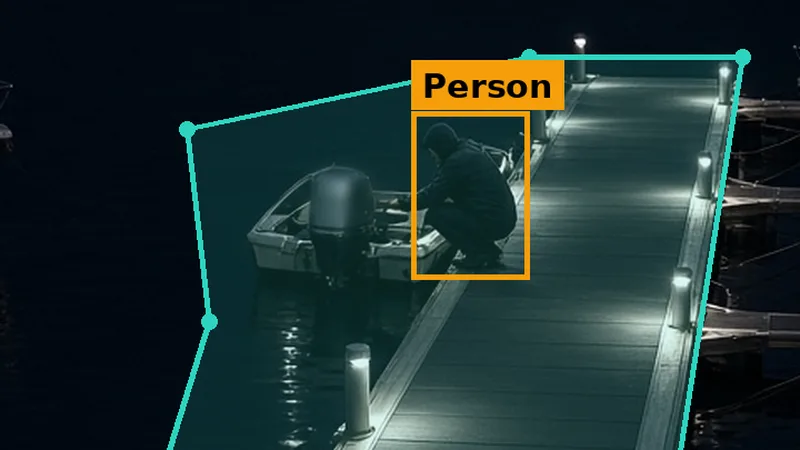
Some berth-holders visit at any hour, and some marinas have liveaboards. That is not a reason to leave the pontoons unwatched; it is a reason to watch them carefully. Zones can be drawn over the outer berths where nobody is expected at night, leaving the liveaboard berths and the walkway to them out, and the clip in every alert shows the person checking it whether this is a berth-holder or someone who should not be there.
How common are boat fires?
More common than most people think. A statement by the National Fire Chiefs Council to the Boat Safety Scheme, using Home Office data for all boats, gives an average of 157 primary fires on boats a year over the five years from 2013/14 to 2017/18, and says the annual figure does not appear to be reducing. The data is not new, but it is the most detailed national breakdown we found.
Most of those fires were accidental, and the NFCC says accidental fires are preventable. But about a fifth were recorded as deliberate across the five years, and in 2017/18 38 of the 157 were recorded as deliberate, against someone else’s property or where the owner was unknown. The NFCC also says a moderate sized boat can carry hundreds of litres of diesel, tens of kilograms of LPG and 20 to 50 litres of petrol, and that it considers boats to present a much higher risk of fire than land-based dwellings.
Fires on boats kill people. The GOV.UK guidance on fire safety on boats says fires on boats have killed 30 boaters in the last 20 years, and that most fires are preventable.
Why does a fire at a marina spread so quickly?
Because boats are moored close together, built from materials that burn, and carry fuel and gas. The Boat Safety Scheme impact assessment published in December 2025 says that between January 2020 and December 2024, at least 90 boats on the waterways where the scheme applies were damaged by fire spreading from one boat to another, a mean of six boats a year, and that up to 1 in 16 boat fires result in more than one boat being damaged. It notes that mooring infrastructure is damaged too, including pontoon systems complete with their services and utilities.
Timing is the other factor. CFPA Europe’s guideline on fire safety in guest harbours and marinas says the greatest risk of fire spreading between boats is when boats are unmanned, or at night when people are sleeping, and the time for discovering and fighting the fire is delayed. That is exactly the situation on most marinas for most of the night, and for much of the winter.
The same guideline sets out practical measures for the water side: a fire risk assessment and a fire safety plan for the marina, fire extinguishers within easy reach along the pontoons, fixed hose reels at larger marinas, a free gap of at least five metres, or about two boat widths, at intervals along long rows of boats, and a night watch when the marina is busy. UK marinas are workplaces, and GOV.UK says the responsible person for non-domestic premises must carry out a fire risk assessment of the premises and review it regularly.
None of that helps if nobody knows a fire has started. A smouldering fire inside a cabin on an empty pontoon can grow for a long time before flames are visible from the shore, and by then the boats either side may be alight. Cameras that already look along the pontoons can also watch for smoke and flame around the clock. Our outdoor fire detection guide covers how that works outdoors.
How do you protect boats laid up ashore for the winter?
Every autumn, boatyards lift boats out and set them on cradles and stands on the hard standing for the winter. Rows of boats sit close together for months, many with outboards still fitted, batteries aboard and covers on, and many owners do not visit until spring. It is one of the busiest places on the site for value and one of the quietest for people.
The CFPA guideline has a section on storage on land. Before a boat is stored, it should be inspected, with gas cylinders and portable fuel cans removed, batteries disconnected, and fixed fuel tanks either empty and ventilated or at least 95% full. Unattended battery charging should not be permitted. The guideline also suggests how to lay out the hard standing.
The spacing it suggests is a distance of preferably 4 metres between boats, boats in blocks of 30 with 8 metres between the blocks, and a minimum of 8 metres between any boat and any building, with the fire and rescue service consulted on access routes. Not every yard has the space, but every yard can make sure the fire risk assessment covers the hard standing and that the access routes stay clear.
Theft is the other winter risk. A boat on a cradle has its outboard at head height on the transom, a ladder often stands against the hull, and the yard can be dark and empty for twelve hours or more. The RYA advice to remove engines and store them in a locked building applies here more than anywhere.

A fire on the hard standing is easier to reach than one on the water, but it can still spread quickly through boats stored close together. Cameras over the hard standing can watch for smoke and flame, and for people, from the end of the working day until the yard opens.
What about fuel, gas and batteries?
Marinas hold fuel in several places: the fuel berth and its tanks, the workshop, and the boats themselves. The GOV.UK guidance on fire safety on boats says spare petrol should be stored in a self-draining locker or on open deck, that outboards should be refuelled well away from the boat where possible, and that gas cylinders should be stored outside, in a self-draining, fire-resistant locker. It also asks owners to unplug appliances when they leave the boat and to take care when reinstalling batteries.
- Fuel berth and tanks. Locked pumps, lighting and a camera on the fuel berth for theft, tampering and spills. Our fuel theft prevention guide covers tanks in more detail.
- Gas. Cylinders in proper lockers aboard, and cylinders for sale in a ventilated, locked cage ashore.
- Batteries. No unattended charging, and care with shore power leads left plugged in on empty boats. Our lithium-ion battery storage guide covers battery fires.
- The workshop. Hot work under a permit, with a fire watch afterwards, and oily waste and solvents stored safely. Our hot works fire risk guide has more.
Why are marinas hard to protect?
A marina is not a normal site. It has a fence on the land side and water on the other, and the water is not a barrier. Many marinas share a shoreline with public footpaths, slipways and beaches. The boats themselves block the view, the site changes with the tide and the seasons, and berth-holders, liveaboards, visitors and contractors come and go at any hour.
- Open water. Anyone with a small boat or a kayak can reach the outer berths without going near a gate, although Hampshire police note that few offenders do.
- Long shorelines. Fences that end at the water, slipways and quay walls are easy ways in.
- Blocked views. Hulls, cabins, masts and covers hide people from cameras placed too low or at the wrong angle.
- Movement everywhere. Water, boats moving on their lines, rigging, flags, covers and birds all move, and all of it confuses simple motion detection.
- Many legitimate users. Berth-holders have every right to be there, at any hour, and must not be treated as intruders.
Those are the reasons a marina needs a plan for its cameras, rather than more cameras. ProtectUK’s site security advice starts from the same idea for any site: understand who should be there, control the ways in, and make sure anything unusual is seen and acted on.
Where should cameras watch at a marina?
Most marinas already have CCTV at the gate, the office and the fuel berth, and often along the pontoons. The question is whether it covers the places where things go wrong, and whether anyone sees it before morning. Walk the site at dusk with the camera views on a phone and ask, for each risk, which camera would see it.
- The road gate and car park. Every vehicle should pass here, including any vehicle big enough to take an outboard or a boat on a trailer.
- The pontoon gates. Who comes onto the berths, and when.
- The outer pontoons. The berths furthest from the office and the gate, where someone can work at an outboard without being seen.
- The hard standing. Boats ashore, the workshop, the engine store and the fuel.
- The dinghy park and the trailer park. Small boats and outboards, easy to carry away.
- The shoreline and the slipway. Where fences end at the water and people walk in.
Mount cameras high enough to see over the boats rather than into the side of the nearest hull, and check what each one sees at night, at low tide and high tide, and in winter when the hard standing is full. Each camera needs power, a connection and enough light or infrared at night, and following the Devon and Cornwall advice, it is worth asking whether key cameras could keep running if the site power is cut.
How does AI on existing CCTV protect a marina?
Recording-only CCTV shows what happened after the berth-holder finds the outboard missing on Saturday morning. AI detection tells someone while it is happening. Woodcock AI connects to the IP cameras and recorders already on site, over RTSP or ONVIF, including Hikvision, and runs on an edge server on site or on a cloud server.
- Polygon zones. Draw a zone of any shape over the outer berths, the hard standing, the engine store or the dinghy park, and leave out the water, the liveaboard berths, the public footpath and the slipway.
- Direction-aware lines. Draw a line along the inside of the perimeter fence or across the entrance road, and choose which direction counts, so someone climbing in raises an alert while people walking the footpath outside are ignored.
- People and vehicles. Detection counts people and vehicles, so ripples, reflections, rigging, covers and gulls do not.
- Smoke and flame. The same cameras watch for smoke and flame around the clock, along the pontoons, over the hard standing and at the workshop and fuel berth.
- Schedules. Each zone and line has its own hours, so the hard standing can be armed from the end of the working day, the outer pontoons in the small hours, and the perimeter day and night.
- Alerts with the clip. Each alert arrives in the app and by email with a short clip and an AI description of what happened, so the person receiving it can decide quickly what to do.
The system is self-learning. It learns each camera, so the swing of a moored boat, the pontoon lights coming on and the night staff doing their rounds become part of the normal view, and marking an alert as correct or false feeds into retraining for your site. Woodcock AI has been in development for years and is now running on customer sites across the UK.
Woodcock AI does not read number plates or identify people. It flags that a person or vehicle is somewhere it should not be, and the clip shows what happened.
Coming next: Ask your cameras Coming soon, early 2027, which will let you ask the system questions about what your cameras have seen.
What does AI detection look like in each part of the marina?
The rules depend on the part of the site. Choose an area to see an example of how a camera there is set up and what an alert looks like. The pontoons are shown at the top of this page.
Which part of the marina are you protecting?
The road gate is where every berth-holder, contractor, delivery and visitor should arrive, and it is the only way in for a vehicle big enough to take an outboard, a tender or a boat on a trailer. A line across the entrance road just inside the gate, set to count vehicles coming in and armed once the yard has closed, flags a van or a car and trailer arriving with nothing booked, while traffic leaving is ignored. A zone over the trailer park and the dinghy park flags someone on foot there at night. Our perimeter intrusion detection guide covers gates and fences in more detail.
Road gate, car park, trailers, dinghy park
The hard standing is where boats spend the winter on cradles and stands, often with outboards still on the transom, and where the workshop, the engine store and the fuel tank usually sit. A zone over the hard standing, armed from the end of the working day until the yard opens, flags a person walking between the boats, climbing a ladder or reaching up to an outboard, and a vehicle backing up to them. Leave the public road and the slipway out of the zone. Our fuel theft prevention guide covers the fuel tank in more detail.
Boats ashore, workshop, engine store, fuel
The perimeter is where people get in without using the gate: over a fence beside a footpath, round the end of a fence at low tide, up the slipway, or by boat to a quiet corner of the yard. A line along the inside of the fence, set to count people coming in, flags someone climbing in, and it can be armed day and night. Keep the footpath and the water outside the boundary out of the zone. The alert gives night staff or a keyholder a chance to check the clip and call 999 before anything is taken.
Landside fence, shoreline, slipway, water gate
Each gate, pontoon, yard and fence line gets its own zones and lines, with its own schedule.
How does AI detection compare with other marina security measures?
No single measure protects a marina on its own. Gates and codes keep the berths to berth-holders; locks, marking and trackers make kit harder to take and easier to recover; staff, alarms and cameras see what is happening. The table compares the usual options.
| Measure | What it does | Strengths | Watch out for |
|---|---|---|---|
| Pontoon gates and access codes | Keeps the berths to berth-holders and their guests | Cheap, familiar and expected at most marinas | Codes get shared; gates are held open or climbed; nothing stops someone arriving by water |
| Locks, chains and locking bars | Makes outboards, tenders and kit harder to take | Often an insurance condition; police and the RYA recommend them | Only as good as the lock and the fitting; cut quickly with the right tools |
| Marking, registration and trackers | Makes stolen kit easier to identify and recover | Helps police return property and prosecute | Works after the event; does nothing about fire or damage |
| Night staff or patrols | A person on site or visiting at set times | Human presence, checks and a fast local response | Ongoing cost; one person cannot watch the gate, the pontoons and the yard at once |
| Alarms aboard | Smoke, CO, hatch or movement alarms on the boat | Warns anyone aboard or nearby; some alert the owner remotely | Fitted boat by boat; nobody may hear one on an empty pontoon in winter |
| Recording-only CCTV | Records what happened | Evidence after the event | Nobody sees it until the missing outboard is found in the morning |
| AI on existing CCTV | Recognises people, vehicles, smoke and flame, in zones and on lines you draw, on a schedule | Watches the gate, the pontoons, the hard standing and the fence at once; the alert includes the clip | Cameras need a clear view, power, a connection and enough light or infrared at night |
How do you stop false alarms on marina cameras?
Marinas are among the hardest places for basic motion detection. The water moves all the time and reflects every light, boats swing on their lines, rigging and flags move in the wind, covers flap, and gulls, herons and cormorants land on the pontoons all night. A system that alerts on every pixel that changes soon gets ignored.
- Count only people and vehicles, so water, boats, rigging and birds are ignored.
- Draw zones that leave out the noise: the open water, the fairway, the public footpath and the slipway.
- Use direction on lines, so only people coming in over the fence count, not people walking along it outside.
- Set schedules that match the marina’s day, so each zone is armed only when nobody is expected there.
- Use the feedback button to mark false alerts, so the system learns your site.
Our guide to reducing CCTV false alarms covers this in more detail.
How should detection schedules match the marina’s day?
A marina’s pattern changes through the year. In summer, berth-holders arrive late and leave early; in winter, the pontoons are quiet and the hard standing is full. The cameras should be armed where and when nobody is expected, and quiet where people have every right to be.
- Hard standing and engine store: armed from the end of the working day until the yard opens, and all weekend if the yard is closed.
- Outer pontoons: armed in the small hours, when no berth-holder is expected there, leaving out the liveaboard berths.
- Perimeter and shoreline: armed day and night, every day, since nobody should be climbing the fence at any time.
- Gate: an inbound vehicle line armed overnight, with late arrivals and early contractors planned around it.
- Smoke and flame: on around the clock, every day.
Review the schedules through the year. Lift-out and launch weeks bring contractors and lorries, summer brings visitors and late arrivals, and the winter lay-up fills the hard standing. A berth-holder walking to their boat at 19:30 is expected; a person at the outer berths at 02:14 is not.
Who responds when an alert fires at night?
An alert is only useful if someone acts on it. Before the cameras go live, agree who receives which alerts and at what hours, what they should do, and who they call. For most marinas that is night staff or a duty manager, a monitoring centre, or both.
- Check the clip first. The clip and the AI description usually show whether it is a person, a vehicle or smoke, and where.
- Call 999 for a crime in progress or a fire. Give the address, the entrance to use, the pontoon or the part of the yard, and what you can see on the clip.
- If someone is in the water, call 999. Ask for the coastguard on the coast or tidal water, or the fire and rescue service inland, and give the exact location. Never go into the water after them.
- Never go alone. Night staff or a keyholder should not go out along a pontoon alone to confront intruders; wait for the police or a security response.
- Review every alert. Mark it correct or false, and fix what it revealed: a gate left open, a code that has been shared, a gap in the fence or a dark corner.
The National Police Chiefs’ Council requirements for security systems say police response to an intruder alarm with a unique reference number (URN) is withdrawn after three false calls in a rolling 12 months, another reason to keep false alerts down and have alerts checked by a person before the police are called.
How do you work with berth-holders, contractors and the police?
Marina security depends on the people who use the marina. Berth-holders see what is normal, notice a stranger on the pontoon and lock their own kit away; contractors need to come and go; and the police need reports and evidence.
- Berth-holders. Tell them what the cameras cover and what happens when an alert fires, ask them to keep codes to themselves, and send reminders before the winter about removing outboards, fuel, gas and valuables. Hampshire police suggest owners ask exactly these questions, so have the answers ready.
- Liveaboards and late arrivals. Keep a list, so night staff know who is expected and zones can leave out their berths.
- Contractors. Keep a daily list of who is expected and where, with permits for hot work and a fire watch afterwards.
- Keys and codes. Record who holds keys, fobs and codes, keep workshop and engine store keys locked away, and change codes when people leave. ProtectUK gives the same advice for any site.
- The police. Report every theft and every case of damage, and keep the crime numbers. Thefts at one marina are often part of a wider series, as the Devon and Cornwall cases show.
Cameras support all of this: a clip of someone working at an outboard at 02:14 gives the police something to work with and the berth-holder a dated record for the insurer.
How do you keep people safe around the water at night?
Pontoons at night are slippery, narrow and often poorly lit, and the water is cold for most of the year. The National Water Safety Forum recorded 202 accidental water-related deaths in the UK in 2025, 57% of them at inland locations such as rivers, lakes and reservoirs.
- Nobody chases anyone along a pontoon. Staff and berth-holders should never follow an intruder onto the berths at night.
- Rescue equipment. Lifebuoys, throwlines and ladders in place, checked and replaced when damaged.
- Lighting. Enough light on the pontoons for people to walk safely and for cameras to see.
- A 999 plan. Night staff know the exact location of every pontoon and who to call.
How does data protection apply to marina CCTV?
Marina cameras see staff, berth-holders, liveaboards, visitors and contractors, and often public footpaths, slipways and the water. The Information Commissioner’s Office guidance on video surveillance expects a clear purpose, signs before people enter the recorded area, footage kept only as long as needed and kept secure, and a data protection impact assessment where the processing is likely to be high risk.
Polygon zones help here too: a zone over the hard standing or a line inside the fence keeps detection to the marina, and a footpath, the public slipway, a neighbour’s land or a liveaboard’s berth can be left out. Woodcock AI does not use facial recognition, identify who anyone is or read number plates. Our AI CCTV and GDPR guide has more.
How do you get started?
Start with the basics: one controlled road gate, coded pontoon gates with codes changed regularly, a fire risk assessment that covers the pontoons, the hard standing, the workshop and the fuel, boats ashore spaced apart with fuel and gas removed and no unattended charging, and berth-holders reminded to lock, mark and remove their kit. Then map the cameras already on site: what each covers, what it sees at night, and where trouble has happened before.
Our site assessment looks at the cameras already on your marina or boatyard and the zones, lines and schedules that would cover the gate, the pontoons, the hard standing and the shoreline, and tells you honestly where a camera cannot do the job. To see it working first, we can run a live test on your cameras: we connect two or three of them for about a fortnight. We can also arrange an on-site demo. See how the same approach works for other open sites in our self-storage security guide and our quarry security guide.
What are the limits of cameras at a marina?
- A camera needs a view. It cannot see behind a hull, under a cover or along a pontoon it does not point at.
- It needs light or infrared at night. Check what each camera actually sees in the dark, including the outer berths and the back of the hard standing.
- It needs power and a connection. If either is cut, cameras and alerts stop, which is why independent power for key cameras is worth considering.
- It detects; it does not stop anyone. Gates, codes, fences and locks still have to do that, and nothing stops someone arriving by water.
- It does not replace fire safety measures. Smoke detection on cameras is an early warning on top of the fire risk assessment, extinguishers along the pontoons, and smoke and CO alarms aboard.
- It does not read number plates or identify people. It flags people and vehicles in zones and on lines; the clip shows what happened.
- Someone has to respond. An alert is only useful if someone acts on it.
Sources
- British Marine, British Marine publishes UK Marina and Moorings Market Report 2025 (January 2026), and The UK Marina and Moorings Market, 2025 (full report, hosted by the Canal and River Trust).
- National Fire Chiefs Council, statement on inland boats and smoke alarms, published by the Boat Safety Scheme, with Home Office data for 2013/14 to 2017/18.
- Boat Safety Scheme, smoke alarms consultation impact assessment (December 2025).
- GOV.UK, Fire safety on boats.
- CFPA Europe, Guideline No 15:2022 F, Fire safety in guest harbours and marinas.
- GOV.UK, Fire safety in the workplace.
- Avon and Somerset Police, Marine security.
- Hampshire and Isle of Wight Constabulary, Marine crime.
- Devon and Cornwall Police, Outboard motors stolen in Teignbridge burglary and Outboard motors stolen in St Austell burglary.
- RYA, IMO guidelines for pleasure craft and Tips for securing engines against damage and theft.
- National Water Safety Forum, 202 accidental water-related fatalities in 2025 (WAID 2025, May 2026).
- ProtectUK, Site security.
- National Police Chiefs’ Council, Police Operational Advice and Security Industry Requirements for Response to Security Systems (March 2024).
- Information Commissioner’s Office, Guidance on video surveillance, including CCTV.
We have summarised these sources in our own words. Always read the current versions in full. This page is general guidance, not legal, fire safety, insurance or security advice; the police, your fire risk assessor, your insurer, your monitoring centre and a competent installer decide what applies to your site.
Want to know when someone is on your pontoons or in your boatyard tonight?
Book a site assessment and we will look at the cameras on your marina or boatyard and plan zones, lines and schedules for the gate, the outer pontoons, the hard standing and the shoreline, with smoke and flame detection along the berths and over the boats ashore from the same cameras. Or ask for a live test on your cameras first: we connect two or three of them for about a fortnight.
Related pages
Frequently asked questions
How do you secure a marina or boatyard?
Start with one controlled road gate, coded pontoon gates with codes changed regularly, good lighting, a fire risk assessment covering the pontoons, the hard standing, the workshop and the fuel, and berth-holders reminded to lock, mark and remove their kit. Cameras should cover the gate, the pontoon gates, the outer berths, the hard standing and the shoreline. AI on existing cameras then flags people, vehicles and smoke out of hours, with the clip in every alert.
How do you stop outboard engine theft?
Police and RYA advice is to secure outboards with a hardened steel chain and padlock or a proprietary locking bar, remove engines and store them in a locked building when the boat is not in use, take keys and valuables ashore, record serial numbers, mark the engine and consider a tracker. Marinas can add controlled gates, lighting and cameras that alert someone when a person is at the outer berths or in the boatyard at night.
How common are boat fires?
Home Office data quoted by the National Fire Chiefs Council gives an average of 157 primary fires on boats a year over five years to 2017/18, with about a fifth recorded as deliberate. GOV.UK says fires on boats have killed 30 boaters in the last 20 years. The Boat Safety Scheme found at least 90 boats damaged by fire spreading from another boat between 2020 and 2024.
Can CCTV detect a fire on a boat in a boatyard?
Yes, where a camera has a clear view. AI smoke and flame detection on existing cameras watches for smoke and flame around the clock, along the pontoons and over boats laid up on the hard standing, and sends an alert with the clip. It is an early warning on top of the fire risk assessment, extinguishers along the pontoons and smoke alarms aboard, not a replacement for them.
Does Woodcock AI read number plates?
No. Woodcock AI detects people and vehicles in zones and on lines, and smoke and flame. It flags that a person or vehicle is somewhere it should not be, such as a van at the boatyard gate at night, and the clip shows what happened, but it does not read number plates or identify people.
Does Woodcock AI need new cameras at a marina?
Usually not. It connects to existing IP cameras and recorders over RTSP or ONVIF, including Hikvision, and runs on an edge server on site or on a cloud server. A site assessment shows which cameras already cover the gate, the pontoons, the hard standing and the shoreline, and where moving or adding a camera would help.
Last reviewed 1 November 2026
Running a holiday or caravan park rather than a marina? See our holiday park security guide.