

Holiday park security: closed-season break-ins, caravan fires and intrusion out of hours
Holiday park security means protecting static caravans, lodges, the shared facilities and the people on site from break-ins, theft, damage and fire, most of all in the closed season, when hundreds of units sit empty for weeks and nobody is around to notice. The basics are a controlled entrance, a secure boundary, owners told to take valuables home and leave curtains open, spacing and fire points that meet the site licence, and safe gas arrangements. AI on the CCTV already on site then flags people, vehicles and smoke in zones and on lines, with the clip in every alert.

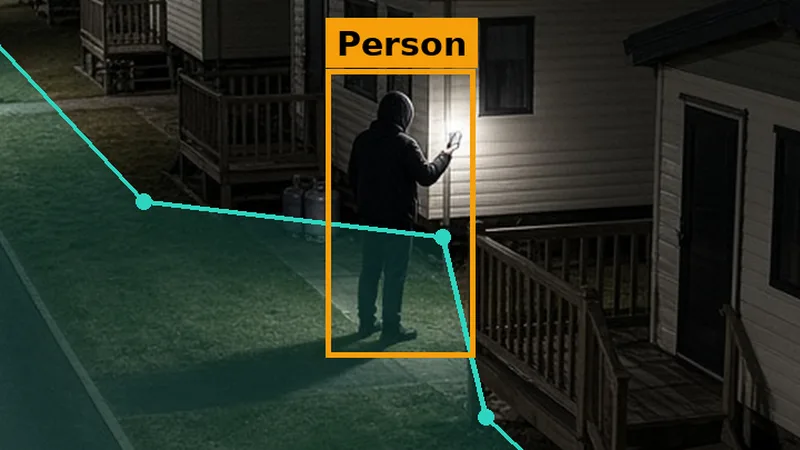
Last updated 1 November 2026. A holiday park is a small village that empties every winter. In the season it is full of families, owners, staff, cars and noise. Then the park closes, the owners lock up and go home, and rows of static caravans and lodges, many with TVs, white goods, bikes and garden furniture inside, sit unwatched for weeks or months. The bar, the shop, the pool plant room and the gas compound go quiet too.
Those quiet weeks are when caravans are broken into, items are stolen from them, and a fire in one unit can take hold and spread before anybody sees it. This guide covers the main risks to UK holiday, caravan and lodge parks, what the figures show, what the police, fire and rescue services and site licence standards say, where cameras should watch, and how AI on the CCTV already on site can watch the entrance, the caravan rows, the facilities and the boundary. It is written for park owners and managers, wardens, groups that run several parks, and their installers.
What are the main security risks to a holiday park?
A small touring and camping site on a farm, a coastal park with several hundred static caravans and a lodge park round a fishing lake all look different. But most of them face the same four kinds of risk, and almost all of them peak when the park has closed, either overnight or for the winter.
- Break-ins and theft from caravans and lodges. TVs, games consoles, tools, bikes, gas cylinders, garden furniture and anything else left inside, underneath or on the decking. A closed-up row of caravans gives a thief time and privacy.
- Caravan fires. A fire in one unit, from an electrical fault, a heater, cooking, gas, smoking or a fire set deliberately. Units sit close together and are built from lightweight materials, so a fire can spread to the next caravan, the decking and the awnings.
- Intrusion and damage. People on the park at night who have no reason to be there, whether they came through the entrance, through a hedge, along a footpath or from the beach, and the vandalism and fly-tipping that come with them.
- The shared facilities. Reception, the bar and clubhouse, the shop, the swimming pool and its plant room, the maintenance yard, the bulk gas tanks or cylinder compound, and the vehicles and machinery the park relies on.
These risks overlap. Someone looking for things to steal from caravans may force a door, break a window or leave a unit open to the weather, and one who is disturbed may damage a camera or a light on the way out. A fire started in an empty caravan can spread along a row before anyone sees the smoke. That is why holiday park security works best when it is planned for the whole park, from the entrance barrier to the furthest lodge, rather than unit by unit.
The cost of an incident is often far bigger than what was taken. A forced door and a missing TV leave an owner with a damaged holiday home, a claim to make and a ruined first visit of the season. A fire can destroy several units and the services that run to them. And a pattern of break-ins makes owners wonder whether to stay on the park, which matters to a business that depends on owners renewing their pitches year after year.
How big is the UK holiday parks sector?
The national trade body for parks, the British Holiday and Home Parks Association, told Parliament in written evidence to Parliament that, as of November 2024, there were 1,677 park businesses operating 2,993 parks providing 386,677 pitches within its membership. Those parks include caravan holiday, touring, residential and chalet parks and campsites for tents.
That works out at about 130 pitches per member park on average, and many parks are much larger. A park of that size can hold more homes than a village, spread over many hectares of grass, roads, hedges and water, with a handful of staff on site out of hours and often none at all in the closed season.
We found no official national figure for crime on holiday parks or for burglary of static caravans. Police forces and councils in coastal areas describe the problem in their own areas, and that, together with the fire figures below, is the evidence this guide uses.
Why are caravans broken into in the closed season?
Because they are empty, and everyone knows they are empty. Most holiday parks close for part of the winter, or keep only a few units open, and owners usually take their last trip of the year in the autumn. For the next few months, row after row of caravans and lodges sit unvisited, often a long way from the park office, with nobody to see a torch or hear a door being forced.
In October 2025, North Wales Police reminded owners that over the closed season there can often be an increase in theft from unoccupied static caravans. In February 2025, Police Scotland appealed for information after a number of static caravans were broken into at a camping and caravan park in Dornoch in the Highlands, discovered on a Sunday in February. On a closed park, a break-in may not be found until an owner or a member of staff happens to check, which can be days or weeks later.
Coastal councils and police have tackled the problem together. In East Lindsey on the Lincolnshire coast, the Caravan Park Watch scheme was set up in 2014, initially to tackle a growing number of burglaries on holiday parks, especially during the winter close-down period. Site owners, site managers, Lincolnshire Police, insurers and the council’s site licensing team meet regularly, and site owners have signed information sharing agreements so that the police can share intelligence on crime trends. The council says caravan burglary in the area fell by 53% in 2022/23 compared with the previous year, and that the drop encouraged other coastal police force areas to consider similar schemes.
The advice to owners is practical and consistent. North Wales Police and Caravan Park Watch both say much the same thing:
- Take valuables home. TVs, DVD players, games consoles and anything else of value, at the end of the season.
- Leave curtains open. North Wales Police recommend leaving curtains, blinds and nets open. It may go against your instincts, but it shows there is nothing worth breaking in for.
- Leave cupboards open. In the kitchen and bedrooms, leave cupboard and wardrobe doors open, and stand mattresses on their side if there is room, to show nothing is hidden away.
- Display a card or sticker. North Wales Police suggest asking a crime prevention officer for a window card, one on each side of the caravan if possible. Caravan Park Watch provides stickers confirming all valuables, including TVs, have been removed.
- Mark property. Caravan Park Watch has given member parks UV pens, so that items can be traced back to a particular park.
- Lock up. Lock and secure all windows and doors before leaving.
Owners can only do so much, though. The park controls the entrance, the boundary, the lighting, the cameras and the way the site is watched when it is closed, and those are what decide whether someone walking the rows at 02:00 is noticed before the first door is forced.
How common are fires in caravans on holiday parks?
Fire statistics for England separate fires in caravans on caravan sites from fires in caravans used as permanent homes. The Ministry of Housing, Communities and Local Government’s table A61, published in July 2025, counts the primary fires that fire and rescue services attended where the property was recorded as a caravan or camper van on a caravan site. Over the five years from 2019/20 to 2023/24 there were 201 such fires, between 35 and 44 a year.
Those fires caused 21 recorded casualties over the five years, and one death in each of the last three years in the table, 2021/22, 2022/23 and 2023/24. The numbers were much higher at the start of the series, at 118 fires in each of 2010/11 and 2011/12, and have been between 35 and 73 a year in every year since. The table covers England only, so the UK total is higher.
Each of those fires is one caravan, or the first caravan. The statistics do not say how many neighbouring units were damaged, and that is where the real risk on a holiday park lies.
Why does a fire on a caravan park spread so quickly?
Because caravans are built from lightweight materials, sit close together and often have gas, awnings, decking and stored items between them. After a fire at a holiday park at Holton Heath in May 2018, Dorset and Wiltshire Fire and Rescue Service said the caravan where the fire started and two others were totally destroyed, and that four fire engines attended. The station manager said caravans have limited escape options and, as they are made of lightweight and highly combustible fittings, a fire can spread very quickly, and reminded owners that keeping a safe distance between caravans, including awnings, is really important.
Tents are faster still. Cambridgeshire Fire and Rescue Service says fires can destroy a tent in less than 60 seconds and, because tents are close together, fires can easily spread. Its advice for caravans is to keep them at least six metres apart, to find out about the firefighting arrangements on the site, and to report a vandalised or damaged site fire alarm to the site manager immediately.
Timing is the other factor. A fire in an occupied caravan in the season is usually noticed quickly, by the people inside or their neighbours. A fire in an empty caravan on a closed row in January can burn for a long time before anyone sees it, and by then the units either side may be alight.
What do site licences say about spacing and fire points?
Caravan sites need a site licence from the local council, and the licence conditions usually follow model standards for spacing, roads and fire safety. The detail varies by council and by country, so always read your own licence, but the figures are broadly similar.
- Spacing between units. The Scottish Government’s fire safety guidance for holiday camping and caravan sites says the distance between any two units should generally be not less than 6 metres for residential and touring sites, and 5 metres for holiday caravan sites. Torbay Council’s standard conditions for static holiday caravan sites set not less than 5 metres between units and 3.5 metres at the corners, rising to 6 metres where aluminium and plywood caravans are mixed.
- Awnings, porches and decking. The Scottish guidance says an awning should be at least 3 metres from an adjoining caravan, and that verandas, ramps and stairs need clear space between them.
- Fire points. Both say fire points should be placed so that no unit or site building is more than 30 metres from one, in a weatherproof structure clearly marked “FIRE POINT”, with a hose reel or extinguishers and a means of raising the alarm.
- Emergency routes. Torbay’s conditions say emergency vehicle routes within the site should be kept clear of obstruction at all times.
- Housekeeping. The Scottish guidance says the spaces below caravans should not be used to store combustible materials, that grass and vegetation should be cut at frequent intervals, that waste should go in purpose-designed containers and be removed regularly, and that open fires should be prohibited and barbecues controlled.
A holiday park is also a workplace, and GOV.UK says the responsible person for non-domestic premises must carry out a fire risk assessment and review it regularly. That assessment should cover the caravan rows in the closed season, not only the clubhouse and the pool.

Fire points and hose reels only help if someone knows there is a fire. On an empty park in winter, the cameras that already look along the rows can also watch for smoke and flame around the clock. Our outdoor fire detection guide covers how that works outdoors.
What about gas, LPG and electrics?
Most static caravans and many lodges run on LPG, from cylinders beside each unit or from bulk tanks piped round the park. Rented holiday accommodation is covered by gas safety law: the Health and Safety Executive says landlords’ duties apply to rented holiday accommodation, including chalets and caravans. Its guide to landlords’ duties requires an annual safety check on each gas appliance and flue, and says that anyone providing LPG for a tenant on a caravan or holiday home park must discuss emergency arrangements with the LPG supplier and agree what to do in case of a gas escape or carbon monoxide from an appliance.
- Cylinders and tanks. Cylinders upright, secured and outside the unit; bulk tanks and cylinder stores fenced, locked, lit and kept clear of rubbish and vegetation.
- The gas compound. A camera on the compound watches for tampering, theft of cylinders and fires nearby, and it is one of the places where an alert should always go straight to a person.
- Electrics. Hook-ups, heaters and appliances left on in empty units are a common worry in winter. The Dorset and Wiltshire advice is to turn off all appliances before leaving the caravan.
- Batteries. E-bikes, scooters and mobility scooters charging in caravans, sheds and the maintenance yard. Our lithium-ion battery storage guide covers battery fires.
- Smoke and CO alarms. In every unit, tested at the start of each season. Dorset and Wiltshire Fire and Rescue Service made exactly this point after the Holton Heath fire.
Why are holiday parks hard to protect?
A holiday park is not a normal site. It covers a large area with long, soft boundaries of hedges, banks and fences, often alongside public footpaths, beaches, rivers or lakes. It is full of private homes that belong to other people. And the number of people on site swings from thousands in August to almost nobody in February.
- Long, soft boundaries. Hedges and fences that run a long way, with gaps, stiles, footpaths and beaches that people use legitimately by day.
- Hundreds of units. Rows of caravans and lodges block the view, so a camera at the end of a row sees the first few units and not the rest.
- Movement everywhere. Trees, hedges, flags, awnings and wildlife all move, and all of it confuses simple motion detection.
- Many legitimate users. Owners can visit their own caravan at any time the park is open to them, and staff, contractors and deliveries come and go.
- Privacy. Guests and owners are on holiday in their own homes, and cameras must never look into them.
Those are the reasons a park needs a plan for its cameras, rather than more cameras. ProtectUK’s site security advice starts from the same idea for any site: understand who should be there, control the ways in, and make sure anything unusual is seen and acted on.
Where should cameras watch on a holiday park?
Most parks already have CCTV at the entrance, reception and the bar, and sometimes on the main roads through the park. The question is whether it covers the places where things go wrong, and whether anyone sees it before morning. Walk the park at dusk in the closed season with the camera views on a phone and ask, for each risk, which camera would see it.
- The entrance and reception. Every vehicle should pass here, including any vehicle big enough to carry away what is inside a row of caravans.
- The roads between the rows. Cameras looking along the roads and paths, high enough to see over the units, not into them.
- The far rows and lodges. The units furthest from the office, where someone can work at a door without being seen.
- The facilities. The bar and clubhouse, the shop, the pool plant room, the maintenance yard and the gas compound.
- The boundary. Gaps in hedges, footpath crossings, the beach access and the lake shore, where people walk in.
Mount cameras high enough to see along a row rather than into the side of the nearest caravan, and check what each one sees at night, in fog and in winter when the trees are bare and the leaves are off. Each camera needs power, a connection and enough light or infrared at night. If the power to empty rows is turned off in winter, check that the cameras watching those rows do not go off with it.
How does AI on existing CCTV protect a holiday park?
Recording-only CCTV shows what happened after an owner finds the door forced at Easter. AI detection tells someone while it is happening. Woodcock AI connects to the IP cameras and recorders already on site, over RTSP or ONVIF, including Hikvision, and runs on an edge server on site or on a cloud server.
- Polygon zones. Draw a zone of any shape over the roads between the rows, the lodge paths, the maintenance yard or the gas compound, and leave out windows, private gardens, hot tubs, the public footpath and the beach.
- Direction-aware lines. Draw a line along the inside of the boundary or across the entrance road, and choose which direction counts, so someone climbing in raises an alert while walkers on the footpath outside are ignored.
- People and vehicles. Detection counts people and vehicles, so deer, foxes, rabbits, hedges and flapping awnings do not.
- Smoke and flame. The same cameras watch for smoke and flame around the clock, along the rows and at the facilities and the gas compound.
- Schedules. Each zone and line has its own hours, so the caravan rows can be armed day and night in the closed season and switched off when guests arrive, while the boundary stays armed all year.
- Alerts with the clip. Each alert arrives in the app and by email with a short clip and an AI description of what happened, so the person receiving it can decide quickly what to do.
The system is self-learning. It learns each camera, so the trees moving in the wind, the security lights coming on and the warden doing their rounds become part of the normal view, and marking an alert as correct or false feeds into retraining for your site. Woodcock AI has been in development for years and is now running on customer sites across the UK.
Woodcock AI does not read number plates or identify people. It flags that a person or vehicle is somewhere it should not be, and the clip shows what happened.
Coming next: Ask your cameras Coming soon, early 2027, which will let you ask the system questions about what your cameras have seen.
What does AI detection look like in each part of the park?
The rules depend on the part of the park. Choose an area to see an example of how a camera there is set up and what an alert looks like. A static caravan row is shown at the top of this page.
Which part of the park are you protecting?
The entrance is where guests, owners, staff, contractors and deliveries should all arrive, and it is the only way in for a vehicle big enough to take a TV, a fridge, garden furniture or a mobility scooter from a row of closed-up caravans. A line across the entrance road just inside the barrier, set to count vehicles coming in and armed overnight, or all day in the closed season when nobody is booked, flags a van or a car arriving after hours while traffic leaving is ignored. A zone over the reception car park flags someone on foot there at night. Our perimeter intrusion detection guide covers gates and barriers in more detail.
Barrier, reception, car park, deliveries
The rows are where most of the value sits and where the closed season bites hardest: hundreds of units, many with TVs, white goods, bikes and garden kit inside or underneath, and nobody around for weeks. A zone over the roads and paths between the rows, armed day and night once the park has closed, flags a person walking the rows, trying doors or looking in at windows, and a vehicle stopping beside a unit. In the open season, the same zone can be switched off, or armed only on rows that are empty. Mask out windows and private gardens, so detection watches the roads, not the guests.
Static caravans, lodges, decking, sheds
The perimeter is where people get in without using the entrance: through a gap in a hedge, over a fence beside a footpath, along a beach or round the end of a fence at the lake shore. A line along the inside of the fence, set to count people coming in, flags someone climbing in, and it can be armed day and night all year. Keep the public footpath and the water outside the boundary out of the zone. The alert gives the warden or a keyholder a chance to check the clip and call 999 before anything is taken or anyone is hurt.
Hedges, fences, footpaths, beach, lake shore
Each entrance, row, facility and boundary gets its own zones and lines, with its own schedule.
How does AI detection compare with other holiday park security measures?
No single measure protects a holiday park on its own. The barrier controls vehicles; owner advice, window cards and marking make caravans less worth breaking into; Caravan Park Watch style schemes share intelligence with the police; and wardens, alarms and cameras see what is happening. The table compares the usual options.
| Measure | What it does | Strengths | Watch out for |
|---|---|---|---|
| Entrance barrier and gate | Controls vehicles coming onto the park | Familiar, cheap to run and expected by guests | Does nothing about people on foot through hedges, footpaths or the beach |
| Owner advice and window cards | Shows thieves there is nothing worth taking | Backed by the police; cheap and quick | Relies on every owner doing it; does nothing about fire or damage |
| Marking and Caravan Park Watch schemes | Makes stolen items easier to trace; shares intelligence with police | Proven locally; helps police link items to a park | Works mostly after the event |
| Wardens or patrols | A person on site or visiting at set times | Human presence, checks and a fast local response | Ongoing cost; one person cannot watch every row, the facilities and the boundary at once |
| Alarms in units | Smoke, CO or intruder alarms caravan by caravan | Warns anyone inside; smoke alarms are expected in every unit | Fitted unit by unit; nobody may hear one on an empty row in January |
| Recording-only CCTV | Records what happened | Evidence after the event | Nobody sees it until the owner finds the door forced at Easter |
| AI on existing CCTV | Recognises people, vehicles, smoke and flame, in zones and on lines you draw, on a schedule | Watches the entrance, the rows, the facilities and the boundary at once; the alert includes the clip | Cameras need a clear view, power, a connection and enough light or infrared at night |
How do you stop false alarms on holiday park cameras?
Holiday parks are full of things that move. Trees and hedges sway, awnings and flags flap, security lights switch on and off, car headlights sweep across the rows, and deer, foxes, badgers and rabbits are out all night, especially on rural and coastal parks. A system that alerts on every pixel that changes soon gets ignored.
- Count only people and vehicles, so wildlife, trees and weather are ignored.
- Draw zones that leave out the noise: hedges, trees, the public footpath, the beach and the lake.
- Use direction on lines, so only people coming in over the boundary count, not people walking along it outside.
- Set schedules that match the park’s seasons, so each zone is armed only when nobody is expected there.
- Use the feedback button to mark false alerts, so the system learns your site.
Our guide to reducing CCTV false alarms covers this in more detail.
How should detection schedules match the park’s seasons?
A holiday park has two very different modes. In the season, the rows are full of guests and owners who have every right to be there at any hour, and detection on the rows would only produce noise. In the closed season, nobody should be on the rows at all, except staff and owners who have arranged a visit. The cameras should be armed where and when nobody is expected, and quiet where people have every right to be.
- Caravan and lodge rows: armed day and night in the closed season, with owner visits and maintenance work planned around it; off, or armed only on empty rows, in the open season.
- Facilities and the maintenance yard: armed overnight all year, from closing time until the first staff arrive.
- Boundary and lake edge: armed day and night, all year, since nobody should be climbing in at any time.
- Entrance: an inbound vehicle line armed overnight, and all day in the closed season.
- Smoke and flame: on around the clock, every day.
Review the schedules at each change of season. Opening weekends, half-terms, events and late arrivals bring traffic at unusual hours, while the winter close-down, refurbishment and caravan deliveries bring contractors. An owner checking their caravan on a Saturday in February is expected; a torch on row D at 01:52 is not.
Who responds when an alert fires at night?
An alert is only useful if someone acts on it. Before the cameras go live, agree who receives which alerts and at what hours, what they should do, and who they call. For most parks that is the warden or a manager living on site, a monitoring centre, or both, and in the closed season it may be a keyholder some distance away.
- Check the clip first. The clip and the AI description usually show whether it is a person, a vehicle or smoke, and where.
- Call 999 for a crime in progress or a fire. Give the address, the entrance to use, the row or unit, and what you can see on the clip.
- If someone is in the lake, call 999. Give the exact location, and never go into the water after them.
- Never go alone. A warden or keyholder should not go out along a dark row alone to confront intruders; wait for the police or a security response.
- Review every alert. Mark it correct or false, and fix what it revealed: a gap in the hedge, a barrier left up, a dark row or a schedule that does not match the season.
The National Police Chiefs’ Council requirements for security systems say police response to an intruder alarm with a unique reference number (URN) is withdrawn after three false calls in a rolling 12 months, another reason to keep false alerts down and have alerts checked by a person before the police are called.
How do you work with owners, guests, staff and the police?
Holiday park security depends on the people who use the park. Owners see what is normal on their row and lock their own units; guests need to feel safe without feeling watched; staff and contractors come and go; and the police need reports and evidence.
- Owners. Before the park closes, send the police advice: take valuables home, leave curtains and cupboards open, lock up and display a card. Tell owners what the cameras cover, what happens when an alert fires, and how to arrange a visit in the closed season so they do not trigger an alert.
- Guests. Signs at the entrance and around the park saying CCTV is in use and why, and a clear answer if anyone asks where the cameras point.
- Staff and contractors. A daily list of who is expected and where in the closed season, with permits for hot work and a fire watch afterwards.
- Keys and codes. Record who holds keys, fobs and barrier codes, keep master keys locked away, and change codes when people leave. ProtectUK gives the same advice for any site.
- The police and other parks. Report every break-in and keep the crime numbers. Where there is a local scheme like Caravan Park Watch, join it; where there is not, talk to neighbouring parks and the local police about starting one.
Cameras support all of this: a clip of someone trying caravan doors at 01:52 gives the police something to work with and the owner a dated record for the insurer.
How do you keep people safe around lakes and water?
Many parks have a fishing lake, a river, a pond or the sea on their boundary, and the water is cold for most of the year. The National Water Safety Forum recorded 202 accidental water-related deaths in the UK in 2025, 57% of them at inland locations such as rivers, lakes and reservoirs.
- Nobody chases anyone near the water. Staff should never follow an intruder along a lake shore or a riverbank at night.
- Rescue equipment. Lifebuoys and throwlines in place round the lake, checked and replaced when damaged or stolen.
- Signs and fencing. Clear signs, and fencing where children could reach the water from the play area or the caravan rows.
- A 999 plan. Staff know the exact location of every part of the lake and who to call.
A line along the lake fence, armed at night, gives a warden early warning that someone is at the water when nobody should be, and the clip shows whether it is an intruder, a guest who has wandered or someone in trouble.
How does data protection apply to holiday park CCTV?
Holiday park cameras see staff, guests, owners, children, contractors and often public footpaths and beaches. People on holiday expect privacy in and around their own caravan or lodge. The Information Commissioner’s Office guidance on video surveillance expects a clear purpose, signs before people enter the recorded area, footage kept only as long as needed and kept secure, and a data protection impact assessment where the processing is likely to be high risk.
Never point a camera into a caravan, a lodge, a hot tub, a private garden, the pool changing rooms or the toilet and shower blocks. Polygon zones help: a zone over the road between the rows watches the road and not the units, windows can be masked out, and a footpath or a neighbour’s land can be left out entirely. Woodcock AI does not use facial recognition, identify who anyone is or read number plates. Our AI CCTV and GDPR guide has more.
How do you get started?
Start with the basics: a controlled entrance, a boundary without obvious gaps, owners reminded before the closed season to take valuables home and leave curtains open, a fire risk assessment that covers the rows in winter, spacing and fire points that meet your site licence, safe gas arrangements, and smoke and CO alarms in every unit. Then map the cameras already on site: what each covers, what it sees at night, and where trouble has happened before.
Our site assessment looks at the cameras already on your park and the zones, lines and schedules that would cover the entrance, the caravan rows, the facilities and the boundary, and tells you honestly where a camera cannot do the job. To see it working first, we can run a live test on your cameras: we connect two or three of them for about a fortnight. We can also arrange an on-site demo. See how the same approach works for other sites that sit empty for long periods in our vacant property security guide and our marina and boatyard security guide. Storing touring caravans and motorhomes rather than running a park? See our vehicle yards page.
What are the limits of cameras on a holiday park?
- A camera needs a view. It cannot see behind a caravan, through a hedge or along a row it does not point at.
- It needs light or infrared at night. Check what each camera actually sees in the dark, including the far rows and the lake shore.
- It needs power and a connection. If either is cut, cameras and alerts stop, which matters on a park where power to empty rows may be turned off in winter.
- It detects; it does not stop anyone. Barriers, fences and locks still have to do that.
- It does not replace fire safety measures. Smoke detection on cameras is an early warning on top of the fire risk assessment, fire points and smoke and CO alarms in every unit.
- It does not read number plates or identify people. It flags people and vehicles in zones and on lines; the clip shows what happened.
- Someone has to respond. An alert is only useful if someone acts on it.
Sources
- Ministry of Housing, Communities and Local Government, Fires, fatalities and casualties in on-site caravans, 2010/11 to 2023/24 (table A61, July 2025).
- British Holiday and Home Parks Association, written evidence to Parliament (November 2024).
- North Wales Police advice to caravan owners, reported by Herald.Wales (October 2025).
- Police Scotland appeal, reported by the Northern Times (February 2025).
- East Lindsey District Council, Caravan Park Watch.
- Dorset and Wiltshire Fire and Rescue Service, Caravan fire safety reminders after fire devastates three caravans in Holton Heath (May 2018).
- Cambridgeshire Fire and Rescue Service, Camping and caravan safety.
- Scottish Government, Practical fire safety guidance for existing premises with sleeping accommodation, Annex 3: holiday camping and caravan sites.
- Torbay Council, Standard conditions for static holiday caravan sites.
- GOV.UK, Fire safety in the workplace.
- Health and Safety Executive, Who is a landlord? and Gas safety: landlords and letting agents (INDG285).
- National Water Safety Forum, 202 accidental water-related fatalities in 2025 (WAID 2025, May 2026).
- ProtectUK, Site security.
- National Police Chiefs’ Council, Police Operational Advice and Security Industry Requirements for Response to Security Systems (March 2024).
- Information Commissioner’s Office, Guidance on video surveillance, including CCTV.
We have summarised these sources in our own words. Always read the current versions in full, and your own site licence conditions. This page is general guidance, not legal, fire safety, gas safety, insurance or security advice; the police, your fire risk assessor, your licensing authority, your LPG supplier, your insurer, your monitoring centre and a competent installer decide what applies to your park.
Want to know when someone is walking your caravan rows tonight?
Book a site assessment and we will look at the cameras on your park and plan zones, lines and schedules for the entrance, the caravan and lodge rows, the facilities and the boundary, with smoke and flame detection along the rows from the same cameras. Or ask for a live test on your cameras first: we connect two or three of them for about a fortnight.
Related pages
Frequently asked questions
How do you protect static caravans in the closed season?
Police advice is to take valuables home, remove televisions and games consoles, leave curtains and cupboards open so it is obvious there is nothing worth taking, lock up properly and display a card in the window. Parks can add a controlled entrance, a boundary without obvious gaps, lighting and cameras that alert someone when a person is on the rows at night while the park is closed.
How common are caravan fires on holiday parks?
Government fire statistics for England record 201 primary fires in caravans on caravan sites over the five years from 2019/20 to 2023/24, between 35 and 44 a year, with 21 casualties and one death in each of the last three years. Fire services warn that caravans are lightweight and close together, so a fire can spread quickly to the units either side.
How far apart should caravans be on a holiday park?
It depends on your site licence, so always check it. Scottish Government guidance says generally not less than 5 metres between units on holiday caravan sites and 6 metres on residential and touring sites, with awnings at least 3 metres from an adjoining caravan, and fire points so that no unit is more than 30 metres from one. Torbay Council’s conditions for static holiday sites set 5 metres, and 3.5 metres at the corners.
Can CCTV detect a fire on a caravan park?
Yes, where a camera has a clear view. AI smoke and flame detection on existing cameras watches the caravan rows, the facilities and the gas compound around the clock and sends an alert with the clip. It is an early warning on top of the fire risk assessment, fire points and smoke and CO alarms in every unit, not a replacement for them.
Will cameras on a holiday park invade guests’ privacy?
They should not. Cameras should never point into caravans, lodges, hot tubs, private gardens, changing rooms or toilet blocks. Polygon zones let you watch the roads between the rows and the boundary while leaving out windows and private space, and Woodcock AI does not identify people or read number plates. The ICO expects signs, a clear purpose and footage kept only as long as needed.
Does Woodcock AI need new cameras on a holiday park?
Usually not. It connects to existing IP cameras and recorders over RTSP or ONVIF, including Hikvision, and runs on an edge server on site or on a cloud server. A site assessment shows which cameras already cover the entrance, the rows, the facilities and the boundary, and where moving or adding a camera would help.
Last reviewed 1 November 2026