

Commercial sprinkler systems: a UK guide to BS EN 12845, maintenance, impairments and the gaps sprinklers leave
A commercial sprinkler system is a network of pipes and heat-operated heads, fed by a reliable water supply, that controls or puts out a fire near where it starts. In the UK, systems are designed to BS EN 12845, now BS EN 12845:2015+A2:2026, and often to the insurer-backed LPC Rules. Only heads heated by the fire open. Trained staff do weekly and monthly checks, a competent contractor services the system and reviews the hazard every six months, and every impairment needs a plan. AI on existing CCTV can add early visual warning where sprinklers do not reach, but never replaces them.

Last updated 3 November 2026. Sprinklers are the most common fixed firefighting system in UK commercial buildings. You will find them in distribution warehouses, factories, large shops, shopping centres, car parks, hotels, schools, hospitals and tall buildings. In some buildings they are there because the building regulations needed them. In many more they are there because an insurer asked for them, or because the owner decided that the cost of losing the building, its stock and its business was too high to leave to chance.
This guide explains commercial sprinkler systems in the UK for the people who look after them: facilities and estates managers, operations and site managers, risk managers, landlords and managing agents of sprinklered units, and anyone who has been made the responsible person for fire safety in a building with sprinklers. It covers how a system works, the main types, hazard classes and water supplies, the standards (BS EN 12845 and its 2026 amendment, and the LPC Rules), when the law needs sprinklers, what the evidence says about how well they work, the maintenance and testing cycle from weekly checks to the 25-year inspection, impairments, six real activations from 2026, a checklist, and where cameras fit.
We make AI detection for existing CCTV cameras: smoke and flame, and people and vehicles. Near the end we explain where that fits alongside sprinklers and where it does not. To be clear from the start: video smoke and flame detection on CCTV is not a sprinkler system, it is not a suppression system, it does not put out fires and it does not replace any part of a sprinkler installation. What it can add is an early visual warning in places sprinklers do not reach, such as yards and outdoor storage, and in the hours when nobody is on site, with a clip so a person can see for themselves whether there is a sign of fire.
If you want to go deeper, we have separate guides on warehouse fire safety, commercial fire alarm systems, fire risk assessment, what insurers expect from fire detection and outdoor fire detection. This page is about the sprinkler system itself, what it does well, and the places and times it does not cover.
What is a commercial sprinkler system?
A sprinkler system is a network of water-filled or air-filled pipes, fitted with sprinkler heads at regular spacings across the ceiling or roof, connected to a reliable water supply. When a fire heats a sprinkler head above its rated temperature, that head opens and sprays water over the fire below it. The aim is to control the fire, or put it out, while it is still small, so that it cannot spread through the building before the fire and rescue service arrives.
The British Automatic Fire Sprinkler Association (BAFSA), the trade body for the industry, uses the term automatic water suppression system, or AWSS, for sprinklers and related systems such as water mist. The National Fire Chiefs Council (NFCC) uses the same term. In this guide we say sprinklers, and we are talking about commercial systems designed to BS EN 12845 or the LPC Rules, rather than domestic and residential systems, which are designed to a different British Standard, BS 9251.
Every system has the same basic parts. There is a water supply, which may be the town main if it is strong enough, but in larger commercial buildings is usually a stored water tank with one or more pumps. There is a control valve set, normally in a room or a small building with an outside door, which includes the main stop valve, the alarm valve, pressure gauges and test valves. BAFSA notes that the main stop valve is normally locked open, so that it cannot be shut by mistake. From the valve set, pipework runs out across the building, getting smaller as it branches, to the sprinkler heads.
When water flows, the alarm valve opens and sends water to a hydraulic alarm, usually a water motor gong on an outside wall, which sounds as long as water is flowing. Most commercial systems also have a flow switch that sends a signal to the fire alarm panel and, often, onwards to an alarm receiving centre. BAFSA's general FAQs note that the waterflow alarm is often connected to an ARC so that the fire service is called. Whether yours is connected, and who is called, is worth checking.
How sprinkler heads work
The part most people misunderstand is the sprinkler head. Each head is a self-contained heat detector and valve. In most modern heads, a small glass bulb filled with a liquid holds a cap in place over the water outlet. When hot gases from a fire heat the bulb to its rated temperature, the liquid expands, the bulb breaks, the cap falls away and water sprays out against a deflector that spreads it over the area below. Some heads use a metal fusible link instead of a bulb.
Because each head responds to the heat directly around it, only the heads close to the fire open. BAFSA's general FAQs are blunt about the popular image from films of every head in the building going off at once: it does not happen. Most fires that sprinklers deal with are controlled by one, two or a handful of heads. BAFSA also says that sprinklers do not respond to smoke, dust or aerosol fumes, and that they cannot false alarm in the way a smoke detector can, because a head only opens when it is heated.
The amount of water is also often exaggerated. BAFSA puts the discharge from a single sprinkler head at between 35 and 100 litres a minute, depending on the system design, compared with 1,000 to 3,000 litres a minute from fire service hoses. Water damage from one or two heads is far less than water damage from firefighting, and much less than the damage a fire left to grow would cause. That is why insurers like sprinklers so much.
What happens when a head operates
When a head opens, water flows from the pipework, the pressure drops, the alarm valve opens and the water motor gong starts to sound. In a wet system the water is already in the pipe, so it sprays straight away. BAFSA says a sprinkler head will normally begin to discharge water 10 to 30 seconds after enough heat reaches it. In other words, the clock starts when the heat reaches the head, not when the fire starts.
Once a head is open, it keeps discharging until somebody closes the valve, usually the fire service once they are satisfied the fire is out. That is why the alarm matters. A head that operates at 02:00 in an empty building will keep the fire in check, but somebody still needs to know, so that the fire service can attend, the fire can be properly put out, the water can be turned off and the system can be put back into service with a new head. The Greater Manchester college fire later in this guide was controlled by three heads, but the building was still closed for four days while the system was reinstated.
The temperature rating of each head is chosen by the designer for the area it protects. BAFSA's general FAQs say heads are made with ratings from 57 °C to 230 °C, and that ratings of 68 °C or 74 °C are typical in temperate climates such as the UK. Heads in hotter places, such as near heaters or under roof lights, have higher ratings so that they do not open in normal conditions. The colour of the liquid in the glass bulb shows the rating: BAFSA's information file on sprinkler heads lists orange for 57 °C, red for 68 °C, yellow for 79 °C, green for 93 °C, blue for 141 °C and mauve for 182 °C. Heads with metal fusible links are used in some places, such as food production, where broken glass would be a problem.
The heat has to reach the head. In a building with a normal ceiling height, it does so quickly. In a tall warehouse, hot gases from a small fire at floor level may take longer to reach the roof, which is why storage buildings often have heads in the racking as well as at the roof. Outside the building, there are usually no heads at all. We come back to both of these points later.
Types of sprinkler system
All sprinkler systems use the same basic idea, but they are set up in different ways for different buildings and conditions. BAFSA's information file on the types of system describes six that you will meet in UK commercial premises. Your sprinkler designer chooses the type for each part of the building, and one building can easily have more than one type, for example a wet system in a heated warehouse with a dry tail-end under an unheated loading canopy.
Wet pipe systems are the most common. The pipes are permanently full of water under pressure, all the way to the heads, so water sprays as soon as a head opens. BAFSA calls them the preferred type, and says they are used in heated buildings where the temperature stays above 5 °C, so that the water cannot freeze, and does not go above 70 °C. Most heated warehouses, factories and shops have wet systems.
Dry pipe systems are used where the pipes could freeze, or where the temperature could go above about 70 °C. The pipes beyond the control valve are filled with compressed air, which holds the water back. When a head opens, the air escapes first and the water follows. Alternate wet and dry systems can be switched between the two, normally wet in summer and dry in winter, and BAFSA lists car parks and loading bays among the places they are used.
Tail-end systems are wet systems with a small part, the tail end, that is dry or alternate, because it is in a place that could freeze. BAFSA says they are commonly used in loading bays and under canopies. That is worth knowing, because canopies are a place where many fires start: the Port Talbot fire later in this guide began in an external canopy.
Pre-action systems are dry pipe systems linked to a separate automatic fire detection system protecting the same area. When a smoke or heat detector operates, which BAFSA says will usually happen before a sprinkler head would, a pre-action valve lets water into the pipes. Water is only discharged when a head then opens. They are often used in electrical rooms and computer suites, where an accidental leak would be costly. Deluge systems use open nozzles, all of which discharge together once a detection system triggers the valve. They are used for specific high-risk plant, such as tanker loading bays and flammable liquid storage.
The practical difference between wet and dry is speed. In a wet system, water reaches the fire as soon as the head opens. In a dry system, the air has to escape first, so there is a short delay before water arrives, and the standards allow for this in the design. Dry systems also need more care: the air pressure has to be maintained, and water left in low points after a test can freeze and split a pipe. If part of your building has a dry or alternate system, check the changeover dates and who is responsible for them.
Hazard classes
Before a sprinkler system can be designed, the designer has to decide how much fire it might have to deal with. BS EN 12845 does this through hazard classes. Each area of the building is classified according to what goes on there and what is stored there, and the class sets the design: how much water each square metre must receive, over what area, for how long.
There are three broad groups. Light hazard (LH) covers areas with a low fire load, such as some offices and schools. Ordinary hazard (OH) covers most commercial and industrial occupancies, and is split into four groups, OH1 to OH4, from lower to higher risk. High hazard is split into high hazard process (HHP), for risky manufacturing, and high hazard storage (HHS), for goods stored above certain heights, which is where most warehouses with high racking fall.
BAFSA's information file on types of system explains what a higher hazard class means for the design. The system has to deliver a higher density of water, over a longer time and over a larger assumed area. To do that, the designer may reduce the area each head protects, use heads with a bigger orifice, increase the stored water and the size of the pumps, and raise the pressure and flow the system needs.
This is the single most important thing for a building manager to understand about hazard classes: the system is designed for what the building was used for when it was designed. If you change what you store, how high you store it, or what you do in the building, the system may no longer be adequate. Higher racking, a move from cardboard-packed goods to plastics, or a new process can all push an area into a higher class.
Water supplies
A sprinkler system needs a water supply that can deliver the design flow, at the design pressure, for the design time. In a small building with a strong town main, the main may be enough. Most larger commercial buildings have a stored water tank, often a large cylindrical tank next to the building, with a pump house containing one or more pumps, which may be electric, diesel, or both. Higher-risk buildings, and some insurers, call for more than one supply, so that the system still works if one fails.
The water supply is also where many impairments happen. Pumps fail, diesel engines will not start, tanks need cleaning and relining, and valves are closed for work. The AXA guide to sprinkler impairments, which we come back to later, gives examples such as a fire pump being out of action while parts are found, and a tank taking about five days to reline. The pump house and tank are worth including in your security as well as your fire planning, because a closed valve or a damaged pump is invisible from inside the building.
Sprinklers in storage buildings
Warehouses with high racking are the hardest buildings for sprinklers. Heat from a fire low down in a rack has to travel a long way to reach heads at the roof, and the racking and goods can shield the fire from the water. So storage systems often combine heads at the roof with heads inside the racking, at intermediate levels. Another approach, for buildings with flat smooth roofs and no obstructions, is early suppression fast response (ESFR) heads, which BAFSA's information file on heads describes as delivering a large volume of water at high velocity, with a quick response element.
Heads also differ in how quickly they respond. BAFSA explains this through the response time index (RTI): the lower the number, the faster the head reacts to hot gases. It says modern heads would not have an RTI above 160, while quick response heads have an RTI of 50 or less. Which heads you have, and where, is set by the designer for the hazard class.
Whatever the design, the same rule applies: it is designed for a particular racking layout, storage height and type of goods. Moving racking, raising it, storing goods in the aisles, blocking in-rack heads with stock, or storing goods too close to the roof heads can all stop the system working as designed. BAFSA's general FAQs say that a review of the hazard should be carried out every six months, so that changes like these are picked up.
The standards: BS EN 12845 and the LPC Rules
Commercial sprinkler systems in the UK are designed, installed and maintained to BS EN 12845, the European standard for fixed firefighting systems, published in the UK by the British Standards Institution. Alongside it sit the LPC Rules for Automatic Sprinkler Installations, published by the Fire Protection Association (FPA). BAFSA's information file describes the LPC Rules as the industry bible, based on BS EN 12845, with the support and endorsement of the insurance industry, specifiers, government departments and installers. In practice, many insurers expect a system to meet the LPC Rules, which add UK requirements and technical bulletins to the base standard.
One of those technical bulletins matters most to building managers: TB203, which covers maintenance. BAFSA's general FAQs say that if you want a maintenance contract to the LPC Rules, you only need to tell your chosen sprinkler maintenance company that you want it to comply with TB203. The FPA has also published a guide to sprinkler service and maintenance, funded by RISCAuthority and endorsed by BAFSA, which sets out the minimum tasks required by BS EN 12845 and TB203. We use it in the maintenance section below.
Domestic and residential sprinklers, for houses, flats and care homes, are covered by a separate British Standard, BS 9251. This guide is about commercial systems, but if your portfolio includes residential buildings, the principles of maintenance and impairment are similar.
What changed in 2026: BS EN 12845 Amendment 2
The current version is BS EN 12845:2015+A2:2026. Writing for the fire engineering firm Jensen Hughes in June 2026, Andrew Cowan explained that Amendment 2 was approved by the European Committee for Standardization (CEN) in January 2026 and became the active British Standard on 9 April 2026, replacing BS EN 12845:2015+A1:2019.
The main change is how the guidance is organised. Instead of one document, the standard now refers to supporting standards for specific areas. Detailed requirements for fire pumps, now called pump sets, have moved into a separate standard, EN 17451. Design guidance for specialist storage systems, such as ESFR and control mode specific application (CMSA) sprinklers, has moved into EN 12845-2. The standard also aligns with European recommendations on seismic bracing, which Jensen Hughes notes do not apply in the UK.
For most building owners, Jensen Hughes says, the update is largely an administrative and technical alignment rather than a major change to sprinkler protection requirements. Existing design principles remain largely unchanged, but designers now need to refer to additional standards depending on the project. If you are planning a new system, an extension or a change of storage, ask your designer which versions they are working to, and make sure your insurer is happy with them.
When does the law need sprinklers?
For most existing commercial buildings in the UK, there is no general law that says you must fit sprinklers. Whether a building has them usually depends on three things: the building regulations that applied when it was built or altered, what the fire risk assessment and fire strategy rely on, and what the insurer requires.
In England, the guidance that goes with the Building Regulations is Approved Document B. Volume 2 covers buildings other than dwellings. For new storage buildings, it links sprinklers to the size of a compartment, the area of the building contained by fire-resisting walls and floors. Under Table 8.1, a single-storey storage building without sprinklers can have a compartment of up to 20,000 square metres, with no limit where sprinklers are fitted. For multi-storey storage buildings, each compartment is limited to 20,000 cubic metres without sprinklers and 40,000 cubic metres with them. Separately, sprinklers are needed in any building where the top storey is more than 30 metres above ground.
BAFSA argues that the 20,000 square metre limit is too large. In its annual review of sprinkler saves for 2025 to 2026, it says it supports the NFCC position that the government should reduce the threshold for sprinklers in storage and warehouse buildings to 4,000 square metres, citing NFCC research on the size of warehouse in which firefighters can safely carry out effective rescues. That is a call for change, not the current rule. Scotland and Wales have their own building rules. BAFSA notes, for example, that sprinklers are already required in new school buildings in Scotland and are a condition of government funding for new schools in Wales. Your designer, building control body and fire engineer will tell you what applies to a particular project.
Many sprinkler systems in commercial buildings were not needed by the building regulations at all. They were fitted because the insurer required them, because the owner wanted to protect the building and the business, or because they allowed a more flexible design. A system fitted for property protection can be just as important to your business as one fitted for life safety, and it needs the same care.
Your duties once sprinklers are fitted
Once a building has sprinklers, the law does have something to say. In England and Wales, article 17 of the Regulatory Reform (Fire Safety) Order 2005 says the responsible person must make sure that facilities, equipment and devices provided for fire safety are subject to a suitable system of maintenance and are maintained in an efficient state, in efficient working order and in good repair, where necessary to safeguard relevant persons. If your fire strategy or fire risk assessment relies on the sprinklers, that duty applies to them.
Your insurer will usually have its own requirements too, written into the policy as a warranty or condition. These often require the system to be maintained to the LPC Rules, impairments to be notified, and the insurer to be told of any change in use or storage. Read the sprinkler conditions in your policy, because a breach can affect a claim. Our guide to what insurers expect from fire detection covers the questions insurers commonly ask.
BAFSA also reminds building owners that sprinklers do not remove the need for other fire precautions. Its general FAQs recommend that portable fire extinguishers are still provided, so that trained people can deal with a small fire before it is big enough to set off a head, and the annual review of sprinkler saves says that the provision of sprinklers does not negate the need for other fire precautions. A fire alarm, escape routes, a fire risk assessment and good housekeeping are all still needed. Our fire risk assessment guide explains how they fit together.
Choosing a competent contractor
BAFSA's general FAQs say that anyone installing or maintaining fire systems required for the safety of life must be able to prove their competence, and that the simplest way to do so is third-party certification from a body accredited by the United Kingdom Accreditation Service (UKAS). For property protection systems, your insurer will usually say which certification it accepts. Ask any contractor for evidence of their certification, and check it with the certification body.
BAFSA also says there is no reason, subject to the insurer's approval, why trained staff, including facilities management staff, cannot carry out most routine checks. Competence, built from training and experience, is what matters. But it draws a line at the six-monthly hazard review, which it says needs significant specialist training, warning that significant liabilities could follow if it is not done properly, including the possibility of an insurer declining a claim.
Do sprinklers work? What the UK evidence says
The most quoted UK evidence on sprinkler performance is a 2017 report by Optimal Economics, commissioned by the National Fire Chiefs Council (NFCC) and the National Fire Sprinkler Network. It analysed fire and rescue service records of fires in buildings where sprinkler systems were fitted between 2011 and 2016. Data came from 47 fire and rescue services, and the 2,294 fires analysed included 1,725 (75%) in non-residential buildings.
In 945 of those fires, the sprinklers operated. The outcome was known for 677 of them. The systems contained or controlled the fire in 62% of cases and extinguished it in a further 37%, so the report put their effectiveness at 99% across all building types. When the NFCC talks about sprinklers being effective, this is the figure it usually means: when sprinklers operate, they almost always stop a fire growing.
Most fires are dealt with by one or two heads
The report also looked at how many heads opened. For the 788 fires with data, only one sprinkler head operated in 65% of cases, and two in a further 20%. In 95% of fires where the system operated, five heads or fewer opened. The 41 larger fires, where more than five heads opened, were mostly in non-residential buildings. This is the practical answer to the worry that a fire will flood the whole building: only the heads near the fire open.
Damage was limited too. For 594 fires with data on the area damaged, over 62% caused damage of five square metres or less, a further 24% between six and 20 square metres, and some 94% less than 50 square metres. In non-residential buildings with sprinklers, the average area of fire damage was 30 square metres, which the report says is half the average for comparable fires in other buildings in England.
Why sprinklers sometimes did not operate
The second headline figure, 94%, comes from the fires where a system was present but did not operate. There were 1,316 of these, and the reason was recorded for 879. In 370 cases, the fire was in an area not covered by the system. In 115, the fire was too small to activate it. In 18, the system was turned off, and in 13 the fire was put out before the system activated. Only 57 of the 879 were cases where the system could have been expected to work but did not, which is how the report reaches an operational reliability of 94%.
For a building manager, the detail matters more than the headline. The single biggest reason a sprinkler did not operate was that the fire was somewhere the system did not cover. That includes outdoor storage, yards, canopies, bin stores and any part of a building left out of the design. The next was that the fire was too small to make enough heat, which can still mean smoke damage and an evacuation. And a small number of systems were simply turned off. Each of these is something you can manage, and each is covered later in this guide.
Recent UK sprinkler saves
BAFSA collects reports of sprinkler activations through its Sprinkler Saves scheme, where a save means one or more heads activated and contained, controlled or extinguished a building fire. Its annual review for 2025 to 2026 is based on 86 fires reported for the year to March 2026, up from 53 reported in 2021 to 2022. These are reported saves, so they are not a count of every activation in the UK.
The same review uses freedom of information data from fire statistics teams in England, Scotland and Wales on fires where sprinklers were present and had an effect. It reports 149 such fires in industrial premises in 2024 to 2025, up from 134 the year before. Factories accounted for 28 activations, which BAFSA notes is surprising because building regulations do not require sprinklers in factories. Waste and recycling accounted for 43 of the industrial fires, which BAFSA links to the growing number of lithium-ion batteries in the waste stream. Our guide to lithium-ion battery storage covers that risk in more detail.
BAFSA presents these figures as part of its case for wider use of sprinklers, and you should read them in that light. But the underlying pattern is consistent with the 2017 research. When a properly designed and maintained system covers the area where a fire starts, and the fire makes enough heat, it is very likely to stop the fire growing.
Sprinkler maintenance and testing
A sprinkler system can last for decades, but only if it is looked after. BAFSA's general FAQs say that most authorities agree a correctly specified and installed system will not need major modification for at least 40 years, and that there is real-life evidence of systems installed more than 60 years ago still in working order. They also say sprinklers need only very basic maintenance compared with many other fire systems. Usually two visits a year by the installation company will keep the system in good working order, with simple weekly and monthly checks of pumps, pressure gauges and valve settings carried out by suitably trained employees.
The detail is set by BS EN 12845 and, where the LPC Rules apply, by LPC Technical Bulletin TB203, Care and Maintenance of Automatic Sprinkler Systems. In 2021, the Fire Protection Association published a guide to sprinkler service and maintenance, with record forms and checklists, funded by RISCAuthority and endorsed by BAFSA. It sets out the minimum tasks needed to comply with both, and explains the minimum frequency of each service routine in the standard. The FPA notes that the guide was prepared with input from leading insurers but is not intended to represent every insurer's view, so check what your own insurer requires.
The weekly and monthly routine
The weekly checks are the ones most likely to catch a problem early. They are usually done by trained staff on site and recorded in the logbook. They typically cover reading the pressure gauges, checking that the valves are in the right position, and running the pumps where fitted. Your contractor will tell you exactly what applies to your system, and should train the people doing it. If a gauge reading looks wrong, a valve is not where it should be, or a pump does not start, treat it as a possible impairment and call the contractor.
Some simple housekeeping rules matter just as much. Keep stored goods below the maximum height the system was designed for, and keep a clear space below the heads so the spray is not blocked. Do not hang anything from the pipework, and never paint over a head: BAFSA says heads do not need routine replacement unless they are damaged or covered in paint. If you see a damaged head, report it straight away.
The six-monthly hazard review
BAFSA describes the hazard review as one of the tasks that must be done every six months as part of a maintenance package. It checks that the system as installed is still fit for purpose, and that the fire risks in the building, such as the materials stored, have not changed. This matters because a sprinkler system is designed for a particular hazard. If you now store more combustible goods, store them higher, add racking, or change how the building is used, the system may no longer be able to control a fire there.
As we noted above, BAFSA's view is that the hazard review needs significant specialist training, and that getting it wrong could lead to an insurer declining a claim. Tell your contractor about any change you are planning before you make it, not after. The same applies to fit-outs: new partitions, mezzanines, ceilings and ductwork can all block or shield heads.
The 25-year inspection
BAFSA notes that good practice endorsed by insurers in the LPC Rules is to carry out a 25-year inspection and test, sending a percentage of heads for laboratory testing and removing sections of pipe for examination. It also suggests that if a building is being upgraded, modified or changed in use, it would be wise to test a sample of heads in systems more than 25 to 30 years old, and to replace all the heads if any sample fails. If your system is approaching that age, ask your contractor when it was last done.
Keep good records
Records are how you show that the system has been maintained, as article 17 of the Fire Safety Order and your insurer expect. Keep the logbook up to date with every check, contractor visit, fault, repair and impairment, and keep the contractor's reports with it. The FPA guide includes template record forms you can copy.
Sprinkler impairments: when the system is off
An impairment is any time a sprinkler system, or part of it, is not working. The insurer AXA's guide to sprinkler impairment management says it is one of the most important things to manage, because during an impairment the protection is reduced, to a lesser or greater degree, and reinstatement should be a priority. AXA groups impairments into three types.
Planned impairments are scheduled shutdowns or partial isolations for alterations or repairs, and should be planned to keep the disruption short. Emergency impairments are unexpected, for example when a head is damaged and part of the system has to be drained down until it is repaired. Improper impairments, often called hidden impairments, happen by accident or on purpose, such as somebody isolating the water supply at a control valve without authority. AXA describes these as the most challenging, because they may go unnoticed for some time, until a routine self-inspection, an insurance survey or a contractor's visit finds them.
Remember that 18 of the fires in the 2017 research happened where the system had been turned off. A closed valve does not look very different from an open one unless you check it, which is why the weekly valve checks and secured valves matter.
How to manage an impairment
AXA asks to be told at least 48 hours before a planned impairment that will put any part of the system out of action for more than eight consecutive hours, which excludes routine short maintenance. Emergency impairments, or the discovery of an improperly impaired system, must be reported as soon as possible. Other insurers have their own rules, so check your policy.
AXA's precautions for any impairment are practical. Carry out a risk assessment and appoint a responsible person to co-ordinate and supervise it. Notify the insurer, the fire and rescue service, the alarm monitoring service, other occupiers and the owner at the start and end, and tell site managers, supervisors and fire wardens. Suspend hazardous processes and any hot work, and provide extra security and fire watch inspections. Provide additional firefighting equipment and make sure staff are trained to use it, put warning tags on the equipment that is out of service, and reinstate the system overnight where possible.
When the work is done, AXA says to restore the protection, verify that it works by appropriate testing, make sure all valves are fully secured and open and system monitoring is working, and then tell everyone it is back. Our guide to hot works fire risk explains how to plan and control hot work safely.
When impairments last for days or weeks
Some impairments are short. Others are not. AXA gives two examples: sourcing replacement parts for a defective fire pump could take up to eight weeks from European manufacturers, or longer from American ones, while draining, relining and refilling a water storage tank could take five days. For the whole of that time, including every night and weekend, the building is relying on its other fire precautions.
That is a long time to rely on fire watches. Patrols cost money and cover a building only while someone is walking it. During a long impairment it is worth asking what else can watch the building around the clock, including the areas that people are not in at night. We come back to this below.
A sprinkler owner's checklist
Use this checklist alongside your contractor's maintenance schedule and your insurer's conditions. It is a summary to help you ask the right questions, not a substitute for the standard, the LPC Rules or professional advice.
Your system
- Know the type of system, its hazard class and what areas it does not cover
- Know where the control valves and pump house are, and who holds keys
- Have the design certificate, LPC certificate if any, and the policy conditions
Weekly and monthly
- Trained staff check gauges, valve positions and pumps, and record the results
- Keep storage below the height limit and clear of heads
- Never hang anything from pipework or paint over heads
Contractor
- Use a contractor with UKAS-accredited third-party certification
- Specify maintenance to LPC TB203 and BS EN 12845
- Get the six-monthly hazard review and act on its findings
Impairments
- Have a written impairment procedure and a named person
- Tell your insurer in time, add fire watches, stop hot work
- Secure valves open after work and check monitoring is back
Out of hours
- Check how the sprinkler alarm reaches someone at night
- Cover yards, canopies and outdoor stock the system does not reach
- Patrol or watch the pump house and valves for tampering
Records
- Logbook of checks, visits, faults and impairments
- Keep extinguishers and the fire alarm maintained too
- Review the fire risk assessment after any change
Sprinklers in action: six UK fires in 2026
These six fires were all reported to BAFSA's Sprinkler Saves scheme in 2026. We have summarised them in our own words from the published reports, which are linked. They show what a well-maintained system does, and also where its limits are.
- Greater Manchester, 11 March. During a science lesson at a college, combustible material that had built up between laboratory worktops caught fire from a nearby lit Bunsen burner. The alarm was raised and the college evacuated, and by the time firefighters arrived three sprinkler heads had contained and controlled the fire, keeping it to the laboratory. The college was closed for four days while the system was reinstated and checks were completed (BAFSA).
- Forth, Scotland, 12 March. At 8.16am, the Scottish Fire and Rescue Service was called to a fire in the loading bay of a single-storey waste recycling warehouse measuring 120 by 115 metres. The sprinklers suppressed the fire, buying time for the incident commander, and 23 pumping appliances and an aerial appliance were needed to control and extinguish it (BAFSA).
- Edinburgh, 7 April. At 8.15am, two pumping appliances went to a fire in a recycling warehouse of 200 by 100 metres holding dry recycling material. The sprinklers contained and controlled the fire before crews arrived, firefighters put it out with one jet, and the stop message was sent at 8.35am (BAFSA).

- Hereford, May. At 2.32pm, a lithium-ion battery pack for a pallet truck failed in the battery charging room of a food processing factory. The smoke detector in the room raised the alarm, and one head above the fire, on a wet pipe system, contained and controlled it before crews arrived. Damage was limited to the battery pack and the area around it, with smoke damage in the room. The fire service noted that sprinklers are not a requirement for factories under current building regulations, and BAFSA noted that sprinkler protection of lithium-ion batteries is outside the scope of current standard design standards (BAFSA).
- Port Talbot, 7 June. At 1.32am, a fire started in the external canopy over a shop's trolley park and spread along the timber joists into the main building. Radiant heat set off one sprinkler head inside, which helped contain the shielded fire until firefighters put it out. The system was designed to BS EN 12845, ordinary hazard OH3, with 68 °C heads and a pump-fed supply. The stop message came at 4.33am (BAFSA).
- Northamptonshire, 23 July. At 9.27pm, firefighters were called to a distribution warehouse on a trading estate and found the sprinklers had already put out a fire on a fifth-floor mezzanine. Crews removed the affected materials and checked for hot spots with a thermal imaging camera (BAFSA).
In four of the six, the fire was contained, controlled or put out before firefighters arrived, and in Hereford and Port Talbot a single head did the work. At Forth, a much bigger fire was held back long enough for crews to get to work. The Hereford factory had sprinklers even though the building regulations did not require them, and the owners now have the evidence that the decision paid off. The Port Talbot fire is the odd one out, and the most useful for this guide: it started outside, in a canopy the system did not cover, and only met a sprinkler head once it had spread into the building.
What sprinklers do not do
Sprinklers are the most proven automatic fire protection there is, and nothing in this guide should be read as saying otherwise. But it helps to be clear about what they are not designed to do, because that is where the gaps in a building's fire protection usually are.
They protect the areas they cover, and no more. In the 2017 research, the most common reason a system did not operate was that the fire was in an area it did not cover. Outdoor storage, yards, skips, bale stacks, external canopies, bin stores, loading areas and vehicles parked against the building are typically outside the system, as are any parts of the building that were left out. A fire there can burn for some time, and spread to the building, before a head inside gets hot enough to open.
They respond to heat, not smoke. A head opens when the hot gases around it reach its rating, often 68 °C. A smouldering fire, a slow fire in a high building, or a fire shielded by racking or a canopy may produce a lot of smoke before it produces enough heat at the ceiling. The research found 115 fires that were too small to set the system off. Those fires were small, but they can still mean smoke damage, an evacuation and lost stock.
They do nothing when they are off. Planned, emergency and hidden impairments all leave the building relying on other precautions, sometimes for weeks.
They raise an alarm, but they do not tell you what is happening. When water flows, the alarm gong sounds and, if it is monitored, a signal goes to an alarm receiving centre. BAFSA points out that even with an automatic fire detection system linked to the fire service through a central alarm station, it could take up to three minutes for the call to reach the nearest fire station. Out of hours, a keyholder may get a call that says only that a sprinkler has operated, with no idea where, how big the fire is, or whether it is still burning.
BAFSA also says discharge begins around 10 to 30 seconds after the fire produces enough heat to operate the head, that no fire brigade is likely to reach the premises in less than four minutes, and that crews are unlikely to reach the seat of the fire for five to ten minutes after they arrive. That gap is exactly why sprinklers are so valuable. It is also why seeing a fire before it gets to the heat needed to open a head, or seeing one somewhere the heads cannot reach, is worth having too.
Where a sprinkler system leaves gaps
A well-designed, well-maintained sprinkler system is one of the best things a commercial building can have. Nothing in this section changes that. But the evidence above points to the same few gaps again and again, and it helps to know where they are, so you can talk to your fire risk assessor and insurer about them.
Outside the building. In the 2017 research, the most common reason a sprinkler did not operate was that the fire was in an area the system did not cover. Yards, external storage, canopies, skips and bin stores are usually outside it. A fire there can grow and spread to the building, as the Port Talbot canopy fire did, before a head inside opens.
Before the heat. Sprinklers respond to heat at the head. A smouldering fire, or a small fire low in tall racking, can produce smoke well before that, and the research counted 115 fires too small to set a system off.
During impairments. When a system is off for work, after damage, or because a valve has been closed without anyone noticing, the building relies on its other precautions, sometimes for days or weeks.
No picture. A sprinkler alarm tells someone that water is flowing. It does not show where the fire is, how big it is, or whether it has been controlled. Out of hours, someone still has to go and look.
Where AI on existing CCTV fits
Most commercial premises with sprinklers also have CCTV, and many cameras already look at the places sprinklers do not cover, such as yards, external storage and loading areas, and down the aisles of large warehouses. AI video detection changes what those cameras can do. Software watches the camera views and looks for visible smoke and flame inside areas you choose, at the times you choose, and sends an alert to a phone or a monitoring centre, with a snapshot and a short clip so a person can see what is happening and decide what to do.
We want to be precise about what this is and is not. Video smoke and flame detection on CCTV does not put out a fire, is not a sprinkler system, is not designed to BS EN 12845 or the LPC Rules, and does not replace sprinklers, a fire alarm or any other precaution your fire risk assessment or insurer requires. It does not sound your fire alarm or call the fire service. It is an extra layer of early visual warning that sits alongside them.
What it can add is useful. Because it sees what the camera sees, it can watch outdoor areas the sprinkler system does not reach. Because it looks for visible smoke rather than heat at the ceiling, it can sometimes see a fire before it is hot enough to open a head. And because each alert comes with a clip, the person who receives it at 2am can see straight away whether there is a fire and where, and tell the fire service what they are looking at. During a long impairment, it can add to fire watches and patrols, though not replace them.
If you are considering it, talk to your fire risk assessor and your insurer first. Ask whether it would help with the risks in your assessment, and make sure your fire safety arrangements do not come to rely on it in place of sprinklers or a fire alarm. Our guide to video smoke detection on existing CCTV explains how it works in more detail, and our outdoor fire detection guide covers yards and external storage.
Where it can help
The places where camera detection adds most are usually the ones the sprinkler system does not cover, or covers least well. Choose an area below to see how a zone might be set up. Each image is a camera view with a zone drawn over the area to watch.
Which area?
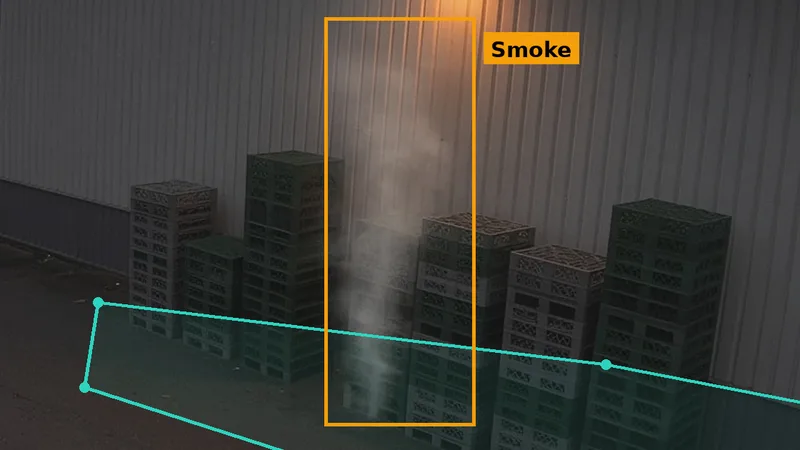
Stock stored outside is one of the most common gaps in sprinkler cover, because heads are inside the building. Pallets, crates, bales and skips against a wall can carry a fire to the building, as the Port Talbot canopy fire did. A camera that already looks over the yard can watch a zone drawn over the stock and send an alert with a clip if visible smoke or flame appears.
Smoke and flame, out of hours
In a tall warehouse, a small or smouldering fire low in the racking may make smoke for some time before enough heat reaches a head. A camera looking down the aisle can see smoke rising. Draw the zone over the aisle rather than the whole view, and arm it when the warehouse is closed. It adds a picture; it does not change what the sprinkler design needs.
Smoke and flame, when closed
Hidden impairments, such as a valve closed without authority, are the hardest to spot. A zone in front of the pump house door, armed out of hours, can alert you when a person is seen there, so you can check whether the visit was expected. It does not replace weekly valve checks or locked and strapped valves.
People, out of hours
Each area needs its own zone and schedule.
Other places worth considering include bin stores and skip areas, charging areas for electric vehicles (see our EV charging fire safety guide), and battery charging rooms, where the Hereford fire started (see our lithium-ion battery storage guide).
The limits of camera detection
Every detection method has limits, and camera detection is no exception. A camera can only see what is in its view: smoke behind racking, inside a machine or in another room will not be seen until it comes into view. It needs enough light, or infrared, to see at night, and very thin smoke in the dark is harder to see. Spray from a sprinkler head that has already opened can also hide the view.
None of that is a reason not to use it. It is a reason to use it for what it is good at, alongside sprinklers and a fire alarm, and to design the set-up carefully: cameras with a clear view of the risk, good lighting or infrared, zones over the areas that matter, and a clear plan for who receives alerts and what they do.
What about false alerts?
Camera detection can have false alerts. Steam from vents, dust from vehicles, headlights, low sun, mist and insects near the lens can all look like smoke or flame. Good set-up keeps false alerts down. Tight polygon zones cover the risk, not the whole view. Schedules arm zones only when the area should be quiet. Clean lenses and steady lighting help, and a self-learning system gets better over time at knowing what is normal for each camera. Reviewing alerts after the first week or two, and adjusting zones, makes a big difference.
A worked example
Here is how this might look for the fictional drinks wholesaler in the picture at the top of this page. It is an example, not a real business. The firm leases a large warehouse with a wet pipe sprinkler system, maintained to the LPC Rules. Empty plastic crates are stacked outside, against the back wall, in an area the sprinkler system does not cover. Its fire risk assessment and its insurer have both mentioned the crate store.
After a conversation with its fire risk assessor and insurer, the firm moves some of the crates further from the wall and adds smoke and flame detection to its existing cameras. A zone is drawn over the crate store, armed from 20:00 to 06:00 when the warehouse is closed. Another zone covers the pump house door.
One night, the last person leaves at 20:00. At 01:52, thin grey smoke starts to rise between the crate stacks. It is outside, so no sprinkler head will see heat from it until the fire reaches the building. The camera zone over the crate store sees the smoke, and within a minute the alert reaches the warehouse manager on call, with the clip. She can see smoke rising at the crates, calls 999 and tells the fire service exactly where it is.
Crews put the fire out in the crate store. The sprinkler system never operates, because the fire never gets inside. The next morning, the firm reviews what happened with its assessor and insurer, and the crate store is moved further from the building. The camera did not do the sprinkler system's job. It covered a place the sprinkler system was never designed to cover.
How Woodcock AI fits
Woodcock AI connects to existing IP cameras and runs on an edge server on site or on a cloud server. It adds smoke and flame detection, and people and vehicle detection, to the cameras you already have. You draw polygon detection areas over the places that matter, choose when they are armed and who gets the alerts. Each alert has a snapshot, a short clip and an AI description of what the camera saw. Our smoke and fire detection page and how it works page show more, and our industrial and warehousing and logistics pages show how it is used in those settings.
Woodcock AI is self-learning, so it gets better over time at knowing what is normal on each camera. It is the result of years of development and is now in use on real sites in the UK. It works alongside your sprinklers, fire alarm, fire risk assessment, maintenance and people rather than replacing them. Ask your cameras (Coming soon, early 2027) will let you ask questions about what your cameras have seen in plain words.
Ways to start
Book a site assessment. We look at what your cameras see by day and after dark, and show where zones would help, such as yards, external storage, loading areas, racking aisles and the pump house. Or ask for a live test on your cameras: we connect two or three of your existing cameras for about a fortnight, so you can see the alerts for yourself. We are also happy to arrange an on-site demo.
Sources
- Optimal Economics for the National Fire Chiefs Council and National Fire Sprinkler Network, Efficiency and effectiveness of sprinkler systems in the United Kingdom: an analysis from fire service data, May 2017; National Fire Chiefs Council, Automatic water suppression systems.
- Jensen Hughes, Andrew Cowan, Key updates to UK automatic sprinkler standards, June 2026.
- British Automatic Fire Sprinkler Association (BAFSA), Information File 6a: general FAQs, September 2024; Information File 15: types of sprinkler system; Information File 8C: sprinkler heads.
- BAFSA, Sprinkler Saves annual review 2025/26.
- Fire Protection Association, Sprinkler system service and maintenance: guidance, records and checklists, 21 June 2021.
- AXA Insurance, Sprinkler impairment management: risk management guidance.
- HM Government, Approved Document B (fire safety), Volume 2: buildings other than dwellings; Regulatory Reform (Fire Safety) Order 2005, article 17 (legislation.gov.uk).
- Reports of 2026 sprinkler activations, all BAFSA: Greater Manchester college, Forth, Edinburgh, Hereford, Port Talbot and Northamptonshire.
We have summarised these sources in our own words and checked them on 3 November 2026. This guide is general information, not fire safety or engineering advice for your premises. BS EN 12845 and the LPC Rules are detailed technical documents, and your sprinkler designer, maintenance contractor, fire risk assessor, insurer and local fire and rescue service can tell you what applies to your building. Insurers' sprinkler conditions differ, so read your own policy. Scotland, Wales and Northern Ireland have their own building and fire safety rules.
Is anything watching the places your sprinklers cannot reach?
Book a site assessment and we will look at what your cameras see by day and after dark, and show where smoke and flame zones would help over yards, external storage, loading areas and racking aisles, or ask for a live test on your cameras.
Related pages
- Warehouse fire safety
- Commercial fire alarm systems
- Fire risk assessment
- What insurers expect from fire detection
- Outdoor fire detection
- Video smoke detection on existing CCTV
- Factory fire safety
- Waste site fire risk assessment
- Hot works fire risk
- Smoke and fire detection cameras
- Book a site assessment
Frequently asked questions
Are sprinklers a legal requirement for commercial buildings in the UK?
Not for most existing buildings. In England, Approved Document B links sprinklers to new buildings, for example storage buildings with very large compartments and any building with a top storey over 30 metres. Scotland and Wales have their own rules. Many systems are fitted because the insurer requires them or the fire strategy relies on them. Once fitted, the Fire Safety Order requires them to be maintained where they protect people.
What is BS EN 12845 and what changed in 2026?
BS EN 12845 is the standard for the design, installation and maintenance of fixed sprinkler systems. The current version, BS EN 12845:2015+A2:2026, became the active British Standard on 9 April 2026. Pump set requirements moved to EN 17451 and ESFR and CMSA storage design moved to EN 12845-2. Jensen Hughes describes it as largely an administrative and technical alignment, with design principles largely unchanged.
Do all the sprinkler heads go off at once?
No. Each head is a heat-operated valve and only heads heated by the fire open. In UK fire service data analysed in 2017, one head opened in 65% of fires where the system operated, and five or fewer in 95%. Sprinklers respond to heat, not smoke, so burnt toast or steam will not set them off.
How often should a sprinkler system be maintained?
BAFSA says trained staff can carry out simple weekly and monthly checks of pumps, gauges and valves, and that usually two contractor visits a year keep a system in good order. A hazard review must be done every six months. The full routine runs from weekly to longer intervals, with a 25-year inspection under the LPC Rules. Ask for maintenance to LPC TB203.
What is a sprinkler impairment?
Any time all or part of the system is not working. Impairments can be planned, for alterations or repairs; emergency, after damage or a fault; or improper, such as a valve closed without authority. Your insurer will usually want notice, and precautions such as stopping hot work, fire watches and reinstating the system overnight. When the work is done, test the system and secure the valves open.
Can AI on existing CCTV replace sprinklers?
No. Video smoke and flame detection on CCTV does not put out a fire, is not designed to BS EN 12845 and does not replace sprinklers or a fire alarm. It can add early visual warning where sprinklers do not reach, such as yards and external storage, and during impairments. Woodcock AI runs on an edge server on site or on a cloud server and sends an alert with a clip, so a person can see for themselves.
Last reviewed 3 November 2026