

Factory fire safety: a UK guide for manufacturers
Factory fire safety means controlling the fire risks of a manufacturing site under the Fire Safety Order: a written fire risk assessment, kept up to date; ignition sources such as hot processes, friction, electrics and hot work kept apart from fuels such as dust, offcuts, packaging and flammables; waste cleared every shift; appropriate fire detection and alarms; clear escape routes; trained staff; and maintained equipment. Nights, weekends and shutdowns need special care, because fires that start in an empty building are found late.

Last updated 3 November 2026. Factories are full of the things fires need. Machines get hot, cutters and grinders throw sparks, motors and bearings run warm, and extraction systems collect fine, dry dust. Around them sit pallets, packaging, offcuts, solvents, oils and finished stock. During the day, people see and smell trouble quickly. At night, at weekends and over holidays, many factories are empty, and a fire can grow for a long time before anyone knows it is there.
This guide explains fire safety in factories and manufacturing sites in the UK. It covers the law, the fire risk assessment, the hazards typical of production sites and their controls, detection, escape, training and records, and why the hours when nobody is there deserve special attention. There is a printable checklist near the end.
We make AI smoke, flame, people and vehicle detection for existing CCTV cameras, and many of the sites we work with are manufacturers. Near the end we explain where cameras fit and where they do not. AI on cameras adds early sight of smoke and flame. It never replaces a fire alarm, sprinklers, a fire risk assessment or the people who run the site. Most of this page applies to any factory, with or without cameras.
What makes factory fire safety different?
Every workplace needs basic fire safety: a risk assessment, escape routes, fire alarms, extinguishers and trained staff. A factory needs all of those, but its fire risks are different in kind from an office or a shop. The government's guide to fire safety risk assessment in factories and warehouses lists the typical sources of ignition on these sites, and most of them are part of the work itself: hot work such as welding and cutting, shrink wrapping, extract fans and dust and fume removal systems where debris builds up, heat from friction in mechanical equipment, static from conveyor belts, poor electrical installations, hot surfaces, oil-soaked rags and residues that heat up by themselves, and arson.
The same guide lists the fuels that are usually close by: flammable liquids, gases and aerosols, stored goods, pallets and packaging, combustible insulation panels, and waste such as shavings, offcuts and dust. Put those two lists together and you have the basic problem. In a factory, heat and fuel are not separate things that occasionally meet. They sit side by side for most of the working day, and the job of fire safety is to keep them apart.
Three other things make factories harder to protect. The first is scale. Production halls are large, often high and open, so smoke can spread across the roof space before it reaches a detector or anyone notices it. The second is shifts. A building that is busy for sixteen hours can be completely empty for the other eight, and for whole weekends and holidays. The third is change. Lines, machines and stock levels change, so last year's assessment may not be right today.
The Health and Safety Executive describes fire in terms of a simple triangle: a fire needs a source of ignition, fuel and oxygen, and taking any one away stops it. HSE says most fires are preventable, and that the people responsible for workplaces can prevent them by taking responsibility and adopting the right behaviours and procedures. In a factory, that mostly means controlling heat and controlling fuel, because oxygen is in the air everywhere and is often helped along by extraction fans and ventilation.
How many fires are there in factories?
The government publishes detailed fire statistics for England. Its data tables do not count factories on their own. Instead, they group manufacturing and processing sites with warehouses and bulk storage, vehicle repair, public utilities, laboratories and the above-ground parts of mines and quarries, under the heading of industrial premises. It is the closest official measure available, so it is the one we use here. Our warehouse fire safety guide looks at the same category from the storage side.
In 2025/26, fire and rescue services in England attended 1,806 primary fires in industrial premises, according to the fire statistics data table FIRE0301. That was up from 1,669 the year before. Of those fires, 169 were recorded as deliberate and 1,637 as accidental. These are what the statistics call primary fires, the more serious category that includes fires in buildings.
The human cost rose sharply. The same table records 135 people injured in fires in industrial premises in 2025/26, almost twice the 71 injured the year before, and two people killed, after none in 2024/25. Most of those injuries, 129, were in accidental fires. Behind every one of those numbers is a person at work, and in a factory that often means someone who was close to a machine, a process or a store of materials when a fire started.
The FIRE0304 table shows how far each fire spread. In 576 fires in industrial premises, the fire was limited to the item first ignited. In another 402, there was no fire damage at all. That is what usually happens when a fire is found quickly, by a person, an alarm or a sprinkler, and someone acts. But 183 fires spread to involve the whole building, and 306 spread through the room where they started. The difference between those outcomes is mostly time.
Why do fires start? The tables do not give causes for industrial premises on their own, but the FIRE0601 table gives them for all buildings other than homes, a group of 13,679 fires in 2025/26. The largest single cause was deliberate fire-setting, with 3,724 fires. After that came faulty appliances and leads with 1,750, faulty fuel supplies with 1,485, misuse of equipment or appliances with 1,026, articles placed too close to heat with 998 and careless handling of fire or hot substances with 861. These are figures for every kind of non-home building, so treat them as a guide to the kinds of causes, not as factory figures.
What do recent factory fires tell us?
On Friday 24 April 2026, a large fire took hold of part of a factory building on an industrial estate in Trafford Park, Greater Manchester. Firefighters were called at around 1.25pm, twelve fire engines and specialist units attended, and the fire service received more than 100 calls to 999. Several hundred people were evacuated from neighbouring buildings, a gas main was damaged and roads were closed for hours. Workers nearby described the smoke as visible for miles.
A fortnight later, on the morning of 4 May 2026, a fire broke out at a large bakery in Burnley, Lancashire. The site was evacuated and production stopped. Lancashire Fire and Rescue Service later ruled the fire accidental. According to the trade report of the cause, a food mixture had been discharged onto a hot plate and kept burning through the night, after the production schedule had finished, before developing into a fire that needed a large emergency response. It is a clear example of a risk that outlasts the shift: heat that stays in equipment after the people have gone.
On Monday 25 May 2026, a bank holiday, a large fire broke out at a manufacturing site in Bracknell, Berkshire. The company said the site was not operating and no employees were present. Firefighters were called at about 15:00. At the height of the fire, fifteen engines attended, homes nearby were evacuated and residents spent the night away from home.
On 5 August 2026, eight fire engines and nine large jets were used on a big pallet fire at an industrial unit in Hunslet, Leeds, which broke out at about 14:00. People nearby were asked to keep windows and doors closed because of the smoke. On the evening of 19 August, eight crews were called at 8.37pm to a fire involving machinery inside a unit on an industrial estate in Tongwell, Milton Keynes, and stayed for several hours to deal with hotspots.
On 14 September 2026, fourteen crews tackled a fire at a plastic packaging factory in Beccles, Suffolk. One industrial unit was destroyed, another severely damaged and a third moderately damaged. And on Sunday 11 October 2026, about 30 firefighters were called at 08:00 to a fire at a bike factory in Machynlleth, Powys. The fire service said it began in the manufacturing area of the two-storey building. Nobody was hurt.
The details differ, and the causes of several are not yet known. But a pattern runs through them. Several started at quiet times, on a bank holiday, a Sunday morning, an evening or overnight after production had stopped. Several involved process equipment such as hot plates and machinery. Most had plenty of fuel nearby, such as plastics, pallets and stock. And most spread beyond the factory itself, into neighbouring units, roads and homes. Those are the risks the rest of this guide is about.
Who is responsible for fire safety in a factory?
In England and Wales, workplace fire safety is governed by the Regulatory Reform (Fire Safety) Order 2005, usually called the Fire Safety Order. According to GOV.UK, you are responsible for fire safety in business or other non-domestic premises if you are an employer, the owner, the landlord, an occupier or anyone else with control of the premises, such as a facilities manager, building manager, managing agent or risk assessor. The law calls you the responsible person. If there is more than one, you must work together.
In a typical factory, the main responsible person is the employer running the site. If you lease a unit on an industrial estate, the landlord or managing agent will usually be responsible for shared areas such as access roads, shared yards and common parts, and you will be responsible for your own unit. Where several businesses share a building, the duty to co-operate matters. A fire in one unit can quickly affect the others, as several of the 2026 fires showed.
GOV.UK sets out what the responsible person must do. You must carry out a fire risk assessment of the premises and review it regularly, tell staff or their representatives about the risks you have found, put in place and maintain appropriate fire safety measures, plan for an emergency, and give staff information, fire safety instruction and training. It also says that you could be fined or go to prison if you do not follow the rules.
Article 9 of the Fire Safety Order requires the responsible person to make a suitable and sufficient assessment of the risks, to identify the general fire precautions needed, and to review it if there is reason to think it is no longer valid or if there has been a significant change. Article 9 also covers dangerous substances, which matters in many factories, as we explain in the section on flammables.
Since October 2023, the rules on records have been tighter. The government's guidance on section 156 of the Building Safety Act 2022 explains that every responsible person must now record the completed fire risk assessment in full, record the name of any person or organisation that helped with it, and record their fire safety arrangements. Before the change, many businesses only had to record these things if they had five or more employees, a licence or an alterations notice. That exemption has gone. Every responsible person must also record a name and UK address for serving notices, and share fire safety information with other responsible persons and with anyone taking over the premises.
Scotland has its own law. The HSE fire safety page notes that general fire safety in Scotland is covered by Part 3 of the Fire (Scotland) Act, supported by the Fire Safety (Scotland) Regulations. Northern Ireland also has separate rules. In most premises, local fire and rescue authorities enforce general fire safety law. HSE remains closely involved with factories through process risks, such as flammable dust, gases and dangerous substances, which are covered by other health and safety law.
None of this requires you to be an expert. The government guide was written to help a responsible person assess less complex factories and warehouses. It says that if you cannot apply the guidance you should get advice from a competent person, and that more complex premises will probably need someone with comprehensive training or experience in fire risk assessment. Our fire risk assessment guide explains how to choose one and how the process works in detail.
How do you do a fire risk assessment in a factory?
The fire risk assessment is the foundation of everything else. It is where you work out what could start a fire, what would burn, who could be hurt and what you are going to do about it. The government guide for factories and warehouses sets out five steps. They are the same for a small workshop and a large plant, though the detail will be very different.
Step 1 is to identify the fire hazards. Walk the whole site, inside and out, and list the sources of ignition, the sources of fuel and the sources of oxygen. In a factory this needs to include the production floor, the plant rooms, the extraction system, the stores, the offices, the welfare areas, the yard, the bin store and the roof space where you can reach it. The guide suggests looking for signs of near misses, such as scorch marks, discoloured or charred plugs and sockets, and cigarette burns, because they show hazards you might otherwise miss.
Step 2 is to identify the people at risk. That means everyone who uses the premises, but the guide asks for particular attention to people who may be especially at risk. In factories that includes people who work alone, such as cleaners and security staff, people in isolated areas, such as maintenance staff and people working on cranes, reach trucks and walkways, and people who are unfamiliar with the site, such as seasonal workers, contractors and visitors.
Step 3 is to evaluate, remove, reduce and protect from risk. For each hazard, ask how likely a fire is and what would happen to people if one started. Then remove the hazard if you can, reduce it if you cannot, and protect people from what is left. Protection covers fire detection and warning, firefighting equipment, escape routes, emergency lighting, signs and notices, and maintenance. Most of the later sections of this guide are about step 3.
Step 4 is to record, plan, inform, instruct and train. Write down what you found and what you did, prepare an emergency plan, tell people what they need to know, co-operate with other responsible persons and provide training. As we saw above, the full assessment must now be recorded, whatever the size of the business.
Step 5 is to review. The guide lists the kinds of change that should trigger a review, such as new equipment or work activities, layout changes, more hazardous substances or goods, more people, and the failure of fire precautions such as detection, alarm or sprinklers. It also makes a good point that applies particularly to factories: think about the fire risk of a change before you introduce it, because it is usually easier to plan proper storage or spacing than to fix a problem afterwards.
Here is what the five steps can look like in a simple production area. It is deliberately small, because a good risk assessment is built from many specific observations like this, not from a general statement that the site is safe.
| Step | What to look at | Factory example |
|---|---|---|
| 1 Hazards | Ignition, fuel and oxygen | A saw line with a dust extraction system next to a stock of sheet material |
| 2 People | Who is at risk and why | A cleaner who works alone after the late shift |
| 3 Act | Remove, reduce and protect | Empty the offcut bins at shift end and keep them away from the machine |
| 4 Record | Findings, plan and training | Write the bin rule into the shutdown check and train every shift |
| 5 Review | Changes and failures | Review when a new machine or a second shift is added |
What are the main fire hazards in a factory?
The guide's lists of ignition sources and fuels read like a tour of a typical manufacturing site. As well as the sources listed at the top of this guide, it names failed temperature controls on hot processes, heat sources such as gas, electric, microwave, radio frequency and thermal fluid systems, steam pipes, battery charging units, blocked equipment ventilation and self-heating.
The guide also points out that oxygen is not always just the air in the room. Ventilation and air handling systems move air into and out of the building. Some chemicals are oxidising materials that can give a fire additional oxygen and help it burn, and oxygen used in welding comes from cylinders and piped systems. These need to be identified, stored apart from fuels and labelled clearly.
How do you control dust and extraction fire risks?
Dust is one of the most important and most underestimated fire risks in manufacturing. Many everyday materials become much easier to ignite when they are finely divided. A solid block of timber is hard to light. A layer of fine sawdust on a ledge, or a cloud of it in the air, is a different matter. The government guide makes the same point about form: solid baulks of timber are not readily ignitable, but chopped wood is, and the same is true of paper and cardboard.
HSE's guidance on combustible dusts, HSG103, explains that friction or grinding on many everyday work materials can produce potentially combustible dust clouds. Its notable examples include sugar, coal, wood, grain, certain metals and many synthetic organic chemicals. That covers a large share of UK manufacturing: joinery and furniture, food and drink, plastics, metalworking, printing and paper, animal feed and many chemical and pharmaceutical processes.
Dust creates two kinds of risk. The first is fire. Layers of dust on beams, ledges, light fittings, motors and ducts can be ignited by a hot surface, a spark or an electrical fault, and fire can then run along the layer. The second is explosion. If dust is lifted into the air at the right concentration and meets an ignition source, it can burn so quickly that it explodes. HSE's woodworking guidance says the minimum explosible concentration for wood flour would resemble a very dense fog. Clouds that thick are far more likely inside machines, ducts and collectors than in the open workshop, which is one reason the guidance pays so much attention to extraction systems.
That is why extraction systems matter so much. They collect dust from machines and concentrate it in ducts, cyclones, filters and collection bins. HSE's woodworking fire and explosion page says that many fires start in the extraction system, which should be built so that sources of ignition, fire and explosion are removed, and that the location of the fan and air cleaner also needs thought. The government guide lists extract fans and dust and fume removal systems where debris has built up among the typical sources of ignition in factories.
In practice, good dust control usually includes extraction at the source on every machine that produces fine dust, so that it is captured rather than spread around the workshop. It includes regular cleaning of the building, especially high ledges, beams and light fittings, using methods that do not lift dust into the air. It includes regular inspection and maintenance of the extraction system by a competent person, and keeping ignition sources away from dusty areas and collection points.
Where dust could form an explosive atmosphere, the law goes further. The Dangerous Substances and Explosive Atmospheres Regulations 2002, known as DSEAR, require employers to control the risks to safety from fire and explosion. HSE says dangerous substances can be found in nearly all workplaces and include solvents, paints, varnishes, flammable gases such as liquefied petroleum gas, dusts from machining and sanding operations, dusts from foodstuffs and pressurised gases.
Under DSEAR, employers must find out what dangerous substances are present and what the risks are, remove the risks or control them, reduce the effects of any incident, prepare plans for accidents and emergencies, make sure employees are informed and trained, and identify and classify areas where explosive atmospheres may occur and avoid ignition sources in those areas. If your factory handles combustible dusts in any quantity, your fire risk assessment should be read alongside your DSEAR assessment, and the two should agree with each other.
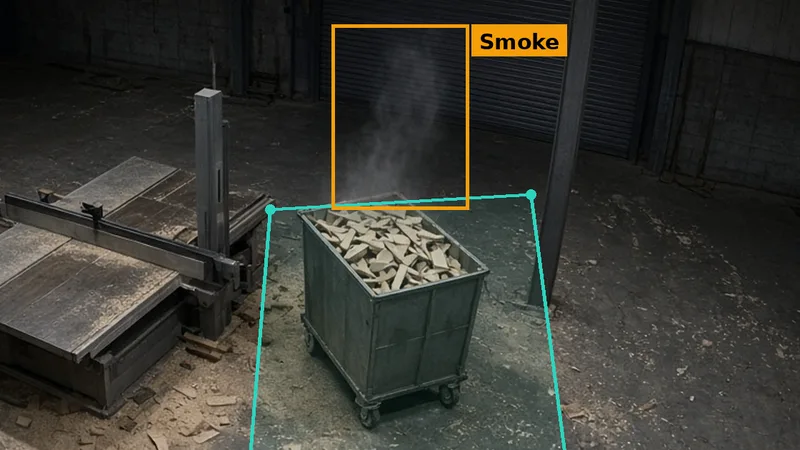
A camera cannot see dust layers building up or measure the air inside a duct, and nothing on this page suggests it can. What cameras can sometimes do is watch the outside of the system, the cyclone, the collection bin and the area around the filter house, where a smouldering fire may show itself as smoke before it is noticed by anyone else, particularly at night.
What about ovens, dryers and hot processes?
Many factories rely on heat. Food manufacturers have ovens, fryers and hot plates. Plastics and packaging firms have extruders, moulding machines and heat-shrink tunnels. Paint and coating lines have curing ovens. Chemical and food plants have dryers, including spray dryers that turn liquids into powders. Each is designed to run hot, safely, under control. The fire risk comes when the control fails, when residues build up, or when heat reaches something it should not.
The government guide lists the failure of temperature controls and thermostats on hot processes as an ignition source in its own right. For cooking processes, it explains that the main causes of fire are ignition of cooking oil, combustion of crumbs and sediment deposits, and fires in ductwork caused by a build-up of fats and grease. It notes that spray dryers can create fire and explosion hazards from powders and dusts.
The guide also warns about combustible panels. It says siting cooking processes close to insulated core panels with combustible insulation can lead to the panels catching fire and to rapid fire spread through the building, and that this should be avoided where possible. Many older factory buildings and food plants have panels of this kind, and it is worth knowing where they are.
For cooking processes, the guide suggests regular cleaning to prevent crumbs and other combustible material from building up, fire-resisting containers for waste, a fire suppression system that can control a fire, monitored heat and oil levels even after the cooking process is complete, temperature controls and cut-off devices, regular inspection and cleaning of ducts, and an annual programme of thermographic surveys to find hot spots. The same thinking applies to many other hot processes.
Notice the words "even after the cooking process is complete". The Burnley bakery fire described above, which kept burning on a hot plate through the night, shows why: equipment can stay hot for hours after a line stops.
How do machinery and maintenance affect fire risk?
Machines start fires in ordinary ways. The government guide lists common causes of fire in equipment: blocked ventilation points causing overheating, poorly cleaned heat-shrink packaging equipment, deposits in extraction ducting, loose drive belts or poor lubrication causing friction, bypassed safety cut-outs, and leaking joints that let oils soak into floors or goods.
Conveyors deserve a mention of their own. The guide notes that they can become an ignition source through friction, bearing seizure and static charge, that they often pass through walls and sometimes ceilings, which can break fire separation between areas, and that hydraulic conveyors can add significantly to the fuel load. It suggests regular maintenance of belts and drive motors, monitoring of bearing temperature and belt slip, conveyor closure devices where they pass through fire-resisting walls, and automatic suppression.
How do you manage electrical and battery charging fire risks?
The government guide is blunt: electrical equipment is a significant cause of accidental fires in factories and warehouses. It lists the main causes as overheating cables and equipment, for example from overloaded circuits, bunched or coiled cables or impaired cooling fans; incorrect installation or use of equipment; little or no maintenance and testing; damaged or inadequate insulation on cables; combustible materials placed too close to electrical equipment, which may give off heat even when working normally; and arcing or sparking.
The guide says all electrical installations should be regularly maintained by a competent person in line with the Electricity at Work Regulations 1989, and that portable equipment, including items staff bring in, should be visually inspected and tested at intervals that suit the type of equipment and how often it is used. It also asks you to consider overloading, fuse ratings, earthing and the environment the equipment is used in, such as wet or dusty atmospheres. In a dusty factory, that last point matters a great deal: dust inside switchgear, motors and panels can overheat and ignite.
Battery charging for site vehicles needs specific attention. The guide explains that charging can give rise to sparks and to hydrogen, a gas that is highly flammable, explosive and lighter than air, and that sparks can occur when power supplies are connected and disconnected. It says charging points should be carefully sited in a well-ventilated area, ideally venting directly to open air, clear of ignition sources and preferably in a separate dedicated non-combustible structure. If the charging point must be inside the building, it should be against a fire-resisting wall.
Charging often happens overnight, when the building is empty, so it is worth thinking about how a fire in the charging area would be found. Our lithium-ion battery storage guide covers the separate risks of lithium-ion batteries, which are increasingly common in tools, equipment and vehicles.
How should flammable liquids and gases be stored?
Most factories use flammable substances of some kind: paints, thinners, adhesives, solvents, lubricating oils, cleaning chemicals, aerosols and gas cylinders for welding, cutting or heating. The government guide's general advice is to substitute highly flammable substances with less flammable ones where possible, to reduce the quantity on site to the smallest reasonable amount, and to store what remains properly.
It suggests keeping stocks of flammable materials, liquids and gases in open areas to a minimum, with the rest in dedicated storerooms or storage areas, preferably outside, where only the appropriate staff can go. Flammable solids, liquids and gases should not be stored together. Areas where flammable gases may collect, such as battery charging areas, should be ventilated. Your supplier should be able to give detailed advice on safe storage and handling for the products you use.

Flammable substances are dangerous substances under DSEAR, so the requirements we described in the dust section apply here too. In practice that means knowing exactly what you have, where it is kept and how much, controlling ignition sources nearby, and making sure people know what to do if there is a spill or a fire. Our flammable storage guide goes into more detail.
How should hot work and contractors be controlled?
Hot work means work that produces heat, flame or sparks, such as welding, flame cutting, using blow lamps and portable grinding. It is common in factories, both in production and in maintenance, and much of it is done by contractors. The government guide says hot work near flammable materials can pose a serious fire hazard and needs to be strictly controlled, for example with a written permit to work for the people involved, whether they are your employees or a contractor's.
According to the guide, the purpose of the permit is to make sure the area is made as safe as possible before any hot work starts, that monitoring and precautions continue while the work is in progress, and that the area where the work was done and the area around it are monitored for at least an hour after the work is finished.
That last point is the dangerous one. Sparks and hot fragments can land in gaps, on dust, in packaging or behind panels, and smoulder unseen. If hot work finishes late in the day, the hour of monitoring afterwards may run into the period when the building is emptying. Plan hot work so that the watch period can be done properly, and do not let it be squeezed by the end of a shift. Our hot works fire risk guide covers permits in detail.
What about waste, pallets and outside storage?
Factories produce a lot of waste: offcuts, shavings, swarf, packaging, film, cardboard, rejected product and broken pallets. The government guide suggests a formal system for controlling combustible waste, so that it is not allowed to build up and is stored carefully until it is disposed of, particularly at the end of the day.
Outside storage is its own risk. The guide explains that the main risks of outdoor storage are fires that prevent escape from the building and fires that spread to the building without being noticed. It says fires outside are most likely to start in waste material or dry undergrowth, that tarpaulins, jute and plastic sacks burn readily, and that sparks, cigarettes and arson are the likely ignition sources. It asks you to site goods, materials, pallets and vehicles in designated storage areas away from the building, fire exits, windows and boundary fences, and to keep outdoor areas tidy.
How do you reduce the risk of arson?
Deliberate fire-setting was the largest single recorded cause of fires in buildings other than homes in 2025/26, and 169 fires in industrial premises were recorded as deliberate. The government guide says deliberately set fires can be particularly dangerous because they generally develop much faster and may be started in escape routes, and that of all the risk-reduction measures, the most benefit may come from efforts to reduce the threat from arson.
Its suggestions include lighting the outside of the premises and securing the perimeter where practical, securing all entry points, including windows and the roof, without compromising escape routes, removing combustible rubbish regularly, not placing skips against the building and keeping bins in a compound away from it, encouraging staff to report people acting suspiciously, removing entry rights from staff who have left, making sure security and fire detection systems are monitored and acted on, and securing flammable liquids so that intruders cannot use them.
The guide also suggests being aware of other small deliberate fires in the area, which can indicate a higher risk to your premises, and being suspicious of small "accidental" fires on site, investigating and recording them. Our arson prevention guide looks at how lighting, fencing, bins and cameras fit together.
Why are shutdowns, nights and weekends so risky?
Look back at the 2026 fires. The Bracknell site was not operating and nobody was there. The Machynlleth fire was on a Sunday morning. The Burnley fire developed overnight after production had finished. The Milton Keynes machinery fire was in the evening. That pattern is not a coincidence. When a factory is empty, nobody is there to notice the first signs, and a fire can grow for a long time before it sets off an alarm or is seen from outside.
At the same time, many risks do not switch off at the end of the shift. Ovens and hot plates cool slowly. Motors and bearings stay warm. Battery charging often runs overnight. Waste and offcuts may be left in bins beside machines. Self-heating materials, such as oil-soaked rags, can take hours to reach the point of ignition. And arson is far more likely when a site is quiet.
Long shutdowns, such as the Christmas break, summer shutdowns and maintenance periods, combine these risks with others. Buildings may be empty for days, normal checks may lapse, contractors may be doing hot work and stock may be piled higher than usual. Our Christmas shutdown checklist covers this in detail.
The answer starts with a proper end-of-shift routine. The government guide asks for waste to be cleared, particularly at the end of the day, for heat levels to be monitored even after a process is complete, for hot work areas to be checked for smouldering material, and for training to include staff who work outside normal hours, such as cleaners and maintenance staff. A short, signed checklist turns those points into a habit. Here is one that you can adapt.
| Check | Why it matters |
|---|---|
| Waste and offcut bins emptied to the outside compound | Waste should not build up, particularly at the end of the day |
| Hot equipment switched off, cooling and clear of combustibles | Heat can stay in equipment after the process stops |
| Hot work areas checked and the watch period finished | Smouldering material can start a fire later |
| Machines and power isolated where the procedure says so | Fewer ignition sources left running overnight |
| Fire doors closed, exits and routes clear | Stops spread and keeps escape open for anyone still on site |
| Flammables back in their store, store locked | Less fuel in the open, and nothing for an intruder to use |
| Doors, windows and yard gates secured | Reduces the chance of arson |
| Check signed, with the time and any faults reported | Gives a record and a starting point if something goes wrong |
What fire detection and alarms does a factory need?
Article 13 of the Fire Safety Order says that where necessary, because of the features of the premises, the activity carried on there, any hazard present or other relevant circumstances, the responsible person must make sure the premises are equipped with appropriate firefighting equipment and with fire detectors and alarms, and that manual firefighting equipment is easy to reach, simple to use and clearly signed. It also requires the responsible person to nominate competent people to carry out firefighting measures and to arrange contact with the emergency services.
What is appropriate depends on the site. The government guide explains that in some simple, open-plan, single-storey factories, a fire may be obvious to everyone as soon as it starts, and a shout of "fire" or a manually operated device such as an air horn may be enough. In more complex premises, an electrical system with sounders and manual call points is likely to be needed. Where there are unoccupied areas in which a fire could develop to the point of affecting escape routes before it is discovered, automatic fire detection may be necessary. A small factory that handles, makes, stores or uses highly flammable substances might also need automatic detection.
Beyond detection, many factories have sprinklers, suppression systems on specific machines or processes, and smoke ventilation. Whether you need them depends on your risk assessment, your building, your insurer's requirements and sometimes local legislation. A competent fire risk assessor or fire engineer can advise on what is right for your site. For an empty building, the key question is what happens when a detector operates: who is told, how quickly, and who goes. Our business alarm systems guide explains how alarms are monitored, and our guide to insurer expectations covers what insurers tend to ask about.
How should escape, training and the emergency plan work?
Factories often have long travel distances, noisy machines and rarely visited areas such as mezzanines and plant rooms. Escape routes need to be kept clear of stock, pallets and waste, exits need to open easily, and fire doors need to stay closed. The government guide says your emergency plan should not rely on the fire and rescue service to be effective.
The guide says training should reflect the fire risk assessment and the work, take place during normal working hours, be repeated periodically, be easily understood and be tested by fire drills. It should include what to do on discovering a fire, how to raise the alarm, how the fire and rescue service is called, escape routes, why fire doors must stay closed and, where appropriate, how to stop machines and isolate power.
The guide suggests carrying out a fire drill at least once a year, or as often as your risk assessment shows, and more often if staff turnover is high. In factories with several shifts, agency workers and seasonal staff, a single annual drill rarely reaches everybody, so it is worth planning drills that reach every shift. Information and instruction must also be given to contractors as soon as they start work, and in a form that people can understand, including those who do not use English as their first language.
How do you keep fire safety equipment maintained?
Article 17 of the Fire Safety Order requires the responsible person, where necessary, to make sure that the premises and the fire safety facilities, equipment and devices are subject to a suitable system of maintenance and are kept in an efficient state, in efficient working order and in good repair. The government guide gives a practical routine. Daily, it suggests removing bolts and padlocks from fire exits, checking escape routes are clear and checking the fire alarm panel. Fire detection and warning systems should be tested weekly following the installer's instructions. Emergency lighting and fire doors should be checked monthly. The fire detection and warning system should be tested and maintained by a competent person every six months, with emergency lighting, firefighting equipment, alarms, sprinklers and smoke control serviced by a competent person every year.
Where does ordinary CCTV fall short on fire?
Most factories already have CCTV, usually for security: gates, yards, loading bays, car parks and sometimes the production floor. Those cameras often have a better view of a fire than anything else on site. The problem is that most CCTV is a record, not a warning. Footage is usually looked at after something has happened. Unless someone is watching the right screen at the right moment, the first wisps of smoke from a smouldering bin or a hot machine will be recorded perfectly and seen by nobody.
Even when someone is watching, early smoke is hard to spot. It is thin, grey and slow, especially at night or in a large hall, and a monitoring screen showing a grid of small pictures makes it harder still. And many of the places where factory fires start are outside, in yards, bin stores and storage areas, where there are often no fire detectors at all.
How can AI on existing CCTV help with factory fire safety?
AI video detection changes what existing cameras can do. Instead of only recording, software watches the camera views continuously and looks for the visual signs of smoke and flame. When it sees them in an area you have chosen, it sends an alert straight away, with a snapshot, a short clip and a description of what the camera saw, so that a keyholder, a security team or a manager can check and act.
For factories, the value is mostly in the hours when nobody is there and in the places where fire detectors do not reach. A camera can watch a dust extraction cyclone, an oven bay after the line has stopped, a yard full of pallets or a bin store, and raise the alarm on what it sees. It can also show what is happening, which helps a keyholder decide what to do and helps the fire service when they arrive.
With Woodcock AI, you draw polygon detection areas on each camera view, around exactly the thing you want to watch, such as a cyclone, an oven door, a skip or a pallet stack, and leave out what you do not, such as a steam vent or a busy road. You choose when each area is armed, so a zone over a hot line can be armed only after the line stops, and who receives the alerts. Our pages on AI smoke and fire detection and industrial and manufacturing sites explain more.
Three areas worth watching
Choose an area below to see what a camera view of it might look like and how a detection zone could be set up.
Which area of your factory?
Draw the zone around the cyclone, the filter house and the collection bin, not the whole wall. Arm it from the end of the last shift, when the extraction is off and nobody is nearby, so smoke from a smouldering deposit is seen while it is still small. Keep the cleaning and inspection routine that stops deposits building up in the first place.
Cyclone, filter and bins
Hot lines can run with steam and heat haze during production, so zones here are usually armed after the line stops. The aim is to catch smoke or flame from residues or a failed control in the hours when the bay is empty, as in the Burnley fire, while the cut-outs, cleaning and heat monitoring keep doing their job.
Ovens, dryers, hot plates
Many yards have no fire detectors at all. A camera that already watches the yard for security can watch a pallet stack, a skip or a waste bay for smoke and flame too. The guide says stacks should be kept away from the building, exits, windows and fences, so treat the camera as a back-up while you move them.
Outside storage
Each area needs its own zone and schedule.
Where should cameras watch in a factory?
Start from your fire risk assessment. The best places for camera-based smoke and flame detection are usually the places where your assessment says a fire is most likely to start, especially if they are left unattended or are outside the reach of your fire detectors. On many factory sites, that means the dust extraction system and its collection bins, hot process lines after they stop, waste bins, skips and compactors, pallet and outside storage, battery charging areas, gas cages and flammables stores, and the perimeter where arson is a risk.
Not every camera is suitable. Detection needs a clear, stable, well-lit view of the area, and a camera mounted high on a pole at the far side of the yard may not show smoke at a bin store clearly enough. Our camera placement guide explains how to check whether a view is good enough, and our factory security guide covers the same cameras from the security side.
What AI on your cameras is not
Be clear about the limits. AI detection on cameras is not a fire alarm system and does not replace one. It does not replace sprinklers, suppression, a fire risk assessment, a DSEAR assessment, maintenance or the people who run the site. It sees only what the cameras can see, so it cannot detect a fire inside a duct, behind a panel or in a room with no camera. What it adds is early sight of smoke and flame in the places your cameras already cover, often at the times when nobody else is looking.
What about false alerts in a dusty, steamy factory?
Factories are full of things that can look a little like smoke: steam from vents and processes, dust in the air, heat haze above hot equipment, and headlights crossing a yard at night. Good set-up keeps false alerts down. Tight polygon areas leave out vents and roads. Schedules arm zones over hot lines only when the line is off. Clean lenses and a steady aim give the software the clearest picture. And because Woodcock AI is self-learning, it gets better over time at knowing what is normal on each camera. Our guide to reducing CCTV false alarms goes into more detail.
A worked example
Here is how this might look for a fictional small joinery workshop with a production hall, a dust extraction system outside and a yard. It is an example, not a real business.
On a Friday, the late shift finishes at 22:00. The machines are switched off, the offcut bins are emptied and the shutdown check is signed at 22:10. One bin beside the panel saw is missed. At 23:47, thin grey smoke begins to rise from it. The camera that watches the production hall has a zone around the offcut bins, armed after hours, and the alert reaches the keyholder a moment later with the clip. She sees smoke, calls 999 and drives to site. The building's fire alarm sounds shortly afterwards. Crews find a small fire in the bin and put it out before it spreads.
On Monday, the manager reviews what happened. The bin had been placed too close to the saw, so it is moved and a second person now signs the bin check at the end of each shift. The fire risk assessment is updated to record the incident and the change. The camera did not prevent the fire, and the fire alarm stayed in charge of the building. What the camera added was earlier sight of the fire and a clear picture of what was happening.
Factory fire safety checklist
Here is a checklist that draws the guide together. It is a starting point, not a substitute for your own risk assessment. Print it, add the items that are specific to your site, and review it whenever things change.
The law and records
- A written fire risk assessment, recorded in full
- The name of anyone who helped with it
- Fire safety arrangements written down
- A name and UK address for notices
- A DSEAR assessment if you have dusts, solvents or gases
- Review after any significant change or failure
Dust and extraction
- Extraction at source on dust-producing machines
- High ledges, beams and lights cleaned regularly
- Extraction system inspected by a competent person
- No ignition sources near collection points
Hot processes and machinery
- Temperature controls and cut-outs working, never bypassed
- Residues and deposits cleaned to a schedule
- Belts, bearings and lubrication maintained
- Oil leaks fixed and soaked materials removed
- Thermographic survey of hot spots, often yearly
Electrics, charging and flammables
- Installation inspected and tested by a competent person
- Portable equipment checked; no overloaded leads
- Battery charging ventilated, away from ignition sources
- Flammables at a minimum, stored apart and locked away
Hot work, waste and arson
- Permit to work for all hot work
- Area watched for at least an hour after hot work
- Waste cleared every shift, bins in a compound
- Pallets and stock away from walls, exits and fences
- Outside lit, perimeter and entry points secure
Every shift and every week
- End-of-shift check signed, with the time
- Escape routes and exits clear, alarm panel normal
- Fire alarm tested weekly; faults logged
- Fire drill at least once a year, reaching every shift
- Detection arranged for when the building is empty
How Woodcock AI fits
Woodcock AI connects to existing IP cameras and runs on an edge server on site or on a cloud server. It adds smoke and flame detection, and people and vehicle detection, to the cameras you already have. You draw polygon detection areas over the places that matter, choose when they are armed and who gets the alerts. Each alert has a snapshot, a short clip and an AI description of what the camera saw.
Woodcock AI is self-learning, so it gets better over time at knowing what is normal on each camera. It is the result of years of development and is now in use on real sites in the UK, including industrial sites. It works alongside your fire alarm, your sprinklers, your risk assessment and your people rather than replacing them. Ask your cameras (Coming soon, early 2027) will let you ask questions about what your cameras have seen in plain words.
Ways to start
Start with a site assessment. We look at what your cameras see by day and after dark, and show where smoke and flame zones would help, such as extraction, hot lines, waste and the yard. Or ask for a live test on your cameras: we connect two or three of your existing cameras for about a fortnight, so you can see the alerts for yourself. We are also happy to arrange an on-site demo.
Sources
- Ministry of Housing, Communities and Local Government, fire statistics data tables: FIRE0301 (July 2026), FIRE0304 and FIRE0601 (August 2026), England, year ending March 2026.
- HM Government, Fire safety risk assessment: factories and warehouses (2006).
- GOV.UK, Workplace fire safety: your responsibilities and fire safety responsibilities under section 156 of the Building Safety Act 2022.
- The Regulatory Reform (Fire Safety) Order 2005, article 9, article 13 and article 17 (legislation.gov.uk).
- Health and Safety Executive, Introduction to fire safety, DSEAR, Woodworking: fire and explosion and HSG103, Safe handling of combustible dusts.
- News reports of 2026 fires: Manchester Evening News, Trafford Park; IN Food, Burnley; BBC News, Bracknell, Leeds, Beccles and Machynlleth; MK Citizen, Milton Keynes.
We have summarised these sources in our own words. The government guide for factories and warehouses dates from 2006, so some of its references have changed; check the current law and guidance for your nation, and any conditions in your insurance policy. This page is general guidance, not legal or insurance advice. In an emergency, always call 999.
Who would see a fire in your factory at midnight?
Book a site assessment and we will look at what your cameras see by day and after dark, and show where smoke and flame zones would help over extraction, hot lines, waste and the yard, or ask for a live test on your cameras.
Related pages
Frequently asked questions
Who is responsible for fire safety in a factory?
In England and Wales, the responsible person under the Fire Safety Order: usually the employer, plus the owner, landlord or anyone else with control of the premises. If there is more than one, they must work together. They must carry out and review a fire risk assessment, tell staff about the risks, put and keep fire safety measures in place, plan for an emergency and train staff.
Does a factory need a written fire risk assessment?
Yes. Since the section 156 changes in October 2023, every responsible person must record the fire risk assessment in full, whatever the size of the business, along with the name of anyone who helped, the fire safety arrangements and a name and UK address for notices. The old exemption for businesses with fewer than five employees has gone.
What are the main fire hazards in a factory?
Ignition sources such as hot work, hot processes and ovens, friction in machinery, electrical faults, battery charging and arson, close to fuels such as dust, offcuts, packaging, pallets, stock and flammable liquids and gases. Dust extraction systems are a particular risk, and HSE says many woodworking fires start in the extraction system.
How many fires are there in factories in England?
Official statistics group factories with warehouses and other industrial sites. In 2025/26, fire and rescue services in England attended 1,806 primary fires in industrial premises, up from 1,669 the year before. They injured 135 people, up from 71, and killed two. 183 of the fires spread to involve the whole building.
Does a factory need automatic fire detection?
It depends on the risk assessment. The government guide says a simple shout or air horn may be enough in a small open single-storey factory, but automatic fire detection may be necessary where a fire could develop unseen in unoccupied areas and affect escape, and may be needed where highly flammable substances are used or stored.
Can AI on CCTV replace a factory fire alarm?
No. AI smoke and flame detection on cameras is not a fire alarm and does not replace alarms, sprinklers or a fire risk assessment. Woodcock AI runs on an edge server on site or on a cloud server and adds early sight of smoke and flame on existing cameras, useful at night and in yards and extraction areas.
Last reviewed 3 November 2026
Charging company vehicles on a production site? See our EV charging fire safety guide.