

Commercial fire alarm systems: a UK guide to categories, testing, false alarms and out-of-hours cover
A commercial fire alarm system detects fire, automatically or through manual call points, and warns people to leave. In England and Wales, the Fire Safety Order 2005 requires appropriate detection and warning where necessary, and BS 5839-1:2025 is the code of practice. Your fire risk assessor chooses the category: M, L1 to L5 or P1 and P2. Check the panel daily, test a call point weekly, service every six months and log everything. AI on existing CCTV can add early visual warning but never replaces a fire alarm.

Last updated 3 November 2026. Almost every UK workplace has a fire alarm of some kind. In a small shop it might be a few call points and a bell. In a large warehouse it might be hundreds of detectors, a panel by the front door and a link to a monitoring centre that calls the fire service. Either way, the system exists for one reason: to warn people early enough to get out, and, in some buildings, to get help on the way before a fire takes hold.
This guide explains commercial fire alarm systems in the UK for the people who are responsible for them: business owners, facilities and estates managers, operations managers at warehouses and factories, landlords and managing agents of commercial units, office managers and anyone who has been told they are the "responsible person" for fire safety. It covers what the law says, what BS 5839-1:2025 is and what changed in the 2025 edition, the eight system categories and who chooses them, the checks and tests you are expected to do, servicing and the logbook, false alarms and the fire service policies on attending them, the switch-off of old telephone lines, eight fires from 2026 that started when nobody was there, a checklist, and where cameras fit.
We make AI detection for existing CCTV cameras: smoke and flame, and people and vehicles. Near the end we explain where that fits alongside a fire alarm and where it does not. To be clear from the start: video smoke and flame detection on CCTV is not a fire detection and fire alarm system under BS 5839-1, it is not certified as one and it does not replace one. What it can add is an early visual warning in places where an alarm is weak, such as outside areas, large open spaces and buildings that are empty at night, with a clip that lets a person see for themselves whether there is a sign of fire.
If you want to go deeper on related topics, we have separate guides on fire risk assessment, what insurers expect from fire detection, video smoke detection on existing CCTV, business alarm systems and reducing CCTV false alarms. This page is about the fire alarm itself, and about the hours when nobody is there to hear it.
What is a commercial fire alarm system?
The formal name is a fire detection and fire alarm system. In a commercial building it is a fixed system, wired or wireless, that does two jobs. It detects a fire, either automatically through detectors or manually when a person presses a call point. And it raises the alarm, through sounders and beacons that warn everyone in the building, and sometimes through a signal to an alarm receiving centre, or ARC, that can pass the call on to the fire service.
A commercial system is different from the smoke alarms you might have at home. Domestic smoke alarms are usually self-contained units, each with its own sounder, covered by a different part of the British Standard, BS 5839-6. A commercial system is designed, installed and maintained to BS 5839-1, the code of practice for non-domestic premises. All the parts report to a control panel, and the system is designed for the building as a whole, its layout, its use and the people in it.
The heart of the system is the control and indicating equipment, known as the CIE or simply the panel. It receives signals from detectors and call points, sets off the sounders, and shows where the alarm came from. In an older conventional system, the panel shows a zone, such as "ground floor east". In an addressable system, it shows the individual device, such as "detector 47, packing room". The panel also reports faults, such as a disconnected detector or a flat battery, which is why somebody needs to look at it every day.
Manual call points are the red boxes on walls near exits and on escape routes. A person who discovers a fire presses one to raise the alarm. Sounders, which can be bells, electronic sirens or voice messages, warn people to leave. Visual alarm devices, or beacons, flash for people who cannot hear the sounders, or for noisy areas. Many systems also link to other building services, such as releasing held-open fire doors, shutting down air handling, or grounding lifts.
Detectors
Automatic detectors are what let a fire alarm work when nobody is around to press a call point. There are several types. Optical smoke detectors sense the smoke particles that scatter light inside the detector. Heat detectors respond either when the temperature reaches a fixed point or when it rises quickly. Multi-sensor detectors combine more than one sensor, usually smoke and heat, and can be less prone to false alarms. Carbon monoxide detectors sense a gas given off by smouldering fires. Specialist detectors include beam detectors for tall, open spaces, aspirating systems that draw air through pipes to a sensitive detector, and flame detectors that look for the radiation from flames.
Each type has its place. Smoke detection gives earlier warning of most fires than heat detection, but it can be set off by steam, dust, cooking fumes or aerosol sprays, which is why heat detectors are often used in kitchens. The Fire Industry Association (FIA) guide to the 2025 changes notes that the standard now recommends multi-sensor detectors where point smoke detectors could cause false alarms. The choice is a design decision for a competent designer, guided by the fire risk assessment and the system category.
All of these detectors share one limit: the smoke or heat has to reach them. Point detectors are mounted on the ceiling. In a room with a normal ceiling height, that happens quickly. In a tall warehouse, a sports hall or a large open-plan unit, smoke from a small fire can cool and spread before it reaches the roof, and heat detection may only respond when a fire is already well developed. Outside the building, in yards, open-sided canopies and storage areas, conventional fire alarm detectors are generally not used at all. We come back to those gaps later in the guide.
What happens when it operates
When a detector senses a fire or a person presses a call point, the panel raises the alarm. In a simple system, every sounder in the building goes off and everyone leaves. In larger buildings the system may be phased, warning one area first, or it may be set to give staff a short time to investigate a single detector before a general alarm, an approach that has to be agreed and designed carefully. If the system is monitored, a signal goes to an ARC, which follows its agreed procedure, usually calling a keyholder and, depending on the premises and local fire service policy, the fire service.
The important point is that every step after the alarm sounds depends on people. Somebody has to evacuate the building, somebody has to check the panel, somebody has to decide whether there is a real fire and somebody has to call 999. In a busy building during the working day, those people are on site. In an empty building at 02:00, they are not. That is the question this guide keeps coming back to.
The law on fire alarms in commercial premises
In England and Wales, the main law is the Regulatory Reform (Fire Safety) Order 2005, usually called the Fire Safety Order. It applies to almost all non-domestic premises, including workplaces, shops, offices, factories, warehouses and the common parts of blocks of flats. Article 13 of the Order says that, where necessary to safeguard the safety of relevant persons, the responsible person must ensure the premises are equipped with appropriate fire-fighting equipment and with fire detectors and alarms.
Two words in that sentence matter. "Where necessary" means the law does not say every building needs a particular system. A small single-room shop where a fire would be obvious to everyone may need very little. "Appropriate" means the system has to suit the building. Article 13 explains that what is appropriate depends on the dimensions and use of the premises, the equipment they contain, the physical and chemical properties of the substances likely to be present, and the maximum number of people who may be there at any one time.
Scotland and Northern Ireland have their own laws. In Scotland, the Fire (Scotland) Act 2005 and the Fire Safety (Scotland) Regulations 2006 set similar duties. Northern Ireland has its own fire safety regulations. The gov.uk guidance on workplace fire safety points out that different rules apply in Scotland and Northern Ireland. The principles are much the same: assess the risk, then provide suitable detection and warning.
New buildings, and building work such as extensions and material changes of use, also have to meet building regulations. In England, the guidance on fire safety is Approved Document B, and BSI notes that BS 5839-1 is referenced in Approved Document B. The FIA category guidance also points out that Scotland has its own building standards, which call for automatic fire detection in some building types, such as assembly buildings for more than 60 people and shops for more than 100, and that Northern Ireland uses Technical Booklet E.
Who is responsible?
The Fire Safety Order puts the duty on the "responsible person". According to gov.uk, you are the responsible person if you are an employer, the owner, the landlord, an occupier, or anyone else with control of the premises, such as a facilities manager, a building manager, a managing agent or a risk assessor. In shared buildings, there can be more than one responsible person, and they must work together.
The responsible person must carry out a fire risk assessment and review it regularly, tell staff or their representatives about the risks identified, put in place and maintain appropriate fire safety measures, plan for an emergency, and provide information, instruction and training. Gov.uk explains that fire and rescue authorities inspect premises and can issue notices, and that you could be fined or go to prison if you do not follow the regulations. A fire alarm that does not work, or that nobody tests, can be a serious failing.
The fire risk assessment drives the fire alarm
The type of fire alarm you need comes out of your fire risk assessment. The assessment looks at what could start a fire, what could burn, who is at risk and how people would escape. It then decides what is needed to keep people safe, and the fire alarm is one of those measures. If your business changes how it uses a building, adds a mezzanine, starts storing different goods, brings in charging points or runs a night shift, the assessment should be reviewed, and the fire alarm with it.
The FIA is clear that the category of system should be decided by the fire safety specialist or fire risk assessor, working with the responsible person and, where relevant, the insurer and enforcing authority, and not left to the installer. An installer's job is to design and fit a system that meets the category specified. If the specification simply says "to BS 5839-1" without a category, the FIA guidance describes that as virtually meaningless, because the standard covers everything from a few call points to detection in every room.
BS 5839-1:2025: the code of practice
BS 5839-1 is the British Standard code of practice for the design, installation, commissioning and maintenance of fire detection and fire alarm systems in non-domestic premises. The current edition is BS 5839-1:2025, which BSI announced in April 2025 and which came into effect on 30 April 2025, replacing the 2017 edition. As a code of practice, it is made up of recommendations rather than legal requirements. But it is the benchmark that fire risk assessors, enforcing authorities, building control and insurers use when they ask whether a fire alarm is appropriate.
In practice, following BS 5839-1 is the usual way to show that your fire alarm is fit for purpose. The standard lets a designer depart from a recommendation, as long as the reason is agreed and recorded as a "variation". The 2025 edition goes further and lists some variations it treats as unacceptable, which we cover below. If your system was installed under an older edition, it does not have to be brought up to the new standard straight away, but any modification or extension should follow the current edition, and the 2025 edition includes a new section on exactly that.
Other parts of BS 5839 cover other things. BS 5839-6 deals with fire alarms in domestic premises. Other parts of the series cover areas such as voice alarm systems. Wireless systems are increasingly common in commercial buildings because they are quicker to fit, especially in older or listed buildings, and they are designed to the same principles. If you are not sure which parts apply to your building, your fire risk assessor or a third-party certificated fire alarm company should be able to tell you.
The fire alarm categories
BS 5839-1 sorts fire alarm systems into categories. Each category describes what the system is meant to achieve and, as a result, where detection goes. The FIA guidance on fire alarm categories, updated in January 2026, explains them clearly. The categories began life as "types" in the 1988 edition of the standard, and categories L4 and L5 were added in 2002. There are three groups.
Category M is a manual system. It has manual call points and sounders, and no automatic fire detection. It relies on a person discovering the fire and pressing a call point, or shouting "fire". Category M systems are very common in workplaces where people are awake and present while the building is in use.
Category L systems are automatic systems intended to protect life. They detect a fire early enough for people to escape. Category L1 has detection throughout all areas of the building. Category L2 covers what an L3 system covers, plus other areas of high fire risk or where people are at particular risk; the 2025 edition makes clear that L2 includes sleeping rooms. Category L3 covers escape routes and the rooms that open onto them. Category L4 covers circulation areas that form part of escape routes. Category L5 is a custom system designed to meet a specific fire safety objective, such as covering a particular area of risk.
Category P systems are automatic systems intended to protect property. Their job is to detect a fire early and call the fire service, so that the fire can be tackled before it does serious damage, protecting the building, its contents and the business. Category P1 has detection throughout the building. Category P2 has detection only in defined areas, usually those with a high fire risk or high value. A P category system is only effective if the alarm reaches someone who will call the fire service, so P systems usually have a link to an ARC.
Typical choices for workplaces
The FIA guidance includes a table of typical categories for different premises. For common places of work, such as offices, shops, factories, warehouses and restaurants, it says a Category M system can normally be expected to meet the requirements of fire safety legislation. It adds that Category M is often combined with a Category P system, written as M/P1 or M/P2, to meet insurers' requirements, as company policy to protect assets, or to protect against business interruption.
The picture changes where people sleep. In hotels, hostels and similar premises, the FIA says automatic detection is normally required, generally a Category L2 or L1 system, and residential care premises are typically L1. In any building where a property insurer requires automatic fire detection, the FIA table gives M/P1 or M/P2. Where a fire could break out in an unoccupied area and spread to threaten the escape routes from occupied areas, the table suggests M/L4 or M/L5, and notes that custom and practice does not involve siting automatic detectors in all unoccupied areas, such as plant rooms and storage areas.
Approved Document B, the FIA explains, takes the view that automatic fire detection is not normally needed in non-residential buildings in England and Wales, with exceptions, such as where a fire could start in an unoccupied part of the building and threaten the escape routes of occupied parts. In other words, the regulations are written mainly to protect people. Protecting an empty building, its stock and the business that depends on it is often a matter for the owner and their insurer.
What a Category M system means at night
This is the part many business owners do not realise. A Category M system has no automatic detectors. It can only raise the alarm if a person is there to notice the fire and press a call point. That is fine during the working day, when the people it protects are also the people who would raise the alarm. But when the building is locked up for the night, the weekend or a holiday shutdown, a Category M system cannot tell anyone anything.
That is not a fault in the system. A Category M system that meets the fire risk assessment is doing exactly what it was designed to do: help people escape. The fire risk assessment may have been right that nobody's life is at risk when the building is empty. But a fire can still destroy stock, machinery, records and the building itself, and it can spread to neighbouring units. Many of the 2026 fires we list later in this guide started at night and were reported by passers-by, neighbours or people who noticed a smell of burning.
If that worries you, the first conversation should be with your fire risk assessor and your insurer about whether you need a Category P system, or a P2 system covering your highest-risk areas, with a monitored link to an ARC. That is the recognised way to protect a building when it is empty. Later in this guide, we explain how AI smoke and flame detection on your existing CCTV can add early visual warning in some of the places a fire alarm does not reach, and why it is a supplement rather than a replacement.
A final point on categories: the category, or combination of categories, should be written down in the fire alarm design documents and in the logbook, together with any agreed variations. If you take over a building and cannot find out what category its system is, ask a competent fire alarm company to survey it. Without knowing the category, you cannot know what the system is supposed to do, or whether it still suits how you use the building today.
What changed in BS 5839-1:2025
The 2025 edition is the first full revision since 2017. The FIA's guide to the changes, published in June 2025, and BSI's announcement set out what is new. Most changes are about designers and installers, but several matter to responsible persons too.
Unacceptable variations. Previously, almost anything could be agreed as a variation. The 2025 edition now says some departures are so harmful to life safety that they should never be accepted: the lack of a zone plan, or similar diagram, in premises with more than one zone on any floor, especially where people sleep; and, in residential care homes and some supported housing, the lack of a facility to send fire alarm signals to an ARC. All agreed variations must now be recorded in the logbook, not just "major" ones.
Sleeping rooms. Category L2 now includes early warning in rooms where people sleep, and heat detectors should no longer be used in those rooms in L2 systems. This mostly affects hotels, hostels, care homes and similar premises. The FIA notes that this is not retrospective, so existing systems do not need to be changed unless they are undergoing new work, such as an upgrade.
Call points. The distance rules have been simplified: nobody should have to go more than 30 m in a straight line, or 45 m of actual travel distance, to reach a call point. Designers can choose shorter distances where needed. Mounting height and the siting of call points on stairways have also been clarified.
Multi-sensor detectors. Where point smoke detectors could give false alarms, the 2025 edition recommends multi-sensor detectors instead. This is part of a wider push to reduce false alarms, which fire services have been asking for.
Extensions and modifications. A new Section 7 covers extending and modifying existing systems. New work should follow the current edition, and the certificate issued at the end is now called an extension or modification certificate. If you are adding a mezzanine, building an extension or reorganising a warehouse, this section will apply to your fire alarm work.
Signalling to an alarm receiving centre
For the first time, the 2025 edition sets maximum times for alarm transmission equipment, the equipment that sends a signal from your panel to an ARC. According to the FIA guide, in a Category L system, a fire signal should reach the ARC within a maximum of 90 seconds, and a total failure of the transmission system, where no signals can get through, should be shown at the ARC and the panel within 3 minutes. In a Category P system, the times are 120 seconds and 31 minutes.
Those figures explain why the link to an ARC is so important for an empty building. If the fire alarm detects a fire at night and nobody is there, the signal to the ARC is the only way anyone finds out. If the link has failed, and nobody notices because nobody is there, the building is unprotected. The 2025 edition also recommends that ARC signals are checked at every service visit.
The 2025 edition also addresses the information that reaches the ARC. It recommends a new false alarm notice fixed on or next to the panel, to remind staff that the system is connected to the fire service through an ARC and that the ARC must be told before any test. It recommends that the ARC is given all relevant information about the premises, such as whether people sleep there, so that it can pass this on to the fire service. And where practicable, the alarm signal should show the type of device that triggered it and whether coincidence filtering is in place. As the FIA notes, this matters because fire services now challenge calls and decide whether to attend.
The telephone line switch-off
Many fire alarm systems still send their signals to an ARC over old copper telephone lines. The UK's public switched telephone network, or PSTN, is being retired, and the FIA guide notes that it is being switched off in 2027. The National Fire Chiefs Council guidance on PSTN migration says the PSTN and ISDN will be retired by January 2027 and calls on building owners and responsible persons to check which of their systems rely on telephone lines and to talk to their suppliers.
When a line is moved to a digital service, the equipment at your premises often needs mains power to work. The NFCC guidance highlights the need for power backup, noting that Ofcom expects a minimum of one hour of backup for telephone services in a power cut. A fire alarm signalling path should be designed so that it still works when it matters. If you have a monitored fire alarm, ask your fire alarm company and your ARC now how your signals are sent, whether the equipment is ready for the switch-off, and how a failure would be reported.
Connected panels, cyber security and firmware
More fire alarm panels are now connected to networks, so that engineers can check them remotely. The 2025 edition adds a clause on remote services and cyber security, clause 43.4, with recommendations to prevent unauthorised remote access, and says that if a remote service might affect the panel, the system must be fully working afterwards. It also clarifies that updating the panel's firmware is a modification and needs a certificate.
One more change is simple but important: if an engineer cannot complete a repair, fault signals should not be hidden, for example by switching off the fault warning. A fault that nobody can see is a fault that nobody fixes. If your engineer leaves a fault showing, ask what is needed to repair it and how long it will take, and record it in the logbook.
Looking after a commercial fire alarm
A fire alarm that is installed and then forgotten will not stay reliable. Batteries age, detectors get dirty, people move furniture in front of call points, partitions go up and dust covers get left on after building work. BS 5839-1 sets out a routine of checks, tests and servicing, and the FIA's technical bulletin on user responsibilities, published in November 2023, summarises what the premises management should do.
The FIA recommends that a single, named member of the premises management, often called the named premises manager or responsible person for the system, is appointed to oversee it. Their job is to make sure the system is tested and maintained in line with BS 5839-1, that records are kept, and that everyone in the building knows their part. They should arrange a service and maintenance agreement with a competent provider, and keep the system documents, such as drawings, specifications, user instructions and certificates, where servicing companies, enforcing authorities and insurers can see them.
Daily, weekly and monthly checks
Every day, someone should look at the panel to check it shows normal operation and no faults. The FIA says the panel should be checked at least once every 24 hours, and any fault should be investigated and put right promptly, by contacting the service provider. This takes seconds, but it is the simplest way to catch a problem.
Every week, the fire alarm should be tested by operating a manual call point, using the test key. According to the FIA, the test should be done during normal working hours, at roughly the same time each week, using a different call point each time, so that over a period every call point is tested. Everyone in the building should know the test is happening. If the system is connected to an ARC, the ARC should be told before the test and the signal confirmed afterwards. The sounders should run for at least 5 seconds, but not normally more than 60 seconds, and the result, including which call point was used, should be written in the logbook.
The Fire Protection Association's guide to testing fire alarms, published in May 2021, gives the same routine and adds practical points: put the system on test with the ARC first, have the call point reset key ready, check at the panel that the right call point and zone are shown, then silence and reset the panel and confirm with the ARC that the signal arrived. It lists common mistakes, including not testing a different call point each week, not writing the test in the logbook, forgetting to remove the test key, and only ever using the "evacuate" button on the panel.
Every month, if people work outside normal hours, such as cleaners or a night shift, the FIA recommends repeating the weekly test at a time when they are present, so that they also know what the alarm sounds like. If the system's power supply includes an automatically started standby generator, it should be tested in line with the maker's instructions and run on load for at least an hour, with fuel, oil and coolant checked afterwards.
Between tests, keep the system able to work. The FIA says detectors should have at least 500 mm of clear space around and below them, and call points should be easy to see and never blocked. Changes to the building, such as new partition walls, can stop sounders being heard or stop smoke reaching detectors. If builders fit dust covers to detectors while they work, the covers must come off at the end of each day or the end of the job, or those detectors will not work.
Servicing and competence
A competent person should inspect and service the system at regular intervals. The 2025 edition says this should be about every six months, and the FIA guide explains that it is acceptable for a service to take place any time between five and seven months after the last one, measured from the date the system was accepted. The 2017 edition said six months at most, so this brings the standard into line with common practice. At every service, the engineer should check any panel time clock, which matters for systems with day and night settings, and confirm that each type of signal sent to an ARC arrives correctly.
How do you know a fire alarm company is competent? The FPA says servicing must be done by a competent specialist approved under BAFE SP203-1, the third-party certification scheme for fire detection and alarm companies. Third-party certification means an independent body has checked the company's work and processes. Insurers often ask for it, and it gives you a clear trail of certificates if anything is ever questioned.
The logbook
Every system should have a logbook. It records the details of the system and who is responsible for it, and then every test, fault, false alarm, service and change. The FIA bulletin says the logbook should include the dates and times of weekly tests, records of faults and false alarms, and the categories and causes of false alarms. The 2025 edition adds that all agreed variations should be recorded too. The FPA adds that the logbook should be kept on the premises, preferably near the panel, and be available for the fire and rescue service to inspect.
If a fire happens, the logbook is one of the first things an enforcing officer or an insurer may ask to see. Gaps in weekly tests, faults left open for months or a long history of false alarms with no investigation are all signs that the system has not been managed. A full, tidy logbook is evidence that it has.
Investigating false alarms
The 2025 edition places more emphasis on the user's role in false alarms. The commissioning or handover organisation should explain the categories of false alarm to the user, so that every false alarm can be recorded under the right category, and the user should investigate every false alarm. At each service visit, the false alarm rate should be worked out. According to the FIA guide, a preliminary investigation is recommended when the rate over the previous 12 months is more than four false alarms per 100 automatic detectors per year. For systems with more than 40 automatic detectors, an in-depth investigation is recommended when the rate is above five per 100 detectors per year.
That is not just box-ticking. False alarms waste fire service time, disrupt your business and, worst of all, teach people to ignore the alarm. And as the next section shows, fire services across the UK are changing how they respond to automatic fire alarms because of them.
False alarms and fire service attendance
False alarms are the biggest operational headache with fire alarms, for businesses and fire services alike. The latest Ministry of Housing, Communities and Local Government statistics, for the year ending June 2026 and published in 2026, show that fire and rescue services in England attended 638,454 incidents. Of those, 260,577 were fire false alarms, 41% of all incidents and more than the 158,659 fires attended. Fire false alarms rose 3.8% on the year before, from 251,039, and are 22% higher than five years earlier.
Most of these are caused by fire alarm equipment. False alarms due to apparatus, the category that covers fire alarms going off when there is no fire, reached 178,003, up 3.2% on the year before and 24% higher than five years ago. Good intent false alarms, where somebody genuinely believed there was a fire, numbered 77,028, and malicious false alarms 5,546. The statistics note that, from November 2025, fire services in England began moving from the old Incident Recording System to a new system, which may affect some comparisons.
Every false alarm that a fire service attends takes crews away from real emergencies, and they cost businesses lost working time too. The FPA points out the other danger: frequent false alarms make staff complacent, so that one day they may ignore a real fire. That is why fire services have changed how they respond.
Call challenge and non-attendance policies
Many UK fire services now challenge calls from automatic fire alarms, or do not attend them unless there is a confirmed fire or a sign of fire. The details vary by area and by type of building, so you need to check the policy of your own fire and rescue service.
Scotland. Since 1 July 2023, the Scottish Fire and Rescue Service has not attended automatic fire alarms from workplaces unless a fire, or a sign of fire, is confirmed. Premises where people sleep, such as hotels, care homes and homes, are exempt and still get a response. SFRS lists what it treats as signs of fire, including visible smoke or flames, a smell of burning, heat, the activation of a multi-sensor detector, a manual call point or a sprinkler system, and two or more smoke detectors going off.
In news published on 1 July 2024, SFRS said the change had led to 52 fewer false alarm call-outs every day, based on data from July 2023 to March 2024. Before the change, it said, crews attended about 28,000 false alarms a year, with more than 50,000 blue-light journeys, and false alarms made up almost a third of all its activity. It estimated the change had saved about 286 tonnes of carbon dioxide.
London. Since 29 October 2024, the London Fire Brigade has not sent crews to automatic fire alarms at most non-residential buildings between 7am and 8.30pm unless a fire is reported, for example by someone who has confirmed it. Between 8.30pm and 7am, it still attends all automatic fire alarms, because buildings are more likely to be empty. Homes, hospitals, care homes, schools, listed buildings and high-risk sites such as COMAH sites are among the buildings that are exempt. LFB says automatic fire alarms made up 34% of the incidents it attended in 2025, about 47,500 calls, and that fewer than 1% of automatic fire alarms from non-residential buildings are fires.
Its guidance for responsible persons says that if your building is not exempt, you should review your fire risk assessment and make sure that, if an automatic alarm goes off between 7am and 8.30pm, someone can confirm whether there is a fire before calling 999. It says that if there are clear signs of fire, such as flames, smoke or the smell of burning, LFB will send a response, and that nobody should put themselves at risk to investigate an alarm. LFB's Guidance Note 54 sets out how to investigate safely and how to reduce unwanted fire signals.
North Yorkshire. North Yorkshire Fire and Rescue Service says it deals with more than 2,500 false alarms a year. From 1 July 2026, it does not attend automatic fire alarms from premises where people do not sleep unless a fire is confirmed, while it still responds to sleeping premises, homes and premises it has identified as high risk.
Charges for repeated false alarms
Some fire services in England charge for repeated false alarms. North Yorkshire Fire and Rescue Service explains that section 18C of the Fire and Rescue Services Act 2004, added by the Localism Act 2011, allows a fire and rescue authority to charge when it responds to a false report of fire at non-domestic premises, caused by fire alarm equipment that has malfunctioned or been poorly installed, where the problem is persistent. North Yorkshire charges from the fourth such call, and every call after that, in a 12 month period, and assesses buildings by their unique property reference number.
Humberside Fire and Rescue Service also charges from the fourth call-out to the same premises within a rolling 12 month period. Each service sets its own approach, so check your local fire service's website. The best way to avoid charges is to avoid the false alarms in the first place.
When nobody is there: out-of-hours fires
Call challenge works well when the building is occupied, because there is someone to check. But a building at night, at the weekend or over a shutdown is a different situation. If the fire alarm is Category M, there are no detectors and nobody to press a call point. If it is an automatic system without a monitored link, the sounders may go off with nobody to hear them, except perhaps a neighbour. If it is monitored, the ARC will usually call the keyholder, who then has to get to the site, and in some areas the fire service may want confirmation of a fire before it is sent.
This is why the 2025 edition of BS 5839-1 asks for so much more information to be passed to the ARC, and why LFB still attends automatic fire alarms at night. It is also why insurers often ask for a Category P system, a monitored link, or both, for premises such as warehouses and factories that hold valuable stock. Our guides on insurer expectations and the out-of-hours site checklist cover this in more detail.
Eight commercial fires from 2026
The following fires, all reported by fire services or local news in 2026, show how often serious commercial fires start when buildings are closed, or are first noticed by people outside. We do not name the businesses involved, and nothing here suggests that any of these premises had a faulty fire alarm. They simply show when and how such fires are found.
- Oldham, 5 August. Shortly before 11pm, a fire broke out at a commercial building on Parsons Street housing several businesses. Eight fire engines attended, crews worked overnight and the roof was badly damaged (The Oldham Times).
- Andover, 13 to 14 August. At about 11.18pm, crews were called to a fire at industrial premises on Greenwich Way involving 45 barrels of chemicals of 200 litres each, with internal smoke and external fire damage to the building. At its peak, the affected area was about 152 m by 127 m. Crews worked through the night and left at about 7.09am (Love Andover).
- Kingsbridge, Devon, 29 August. At about 2.47am, Devon and Somerset Fire and Rescue Service was called to reports of a smell of burning at an industrial estate. A two-storey unit of about 20 m by 40 m was well alight. Eight crews attended, with more sent later (Devon Live).
- Jarrow, 4 September. Just after midnight, a passer-by saw the fire at a timber yard and called 999. Four fire appliances attended and crews spent nearly 12 hours putting the fire out. An office block and sheds were destroyed (Chronicle Live).

- Beccles, Suffolk, 14 September. A fire at a packaging factory on London Road was tackled by 14 crews. One unit was destroyed and two others damaged, and the fire was brought under control by 11pm (BBC News).
- Warwick, 28 September. In the afternoon, six crews attended a fire in a single-storey industrial unit involving lithium batteries and engine oil. Smoke drifted across the A46, and two men were taken to hospital for checks (Warwick Nub News).
- Wembley, 15 October. At 2.18am, London Fire Brigade was called to a warehouse fire on Water Road. Twelve fire engines and about 80 firefighters attended, and the fire was under control by 4.07am (London Fire Brigade).
- Dagenham, 21 October. At 9.57pm, London Fire Brigade was called to a fire at an industrial unit containing tyres on Kemp Road. Ten fire engines and about 70 firefighters attended, and the fire was under control by 11.33pm (London Fire Brigade).
Six of these eight fires were reported in the evening or at night. In at least two, Kingsbridge and Jarrow, the first reports came from people outside the building: a smell of burning and a passer-by. That pattern is common. When a building is empty, the earliest sign of a fire may be visible to a camera, or to a passer-by, before anyone inside can do anything about it, because there is nobody inside.
Reducing false alarms from your fire alarm
If your fire alarm gives false alarms, there is a lot you can do. The causes are usually well known: cooking fumes, steam from showers or kettles, aerosol sprays, dust from building work, insects in detectors, faults, and tests carried out without telling the ARC. The fix is usually a combination of the right detector in the right place, good maintenance and good management.
Start by investigating every false alarm and recording its cause, as the 2025 edition recommends. Look for patterns: the same detector, the same time of day, the same activity. Talk to your fire alarm company about whether a different type of detector, such as a multi-sensor or heat detector, would suit that area better. Tell the ARC before tests, servicing and any hot work. Train staff about what sets off detectors. And, if your fire service and fire risk assessment allow it, agree a safe filtering process, a way to check quickly and safely whether there is a real fire before calling 999. Our guide to reducing CCTV false alarms covers the same principle for security cameras.
Commercial fire alarm checklist
Use this checklist to review your own system. It is not a substitute for a fire risk assessment or advice from a competent fire alarm company, but it covers the points most often missed.
Your system
- Know the category of your system (M, L or P) and why it was chosen
- Have the design drawings, zone plan and certificates on site
- Find out whether your system is monitored by an ARC, and how signals are sent
- Ask about the 2027 telephone switch-off if signals use a phone line
Daily and weekly
- Check the panel every day for faults
- Test a different call point each week, at the same time
- Tell the ARC before each test and confirm the signal after
- Write every test, fault and false alarm in the logbook
Servicing
- Service every six months, within five to seven months of the last
- Use a third-party certificated company, such as BAFE SP203-1
- Make sure ARC signals are checked at each service
- Never accept faults left hidden
False alarms
- Investigate every false alarm and record its cause
- Know your false alarm rate per 100 detectors
- Read your local fire service policy on automatic alarms
- Plan how an alarm is checked safely before 999 is called
Out of hours
- Agree keyholders with the ARC and keep their details current
- Ask your assessor and insurer if a P category or P2 system is needed
- Look at outdoor areas and large open spaces the alarm does not cover
- Review the fire risk assessment after any change in use
Go through the list at least once a year, after any change to the building or how you use it, and after any fire or false alarm. If you find something you cannot answer, that is the question to put to your fire alarm company, your fire risk assessor or your insurer.
Where a fire alarm leaves gaps
A well-designed, well-maintained fire alarm is the backbone of fire safety in any commercial building. Nothing in this section changes that. But there are places and times where even a good fire alarm is weaker, and it helps to know where they are, so you can talk to your fire risk assessor and insurer about them.
Outside the building. Fire alarm detectors are designed for inside. Yards, external storage, skips and bin stores, plant compounds, loading canopies and the ground around a building are usually not covered at all. Yet many fires start outside and spread in, and several of the 2026 fires above involved yards or outdoor stock. Our guide to outdoor fire detection covers this in detail.
Large open spaces. In tall warehouses and stores, smoke from a small fire can cool, spread and layer below the roof before it reaches a point detector. Beam and aspirating detectors help, and a designer will take this into account, but it remains a known challenge in tall, open buildings. Our warehouse fire safety guide looks at it more closely.
Empty buildings. As we have seen, a Category M system cannot raise the alarm with nobody there, an unmonitored automatic system may sound with nobody to hear it, and even a monitored system depends on a keyholder and, in some areas, on confirmation before the fire service attends.
No picture. A fire alarm panel tells you where an alarm came from, a zone or a device. It does not tell you what is happening. Somebody still has to go and look, which is exactly what fire services now ask for during the day, and exactly what is hard at 02:00.
Where AI on existing CCTV fits
Most commercial premises already have CCTV, and many cameras look straight at the places a fire alarm does not cover: yards, plant, external storage, loading areas and the inside of large open buildings. AI video detection changes what those cameras can do. Software watches the camera views and looks for visible smoke and flame, and for people and vehicles where nobody should be after hours. When it sees them in an area that is armed, it sends an alert straight away with a snapshot, a short clip and a description of what the camera saw, so a keyholder or manager can see what is happening for themselves.
We want to be precise about what this is and is not. Video smoke and flame detection on CCTV is not a fire detection and fire alarm system under BS 5839-1. It is not certified as one, it does not sound your fire alarm, it does not evacuate the building and it does not replace any detector, call point or ARC link that your fire risk assessment calls for. It is not a Category P system, and it should not be described to anyone as one. It is a supplement: an extra early warning, with a picture, in places and at times where that can help.
What it can add is useful. Because it sees what the camera sees, it can watch outdoor areas that fire alarm detectors do not cover. Because it looks at the whole view rather than waiting for smoke at the ceiling, it can sometimes see smoke rising from a stack or a machine early. And because each alert comes with a clip, the person who receives it can see whether there is a sign of fire. If they see visible smoke or flames, they can call 999 and say so. Whether that changes how a particular fire service responds is a matter for that service and its policy, and you should not assume it does; but a person who can see smoke on a clip can at least tell the control room exactly what they are looking at.
If you are considering it, talk to your fire risk assessor and your insurer first. Ask whether it would help with the risks in your assessment, and make sure your fire safety arrangements do not come to rely on it in place of the fire alarm. Our guide to video smoke detection on existing CCTV goes into more detail on how it works.
Where it can help
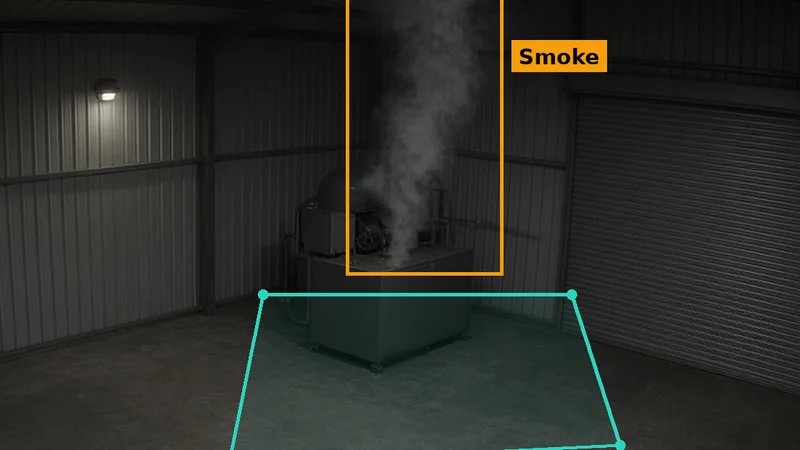
The places where camera detection adds most are usually the ones a fire alarm design leaves out or covers least well. Choose an area below to see how a zone might be set up. Each image is a camera view with a zone drawn over the area to watch.
Which area?
Outdoor plant, such as condenser units, compressors, generator enclosures and charging points, is outside the building and so outside most fire alarm designs. A camera that already looks over it can watch a zone drawn around the plant and send an alert with a clip if visible smoke or flame appears. Keep the zone tight, so that steam from vents or headlights on the road do not set it off.
Smoke and flame, out of hours
In a tall open store, smoke from a small fire may cool and spread before it reaches ceiling detectors. A camera looking across the stacks can see smoke rising from them. Draw the zone over the stacks rather than the whole view, and arm it when the store is closed. It adds a picture to the fire alarm; it does not replace any detector the design calls for.
Smoke and flame, when closed
Loading canopies, covered yards and open-sided stores are often neither inside nor outside in fire alarm terms. Pallets, packaging and waste can be left there overnight, close to the building. A zone under the canopy, armed out of hours, watches for smoke and flame by the doors, which is where an outside fire can get into the building.
Smoke and flame, overnight
Each area needs its own zone and schedule.
Other places worth considering include bin stores and skip areas, which are a common starting point for fires (see our bin store fire safety guide), charging areas for electric vehicles (see our EV charging fire safety guide) and battery storage (see our lithium-ion battery storage guide), and areas where hot work has taken place during the day (see our hot works guide). Where to put the cameras is covered in our CCTV camera placement guide.
The limits of camera detection
Every detection method has limits, and camera detection is no exception. A camera can only see what is in its view: smoke behind a wall, inside a machine or in another room will not be seen until it comes into view. It needs enough light, or infrared, to see at night, and very thin smoke in the dark is harder to see than thick smoke in daylight. Heavy rain, fog, snow, steam and dust can all make detection harder. And a camera alert depends on a person receiving it and acting on it.
None of that is a reason not to use it. It is a reason to use it for what it is good at, alongside a fire alarm, and to design the set-up carefully: cameras with a clear view of the risk, good lighting or infrared, zones over the areas that matter, and a clear plan for who receives alerts and what they do.
What about false alerts?
Just as fire alarms have false alarms, camera detection can have false alerts. Steam from vents, dust from vehicles, headlights, low sun, mist and insects near the lens can all look like smoke or flame. Good set-up keeps false alerts down. Tight polygon zones cover the risk, not the whole view. Schedules arm zones when the area should be quiet. Clean lenses and good lighting give the software the clearest view. And because Woodcock AI is self-learning, it gets better over time at knowing what is normal on each camera. Because every alert comes with a clip, a person can see in seconds whether it is real, rather than travelling to site to find out. Our guide to reducing CCTV false alarms goes into more detail.
A worked example
Here is how this might look for the fictional packaging firm in the picture at the top of this page. It is an example, not a real business. The firm rents a single-storey unit on an industrial estate. Its fire alarm is Category M, which its fire risk assessment found suitable, because nobody sleeps there and staff are always present while it is in use. It already has six CCTV cameras, one of which looks across the back of the unit, where the air compressor sits by the roller door.
After a conversation with its fire risk assessor and insurer, the firm adds smoke and flame detection to its existing cameras. A zone is drawn over the compressor corner, another over the floor store, and another over the plant and bins outside. The zones are armed from 18:00 to 07:00 and at weekends. The operations manager and a second keyholder receive the alerts.
One night, the last person leaves at 18:00. At 02:14, thin grey smoke starts to rise from the top of the compressor. Nobody is inside, so nobody presses a call point. The camera zone over the compressor corner sees the smoke, and within a minute the alert reaches the operations manager, with the clip and a description. She watches the clip at home, sees smoke rising and getting thicker, and calls 999, telling the control room she can see smoke on a camera inside the unit. She does not go in.
The next morning, the firm reviews what happened with its fire risk assessor and insurer. The compressor is inspected and serviced, and the assessor and insurer discuss whether the unit should have automatic detection, such as a Category P2 system over the highest-risk areas with a monitored link. The camera did not put the fire out or replace any part of the fire alarm. What it added was an early visual warning in an empty building, and a clip to show what happened.
How Woodcock AI fits
Woodcock AI connects to existing IP cameras and runs on an edge server on site or on a cloud server. It adds smoke and flame detection, and people and vehicle detection, to the cameras you already have. You draw polygon detection areas over the places that matter, choose when they are armed and who gets the alerts. Each alert has a snapshot, a short clip and an AI description of what the camera saw. Our smoke and fire detection page and how it works page show more, and our industrial and warehousing and logistics pages show how it is used in those settings.
Woodcock AI is self-learning, so it gets better over time at knowing what is normal on each camera. It is the result of years of development and is now in use on real sites in the UK. It works alongside your fire alarm, fire risk assessment, servicing and people rather than replacing them. Ask your cameras (Coming soon, early 2027) will let you ask questions about what your cameras have seen in plain words.
Ways to start
Book a site assessment. We look at what your cameras see by day and after dark, and show where zones would help, such as outdoor plant, external storage, loading areas and large open stores. Or ask for a live test on your cameras: we connect two or three of your existing cameras for about a fortnight, so you can see the alerts for yourself. We are also happy to arrange an on-site demo.
Sources
- Regulatory Reform (Fire Safety) Order 2005, article 13 (legislation.gov.uk); gov.uk, Fire safety in the workplace: who is responsible.
- BSI, BS 5839-1:2025, Fire detection and fire alarm systems for buildings: code of practice for non-domestic premises, and BSI announces updated fire safety standard, April 2025.
- Fire Industry Association, Guide to the changes in BS 5839-1:2025, Version 1, June 2025; Guidance on fire alarm categories, Version 2, January 2026; Technical Bulletin: User responsibilities, Version 1, November 2023.
- Fire Protection Association, How to test fire alarms, May 2021.
- Ministry of Housing, Communities and Local Government, Fire and rescue incident statistics: year ending June 2026.
- Scottish Fire and Rescue Service, Reducing unwanted fire alarm signals and Fire crews see reduction of 52 false alarm call-outs every day, 1 July 2024.
- London Fire Brigade, Automatic fire alarm policy, Guidance for responsible persons and Guidance Note 54.
- North Yorkshire Fire and Rescue Service, Automatic fire alarm attendance information; Humberside Fire and Rescue Service, Call-out charges.
- National Fire Chiefs Council, Guidance for PSTN migration.
- Reports of 2026 fires: The Oldham Times, Oldham; Love Andover, Andover; Devon Live, Kingsbridge; Chronicle Live, Jarrow; BBC News, Beccles; Warwick Nub News, Warwick; London Fire Brigade, Wembley and Dagenham.
We have summarised these sources in our own words and checked them on 3 November 2026. This guide is general information, not fire safety advice for your premises. BS 5839-1 is a code of practice and your fire risk assessor, fire alarm company, insurer and local fire and rescue service can tell you what applies to your building. Fire service policies on automatic fire alarms differ by area and change from time to time, so check your local service. Scotland and Northern Ireland have their own fire safety laws.
Is anything watching when the unit is empty?
Book a site assessment and we will look at what your cameras see by day and after dark, and show where smoke and flame zones would help over outdoor plant, external storage, loading areas and large open stores, or ask for a live test on your cameras.
Related pages
- Fire risk assessment
- What insurers expect from fire detection
- My insurer requires fire detection
- Video smoke detection on existing CCTV
- Outdoor fire detection
- Warehouse fire safety
- Factory fire safety
- Business alarm systems
- Out-of-hours site security checklist
- Smoke and fire detection cameras
- Book a site assessment
Frequently asked questions
Is a fire alarm a legal requirement for a business in the UK?
In England and Wales, the Fire Safety Order 2005 says the responsible person must make sure the premises have appropriate fire detectors and alarms where necessary. What is appropriate depends on the size and use of the building, what is in it and how many people may be there, and is decided through your fire risk assessment. Scotland and Northern Ireland have their own laws with similar duties. Very small premises may need only a simple system.
What is BS 5839-1:2025?
BS 5839-1:2025 is the British Standard code of practice for the design, installation, commissioning and maintenance of fire detection and fire alarm systems in non-domestic premises. It came into effect on 30 April 2025, replacing the 2017 edition. It is made up of recommendations, not law, but it is the benchmark used by fire risk assessors, enforcing authorities, building control and insurers. Changes include unacceptable variations, signalling times and a new section on extensions and modifications.
What are the fire alarm categories M, L and P?
Category M is a manual system with call points and sounders but no automatic detection. Category L systems, L1 to L5, use automatic detection to protect life, from detection throughout the building in L1 to a specific objective in L5. Category P systems, P1 and P2, use automatic detection to protect property, throughout the building or in defined areas. Many workplaces have a combination, such as M with P2. Your fire risk assessor should choose the category.
How often should a commercial fire alarm be tested?
Check the panel every day for faults. Test the system every week by operating a different manual call point, at about the same time, telling the ARC first if the system is monitored, and record it in the logbook. Repeat the test monthly for out-of-hours staff. A competent company should inspect and service the system about every six months, and BS 5839-1:2025 accepts any time between five and seven months after the last service.
Will the fire brigade come if my fire alarm goes off?
It depends on where you are, the type of building and the time of day. The Scottish Fire and Rescue Service does not attend automatic alarms from workplaces unless a fire or sign of fire is confirmed. London Fire Brigade does not attend most non-residential automatic alarms between 7am and 8.30pm unless a fire is reported, but attends at night. North Yorkshire has a similar policy from 1 July 2026. Sleeping premises are generally still attended. Check your local fire service.
Can AI on existing CCTV replace a fire alarm?
No. Video smoke and flame detection on CCTV is not a BS 5839-1 fire alarm system, is not certified as one and does not replace any part of the system your fire risk assessment calls for. It can add early visual warning in places a fire alarm covers less well, such as outdoor areas, large open stores and empty buildings. Woodcock AI runs on an edge server on site or on a cloud server and sends an alert with a clip, so a person can see for themselves.
Last reviewed 3 November 2026
Sprinklers are the other half of many buildings’ fire protection: see our commercial sprinkler systems guide.