

Electric vehicle charging fire safety: car parks, fleet depots and workplaces
EV charging fire safety means managing the fire risks of charging electric vehicles under the Fire Safety Order: a fire risk assessment before chargepoints go in; certified Mode 3 or 4 chargers installed to BS 7671 by a competent person; chargers placed outside or on open decks, protected from impact and within reach of firefighters; signed, easy-to-reach isolation; fire detection suited to the area; and an emergency plan that says never tackle a battery fire, call 999, get clear and isolate the power if safe.

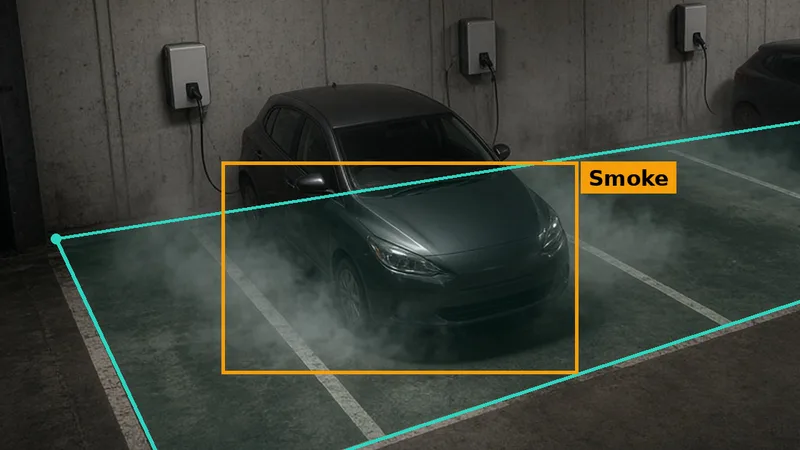
Last updated 3 November 2026. Electric vehicle chargepoints are going into car parks, office basements, supermarket decks, hotel car parks, workplace bays and fleet depots across the UK. Most of the time they do exactly what they should. But a charging car is a large lithium-ion battery connected to a high-power electrical supply, often left alone overnight, often in a covered or underground space, and often parked a few feet from other cars. When something does go wrong, the fire behaves differently from the car fires most buildings were designed for.
This guide explains EV charging fire safety in the UK for the people who run the places where vehicles charge: car park operators, facilities and estates managers, fleet and depot managers, and employers with workplace charging. It covers how EV fires differ, what the figures do and do not show, the law and guidance, the fire risk assessment, where to put chargepoints, how to isolate them, detection and the emergency plan. There is a printable checklist near the end.
We make AI smoke, flame, people and vehicle detection for existing CCTV cameras, and many of the sites we work with have car parks, yards and vehicle depots. Near the end we explain where cameras fit and where they do not. Be clear from the start: AI on cameras adds early sight of visible smoke and flame. It cannot see heat building inside a battery, it cannot detect gas, and it never replaces a fire alarm, sprinklers, a fire risk assessment or the people who run the site. Most of this page applies to any site, with or without cameras.
What makes an EV charging fire different?
A fire in a petrol or diesel car usually starts in the engine bay, the fuel system or the interior, and the fire service has decades of experience with it. A fire that starts in, or reaches, the battery of an electric vehicle is different. The government's covered car parks fire safety guidance for electric vehicles, published by the Office for Zero Emission Vehicles, explains why.
The key process is thermal runaway. Inside a battery, a cell that overheats, or receives too high a voltage, can start chemical reactions that produce more heat than its cooling can remove. If it ignites, the cells next to it heat up and can go into thermal runaway in turn, until the whole battery may fail. The guidance notes that thermal runaway can also happen at relatively low temperatures, with the battery venting flammable gases rather than flames. Those gases can then ignite if they meet a source of ignition.
That is important in a car park, because the battery provides its own fuel and, through its chemistry, part of its own oxygen. The government guidance describes four ways the vented gas can burn, depending on the space around the car: an ordinary free-burning fire; a jet fire, where gas vents with force in one direction, sometimes sideways from under the car; a flash fire, where a flame front runs through a cloud of gas; and, if enough gas builds up in a confined space, a vapour cloud explosion.
The Fire Protection Association's RC59 recommendations for fire safety when charging electric vehicles add a practical detail. A battery cell in thermal runaway will typically rupture or vent through built-in rupture discs, releasing a jet of flammable gas that can form a short jet fire. From what has been observed in car fires, RC59 says this jet is typically 2 to 3 metres long, and its direction depends on the design of the battery and the way it fails. In a row of parked cars, that is the width of the next bay.
One more feature of these fires matters for anyone with cameras. The government guidance says the vapour cloud from a venting battery is a white, opaque gas, occasionally dark, which could be mistaken for steam. Unlike steam, it is denser than air, so it tends to stay low rather than rise. It contains flammable and toxic components. It looks like smoke, but it is not the same as smoke from a fire, and it may appear before any flame. We come back to what that means for detection later.
Why are EV fires hard to put out?
EV batteries are sealed inside metal or plastic casings under the floor of the car, which makes it hard for firefighters to get water onto the cells that are burning. The government guidance summarises the research: an EV fire took between about 6 and 49 minutes to put out, against about 5 minutes for a typical petrol or diesel car fire, and needed around 10,000 litres of water where the battery was involved, against 4,000 litres for a conventional car.
Then there is reignition. Cells damaged in the first fire can go into thermal runaway later. In the research the guidance draws on, 13 per cent of vehicles reignited after the fire had first been put out, two cases reignited several times over several hours, and in one study a vehicle reignited 22 hours after the first fire. The guidance advises monitoring partly burnt batteries with a thermal imaging camera, and listening for popping, whistling or hissing, before moving the vehicle.
It is worth being clear what the research does not say. Full-scale tests reviewed by the government guidance suggest an EV fire releases about the same overall heat as a petrol or diesel car fire, though it can show a second peak when the battery becomes involved and then die down more slowly. EV fires are not bigger. They are harder to finish and last longer, which means more time heating the structure and the cars nearby.
How often do electric vehicles catch fire?
Less often than petrol and diesel cars, as far as the evidence goes. The government's covered car parks guidance says most of the evidence to date suggests that fires in EVs are less likely than in hybrid, petrol or diesel vehicles. It quotes an analysis by Thatcham Research, the UK motor insurers' research centre, which compared fire insurance claims with the number of licensed cars of each type for 2018 to 2020, leaving out claims linked to theft. Fire claims per car per year were 0.001 per cent for fully electric cars, 0.003 per cent for plug-in hybrids and range-extended EVs, 0.007 per cent for petrol cars and 0.011 per cent for diesel cars.
That is reassuring, but the guidance adds two warnings. First, cars are more likely to catch fire as they age, and the oldest EVs are still young compared with the petrol and diesel fleet. Second, it says the risk will need to be watched as cars age and as EVs reach a wider range of drivers. The National Fire Chiefs Council makes the same point in its position statement on fire risks in energy technologies: EVs may currently be less likely to ignite than petrol and diesel vehicles, but ageing and growing numbers of EV batteries could change that, and a second-hand market with ageing batteries and charging equipment is coming soon.
The numbers in cities are growing. The London Assembly Research Unit's analysis of London Fire Brigade data found 521 fires involving lithium-ion batteries in London in 2025, an increase of 28 per cent on the year before. They injured 109 people and killed three. E-bikes were the largest group, with 228 fires. Electric cars were involved in 91, 18 per cent of the total. Those are all fires involving electric cars, not only fires while charging, and the figures do not say how many happened in car parks.
Two more facts from the guidance are worth keeping in mind. Fire statistics for England from 2010 to March 2021 show that 46.5 per cent of car fires were deliberate, so arson remains a major cause of car fires of every kind. And the guidance's review of fire tests found that a fire started deliberately on the outside of an EV behaved much like the same fire on a conventional car, because the battery is protected inside the structure of the vehicle. In other words, an EV charging bay faces the ordinary car park risks as well as the new ones.
What does this mean for a site manager? Not that EVs are dangerous, and not that charging should be avoided. It means that the chance of a fire at any one chargepoint is low, but the consequences of one in the wrong place, at the wrong time, with nobody nearby, can be serious. That is exactly the kind of risk a fire risk assessment is for.
What do recent fires at charging sites and car parks tell us?
On 18 March 2026, crews were called at 11.25am to a fire at a multi-storey car park at Aintree University Hospital in Fazakerley, Liverpool. Merseyside Fire and Rescue Service found three vehicles on fire on the second floor. Firefighters wearing breathing apparatus put the fire out by 11.45am, then checked the floors above and below for hot spots and used fans to clear the smoke. The fire service report does not say what powered the cars. It is a reminder that in a car park, the problem is rarely one car. It is the cars on either side.
Shortly after 7.45pm on 1 June 2026, three fire engines from West Midlands Fire Service went to a car park on the High Street in Kings Heath, Birmingham, where the battery of an electric car was on fire. According to the Birmingham Mail, the car was next to a charging point. Firefighters damped down the battery for several hours, the car was placed in a containment unit, and crews left at about 11.50pm.
On the evening of 24 June 2026, four fire engines went to a bus depot in Westbourne Park, west London. The London Fire Brigade said a double-decker electric bus and two electric vehicle charging points were destroyed. Nobody was reported hurt, and the cause was under investigation.
On 21 August 2026, shoppers and staff were evacuated from a supermarket in Maryhill, Glasgow, after a car caught fire in the covered car park beneath the shop floor. According to the BBC, black smoke filled the car park and spilled onto the main road, and the store was temporarily closed. Nobody was reported hurt. The reports did not say what powered the car or how the fire started.
In late August 2026, a fire at an off-airport parking site near Crawley used by Gatwick passengers destroyed about 140 vehicles, according to West Sussex Fire and Rescue Service as reported by the BBC, and a man was arrested on suspicion of arson. Nothing suggests EVs or charging were involved. It shows how far fire can spread along rows of parked cars.
On the afternoon of 7 September 2026, an electric car caught fire at a charging point at Rownhams services on the M27 in Hampshire. A Hampshire Fire and Rescue Service spokesperson said the electricity supply to the charging station was isolated and the fire was tackled with hose reels and jets. The services were closed because of the smoke.
Just before 5am on 6 October 2026, Devon and Somerset Fire and Rescue Service were called to a bus depot in Matford, near Exeter, where electrical switching gear used to charge electric buses was on fire. It was put out with a hose reel and a dry powder extinguisher, and nothing else was damaged. That is what a fire found early, in the charging equipment, can look like.
The causes of several of these fires are not known, and some did not involve an EV at all. But they show the range of things that can happen where vehicles park and charge, from a fire in the charging equipment to a car park beneath a building that has to be cleared. Several started in the evening or early morning, and several needed power isolated.
Who is responsible for fire safety where vehicles charge?
Adding chargepoints does not change who is responsible for fire safety. In England and Wales, the Regulatory Reform (Fire Safety) Order 2005 applies to almost all non-domestic premises, including car parks, workplaces and depots. According to GOV.UK, you are the responsible person if you are the employer, the owner, the landlord, an occupier or anyone else with control of the premises, such as a facilities manager, building manager or managing agent. If there is more than one responsible person, you must work together.
That matters for charging, because chargepoints often sit across those lines. A landlord may own the car park, a tenant may lease spaces in it, a charging company may own and run the chargers, and a contractor may maintain them. The government's covered car parks guidance says a fire risk assessment must be carried out before chargepoints are installed, to assess their effect on the existing fire safety measures and identify any new or different risks from more EVs and chargepoints in the car park. It says that, given the complexity, a competent person who understands fire safety in car parks should carry it out.
The responsible person's duties are the same as anywhere else. You must carry out a fire risk assessment and review it regularly, tell staff about the risks, put in place and maintain fire safety measures, plan for an emergency and train staff. Article 9 of the Fire Safety Order requires the assessment to be suitable and sufficient and to be reviewed when there has been a significant change. Installing chargepoints, adding more of them, or changing from a few EVs to a fleet of electric vans are all significant changes. Our fire risk assessment guide explains the process in detail.
The government guidance also reminds responsible persons of the principles of prevention set out in the Fire Safety Order. They include avoiding risks, evaluating the risks that cannot be avoided, combating risks at source, adapting to technical progress, and giving collective protective measures priority over individual ones. For EV charging, adapting to technical progress is a live issue. The guidance itself says the review stage is very important, because EVs and chargepoints are new technologies and new evidence and guidance keep appearing.
What rules and guidance apply to EV charging?
There is no single law for EV charging fire safety. Instead, several sets of rules apply at once, and they do different jobs. The Fire Safety Order covers how premises are run. Building Regulations cover what is built or altered. Wiring rules cover the electrical installation. And a growing body of guidance, some from government and some from insurers, explains good practice.
Building Regulations in England include Part S, on infrastructure for charging electric vehicles. Approved Document S took effect on 15 June 2022. It sets out how many chargepoints and cable routes new buildings, buildings undergoing major renovation and some changes of use must have. For a new building that is not residential or mixed use, with more than 10 parking spaces, at least one space must have access to a chargepoint and cable routes must be installed in at least one fifth of the remaining spaces. Under the regulation, spaces outside a covered car park are used first, and cable routes go in the covered car park only if there are not enough outside spaces.
Approved Document S is about numbers and specifications, not fire. It says that chargepoints installed under Part S must be at least a Mode 3 system with a minimum nominal rated output of 7kW. And it says plainly that where a car park is built or work is carried out to an existing car park, care must be taken to ensure the fire safety requirements of the Building Regulations are met, by following Approved Document B. Part S puts chargepoints into car parks. Part B is what keeps the car park safe.
The electrical installation is covered by the IET Wiring Regulations, BS 7671, which has a section, Section 722, for electric vehicle charging installations. The IET also publishes a Code of Practice for Electric Vehicle Charging Equipment Installation. According to the IET's Wiring Matters article on the fifth edition, it takes account of the accessibility standard PAS 1899:2022 and advises installers to consider RC59 when deciding where to put charging points. The practical point is simple: chargepoints must be installed by a competent electrician, with fire safety in mind as well as electrical safety.
Then there is guidance. The most important for car parks is the government's covered car parks fire safety guidance, prepared for the Office for Zero Emission Vehicles and published in July 2023. It is for car park operators, designers, risk assessors and owners installing chargepoints in covered car parks, new or existing. It covers cars and vans with lithium-ion batteries charged by cable, not e-bikes, e-scooters or electric buses. It applies to England.
The guidance is careful about its own status. It says it is not a legal compliance document and does not replace existing regulations. It calls itself interim, because the evidence on EV fires is still developing and the effect of age on EV batteries is not yet understood. It sets out measures on a precautionary principle, for operators to choose from through their fire risk assessment. That is a sensible way to read all EV fire safety guidance at the moment.
The insurance industry's view is set out in RC59, from RISCAuthority and the Fire Protection Association. It is aimed mainly at commercial and industrial premises, and many insurers use it as a reference. It is more direct than the government guidance, with specific separation distances, fire resistance periods and detection standards, and we draw on it in the sections on workplaces and depots. Check your insurance policy too. Some insurers set their own conditions for charging areas, and RC59 notes that increased separation may be appropriate based on an insurer's expectations.
Scotland, Wales and Northern Ireland have their own building rules, and Scotland has its own fire safety law, the Fire (Scotland) Act 2005. The principles in this guide apply across the UK, but check the rules for your nation before you rely on any detail.
How do you assess the fire risk of EV charging?
The fire risk assessment is where all of this comes together. The government guidance says the starting point is the fire safety you already have. For an existing car park, review the fire safety strategy: what active and passive fire precautions it has, how they are expected to work in a fire, and whether they have been maintained and tested. If there is no strategy, a competent person can develop one from the car park's actual features. Then work out whether there are property protection or business continuity concerns on top of protecting life.
The guidance uses the familiar HSE framework for the assessment itself: identify the hazards, decide who might be harmed, evaluate the risks, record the findings and review. For a car park, the people who might be harmed include not only those in the car park but people in the building above it and in buildings nearby. If the risks are not acceptable, you add measures until they are.
The hazards fall into a few groups. The battery can be damaged by heat, for example from a fire in the car next to it. It can be damaged electrically, for example by a faulty charger that delivers too much current. It can be damaged mechanically, for example in a collision with a pillar. The charger and its cable can be damaged by vehicles, by people tripping over trailing cables, or deliberately. And a charger can simply develop a fault. The guidance has a table of measures for each.
| Step | What to look at | Car park example |
|---|---|---|
| 1 Hazards | Batteries, chargers, cables, collisions, arson | Six chargers in a row on a basement deck, next to the only stair |
| 2 People | Users, staff, people above and nearby | Offices above the car park, and a cleaner who works alone at night |
| 3 Evaluate | Is the risk acceptable? If not, add measures | Move two chargers away from the stair and add an isolator by the entrance |
| 4 Record | Findings, measures, plan and training | Update the premises information plan and brief the security team |
| 5 Review | New chargers, new vehicles, new guidance | Review when the fleet switches to electric vans or the guidance changes |
To choose between measures, the guidance uses what it calls the ERIC hierarchy: eliminate, reduce, isolate, control. Eliminating a hazard is the most effective option, such as taking a faulty charger out of use straight away. Reducing it comes next, such as wider spacing between cars or crash protection for chargers. Isolating limits the effect when something goes wrong, such as an automatic power cut-off linked to the fire alarm. Controlling it, through procedures, training and equipment, is the least effective on its own, because it depends on people doing the right thing at the right time.
Most sites end up with measures from every level. The point of the hierarchy is to start at the top. If you can put chargepoints somewhere a fire would do less harm, that is better than relying on a plan for what to do when one happens there.
What changes in a covered or underground car park?
Covered car parks raise the stakes. The government guidance uses the term for parking spaces beneath a roof, including basement car parks, standalone multi-storey car parks and car parks built into other buildings. Smoke and heat cannot escape as easily, firefighters have to go inside, and there may be offices, shops or homes above. The guidance says some fire safety features of existing car parks assumed a fire would not spread beyond one car or a few, which may no longer hold for modern, larger cars.
One concern is the structure. The government guidance refers to the 2018 CROSS report on the Liverpool Echo Arena car park fire in December 2017, where a fire in a petrol or diesel car spread rapidly to other cars and the car park was later demolished. Approved Document B allows 15 minutes structural fire resistance for some car parks. The guidance notes it could take up to 60 minutes for the fire service to put out a fire involving EVs, and suggests a minimum of 60 minutes should be considered unless sprinklers or similar are also installed. Our car park security guide covers the 2017 fire in more detail.
Another is spread between cars. The guidance's options include wider bays, either designed in or repainted in an existing car park, and fire-resisting construction between bays, which can be full or partial height. RC59 says where charging has to be in a basement, the sprinkler and ventilation design need careful thought, the fire and rescue service should be consulted about access, and basement garages with chargers should be separated from other parts of the premises by at least 120 minutes fire resistance. For multi-storey car parks, RC59 says serious consideration should be given to putting chargers in open areas with good access for firefighting.
Sprinklers are the measure most fire safety bodies favour. RC59 says sprinklers provide the best form of active fire protection for enclosed car parks and that sprinkler protection is strongly recommended for enclosed car parks with EV charging points. Both RC59 and the government guidance are honest about what they do: sprinklers are designed to control the spread of the fire, but will probably not put out the EV fire itself, because the battery is shielded beneath the body of the car and water cannot get into the battery casing. Final control and extinguishment rely on the fire and rescue service.
Water supply is the other side of the same problem. The government guidance says significantly more water is needed to tackle an EV fire than a petrol or diesel car fire, and that the supply may need to be increased to meet the British Standard BS 9990 recommendation of 1,500 litres a minute for 60 minutes, through better hydrant or mains provision or through tanks and pumps. It also suggests talking to the local fire service about an inlet so they can top up a sprinkler tank during a long fire.
Smoke is a more subtle issue. According to the guidance, the volume of smoke from an EV fire is not significantly different from a petrol or diesel car fire, but there is a greater presence of toxic gases. Car parks that rely on a bespoke smoke ventilation design, for example to justify longer escape distances, should check whether it is still adequate. Higher air change rates, longer run times on back-up power and the order in which fans and sprinklers operate all need thought, so that ventilation does not delay the sprinklers.
Finally, talk to your fire service before you install anything for their benefit, as each service has its own approach and equipment for EV fires. The guidance also makes a point many operators miss: in the UK, it is not the fire and rescue service's job to remove a burnt vehicle from a car park. That is the responsibility of the premises, so you need an arrangement with a recovery company that can deal safely with a damaged battery.
How should chargepoints be chosen and placed?
Good equipment, well installed, is the first line of defence. The government guidance says there is no accreditation list for chargepoints in the UK, but that you can check a chargepoint conforms to BS EN 61851-1 through product certification schemes. It recommends Mode 3 or Mode 4 chargepoints, which have a built-in interface to monitor faults and can stop charging when something goes outside normal limits. Mode 1 chargepoints do not meet the statutory guidance in Approved Documents P or S and should not be used.
The guidance lists built-in protective features worth looking for: overcurrent protection, tilt sensors that stop a knocked chargepoint being used, damage and fault reporting to the maintenance company, ventilation, and temperature sensors that cut the supply when the temperature is too high or too low. Your fire risk assessment decides which you need. Installation should be by a competent person who is a member of a competent person scheme, with a maintenance regime afterwards.
Where you put chargepoints matters as much as which ones you buy. The guidance says a fire at a chargepoint should not block the only means of escape, and chargepoints should be within hose reach for the fire service. RC59 says charging equipment and cables should not get in the way of access or emergency exit routes, and that no flammable or combustible material should be stored in charging areas. In an existing car park, that might mean choosing a row near the open side of a deck, close to the firefighting entrance, rather than the far end of a basement next to the stair.
Physical protection comes next. RC59 says charging points should be protected against damage by vehicles, for example with a raised island, kerbs, bollards or metal barriers, and the government guidance mentions crash protection designed to BS 6180 or PAS 68. Mark bays so drivers park close to the chargepoint and cables are not stretched across walkways. RC59 says extension cables in public areas should be prohibited.

Accessibility is part of good layout too. The government guidance points to PAS 1899:2022, the BSI specification for accessible chargepoints, which sets out dimensions for chargepoints and the space around them. A layout that is easy for everyone to use is also easier to keep tidy, with fewer stretched cables and fewer knocks.
Isolation: how do you cut the power in a fire?
One of the first things firefighters want to know at a charging fire is how to cut the power, as at Rownhams services. The government guidance explains why this is not always simple. Manufacturers usually do not put isolation switches on the chargepoint itself, because of concerns about passers-by switching off cars that are charging. So a manual cut-off normally has to be at the distribution board or circuit serving the chargepoints. To help the fire service, the guidance says the means of isolating power to chargepoints should be near a firefighting entrance, or next to the fire alarm panel or fire service information point.
RC59 adds that emergency isolation points should be prominently signed and placed where trained staff and firefighters can reach them easily, should have lock-out facilities to stop anyone switching the power back on, and that circuits should need a manual reset when the power is restored. The government guidance also describes automatic isolation, linked to the fire alarm or sprinklers, so that when a fire is confirmed the power to chargepoints on that floor or in the whole car park is cut. It suggests this where there are no staff, or where staff would take too long to get there.
Whichever you choose, make sure the people who will be there at 2am know where it is. RC59 says security or other responsible staff who may be called in an emergency should know where the charging areas are, how to isolate the power and how to raise the alarm. A label that says which bays an isolator controls saves time when it matters.
What about workplace car parks and charging at work?
Workplace charging brings a particular problem that RC59 puts plainly. In commercial and industrial premises, the fire hazards and the threats to the business are increased because charging carries on during the night and at weekends, when very few or no staff are present. A car left on charge at 6pm on a Friday may still be connected on Monday morning. If something goes wrong in between, there may be nobody to see it.
RC59 says a fire risk assessment for commercial and industrial premises should consider the risk from charging electric vehicles, and lists the measures to think about. They include separating charging areas from process and storage areas; power supply, control and isolation that can be operated from a safe place without stopping the rest of the business; controls for when the premises are unoccupied; suitable automatic fire detection and warning; portable firefighting equipment and, where proportionate, fixed suppression; an emergency plan; and staff training, including how to isolate the power and evacuate.
RC59 also says charging points for company vehicles and visitors should normally be outside the premises, with suitable lighting. Where that is not possible, inside charging should be risk assessed and, where possible, put in a detached single-storey structure; failing that, the enclosure should give at least 60 minutes fire resistance from the rest of the building, and charging points should be at least 10 metres from any hazardous area such as an ignitable liquids store.
Day-to-day habits matter too. RC59 says staff should be trained to use chargers safely and to check the equipment visually before each use, and that damaged or faulty equipment should be reported immediately, isolated, taken out of service and marked with a warning notice or barrier until it is repaired. It says only vehicles with the manufacturer's original batteries, or approved replacements fitted by a competent person, should be charged. And it says staff-owned e-bikes should be charged in a secure fire compartment or a detached single-storey structure, separate from car charging. Our lithium-ion battery storage guide covers e-bikes, e-scooters and battery stores in depth.
What about fleet depots, bus garages and vehicle yards?
Fleet depots concentrate the risk. Instead of a few cars charging in a row, there may be dozens of vans, buses or lorries parked close together and charging at the same time after the last shift, from high-power chargers fed by switchgear on site. The government's covered car parks guidance covers cars and vans only and does not consider electric buses or other utility vehicles, so depot operators have to lean on RC59, their insurers and their fire risk assessor.
The National Fire Chiefs Council has said it is concerned about underground or enclosed parking of electric buses below high-rise buildings, and has called for clearer guidance on charge point placement, isolation, integration with fire detection, and firefighting access. The 2026 fires at Westbourne Park and Matford show two different ends of the depot risk: a vehicle and two chargers destroyed in one, and a fire found in the charging switchgear with nothing else damaged in the other.
For a depot, the RC59 recommendations on separation, outside charging, isolation and detection all apply, with more vehicles to protect. Think about parking patterns, so a fire in one vehicle has less chance of reaching the next; where damaged vehicles are kept, since the government guidance suggests vehicles prone to knocks may need a separate, segregated area; and how the yard is watched at night. Our guides to HGV yard security, vehicle yards and vehicle repair garages cover the security side of the same sites.
What fire detection suits charging areas?
The government guidance points out that current statutory guidance does not require automatic fire detection in most car parks, but says it brings extra benefits as EV numbers grow: earlier detection, earlier warning for people to escape and, if the system is monitored, a faster call to the fire service. RC59 goes further for commercial and industrial sites. It says internal charging areas should be protected by automatic fire detection to at least category P2 of BS 5839-1, installed by certificated contractors, monitored on site or by an accredited alarm receiving centre, tested weekly with records kept, and serviced by a competent engineer.
The type of detector matters. The guidance says detectors need to be chosen so that exhaust from petrol and diesel cars does not cause false alarms, and that smoke detectors are useful for detecting EV fires. It mentions gas detectors coming onto the market that could give earlier warning of the vapour cloud, and suggests detection can be linked to automatic isolation of the chargepoints.
Thermal imaging cameras are a separate technology. The guidance says they can alert operators earlier to the possibility of an EV fire, but that there is no specific UK guidance on their design, that further research is needed because the battery may sit in the middle of the car, and that they should supplement other fire and smoke detection. If they are ceiling-mounted, it says they should see the sides of cars, not just the roofs. Thermal imaging cameras are not the same as the ordinary CCTV cameras most sites already have, and ordinary CCTV cannot measure heat.
What should you do if a vehicle catches fire on charge?
Do not try to put it out. After the Kings Heath fire, West Midlands Fire Service reminded people never to tackle fires involving lithium-ion batteries themselves, saying they are extremely dangerous, burn at very high temperatures and produce toxic, flammable gases. The government guidance mentions extinguishers and dedicated EV fire blankets near charging bays for trained staff, for a fire that starts somewhere other than the battery, but notes that EV fire blankets are still being developed and their testing should be checked before relying on them.
Instead, call 999 and say that an electric vehicle or charging equipment is involved. Get everyone away from the area, including people in parts of the building above or next to it. If it is safe to do so, isolate the chargers. Then meet the fire service with plans showing where the chargepoints, isolators and fire main outlets are; RC59 recommends an information box for firefighters.
Write it down, train people and rehearse it. RC59 says the emergency plan should be rehearsed and improved after each exercise, and that businesses should have a business continuity plan for losing a critical area. If your fleet depot burned overnight, how would vehicles get out the next morning? If the car park under your office were closed for weeks, where would people park?
The fire is not over when the flames go out. RC59 warns that even where an EV fire seems to have been put out, the battery can reignite, and that moving or dragging the vehicle can make this more likely. That is why crews at Kings Heath damped the battery down for hours and the car left in a containment unit. Plan how a burnt vehicle will be removed, by whom, and where it will be kept, and review your fire risk assessment and talk to your insurer afterwards.
Where does ordinary CCTV fall short?
Most car parks, workplaces and depots already have CCTV, usually for security, and those cameras often have a better view of the charging bays than anything else on site. The problem is that most CCTV is a record, not a warning. Footage is usually looked at after something has happened. Unless someone is watching the right screen at the right moment, smoke from under a car on charge at 2am will be recorded and seen by nobody until morning.
How can AI on existing CCTV help?
AI video detection changes what existing cameras can do. Software watches the camera views all the time and looks for the visual signs of smoke and flame. When it sees them in an area you have chosen, it sends an alert straight away, with a snapshot, a short clip and a description of what the camera saw, so a security officer, a keyholder or a depot manager can check, call 999 and isolate the chargers. It also shows what is happening, which helps the fire service when they arrive. Our guide to video smoke detection on existing CCTV explains the technology.
With Woodcock AI, you draw polygon detection areas on each camera view, around exactly what you want to watch, such as a row of charging bays, a charging cabinet or a line of vans, and leave out what you do not, such as a ramp, a driving aisle or a road. You choose when each area is armed and who receives the alerts. Our page on AI smoke and fire detection explains more, and our page on battery energy storage sites covers larger battery installations.
Three charging areas worth watching
Choose an area below to see what a camera view of it might look like and how a detection zone could be set up.
Which charging area?
Draw the zone over the charging bays and the cars on either side, not the ramp or the driving aisle, where headlights and exhaust come and go. Arm it all the time or out of hours, depending on how busy the deck is. A camera that can see the bays and the nearest exit gives the fire service a picture of where the smoke is going.
Multi-storey and basement
Workplace car parks are busy by day and empty at night, which is when RC59 says the risk to the business rises. A zone over the bays, armed from the evening, means smoke from a car left on charge is seen by the security officer or keyholder, not found by the first person in next morning.
Cars left on charge overnight
In a depot, the camera can watch the rows of vehicles and the charging cabinets or switchgear at the end of each row, as in the Matford fire. Many yards have no fire detectors at all, so cameras that already watch the yard for security can watch for smoke and flame too, especially during the quiet hours before the first shift.
Vans, buses and charging cabinets
Each area needs its own zone and schedule.
Where should cameras watch?
Start from your fire risk assessment. The best places for camera-based smoke and flame detection are usually where your assessment says a fire would do most harm or be found latest: charging bays in covered car parks, cars on charge overnight, chargers and their cables, the switchgear and cabinets that feed them, rows of fleet vehicles charging before a shift, the ramps and exits where smoke would show, and any area where damaged vehicles are kept.
Not every camera is suitable. Detection needs a clear, stable view of the area, and a camera at the far end of a long, low deck may not see smoke from the last bay clearly. Our camera placement guide explains how to check whether a view is good enough.
What AI on your cameras cannot do
Be clear about the limits, because they matter more with batteries than with most fire risks. AI on ordinary CCTV sees what the camera sees: visible smoke and visible flame. It cannot detect gas. It cannot sense heat inside a battery, and it cannot see thermal runaway before there is smoke or flame to see. Ordinary CCTV is not thermal imaging. The white vapour cloud from a failing battery can look like steam, and we do not claim that cameras will reliably pick it out before it ignites. AI on cameras is an addition to your fire alarm, never a replacement for it, or for sprinklers, isolation, a fire risk assessment or the people who run the site. What it adds is early sight of smoke and flame in the places your cameras already cover, often when nobody else is looking.
What about false alerts in a car park?
Car parks and depots have things that can look a little like smoke: exhaust on a cold morning, steam from wet cars, headlights sweeping across a deck, and dust in a yard. Good set-up keeps false alerts down. Tight polygon areas leave out ramps and aisles. Schedules arm zones when the site is quiet. Clean lenses and a steady aim give the software the clearest picture. And because Woodcock AI is self-learning, it gets better over time at knowing what is normal on each camera. Our guide to reducing CCTV false alarms goes into more detail.
A worked example
Here is how this might look for a fictional office building with a car park beneath it and six charging bays on level -1. It is an example, not a real business. The last driver leaves at 19:30, with two cars still on charge. At 22:00, the zone over charging bays 1 to 6 is armed. At 02:14, grey smoke begins to drift from under the cars on charge and along the floor of the bays. The camera that watches the bays sees it, and the alert reaches the night security officer with the clip. He sees the smoke, calls 999, tells the call handler a car on charge is involved, and isolates the chargers from the signed switch by the entrance. The building's fire alarm sounds shortly afterwards, and he meets the crews with the premises information plan.
The next day, the building manager and the fire risk assessor review what happened. The isolator worked and was easy to find, but the plan did not say who would call the recovery company, so that is added. The camera did not prevent the fire, and the fire alarm stayed in charge of the building. What the camera added was earlier sight of the fire and a clear picture of where it was.
EV charging fire safety checklist
Here is a checklist that draws the guide together. It is a starting point, not a substitute for your own fire risk assessment. Add the items that are specific to your site and review it whenever things change.
The law and records
- Fire risk assessment reviewed before chargers go in
- Responsible persons agreed: landlord, tenant, operator
- Insurer told about the chargers and their location
- Electrical installation by a competent person to BS 7671
- Review when you add chargers or switch a fleet to electric
Location and layout
- Outside or on open decks where possible
- Within hose reach, not blocking the only exit
- Bays marked; chargers behind kerbs, bollards or barriers
- No storage or combustibles in charging areas
- Rapid chargers clearly marked apart
Equipment and inspection
- Mode 3 or 4 chargers certified to BS EN 61851-1
- Visual check before use; routine inspections
- Faulty chargers isolated, locked out and signed
- No extension leads; cables stowed after use
Isolation and detection
- Isolator near the fire service entrance, signed and lockable
- Security staff know where it is and what it controls
- Fire detection to BS 5839-1 where your assessment calls for it
- Alarm tested weekly; faults logged
- Detection arranged for nights and weekends
Emergency and recovery
- Plan: never tackle it, call 999, get clear, isolate if safe
- Premises information plan shows chargers and isolators
- Plan rehearsed, including the night shift
- Recovery arranged for burnt vehicles
- Business continuity plan covers losing the car park or depot
How Woodcock AI fits
Woodcock AI connects to existing IP cameras and runs on an edge server on site or on a cloud server. It adds smoke and flame detection, and people and vehicle detection, to the cameras you already have. You draw polygon detection areas over the places that matter, choose when they are armed and who gets the alerts. Each alert has a snapshot, a short clip and an AI description of what the camera saw.
Woodcock AI is self-learning, so it gets better over time at knowing what is normal on each camera. It is the result of years of development and is now in use on real sites in the UK. It works alongside your fire alarm, your sprinklers, your risk assessment and your people rather than replacing them. Ask your cameras (Coming soon, early 2027) will let you ask questions about what your cameras have seen in plain words.
Ways to start
Book a site assessment. We look at what your cameras see by day and after dark, and show where smoke and flame zones would help, such as charging bays, chargers, cabinets and depot rows. Or ask for a live test on your cameras: we connect two or three of your existing cameras for about a fortnight, so you can see the alerts for yourself. We are also happy to arrange an on-site demo.
Sources
- Office for Zero Emission Vehicles (prepared by Arup), Covered car parks: fire safety guidance for electric vehicles (July 2023), including the Thatcham Research, London Fire Brigade and England fire statistics it quotes.
- RISCAuthority and Fire Protection Association, RC59: Recommendations for fire safety when charging electric vehicles (version 2, January 2023), as published by Kent Fire and Rescue Service.
- Department for Levelling Up, Housing and Communities, Approved Document S: infrastructure for the charging of electric vehicles (2021 edition, in force 15 June 2022).
- The Institution of Engineering and Technology, Wiring Matters, Fifth Edition of the IET Code of Practice for Electric Vehicle Charging Equipment Installation (September 2023).
- National Fire Chiefs Council, position statement on fire risks in energy technologies.
- London Assembly Research Unit, London Fire Brigade research on lithium-ion battery fires in London in 2025.
- GOV.UK, Workplace fire safety: your responsibilities; the Regulatory Reform (Fire Safety) Order 2005, article 9 (legislation.gov.uk).
- Reports of 2026 fires: Merseyside Fire and Rescue Service, Aintree; Express and Star, Kings Heath, and Birmingham Mail, Kings Heath; London Fire Brigade, Westbourne Park; BBC News, Maryhill and near Gatwick; Southern Daily Echo, Rownhams; Devon Live, Matford.
We have summarised these sources in our own words. The government covered car parks guidance is interim and applies to England, and Approved Document S applies to England; check the current law and guidance for your nation, and any conditions in your insurance policy. This page is general guidance, not legal, electrical or insurance advice. In an emergency, always call 999.
Who would see smoke at your charging bays at 2am?
Book a site assessment and we will look at what your cameras see by day and after dark, and show where smoke and flame zones would help over charging bays, chargers, cabinets and depot rows, or ask for a live test on your cameras.
Related pages
Frequently asked questions
Are electric cars more likely to catch fire than petrol cars?
The evidence so far says no. Thatcham Research figures quoted in the government covered car parks guidance found fire insurance claims of 0.001 per cent a year for electric cars, against 0.007 per cent for petrol and 0.011 per cent for diesel. But EV fires behave differently, can reignite, and the risk may change as batteries age.
Who is responsible for fire safety at EV chargepoints?
In England and Wales, the responsible person under the Fire Safety Order: the employer, owner, landlord, occupier or anyone else with control of the premises. If there is more than one, such as a landlord, a tenant and a charging operator, they must work together. A fire risk assessment should be carried out before chargepoints are installed.
What guidance covers EV charging in car parks?
Approved Document S sets numbers of chargepoints and cable routes for new buildings, and says to follow Approved Document B for fire safety. BS 7671 section 722 and the IET code of practice cover installation. The government covered car parks guidance (2023) and the insurers’ RC59 set out fire safety measures.
Should EV chargers be put in underground car parks?
Avoid it if you can. RC59 favours outside charging and open areas of multi-storey car parks with good firefighting access. Where charging must go in a basement, it says to design sprinklers and ventilation carefully, talk to the fire service, and separate the car park from the rest of the building with at least 120 minutes fire resistance.
What should you do if an EV catches fire while charging?
Never try to tackle it. Call 999 and say an electric vehicle is involved, get everyone clear, including people above, and isolate the chargers only if it is safe. Meet the fire service with plans showing the chargepoints and isolators. Even when it seems out, the battery can reignite hours later.
Can CCTV detect an EV battery fire?
Ordinary CCTV with AI can detect visible smoke and flame, not gas or heat inside a battery, and it is not thermal imaging. Woodcock AI runs on an edge server on site or on a cloud server and adds early sight of smoke and flame at charging bays on existing cameras, as an addition to the fire alarm, not a replacement.
Last reviewed 3 November 2026