

Fire risk assessment for business premises: a UK guide and template
A fire risk assessment is a review of your business premises to find what could start a fire, who would be at risk, and what you will do to remove or reduce the risk and protect people. In the UK the responsible person must make one and keep it under review. Follow five steps: identify the fire hazards, identify the people at risk, evaluate and remove or reduce the risks and protect people, record the findings and plan, inform and train, then review regularly. In England and Wales the whole assessment must now be recorded in writing.

Last updated 2 November 2026. If you run a business in the UK, you almost certainly need a fire risk assessment. The law calls it a duty of the responsible person, and in England and Wales it has had to be written down in full for every business premises since 1 October 2023, whatever the number of staff. This guide explains what a fire risk assessment is, who has to do it, what the law says in England, Wales, Scotland and Northern Ireland, and how to work through the five steps properly rather than ticking boxes. It includes the latest national fire figures, eight prosecutions from 2026, a template, a worked example and a checklist.
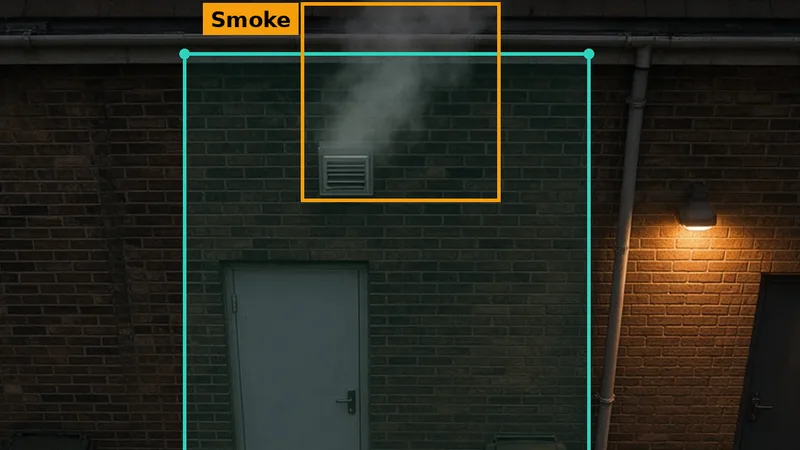
We make AI smoke and flame detection for existing CCTV cameras, so the last part of the guide also explains where camera detection fits, and where it does not. It is not a fire alarm system and it does not replace any of the duties in this guide. What it can do is watch the outside of a building, such as bin stores, pallet stacks and yards, when nobody is there to see the first smoke. That is a gap many assessments mention and few close.
The rest of this page follows the same order as most good assessments. We start with what the law requires and who is responsible. Then we look at the evidence on where fires happen and what courts have found in 2026. Then we go through the five steps in depth, with a template you can copy, a worked example for a small industrial unit, and a checklist to test what you already have.
What is a fire risk assessment?
A fire risk assessment is a careful, written look at your premises and the way you use them, to find out what could cause a fire, what would burn, who would be at risk if a fire started, and whether the fire safety measures you have are enough to keep those people safe. Where they are not enough, it says what you will do and by when. GOV.UK describes it as identifying the fire hazards and the people at risk, then removing or reducing the risks, recording what you find and reviewing it regularly.
The legal phrase in England and Wales is a "suitable and sufficient assessment" of the risks to which relevant persons are exposed, so that you can identify the general fire precautions you need. Relevant persons means anyone who is, or may lawfully be, on or near the premises and could be affected by a fire: staff, visitors, contractors, customers, residents above a shop and people next door. It does not mean firefighters, whose safety is dealt with in other ways, though the law does expect you to think about them and to tell the fire and rescue service about dangers on site.
"Suitable and sufficient" is not defined as a set length or format. In practice it means the assessment fits the size, use and complexity of the premises, it was done by someone who understood them, it looked at the real risks rather than a generic list, and its findings are specific enough to act on. A two-page record can be right for a small office. A distribution warehouse with racking, a battery charging area and a yard full of pallets needs a lot more.
An assessment is not just a form. It is the thinking that leads to the fire precautions you have: the fire detection and warning system, the escape routes and fire doors, the emergency lighting and signs, the extinguishers, the way you store waste and stock, the emergency plan and the training you give people. If the thinking is wrong, the precautions will be wrong too. If it is right but never updated, the precautions slowly drift out of step with the building.
It also covers the whole premises, not just the inside. The yard, the bin store, the pallets stacked against the back wall and the car park all count. Many serious fires in commercial buildings start outside and spread in through the eaves, a window or a roller shutter, often at night when nobody is there. A good assessment looks at those areas by day and after dark, and asks what would happen if a fire started there at 02:00.
Who has to carry out a fire risk assessment?
In England and Wales the duty sits with the responsible person. GOV.UK says you are responsible for fire safety in business or other non-domestic premises if you are an employer, the owner, the landlord, an occupier, or anyone else with control of the premises, such as a facilities manager, building manager, managing agent or risk assessor. In a workplace, the employer is the responsible person to the extent that the workplace is under their control. Elsewhere it is the person who has control of the premises in connection with a trade, business or other undertaking, or the owner.
More than one person can have duties for the same building. A landlord may be responsible for the common parts, the shared staircase and the fire alarm, while each tenant is responsible for its own unit. Since October 2023, responsible persons in England have had to identify each other and share information so that their assessments line up. If you rent a unit on an industrial estate, ask the landlord or managing agent what they cover, and write the answer down.
The responsible person does not have to do the assessment personally. GOV.UK says you can do it yourself or appoint a competent person to do it for you. What you cannot hand over is the responsibility. If you appoint an assessor, the duty to have a suitable and sufficient assessment, and to act on it, stays with you. The fire and rescue service can give advice, but it will not carry out your assessment for you.
The duties are wider than the assessment itself. The responsible person must put in place and maintain the fire safety measures the assessment identifies, plan for an emergency, give staff clear and relevant information, appoint people to help, and provide instruction and training. Before October 2023, the significant findings only had to be written down where five or more people were employed, a licence was in force or an alterations notice required it. That limit has gone in England and Wales: every responsible person now has to record the full assessment.
Fire risk assessment, health and safety, and security
A fire risk assessment is one of several assessments a business needs, and they overlap. The general health and safety risk assessment covers every hazard at work, from manual handling to machinery, under HSE guidance. A security risk assessment looks at deliberate harm such as theft, break-ins and violence. The fire risk assessment focuses on fire: what could start one, how it would spread, and how people would be warned and get out.
They meet in a few places that matter. Arson is both a fire hazard and a security risk, and the measures for one help the other: locked bin stores, bins kept away from the walls, good lighting and cameras that someone actually watches. Lone working at night is a health and safety issue and an escape issue. Storage outside the building is a fire hazard, a security risk and sometimes a planning issue. If you do the site walk once, with all three in mind, you will find more and repeat less.
If you already have a security risk assessment, read its arson and out-of-hours findings alongside this one. If your site has particular fire hazards, our specialist guides go further: waste site fire risk assessment, warehouse fire safety, hot works, flammable storage and construction sites.
The law in England and Wales
In England and Wales, workplace fire safety is governed by the Regulatory Reform (Fire Safety) Order 2005, usually called the Fire Safety Order. It applies to almost all non-domestic premises, including offices, shops, factories, warehouses, pubs, restaurants, hotels, care homes, schools and the common parts of blocks of flats and houses in multiple occupation. It does not apply to people's own homes. Article 9 is the core duty: the responsible person must make a suitable and sufficient assessment of the risks to which relevant persons are exposed, for the purpose of identifying the general fire precautions needed to comply with the rest of the Order.
The same article says the assessment must be reviewed regularly so that it stays up to date, and in particular if there is reason to suspect it is no longer valid or there has been a significant change in the matters it relates to, including the premises, special technical and organisational measures, or the organisation of the work. Where changes are needed, the responsible person must make them. Article 9 also requires the assessment to look at dangerous substances, and young people at work, in more detail.
Article 18 requires the responsible person to appoint one or more competent persons to help with the preventive and protective measures. The Order describes a competent person as someone with enough training and experience or knowledge and other qualities to be able to help properly. Article 32 sets out the offences. Failing to comply with a duty that puts one or more relevant persons at risk of death or serious injury in case of fire is an offence, and on conviction on indictment the court can impose a fine, a prison sentence of up to two years, or both.
What changed in October 2023
Section 156 of the Building Safety Act 2022 amended the Fire Safety Order, and in England the changes came into force on 1 October 2023. They were made after the Grenfell Tower fire, but they are not only about tall residential buildings. They apply to all premises covered by the Order, including the smallest shop.
The biggest change for most businesses is the record. Every responsible person must now record the completed fire risk assessment in full, where previously only specific information had to be recorded. You must also record the name of anyone you engaged to make or review the assessment, and their organisation if they have one. You must record your fire safety arrangements, meaning how fire safety is planned, organised, controlled, monitored and reviewed on the premises. And you must record your own contact details, including a UK address where you can receive notices.
Government guidance on enforcement gives a simple example. A shop run by a sole trader with no employees did not have to record its assessment before. It must now record it. If you have never written yours down because you were below the old five-employee threshold, that is the first job.
The changes also require responsible persons who share premises to find each other, exchange names and UK addresses, and cooperate. An outgoing responsible person, for example a tenant leaving a unit, must pass relevant fire safety information to the incoming one, including the assessment, the review records and the identity of anyone who helped with it. In buildings with two or more sets of domestic premises, such as a shop with flats above, residents must be given relevant fire safety information in a form they can understand. Some fines were also increased, and the status of statutory guidance under Article 50 of the Order was strengthened, which means courts can take it into account.
One change is not yet in force. Section 156 adds a requirement that, where the responsible person appoints someone to make or review the assessment, that person must be competent. The GOV.UK guidance says this will be brought into force at a later date. Until then, the guidance still recommends that anyone you appoint is competent, and choosing a competent assessor is simply good practice. We cover how to choose one later in this guide.
Wales
The Fire Safety Order applies in Wales too, enforced by the Welsh fire and rescue services. After a consultation, the Welsh Government brought section 156 into force in Wales on the same date as England, 1 October 2023, except the part about appointing a competent assessor, which was delayed. Its consultation noted that the old rule, where an assessment only had to be recorded if there were five or more employees, a licence or an alterations notice, was in its words a defect in the Order. So in Wales, as in England, every responsible person must now record the assessment in full.
Scotland
Scotland has its own law: Part 3 of the Fire (Scotland) Act 2005 and the Fire Safety (Scotland) Regulations 2006. The person with the duty is called the dutyholder rather than the responsible person. The Scottish Fire and Rescue Service describes the same idea in its own five steps, starting with the people at risk, then the hazards, then evaluating and reducing the risks, recording the findings, and reviewing. In Scotland the significant findings must be recorded where there are five or more employees, where the premises are subject to a licence or registration, or where an alterations notice requires it. Recording the assessment is still good practice everywhere. SFRS is also clear that if you appoint someone to do the assessment, the dutyholder remains responsible.
Northern Ireland
In Northern Ireland the main laws are the Fire and Rescue Services (Northern Ireland) Order 2006 and the Fire Safety Regulations (Northern Ireland) 2010. According to the Northern Ireland Fire and Rescue Service, the Order applies to almost all buildings, places and structures that are not domestic premises, including houses in multiple occupation. The approach is the same: assess, act on the findings, plan for emergencies, train people and review. Check NIFRS guidance for the recording rules that apply to you.
How the law is enforced
In most premises the fire and rescue authority enforces the law. Other bodies enforce it in some places, such as HSE on construction sites and on some specialist sites, and local authorities at some sports grounds. Most inspections end with advice and an agreed list of improvements. When things are more serious, inspectors can use notices.
GOV.UK describes three kinds of notice. An alterations notice can be served if your premises have high safety risks, or will have if the use changes, and it requires you to tell the authority before making changes. An enforcement notice is served when the authority finds a serious risk that is not being managed, and it says what improvements are needed and by when. A prohibition notice takes effect immediately if the authority thinks the fire risk is so great that access to the premises needs to be prohibited or restricted. You can appeal to your local magistrates' court within 21 days of receiving a notice, and if you disagree with the authority about fire safety measures you can ask for a determination by the Home Secretary, as long as no enforcement notice has been served.
If you do not follow the law, GOV.UK says you can be fined or go to prison. Minor penalties are fines at a set level. Major penalties can mean unlimited fines and up to two years in prison. The prosecutions later in this guide show that courts use these powers against small business owners, landlords and company directors as well as large organisations, and that breaching a prohibition notice is treated particularly seriously.
Official guides for your type of premises
The Home Office publishes a set of fire safety risk assessment guides for different types of premises, listed in the GOV.UK guidance collection. There is a short 5-step checklist for the simplest premises, and longer guides for offices and shops, factories and warehouses, sleeping accommodation, residential care, educational premises, small and medium places of assembly, large places of assembly, theatres and cinemas, open-air events, healthcare premises, animal premises and stables, and transport premises. There is separate guidance for purpose-built blocks of flats. Fire safety on construction sites is covered by HSE.
These guides are long, but they are the best official source of detail on what is expected in each kind of building. The offices and shops guide, for example, covers the fire triangle, how to spot sources of ignition, fuel and oxygen, and how to plan escape routes, and much of it is useful for any small business. If your premises do not fit neatly into one type, use the guide for the closest one and add the hazards it does not mention.
The evidence: fires in business premises
The latest national figures for England are the fire and rescue incident statistics for the year ending March 2026, published by the Ministry of Housing, Communities and Local Government on 22 July 2026. Fire and rescue services in England attended 641,227 incidents, up 5.8% on the previous year. Of those, 170,597 were fires, up 19%, driven mainly by small outdoor fires during a hot summer. There were 66,383 primary fires, the more serious fires that involve buildings, vehicles, casualties or five or more fire engines.
For businesses, the figure that matters most is fires in other buildings, which means buildings that are not homes: shops, offices, factories, warehouses, farms, schools, hospitals and so on. There were 13,679 of these, up 3.7% on the year before and up 15% on five years ago, although still 15% lower than ten years ago. Across all buildings, including homes, there were 39,859 fires, up 3.1%.
The same statistics show that the average total response time to fires in other buildings was 9 minutes and 12 seconds, measured from the time of the call to the arrival of the first fire engine. That is nine seconds slower than the year before and 46 seconds slower than ten years ago. The clock only starts when someone calls. In an empty building at night, the time before anyone notices the fire can be much longer than the response itself, which is why early warning matters so much in an assessment.
False alarms are a fact of life too. Fire and rescue services attended 255,047 fire false alarms, 40% of all incidents. Most were caused by fire alarm apparatus, and many by people acting in good faith. A good assessment looks at the fire detection and warning system as a whole, including how often it goes off for no reason, because a system that cries wolf trains people to ignore it. Ask your local fire and rescue service how it responds to automatic fire alarms at commercial premises, and record the answer in your emergency plan.
A note on the data: since November 2025 the figures have been collected through a new system, the Fire and Rescue Data Platform, which replaced the old Incident Recording System. Some year-on-year comparisons may be affected while the new system beds in. Scotland, Wales and Northern Ireland publish their own figures.
What courts found in 2026
Prosecutions under fire safety law are not rare, and they are not limited to large companies. Fire and rescue services publish their cases to warn other responsible persons. We have summarised eight from 2026 below, by place, court and date, using the services' and councils' own reports. Read them as a list of what goes wrong, not as a list of unusual people. The same failings turn up again and again.
- Nuneaton, Warwick Crown Court, sentenced 12 February 2026. After a multi-agency inspection of a town-centre premises, two companies and an individual pleaded guilty to thirteen fire safety offences. The judge called it "a fire safety disaster waiting to happen". The individual received a suspended prison sentence with unpaid work, and both companies were fined. (Warwickshire County Council)
- Truro, Truro Crown Court, 18 March 2026. The owner of a takeaway pleaded guilty to five offences, including failing to make a suitable and sufficient fire risk assessment, failing to provide fire detectors, alarms and firefighting equipment, two counts of failing to keep emergency routes clear, and failing to comply with an enforcement notice. He received a 16-month prison sentence, suspended for two years. (Cornwall Council)
- Windsor, Reading Crown Court, 22 May 2026. The managers of a flat above a restaurant were sentenced for fire safety offences after inspectors found no fire detection, no emergency lighting and no fire doors protecting the escape route. There was a suspended prison sentence and fines. (Royal Berkshire Fire and Rescue Service)
- Brighton, Brighton Magistrates' Court, plea 20 April and sentence 20 July 2026. The person in control of a shop with a house in multiple occupation above it was fined for failing to take general fire precautions. Inspectors had first visited because of concerns about fireworks stored in the ground-floor shop, and found a fire alarm panel showing faults across several zones, missing smoke detector heads and a manual call point that was not securely fixed. (East Sussex Fire and Rescue Service)
- Darwen and Bacup, Preston Crown Court, 28 September 2026. A landlord and his company were sentenced for multiple offences at two converted residential buildings. The failures included not carrying out suitable and sufficient fire risk assessments, obstructed escape routes, damaged fire doors, missing fire-resisting glazing and fire alarm systems that were switched off or had no power. An enforcement notice and a prohibition notice had been served. The landlord received a suspended prison sentence, and both were fined. (Lancashire Fire and Rescue Service)
- Kidderminster, Worcester Crown Court, 8 October 2026. The owner of a pizza business was sentenced after breaching a prohibition notice, tampering with the fire alarm, covering smoke detectors and locking final exits, and obstructing inspectors. He received a suspended prison sentence and unpaid work. (Hereford and Worcester Fire and Rescue Service)
- Burnley, Preston Crown Court, October 2026. Two people responsible for a nightclub admitted a long list of offences, including having no suitable and sufficient fire risk assessment, inadequate fire detection and alarm systems, emergency exits that could not be opened easily, poor emergency lighting, missing escape signs and no staff training. The club was reopened within four hours of a prohibition notice being served and the notice was breached again the same evening. Both received suspended sentences. (Lancashire Fire and Rescue Service)
- Taunton, Taunton Magistrates' Court, 19 October 2026. A company and a sole trader were fined for failings at a guest house, found on an inspection after a referral from the local authority: no fire risk assessment, no fire alarm system, inadequate emergency lighting, incomplete fire doors, inadequate evacuation procedures and no firefighting equipment. A prohibition notice stopped people sleeping there until the work was done. (Devon and Somerset Fire and Rescue Service)
Almost every one of these cases started with a missing, out-of-date or poor fire risk assessment. Most also involved a fire warning system that was missing, faulty or switched off, and escape routes that were blocked, locked or unprotected. Several involved sleeping accommodation above or alongside a business, which raises the stakes because people may be asleep when a fire starts. And the heaviest sentences came where notices were ignored. The lesson is simple: do the assessment properly, act on it, keep the warning system working and the exits clear, and treat any notice as urgent.
Not every fire ends in court, of course. Many simply end the business. On 2 October 2026, for example, West Yorkshire Fire and Rescue Service sent two fire engines to Gelderd Road, Birstall, near Batley, after numerous calls about a large fire outside a premises. It turned out to be a stack of pallets about 15 metres by 5 metres, put out with two hose reels and two large jets. Pallet and waste fires outside buildings are among the hazards a fire risk assessment most often underestimates, and we come back to them in step one.
The five steps of a fire risk assessment
The Home Office 5-step checklist, first published in 2006 and updated in January 2025, sets out the method used across England and Wales: identify the fire hazards; identify the people at risk; evaluate, remove or reduce, and protect from risk; record, plan, inform, instruct and train; and review. The Scottish Fire and Rescue Service uses the same idea in a slightly different order, starting with the people. The checklist itself is meant for the simplest premises. For anything bigger, use the longer guide for your type of premises, or appoint a competent assessor.
Before you start, gather what you already have: a plan of the building, the previous assessment, the fire alarm and emergency lighting logbooks, servicing records for extinguishers, any notices or letters from the fire and rescue service, your insurer's survey, and a list of who uses the building and when. Then walk the whole site, inside and out. Do it during the working day and again after closing, because the building at 18:30 with one person locking up is not the same building as at 11:00 on a busy weekday.
Step 1: Identify the fire hazards
A fire needs three things to start: a source of ignition, fuel and oxygen. The GOV.UK guides call this the fire triangle. Take any one away and a fire cannot start, or will go out. Step one is about finding each side of the triangle in your premises and, above all, finding the places where they come together.
Sources of ignition are anything hot enough to set something alight. In most workplaces the main ones are electrical: faulty or damaged wiring, overloaded extension leads, equipment left on overnight, and battery chargers for phones, tools, e-bikes and e-scooters. Then there are heaters, especially portable ones, cooking equipment and the grease that builds up in extract ducts, hot surfaces such as lights and machinery, hot work such as welding and grinding, smoking, and naked flames. Arson is a source of ignition too. GOV.UK says to look for any situation that may give an arsonist an opportunity.
Sources of fuel are anything that will burn, in enough quantity to feed a fire or carry it to something else. In offices and shops the GOV.UK guide lists flammable liquids such as paints, thinners and cooking oils, paper and card, plastics and rubber, textiles, furniture, packaging and waste. In industrial units add pallets, timber, stock in racking, dust from cutting and sanding, and fuel for vehicles and plant. Look at the building itself too: some wall and roof panels, linings and false ceilings can help a fire spread.
Oxygen is always in the air, so the question is mainly how much extra air a fire would get. Doors and windows left open, ventilation systems that keep running, and gaps around services all help a fire grow and smoke spread. Some materials add oxygen of their own: oxidising chemicals, oxygen cylinders used for welding and medical use, and fireworks. The GOV.UK guide suggests closing doors and windows that are not needed for ventilation, particularly out of working hours, and not storing oxidisers near heat.
The important part is to find where the three come together. A charging point next to a stack of cardboard. A portable heater under a desk full of paper. A fryer beneath a greasy extract hood. A smoker's bin by the back door, next to the pallet stack. Write down each place where a fire could start and what it would spread to, rather than writing a general list of hazards.
Hazards outside the building
Do not stop at the walls. Many fires in commercial buildings start outside and spread in. Wheeled bins, skips, pallets, packaging and waste stacked against a wall can carry a fire into the eaves, through a roller shutter or a window, or across to the next unit. They are also the easiest targets for arson. The GOV.UK guide for offices and shops says never to place skips against a building, and that they should normally be at least 6 metres away from any part of the premises. Secured by Design's Commercial Developments 2023 guide goes further and says combustible materials should not be stored within 10 metres of the building.
Look at the bin store and where bins actually end up, which is often not the bin store. Look at where pallets are stacked, where deliveries are left, where staff smoke, where the skip is, and whether any of it is near a window, a vent, a door or the eaves. Do the same walk after dark. A yard that looks tidy at 14:00 may have a row of full bins against the back wall at 22:00. Our guide to arson prevention covers the outside of the building in more detail.
Step 2: Identify the people at risk
Step two is about who could be harmed if a fire started, and where they would be. Start with everyone who uses the premises: employees at their usual places of work and in occasional places such as stores and plant rooms, then customers, visitors, contractors, delivery drivers, and anyone who lives in or next to the building. The law also expects you to think about people near the premises, such as neighbours in an adjoining unit or flat.
Then pay particular attention to people who may be especially at risk. The GOV.UK guide lists people working alone or in isolated areas, such as cleaners, security staff and maintenance workers; people who are unfamiliar with the premises, such as visitors and contractors; people with disabilities or anything else that might stop them leaving quickly; young people; and people sleeping on the premises. Where someone has particular needs, the guidance says you may need to discuss them with the person directly. For staff who need help to leave, a personal emergency evacuation plan is the usual answer.
Think about time as well as place. During opening hours there may be dozens of people who know the building and can see and hear an alarm. At closing time there may be one person locking up, working alone, possibly in a back office. At night there may be nobody at all, or a cleaner, or someone sleeping in a flat above. Each of those situations needs its own answer: how would that person know there was a fire, and how would they get out? And if nobody is there, who would know?
Step 3: Evaluate, remove, reduce and protect
Step three is where the assessment turns into decisions. First evaluate the risk: how likely is a fire to start, given the hazards you found, and what would happen to the people you identified if one did? The GOV.UK guide says the chance of a fire starting will be low if your premises have few ignition sources and combustible materials are kept away from them. The consequences depend on how fast a fire would grow, how soon people would know, and how quickly and safely they could get out.
Then remove or reduce the hazards. This is always the first choice, because a hazard you have removed cannot cause a fire. Replace a portable heater with fixed heating. Keep stock away from light fittings and heaters. Reduce the amount of flammable material on site. Empty waste bins at the end of each day and lock them in a store away from the building. Control hot work with a permit and a fire watch, and give smokers a safe place well away from doors, bins and stock. Lock away flammable liquids and gases when the premises are closed, as the GOV.UK guide advises, so they cannot be used in an arson attack.
Only then decide how to protect people from the risk that remains. The GOV.UK guidance lists the measures to consider: fire detection and warning systems, firefighting equipment, emergency routes and exits, the removal or safe storage of dangerous substances, an emergency evacuation plan, the needs of vulnerable people, information for employees and others, and staff training. Your assessment decides what each of these needs to be for your premises.
Fire detection and warning
GOV.UK is direct: you must have a fire detection and warning system, and you may need different types of detectors depending on the type of building and the work carried out in it. In a very small premises where everyone would see or smell a fire and hear a shout, a simple arrangement may be enough. The offices and shops guide says that in some small premises a shout of "fire" or a manually operated device such as a gong or air horn that everyone can hear may be all that is needed. Most business premises need an electrical fire alarm system, and many need automatic detection, especially where parts of the building are unoccupied or people may be asleep.
The type and coverage of a fire alarm system should be specified by a competent person, usually a fire alarm designer or installer, based on your assessment. Record what you have, where it covers, how it is tested and who responds when it goes off. If the building is empty at night, record who is told when the alarm activates and how quickly they can get there. Many of the 2026 prosecutions involved alarm systems that were faulty, switched off, tampered with or had detectors covered up. Keeping the system working is as important as having it.
Fire alarm systems detect fires inside the building. They do not usually watch the outside: the bin store, the pallet stack against the back wall or the yard. That is where cameras can add early visual warning, which we come to later. It is an addition, never a replacement.
Escape routes, fire doors and exits
People need to be able to get out quickly and safely, without help, before a fire makes the route impassable. GOV.UK says your fire safety and evacuation plan must show how you have a clear passageway to all escape routes, clearly marked escape routes that are as short and direct as possible, enough exits and routes for everyone to escape, emergency doors that open easily, emergency lighting where needed, training for all employees to know and use the escape routes, and a safe meeting point. It also says to make special arrangements for people with mobility needs, such as making sure there are people to help wheelchair users downstairs.
Escape routes fail in ordinary ways. Stock is parked in a corridor during a busy week. A fire door is wedged open because it is heavy. A final exit is locked at night against burglars, then left locked in the morning. Rubbish is left on an external fire escape. A new partition makes a route longer. Look for all of these on your walk round and again after closing, and make sure people know which doors are fire exits and that they must never be locked while anyone is inside.

Fire doors protect escape routes by holding back fire and smoke for long enough for people to get out. They only work if they close fully, so check the self-closers, the seals and the gaps, and do not let anyone wedge them open. Walls, floors and ceilings that separate parts of the building need to stay intact too. New cable runs, pipes and ducts often leave holes that let smoke through. Our warehouse fire safety guide covers compartments and racking in larger buildings.
Emergency lighting, signs and firefighting equipment
If the power fails in a fire, people still need to see the way out. Emergency lighting is needed where escape routes would not be lit well enough by daylight or borrowed light, including stairs, corridors, internal rooms without windows and areas used after dark. Fire exit signs should be in the right places, so that someone who has never been in the building can follow them. Your assessment should say where lighting and signs are needed and how they are tested.
Firefighting equipment, usually portable extinguishers and fire blankets, depends on the hazards. GOV.UK says you need to have it properly installed, tested and maintained and train staff to use it if necessary. Different extinguishers suit different fires, such as those involving paper and wood, flammable liquids, electrical equipment or cooking oil. Training should make clear that escape comes first: only tackle a fire if it is small, you have been trained, and you have a safe way out behind you.
GOV.UK also lists regular checks you must carry out: that all fire alarm systems are working, that the emergency lighting is working, that you record any faults in systems and equipment, that all escape routes are clear and the floor is in good condition, that all fire escapes can be opened easily, that automatic fire doors close correctly, and that fire exit signs are in the right place. Put these checks in a logbook with dates and names. If an inspector visits, the logbook is one of the first things they will ask for.
The outside of the building, out of hours
One part of step three is often skipped: what happens when nobody is there. The fire alarm may tell a monitoring centre or a keyholder that a detector inside has activated, but a fire that starts in a bin store or a pallet stack outside may grow for a long time before it reaches a detector. In an empty building at night, nobody may see it until a passer-by calls 999 or the fire is already in the roof.
The first answer is always to remove or reduce the hazard: keep bins locked away from the building, move pallets and waste away from the walls, and keep skips at least 6 metres away. Where you cannot do that, or where the risk remains high, your assessment should say how a fire outside would be noticed and who would be told. Options include better lighting, security patrols, a monitored intruder alarm, and cameras with smoke and flame detection that send an alert to a keyholder. Whatever you choose, record it, record who acts on it, and test that it works.
Step 4: Record, plan, inform, instruct and train
Step four makes the assessment usable. In England and Wales every responsible person must now record the assessment in full, so write down what you found in steps one to three, the measures in place and the actions you will take. Before October 2023 the record only had to cover the significant findings, the measures taken or planned, and any group of people identified as especially at risk. Now all findings must be recorded, and you must also record your fire safety arrangements, the name of anyone who helped with the assessment, and your own name and a UK address.
Plan for an emergency. Your emergency plan, often called the fire safety and evacuation plan, says what people should do if they discover a fire or hear the alarm, how the alarm is raised, how the fire and rescue service is called, the escape routes and the assembly point, who checks that everyone is out, how people who need help will be helped, and how the building is handed over to firefighters. For buildings that are empty at night, add who is told about a fire out of hours and how they are told.
Inform, instruct and train. GOV.UK says you need to train new staff when they start work and tell all employees about any new fire risks. Staff need to know the plan, the escape routes, how to raise the alarm and how to use the equipment if they have been trained to. Most businesses appoint fire marshals or wardens to help with evacuation and checks. Contractors and temporary staff need a short induction too.
Hold drills. GOV.UK says you should carry out at least one fire drill per year and record the results, and keep the results as part of your fire safety and evacuation plan. A drill is a test of the plan, not just a chance to walk outside. Time it, note any doors that were hard to open or people who did not hear the alarm, and change the plan if it did not work. If you share a building, coordinate drills with the other occupiers.
Step 5: Review
The law says the assessment must be reviewed regularly, and also whenever there is reason to suspect it is no longer valid or there has been a significant change. There is no fixed interval in the Order. Many businesses review it once a year as a minimum, and higher-risk premises more often. The important thing is to set a date, keep to it, and review whenever something changes.
Significant changes include a new layout or partitions, a change of use, a new process or machine, more stock or a new kind of stock, building work, a new tenant next door, a change in the number or type of staff, someone with particular needs joining, and a new charging area for vehicles, tools or e-bikes. Any fire, near miss or run of false alarms is a reason to review too, as is an inspection, a notice or a letter from the fire and rescue service or your insurer. Record each review, with the date, who did it and what changed.
Who can carry out a fire risk assessment?
Anyone can carry out the assessment if they are competent to do it for those premises. For a small, simple premises, such as a small office or shop with no unusual hazards, the responsible person can often do it with the help of the GOV.UK guides. For larger or more complex premises, such as buildings with sleeping accommodation, several floors, complex layouts, high-risk processes or flammable materials, a professional fire risk assessor is usually the right choice.
The Fire Sector Federation publishes a guide to choosing a competent fire risk assessor. It suggests checking whether the assessor is on a professional register or has third-party certification through a UKAS-accredited scheme, checking their experience with premises like yours and asking for references, agreeing the scope in writing before work starts, giving the assessor access to all areas and records, comparing quotes for the same scope, checking professional indemnity and public liability insurance, and keeping a record of how you made your choice. The guide is clear that whoever carries out the assessment, the duty holder keeps responsibility for it. It also notes that fire and rescue services will not complete an assessment for you, but you can ask your local service for advice if you are concerned about yours.
Many professional assessors follow PAS 79-1:2020, a code of practice from BSI for fire risk assessment of premises other than housing. It sets out a structured method and a format for recording the findings. You do not need to buy it to do your own assessment, but if you appoint someone, you can ask whether they follow a recognised method such as this one.
Fire risk assessment template
There is no single official format, but a template with one row per area of the premises works well, because it forces you to look at real places rather than general hazards. Use the columns below, add your fire safety arrangements, your emergency plan and the records required since October 2023, and you have the core of a full written assessment. The example in each row is for the rear yard of a small industrial unit.
| Column | What to write | Example |
|---|---|---|
| Ref and area | A reference and the part of the premises | R3, rear yard and bin store |
| Ignition | What could start a fire here | Arson; discarded cigarettes from the back door |
| Fuel | What would burn and what it could spread to | Four wheeled bins and a pallet stack against the wall, under the eaves |
| People at risk | Who, and when | Staff by day; nobody 18:00 to 07:00; neighbours in the next unit |
| Existing measures | What is already in place | Fire alarm inside; yard light on a timer; camera on the yard, recorded only |
| Risk | Low, medium or high, with the reason | High: fuel against the building, empty at night, no outside warning |
| Actions | Remove, reduce, then protect | Bins into a locked store 10 m away; pallets moved off the wall; smoke and flame detection on the yard camera after hours |
| Owner and date | One named person and a date | Site manager, by 30 November |
| Residual risk | The risk after the actions | Low |
| Review | When this row is next checked | At the annual review, or after any fire or change in the yard |
Alongside the rows, keep a front sheet with the premises address, the responsible person's name and UK address, the name of any assessor and their organisation, the date of the assessment and the next review date, a short description of the building and its use, the number of people and when they are there, and the fire safety arrangements. Attach a simple plan showing escape routes, fire doors, alarm points, extinguishers and the assembly point.
Worked example: a small industrial unit
Here is a fictional example to show the method. A firm makes and repairs timber shopfittings in a single-storey industrial unit on an estate. Eight people work there from 07:30 to 17:00, and one person locks up alone. There is a small office at the front, a workshop with saws and a dust extractor, a spray area, a battery charging bench for cordless tools, and a rear yard with a skip, bins and a stack of returned pallets against the back wall. Nobody is there at night or at weekends.
Hazards. Ignition sources are the saws and the dust extractor, the charging bench, the spray area, a portable heater in the office, and arson in the yard. Fuel includes timber, offcuts, sawdust, finishes and thinners, packaging, and the pallets, skip and bins in the yard. The pallets are under the eaves and the skip is two metres from the back door.
People. Eight staff, all able to leave unaided, a visiting delivery driver most days, and the person who locks up alone. The next unit shares a wall. Nobody is on site from 17:30 to 07:30, so a fire then would only be noticed by the fire alarm if it reached a detector inside, or by someone outside.
Actions. Empty the dust extractor bin at the end of every shift and clean down the workshop weekly. Move the charging bench away from timber and packaging onto a non-combustible surface, and stop charging overnight. Replace the portable heater with fixed heating. Keep the spray area's thinners in a fire-resisting cabinet. Move the pallets and bins at least 10 metres from the building into a locked store, and the skip at least 6 metres away. Check that the fire alarm covers the workshop and spray area. Add smoke and flame detection on the existing yard camera, armed after hours, with alerts to the owner and the person who locks up.
Record and train. Write the full assessment with the front sheet, the plan and the arrangements. Brief all staff, appoint two fire marshals, hold a drill within a month and then at least yearly, and give the person locking up a short lock-up checklist: charging bench off, heater off, doors closed, yard clear.
Review. In 12 months, or sooner if the layout, stock, staff or processes change, or after any fire or near miss.
Common mistakes
The most common mistake is a generic assessment: a downloaded form with ticks in boxes that could describe any building. An inspector will spot it at once, and it will not have found the real hazards. Close behind are looking only inside the building, looking only during the working day, actions without a name or a date, assessments that were never reviewed after a change, and findings that were filed rather than fixed. Each of these turns up in the 2026 prosecutions above.
Where cameras and AI detection fit
A fire risk assessment is about the whole premises, and most of its answers have nothing to do with cameras: removing hazards, keeping exits clear, a working fire alarm, training and drills. But two gaps come up again and again: the outside of the building, and the hours when nobody is there. A fire that starts in a bin store, a skip or a pallet stack at 23:48 may not reach a detector inside until it is in the roof, and there may be nobody to see it.
That is where AI detection on the cameras you already have can help. Smoke and flame detection on a camera watching the bin store, the yard or the back of the building, armed when the site is shut, can send an alert while the smoke is still thin. A polygon zone covers exactly the area that matters, such as the bin store, rather than the whole view including the road. A schedule arms it only out of hours. The alert goes to the people you choose, with a snapshot, a short clip and an AI description of what the camera saw.
In your assessment, record it as what it is: an additional measure for early warning of fire outside or out of hours, covering named areas, with named people who receive the alert, and a written action for them. That action is to check the clip, call 999 if there is a fire, and follow the emergency plan. They should not go to the site alone to tackle a fire. Clips from alerts and false alerts are also useful evidence at each review, showing which areas have problems.
Different kinds of premises
Each kind of premises has its own typical findings. Choose one below to see what a fire risk assessment usually finds, and where cameras could help.
Which kind of premises?
Shops usually find blocked exits and stock rooms, cardboard and waste building up, chargers and heaters behind the counter, and bins against the back wall. Keep exits clear inside and out, flatten and remove cardboard daily, and lock bins away from the building. A camera on the service yard can show exits that are blocked from outside, and smoke and flame detection on the same view covers the bins after closing.
Exits, stock rooms and service yards
Workshops and small factories find dust, offcuts, finishes and thinners, battery charging, hot work and machines left running. Clean down daily, empty extractor bins, store finishes in a fire-resisting cabinet, stop charging overnight and use a hot work permit. Smoke and flame detection on views inside the workshop, armed after hours, adds early sight when nobody is there to smell smoke.
Dust, chargers, hot work and finishes
Yards find pallets and waste against the building, skips too close, stock in containers and vehicles parked by the wall. Move combustibles away from the building, keep skips at least 6 metres away and lock containers. Smoke and flame zones over the yard and the containers, armed out of hours, watch the places that a fire alarm inside the unit cannot.
Containers, pallets, skips and waste
Each kind of premises has its own typical findings, inside and out.
What AI on your cameras is not
Be honest about the limits. Smoke and flame detection on cameras is not a fire alarm system. It does not replace the fire detection and warning system that GOV.UK says you must have, and it does not satisfy any duty under fire safety law on its own. It sees only what the cameras can see, so rooms without cameras, dark corners and views blocked by stock stay blind. Someone still has to look at the alert and act. And it is not a fire risk assessment: the duties stay with the responsible person. Record each of these as a limit, so nobody assumes the cameras cover more than they do. For more detail, see our guides to video smoke detection on existing CCTV and outdoor fire detection.
Cameras and privacy
If your cameras capture people, UK GDPR and the Data Protection Act 2018 apply. The ICO's video surveillance guidance covers installation, management, operation, public awareness and signage. Have a clear purpose for each camera, put up signs, keep views on your own site rather than neighbouring homes, and keep recordings only as long as you need them. Our guide to AI CCTV and GDPR in the UK covers how AI detection fits into this.
Fire risk assessment checklist
- Do you know who the responsible person is, and have you recorded their name and a UK address?
- Have you walked the whole premises, inside and out, during the day and after closing?
- Have you found the places where ignition sources and fuel come together, including outside?
- Are bins, pallets and waste away from the building, and skips at least 6 metres away?
- Have you identified everyone at risk, including lone workers, visitors and people with particular needs?
- Do you have a working fire detection and warning system, tested and recorded?
- Are escape routes clear, fire doors closing, exits unlocked and emergency lighting and signs working?
- Have you recorded the whole assessment, your fire safety arrangements and an emergency plan?
- Have staff been trained, and have you held and recorded at least one fire drill this year?
- Have you set a review date, and will you review after any fire, near miss or significant change?
If you can answer yes to all ten, your assessment is in better shape than many. If not, start with the walk round and the places where heat and fuel meet, and build from there. Our bin store fire safety guide and lithium-ion battery storage guide cover two of the most common hazards in more detail.
How Woodcock AI fits your fire risk assessment
Woodcock AI connects to existing IP cameras and runs on an edge server on site or on a cloud server. It adds smoke and flame detection, and people and vehicle detection, to the cameras you already have. You draw polygon zones over the areas your assessment has flagged, such as bin stores, yards and the backs of buildings, set schedules so they are armed when the site is shut, and choose who gets the alerts. Each alert has a snapshot, a short clip and an AI description of what the camera saw.
Woodcock AI is self-learning, so it gets better over time at knowing what is normal on each camera, such as steam from a vent on a cold morning or headlights sweeping the yard. It is the result of years of development and is now in use on real sites in the UK. It works alongside your fire alarm, your fire safety arrangements and your people rather than replacing them. For more, see AI smoke and fire detection on cameras. Ask your cameras (coming soon, early 2027) will let you type a question about what the cameras have seen.
Ways to start
Start with a site assessment. We walk your premises from the outside in, look at what each camera sees by day and after dark, and show where smoke and flame zones would cover the outside and out-of-hours gaps in your fire risk assessment. Or ask for a live test on your cameras: we connect two or three of your existing cameras for about a fortnight, so you can see the alerts for yourself before deciding. We are also happy to arrange an on-site demo.
Sources
- GOV.UK, Fire safety in the workplace, including fire risk assessments, fire safety and evacuation plans, fire safety equipment, drills and training and enforcement, appeals and penalties.
- Home Office, Fire safety risk assessment: 5-step checklist, Fire safety risk assessment: offices and shops and fire safety legislation guidance for those with legal duties.
- The Regulatory Reform (Fire Safety) Order 2005, article 9, article 18 and article 32; Building Safety Act 2022, section 156.
- Home Office, fire safety responsibilities under section 156 of the Building Safety Act 2022 and supplement to guidance note 1: enforcement.
- Welsh Government, commencement of section 156 in Wales (consultation) and the Building Safety Act 2022 (Commencement No. 3) (Wales) Regulations 2023, regulation 3; Scottish Fire and Rescue Service, fire risk assessment; Northern Ireland Fire and Rescue Service, business fire safety.
- Home Office, Fire and rescue incident statistics: year ending March 2026.
- Fire Sector Federation, a guide to choosing a competent fire risk assessor (PDF); BSI, PAS 79-1:2020; Secured by Design, Commercial Developments 2023 (PDF).
- Prosecution and incident reports: Warwickshire County Council, Cornwall Council, Royal Berkshire Fire and Rescue Service, East Sussex Fire and Rescue Service, Lancashire Fire and Rescue Service (Darwen), Hereford and Worcester Fire and Rescue Service, Lancashire Fire and Rescue Service (Burnley), Devon and Somerset Fire and Rescue Service and West Yorkshire Fire and Rescue Service.
- Information Commissioner's Office, video surveillance guidance.
We have summarised these sources in our own words. Guidance is updated from time to time, so read the current versions. This page is general guidance, not legal advice; a competent fire risk assessor, your fire and rescue service and your insurer can advise on your own premises. In an emergency, always call 999.
Would anyone see smoke at your bin store at 23:48?
Book a site assessment and we will walk your premises from the outside in, look at what your cameras can see by day and after dark, and show where smoke and flame zones would cover the outside and out-of-hours gaps in your fire risk assessment, or ask for a live test on your cameras.
Related pages
Frequently asked questions
What is a fire risk assessment?
A fire risk assessment is a review of your premises to find what could start a fire, who would be at risk, and what you will do to remove or reduce the risk and protect people. It follows five steps: identify the hazards, identify the people at risk, evaluate and act, record, plan and train, and review. In the UK the responsible person for non-domestic premises must make one and keep it up to date.
Is a fire risk assessment a legal requirement?
Yes. In England and Wales the Regulatory Reform (Fire Safety) Order 2005 requires the responsible person to make a suitable and sufficient fire risk assessment. Scotland and Northern Ireland have their own laws with similar duties. Not having one, or not acting on it, can lead to enforcement notices and, for serious failures, prosecution, unlimited fines and up to two years in prison.
Does a fire risk assessment have to be written down?
In England and Wales, yes. Since 1 October 2023 every responsible person must record the whole assessment in writing, along with their fire safety arrangements, whatever the size of the business. In Scotland the significant findings must be recorded if you have five or more employees, a licence or registration, or an alterations notice. Recording it is good practice everywhere.
Who can carry out a fire risk assessment?
Anyone competent to do it for the premises. For small, simple premises the responsible person can often do it with the GOV.UK guides. For larger or more complex premises, use a professional assessor. The Fire Sector Federation suggests checking for registration or third-party certification, relevant experience, references, a written scope and insurance. The responsible person keeps the duty either way.
How often should a fire risk assessment be reviewed?
The law says regularly, and whenever there is reason to think it is no longer valid or there has been a significant change. There is no fixed interval, but many businesses review at least once a year and higher-risk premises more often. Review after any fire, near miss, change of layout, use, stock, staff or processes, and after an inspection.
Can CCTV or AI smoke detection replace a fire alarm?
No. GOV.UK says you must have a fire detection and warning system, and AI smoke and flame detection on cameras is not a fire alarm system. It can add early warning of fire outside the building and out of hours, where a fire alarm inside may not see it. Woodcock AI runs on an edge server on site or on a cloud server and works alongside your fire alarm.
Last reviewed 2 November 2026
Reviewing your assessment before a long closure: see our Christmas shutdown checklist for business premises.