

HGV yard and lorry park security: cargo theft, fuel theft and out-of-hours intrusion
HGV yard security means protecting a haulier’s depot, trailer park or lorry park, and the loaded trailers, tractor units, diesel and drivers in it, from trailer theft, fuel theft, curtain slashing, break-ins and fire, most of all at night and at weekends when the yard is closed or thinly staffed. The basics are a fenced yard with one lockable, lit gate, kingpin locks on every dropped trailer, unit keys locked away, locking fuel caps and a locked bunker with daily level checks, trailers parked doors to doors, waste kept away from vehicles, and checks on every collection. AI on the yard’s existing cameras then flags a person or a vehicle at the trailers, the units, the bunker, the gate or the fence after hours, and smoke anywhere in the yard, with the clip in every alert.

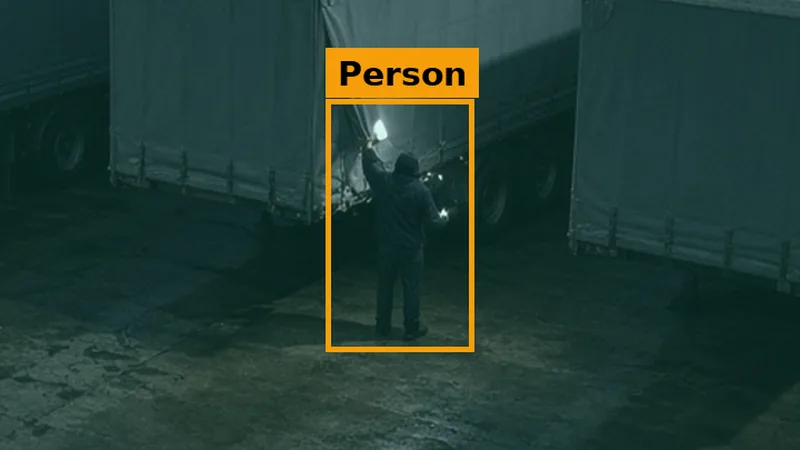
Last updated 1 November 2026. By ten at night most haulage yards have changed. The last trunk has gone, the day drivers have parked up and gone home, the office is locked and the gate is shut. What is left is a fenced square of concrete holding the most valuable things the business owns: loaded trailers waiting for an early delivery, tractor units with full tanks, a fuel bunker, a workshop full of batteries and tools, and sometimes drivers asleep in their cabs.
Those empty hours are when loaded trailers are hooked up and driven away, when diesel is drained from parked lorries, when curtains are slashed to see what is inside, and when a fire in one trailer can spread along a row with nobody there to see the first smoke. This guide covers the main security and fire risks to UK haulage yards, transport depots, trailer parks and small lorry parks: the figures and recent cases, official guidance, where cameras should watch, and how AI on a yard’s existing CCTV can help.
What are the main security risks at an HGV yard?
A small operator’s yard, a regional depot and a commercial lorry park look very different, but most face the same four kinds of risk, and all four are at their worst when the yard is closed or thinly staffed.
- Trailer and vehicle theft. Loaded trailers hooked up to a unit the thieves have brought with them and driven out of the gate, and tractor units or rigid lorries taken when the keys can be found.
- Fuel theft. Diesel siphoned or drained from the tanks of parked lorries after the caps are broken or the pipes cut, and fuel pumped out of the yard’s own bunker or bulk tank.
- Curtains and loads. Curtains slashed on parked trailers to see what is inside, and the load taken by hand.
- Fire. Fires in parked lorries and trailers, some accidental and some deliberate, which can spread between vehicles parked close together.
Behind all four is the same fact: an HGV yard is full of high-value, movable property, much of it designed to be driven away, parked in one place for hours with nobody watching. The National Vehicle Crime Intelligence Service (NaVCIS), the police unit that collates freight crime intelligence for the UK, describes the thefts as carried out by organised crime groups, and says it works with the industry, the Home Office and the police to tackle them.
What do the freight crime figures show?
There is no Home Office crime code for freight crime, so most thefts from lorries are recorded as ordinary theft from a vehicle. The best national picture comes from NaVCIS, which collects notifications from police forces, insurers, loss adjusters and the industry.
- 3,424 incidents in 2025. Fleet News, reporting the NaVCIS annual report, says there were 3,424 reported incidents of HGV cargo crime in 2025, about nine a day.
- 54% away from staffed sites. More than half (1,831) happened at what NaVCIS calls independent parking locations, such as industrial estates and laybys, and 699 (20%) at motorway service stations.
- 176 trailer hook-up thefts. In these, criminals clone tractor units, drive into empty or scarcely staffed yards and steal loaded trailers. NaVCIS said these were on the rise.
- 915 curtain slashings. Curtain slashing was the most common method, at 26.9% of cases.
- 1,892 notifications so far in 2026. The NaVCIS Freight Bulletin of 2 October 2026 records 1,892 HGV and cargo crime notifications in 2026 up to that date.
Two cautions. First, these are notifications, not a full count: NaVCIS relies on what police forces and businesses report to it, and it has warned against comparing one year with the next because of the way the figures are collected. Second, they are mostly about cargo, not fuel or fire. The NaVCIS field intelligence officer quoted by Fleet News put it simply: “Probably three quarters if not more is serious and organised crime; it’s not opportunist.”
The timing matters as much as the numbers. NaVCIS told Fleet News that curtain slashing typically happens on weekday nights and that trailer hook-ups are usually at weekends. Every case cited in this guide started in the evening or the small hours.
How are loaded trailers stolen from yards?
A hook-up theft is quick and quiet. The thieves arrive with a tractor unit, often one made to look like a legitimate unit, drive into a yard, reverse under a loaded trailer, couple up, connect the lines and drive out of the gate. To a passer-by it looks like an ordinary collection. Recent cases show the pattern:
- Runcorn, Cheshire. On the evening of Monday 31 August 2026, a lorry drove onto a site on an industrial estate, was connected to a loaded trailer and left. Cheshire Police said it arrived at about 7.45pm and was gone by 7.55pm. A second lorry arrived at the same site at 9.12pm and left with another loaded trailer at about 9.30pm.
- Penrith, Cumbria. On a Saturday night in October 2025, thieves entered a small haulage yard just west of Penrith next to the M6 at about 22:30 and got into one of the trucks at about 23:30. The yard’s own tractor unit was dragged off its loaded trailer with chains, with the locks broken and the brake chambers damaged, and the thieves’ unit left the yard with the trailer at 01:45. The trailer was later found empty on the A580 East Lancashire Road. A second unit had its cab panels ripped out and its dashcam stolen.
- Stanford-le-Hope, Felixstowe and Kirkby. The NaVCIS bulletin of October 2026 lists trailer hook-up thefts at Stanford-le-Hope in Essex on 10 September, at Felixstowe in Suffolk in the early hours of 17 September, and at Kirkby on Merseyside on 30 September 2026, where a preloaded trailer was taken.
Three things stand out. The thieves knew which trailers were loaded. They needed only minutes once they were in the yard: at Runcorn, about ten. And in the Penrith case they spent more than three hours on site, working on locks and a tractor unit, without anyone knowing until the morning. What was missing was somebody being told while it was happening.
A trailer hook-up is a vehicle doing something that vehicles do in a yard every day, so the question for any detection is not “is there a lorry?” but “should there be a lorry here now?” That is a question about time and place: the trailer rows at 23:12 on a Saturday, with no collection booked, are not the same as the trailer rows at 14:00 on a Tuesday.
How do you stop a trailer being hooked up and driven away?
The physical measures matter most, because only they stop a coupled trailer leaving the yard.
- Kingpin locks. Fit a kingpin lock to every dropped trailer, loaded or empty, every time it is uncoupled. A trailer that cannot be coupled cannot be towed away.
- Limit parked loads. Plan pre-loading so attractive loads spend the least time parked, away from the gate and the fence.
- Park doors to doors. Park box trailers back to back, or rear doors against a wall, and curtain-siders close together, so doors and curtains are harder to reach.
- Check every collection. Check every collecting unit against a booking. NaVCIS warns of bogus collections, where criminals intercept emails and change the details of the collecting vehicle.
- Lock the gate. Lock it, light it, and do not leave it open for a late trunk with nobody watching.
- Mark and track. Mark trailers with the operator’s details, record trailer numbers and serials, and consider trackers on trailers that carry high-value loads.
Our warehouse security guide covers the dock side of the same problem: loaded trailers waiting at a distribution centre, trailer marshalling areas and the gatehouse. This guide is about the haulier’s own yard, where there is usually no warehouse and often nobody on site at all.
How are tractor units and lorries stolen from yards?
Thieves do not always bring their own unit. Where they can find keys, the yard’s own lorries become the getaway vehicle and the prize. On Monday 21 September 2026, the NaVCIS bulletin recorded the theft of a curtain-sided lorry at Burslem in Stoke-on-Trent. At Penrith, the thieves spent an hour in the yard before they got into a truck, and when they could not drive it away they used chains to drag it off the loaded trailer they wanted.
Parked units are also stripped where they stand, for dashcams, sat-navs, tools and batteries. The Penrith case cost the operator two damaged units as well as a trailer and its load.
Keep every unit key in a locked key safe in a locked office, with a log, never in cabs or on the desk for an early start; use the immobiliser and trackers; take dashcams and sat-navs out of the cab; and park units where the office and the cameras can see them.
How is diesel stolen from parked lorries?
A tractor unit parked overnight can carry hundreds of litres of diesel, and a yard full of them is a reservoir. Thieves break off the fuel caps or cut the pipes on the fuel sender units, and drain the tanks into containers or a vehicle of their own. Recent cases show how it is done:
- Worcester. Over the weekend of 24 and 25 October 2026, a haulier in Worcester had about 400 litres of diesel stolen from two lorries in its yard. The thieves cut the pipes on the fuel sending units and broke fuel caps, and the lorries were off the road for a day being repaired. West Mercia Police said it was investigating a burglary at the business.
- North Cove, near Beccles, Suffolk. Between 6pm on 26 July and 5am on 27 July 2026, diesel was siphoned from several lorries after their fuel caps were broken off, Suffolk Police said.
- Grantham, Lincolnshire. Over the nights of 14 to 15 March and 21 to 22 March 2026, thieves took more than 25,000 litres of diesel from a haulage firm’s bulk storage tank, laying duct pipe across neighbouring land to pump it to a vehicle waiting in a lay-by on the A1.
The Association of Fleet Professionals said in May 2026 that, after oil price spikes, some fleets were reporting what appeared to be professional fuel thefts, with the tanks of commercial vehicles parked in secure depots drilled and drained overnight, while stressing that such cases were not widespread and were notable largely for their professionalism. The Grantham case shows the other risk: thieves who come back. Losses from a bulk tank over two nights can go unnoticed unless someone checks the level every morning.
How do you protect diesel in the yard?
Diesel in the yard is in two places: the tanks of the parked lorries and the yard’s own bunker or bulk tank. Both need protecting, and both are easier to watch than to guard.
- Locking caps and anti-siphon devices on every vehicle tank. They will not stop a determined thief who cuts the sender pipes, but they slow them down and stop the casual siphoner.
- Park tank sides inward. Park lorries with their tanks facing a wall, a fence or another lorry, so a thief has to work in a confined space in view of a camera.
- Fill up in the morning, where you can. As the Worcester haulier suggested, a lorry that is not filled until the morning it goes out has less in the tank overnight.
- Lock and isolate the bunker. Lock the bunker, the pump and the fill point; isolate the pump at night; and keep the bunker lit and in sight of a camera.
- Check levels every morning. Record the bunker level at close and at opening, and use a tank level monitor that raises an alert if the level drops overnight.
- Walk the boundary. At Grantham, the fuel went through pipes laid across neighbouring land. A walk round the fence after a weekend finds holes and pipes before the next night.
Our fuel theft prevention guide covers diesel theft from depots, plant and vehicles in more detail, including bunkers, tank monitors and the cases behind them.
What about curtain slashing and cargo on parked trailers?
Curtain slashing is the most common form of freight crime NaVCIS records: 915 cases in 2025, more than a quarter of the total. Thieves cut the curtain of a parked trailer to see what is inside, and take the load if it is worth taking. Much of it happens at motorway services and laybys, but a loaded trailer parked overnight in an unattended yard is just as exposed. On 1 October 2026, the NaVCIS bulletin recorded a report of multiple lorries with their curtains slashed at Cobham services on the M25. In an open yard, the same thing can happen along a whole row of trailers in an hour.
Park loaded curtain-siders close together in the middle of the yard, in sight of the office and the cameras, check curtains at the start of every shift, and ask customers with high-value loads what they require.
A camera does not stop a knife. A zone over the trailer rows, armed after the last movement, flags a person walking between trailers at night, while they are still looking, and the clip shows which trailers they were at.
What about drivers sleeping in the yard?
Many yards and small lorry parks have drivers on site overnight: an operator’s own drivers between shifts, visiting drivers waiting to tip in the morning, or paying customers at a truck stop. That changes the security picture in two ways. There are people in the yard at night who have every right to be there, and they are themselves at risk.
The Department for Transport’s National Survey of Lorry Parking 2022 found that 96%, 95% and 94% of drivers rated CCTV, security staff and security fencing respectively as very or quite important at an overnight parking site, and that 92% of drivers felt lorry crime had increased in the previous five years.
- Know who is on site. Keep a log of every driver staying overnight, with the unit and the bay.
- Leave the rest area out of the zones. Draw zones over the trailer rows and the bunker, not over the bays where drivers sleep and the path to the welfare block.
- Light the way. Light the routes from the bays to the toilets and showers, for drivers’ safety and so cameras can see.
How do fires start in haulage yards?
A yard full of parked lorries and trailers holds diesel, tyres, batteries, wiring, plastics and whatever is in the trailers, parked close together on purpose to save space. A fire that starts in one vehicle at night can spread along a row before anyone sees it. Recent fires show how quickly it happens:
- Thornbury, South Gloucestershire. From 01:34 on 5 September 2024, Avon Fire and Rescue received multiple 999 calls about a fire at an industrial unit and found a fire involving eight lorries. The cause was thought to be accidental ignition.
- Lostock Gralam, Northwich. On a Wednesday evening in May 2026, crews arrived at about 9.15pm to find five lorry trailers on fire in a yard, one containing plastic material. Eight crews attended.
- Widnes, Cheshire. At about 3am on Monday 4 May 2026, three lorries and two tanker trailers were on fire in an industrial yard. There was a significant smoke plume and people living nearby were told to keep doors and windows closed.
- Common Lane, near Lichfield. At about 9.45pm on Monday 9 February 2026, Staffordshire crews found a double-decker trailer well alight, not attached to a cab.
- Halesfield, Telford. In October 2026, firefighters were called during the night to a blaze involving a trailer unit on an industrial estate.
None of these reports gives a cause beyond Thornbury’s accidental ignition, and this guide does not guess. What they share is timing and spacing: all of them were in the evening or at night, and three of the four in the figure involved more than one vehicle parked close to another.

What do the fire figures say about vehicle fires?
The Home Office’s detailed analysis of fires in England for 2024-25 records 18,494 road vehicle fires attended by fire and rescue services, down 1.0% from 18,675 the year before. There were 30 fire-related deaths in road vehicle fires, 11% of all fire-related deaths. Road vehicle fires showed a small increase in the summer months.
Those figures cover every kind of road vehicle, so they do not say how many lorries burn in yards, but they show that vehicle fires are common.
- Electrical faults. Parked units with faults in their wiring, cab heaters, fridge units on temperature-controlled trailers, and battery chargers in the workshop.
- Deliberate fires. Fires set in or against parked trailers, in waste near the fence, or to cover a theft.
- Waste and pallets. Stacks of pallets, cardboard and general waste stored against trailers, the fence or the workshop wall.
- Spacing. Vehicles parked close together, which is how most yards make the space work, so a fire in one can reach the next.
How do you reduce the fire risk in a yard?
Your fire risk assessment, your insurer and your local fire and rescue service should guide the detail. The basics are the same for most yards:
- Keep waste away from vehicles. Store pallets, cardboard and waste skips well away from parked trailers, the fence and buildings, and lock the skips.
- Leave gaps. Where space allows, leave fire breaks between rows of trailers and between the trailer park and the workshop, the fuel bunker and the office.
- Isolate what you can. Switch off cab heaters, fridge units that are not needed overnight, and chargers left in the workshop, unless they are designed to run unattended.
- Mark what is in each trailer. Know which trailers hold hazardous or flammable loads, and park them where the fire service can reach them.
- Keep access clear. Make sure a fire engine can get through the gate and into the yard at night, and that someone with the keys can be reached.
- Watch for smoke. A yard with nobody on site overnight has nobody to see the first smoke. Smoke detection on the cameras the yard already has watches the trailer rows, the units, the bunker and the waste area all night.
Why does the shortage of lorry parking matter for yards?
Lorries that cannot find a secure space park wherever they can: on industrial estates, in laybys and outside yards. The Department for Transport’s National Survey of Lorry Parking 2022 found that, on the survey night, on-site lorry parking in England was 83% full, up from 76% in 2017, with the survey treating 85% or more as critical. It counted 4,473 more lorries parked within 5 km of the strategic road network than there were on-site spaces, and 100 sites that were full or over capacity.
The Road Haulage Association said in April 2026 that the country needs 11,000 more safe and secure lorry parking spaces, and that trucks parked in laybys, industrial estates and other remote locations remain “magnets to criminals”. The Department for Transport has commissioned WSP to carry out a new National Survey of Lorry Parking in 2026, visiting every lorry parking site in England; its findings had not been published at the time of writing.
For a haulier, the shortage cuts both ways. A secure yard of your own is the best place for your lorries and trailers overnight. And lorries parked on the estate road outside your fence, waiting for a space or a delivery slot, bring thieves to your gate.
Are there security standards for lorry parks?
There is no single legal standard for the security of a haulier’s yard. For lorry parks and truck stops, the main UK scheme is Safer Parking, the police standard run by Police Crime Prevention Initiatives, which covers freight parking. Parking operators that meet a police risk assessment can be awarded the Safer Parking mark, and NaVCIS and the industry have called for more secure lorry parking of this kind.
The government has also paid for security at lorry parks. A 2026 evaluation of the HGV parking and driver welfare grant, carried out by AECOM for the Department for Transport, covered 70 lorry parks run by 35 operators that received funding in the first two windows. Of 166 drivers surveyed, 83% agreed vehicle security had improved and 78% agreed their personal security had improved. National Highways’ current lorry parking facilities improvement grant, for operators on or within 5 km of the strategic road network in England, says security of drivers, vehicles and cargo is a high priority, and lists “lighting systems, CCTV, other monitoring equipment and secure fencing” among the measures it may cover.
For a private yard, the requirements that matter in practice come from your insurer, from customers who send high-value loads, and from the police crime prevention advice in your area. If you run a lorry park, or let spaces to other operators, the Safer Parking scheme and the grants are worth looking at.
Is CCTV enough on its own?
Drivers value CCTV: 96% in the 2022 survey rated it as important at an overnight parking site. But the AECOM evaluation recorded an important qualification. Drivers rated fencing, gates, lighting and CCTV highly, but “some driver in-depth interviewees thought that CCTV was only truly effective when monitored in real time by on-site security staff”. The same evaluation noted that industry stakeholders saw longer-term benefits from CCTV in supporting crime response and catching offenders.
That matches the cases in this guide: at Runcorn and Penrith, cameras and dashcams could help the police afterwards, but nobody was watching while the trailers were taken. Most yards cannot afford a guard every night, and even a guard cannot watch every row and fence at once. AI on the yard’s cameras watches every camera all night and tells a person when something needs a look, with the clip.
Why is an HGV yard hard to protect?
Most security advice is written for a building with doors and a fixed closing time. A haulage yard is mostly open ground full of vehicles, used at all hours, and often empty when it matters most.
Vehicles move at all hours, so a lorry in the yard at night is not, on its own, a reason for alarm. Rows of trailers make long corridors and deep shadows, and the view changes as trailers move. Many yards have nobody on site after the last trunk leaves, some have drivers asleep in their cabs, and long boundaries back onto fields, railway lines, laybys and other units that nobody watches at night.
That is why yard security starts with the places that matter most when the yard is closed, the trailer rows, the units and the fuel, the gate and the fence, rather than trying to watch every square metre of concrete.
Look at a plan of your own yard the same way. Where do the loaded trailers wait overnight, where are the units parked, where is the bunker, and which parts of the fence back onto land nobody watches? Those are the places to lock, light and watch.
Where should cameras watch in an HGV yard?
Start with the trailer park and the gate, then the units and the fuel, then the fence. Many yards already have cameras, often at the gate and the office, put in for insurance or after a theft. The gaps are usually the back rows of the trailer park, the bunker, and the stretch of fence furthest from the office.
- The trailer park. The trailer rows, the space between them and the rear doors, with a camera looking along each row rather than across it.
- The units and fuel. The unit bays, the tank sides of parked lorries, the fuel bunker and pump, and the workshop door.
- The gate. The entrance, where every lorry has to come in and go out, and the gatehouse.
- The perimeter. The back fence and any known gaps, especially where the yard backs onto fields, laybys or other units.
Each camera needs power, a connection and enough light or infrared at night. ProtectUK’s site security guidance says CCTV is central to most modern security systems, and that its primary purpose is to detect suspicious activity and act as a verification system for other security measures. Check what each camera sees at 02:00 in rain, and when the yard is full of trailers on a Friday night, because the view changes with the load plan.
How does AI on existing CCTV protect an HGV yard?
Recording-only CCTV shows what happened after the trailer has gone. AI detection tells someone while it is happening, while the unit is still coupling up. Woodcock AI connects to the IP cameras and recorders already on site, over RTSP or ONVIF, including Hikvision, and runs on an edge server on site or on a cloud server (an edge server needs only a power socket and a network connection).
- Polygon zones. Draw a zone of any shape over the trailer rows, the unit bays, the fuel bunker or the workshop door, and leave out the drivers’ rest area, the estate road and the neighbouring units.
- Direction-aware lines. Draw a line across the yard entrance or along the back fence and choose which direction counts, so a person or vehicle coming in after the gate is locked raises an alert while traffic on the road outside is ignored.
- People and vehicles. Detection counts people and vehicles, so most movement from foxes, birds, rain and flapping curtains is ignored.
- Smoke and flame. The same cameras watch for smoke and flame around the clock, along the trailer rows, by the units, the bunker, the workshop and the waste area.
- Schedules. Each zone and line has its own hours, so the trailer rows can be armed from the last booked movement until the morning shift, the bunker overnight, and smoke detection all the time.
- Alerts with the clip. Each alert arrives in the app and by email with a short clip and an AI description of what happened, so whoever receives it can decide quickly what to do.
The system is self-learning. It learns each camera, so headlights on the estate road, trailer curtains moving in the wind and the night shunter’s usual routes become part of the normal view, and marking an alert as correct or false feeds into retraining for your site. Woodcock AI has been in development for years and is now running on customer sites across the UK.
Woodcock AI does not read number plates or identify people. It flags that a person or vehicle is somewhere it should not be at a time nobody should be there, and watches for smoke and flame, and the clip shows what happened. In the daytime, PPE (hard hats & hi-vis) detection can also be set on chosen zones, such as the loading area or the workshop apron.
Coming next: Ask your cameras Coming soon, early 2027, which will let you ask the system questions about what your cameras have seen.
What does AI detection look like around a haulage yard?
The rules depend on the part of the yard. Choose an area to see an example of how a camera there is set up and what an alert looks like. A trailer park alert is shown at the top of this page, and a smoke alert in the fire section.
Which part of the yard are you protecting?
Loaded trailers are the reason most thieves come. A zone over the trailer rows, armed from the last booked movement until the morning shift, flags a person or a vehicle there when nobody should be: someone walking the rows looking at curtains, or a unit reversing under a trailer with no collection booked. A camera does not stop a unit coupling up; kingpin locks and a locked gate do that, and the alert tells someone while it is happening.
Loaded trailers, the trailer rows, rear doors and curtains, the drop yard
Parked units carry full tanks of diesel, dashcams and tools. A zone over the unit bays and the tank sides of the parked lorries, armed from the last unit parking up until the first driver arrives, flags a person crouched at a tank or walking between cabs at night. Add a zone over the fuel bunker and its pump, and the workshop door where the batteries and tools are kept. Our fuel theft prevention guide covers diesel in more depth.
Unit bays, the tank side of each lorry, the fuel bunker, the workshop door
A loaded trailer can only leave through the gate, but a person can come in over almost any fence. A direction-aware line across the yard entrance, set to count vehicles and people coming in and armed after the gate is locked, flags a unit arriving with no booking. A line along the back fence, armed overnight, flags someone on it, while traffic on the road outside is ignored. Our perimeter intrusion detection guide covers lines and fences in more detail.
The yard gate, the gatehouse, the back fence, the boundary with fields, laybys or other units
Each trailer row, bunker, gate and fence gets its own zones and lines, with its own schedule.
How does AI detection compare with other yard security measures?
No single measure protects a yard on its own. The table compares the usual options.
| Measure | What it does | Strengths | Watch out for |
|---|---|---|---|
| Fencing and a lockable gate | Keeps vehicles in and people out, with one way in and out for lorries | The only thing that physically stops a stolen trailer leaving | Gates left open for a late trunk; fences next to fields and laybys that nobody walks |
| Kingpin and fifth-wheel locks | Stops a trailer being coupled to a unit | Cheap, simple, and it defeats a hook-up gang on the spot | Only works if every dropped trailer gets one, every time, and the keys are controlled |
| Key control | Unit keys and lock keys kept in a locked cabinet or safe, with a log | Stops the yard’s own lorries being driven away | Keys left in cabs or on the office desk for an early start |
| Fuel protection | Locking caps, anti-siphon devices, a locked bunker, daily level checks | Slows thieves and shows quickly when fuel has gone | Caps can be broken and pipes cut; slow losses from a bulk tank can go unnoticed for days |
| Lighting | Lights the gate, the trailer rows, the bunker and the fence | Deters and helps cameras see | Long rows of trailers cast deep shadows; lights facing the road can dazzle drivers |
| Security staff or a gatehouse | A person checks who comes in and patrols the yard | Can challenge, check collections and act at once | One person cannot see every row and fence at once, and not every yard has the budget for nights |
| Recording-only CCTV | Records what happened | Evidence after the event | Nobody sees it until the trailer is missing in the morning |
| AI on existing CCTV | Recognises people, vehicles, smoke and flame, in zones and on lines you draw, on a schedule | Watches the trailer rows, the units, the bunker, the gate and the fence at once; the alert includes the clip | Cameras need a clear view, power, a connection and enough light or infrared at night; drivers and animals can still cause some alerts |
A guard or a gatehouse is the strongest single measure where a yard can afford one, and many busy yards have both a gatehouse and cameras. But one person cannot see every row and fence at once, and most smaller yards have nobody at all at night. AI detection on the cameras you already have watches all of them at once, and wakes a person only when something happens.
Will late drivers and headlights trigger false alerts?
This is the first question most transport managers ask, and the honest answer is that it depends on where the cameras look and when they are armed. A haulage yard at night is full of things that move: units arriving late, drivers walking to the welfare block, shunters, headlights sweeping across the yard from the road, curtains flapping, foxes and birds, and rain on the lens. We do not promise that a driver or an animal will never cause an alert.
What keeps alerts useful in a yard is the set-up:
- Point cameras along the trailer rows, not across the road. Watch the rows, the bunker and the gate, not the estate road.
- Count only people and vehicles, so most animals, weather and lights are ignored.
- Draw tight zones over the trailer rows, the bunker and the unit bays, leaving out the drivers’ rest area, the road and the neighbours.
- Use direction on lines, so only people and vehicles coming in through the gate or over the fence count.
- Set schedules round the yard’s week, so each zone is armed only when nobody is expected.
- Use the feedback button to mark false alerts, so the system learns your yard.
Our guide to reducing CCTV false alarms covers this in more detail.
How should detection schedules fit round the yard’s week?
Every yard has a rhythm that a schedule can follow. Day drivers leave early and come back in the afternoon, trunkers leave in the evening and come back in the small hours, pre-loaded trailers are dropped for an early delivery, and the yard may be closed from Friday afternoon until Monday morning. The cameras should be armed where and when nobody is expected, and quiet when drivers have every right to be there.
- Trailer rows: armed from the last booked movement until the morning shift starts.
- Fuel bunker: armed from the last fill until the first driver arrives.
- Gate: an inbound line armed after the gate is locked, off when a late trunk is due back.
- Back fence: a line armed from dusk until dawn.
- Smoke and flame: on around the clock, every day, all year.
Yards that run around the clock need finer rules than yards that close. Arm the trailer rows that should be quiet, rather than the whole park, and the bunker and fence even when the gate is busy. At weekends, arm everything for longer. Agree a simple rule for drivers who come back at odd hours, such as a message to the transport office first, so a late unit is expected and the alert is no surprise. Review the schedules when the clocks change, when the load plan changes, and in the run-up to Christmas.
Who responds when an alert fires at night?
An alert is only useful if someone acts on it, and in a yard with nobody on site that needs agreeing in advance. Before the cameras go live, decide who receives which alerts and at what hours, what they should do and who they call. For most yards that is the transport manager, one or two keyholders who live nearby, a monitoring centre, or a guard on site.
- Check the clip first. The clip and the AI description usually show whether it is a person at the trailers, a unit at the gate with no booking, smoke from a trailer, or a driver coming back late.
- Call 999 for a crime in progress or a fire. Give the address and postcode, the gate to use, the part of the yard and what you can see on the clip.
- Never go alone. Nobody should go to confront a gang in a dark yard at night. Wait for the police. Drivers on site should stay in their cabs and call.
- Review every alert. Mark it correct or false, and fix what it revealed: a gate left open, a light that has failed, a schedule that does not match the trunk times.
The National Police Chiefs’ Council requirements for security systems say police response to an intruder alarm with a unique reference number (URN) is withdrawn after three false calls in a rolling 12 months, another reason to keep false alerts down and to have alerts checked by a person before the police are called. Our out-of-hours site security checklist covers response planning for any site.
What should you do after a theft from the yard?
The first hours after a theft matter. Stolen trailers are emptied and dumped quickly, as the Penrith trailer found on the A580 showed, and loads are moved on fast.
- Report it to the police straight away. Call 999 if it is still happening; otherwise report it as soon as it is found, and keep the crime reference.
- Then tell NaVCIS. The NaVCIS freight page asks for freight crime to be reported to the police first, and then emailed to the NaVCIS Freight team with the details and a What3words reference for the location. NaVCIS shares the intelligence with the industry and the police.
- Keep the evidence. Save the camera clips before they are overwritten, photograph the damage and do not move anything until the police say so.
- Tell the right people. Your insurer, the customer whose load it was, your tracking provider and nearby operators.
- Make it safe. Repair the gate, fence and locks, and check the cameras before the next night.
- Fix the gap. Work out how they got in, how they knew which trailer to take, and why nobody knew until morning.
How do drivers, staff and procedures help?
Yard security depends on people and routines more than on equipment.
- A security lead. Give one person, often the transport manager, the job of yard security, with a simple close-down checklist and a list of who has keys and codes.
- The close-down check. Every night, check every dropped trailer has its kingpin lock, every unit key is in the safe, the bunker is locked and the pump isolated, and the gate is locked.
- Collections. Check every collecting driver and unit against the booking. Be wary of a changed driver, vehicle or time, especially when the change arrives by email.
- Information. Keep load details on a need-to-know basis; a NaVCIS officer told Fleet News there is “an element of insider stuff” in bogus collections.
- Neighbours and the police. Share contacts with the units next door, report every incident, and ask your local police for crime prevention advice.
How does data protection apply to yard CCTV?
Yard cameras see drivers, staff, visitors and contractors, and sometimes a road, a footpath or a neighbour’s yard. Drivers asleep in their cabs and staff at work have a right to privacy too. The Information Commissioner’s Office guidance on video surveillance sets out what is expected:
- Focus. Cameras should be focussed on a relevant space, and where wider surveillance is possible but unnecessary, it should be restricted.
- Signs. Place signs prominently before people enter the area a camera sees, including at the gate.
- Retention. There is no fixed period; the purpose should decide how long footage is kept, and the shortest period for that purpose is the right one.
- Impact assessment. A data protection impact assessment for processing that is likely to result in a high risk to individuals.
- Audio. Audio recording should be switched off by default.
- Staff and drivers. Tell staff and drivers what the cameras are for, and do not point them into welfare blocks, showers or toilets, or into cab windows where drivers sleep.
Polygon zones help: a zone over the trailer rows watches the trailers, not the bays where drivers rest, and the estate road or a neighbour’s yard can be left out entirely. Woodcock AI does not use facial recognition, identify who anyone is or read number plates. Our AI CCTV and GDPR guide has more.
How does a haulier get started?
Start with the basics: a fenced yard with one lockable, lit gate, kingpin locks on every dropped trailer, unit keys in a safe, locking fuel caps and a locked, isolated bunker with daily level checks, loaded trailers parked doors to doors in the middle of the yard, waste kept away from vehicles, checks on every collection, and a fire plan everyone knows. Then map the cameras you already have: what each covers, what it sees at night, and where trouble has happened before.
Our site assessment looks at the cameras already in your yard and the zones, lines and schedules that would cover the trailer rows, the units, the bunker, the gate and the fence, and tells you honestly where a camera cannot do the job. To see it working first, we can run a live test on your cameras: we connect two or three of them for about a fortnight. We can also arrange an on-site demo. If your cameras are looked after by an installer, our guide for installers explains how they can add AI detection to the system.
What are the limits of cameras in an HGV yard?
- A camera needs a view. Parked trailers and units block views, and the view changes every time the yard is reorganised.
- It needs light or infrared at night. Check what each camera actually sees in the dark, including the back rows and the far fence.
- It needs power and a connection. If either is cut, cameras and alerts stop.
- It detects; it does not stop anyone. Kingpin locks, the gate, key control and fuel locks still have to do that.
- It does not replace fire or intruder alarms. Smoke detection on cameras is an early warning, on top of the fire risk assessment, the detectors inside buildings and the alarms your insurer expects. It cannot see a fire starting inside a closed trailer or a room it does not view.
- It does not know which collections are genuine. That is a job for your booking checks.
- Drivers and animals can still cause some alerts. Good set-up keeps them down, but we do not promise none.
- Someone has to respond. An alert is only useful if a manager, a keyholder, a guard or a monitoring centre acts on it.
Sources
- Fleet News, Number of cargo thefts from HGVs revealed in new report (June 2026), reporting the NaVCIS annual report for 2025.
- National Vehicle Crime Intelligence Service, NaVCIS Freight, and NaVCIS Freight Crime Intelligence Bulletin 020 (2 October 2026).
- Cheshire Constabulary, appeal for information after trailer thefts in Runcorn (September 2026).
- Local Cumbria News, loaded trailer stolen and two trucks damaged at a yard near Penrith (October 2025).
- BBC News, diesel stolen from lorries at a Worcester haulier (October 2026).
- Beccles and Bungay Journal, diesel theft at Beccles Airfield, North Cove (July 2026).
- Grantham Journal (LincsOnline), diesel piped from a Grantham haulier’s tank to an A1 lay-by (April 2026).
- GB News, Association of Fleet Professionals on depot fuel theft (May 2026).
- Avon Fire and Rescue Service, Short Way, Thornbury (September 2024).
- Northwich Guardian, trailer fire at Lostock Gralam (May 2026); Runcorn and Widnes World, vehicle fire on Gorsey Lane, Widnes (May 2026); Staffordshire Fire and Rescue Service, large trailer fire (February 2026); and Telford Live, overnight trailer blaze at Halesfield (October 2026).
- GOV.UK, Detailed analysis of fires and response times to fires attended by fire and rescue services, England, April 2024 to March 2025.
- Department for Transport, National Survey of Lorry Parking: part one, 2022.
- Department for Transport and AECOM, HGV parking and driver welfare grant evaluation (2026).
- National Highways, Lorry parking facilities improvements scheme.
- Road Haulage Association, 11,000 spaces short: why lack of secure parking is a gift to thieves (April 2026).
- APPG for Freight and Logistics, welcomes the National Lorry Parking Survey (February 2026).
- Police Crime Prevention Initiatives, Safer Parking.
- ProtectUK, Site security.
- National Police Chiefs’ Council, Police Operational Advice and Security Industry Requirements for Response to Security Systems (March 2024).
- Information Commissioner’s Office, Guidance on video surveillance, including CCTV.
We have summarised these sources in our own words. Always read the current versions in full. This page is general guidance, not legal, fire safety, insurance or security advice; the police, NaVCIS, your fire and rescue service, your fire risk assessor, your insurer, your monitoring centre and your installer can advise on your own yard.
Want to know when someone is at your trailers tonight?
Book a site assessment and we will look at the cameras in your yard and plan zones, lines and schedules for the trailer park, the tractor units and fuel bunker, the gate and the back fence, or ask for a live test on your cameras.
Related pages
Frequently asked questions
How do you stop trailers being stolen from a yard?
Fit a kingpin lock to every dropped trailer every time it is uncoupled, keep the yard fenced with one locked and lit gate, park loaded trailers doors to doors in the middle of the yard, check every collecting driver and unit against a booking, and keep unit keys in a locked safe. A camera zone over the trailer rows, armed from the last booked movement until the morning shift, flags a person or a vehicle there at night.
How common is HGV cargo crime in the UK?
Fleet News, reporting the NaVCIS annual report, says there were 3,424 reported incidents of HGV cargo crime in 2025, about nine a day, including 176 trailer hook-up thefts and 915 curtain slashings. More than half happened at independent parking locations such as industrial estates and laybys. NaVCIS warns that these are notifications, not a full count, and that year-on-year comparisons are difficult.
How do you stop diesel being stolen from lorries in a yard?
Fit locking caps and anti-siphon devices, park lorries with their tanks facing a wall or another vehicle, fill up in the morning where possible, lock the bunker and isolate the pump at night, and check bunker levels at close and at opening. A camera zone over the unit bays and the bunker, armed overnight, flags someone crouched at a tank or at the pump.
Who should I report freight crime to?
Report it to the police first, by calling 999 if it is still happening, and keep the crime reference. NaVCIS then asks for freight crime to be emailed to its Freight team with the details and a What3words reference for the location, so the intelligence can be shared with the industry and the police.
Will late drivers and headlights set off AI camera alerts?
We do not promise that a driver or an animal will never cause an alert. Pointing cameras along the trailer rows rather than across the road, counting only people and vehicles, drawing tight zones that leave out the drivers’ rest area and the road, using direction on lines and arming each zone only when nobody is expected keeps them down.
Does Woodcock AI need new cameras in a haulage yard?
Usually not. It connects to existing IP cameras and recorders over RTSP or ONVIF, including Hikvision, and runs on an edge server on site or on a cloud server. A site assessment shows which cameras already cover the trailer rows, the units, the bunker, the gate and the fence, and where a camera cannot do the job.
Last reviewed 1 November 2026