

Petrol station security: forecourt crime, night break-ins and fire
Petrol station security means protecting the forecourt shop, the cash machine, the fuel, the car wash and the people on site from break-ins, ram raids, unpaid fuel and fire, most of all at night, when the site is shut or run by one cashier at a night window. The basics are a shop closed properly every night (tobacco locked away, tills emptied and left open, cash banked, shutters down), bollards in front of the cash machine, wash bays and plant rooms locked, bins and the gas cage away from the shop wall, pre-pay and careful pump authorisation for unpaid fuel, and a tested emergency plan for a fire on the forecourt. AI on existing CCTV adds alerts with a clip when a person or vehicle is at the shop doors, the cash machine wall, the wash bays or the rear yard after closing, and when smoke or flame appears, while the night window and the pumps stay out of the zones. It does not read number plates or recognise faces.

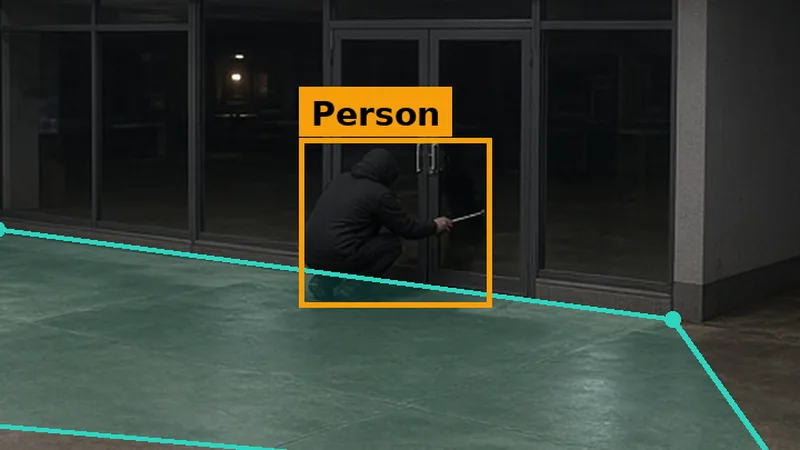
Last updated 1 November 2026. At ten o’clock at night, a petrol station changes shape. At a site that shuts overnight, the pumps are switched off, the shop lights go down, cones go across the entrance and the last member of staff locks up and drives home. At a 24-hour site, the shop door is locked and one cashier serves the rest of the night through a small window facing the pumps. Either way, from that point until the morning shift, the shop full of tobacco, the tills, the cash machine in the wall, the car wash, the jet wash bays, the bins and the gas cage at the back are watched by nobody at all, or by one person who cannot see them.
That is what makes petrol stations different from most shops. They sit on main roads, open to anyone who drives in, with a shop stocked with exactly what burglars want and a forecourt built for vehicles to come and go. By day, the main worry is unpaid fuel. By night, it is break-ins, ram raids on the cash machine and fire. This guide covers the main security and fire risks at UK petrol stations and forecourt shops: the figures and recent cases, what owners and managers can do, the rules that apply, where cameras should watch, and how AI on a forecourt’s existing CCTV can help, and where it cannot.
What are the main security risks at a petrol station?
From a single-pump village garage to a motorway service area forecourt, most petrol stations face the same four kinds of risk. Three of them are at their worst at night.
- The shop. Overnight break-ins for cigarettes, tobacco, tills and high-value stock. Every forecourt break-in reported in the cases in this guide was after tobacco or cash, and every one happened between midnight and dawn.
- The cash machine. Ram raids in which stolen plant or cars are driven at the shop, or a chain is used to pull a machine out of the wall. They are fast, violent and very destructive to the building.
- Unpaid fuel. Drivers who fill up and leave without paying, and drivers who say they cannot pay. This is the daily crime of the forecourt, and it is rising.
- Fire. Vehicles catching fire at the pumps, electrical equipment in the shop or plant, deliberate fires and bins by the building, all on a site that stores fuel in underground tanks.
Around those four sit the other targets on a typical site: the car wash and jet wash bays with their pay units and plant rooms, the bottled gas cage, the air and water machine, the rear yard and bins, and the tank fill points. This guide is about fuel retail sites with a forecourt and, usually, a shop. Fuel stolen from vehicles and tanks on other sites is covered in our fuel theft prevention guide, shops without a forecourt in our shop security guide, and garages that repair and service vehicles in our vehicle repair garage security guide.
What do the figures show about UK petrol stations?
There is no single official count of crime at petrol stations, because the police record forecourt shop break-ins as burglary and cash machine raids as burglary or theft, alongside every other business. But the industry’s own figures show how many forecourts there are, how many have shops, and how the main forecourt crime, unpaid fuel, is moving.
- There are over eight thousand forecourts. The Petrol Retailers Association’s facts and figures, using myAutomate data, count 8,338 open forecourt sites in the UK as at 31 May 2026. The Association of Convenience Stores’ Forecourt Report 2026 puts the number of fuel forecourt sites at 8,314, of which 7,372 have shops.
- They employ tens of thousands of people. The ACS report says UK forecourts provide around 90,000 jobs.
- Unpaid fuel is rising. The British Oil Security Syndicate’s Forecourt Crime Index, which tracks drive-offs and no-means-of-payment reports against a 2015 baseline of 100, reached 226 in the second quarter of 2026, up 3% on 219 in the first quarter and continuing a rise recorded since the third quarter of 2025.
- Most forecourts are dealer sites. Of the 8,338 open sites the PRA counts, 6,084 are dealer sites, 1,147 are supermarket sites and 1,107 are company sites. Dealer sites are independently run, under a fuel brand or none, and include everything from one village garage to groups with dozens of forecourts.
Where are the UK’s petrol stations?
The Office for National Statistics publishes another view, in its UK business: activity, size and location 2026. It counts businesses classified to the retail sale of automotive fuel: 3,795 sites (local units) belonging to 2,115 businesses (enterprises) in March 2026, 2,915 of them in England. That is fewer than the PRA and ACS totals because many forecourts, including most supermarket sites, are classified under their parent business rather than as fuel retailers. But it is the best official picture of where the specialist fuel retailers are, and how big they are.
- Every region has hundreds. The South East has the most fuel retail sites, 505, followed by the North West with 400 and the West Midlands with 360; the North East has the fewest, 170.
- Rural and roadside sites matter. London has fewer fuel retail sites than Wales or Northern Ireland. Many forecourts sit on main roads and in small towns and villages, where the nearest police response may be some distance away at 3am.
- Many are small. Of those 3,795 sites, 765 employ fewer than five people and 1,170 employ five to nine. That is 1,935 sites, about half, with fewer than ten people employed across every shift, seven days a week.
- Very few are large. 1,350 sites employ ten to nineteen people, 445 employ twenty to forty-nine, and only 65 employ fifty or more.
A forecourt that opens long hours with fewer than ten staff is a forecourt where the night shift, if there is one, is a single person, and where nobody is spare to walk round the back of the shop after dark.
Who is looking after a petrol station at night?
Petrol stations run on one of two night patterns, and each leaves the site exposed in a different way.
- Sites that shut overnight. Many forecourts, especially small dealer sites, close in the evening and open early in the morning. Overnight, the site is empty. The shop has an intruder alarm, perhaps shutters, and cameras that record to a box in the back office. If anyone reaches the shop doors, the first anyone knows is the alarm, once they are inside.
- Sites open 24 hours. Main road, motorway and some supermarket forecourts stay open all night, but after late evening the shop door is often locked and one cashier serves through a night window or kiosk. The cashier sees the pumps and the customer in front of them. They do not see the back of the shop, the car wash, the yard or the side wall with the cash machine.
- Keyholders on call. When an alarm goes off at a closed site, the alarm company or the police will call a keyholder, who may be the owner or a manager living some distance away.
How do you protect a cashier working alone at night?
At a 24-hour site, the night cashier is the most important thing on the forecourt. The rule that keeps them safe is simple: they serve customers through the window, and they never go out to deal with trouble.
- Lock the shop and serve through the window. Agree the time the shop door is locked, and stick to it. Nobody is let into the shop at night who is not expected, however reasonable the story.
- A way to call for help. A panic alarm, a working phone, and a keyholder or manager who knows they may be called. Check the panic alarm works, regularly.
- Never go outside to tackle anyone. If something is happening at the car wash or the back of the shop, the cashier stays inside, behind the locked door, and calls 999 if a crime is in progress.
- Know what is happening outside. This is where cameras help most. An alert on the cashier’s phone or screen that someone is at the back door or in the wash bays tells them to stay put and call for help, rather than finding out when the noise starts.
Treat a night cashier on a main road as a lone worker, and assess the risks to them as you would for anyone working on their own. The point of watching the rest of the site is to keep the cashier informed and inside, never to send them out to look.
When do petrol station incidents happen?
The reported times of the forecourt break-ins, raids and fires cited in this guide tell a clear story.
- Break-ins and raids are between midnight and dawn. A cash machine raid at a motorway services forecourt shop at Wetherby, on the A1(M), at about 02:00, a break-in at Holtspur shortly before 03:40, a cash machine raid at Burwell at 04:57, and a break-in at Carlisle that police say happened between midnight and 06:00, with the call at 06:27. At Chester and Thornaby the shops were broken into overnight and in the early hours.
- Fires come at any hour. An electrical fire at Ambergate was called in at 05:20, a camper van fire at Penrhyndeudraeth at about 12:49 and a van fire at Leicester at 13:19.
That pattern is why most of this guide is about the night. The hours when burglars and raiders come are the hours when the site is shut, or one person is behind a window, and they are hours when smoke and fire may also go unseen.
What does a petrol station look like to a burglar?
Every petrol station is different, but most share a layout: a canopy over pump islands near the road, a shop behind them, a car wash and jet wash bays to one side, a cash machine in the shop wall, and a yard behind the shop with the bins and the bottled gas. The tank fill points and vent pipes are somewhere on the forecourt, away from the pumps.
- The front faces the road. The canopy is lit and the pumps are in view of passing traffic and, at a 24-hour site, of the cashier. That is the most visible part of the site.
- The back faces nobody. The rear of the shop, the yard, the bins, the gas cage and often the side wall with the cash machine face a hedge, a fence, a field or a back lane. That is where break-ins start.
- The wash bays are at the edge. They are usually at the far side of the site, near the boundary, out of sight of the till.
- The site is built for vehicles. Wide entrances and exits on to a main road make it easy to drive in, reverse up to the shop and leave quickly, which is exactly what ram raiders need.
How do burglars break into forecourt shops?
Forecourt shop break-ins follow a familiar pattern: overnight, at a site that is shut, quick, and aimed at tobacco and cash. The cases reported in 2026 show how varied the way in can be, and how consistent the target is.
- Carlisle, April 2026. Cumbria Police were called at 06:27 on 9 April to a break-in at a petrol station on Kingstown Road. A significant number of cigarettes and tobacco had been taken, and police appealed for anyone who had been in the area between midnight and 06:00.
- Holtspur, Buckinghamshire, April 2026. Shortly before 03:40 on Monday 6 April, a door was smashed in at a petrol station on the A40 Oxford Road, and tills containing cash were taken along with cigarettes, the Bucks Free Press reported. One of the tills was later found discarded.
- Chester, February 2026. A petrol station on Caldy Valley Road was burgled overnight and found on 18 February. The wall had been smashed through, with metal wall plates, bricks and breezeblocks removed, and cigarettes taken from the display. A man was later jailed, Dee 106.3 reported.
- Thornaby, Teesside, September 2026. A garage at a retail park in Thornaby was burgled in the early hours of Wednesday 30 September and a quantity of cigarettes was reported stolen, the Teesside Gazette reported.
Four sites, four different parts of the country, and the same result: someone reached the shop at night, got in through a door or a wall, and took tobacco or tills. At Chester, the burglar did not bother with the doors at all and went through the wall, which is a reminder that the back and sides of a forecourt shop are often weaker, and less watched, than the front.
- Tobacco. Cigarettes and tobacco are small, valuable and easy to sell on, and every forecourt shop keeps a gantry of them behind the counter. They were taken in all four of the cases above.
- Tills. A till may hold a float overnight. At Holtspur, the tills themselves were carried out and one was dumped later.
- The cash machine. A different kind of attack, covered in the next section.
- High-value stock. Alcohol, vapes, phone top-up cards and other small, valuable lines are also at risk wherever they are displayed.
Most of what a burglar wants is behind the counter, a few metres inside the door. That is why break-ins are fast, and why an alarm that sounds once they are inside often goes off only a minute or two before they leave. The time that matters is the time they spend outside, at the door, the shutter or the wall, before they are in.
How should a forecourt shop be closed for the night?
The best protection for a forecourt shop costs very little: closing it properly, every night, so that anyone looking in can see there is little worth taking.
- Lock away or cover the tobacco. Use a lockable gantry or shutter, and lock it at close. Do not leave cartons of cigarettes in the stock room by the back door.
- Empty the tills and leave them open. An open, empty drawer visible from outside tells a burglar the tills are not worth the trouble.
- Bank the cash or put it in a time-delay safe. Keep as little cash on site overnight as possible, and say so on the doors.
- Shutters down, doors locked, and checked. A shutter only works if it is down. Check the back door and the stock room door as well as the front.
- Leave some light on. A lit shop interior, with a clear view in through the front, helps passing police and the cameras. A dark shop is easier to work in unseen.
- Set the alarm and test it. Keep the intruder alarm maintained, with the keyholder list up to date.
Write it down as a closing checklist, done the same way whoever locks up; our commercial burglary prevention guide covers locks, lighting and alarms in more detail. None of this stops a determined burglar on its own. But it removes the easy wins, and it makes the time they spend outside the shop longer, which is the time a camera alert can use.
How are cash machines at petrol stations attacked?
Cash machines set into the wall of a forecourt shop are a target for a different kind of criminal: organised, equipped and willing to cause serious damage. The raids use vehicles, and they happen in the dead hours.
- Burwell, Cambridgeshire, June 2026. At 04:57 on Wednesday 17 June, a stolen telehandler and two other vehicles were used to rip a cash machine from the wall of a petrol station shop on Ness Road, BBC News reported. The building was badly damaged. It was the second ram raid in the county in two days, the Cambridge Independent reported.
- Wetherby, A1(M), July 2026. At about 02:00 on Wednesday 29 July, a car was driven through the doors of a shop at the motorway services, BBC News reported. Two men attached a chain to a cash machine, which was pulled free by the car and loaded into it. Four men in face coverings and gloves were involved, and the car was later found set on fire in Leeds with the machine inside, Yorkshire Live reported. Police asked for anyone who had seen anything between 01:00 and 05:00.
Both raids used vehicles, both caused serious damage to the building, and both were over quickly. Ram raids like these are rarely stopped by a shop’s locks: the vehicle is the tool. What helps is physical protection that stops a vehicle reaching the wall, and early warning that a vehicle is at the wall when it should not be.
- Bollards and anti-ram measures. Rated bollards, planters or barriers in front of the wall with the machine, and in front of the shop doors, stop a vehicle getting close enough to do damage. They need planning round fuel deliveries, the shop deliveries and the forecourt layout.
- Placement. A cash machine next to glass doors, or in a thin wall, is easier to rip out. If you are planning a refit, think about where the machine goes.
- The machine operator. If the machine is run by a separate operator, ask them about anchoring, cash levels overnight and the protection they fit or recommend.
- Watch the wall, not just the machine. A vehicle stopping in front of the cash machine wall at 3am is the earliest sign of a raid. A zone over the paving in front of the wall, armed overnight, raises an alert with the clip when it happens.
- Keep the site tidy. Stolen plant has been used in raids. Do not leave anything on or near the site that could be used against the building.
Be realistic about what an alert can do against a raid that is over in minutes. It will not stop the vehicle. It can get the police called while the raiders are still there, give officers a clip of the vehicles and the direction they left in, and stop a raid being discovered only when the morning shift arrives.
What about drive-offs and unpaid fuel?
Unpaid fuel is the most common forecourt crime, and it happens in daylight as much as at night. The British Oil Security Syndicate (BOSS), which runs the BOSS Payment Watch reporting scheme, publishes a Forecourt Crime Index based on drive-off and no-means-of-payment reports, with the second quarter of 2015 as the baseline of 100.
- The index is more than double its 2015 level. It reached 219 in the first quarter of 2026, up 4% on the last quarter of 2025, and 226 in the second quarter, a further 3% rise, continuing an upward trend recorded since the third quarter of 2025.
- Failure to pay is rising. In the second quarter of 2026, failure-to-pay incidents rose by 3.5%, while no-means-of-payment reports were unchanged.
- Most reports are “no means of payment”. BOSS says no-means-of-payment incidents, where a driver fills up and then says they cannot pay, account for around two-thirds of all reports.
- Most drive-offs start in the shop. BOSS says 65% of drive-off failure-to-pay incidents involve motorists going into the forecourt shop and leaving without paying for their fuel.
- Self-service tills are a weak point. BOSS has also reported cases at self-service checkouts where drivers deliberately avoid adding their fuel when prompted.
It is worth being honest here. AI detection on cameras is not a drive-off tool. While the site is open, customers are meant to be on the forecourt, and Woodcock AI does not read number plates or identify anyone, so it cannot tell a paying customer from one who will not pay. Unpaid fuel is reduced by till and forecourt procedure, and by reporting.
- Pre-pay. Switch pumps to pre-pay at night, or for vehicles and drivers staff are unsure of.
- Pump authorisation. Staff look at the vehicle and the driver before authorising a pump, rather than authorising automatically.
- Ask about fuel at the till. Train staff to ask every customer whether they have fuel to pay for, every time, including at self-service tills.
- Report every case. Use your reporting scheme and give the police what they need. Ordinary recorded CCTV at the pumps and the till, kept for long enough, is the evidence most reports depend on.
Woodcock AI’s part in this is limited to the hours when a forecourt is closed: a vehicle coming onto a shut forecourt at night is worth knowing about, whatever it is there for. During opening hours, the cameras at the pumps should keep recording, as they do now.
How do you protect the car wash and jet wash bays?
The car wash and jet wash bays are often the most isolated part of a petrol station. They sit at the edge of the site, frequently against a fence or a back lane, with their own plant room full of equipment and chemicals, and pay units that may hold cash or tokens.
- Lock the plant room. Use a solid door and a good lock, and keep anything valuable, including spare parts and chemicals, out of sight.
- Empty the pay units. Collect cash regularly, and do not leave coin boxes full overnight. A visible notice that the unit is emptied every night helps.
- Close off the bays at night. Where a site shuts, close the bays with a barrier or chain, or at least keep them lit and in camera view.
- Turn the water off where possible. An unattended bay with the water on invites misuse after hours.
Because the wash bays are out of sight of the till, they are where a camera alert adds most at a 24-hour site. A person in the bays at 1am, or at the plant room door, is something the night cashier needs to know about, from behind the locked door.
What about the rear yard, bins and gas cage?
Behind almost every forecourt shop is a yard: bins, recycling, cages of bottled gas for sale, the back door, delivery cages and, on many sites, the tank fill points and vent pipes somewhere nearby. It is the part of the site nobody visits after dark.
- Bins away from the shop wall. Keep bins and recycling in a compound or a locked enclosure, away from the walls and from anything flammable, so a bin set alight cannot spread to the building.
- Lock the gas cage. Keep the bottled gas cage locked, lit and in camera view, and follow your supplier’s guidance on where it goes.
- Lock the fill points. Tank fill point caps should be locked, and the area kept clear for deliveries and for emergency access.
- Nothing to climb on. Do not leave pallets, ladders or wheelie bins where they help someone onto a flat roof or over a fence.
- Watch the back door. The back door and the stock room are the obvious way into the shop from the yard. Check them at close.
How do fires start at petrol stations?
Petrol stations are designed and regulated around fire. The fuel is stored underground, the pumps have emergency stops, and staff are trained in what to do. But fires still happen on forecourts, and recent cases show where they start.
- Penrhyndeudraeth, Gwynedd, May 2026. A camper van was alight just yards from the forecourt pumps on the A487. North Wales Fire and Rescue Service was called at about 12:49 on 21 May and sent two crews, and the road was closed both ways, the Daily Post reported.
- Leicester, June 2026. At 13:19 on Saturday 20 June, emergency services were called to a van on fire at a petrol station on Uppingham Road. A man in his 60s suffered serious burns, and a 62-year-old man was arrested on suspicion of arson with intent to endanger life, the Leicester Mercury reported.
- Ambergate, Derbyshire, August 2026. A 999 call came in at 05:20 on Wednesday 12 August to a petrol station on the A6 Derby Road. Staff had found the alarm sounding and electrical equipment on fire. Crews used four breathing apparatus wearers, and nobody was hurt, thanks to working alarm systems, the Derbyshire Times reported.
- Southampton, September 2026. A van fire at a petrol station on Winchester Road destroyed the van and spread to the canopy. Nobody was injured, Greatest Hits Radio reported.

- Vehicles. Three of the four cases above began with a vehicle on the forecourt. A vehicle fire at the pumps puts fuel, the canopy and customers at risk within minutes.
- Electrics. The shop, the plant rooms, the car wash and the pumps all depend on electrical equipment, which can fail at any hour, including when the site is shut.
- Deliberate fires. Arson against vehicles, bins or the building is a risk at any business; read our arson prevention guide.
- Rubbish. Bins and waste against the shop wall can carry a small fire into the building.
At Ambergate, the fire was found because the alarm was working and staff were there. At a site that shuts overnight, a fire in the plant room or the yard may burn for some time before anyone passing notices. Smoke and flame detection on cameras that see the yard, the plant and the forecourt, running around the clock, adds an outside view to the alarm inside.
- Stop the pumps. Use the emergency stop to cut the pumps, as set out in your site’s emergency plan.
- Call 999. Call the fire service at once, and tell them it is a petrol station.
- Move everyone away. Customers, staff and other vehicles, well away from the fire and the pumps, and keep them away.
- Brief the crew. Tell the fire service what is burning, where the tanks, fill points and gas cage are, and whether anyone is missing.
Every site should have its own emergency plan covering this, and staff should know it. The responsible person for the premises must also keep a fire risk assessment up to date, as GOV.UK’s workplace fire safety guidance explains.
What rules apply to petrol station security?
Petrol stations are among the most regulated small businesses in the UK. None of the rules requires AI detection, but several affect what you can install and where.
- Petrol storage. Under the Petroleum (Consolidation) Regulations 2014, the old petrol licensing regime was replaced from 1 October 2014 with certification. A site that stores petrol needs a Petroleum Storage Certificate from its local Petroleum Enforcement Authority (PEA), as HSE explains. A “prescribed material change” to the site needs a new certificate; replacing a tank or pipework is not one.
- DSEAR. The Dangerous Substances and Explosive Atmospheres Regulations 2002 apply to petrol stations. In practice, that means any new camera, cable, bracket or electrical equipment near the pumps, the tanks, the fill points or the vent pipes must suit the site’s hazardous area classification. Your installer and your PEA’s requirements decide what can go where.
- Fire safety. The responsible person must carry out and keep up to date a fire risk assessment for the premises.
- Data protection. CCTV that captures customers, staff and the public is covered by UK GDPR; see the privacy section below.
The practical point is that most new security cameras at a forecourt go on the shop building, the canopy edge, the car wash and the yard, away from the pumps and vents. Using the cameras already on site, and adding AI to them, avoids new cabling on the forecourt altogether.
Why are petrol stations hard to protect with ordinary CCTV?
Almost every petrol station already has cameras, usually plenty of them. Most were fitted to cover the pumps, the till and the shop, so that drive-offs and shop theft are recorded, and they record day and night to a recorder in the back office, with a monitor behind the counter. The trouble is not the cameras; it is that nobody is watching the ones that matter at night, and the ones that do get watched are pointed at the pumps.
- Vehicles and people all the time. At a 24-hour site, cars pull in at every hour, headlights sweep across every camera and customers walk to the window. Motion detection that alerts on every movement on a forecourt is useless, and is usually switched off.
- One monitor, one person, or nobody. At a closed site, nobody sees the monitor until the morning. At a 24-hour site, the cashier can glance at it between customers, but cannot watch the wash bays and the yard while serving at the window.
- The cameras face the wrong way at night. Most views are of the pumps and the till, which matter by day. The back of the shop, the cash machine wall and the wash bays may have one camera each, if any.
What most petrol stations need is for the cameras they already have to tell someone when something matters at night, and to stay quiet when a customer fills up.
Where should cameras watch at a petrol station?
Each camera at a forecourt should have a clear job. For security at night, most sites need cameras watching four places, and many already cover at least two of them.
- The shop front. The doors, the windows and the night window, close enough to see someone at the glass, lit at night.
- The cash machine wall. The wall and the ground in front of it, for vehicles and people stopping there at night.
- The wash bays. The car wash, the jet wash bays, the pay units and the plant room door.
- The rear yard. The back door, the bins, the gas cage and the boundary behind the shop, for people at night and for smoke at any hour.
- The pumps and the till. For the record, and for unpaid fuel reports; these are busy whenever the site is open and are not where theft alerts belong at a 24-hour site.
How can AI on existing CCTV help a petrol station?
Recording-only CCTV shows what happened after the event. AI detection tells someone while it is happening, in time to act. Woodcock AI connects to the IP cameras and recorders already on site, over RTSP or ONVIF, including Hikvision, and runs on an edge server on site or on a cloud server (an edge server needs only a power socket and a network connection).
- Polygon zones. Draw an area of any shape on a camera’s view, around the shop doors, the paving in front of the cash machine wall, the wash bays or the yard, and detect only inside it. A zone can follow the shop front exactly, and leave out the night window where customers queue.
- Lines. Draw a line along the back fence or the edge of the yard, and alert when a person or vehicle crosses it, in the direction you choose.
- People and vehicles. Detect people and detect vehicles moving in a zone, ignoring foxes, cats, gulls, rain and passing headlights.
- Smoke and flame. Smoke and flame detection on the cameras that see the forecourt, the yard, the plant room and the wash bays, around the clock.
- Schedules. Arm each rule for the hours that make sense: the shop front and the cash machine wall from closing until the morning shift, smoke always.
- Alerts with the clip. Alerts arrive in the app and by email with a short clip and an AI description, so the keyholder or the night cashier can see in seconds whether it is a late customer or someone at the shop doors.
The system is self-learning. It learns each camera, what is normal on that view and what is not, and marking an alert as correct or false feeds into retraining for your site. Woodcock AI has been in development for years and is now running on customer sites across the UK.
Woodcock AI does not read number plates or identify people. It tells you that a person is at the shop doors at 02:41, or that a vehicle has stopped by the cash machine wall at 03:58, with the clip; what happens next is up to you.
Coming next: Ask your cameras Coming soon, early 2027, which will let you ask the system questions about what your cameras have seen.
What does detection look like in each part of a petrol station?
Each part of a forecourt needs a different rule. The cash machine wall needs to know about vehicles as well as people; the wash bays need a zone that ends at the boundary; the forecourt entrance needs a rule only at sites that shut. Choose an area to see an example.
Which part of the site are you protecting?
Cash machine raids use vehicles: a stolen telehandler at Burwell, a car and a chain at Wetherby. A zone over the ground in front of the machine wall, armed from closing until the first shift, flags a vehicle or a person stopping there at night, which is when both of those raids happened. Keep the zone to the strip in front of the wall, not the parking bays customers use by day.
The wall, the paving in front of it and any bollards
Wash bays sit at the far side of the forecourt, often out of sight of the till and next to a fence or a back lane. A zone over the bays and the plant room, armed from when the wash closes, flags a person or a vehicle there when nobody should be washing a car. At sites that run the jet wash late, start the schedule when it shuts.
The bays, the pay units, the plant room door and the edge of the site
At a site that shuts overnight, nobody should drive onto the forecourt between closing and opening. A zone over the entrance and the pump islands, armed from closing, flags a vehicle coming in while it is still on the move. At a 24-hour site, leave this zone out: night customers are meant to be there, and the rear, wash bay and cash machine zones do the work.
The entrance and exit, the pump islands and the route to the shop
The cash machine wall, the wash bays and the forecourt entrance each get their own zones, with their own schedule.
These are examples, not a fixed set. The right rules for any petrol station depend on its layout, its cameras and its hours, and a site assessment starts from what each existing camera can see.
How does AI detection compare with other measures?
No single measure protects a petrol station. The table sets out what each one does well and what it cannot do. Most forecourts need several, and AI on existing cameras is one layer among them.
| Measure | What it does | Strengths | Watch out for |
|---|---|---|---|
| Night window or kiosk | Lets one cashier serve through a hatch with the shop locked | Keeps the cashier and the stock behind a locked door | The cashier sees the pumps, not the back of the shop, the wash bays or the yard |
| Shutters, grilles and locks | Closes the shop front, the back door and the plant rooms | Slows a break-in down and makes it noisy | Raids have gone through doors and even walls; shutters must actually be down |
| Bollards and anti-ram measures | Stop a vehicle reaching the shop front or the cash machine wall | Physical protection against ram raids | Need planning round deliveries, tankers and the forecourt layout |
| Lighting | Lights the canopy, the shop front, the wash bays and the yard | Deters, helps cameras see, helps a night cashier | Canopy lights may be dimmed or off when the site shuts; dark corners behind the shop |
| Intruder alarm | Detects someone inside the shop when it is closed | Covers the shop and the stock room at closed sites | Goes off once someone is inside; police response can be withdrawn after repeated false calls |
| Recording-only CCTV | Records what happened, at the pumps and in the shop | Evidence after the event, and the footage most drive-off reports rely on | Nobody sees the yard or the wash bays at night until the morning |
| AI on existing CCTV | Recognises people, vehicles, smoke and flame, in zones you draw, on a schedule | Watches the shop front, cash machine wall, wash bays and yard at once; the alert includes the clip | Cameras need a clear view, power, a connection and enough light or infrared at night; it is not a drive-off tool and it does not read number plates |
How do you keep false alerts down at a petrol station?
We do not promise no false alerts. A forecourt is built for vehicles, and cameras see the real world, which at a petrol station includes night customers, staff opening up, tanker deliveries and gulls at the bins. But most false alerts come from a handful of causes, and most of them can be designed out.
- Zones away from customer routes. Draw zones over the places nobody should be at night, the shop doors at a closed site, the cash machine wall, the wash bays and the yard, not over the pump islands or the queue at the night window at a 24-hour site.
- People and vehicles only. Alert on people and vehicles, not on any movement, so animals, rain and headlights are ignored.
- Schedules that match the site. Arm rules after the last staff leave, and turn them off before the opening shift, the first delivery and any booked fuel delivery.
- Headlights and reflections. Wet forecourts and canopy lights cause glare; check each view at night, and adjust a zone that catches sweeping headlights from the road.
- Feedback. Mark each alert as correct or false; the system learns from it.
Our guide to reducing CCTV false alarms covers this in more depth.
What detection schedule suits a petrol station?
A petrol station’s schedule follows its opening hours. Smoke detection runs all the time, because fires start at every hour. Theft rules come on when the site shuts, or when the shop door is locked at a 24-hour site, and go off before the morning shift arrives.
- Car wash and jet wash: 21:00 to 07:00. After the wash closes, until it opens again.
- Rear yard and gas cage: 22:00 to 06:00. After the last bins go out, until the morning delivery.
- Shop front and doors: 22:30 to 05:30. From locking up until the opening shift.
- Cash machine wall: 22:30 to 05:30. The hours when both of the raids in this guide took place.
- Forecourt entrance: closing to opening, at closed sites only. Nobody should drive onto a shut forecourt.
- Smoke and flame: all day and night. Vehicles, electrics and bins can catch fire at any hour.
Adjust the times to the site’s real hours, including late jet wash use, early tanker deliveries and the shop’s delivery days. At a 24-hour site, keep the rear yard, wash bay and cash machine rules, and drop the forecourt entrance rule; the shop front rule then covers the doors, not the night window.
What should happen when an alert comes in?
An alert is only as good as the response to it. Before the cameras go live, agree who gets alerts at what hours, what they should do, and who they call. At a closed site, that is usually the keyholder or owner; at a 24-hour site, the night cashier and a manager.
- Check the clip. Is it a customer, a member of staff, a delivery, someone who should not be there, or smoke?
- Call 999 if a crime is in progress, or there is a fire. Tell the police or fire service what the clip shows, how many people and vehicles, which way they went, and that it is a petrol station.
- Never confront anyone. The night cashier stays inside behind the locked door, and nobody goes to the site alone to tackle intruders. Raiders have used stolen plant and vehicles as weapons against buildings.
- Review. Mark the alert, save the clip, and fix what it showed.
Keep the shop’s monitored intruder alarm working and well maintained. Under the National Police Chiefs’ Council requirements for security systems, police response to an alarm system with a unique reference number is withdrawn after three false calls in a rolling 12 months. Fewer false alarms keep the police response. Our out-of-hours site security checklist covers response planning in more detail.
What should a petrol station do after a break-in or raid?
If the worst happens, what you do in the first few hours makes a difference to the police investigation, to the insurance claim and to whether the site can open safely.
- Report it. Call the police, keep the crime reference, and give them the times and the clips.
- Preserve the clips. Save the footage from every camera, including the pumps and the road, before the recorder overwrites it, and do not touch anything the burglars may have handled.
- Make the site safe. A raid that damages a wall, the canopy, the pumps or electrical equipment may need checks before you reopen. If fuel equipment is involved, follow your emergency procedures and tell your PEA where required.
- Fix the gaps. Look at how they got in, which camera saw them and which did not, and fix those first.
What about privacy and data protection?
Cameras at a petrol station see customers, staff, passers-by and the road. Customers expect cameras on a forecourt, but they still have rights over the footage. Under UK GDPR, the business running the site is responsible for it. The ICO’s guidance on video surveillance sets out what to do.
- Signs. Put up clear signs at the entrance and in the shop saying CCTV is in use and who runs it.
- Focus. Point cameras at the forecourt, the shop and the yard, not at neighbours’ homes or further along the road than you need.
- Never in private spaces. No cameras in toilets or staff rest areas.
- Retention. Keep footage only as long as you need it, long enough for unpaid fuel and crime reports, and delete it after that.
- Assessment. Carry out a data protection impact assessment where the cameras are likely to be high risk to privacy.
- Audio. Leave audio recording off by default.
Woodcock AI does not use facial recognition, identify who anyone is or read number plates. It detects people, vehicles, smoke and flame in the areas you choose, at the hours you choose. Our guide to AI CCTV and GDPR in the UK covers this in more depth.
How do you get started?
Start with the simplest steps: a proper closing routine for the shop, bollards in front of the cash machine, wash bays and plant rooms locked, bins and the gas cage away from the shop wall, pre-pay and careful pump authorisation, a lone working plan for the night cashier, and a tested emergency plan. Then look at what your cameras can already see.
Our site assessment looks at the cameras already at your petrol station, what each one can see by day and night, and where zones would go. To see it working first, we can run a live test on your cameras: we connect two or three of them for about a fortnight. We can also arrange an on-site demo.
What are the limits?
AI on existing cameras is useful, and it is not magic. It is worth being clear about what it cannot do.
- It only sees what the cameras see. Canopy posts, parked vans, the car wash and walls block views, and a camera pointed at the pumps will miss the back of the shop.
- It needs light. At night, cameras need site lighting or infrared to see well, which matters when canopy lights are dimmed or off.
- It needs power and a network. If the power or the network goes down, so do the cameras and the alerts.
- It detects; it does not stop. An alert does not stop a vehicle reaching the cash machine. Bollards, locks, routines and people do that.
- It is not a drive-off tool. While the site is open, customers are meant to be there, and it does not read number plates. Pre-pay, procedures and reporting deal with unpaid fuel.
- It does not replace the fire alarm or the emergency stop. Keep the site’s alarms and emergency procedures maintained. Cameras add an outside view.
- Someone has to respond. An alert at 3am is only useful if someone sees it and acts.
Sources
- Petrol Retailers Association, Facts and figures (myAutomate data, open sites as at 31 May 2026).
- Association of Convenience Stores, Forecourt Report 2026.
- Office for National Statistics, UK business: activity, size and location 2026 (SIC 47.30, retail sale of automotive fuel).
- British Oil Security Syndicate, Forecourt Crime Index, with its Q1 2026 and Q2 2026 updates.
- Health and Safety Executive, If you are an operator of or an employee at a petrol filling station, and Dangerous Substances and Explosive Atmospheres Regulations (DSEAR).
- GOV.UK, Fire safety in the workplace: your responsibilities.
- Cumbria Police, appeal after a break-in and burglary in Carlisle (April 2026).
- Bucks Free Press, tills stolen in an early-hours burglary at Holtspur (April 2026); Dee 106.3, man jailed after a burglary in Chester (April 2026); Teesside Gazette, burglary at a garage in Thornaby (September 2026).
- BBC News, cash machine ripped from a shop wall in Burwell (June 2026), and Cambridge Independent, second ram raid in two days (June 2026).
- BBC News, cash machine taken in a ram raid at Wetherby, on the A1(M) (July 2026), and Yorkshire Live, CCTV appeal after the Wetherby raid (July 2026).
- Daily Post, vehicle fire by the A487 at Penrhyndeudraeth (May 2026); Leicester Mercury, fire at a petrol station in Leicester (June 2026); Derbyshire Times, fire at a petrol station on the A6 at Ambergate (August 2026); Greatest Hits Radio, van destroyed in a petrol station fire in Southampton (September 2026).
- National Police Chiefs’ Council, Police Operational Advice and Security Industry Requirements for Response to Security Systems (March 2024).
- Information Commissioner’s Office, Guidance on video surveillance, including CCTV.
We have summarised these sources in our own words. Always read the current versions in full. This page is general guidance, not legal, fire safety, petroleum, insurance or security advice; the police, your fire and rescue service, your Petroleum Enforcement Authority, your fire risk assessor, your insurer, your monitoring centre and your installer can advise on your own site.
Want to know when someone is at your shop doors tonight?
Book a site assessment and we will look at the cameras at your petrol station and plan zones, lines and schedules for the shop front, the cash machine wall, the wash bays and the rear yard, kept clear of the pumps and the night window, with smoke detection around the clock, or ask for a live test on your cameras.
Related pages
Frequently asked questions
How do you stop break-ins at a petrol station shop at night?
Close the shop properly every night: tobacco locked away or covered, tills emptied and left open, cash banked or in a time-delay safe, shutters down and the back door checked, with some light left on and the alarm set. A camera zone over the shop front and the rear yard, armed from closing, flags a person at the doors, the shutter or the back wall while they are still outside.
How do you protect a petrol station cash machine from ram raids?
Ram raids use vehicles, so physical protection matters most: bollards or barriers in front of the machine wall and the shop doors, careful placement away from glass, and advice from the machine operator on anchoring and cash levels. A zone over the paving in front of the wall, armed overnight, raises an alert with the clip when a vehicle stops there at night.
Can AI cameras stop drive-offs at a petrol station?
No, and we do not claim they can. While the site is open, customers are meant to be on the forecourt, and Woodcock AI does not read number plates or identify anyone. Pre-pay at night, careful pump authorisation, asking about fuel at the till and reporting every case are what reduce unpaid fuel, with ordinary recorded CCTV at the pumps as evidence.
Can CCTV detect a fire at a petrol station?
Yes, AI smoke and flame detection on existing cameras can raise an alert from the first visible smoke in areas the cameras see, such as the forecourt, the rear yard, the plant room and the wash bays, around the clock, including when the site is shut. It adds an outside view; it does not replace the site’s fire alarm, the pump emergency stop or the emergency plan.
Can new cameras be fitted near the pumps?
Petrol stations come under DSEAR, so any new camera, cable or electrical equipment near the pumps, tanks, fill points or vent pipes must suit the site’s hazardous area classification, and your installer and your Petroleum Enforcement Authority’s requirements decide what can go where. Most security views can be covered from the shop building, the canopy edge and the car wash, and using existing cameras avoids new forecourt cabling.
Does Woodcock AI need new cameras at a petrol station?
Usually not. It connects to existing IP cameras and recorders over RTSP or ONVIF, including Hikvision, and runs on an edge server on site or on a cloud server. A site assessment shows which cameras already cover the shop front, the cash machine wall, the wash bays and the rear yard, and where a camera cannot do the job.
Last reviewed 1 November 2026