

Quarry security: plant, fuel, trespass and open water out of hours
Quarry security means protecting an extraction site, its plant, its fuel and its processing equipment from theft, vandalism and fire, and protecting the public from its deep water and steep faces, most of all when the quarry is closed: at night, at weekends and on summer evenings. The basics are a maintained boundary barrier and signs, one controlled gate, plant and bowsers locked and immobilised, and fuel kept to a minimum. AI on the CCTV cameras already on site then flags people, vehicles and smoke in zones and on lines out of hours, with the clip in every alert.

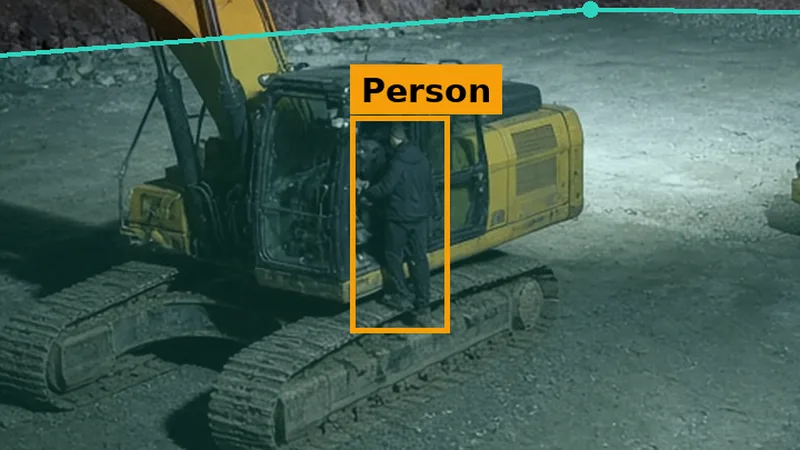
Last updated 1 November 2026. A working quarry is one of the largest and most open sites in any county: a haul road down to the face, a compound of excavators, dumpers and loading shovels, a fuel bowser, crushers, screens and conveyors, stockpiles, lagoons and often a lake where old workings have filled with water. When the last load goes out and the gate is locked, it goes quiet, and on most quarries nobody is there again until the first shift.
Those quiet hours are when plant and fuel are taken, the processing plant is damaged, and people come in over the fence to swim, climb or ride bikes. This guide covers the main risks to UK quarries and aggregates sites, what the Quarries Regulations 1999 and the industry’s public safety guidance ask of operators, what the figures show, where cameras should watch, and how AI on the CCTV already on site can watch the gate, plant, fuel, boundary and processing plant out of hours. It is written for quarry managers, health and safety teams and their installers.
What are the main security risks to a quarry?
A small sand and gravel pit and a large hard rock quarry with its own asphalt plant and rail sidings have little in common. But most quarries face the same four kinds of risk, and almost all of them peak once the site has closed for the day.
- Plant and equipment theft. Excavators, dumpers, loading shovels, telehandlers, generators, lighting towers, breakers, buckets and other attachments, and the tools in the workshop. Quarry plant is valuable, built to be driven or loaded, and often parked in the same place every night.
- Fuel theft. Diesel from bowsers, fixed tanks and the tanks of parked machines. A quarry can hold a lot of fuel, and it is easy to sell on.
- Trespass. People coming in over the boundary to swim in the lake, jump from the edge, climb the face, ride off-road bikes on the haul roads, explore the plant or camp. Many of them have no idea how dangerous the site is.
- Fire. Conveyors, crushers, screens, plant, the workshop and the fuel store. A belt fire, a hot bearing or an overheating machine can grow unseen after the plant stops, and some fires are set deliberately.
These risks overlap. Someone who comes in to steal diesel may damage a machine or start a fire, and a gap cut in the fence by thieves is then used by swimmers all summer. That is why quarry security works best when it is planned for the whole site, from the gate to the lake edge, rather than machine by machine.
The cost of an incident is often much bigger than what was taken. A stolen excavator stops work at the face, a drained bowser leaves the first shift without fuel, and a conveyor fire can take the processing plant out for weeks. Worst of all, a young person drowning in a quarry lake is a tragedy for a family and a community.
How big is the UK quarrying industry?
Quarries are everywhere, often out of sight behind bunds and tree belts. The Mineral Products Association (MPA) reported that the 2023 Aggregate Minerals Survey, carried out by the British Geological Survey, captured 699 active quarries across Great Britain. The MPA’s own Annual Mineral Products Survey puts the wider industry at about 2,200 quarrying, mining and mineral production sites across the UK.
Demand has been weak. The same survey reports that sales of primary aggregates were 122 million tonnes in 2025, the lowest since 2013. Quieter quarries can mean shorter working days, fewer people on site and plant standing idle for longer, all of which give thieves and trespassers more time.
We found no official national figure for crime at quarries, and the industry does not publish a theft rate. What there is, and what this guide uses, is evidence about the things quarries hold, such as plant, and about the people who come onto them, especially around water.
What do the Quarries Regulations ask of operators?
Quarries in Great Britain are covered by the Quarries Regulations 1999, which the Health and Safety Executive (HSE) enforces. Two regulations deal directly with keeping people out.
- Regulation 16, barriers around the boundary. It says: “The operator shall ensure that, where appropriate, a barrier suitable for the purpose of discouraging trespass is placed around the boundary of the quarry and is properly maintained.”
- Regulation 22, danger areas. Areas of the quarry where there is a risk of someone dropping from a height, being hit by material coming down, or another significant health and safety risk must be clearly marked, with equipment such as barriers to stop unauthorised people from entering them by accident.
HSE explains how this sits alongside access rights in its page on quarries and the Countryside and Rights of Way Act: HSE enforces regulation 16, while section 151 of the Mines and Quarries Act 1954 makes an inadequately fenced quarry a statutory nuisance for the local authority.
The industry’s detailed guidance is the MPA’s Management of Public Safety at quarries, written with the Quarries National Joint Advisory Committee. It asks operators to assess the risk to the public at each site. The factors include deep water and high faces, nearby homes, schools and rights of way, any history of trespass, when the site is unmanned, and how good the existing barriers and signs are.
The guidance expects fencing, signs and public rescue equipment to be inspected at a frequency set by that risk, with a record of damage and repairs; it says a photographic record is ideal. It also accepts that no barrier will stop a determined person, which is why it goes beyond fences to signs, education, community engagement and the police.
Cameras help with much of this. They show where and when people get in, give a dated picture of damage to the fence or signs, and give evidence to take to the police.
Why are trespass and open water the biggest public risk?
The MPA’s Stay Safe campaign says that incidents involving the public at quarries are predominantly water related. Old workings fill with water, settling lagoons are steep-sided and deep, and restored quarry lakes can look like a calm place for a swim on a hot day. They are not.
The National Water Safety Forum recorded 202 accidental water-related deaths in the UK in 2025 in its Water Incident Database, published in May 2026. More than half of them, 57%, happened at inland locations such as rivers, lakes, reservoirs, canals, quarry lakes and lochs, and the MPA notes that inland sites have accounted for more than half of accidental drowning deaths every year since 2019. Of those who died, 85% were male. Recreational activities accounted for 63% of the deaths and everyday activities such as walking or running for 32%.
The Royal Society for the Prevention of Accidents (RoSPA) adds that in almost half of inland drownings the person had no intention of being in the water at all. It describes site managers as having a pivotal role, and says organisations responsible for sites where water is accessible carry a duty of care.
The busiest months were in the summer: August had the most deaths, 31, followed by June and July with 27 each. On a hot evening or at the start of the school holidays, young people come in over the fence to swim or jump from the edge, often after the quarry has closed and nobody is there to see them.
The MPA’s Stay Safe flyer explains why quarry water is so dangerous:
- It is cold. Even in mid-summer, the water in many quarry lakes is well below 15°C, cold enough to cause cold water shock: a gasp, panic and loss of control within moments of going in.
- It is deep, and the depth changes suddenly. A shallow edge can drop away into deep water within a step.
- The sides are unstable. Edges can give way, and steep sides make it hard to climb out.
- There are hidden hazards. Submerged machinery, rocks and debris can injure anyone who jumps or dives in.
The flyer’s advice for anyone who sees someone in trouble is to call 999, tell them to float, and throw them something that floats, rather than going in after them. That message matters for quarry staff and keyholders too: nobody should go into the water to attempt a rescue.
The MPA guidance also covers settling lagoons, which can be steep-sided and relatively deep. It says it may be appropriate to fence them securely, and that applies whether or not the rest of the boundary is fenced.
Other trespass at quarries
Water is not the only draw. People come onto quarries to climb the face, ride off-road bikes on the haul roads, explore the plant or camp, mostly when the site is closed, and repeated trespass at one spot is often a sign that a fence has been cut.
Trespass tends to use the same routes: a gap beside a footpath, a low point in the fence near a car park, the far side of the lake away from the office. Cameras watching those spots, armed when the quarry is closed, give the operator a chance to act before anyone reaches the water.
How big a problem is plant theft from quarries?
Quarry plant is the same kind of machinery stolen from construction sites and farms, and it is targeted by the same organised groups. The Construction Plant-hire Association (CPA) says that before the war in Ukraine, between 40 and 70 high-value machines were typically stolen across the UK in a month. It reports that in a single month more than 200 machines were stolen nationwide, and that for 18 months thefts were over 110 machines every month.
The CPA helps fund the National Construction and Agriculture Theft Team (NCATT), a specialist police unit formed in January 2023 to tackle organised plant theft. In September 2026, CITS and CESAR reported an NCATT investigation into a group suspected of stealing machinery, cloning its identity and selling it on, in which more than 60 machines were seized.
For a quarry, that means:
- Machines are stolen to order. Thieves often know what they want, where it is parked and how to move it, and some will visit a site before the theft.
- They come with transport. A low loader or a lorry and trailer at the gate at night is a warning sign in itself.
- Attachments and small plant go too. Buckets, breakers, generators, lighting towers, pumps and power tools are easier to take than a whole machine.
- Recovery is hard. Machines with cloned identities can be sold on quickly or shipped abroad, so marking, registration and tracking matter as well as stopping the theft.
The basics are well known: park plant together in a compound, in view of a camera; immobilise machines and take the keys away; remove or lock attachments; register and mark plant so that police can identify it; and fit trackers to the most valuable machines. Our plant and machinery theft guide covers this in detail for any site.
How do you protect fuel bowsers and tanks at a quarry?
A quarry runs on diesel. Bowsers are towed round the site to refuel plant at the face, fixed tanks sit by the workshop, and every parked machine has fuel in it. Thieves know this, and fuel is one of the things most often taken from remote sites, either by siphoning from machines or by drawing it from a bowser or tank.
The oil storage regulations for businesses in England apply to any container of 201 litres or more, including mobile bowsers. They are pollution rules, written to stop oil getting into the ground and watercourses, but several of them also make theft harder:
- Secondary containment. Containers need a bund or drip tray that can hold 110% of the container’s capacity.
- Locked taps and valves. The guidance says a bowser’s taps and valves must have a lock and be locked shut when not in use.
- Secured pumps. Pumps on fixed tanks should be secured to stop them being used by someone without permission, for example by locking them, isolating the power or fitting a lockable cage.
For a quarry, add the basics: keep as little fuel on site overnight as the work allows, park bowsers in the compound rather than by the face or the gate, lock fuel caps on plant, and keep the bowser and tanks in view of a camera. A tank or bowser damaged or left open by thieves can also leak into a lagoon or watercourse. Our fuel theft prevention guide covers this for any site.
Why are quarries hard to secure?
Part of the answer is what a quarry holds: plant, fuel, metal and cable. The bigger part is the land itself. Quarries are designed around the mineral, not around being watched.
- Long boundaries. A quarry boundary can run for miles, through woods and fields, past houses and alongside roads and footpaths. Checking all of it is a job in itself.
- Remote and rural. Many quarries are a long way from a police station, with nobody living close enough to see or hear what happens at night.
- Unmanned for long periods. Most quarries close at the end of the working day and at weekends, and some are worked in campaigns, standing idle for weeks.
- Plant and fuel in the open. Machines, bowsers and attachments are parked outside, often near the face, far from the office.
- Hazards that attract people. A lake, a high face and a network of haul roads are exactly what swimmers, climbers and bikers are looking for.
The MPA guidance adds a point about sites that are no longer worked: remove fuel and chemicals, remove the temptation of scrap metal, and block access to the faces and the haul roads. Many of the same steps make sense on a working quarry at the end of each day.
How big a risk is fire at a quarry?
Fires at quarries are less common than at waste sites, but when they happen they can be costly. The usual places are the processing plant and the plant compound:
- Conveyors. A seized idler, a misaligned belt or a build-up of spillage can heat a conveyor belt by friction until it smoulders. Rubber belts burn hot and spread fire along the length of the conveyor.
- Crushers and screens. Hydraulic oil, grease and electrical cabinets can catch fire, especially after maintenance.
- Mobile plant. Engine bays collect dust and oil, and a hot machine parked at the end of the day can catch fire hours later.
- Deliberate fires. Machines, offices and cabins set alight by vandals or to cover a theft.
We did not find a published national figure for fires at quarries, so this guide does not quote one. The practical steps are those of any industrial site: maintain belts and idlers, clear spillage and oily waste from under conveyors, control hot work with permits and a fire watch, park plant apart where you can, and make sure the fire risk assessment covers the processing plant, workshop and fuel store, and that the fire and rescue service knows how to get onto the site.
The problem is time. A conveyor or a parked machine can smoulder for an hour or more after the plant stops, and on an empty quarry nobody sees the smoke until the fire is well established. Cameras that already look at the processing plant and the compound can also watch for smoke and flame around the clock. Our outdoor fire detection guide and hot works fire risk guide cover both in more detail.

What else goes wrong at a quarry out of hours?
- Metal and cable theft. Copper cable from the processing plant, pump houses and site power, scrap metal, worn crusher parts and steel stock. Our metal theft prevention guide covers this.
- Vandalism. Windows, cabs and control panels smashed, tyres slashed, signs and rescue equipment damaged or thrown in the water, and graffiti on the plant. Our vandalism prevention guide covers this in more detail.
- Fly-tipping. Waste dumped at the gate, in a lay-by on the access road or tipped over the fence into the quarry. Our fly-tipping CCTV guide covers this.
- Explosives. Quarries that blast may store explosives or receive them on the day. Storage of explosives has its own licensing regime under HSE, with its own security requirements, and this guide does not cover it. Cameras that cover the approach to a store can be part of a wider site plan, but they do not replace what that regime requires.
Where should cameras watch on a quarry?
Most quarries already have CCTV at the gate, the weighbridge and the office. The question is whether it covers the places where things go wrong, and whether anyone sees it before morning. Drive the site at dusk with the camera views on a phone and ask, for each risk, which camera would see it.
- The gate, weighbridge and office. Every vehicle should pass here. A camera here sees arrivals out of hours and the direction they are travelling.
- The plant compound. Where the excavators, dumpers and loading shovels spend the night.
- The bowser and fuel tanks. For theft, tampering and leaks.
- The processing plant. Crushers, screens and conveyors, for fire as well as theft and damage.
- The boundary where people get in. Gaps beside footpaths, low points near roads and car parks, and the gates used by farm traffic or contractors.
- The lake edge and the top of the face. The places where trespassers are in the most danger.
Not every metre of boundary can be on camera. Start with the places that matter most and the routes people actually use, which inspection records and local knowledge will show. Each camera needs a clear view, power, a connection and enough light or infrared at night, and views need checking as the face and the stockpiles move.
How does AI on existing CCTV protect a quarry?
Recording-only CCTV shows what happened after the empty bowser is found at 06:30. AI detection tells someone while it is happening. Woodcock AI connects to the IP cameras and recorders already on site, over RTSP or ONVIF, including Hikvision, and runs on an edge server on site or on a cloud server.
- Polygon zones. Draw a zone of any shape over the plant compound, the bowser, the workshop yard or the processing plant, and leave out the haul road, the stockpiles, public footpaths and land outside the boundary.
- Direction-aware lines. Draw a line along the inside of the boundary fence or across the access road, and choose which direction counts, so someone climbing in towards the lake raises an alert while people walking the footpath outside are ignored.
- People and vehicles. Detection counts people and vehicles, so dust, rain, ripples on the water, deer, foxes and birds do not.
- Smoke and flame. The same cameras watch for smoke and flame around the clock, from the conveyors and the crusher to the compound and the workshop.
- Schedules. Each zone and line has its own hours, so the compound can be armed from the end of the working day and the lake edge day and night.
- Alerts with the clip. Each alert arrives in the app and by email with a short clip and an AI description of what happened, so the person receiving it can decide quickly what to do.
The system is self-learning. It learns each camera, so stockpile dust, a floodlight on a timer and the fitter checking the pumps become part of the normal view, and marking an alert as correct or false feeds into retraining for your site. Woodcock AI has been in development for years and is now running on customer sites across the UK.
Woodcock AI does not read number plates or identify people. It flags that a person or vehicle is somewhere it should not be, and the clip shows what happened.
Coming next: Ask your cameras Coming soon, early 2027, which will let you ask the system questions about what your cameras have seen.
What does AI detection look like in each part of the quarry?
The rules depend on the part of the site. Choose an area to see an example of how a camera there is set up and what an alert looks like.
Which part of the quarry are you protecting?
The gate is where every lorry, loading shovel driver, fitter and visitor should arrive, and on most quarries it is the only way in for a vehicle big enough to take a machine or a bowser away. A line across the access road just inside the gate, set to count vehicles coming in and armed once the last load has gone, flags a pick-up or a lorry and trailer arriving when nothing is booked, while traffic leaving is ignored. A zone over the weighbridge and the office flags someone on foot there at night. Our perimeter intrusion detection guide covers gates and fences in more detail.
Entrance, weighbridge, office, haul road
The plant compound is where the excavators, dumpers, loading shovels, attachments and the fuel bowser usually spend the night, and it is the part of the site most worth stealing from. A zone over the compound, armed from the end of the working day until the first shift arrives, flags a person walking between the machines or crouching at the bowser, and a vehicle backing up to them. Leave the haul road and the stockpiles out of the zone. Our plant and machinery theft guide and fuel theft prevention guide cover both in more detail.
Plant compound, bowsers, tanks, workshop
The boundary is where trespass happens: a gap in the fence by a footpath, a climb over the gate on a hot evening, a bike track along the bund. A line along the inside of the fence, set to count people coming in, flags someone climbing over towards the lake or the top of the face, and it can be armed day and night. Keep public footpaths and land outside the boundary out of the zone. The alert gives the person receiving it a chance to send someone, sound a warning or call 999 before anyone reaches the water.
Fence lines, footpaths, lake edge, the face
Each gate, compound, fence and lake edge gets its own zones and lines, with its own schedule.
How does AI detection compare with other quarry security measures?
No single measure protects a quarry on its own. Fences, bunds, gates and signs mark the boundary and discourage trespass; immobilisers and trackers make plant harder to take and easier to recover; people and cameras see what is happening. The table compares the usual options.
| Measure | What it does | Strengths | Watch out for |
|---|---|---|---|
| Fencing, bunds and gates | Marks the boundary and discourages trespass | Expected by the Quarries Regulations where appropriate; stops vehicles driving straight in | Miles of boundary to inspect; gaps cut by footpaths and bikes; no barrier stops a determined person |
| Signs and public rescue equipment | Warns people of deep water and the face; gives a way to help | Cheap, visible and part of most public safety plans | Signs are ignored on hot days; throwlines and buoyancy aids get stolen or damaged |
| Immobilisers, trackers and marking | Makes plant harder to take and easier to recover | Helps police identify and return stolen machines | Works after the event; does nothing about trespass, fuel or fire |
| Security officers or patrols | A person on site or visiting at set times | Human presence, checks and a fast local response | Ongoing cost; one patrol cannot watch the gate, the compound and the lake at once |
| Recording-only CCTV | Records what happened | Evidence after the event | Nobody sees it until the empty bowser or missing excavator is found at 06:30 |
| Live-monitored CCTV | An operator watches the screens | A person can act on what they see | One person cannot watch every camera on a large site all night |
| AI on existing CCTV | Recognises people, vehicles, smoke and flame, in zones and on lines you draw, on a schedule | Watches the gate, the plant, the fence and the processing plant at once; the alert includes the clip | Cameras need a clear view, power, a connection and enough light or infrared at night |
How do you stop false alarms on quarry cameras?
Quarries are hard places for basic motion detection. Dust blows off the stockpiles and the haul roads, rain and mist drift across the face, the lake ripples and reflects the lights, deer and foxes cross the site at night and birds land on the conveyors. A system that alerts on every pixel that changes soon gets ignored.
- Count only people and vehicles, so dust, rain, water and animals are ignored.
- Draw zones that leave out the noise: the surface of the lake, the stockpiles, trees, the public road and footpaths outside the boundary.
- Use direction on lines, so only people coming in over the fence count, not people walking along it outside.
- Set schedules that match the working day, so the compound is only armed when the plant has stopped and the gate is locked.
- Use the feedback button to mark false alerts, so the system learns your site.
Our guide to reducing CCTV false alarms covers this in more detail.
How should detection schedules match the quarry’s working hours?
A quarry’s normal pattern is set by its working hours, its planning conditions and its customers. The cameras should be armed when the site, or a part of it, is meant to be empty, and quiet when people are expected there.
- Plant compound and bowser: armed from the end of the working day until the first shift starts, and all weekend.
- Boundary and lake edge: armed day and night, every day, since nobody should be climbing the fence towards the water at any time.
- Gate: an inbound vehicle line armed out of hours, with early lorries and contractors planned around it.
- Processing plant: people and vehicles armed when the plant has stopped.
- Smoke and flame: on around the clock, every day.
Review the schedules through the year. Longer evenings and hot weather bring more trespass, a campaign of working changes the hours, and a shutdown for maintenance brings contractors on site. A fitter booked for 06:00 on a Saturday is expected; a person at the bowser at 01:42 is not.
Who responds when an alert fires at night?
An alert is only useful if someone acts on it. Before the cameras go live, agree who receives which alerts and at what hours, what they should do, and who they call. For most quarries that is a small rota of managers or keyholders, a monitoring centre, or both.
- Check the clip first. The clip and the AI description usually show whether it is a person, a vehicle or smoke, and where.
- Call 999 for a crime in progress or a fire. Give the address, the entrance to use, what you can see on the clip and where on the site it is.
- If someone is in the water, call 999. Ask for the fire and rescue service at an inland site, or the coastguard on the coast, and give the exact location. Never go into the water after them.
- Never go alone. A keyholder should not go to the site alone to confront intruders; wait for the police or a security response.
- Review every alert. Mark it correct or false, and fix what it revealed: a cut fence, a gate left open, a missing sign or throwline.
The National Police Chiefs’ Council requirements for security systems say police response to an intruder alarm with a unique reference number (URN) is withdrawn after three false calls in a rolling 12 months, another reason to keep false alerts down and have alerts checked by a person before the police are called.
How do you manage people, the police and the community?
Many quarry incidents involve people who know the site: former workers, contractors, neighbours and local young people. The MPA guidance says that where trespass is a significant risk, operators should engage with the police and community stakeholders, and keep records of those contacts, including crime incident numbers.
- Keys and codes. Keep plant and building keys in a secure locker, record who holds keys and codes, and change codes when people leave. ProtectUK gives the same advice for any site with vehicles: keys locked away, visitors signed in and out, and unauthorised vehicles controlled.
- Contractors and hauliers. Keep a daily list of who is expected, especially early and late, with permits for hot work and a fire watch afterwards.
- The police. Report every theft, every case of damage and every serious trespass, and keep the crime numbers. The MPA guidance says operators should support police prosecution of criminal damage or theft.
- The community. The guidance describes a community engagement plan that may include residents, schools, the parish council, the fire and rescue service, the police, youth workers, local councillors and local media. Talks in schools before the summer holidays are a common part of it.
Cameras support all of this: a clip of a cut fence or a group heading for the water gives the police something to work with and the operator a dated record.
How does data protection apply to quarry CCTV?
Quarry cameras see staff, hauliers, visitors and sometimes footpaths and roads. The Information Commissioner’s Office guidance on video surveillance expects a clear purpose, signs before people enter the recorded area, footage kept only as long as needed and kept secure, and a data protection impact assessment where the processing is likely to be high risk.
Polygon zones help here too: a zone over the compound or a line inside the fence keeps detection to the quarry, and a footpath, road or neighbour’s land can be left out. Woodcock AI does not use facial recognition, identify who anyone is or read number plates. Our AI CCTV and GDPR guide has more.
How do you get started?
Start with the basics the Quarries Regulations and the MPA guidance set out: assess the risk to the public, keep the barrier and signs in repair, protect danger areas, inspect and record, and engage with the police and the community. Lock, immobilise and mark plant, and keep fuel to a minimum. Then map the cameras already on site: what each covers, what it sees at night, and where trouble has happened before.
Our site assessment looks at the cameras already on your quarry and the zones, lines and schedules that would cover the gate, compound, bowser, processing plant and boundary, and tells you honestly where a camera cannot do the job. To see it working first, we can run a live test on your cameras: we connect two or three of them for about a fortnight. We can also arrange an on-site demo. See how the same approach works on our construction and industrial pages and in our factory security guide.
What are the limits of cameras at a quarry?
- A camera needs a view. It cannot see behind a stockpile, over the top of a bund or along a boundary it does not point at.
- It needs light or infrared at night. Check what each camera actually sees in the dark, including the far side of the lake and the back of the compound.
- It needs power and a connection. Remote cameras rely on site power, solar or batteries and a mobile or radio link; if either goes off, cameras and alerts stop.
- It detects; it does not stop anyone. Fences, bunds, gates and locks still have to do that, and no barrier stops a determined person.
- It does not rescue anyone. Signs, throwlines, buoyancy aids, education and a clear 999 plan still matter at the water.
- It does not replace fire safety systems. Smoke detection on cameras is an early warning on top of the fire risk assessment, any fire alarm and the emergency plan.
- It does not read number plates or identify people. It flags people and vehicles in zones and on lines; the clip shows what happened.
- Someone has to respond. An alert is only useful if someone acts on it.
Sources
- legislation.gov.uk, The Quarries Regulations 1999 (SI 1999/2024), regulations 16 and 22.
- Health and Safety Executive, Quarries and the Countryside and Rights of Way Act.
- Mineral Products Association, Management of Public Safety at quarries (2026), with QNJAC information sheets.
- Mineral Products Association, Stay Safe campaign and the Stay Safe flyer 2026.
- National Water Safety Forum, 202 accidental water-related fatalities in 2025 (WAID 2025, May 2026).
- Royal Society for the Prevention of Accidents, Inland water safety for businesses.
- Mineral Products Association, Aggregate Minerals Survey 2023 news release and Annual Mineral Products Survey 2025.
- Construction Plant-hire Association, National Construction and Agriculture Theft Team (NCATT).
- CITS, CEA-funded training proves its value in machinery theft investigation (September 2026).
- GOV.UK, Oil storage regulations for businesses.
- Health and Safety Executive, Explosives: authorisations and licensing.
- ProtectUK, Site security.
- National Police Chiefs’ Council, Police Operational Advice and Security Industry Requirements for Response to Security Systems (March 2024).
- Information Commissioner’s Office, Guidance on video surveillance, including CCTV.
We have summarised these sources in our own words. Always read the current versions in full. This page is general guidance, not legal, health and safety, fire safety, insurance or security advice; HSE, the police, your fire risk assessor, your insurer, your monitoring centre and a competent installer decide what applies to your site.
Want to know when someone is at your plant, your bowser or over your fence tonight?
Book a site assessment and we will look at the cameras on your quarry and plan zones, lines and schedules for the gate, the plant compound, the fuel, the boundary and the lake edge, with smoke and flame detection on the processing plant from the same cameras. Or ask for a live test on your cameras first: we connect two or three of them for about a fortnight.
Related pages
Frequently asked questions
How do you secure a quarry?
Start with the risk assessment the Quarries Regulations and MPA guidance expect: a maintained boundary barrier and signs, danger areas marked and protected, one controlled gate, plant locked, immobilised and marked, and fuel kept to a minimum. Cameras should cover the gate, the plant compound, the bowser, the processing plant and the places people get in. AI on existing cameras then flags people, vehicles and smoke out of hours, with the clip in every alert.
Does a quarry have to be fenced?
Regulation 16 of the Quarries Regulations 1999 says the operator must ensure that, where appropriate, a barrier suitable for discouraging trespass is placed around the boundary and properly maintained. HSE enforces it. Danger areas inside the quarry must also be marked, with barriers to stop people entering them by accident. The MPA guidance helps operators decide what is appropriate at each site.
Why are quarry lakes so dangerous?
The MPA says that even in mid-summer many quarry lakes are well below 15°C, cold enough to cause cold water shock, and that they can be deep, with sudden changes in depth, unstable sides and submerged machinery or rocks. The National Water Safety Forum recorded 202 accidental water deaths in the UK in 2025, 57% at inland locations including quarry lakes.
How can CCTV help stop trespass at a quarry?
AI on existing cameras can watch a line along the inside of the boundary fence day and night and raise an alert, with the clip, when someone climbs in towards the lake or the face. That gives a keyholder or monitoring centre the chance to act early, and the clips show where and when people get in, which helps with repairs, policing and community work.
Does Woodcock AI read number plates?
No. Woodcock AI detects people and vehicles in zones and on lines, and smoke and flame. It flags that a person or vehicle is somewhere it should not be, such as a pick-up at the plant compound at night, and the clip shows what happened, but it does not read number plates or identify people.
Does Woodcock AI need new cameras at a quarry?
Usually not. It connects to existing IP cameras and recorders over RTSP or ONVIF, including Hikvision, and runs on an edge server on site or on a cloud server. A site assessment shows which cameras already cover the gate, compound, fuel, processing plant and boundary, and where moving or adding a camera would help.
Last reviewed 1 November 2026
Running a marina or boatyard on the water rather than a quarry? See our marina and boatyard security guide.